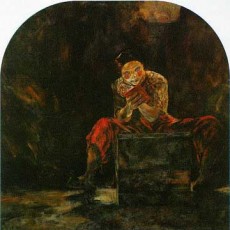
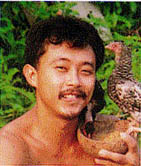
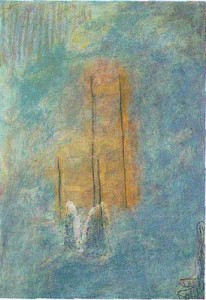
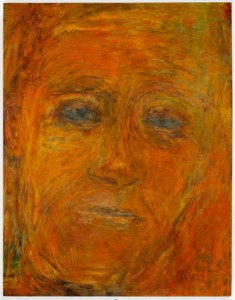
Australian painter Thornton Walker was the Australian artist of the year-long Malaysia-Australia Visual Arts Residency at Rimbun Dahan in 1996, and undertook a one-month residency in Hotel Penaga in 2012.
Bio
 Thornton Walker was born in Auckland, New Zealand in 1953, and emigrated to Australia, settling in Melbourne in 1965. He graduated with a Diploma of Art (Printmaking) from the Prahan College of Advanced Education in 1976, and began a Post Graduate Diploma (Printmaking) at the Victorian College of the Arts, Melbourne in 1977. He later deferred these studies to travel and work in Europe and the United States.
The artist’s first solo exhibition was held in Melbourne in 1980. Walker’s work is represented in collections throughout Australia including the National Gallery of Australia, Art Gallery of New South Wales, Art Gallery of Western Australia, QUT Art Museum, Brisbane, Artbank, University of New South Wales, Philip Morris Arts Grant Collection: Parliament House, Canberra, Macquarie Bank, and AXA Australia.


Exhibition Catalogue Essay
A traveller in the landscapes of our world and the landscapes of his mind, Thornton Walker evokes in his works both the presence of the environment in which they were created and the inner contemplation of their creator.
In subject, Walker’s works include three established genres of traditional art – the landscape, the portrait and the still life. Yet he blurs the distinction between these genres, and creates works which embody all three of these forms while embracing abstraction and the serendipity of chance.
Overlaying or, perhaps, underpinning Walker’s choices for the content of his work, is his own personal interest in philosophy and the spiritual, and with Eastern/Asian philosophy in particular. One particular Buddhist text has long been of importance in his considerations of the great questions of human existence: “What is the enduring body of reality?” It is a question that perhaps best conveys the concerns that Walker addresses in his work and, by implication, in his life, and it is a question to which I will return.
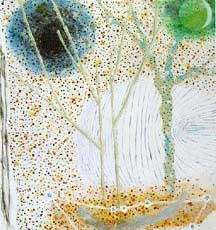
The work which Walker had created during his residency at Rimbun Dahan follows naturally from his accumulated body of previous work. His depiction of the orchard outside his Rimbun Dahan studio and various studies of fruits and ceramic bowls reflect his continuing use of the external world as a means of considering, even meditating on, the internal world of the mind.
For many years, Walker has depicted a simple Chinese bowl, whether alone or with one or two others, as the sole physical object set in an abstract and seemingly random background whose presence is, nevertheless, just as concrete as the delicately painted but solid bowl. Examples of this aspect of Walker’s work can be seen in “Two Chinese Bowls (Tea Ceremony l)” 1997 and “Two Chinese Bowls (Tea Ceremony ll)” 1997. These are paintings that were made using wood found in the Rimbun Dahan grounds. The ‘background’ of each painting happens to be naturally occurring marks and stains on the wood arising from its previous use in some form of construction. However, the works’ appearance is not unlike paintings which Walker has previously created on canvas, where the space surrounding the bowls has been built up with layers, drips and washes of paint and, sometimes, fragments of handwritten text.
In both paintings, the bowls are distinct and unique individuals, their substance confirmed by the shadows which they cast on their uncertain surroundings. However, they have a presence beyond that of mere inanimate objects. They are metaphors for order, creation and life, surrounded by the apparent chaos of vast forces we cannot measure and do not fully understand.
In the suite of watercolours, Walker once again focuses on ceramic bowls, some plain and unadorned, others with decorative patterns or embellishments. Sometimes they are alone, at other times in pairs or in groups or hovering over a paler reflection or ghostly image of themselves. These bowls, which themselves take on a life, are often seen together with fruit in or around them. Guavas, limes, papaya and cempedak provide forms through which Walker can apply, with such delicacy, his fluid washes of colour onto a paper that is stained and splattered, like some parchment that has been recovered from a flood.
These images of bowls and fruit acquire their own personalities, engage in dialogue, remain silent, occupying space in a minimalist landscape of washes which run and drip. Once again these objects are lit by an unseen source of light and although their shadows confirm their existence, they seem removed from space and time and become, for us, almost devotional objects upon which we may meditate.
A group of somewhat dark and brooding landscapes, based on the view of the orchard outside his Rimbun Dahan studio, provides an insight into another aspect of Walker’s oeuvre. These images are essentially tonal, capturing both shadow and light, and transforming the simple, close view of tree trunks and branches into a mysterious place where the footfall of people is anticipated but not witnessed.

In some of the watercolours appear fragments of text, sometimes Chinese, sometimes European, adding another dimension to an already multi-layered image. The graphic linear quality of the Chinese characters which appear to have been stamped on (but which are in fact rendered painstakingly by hand) give the work a sense of documentation, something vaguely official. In two works in particular, small red freshly rendered lychees maintain their distance from the well-ordered text, text that may describe or perhaps proscribe them.
And there, in the overlapping washes of “Two Malaccan Bowls” 1997, we can make out the words “the enduring body of reality”. For Walker, it comes down to this: What are we? What is real? What is unreal? What is permanent? What is transient? What is the mind? What is the body? Walker’s works address these questions with a quiet persistence and we have the privilege of experiencing, with him, this quest for the essential nature of the universe.
Guy Abrahams
August 1997
Director, Christine Abrahams Gallery
Artist Statement for Hotel Penaga Residency
I wanted to be completely open to new influences and subject matter during my time at Penaga as the artist in residence; to absorb the rich culture in Penang and respond to it as best I could, in the studio.
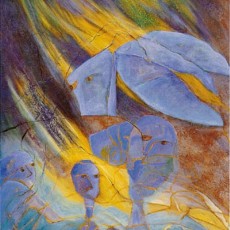
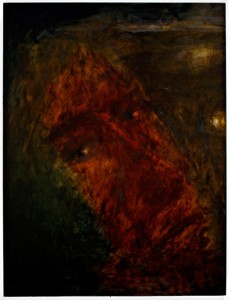
After exploring the town for a week, what stayed with me were the old faded photographs of faces I saw on temple and clan house walls. They resonated for me as a window into the past, a nostalgic glimpse of a rich culture.
I decided to do my best to recreate this feeling in paint. I took snap-shots of these photographs, often out of focus and partly obscured with reflections on their glass frames, and then set about interpreting them in watercolor, ink, acrylic and oil paint.