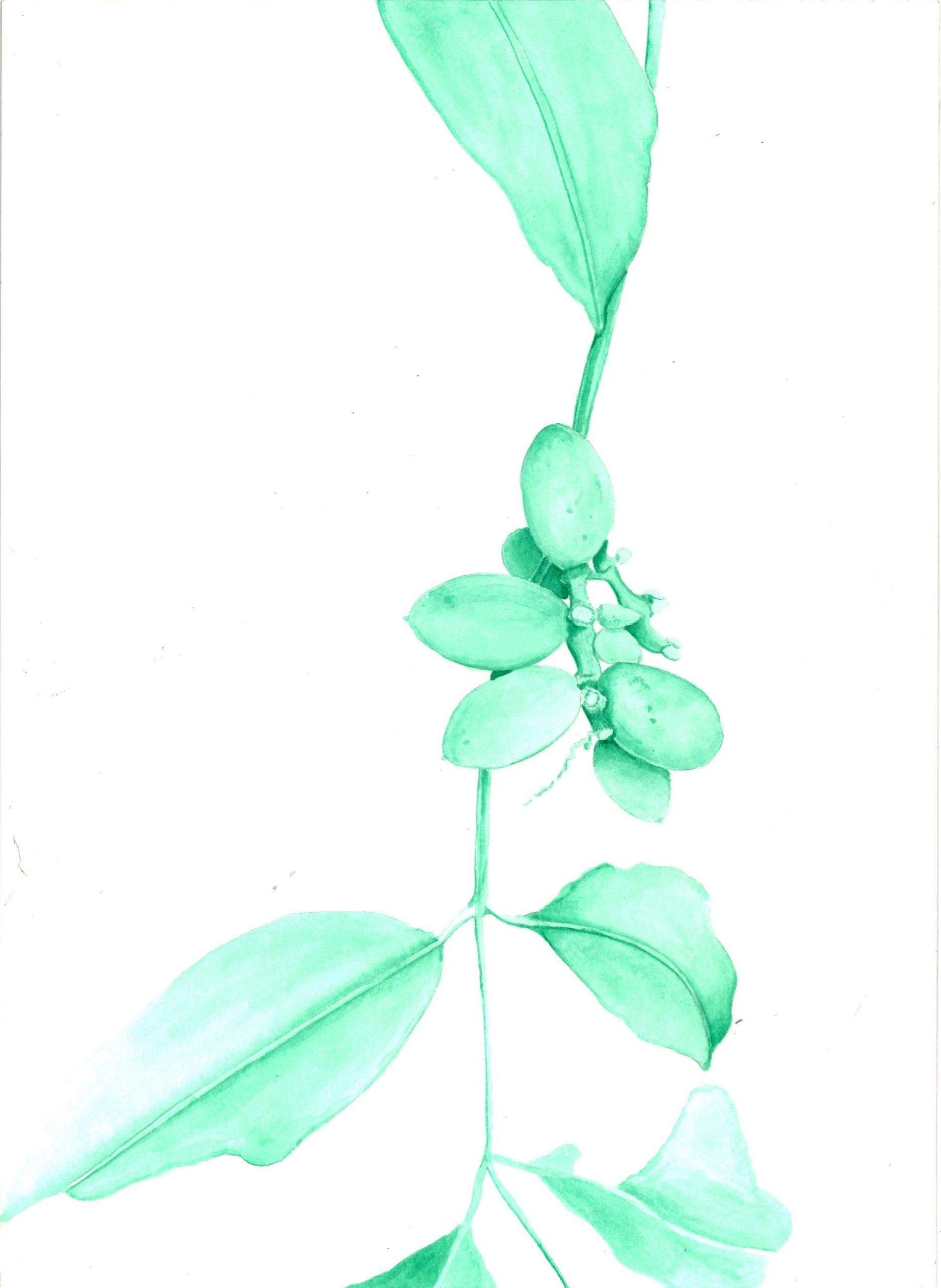
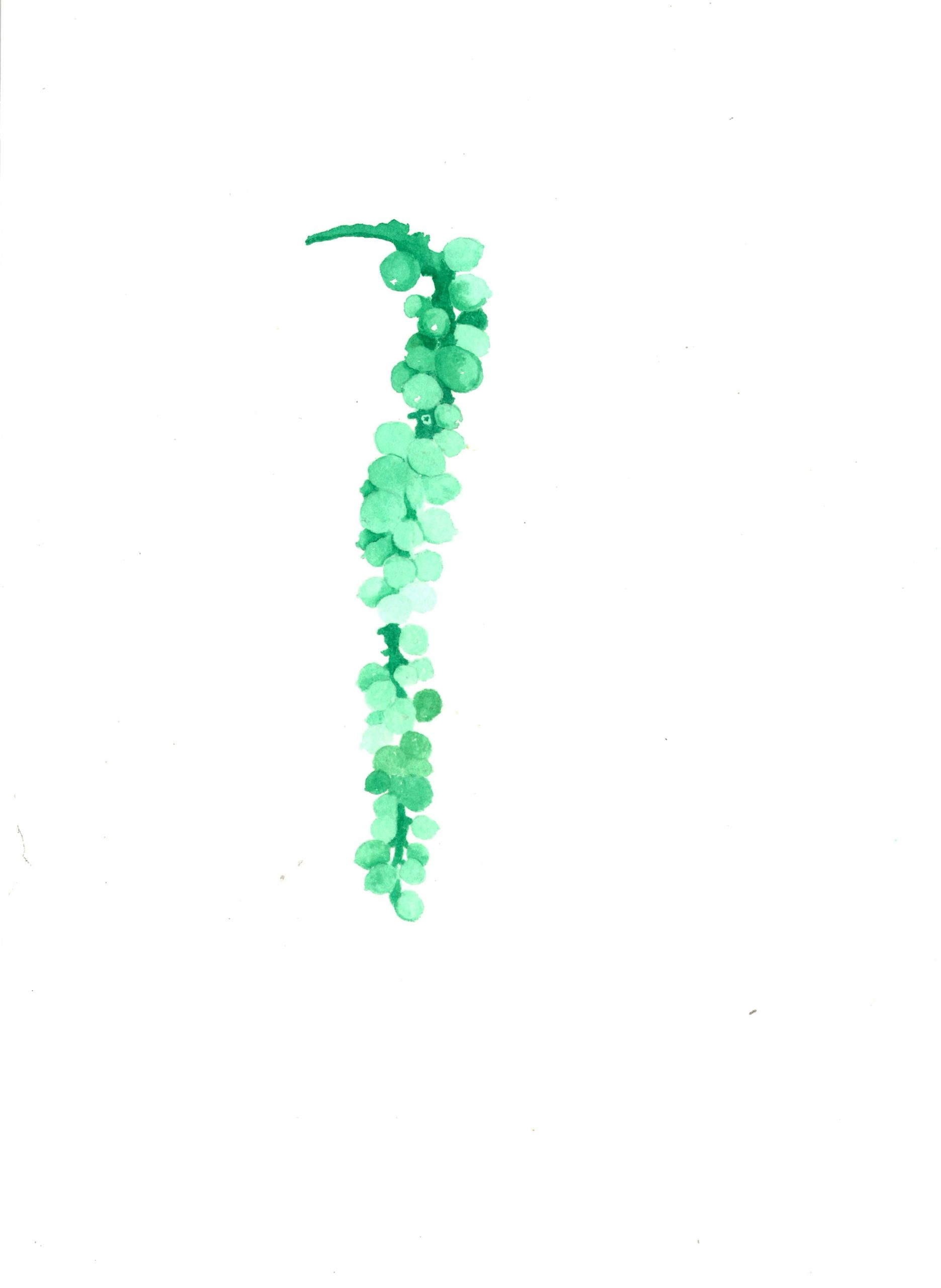
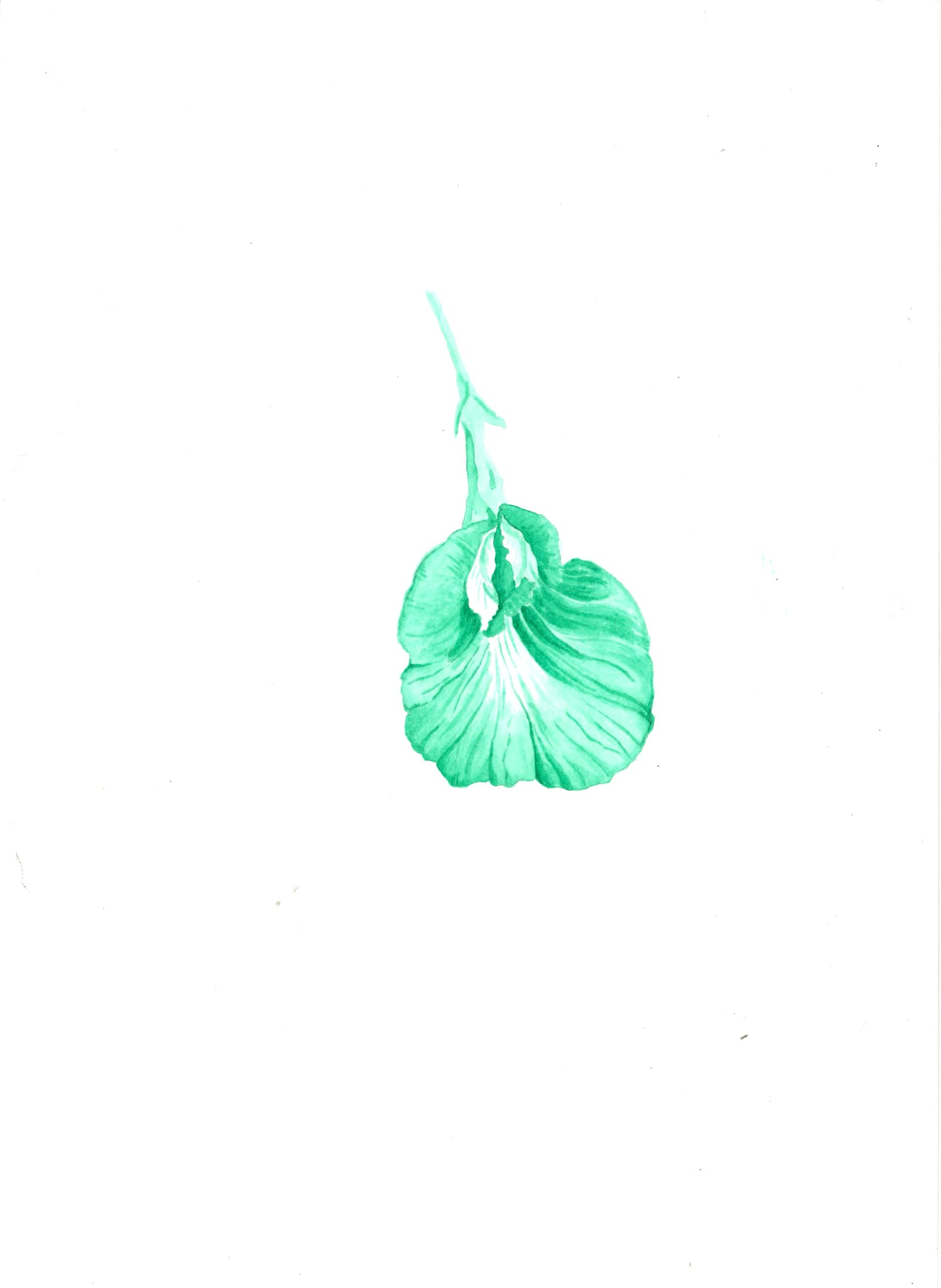
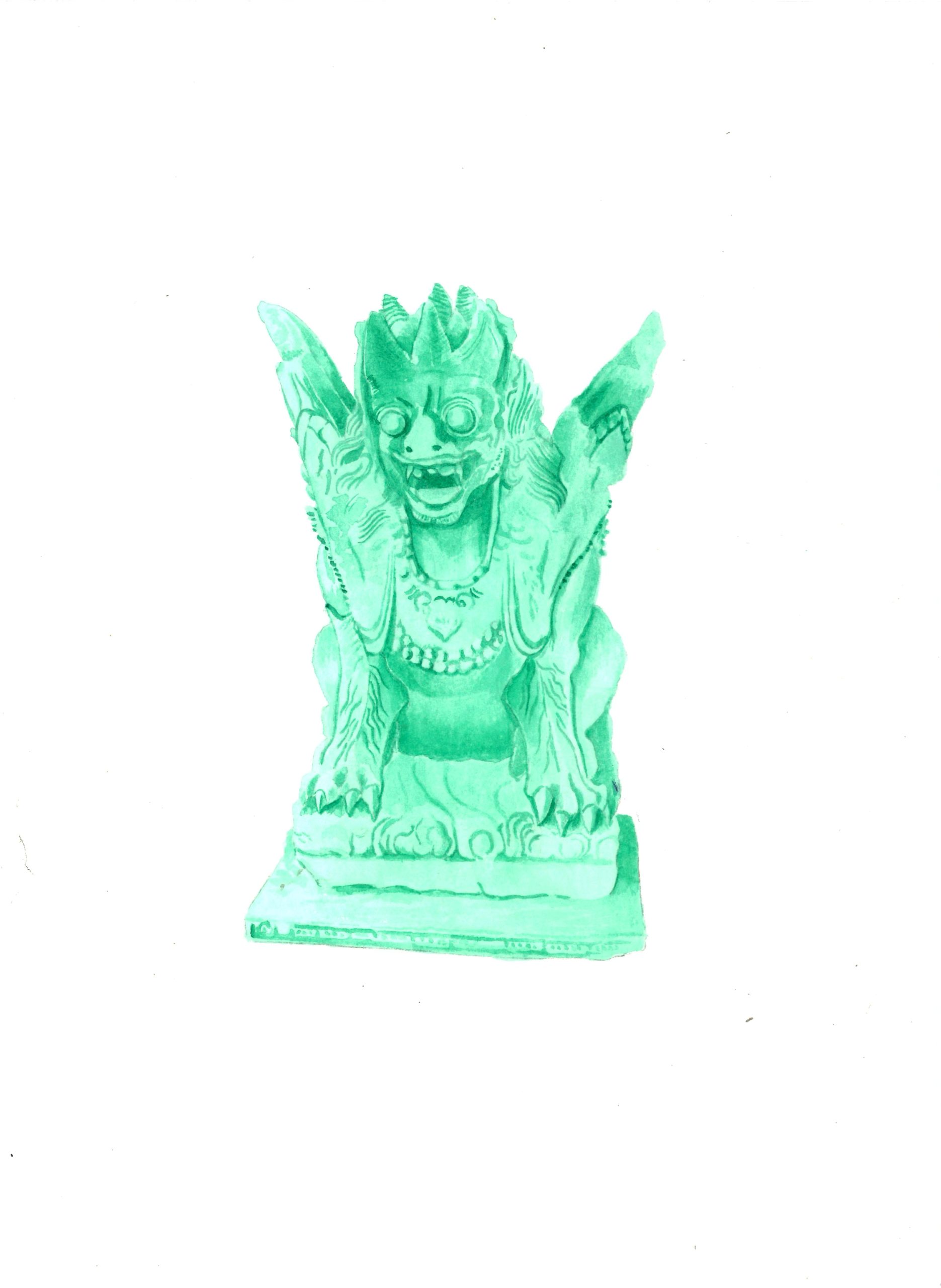
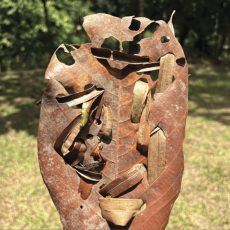
Australian interdisciplinary artist Zara Collins is concluding her month-long Open International Arts Residency at Rimbun Dahan with an open-studio sharing of her works in progress on Sunday 27 September 2026, from 11am to 6pm. More info about visiting Rimbun Dahan in Sept 2026…
About the Artist
Zara Collins is an Australian interdisciplinary artist working across porcelain and paper. Her practice explores memory, the trace and ways everyday objects and materials can hold personal and cultural histories. Collins uses a variety of processes and material transformation to explore absence, longing, loss and the passage of time.
She holds an MFA from the National Art School and a BVA from Sydney College of the Arts, Sydney University. Her practice has been supported by an Ian Potter Foundation Cultural Grant and residencies including the Australia-China Council Residency (Beijing), Bundanon Trust (South Coast NSW) and Rimbun Dahan (Kuala Lumpur, Malaysia) in September 2026. Zara has exhibited widely, presenting eight solo exhibitions and participating in numerous group shows since 1999. Her work has been recognised internationally in exhibitions such as Talente (Germany), Young Glass (Denmark), SOFA (sculpture objects & functional art) Chicago and the Japanese Jewellery Competition (Tokyo).
Zara is using her residency to respond to the Malay Traditional Textile Collection on site, continuing her engagement with ideas of the passage of time, the material trace, and the ways textiles can act as a metaphor for the temporality of human existence.
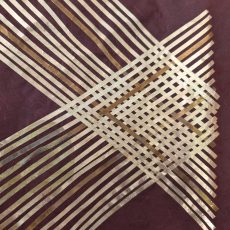
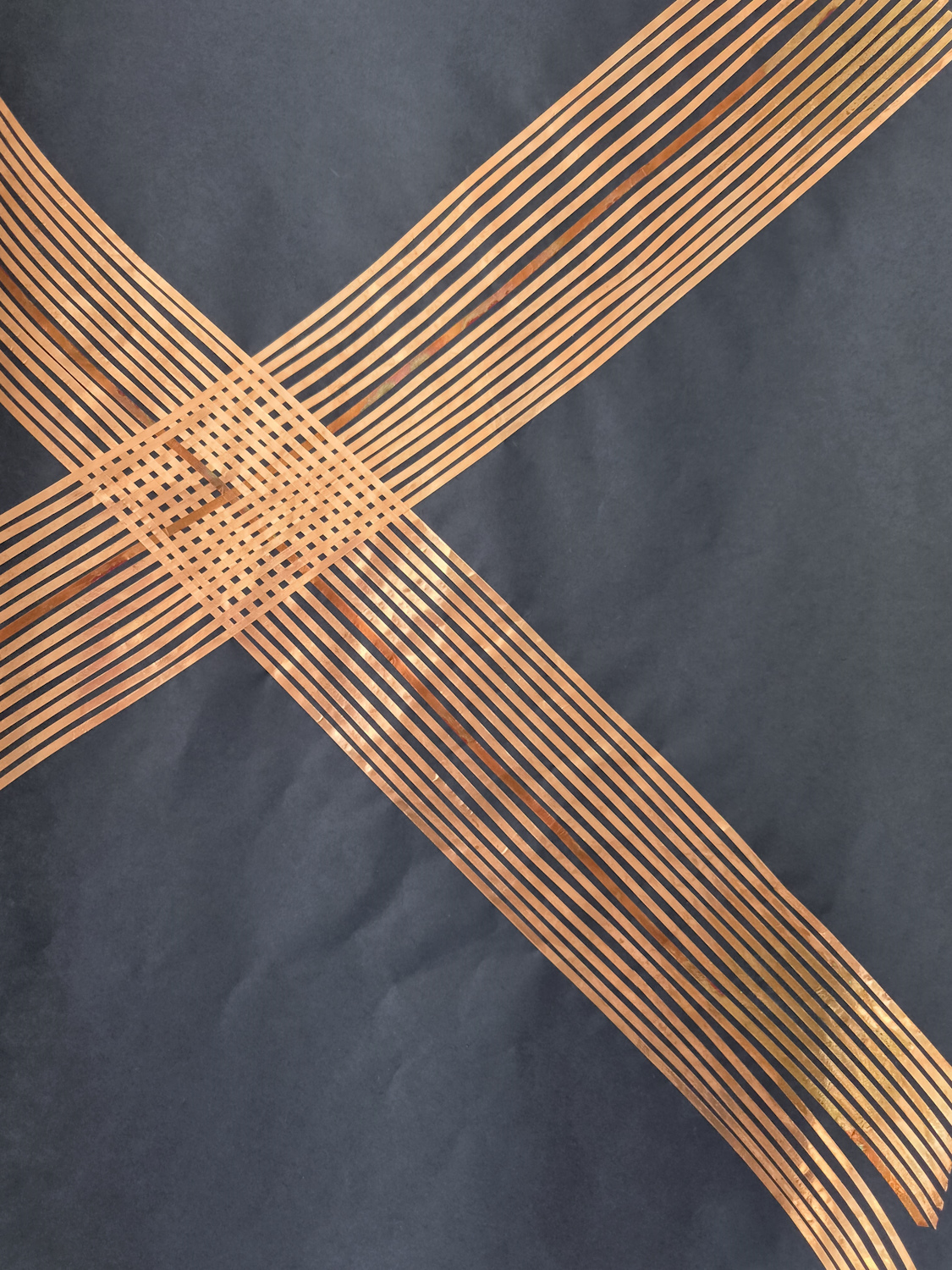
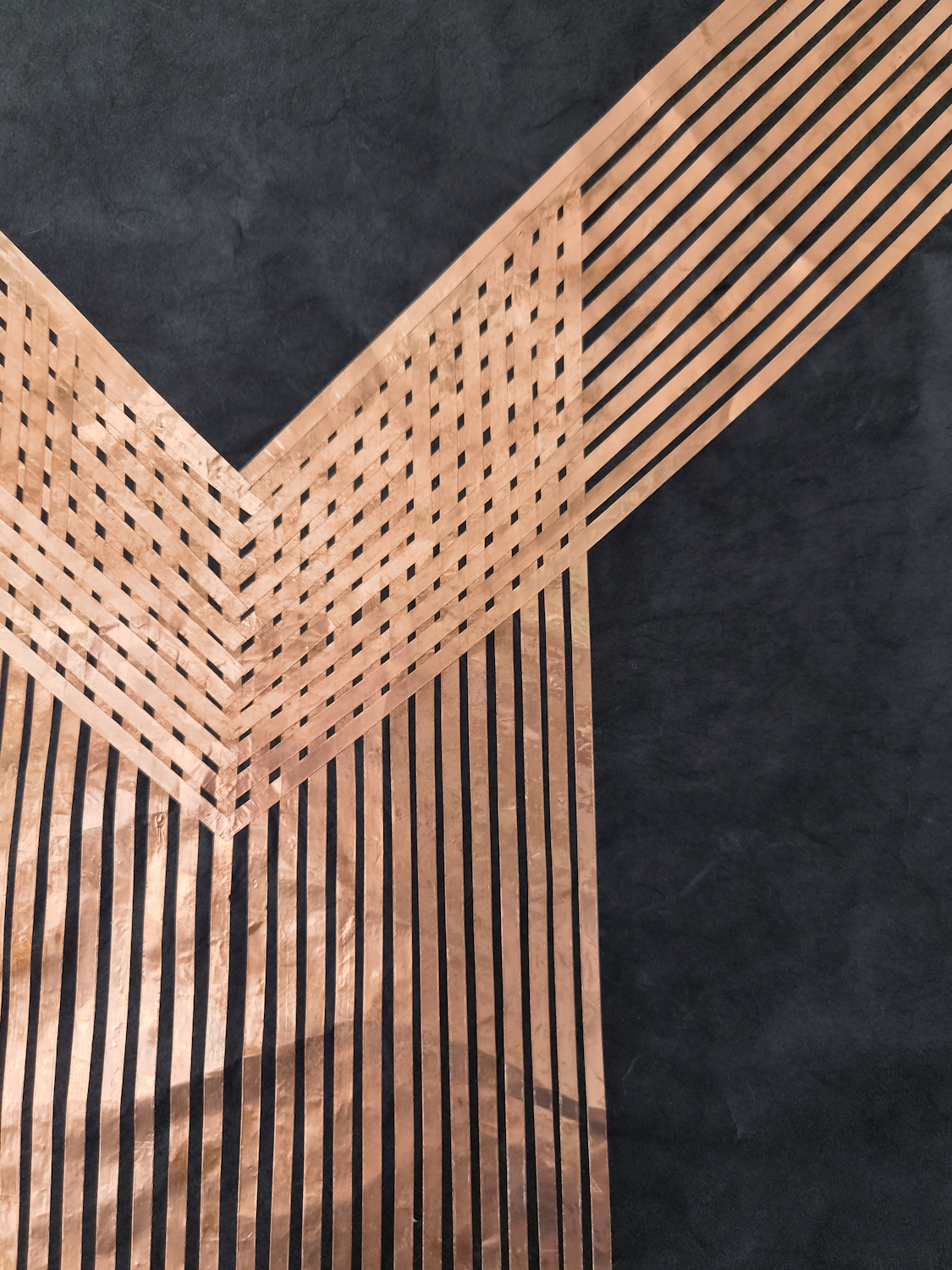
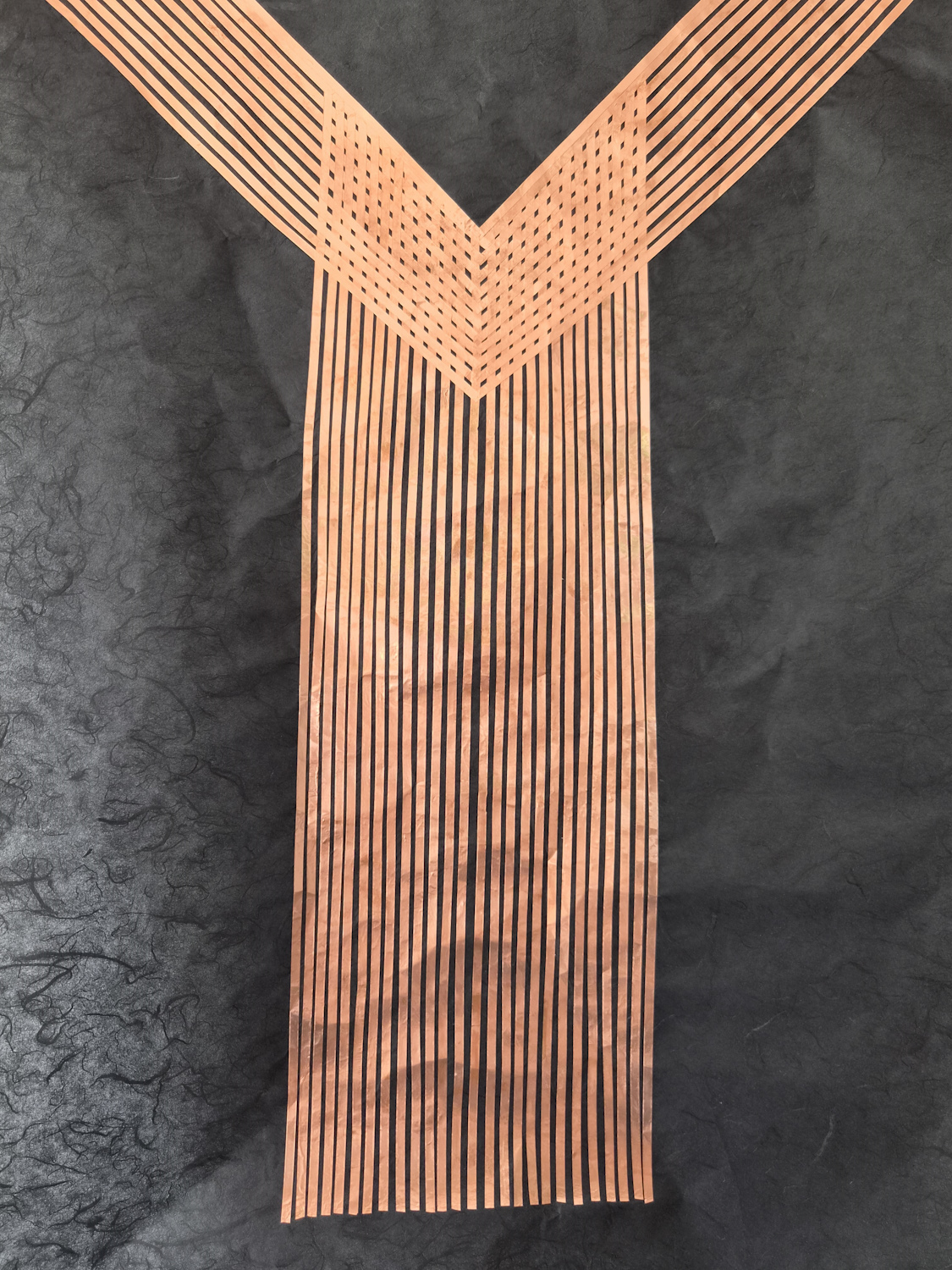
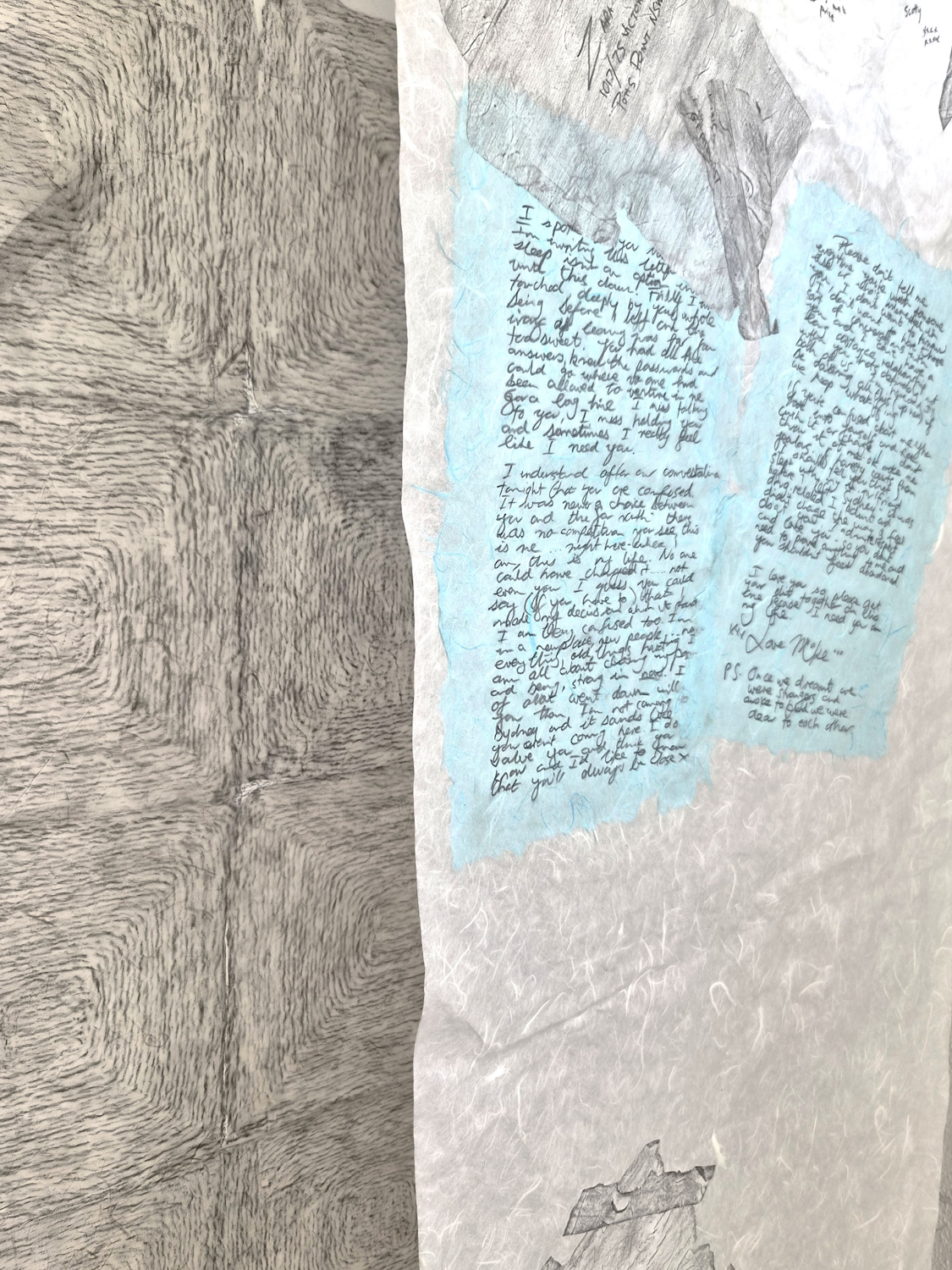
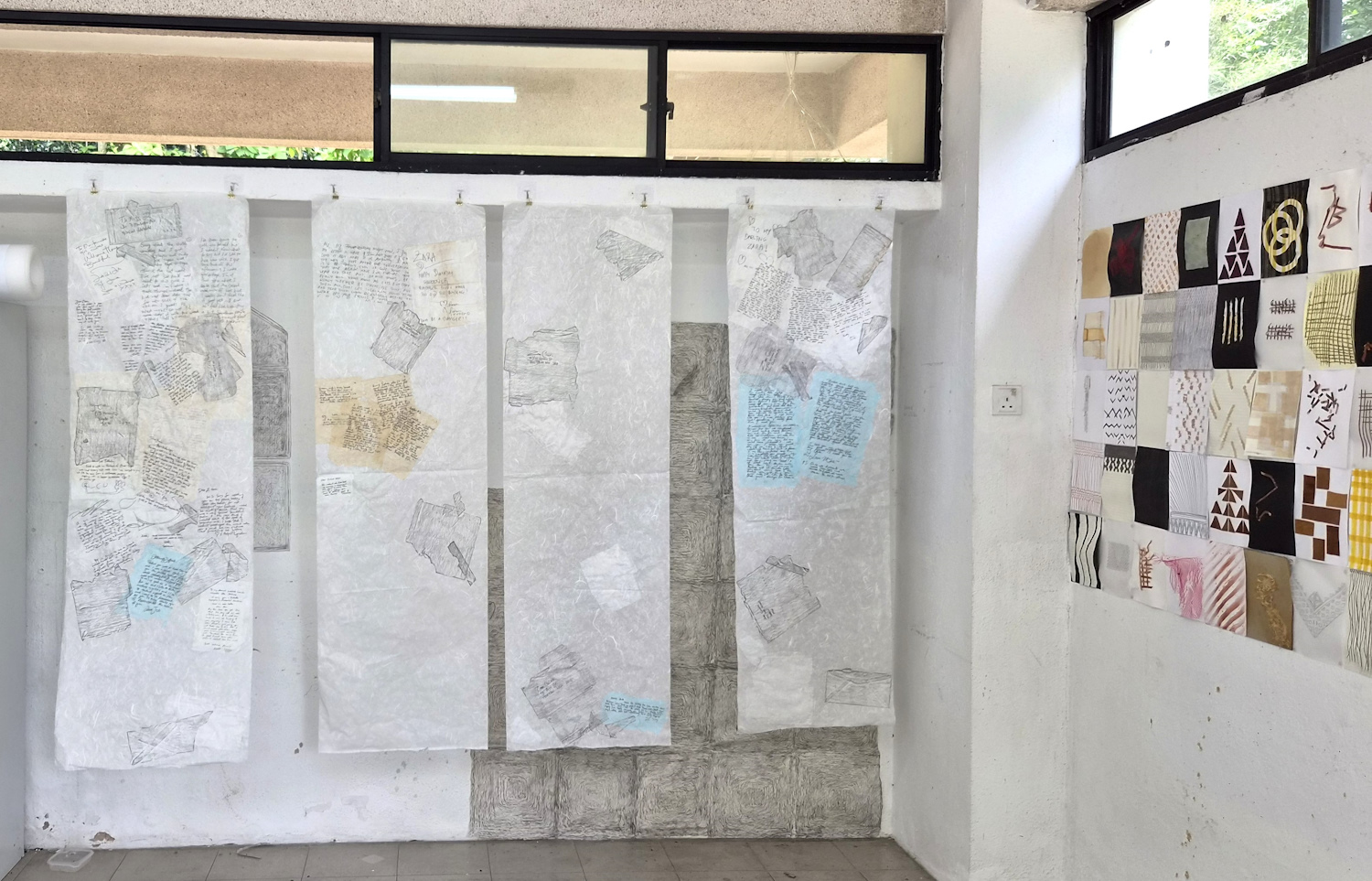
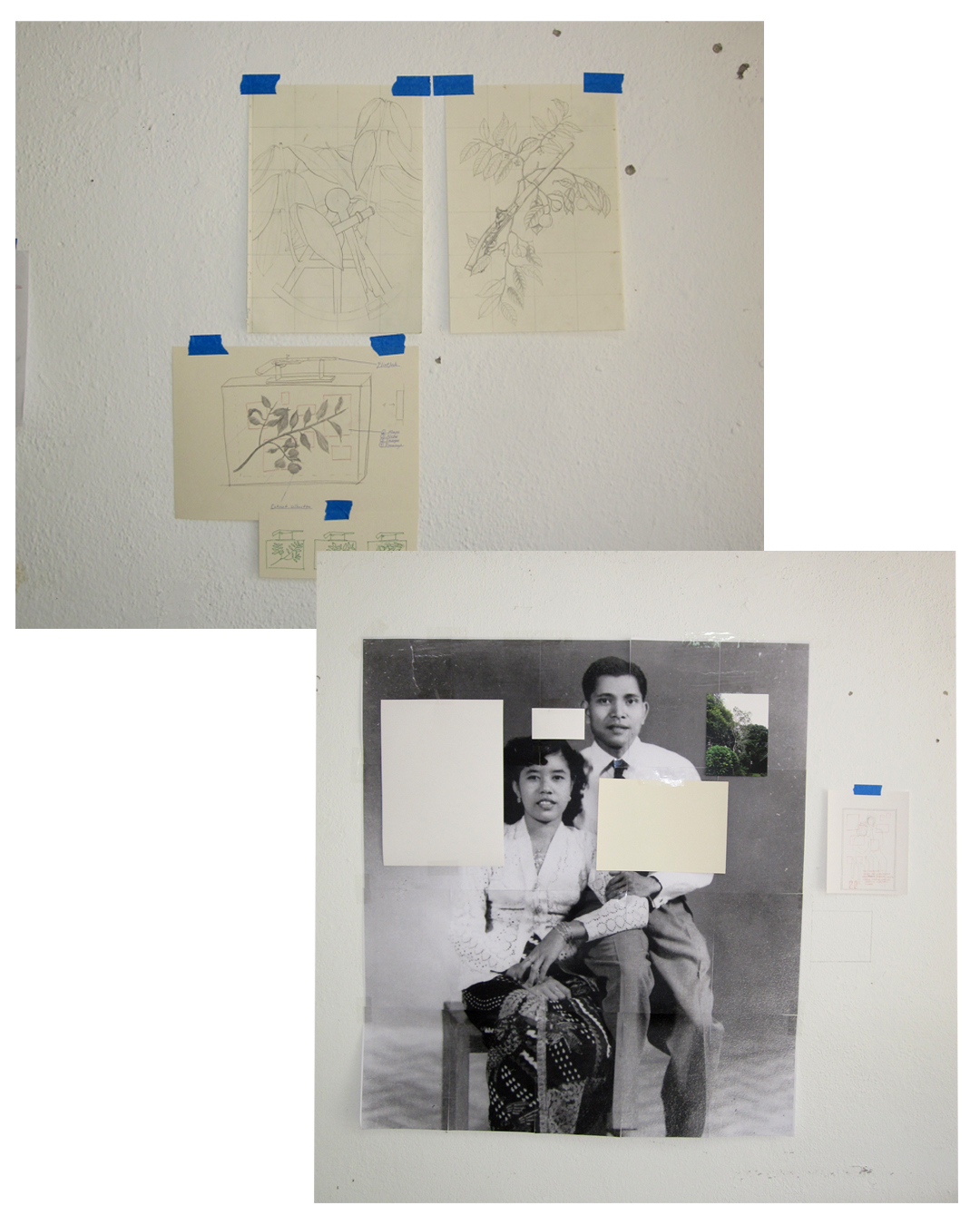
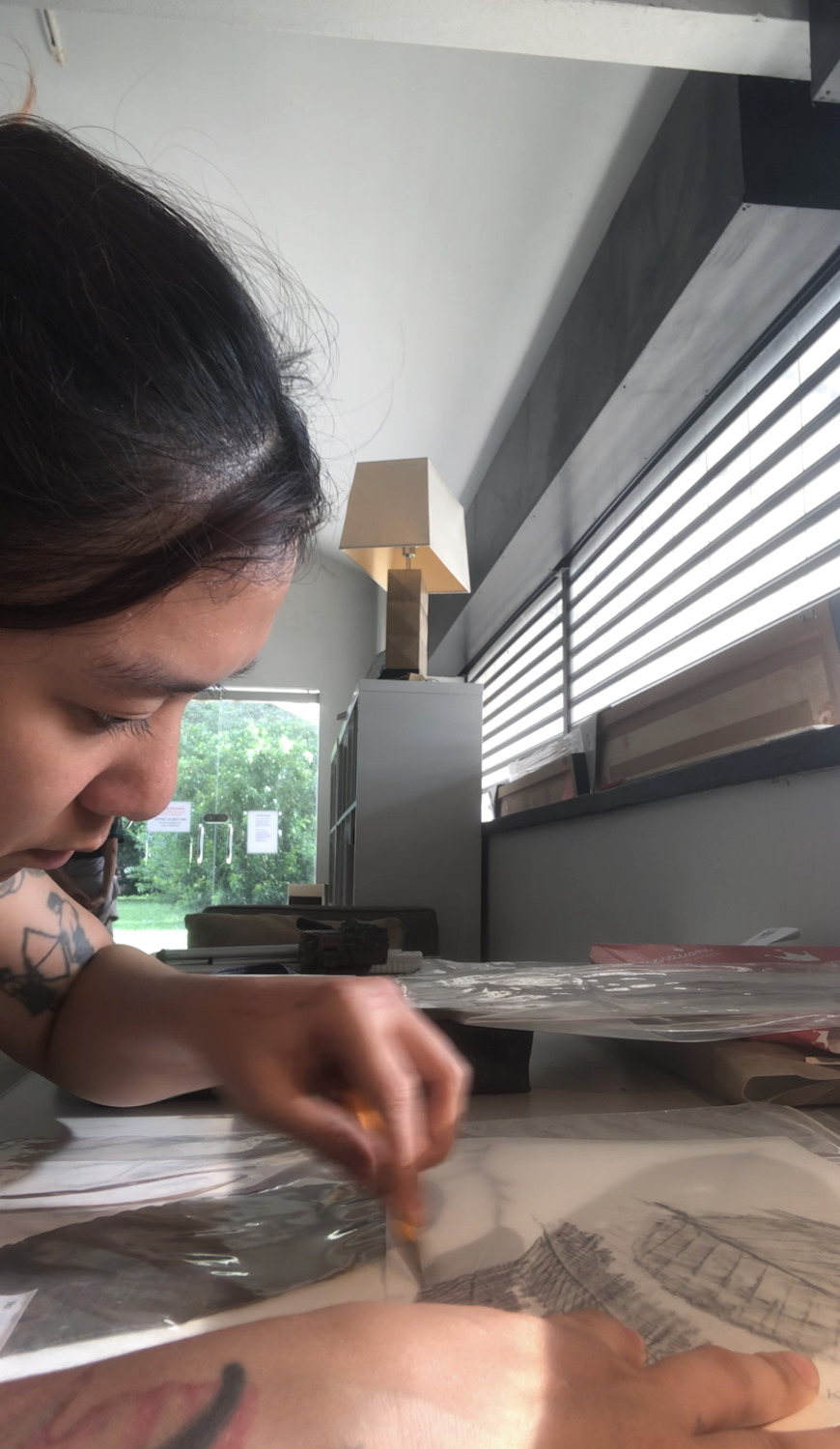
Working with Korean Kozo paper and copper, Zara is experimenting with drawing, layering and tracing processes to translate and abstract forms encountered within Rimbun Dahan’s architecture and textile collection. She has been weaving fine copper threads into abstract motifs, exploring the relationship between line, material and structure, while using paper to record, transform and reimagine visual and tactile encounters with the site.
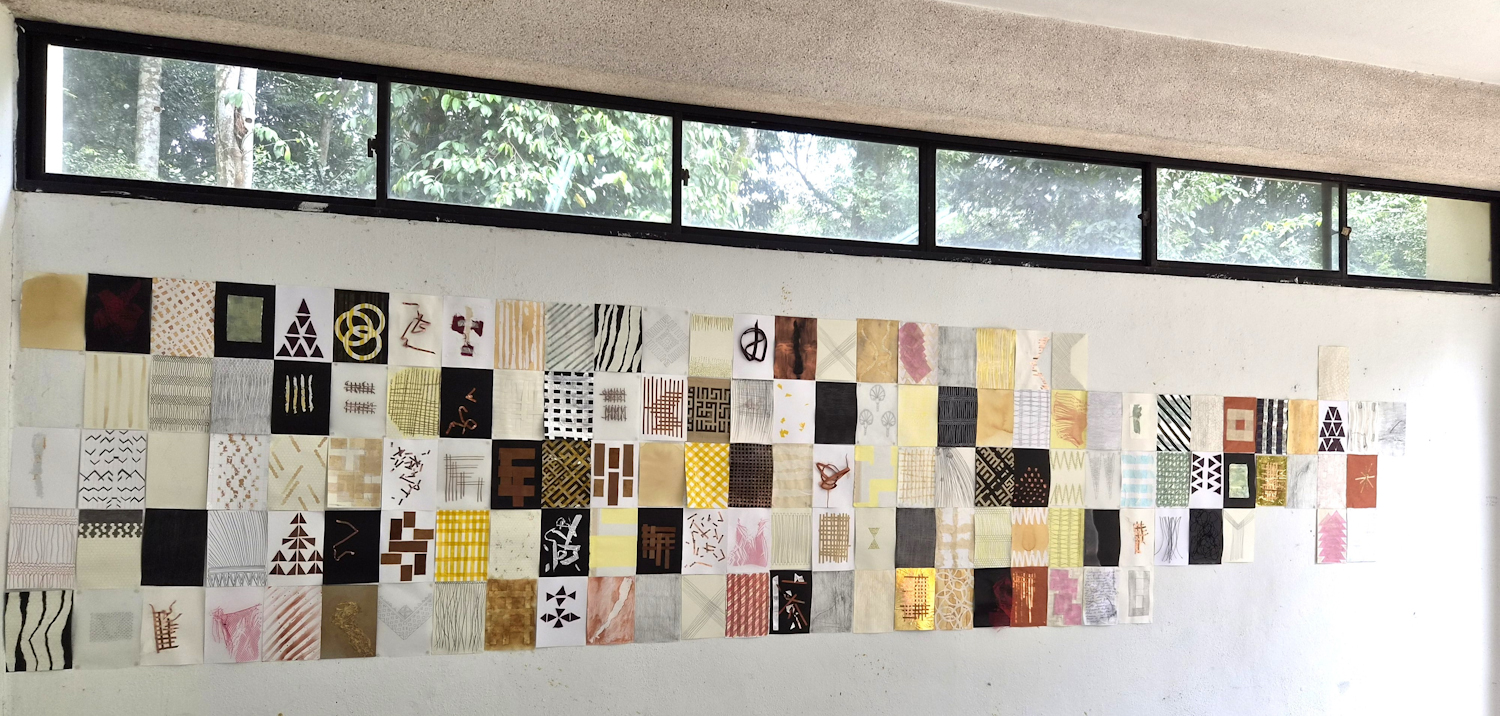
The residency provides Zara with an opportunity to work slowly and experimentally, allowing new processes and ideas to emerge through sustained engagement with a series of small-scale material experiments. These A5 studies provide a space to test ideas and material combinations quickly and without judgement, allowing successful experiments to be developed further or up-scaled, while others can remain as traces of the exploratory process.
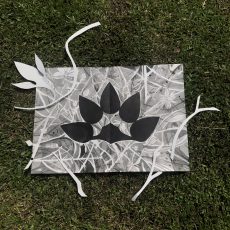
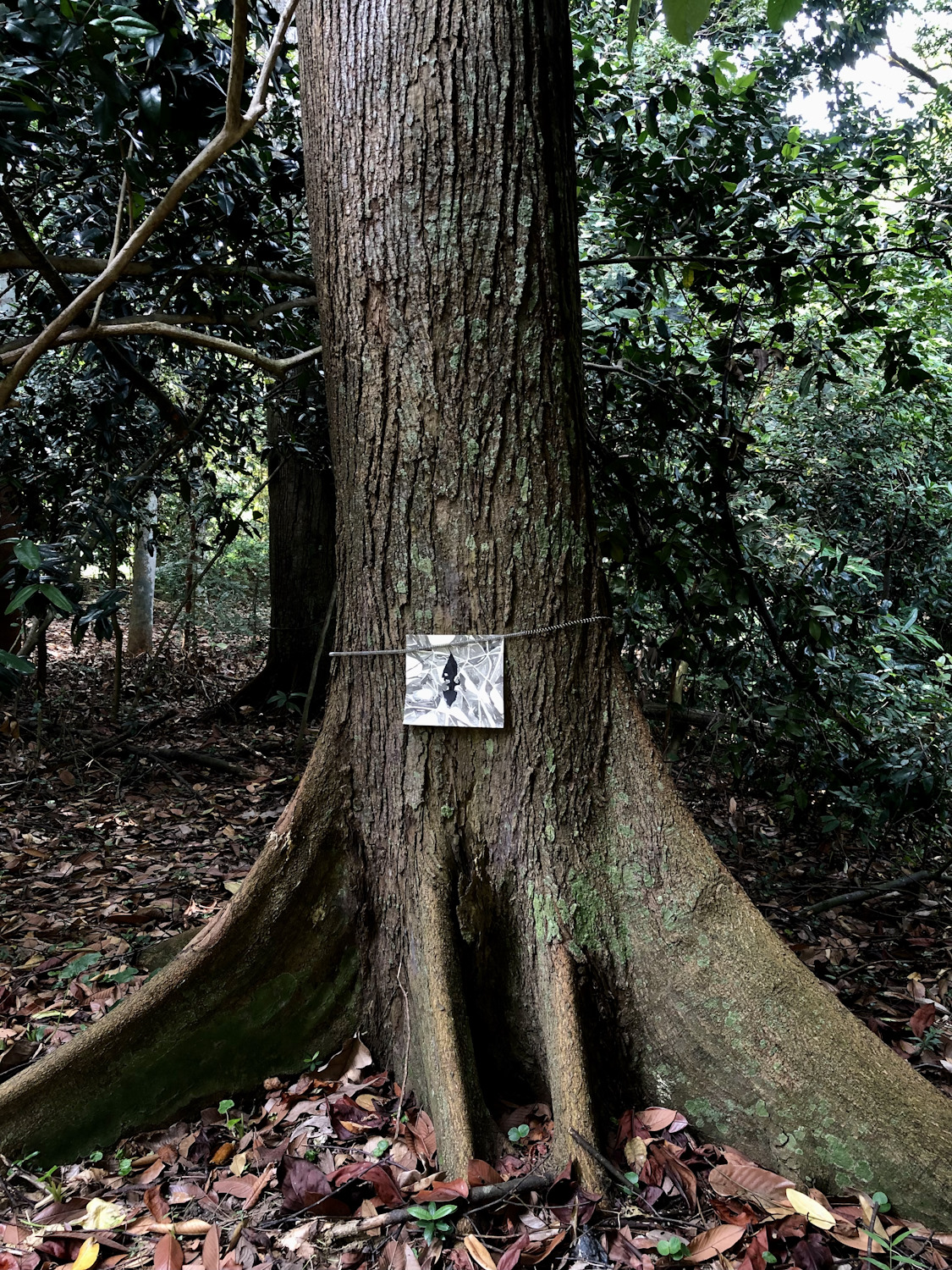
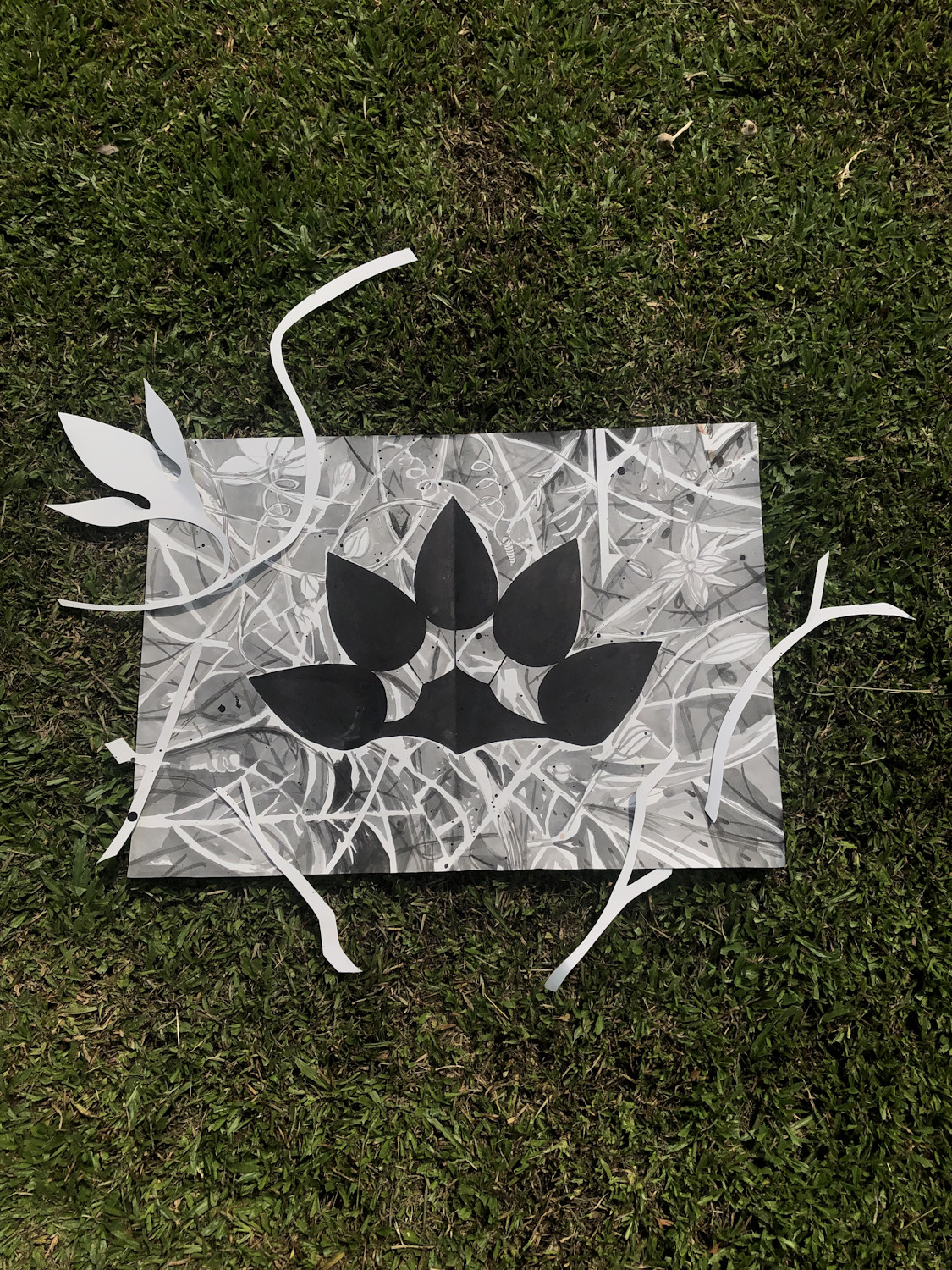
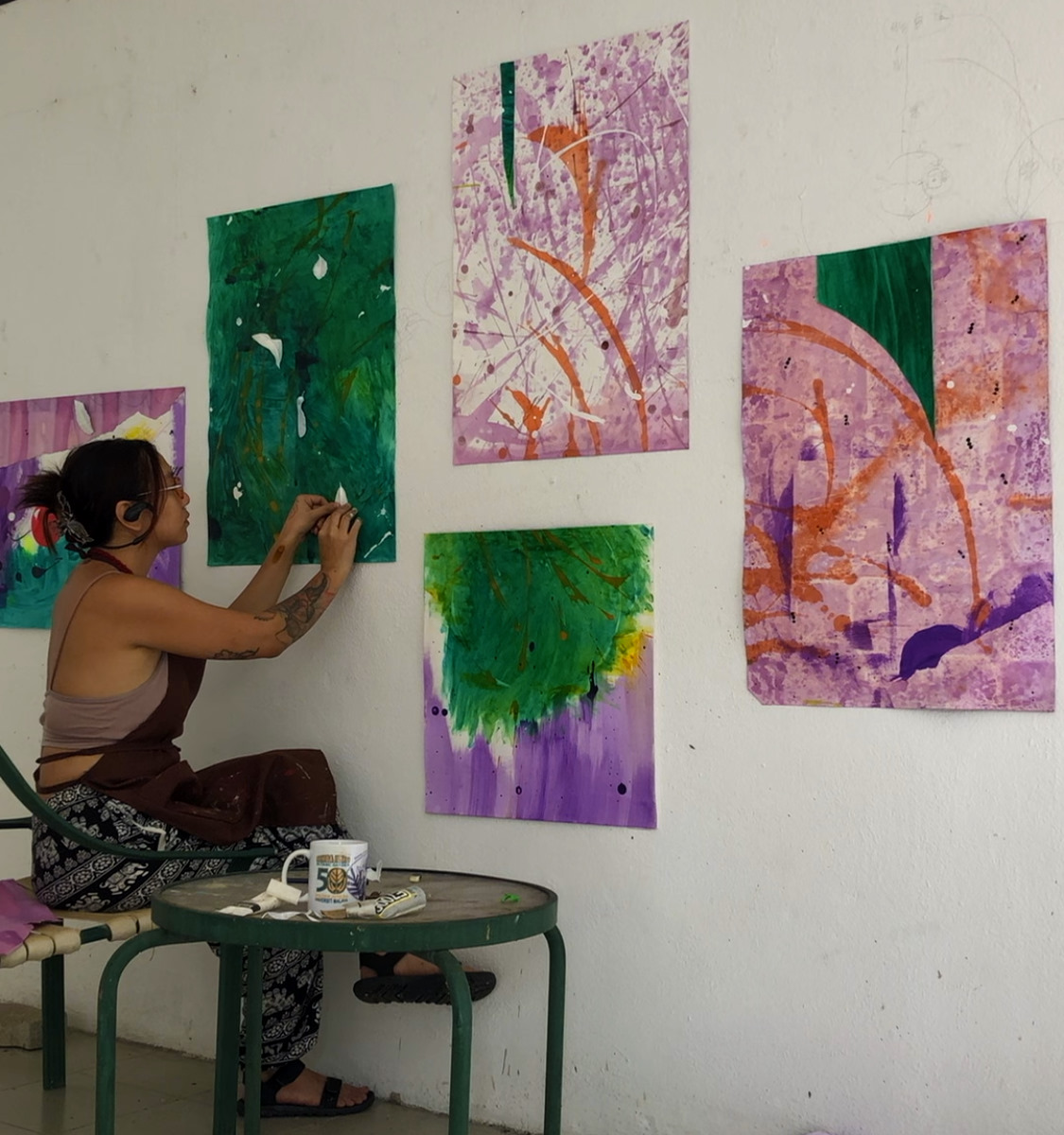
Below: Works in progress from the series “Could not be spoken”, 2026, Kozo papers and graphite
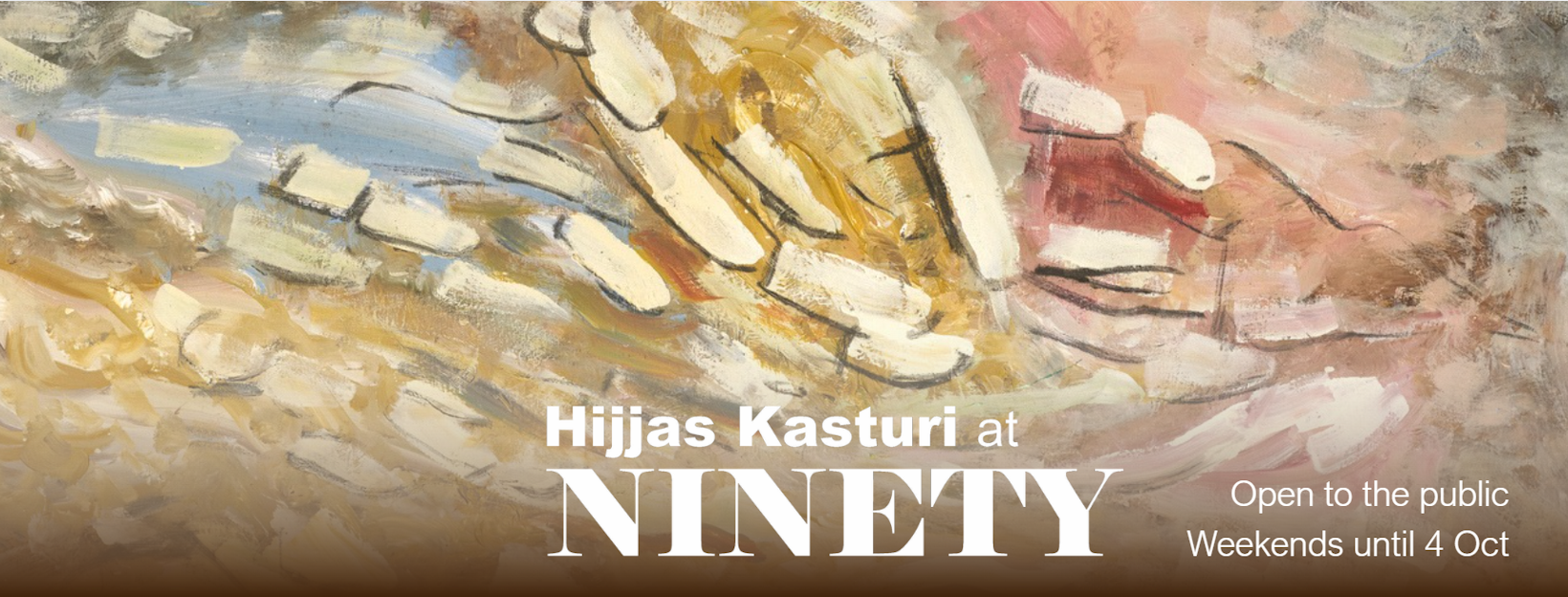
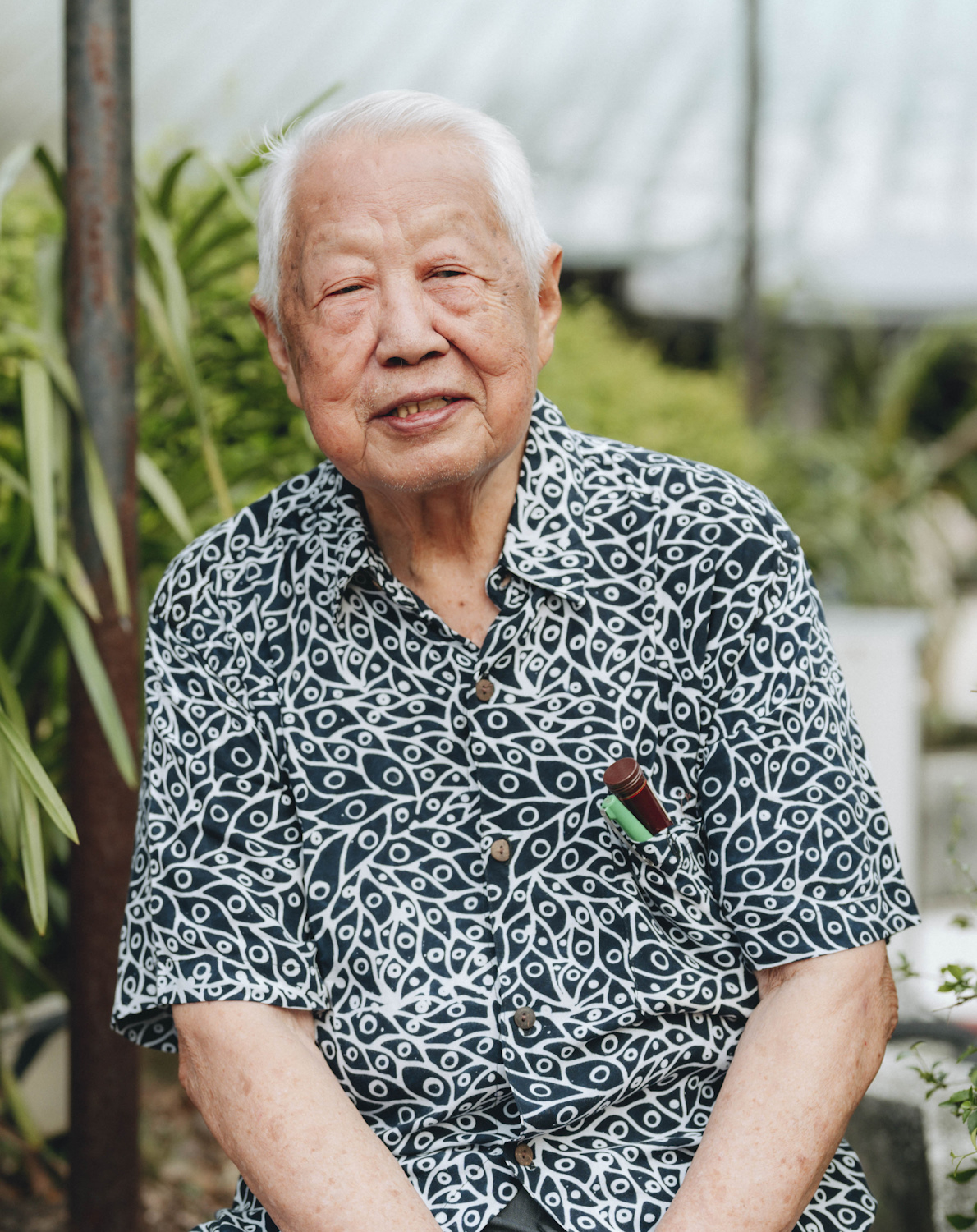
Ar. Hijjas Kasturi, our owner and founder, turns 90 years old in September 2026!
As part of our celebrations, Rimbun Dahan will be open to the public with a solo exhibition of Hijjas’ recent paintings in the Underground Gallery.
Open times: 11am to 6pm Open dates: * Saturday 19 Sept * Sunday 20 Sept * Saturday 26 Sept * Sunday 27 Sept * Saturday 3 Oct * Sunday 4 Oct
During your visit, you are welcome to explore the 14-acre indigenous garden and visit the two heritage houses on site.
Other Activities
Sunday 27 September — Australian resident artist Zara Collins will open her studio to the public, to share the works in progress she has made during her residency. More info…
UDPATE: Garden Tour is FULL and registration is CLOSED. The next Garden Tour will take place on Sunday 25 October.
Sunday 4 October — Angela Hijjas will lead a tour of her 14-acre native garden at Rimbun Dahan, from 9am to 11am. The tour is free, but registration is required for the garden tour only; you are welcome to drop in without registration from 11am onwards. Register for the garden tour here:https://forms.gle/Lv81KpxDmj2Lgohp7
Tips for Visitors
Food and water are not provided on site. You can bring your own picnic to enjoy in the gardens; please take all your trash with you.
Swimming and visiting pets are not allowed, thank you for your cooperation.
Outdoor parking is available on the driveway, at your own risk.
As Rimbun Dahan is our private family home, please be advised that we are not open to the public on other dates.
The paintings in the exhibition are for sale. You can download a copy of the catalogue here: [PDF 30 MB]
Landmarks: Our front gate with the Rimbun Dahan signboard is opposite Warung Selera Ria and also next to the start of Lorong Belimbing. Do not enter Lorong Belimbing, please enter Rimbun Dahan via the front gate from the main road.
About Rimbun Dahan
Rimbun Dahan is the home of Malaysian architect Hijjas Kasturi and his wife Angela. Set on fourteen acres outside Kuala Lumpur, Malaysia, the compound of Rimbun Dahan is a centre for developing traditional and contemporary art forms. It features buildings designed by Hijjas Kasturi, as well as two early 20th century traditional Malay houses from Perak and Penang, in an indigenous Southeast Asian garden environment which has been awarded arboretum status. Rimbun Dahan is private property, and is only open to the public on Open Days.
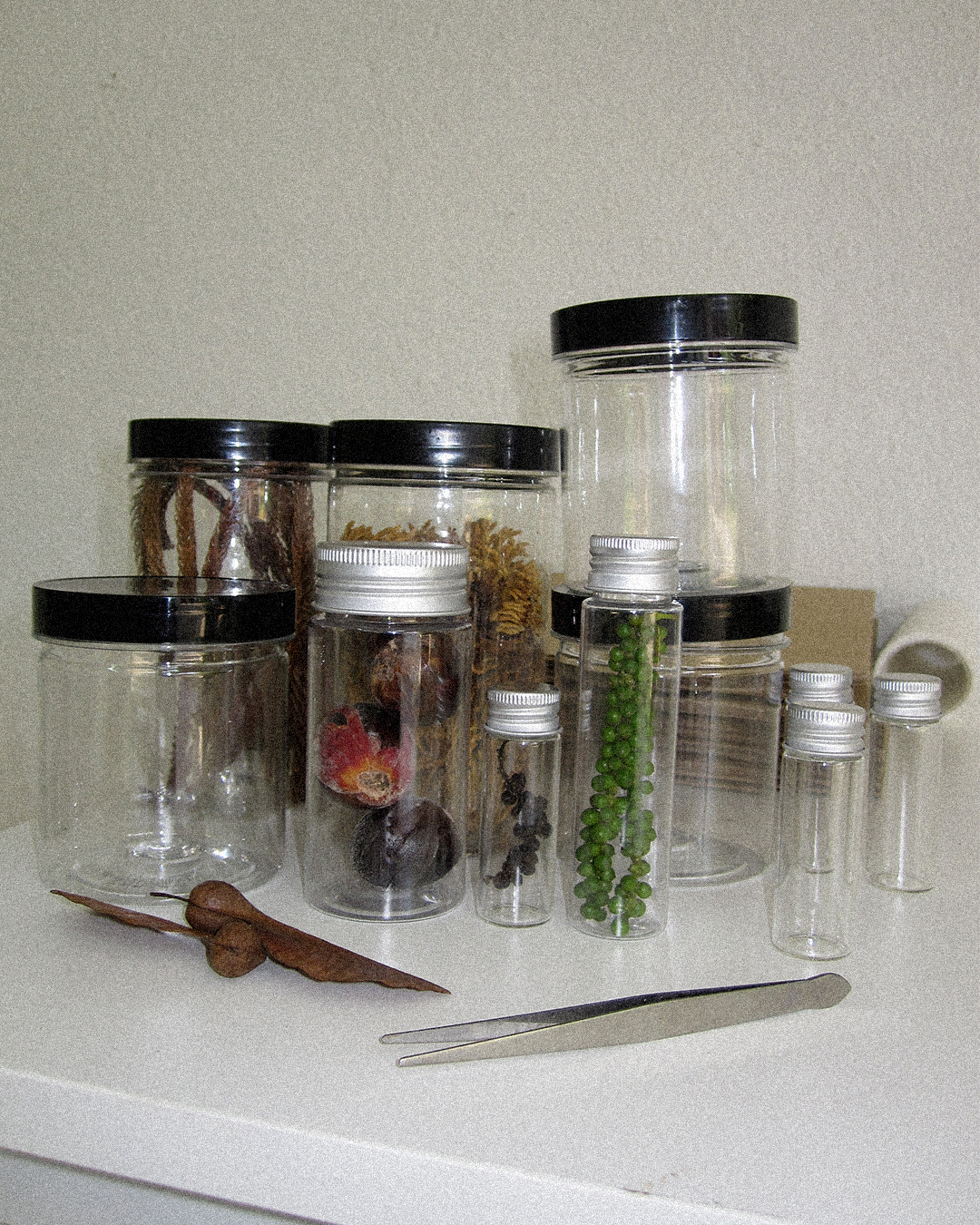
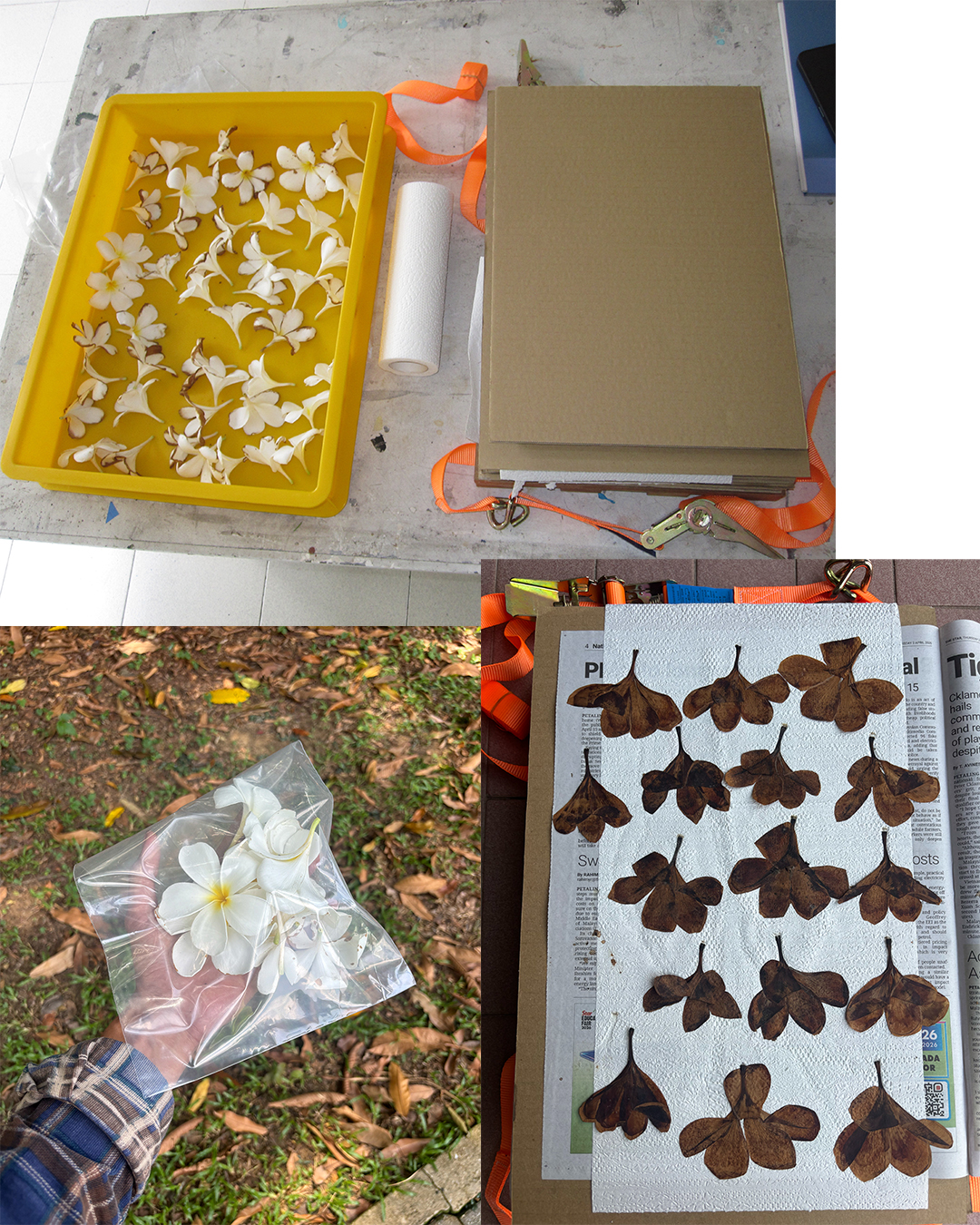
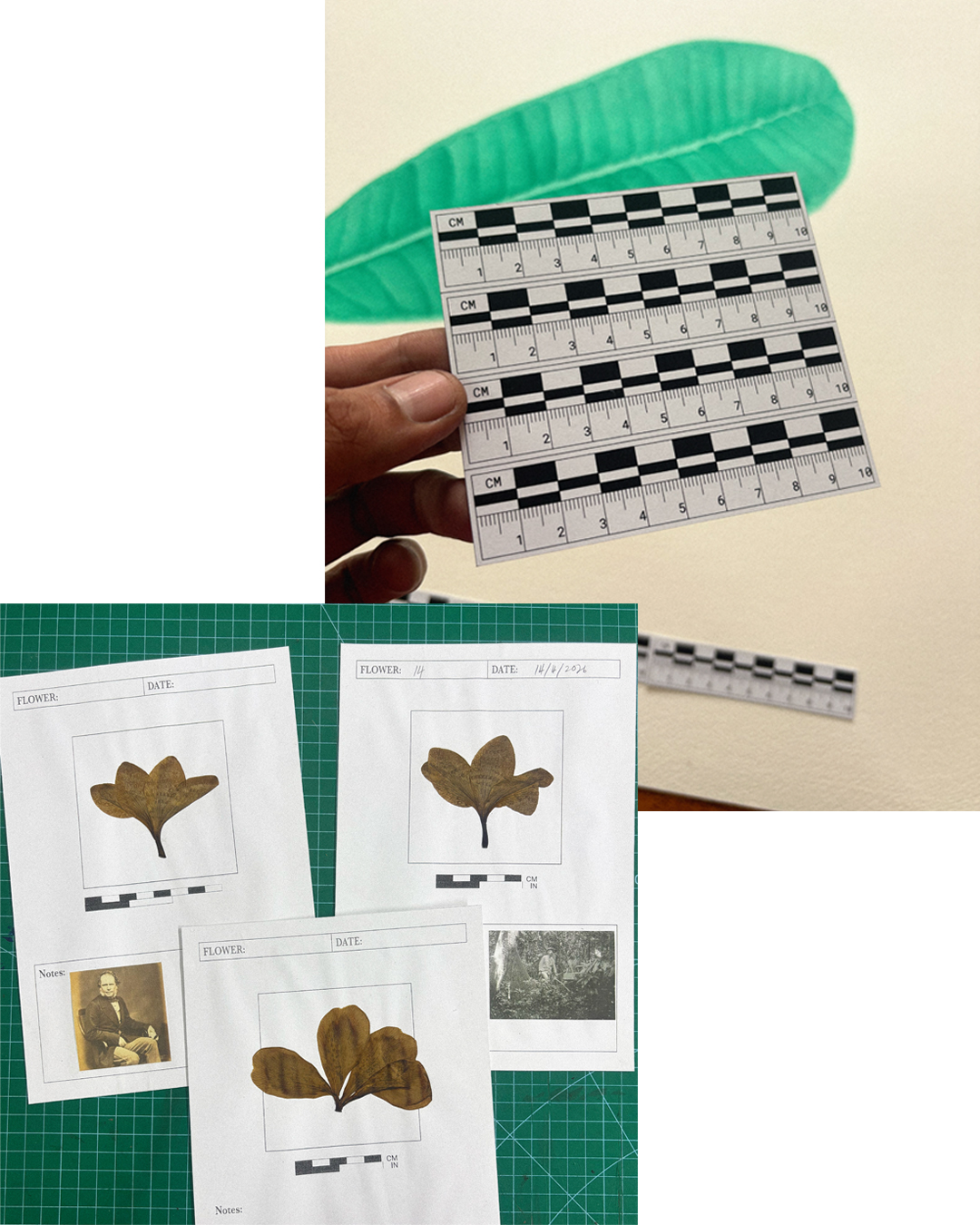
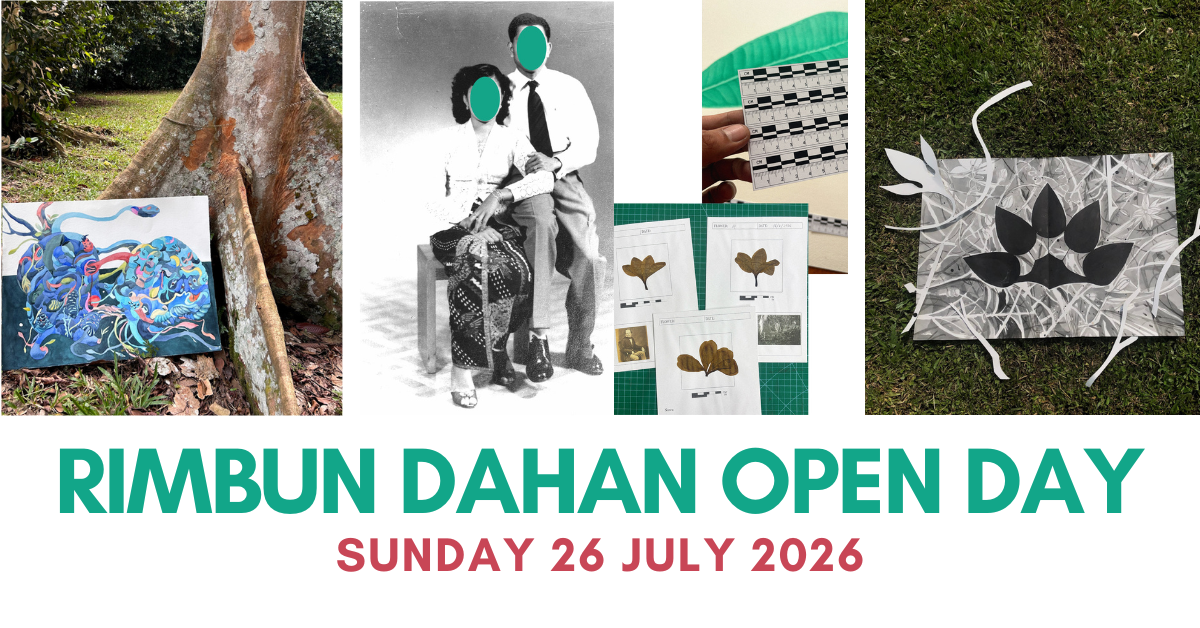
Malaysian visual artist Anas Afandi has used his 2-month residency at Rimbun Dahan in 2026 as a period of research and experimentation, cultivating a daily practice of collecting fallen kemboja flowers and experimenting with collecting and documentation methods from botanical and archaeological practices, while thinking about cultural memory and meaning.
About the Artist
Anas Afandi (b. 1991) works across drawing, painting, sculpture, and installation. His practice examines the relationship between the natural world, history, and cultural identity. Through research-driven projects and speculative methodologies, he often constructs pseudo-worlds that question how institutions shape his surroundings. In recent years, Anas’ work has expanded toward environmental politics, colonial legacies, and the construction of cultural narratives, positioning the environment not only as a subject of representation but as a method of inquiry.
About the Residency
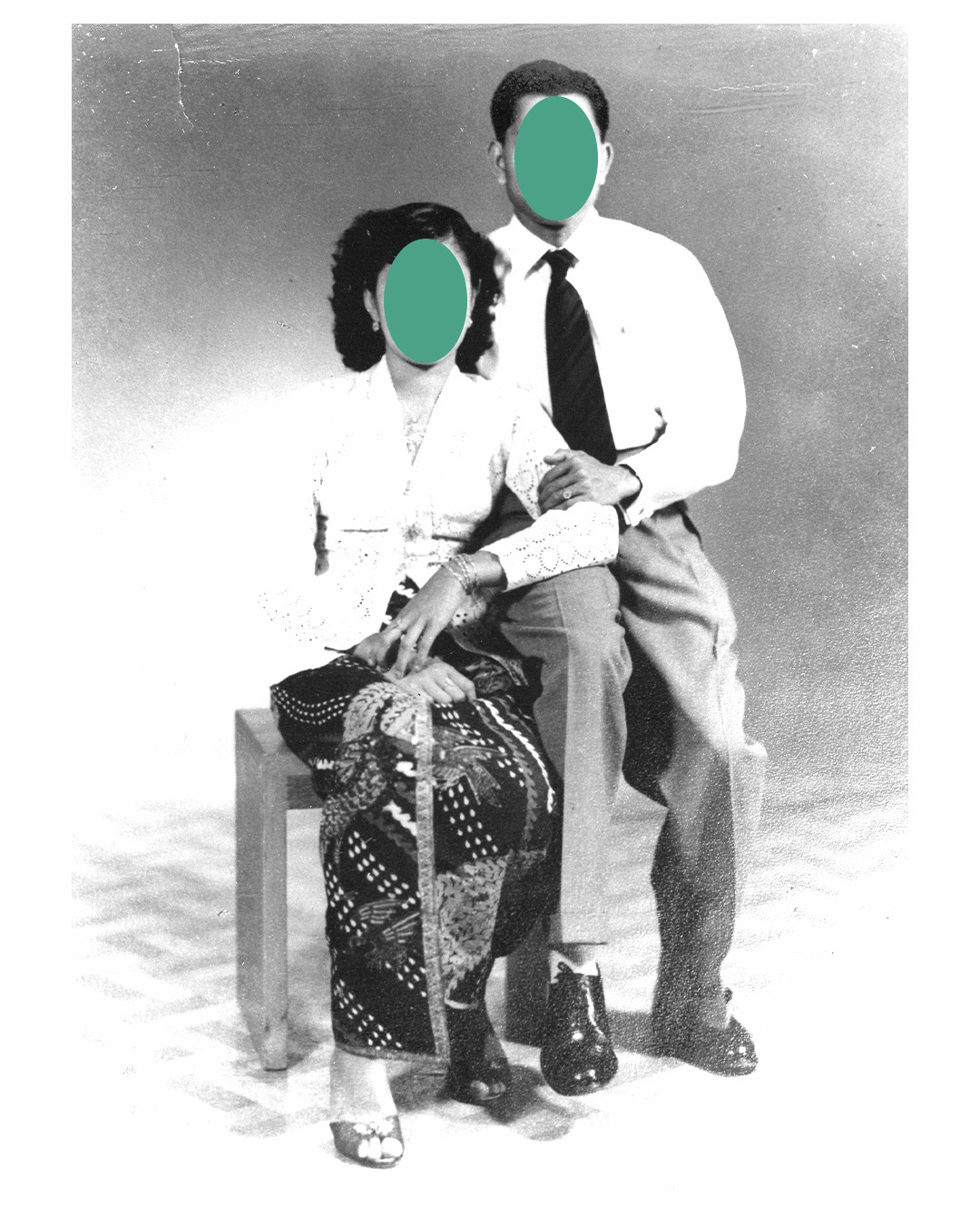
Pictures Of You
Over the course of this residency, I focused my research on Taman Sari, a garden in Rimbun Dahan dedicated to the collection and preservation of medicinal and fragrant plants from the Malay Archipelago and its surrounding region. I approach the garden as a model for thinking about culture, investigating how plants can become carriers of history and identity, and how systems of preservation construct cultural narratives.
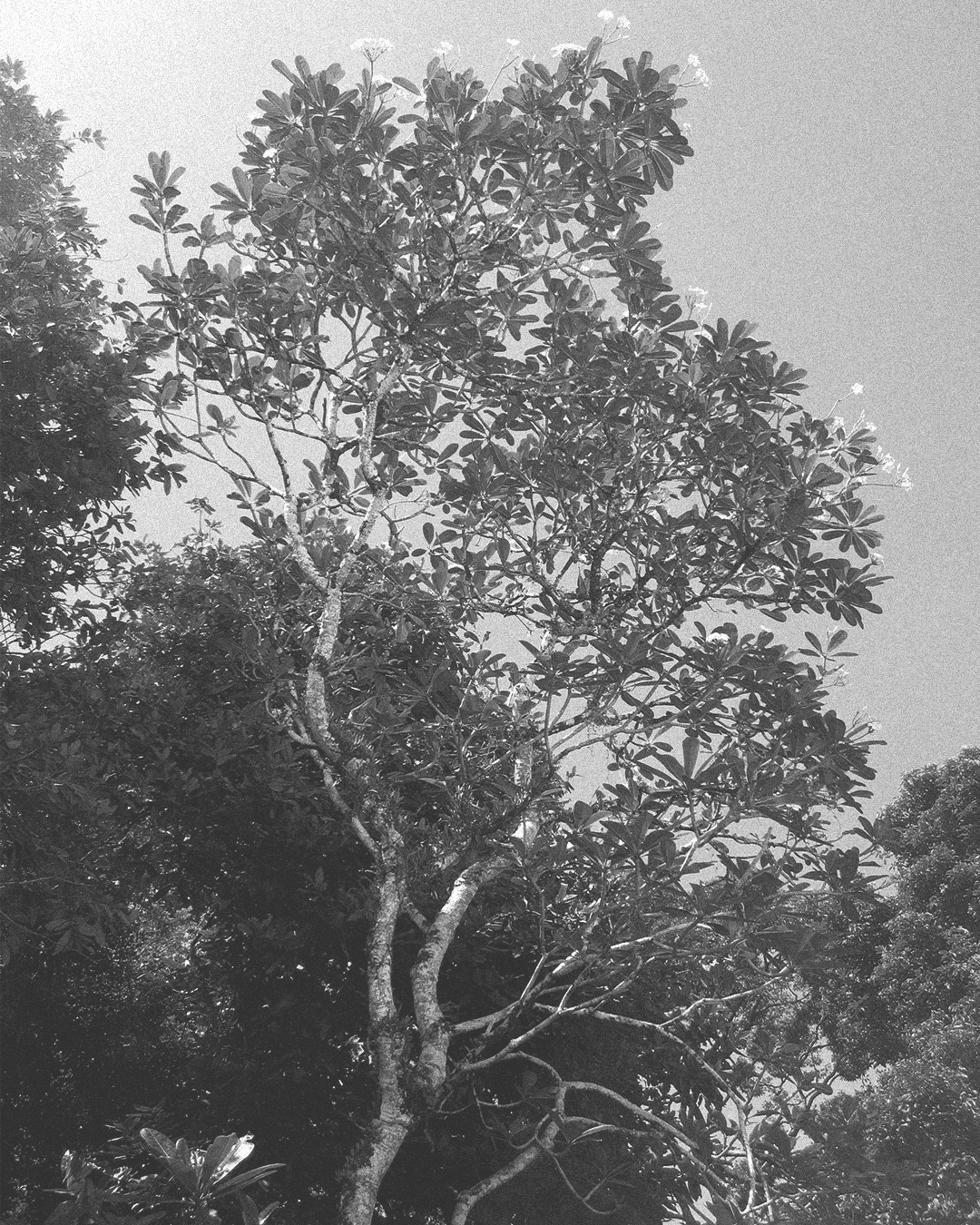
I am interested in the kemboja; a naturalised, non-native species that holds deep personal significance for me. It became the entry point for this research. Its continued presence in Taman Sari exposes a tension between botanical classification and its cultural significance. Even though it has been part of the garden for almost forty years, it will not be replanted once it dies, keeping with the garden’s commitment in preserving species native to Southeast Asia.
Hence, the anticipated disappearance of the tree one day raises questions beyond botany that shape this project; (1) what happens when something culturally meaningful no longer fits within systems of preservation and (2) how do we preserve forms of attachment and meaning that extend beyond physical material?
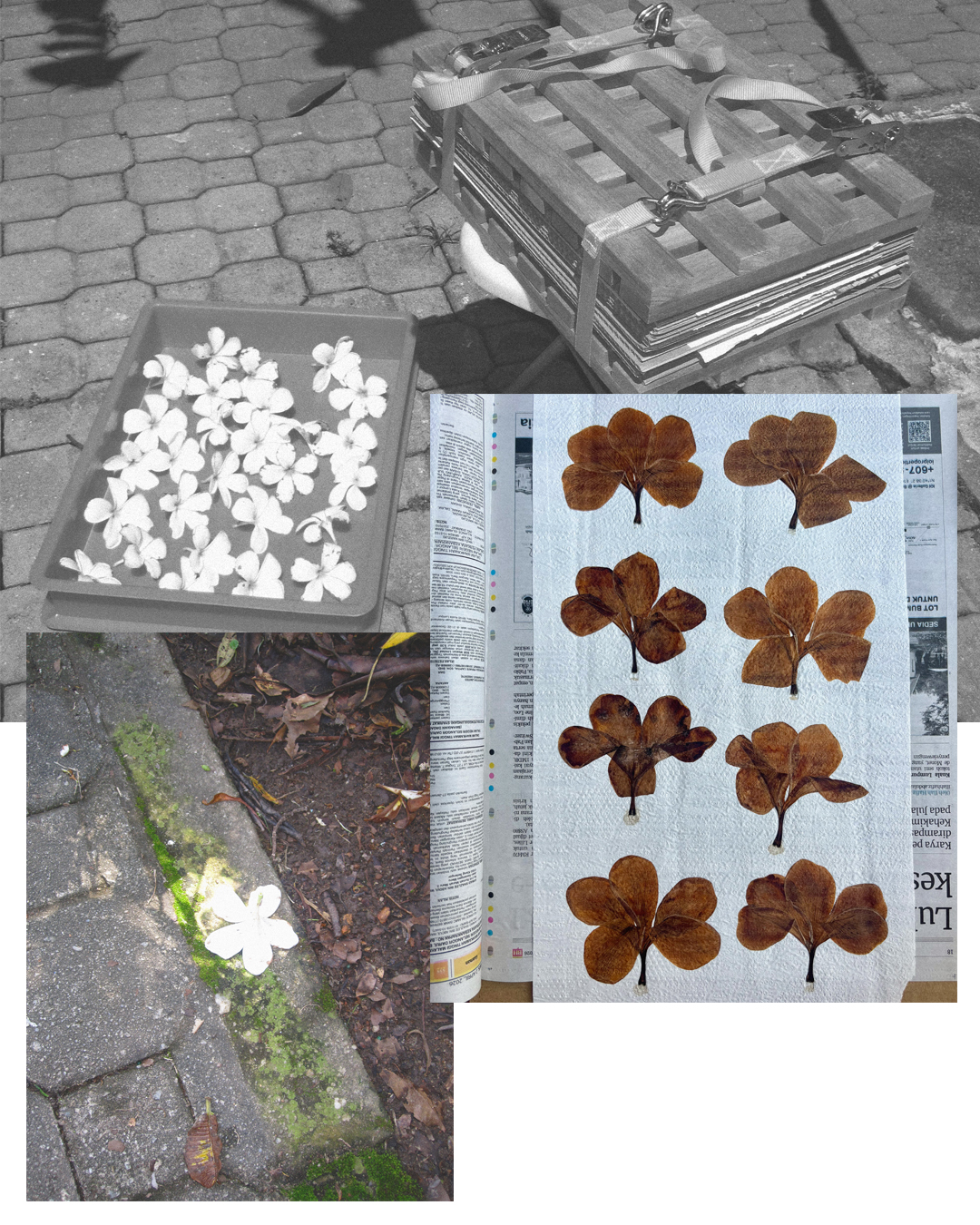
One of the projects that I worked on was creating a daily ritual of walking through the garden and gathering kemboja flowers that had fallen from the tree every morning. The flowers were then preserved. By conducting this, I am reflecting how cultural meanings are formed gradually over time and imitating as well as speculating how such meanings come to exist.
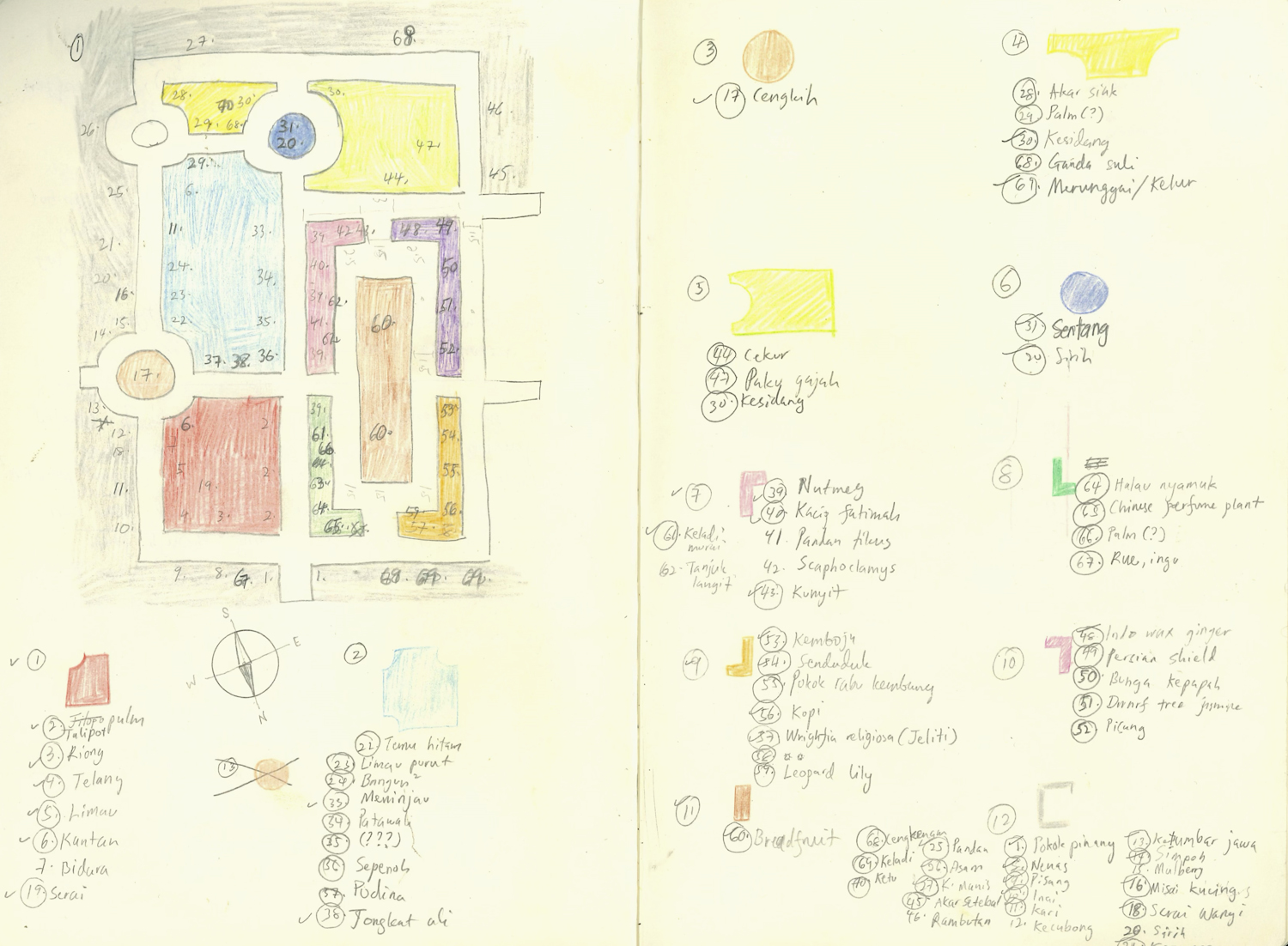
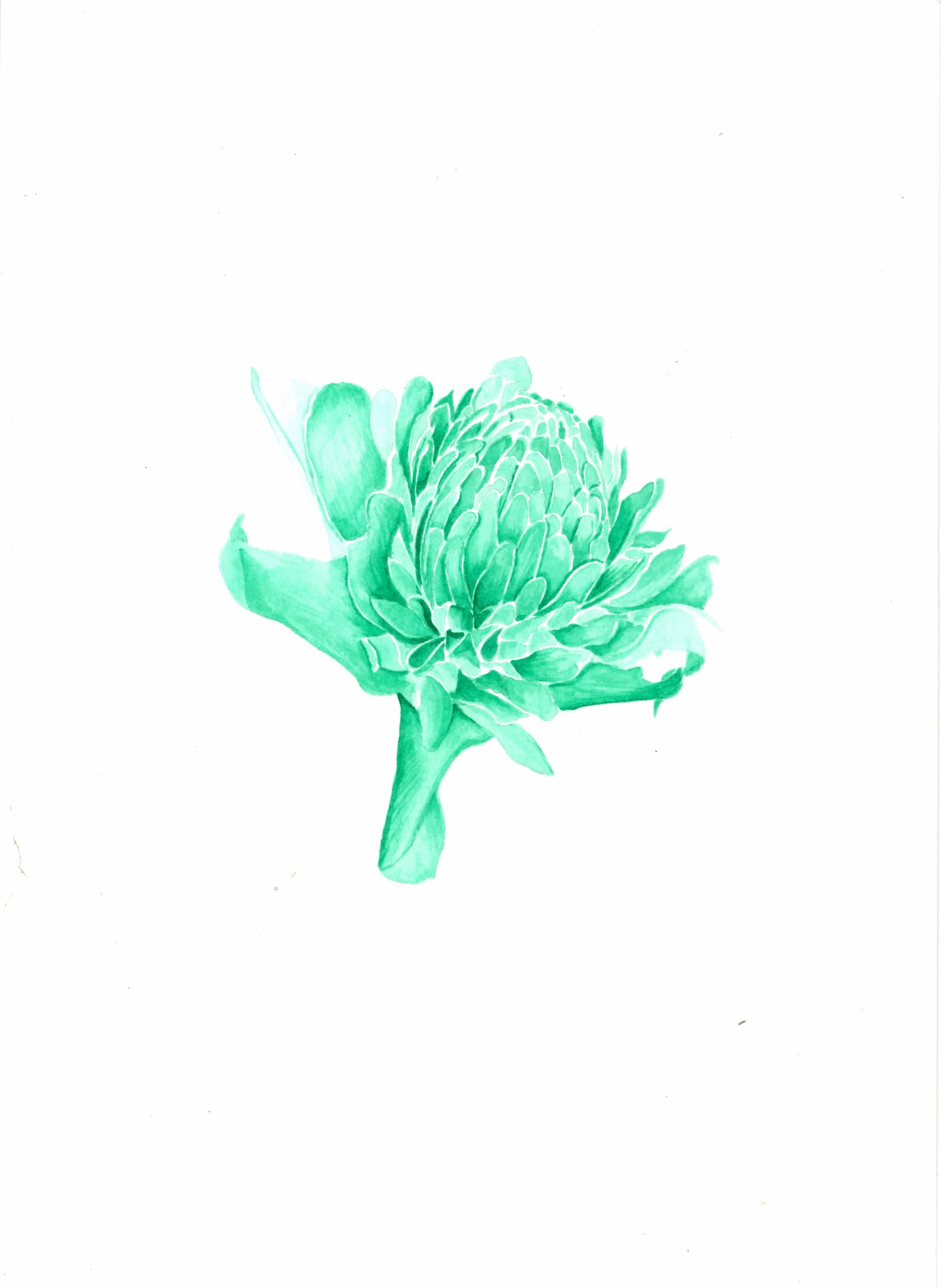
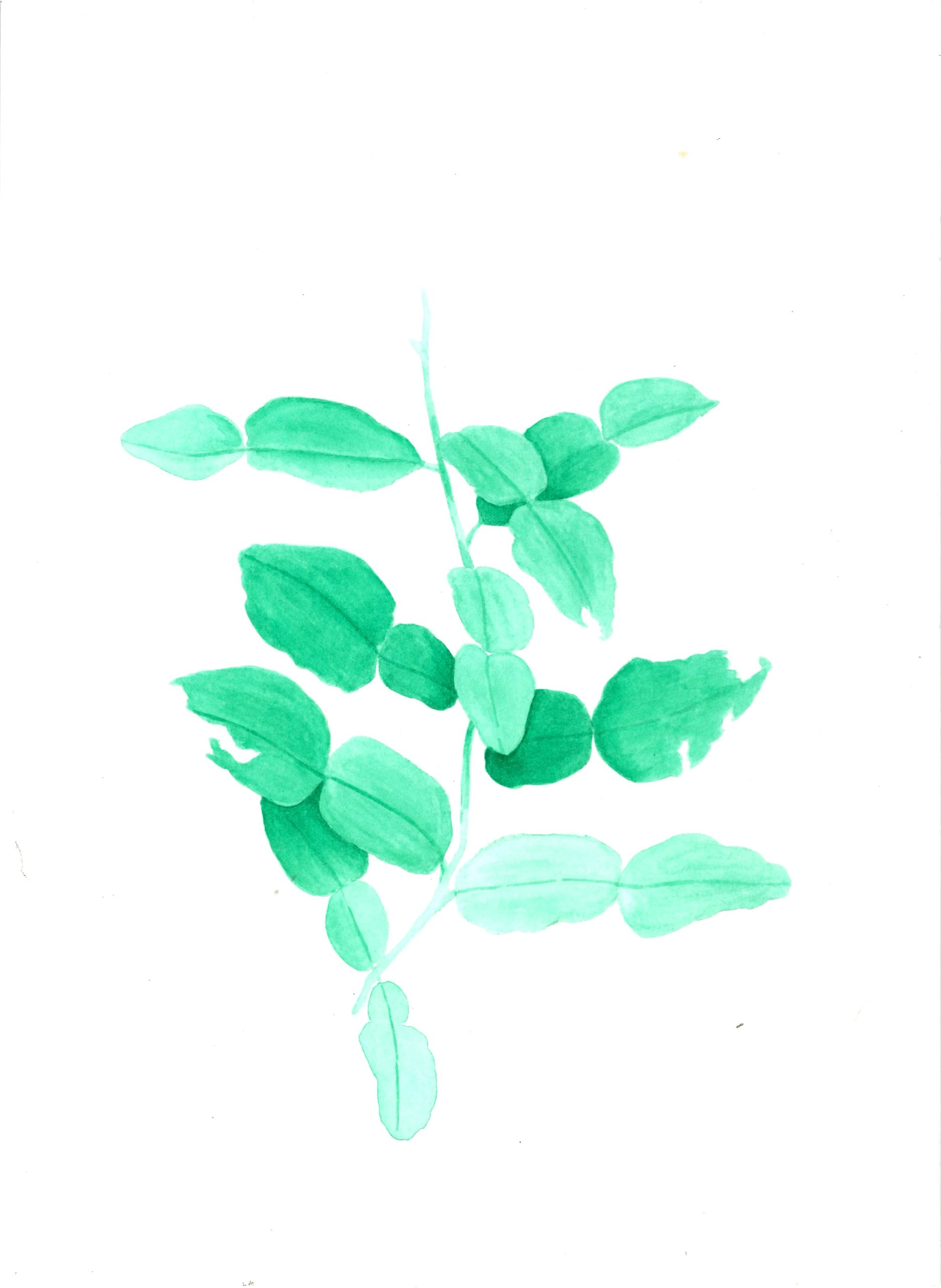
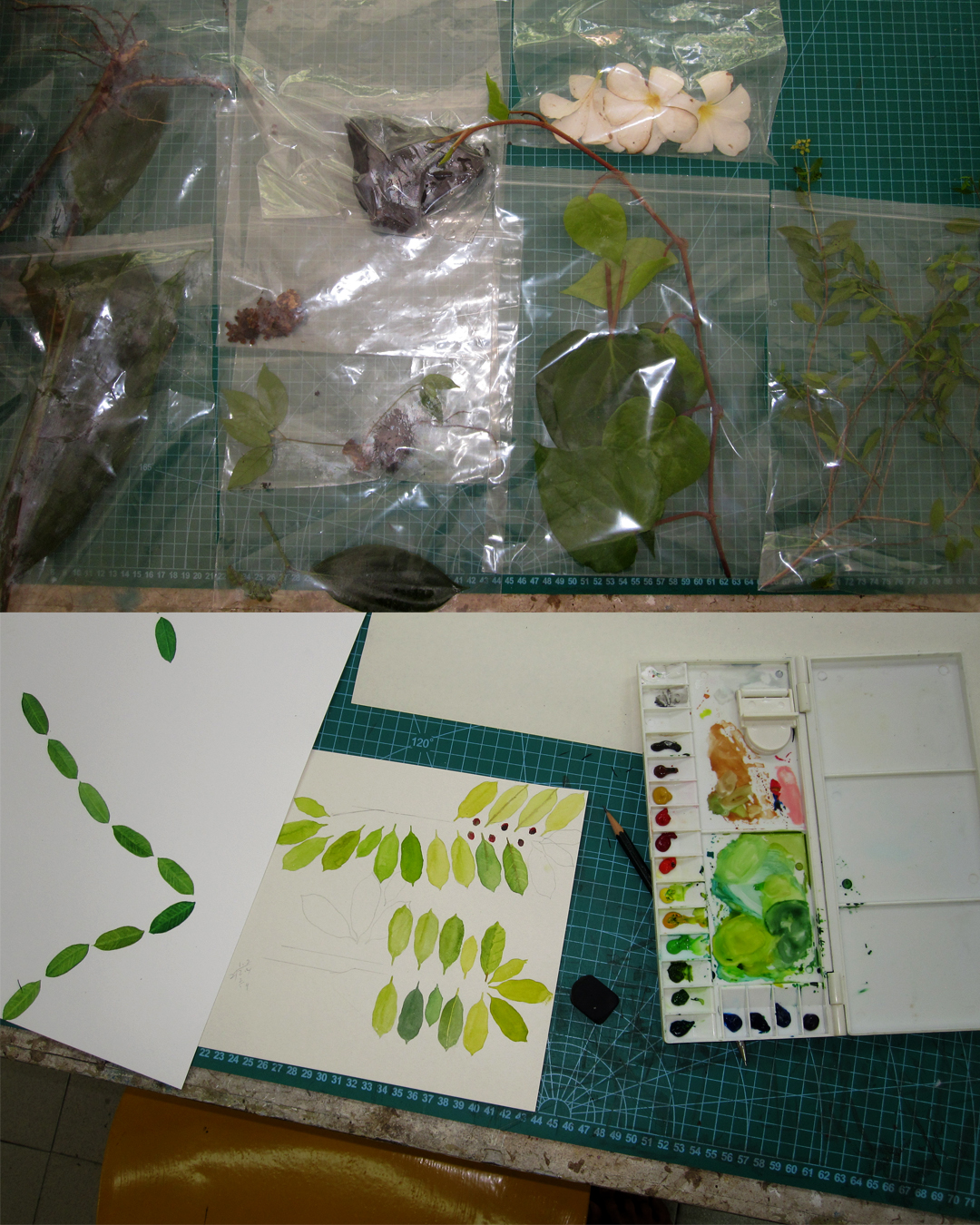
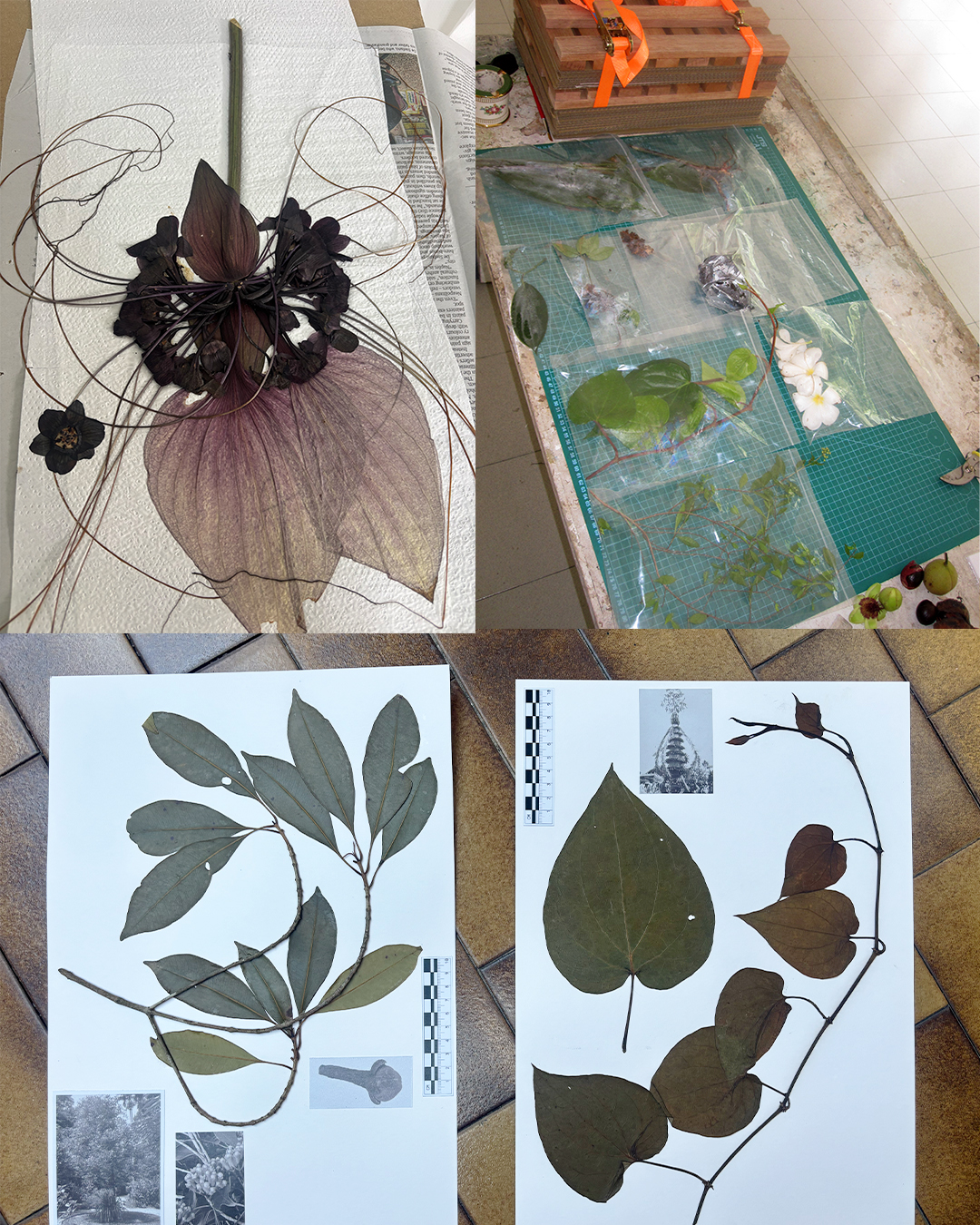
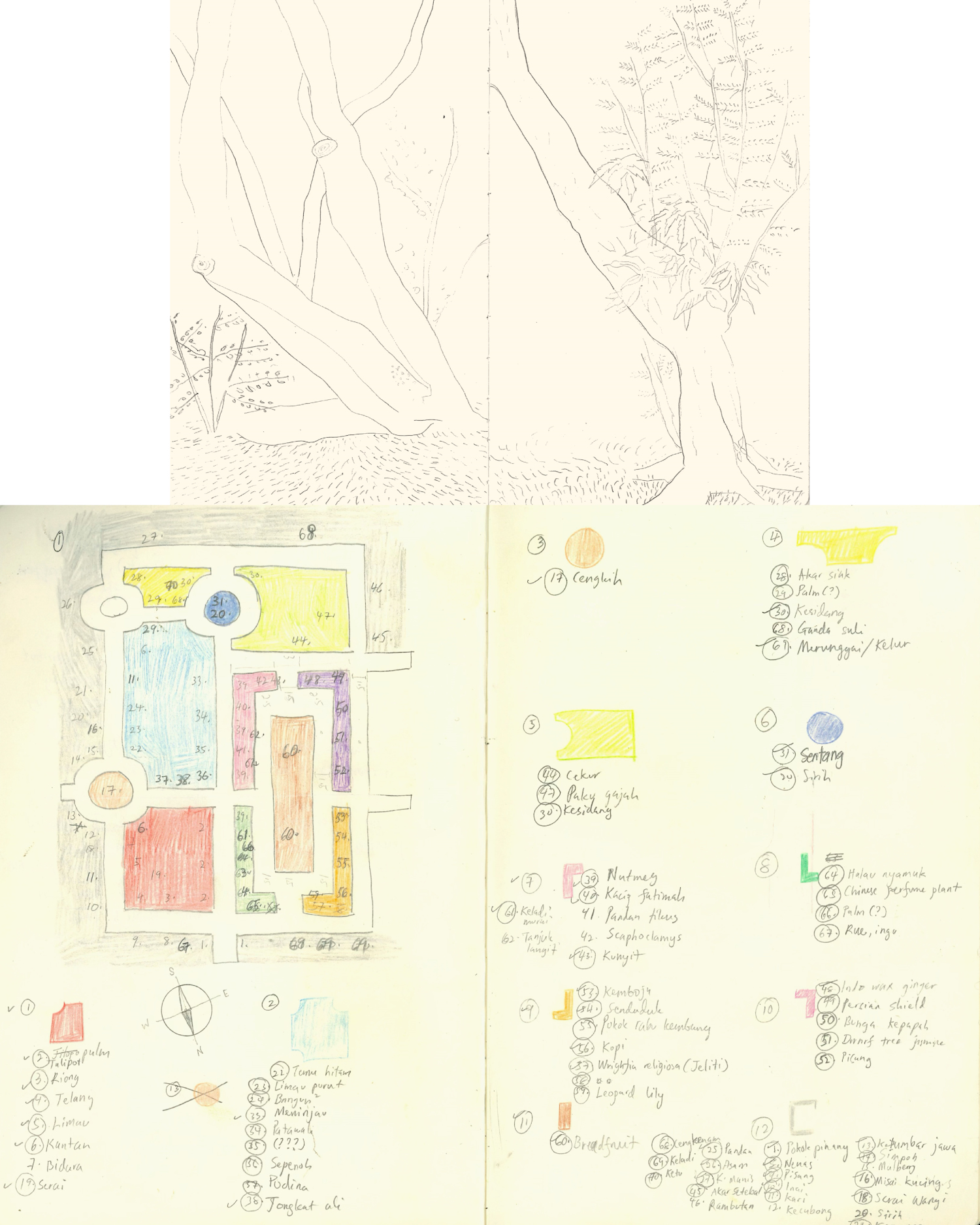
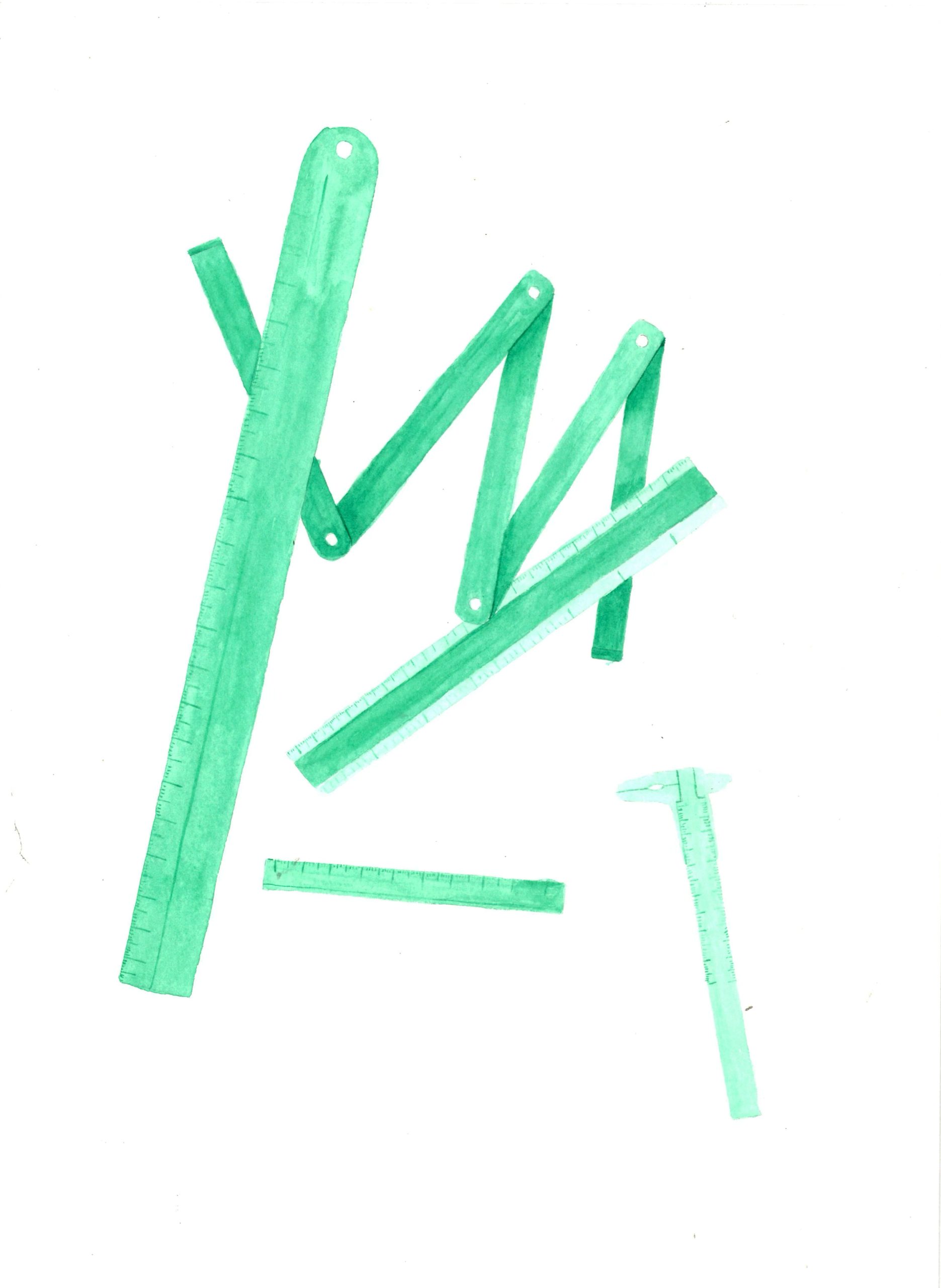
In another series, I have conducted fieldworks at Taman Sari. If the garden metaphorically represents the culture itself, the plants within it were imagined as elements that constitute cultural identity. I mapped the garden, marking the locations of each plant. Some of the plants were collected and pressed, along with botanical illustrations that do not adhere to any scientific rules. The color viridian green was chosen as I was looking for a color that gives an almost artificial representation of nature, or in other words, another version of nature rather than the nature itself.
Rather than focusing on producing finished works, this residency has been a period of research and experimentation. Methods from botanical and archaeological practices have been adopted, including collecting, documenting, and examining fragments. This process allowed me to investigate different materials and forms, from which several projects have gradually emerged and will be developed more in the near future.
I am Khin May Moe (born 1996), also known as May Moee, a full-time visual artist based in Yangon, Myanmar.
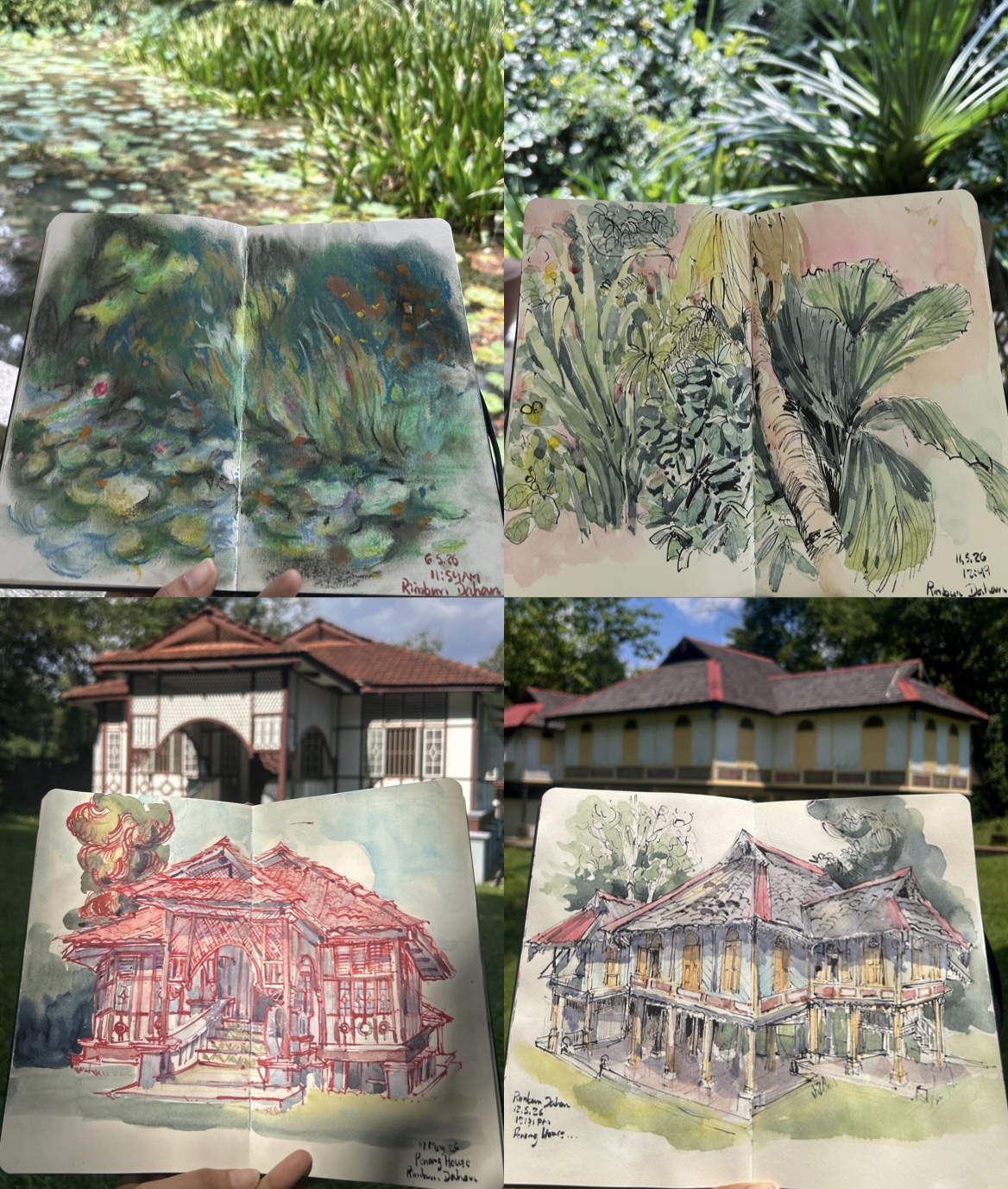
I mainly work with watercolor and ink, creating paintings and urban sketches. I enjoy painting historic buildings, cityscapes, and scenes from everyday life. I am a member of Urban Sketchers Yangon and often draw outdoors. For my urban sketches, I usually use brush pen ink and twig ink, and in my recent work I have been exploring detailed experimental watercolor techniques.
I graduated with a Bachelor’s degree in German from Mandalay University of Foreign Languages (MUFL) and worked as a German-speaking tour guide from 2018 to 2020. Although I have loved drawing since childhood, I began studying academic painting in 2019 and later graduated with a Diploma in Painting from the National University of Arts and Culture, Yangon (NUAC). Since then, I have been actively creating artworks and participating in group exhibitions in Myanmar.
In 2024, I received an artistic residency scholarship through the EMPM programme and spent six months as a resident artist at Beaux-Arts Nantes Saint-Nazaire in Saint-Nazaire, France, where I presented my work in a student exhibition. After returning to Myanmar, I also participated in the group exhibition J’ai vu le soleil dans l’ombre, organised by the European Union in Myanmar.
I am currently an artist-in-residence at Rimbun Dahan, Malaysia. The work I have developed during this residency will become the foundation of my first solo exhibition in Yangon.
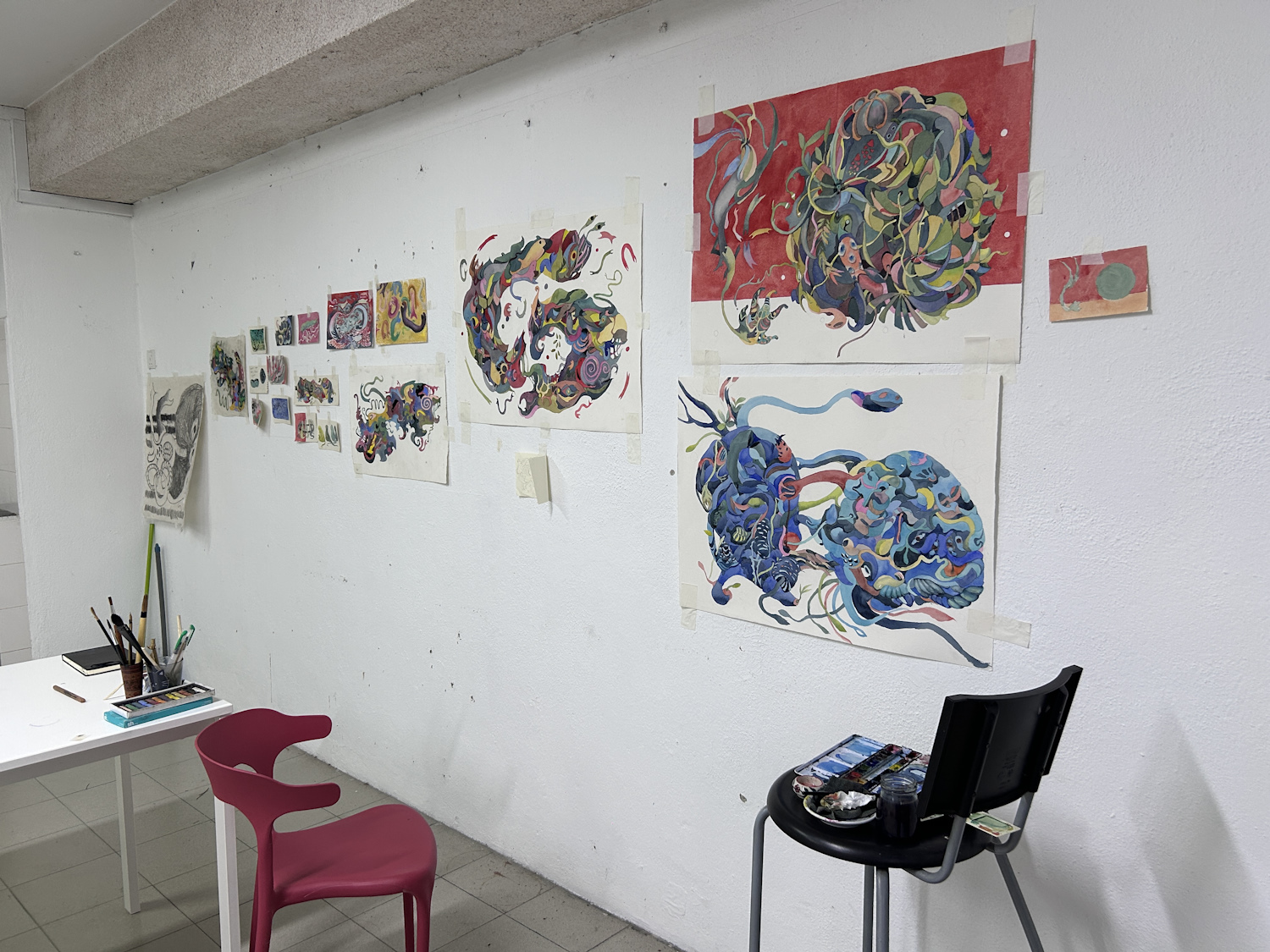
I spent two months as an artist-in-residence at Rimbun Dahan (May and July). During my residency, I had a lot of time to think, explore, and focus on my art practice every day. Being in a place where I could work freely gave me the opportunity to try a new art practice and experiment with ideas that were different from what I usually draw. As the residency progressed, I created a completely different body of work from the proposal I had written before coming to the residency.
It was also a time to dive into my own mind. I started to enjoy gazing at plants and trees every day, something that is difficult to do regularly in my daily life in Yangon. I enjoyed exploring the garden and drawing from my surroundings. During this process, I broke the boundaries of my own thinking and started making imaginative work that I never thought I could create. I discovered a new way of making art that came not only from what I saw in front of me, but also from what I imagined and felt inside my mind.
At the same time, I did not want to lose my favourite habit of observational sketching. I walked around the garden and made sketches during my first month here. As someone who enjoys drawing old buildings, I especially loved sketching the heritage houses at Rimbun Dahan. After sketching, I often stepped out of my comfort zone and experimented with new ideas. This became an important part of my art practice.
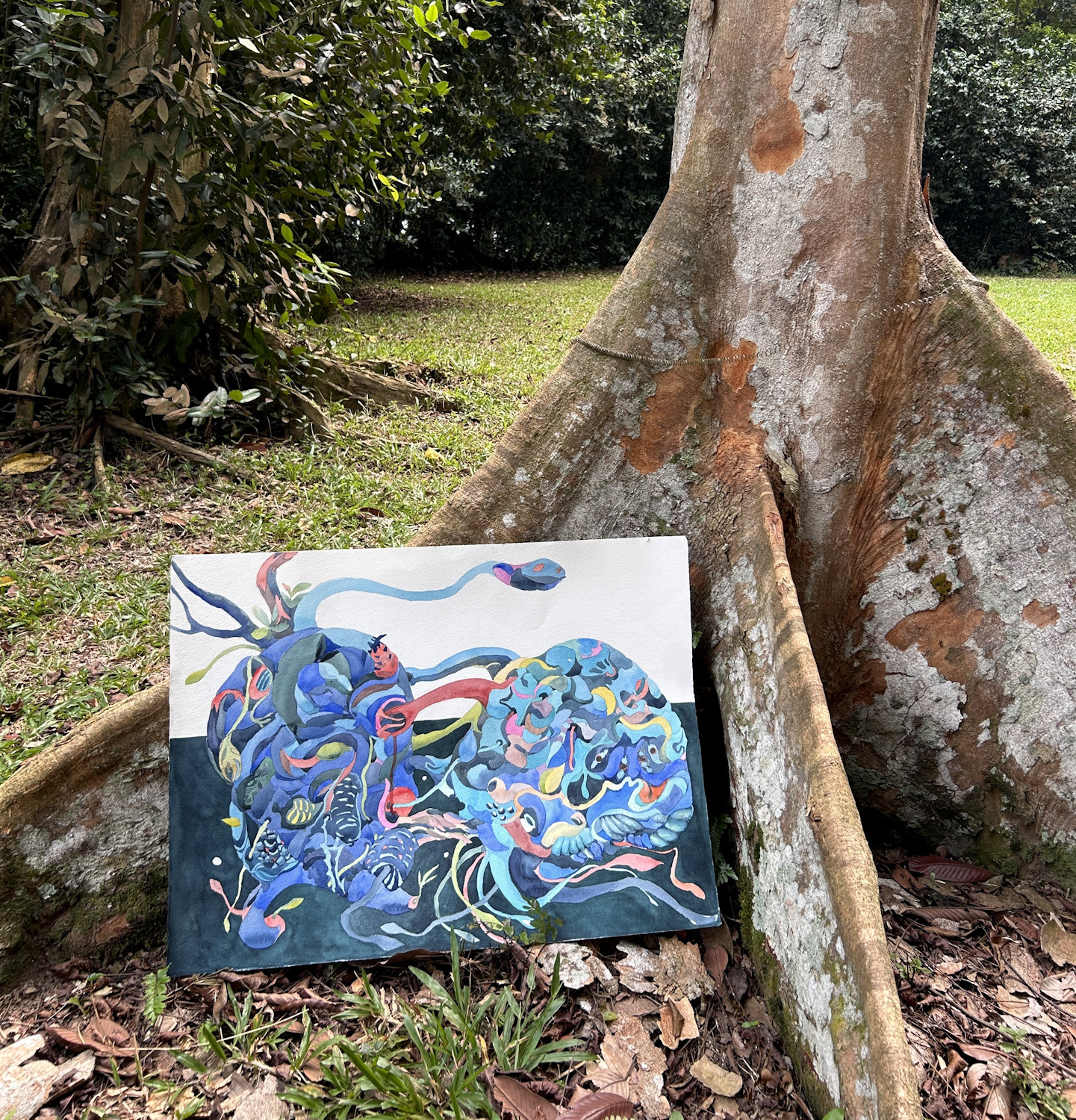
During the residency, I also faced my long-term problem of insomnia. Being awake at night gave me time to think about my emotions and inner thoughts. I wanted to connect this experience with my artwork. Through these paintings, I explore different aspects of mental health, emotions, sensitivity, and the expressions that come from my deep subconscious during sleepless nights.
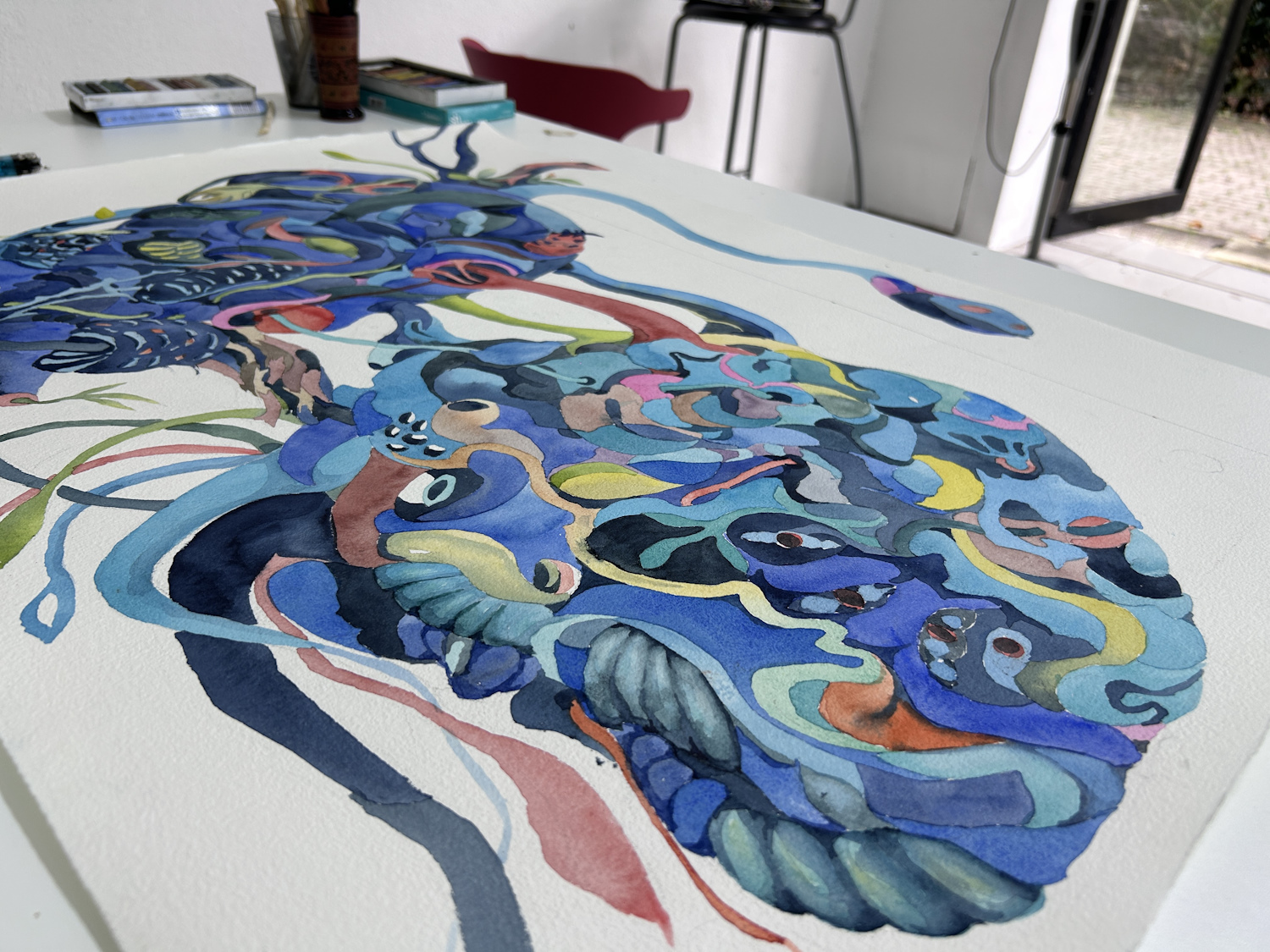
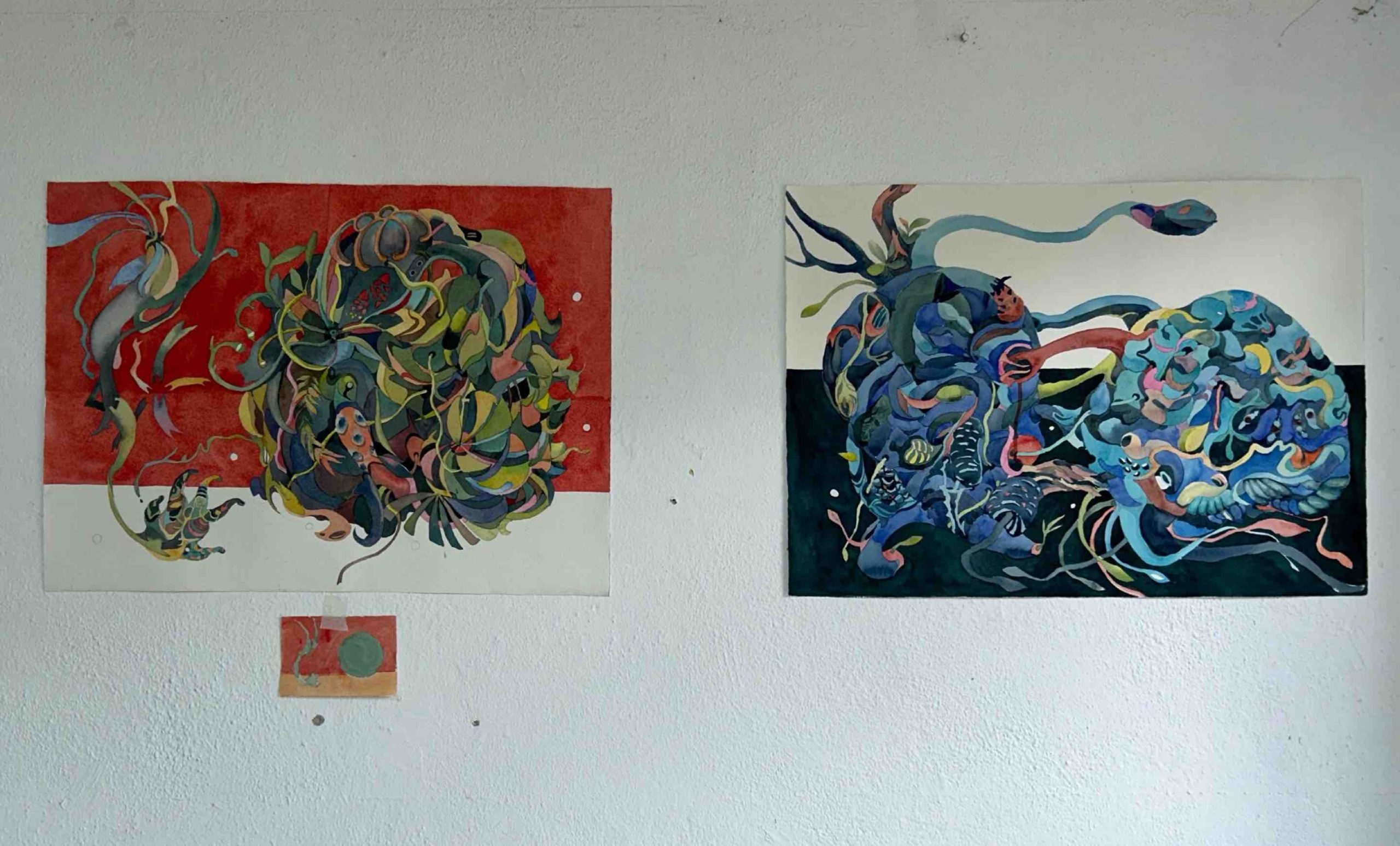
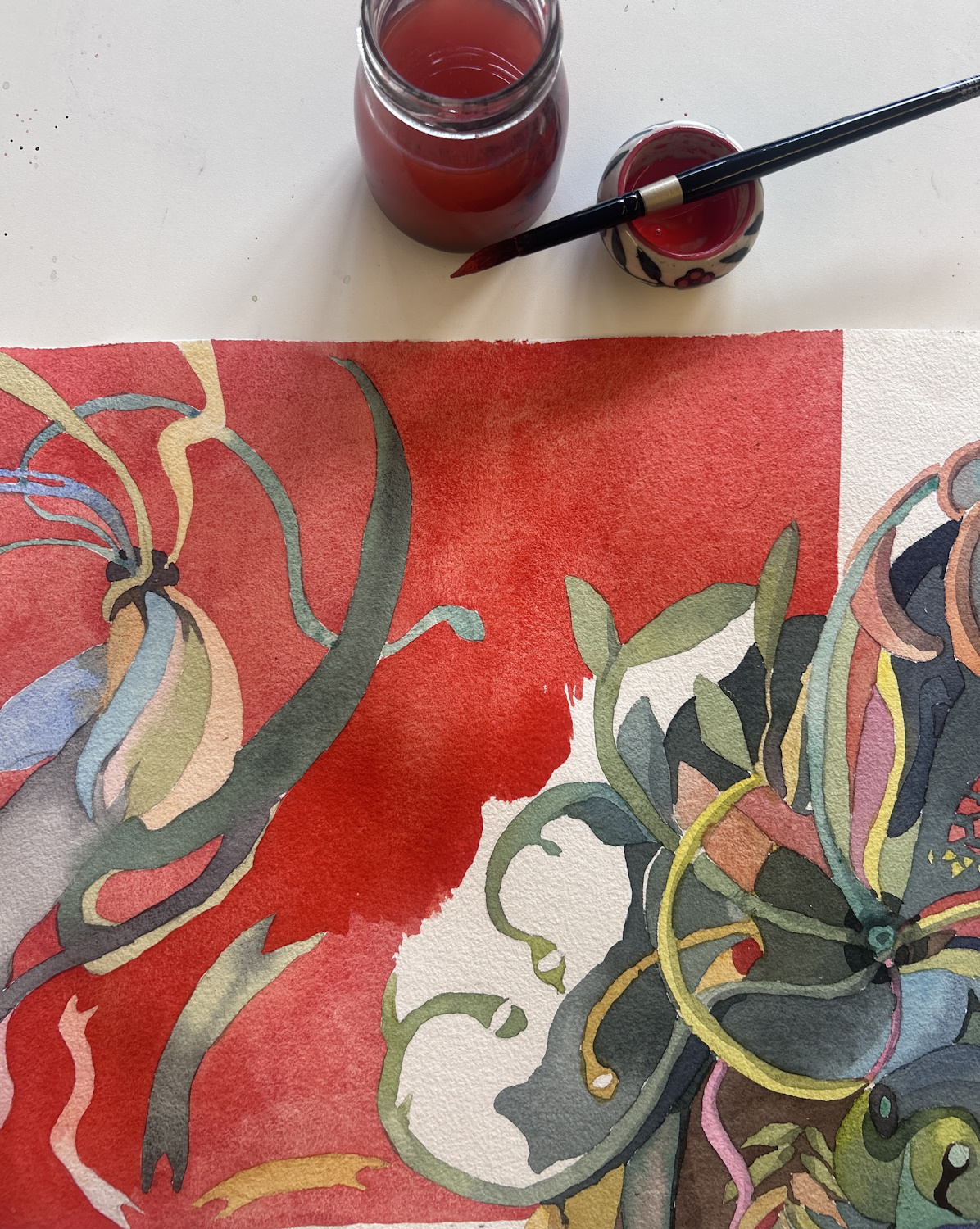
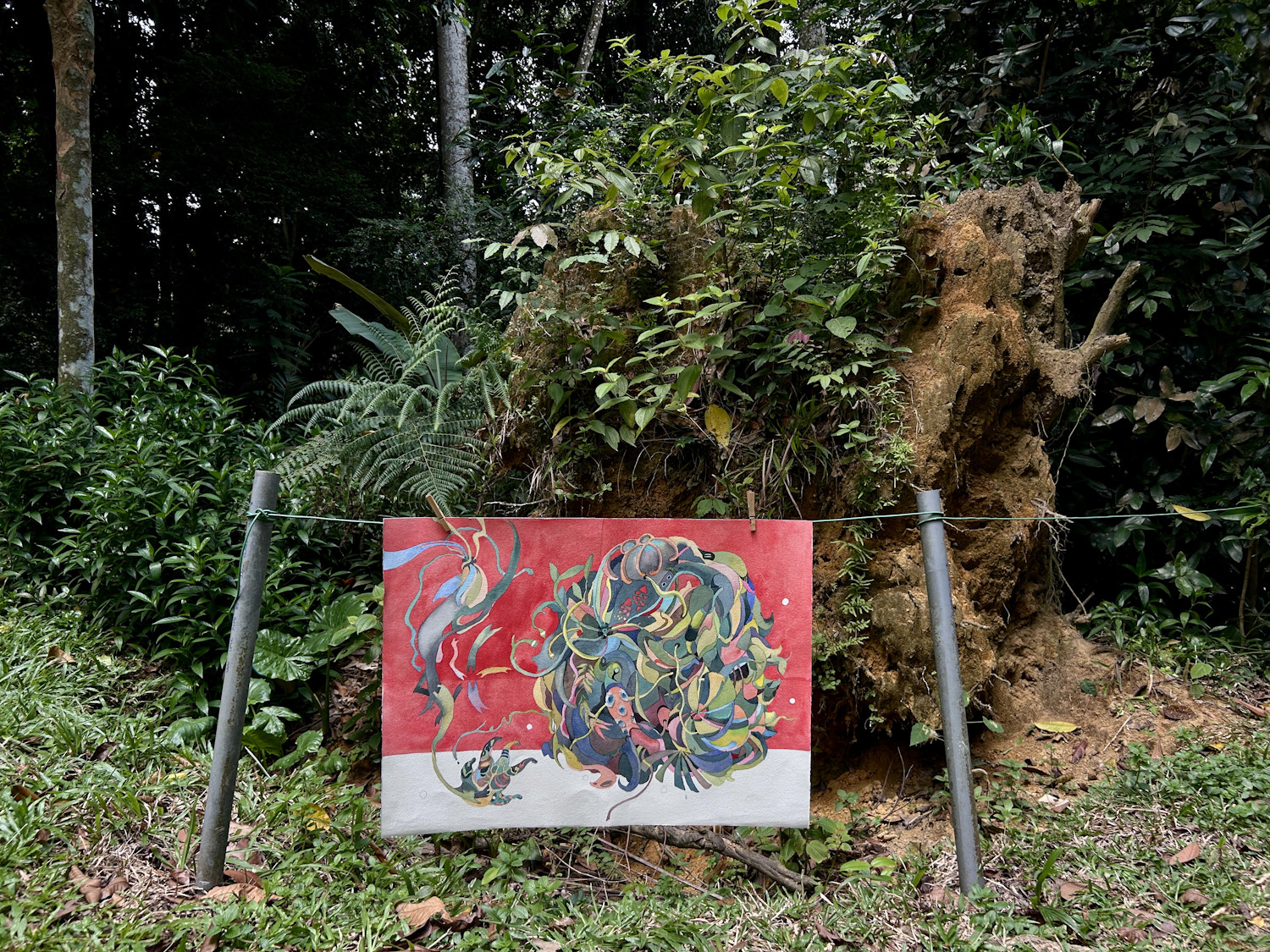
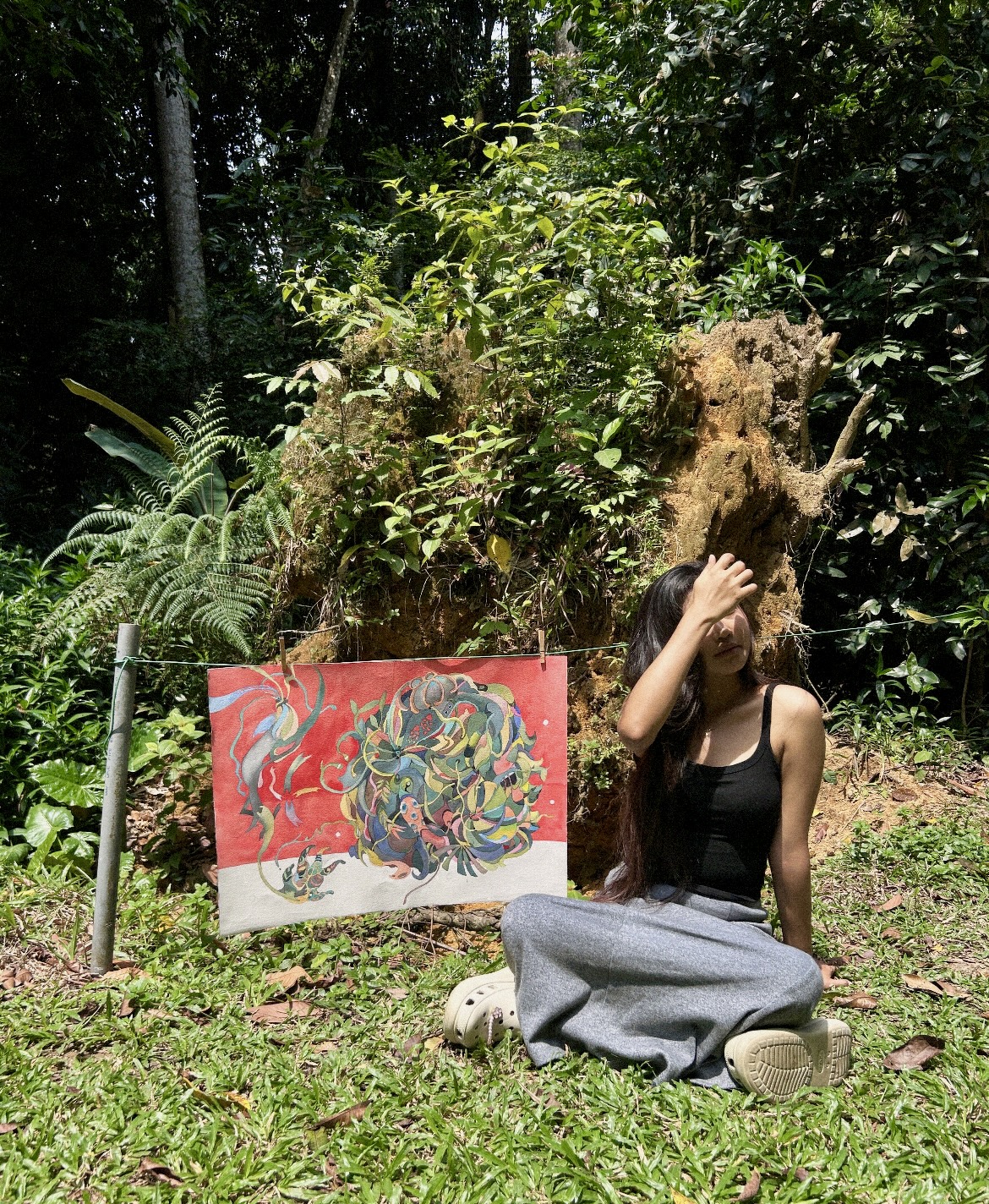
The objects embedded in the paintings are like illustrations that can be imagined by the viewer’s eyes, with faces, figures, and intestine-like forms appearing in random patterns. I try to draw intricate patterns by combining ambiguous shapes, different leaf shapes, creatures, and animal parts that I found in my surroundings.
Inspired by nature, leaf shapes, animals, and my daily observations in the garden, I began creating experimental watercolor paintings with intricate, floating forms. I want to build a living visual world that reflects my own inner experiences.
This personal project began with Bipolar creatures, an idea I had been developing since I was in Yangon. These creatures slowly changed and became connected with roots, plants, and natural forms. They grew into mysterious and unique beings. The title of this project is credited to my fellow resident artist, Brisa. While viewing my artworks, she mentioned that they evoked a sense of pareidolia, and I chose Pareidolia as the title of this project.
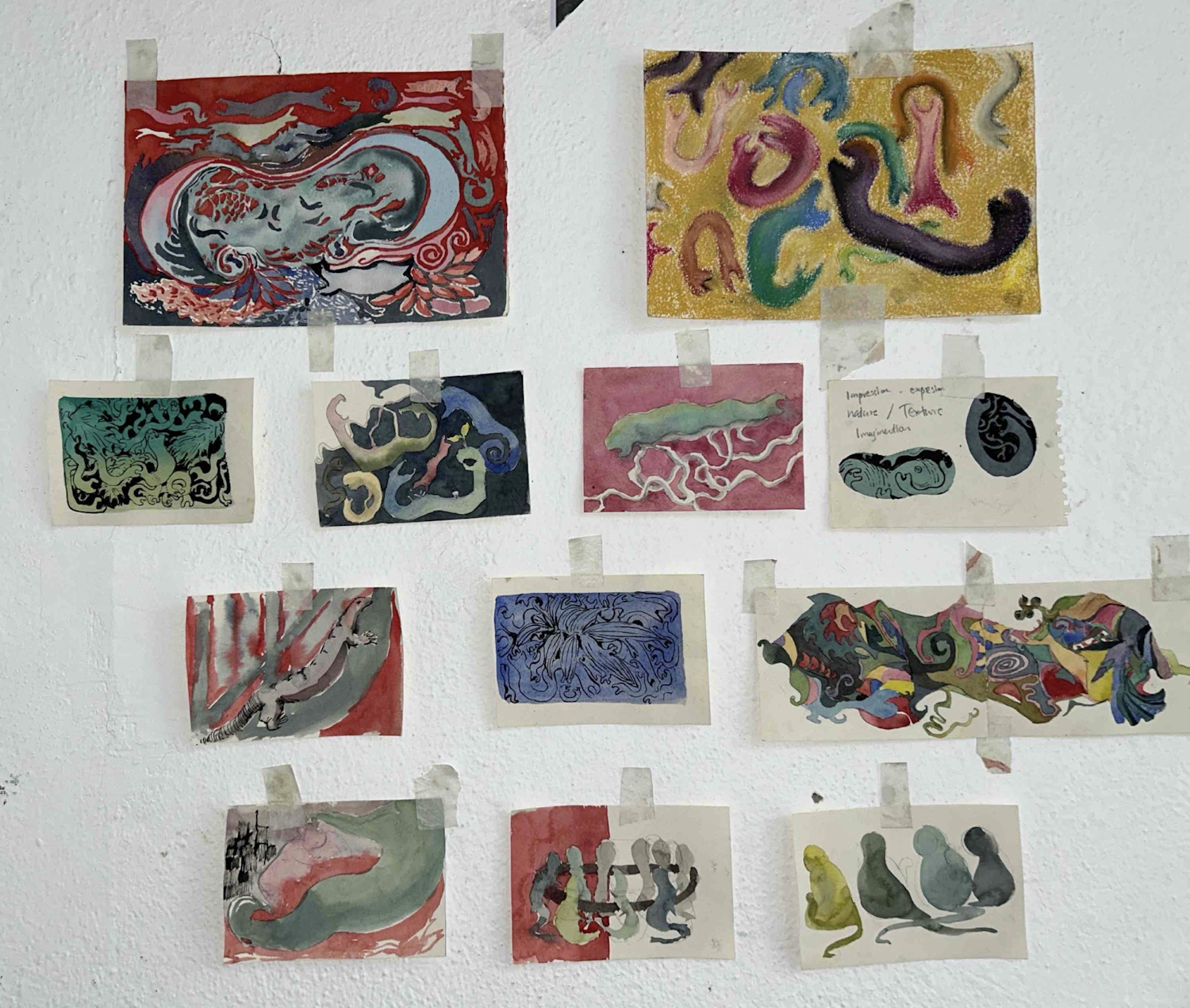
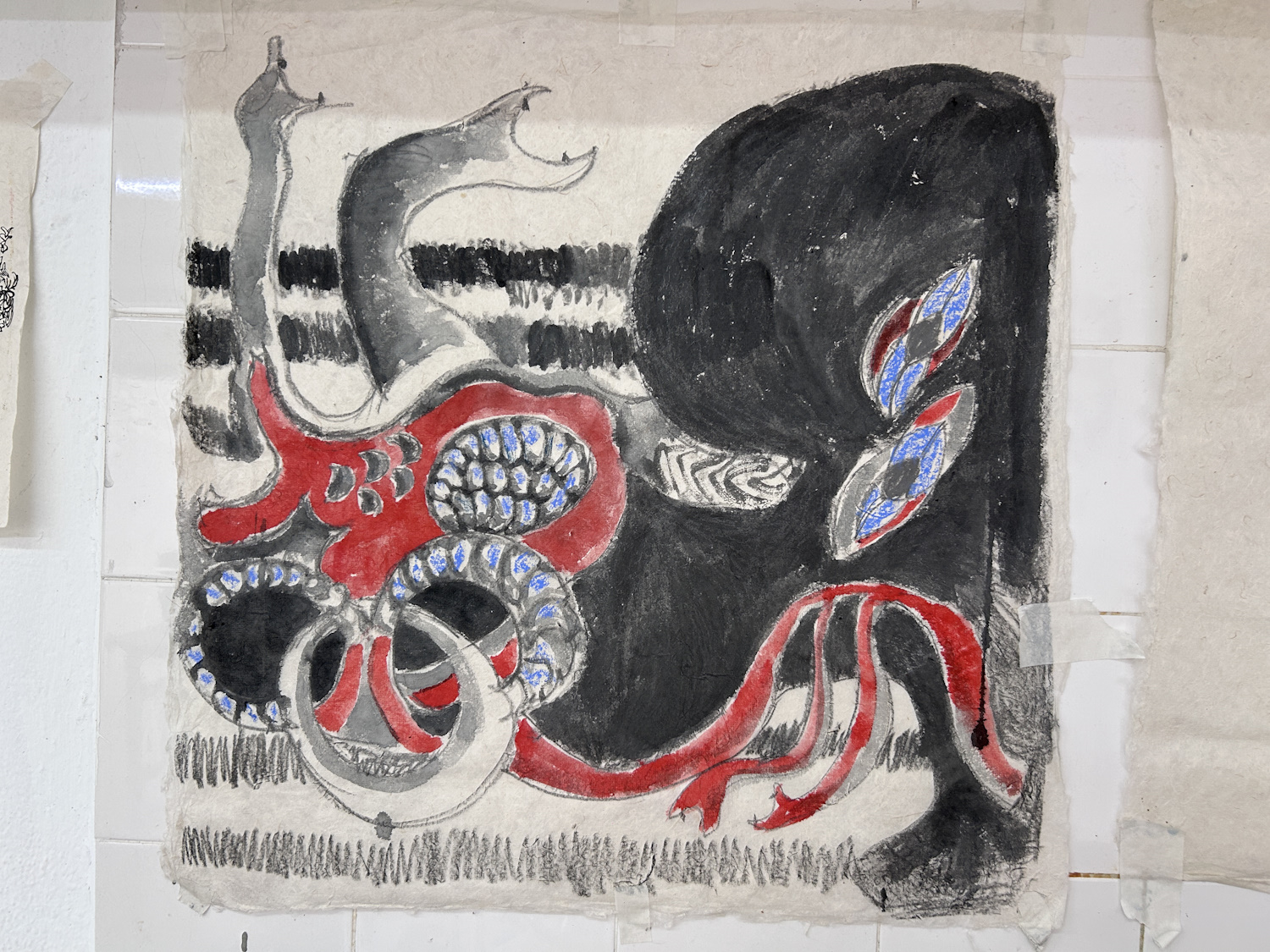
This residency encouraged me to face the negative thoughts and emotional struggles that I usually keep inside. For the Open Day, I will share my new experimental watercolor paintings, works in progress, ink sketches on Shan Sakku (Shan paper from Myanmar), and observational drawings created during the residency. This body of work will become the starting point for my first solo exhibition in Yangon, inspired by my time at Rimbun Dahan.
Visual artist Brisa Amir from the Philippines has been in residence at Rimbun Dahan for two months in 2026, working with the flora and handmade ink as her primary material to explore the displacement of nature in urban settings. She will be sharing the results of her residency on Open Day on Sunday 26 July.
About the Artist
Brisa Amir paints across layers and draws through texture, working from her studio and its peripheries. Her practice embraces unfinished spaces — cracks in walls, rainwater stains, and the imprints of everyday movement — creating tactile, collage-based paintings rooted in paper’s fragility and resistance. Her walks become acts of noticing and collecting, stitching urban traces into visual, botanical rhythms.
A BFA Painting graduate from the University of the Philippines, Diliman, she held her first solo exhibition at Artinformal in 2018, This was followed by a solo presentation at the inaugural S.E.A. Focus in Singapore in (2019), a feature in Artforum, and a cover feature in Vogue Philippines in (2023).
She received the Ateneo Art Awards Embassy of Italy Purchase Prize in 2021. Her work continues to be seen in local and regional exhibitions, including UP Vargas Museum and a cultural collaboration with the Embassy Of Spain through Instituto Cervantes.
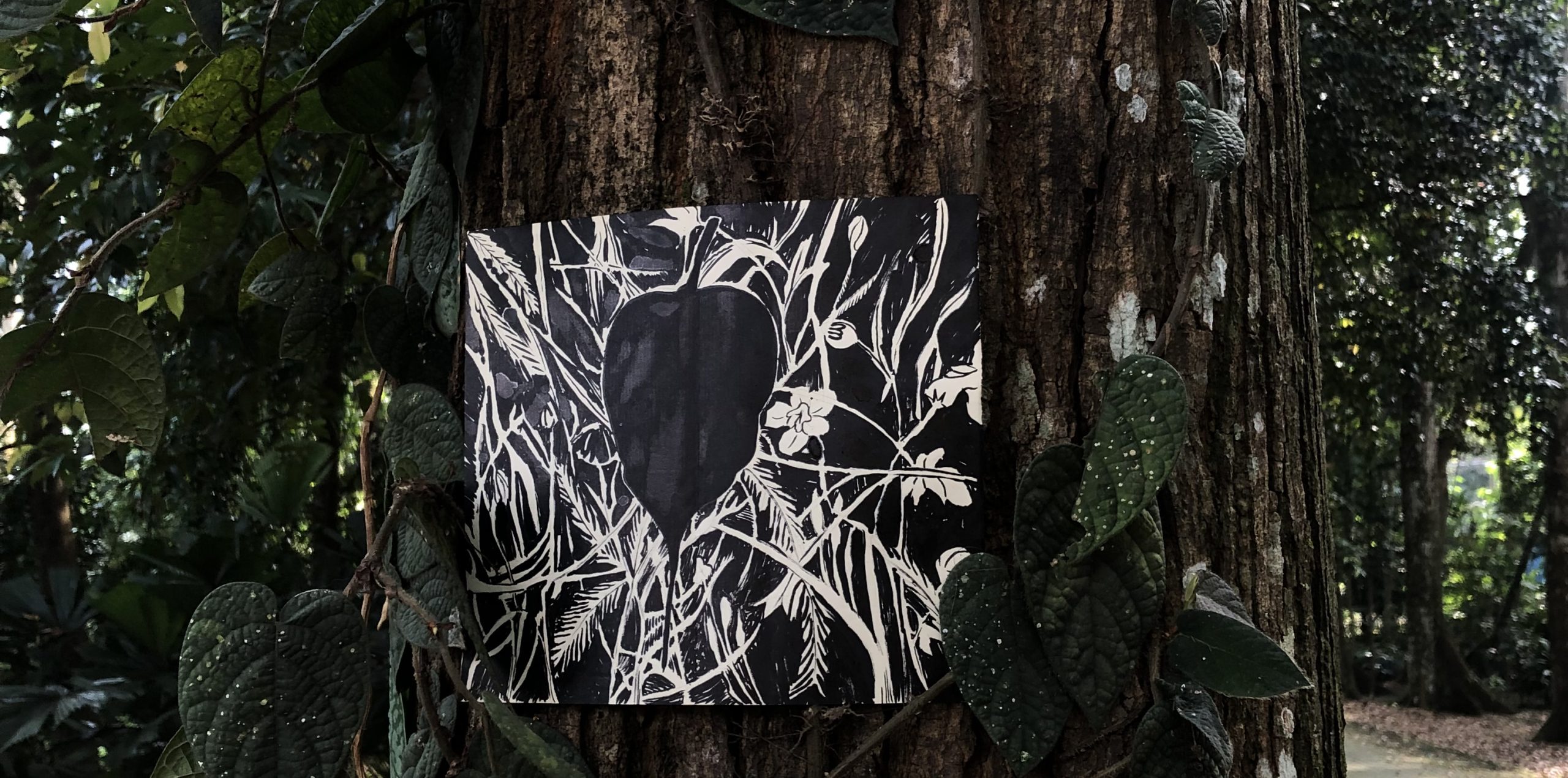
A leaf represents my first connection with nature. The sprouting of a leaf holds deep meaning for me as a human being who grew up on ancestral land that has been paved over with concrete. I grew up seeing corners of gray walls and a mere square of blue sky, reached only by plants thriving amidst the concrete-layered, congested informal houses as they stretched toward the sunlight. The plants I have observed cresting among the urban grid and on gated, abandoned lands mirror my relationship with –and understanding of– the messages of ancestors living on disputed territories. These ancestors fought and continue to fight back, reclaiming and protecting Mother Nature.
II. Organically Unfolding ੈ
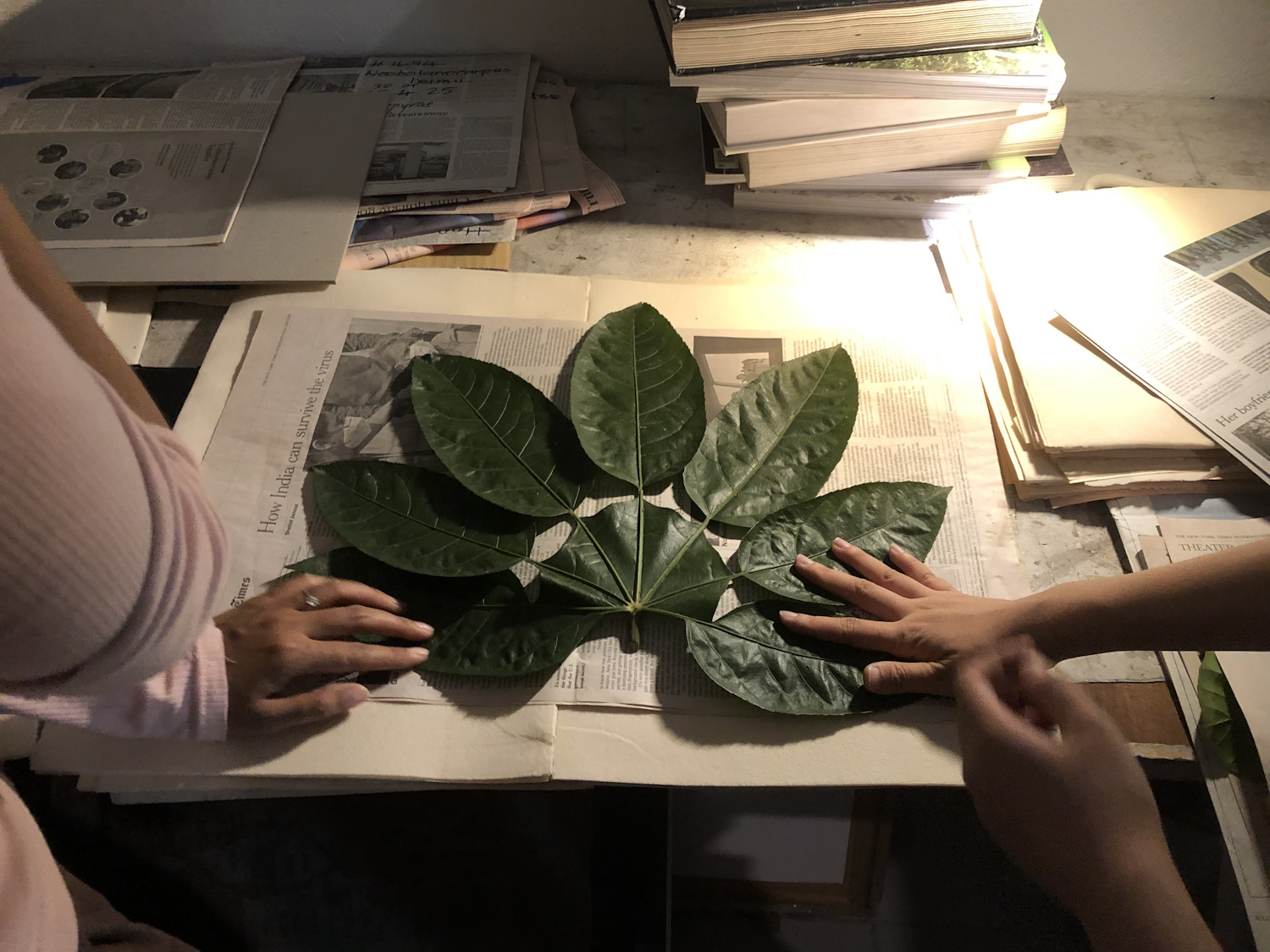
Like a seed constantly in motion, flying through the air, hitching a ride on birds, and waiting to burst open to scatter itself 𓇢𓆸 — I spent the first month of my artist residency gallivanting through the forest and swimming. I expanded my introspection by browsing the library and examining the inventory of pressed leaves, observing the diverse flora turning empty ground into life, identifying themselves as either native or invasive. I traced some leaves, preserved them through the guidance of Rimbun Dahan’s intern Kah Wei, and adopted them as my primary material.
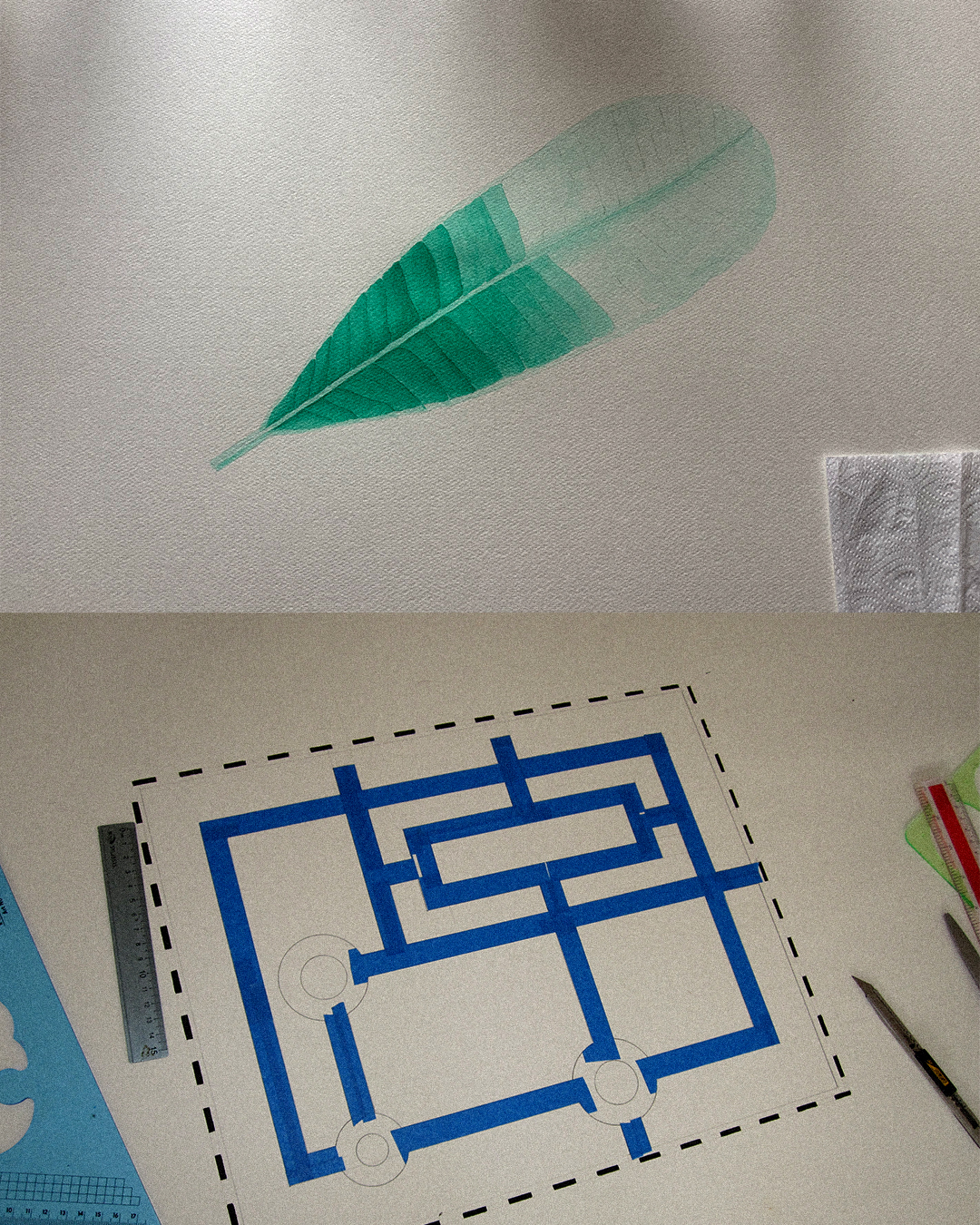
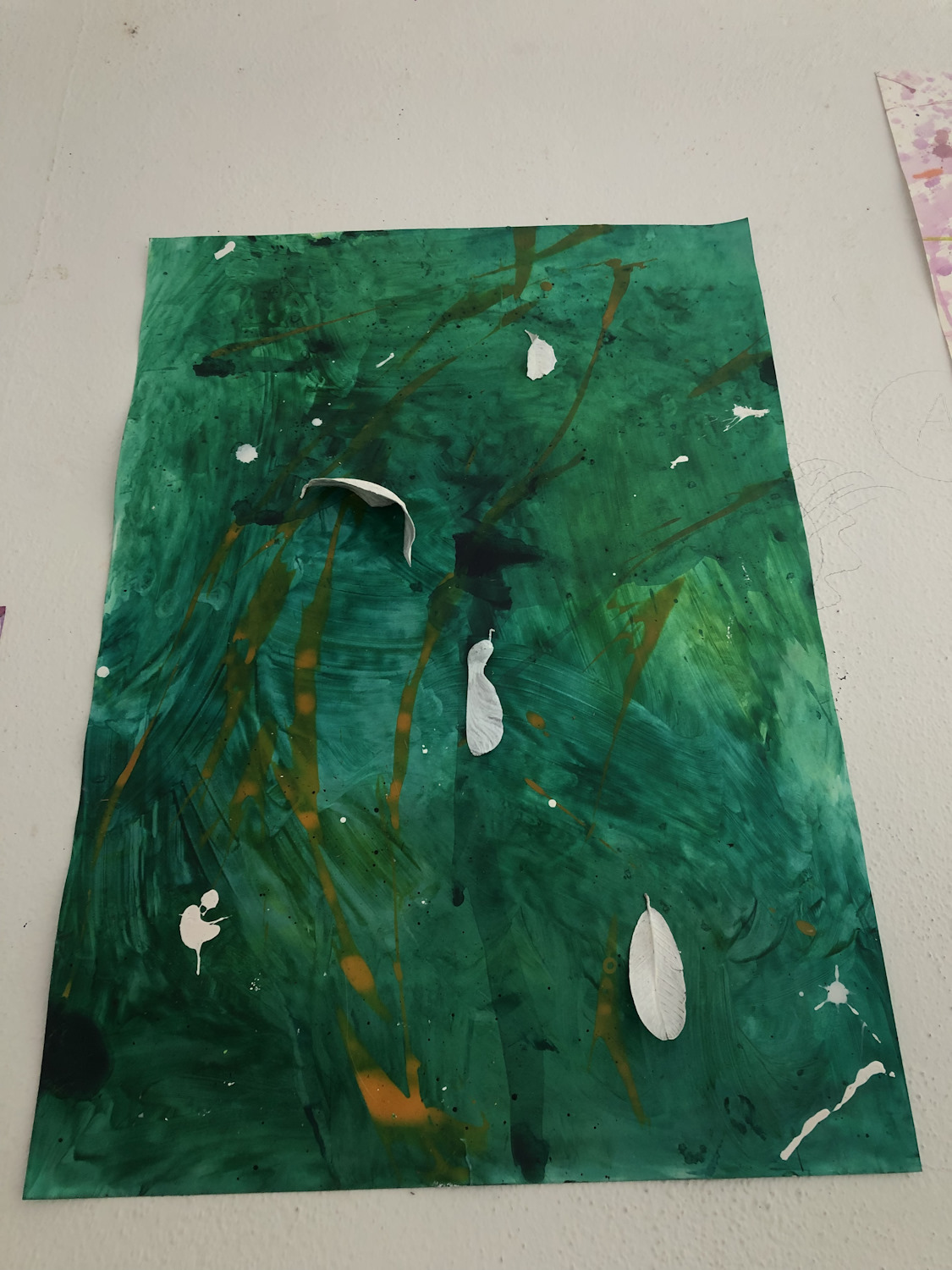
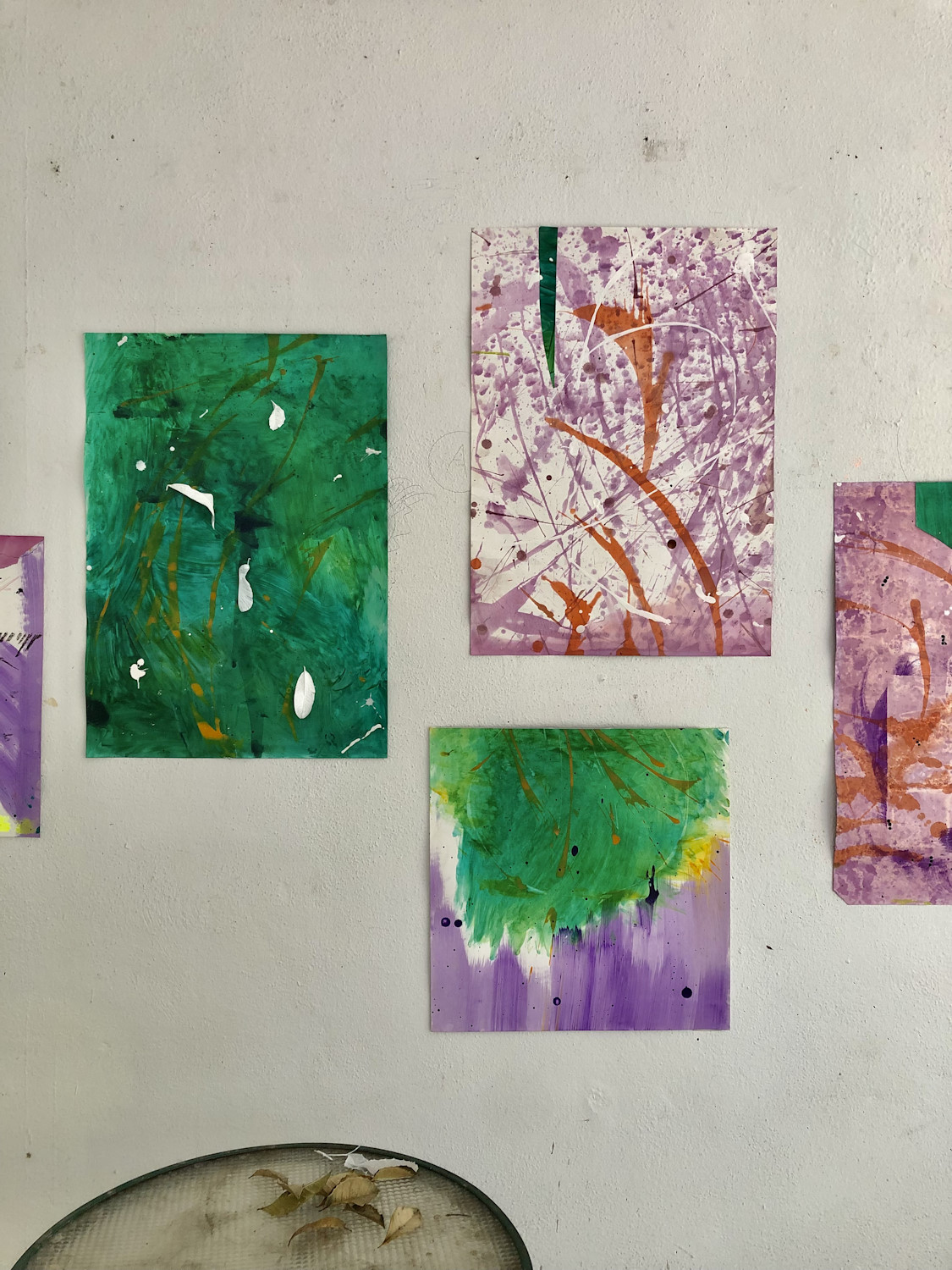
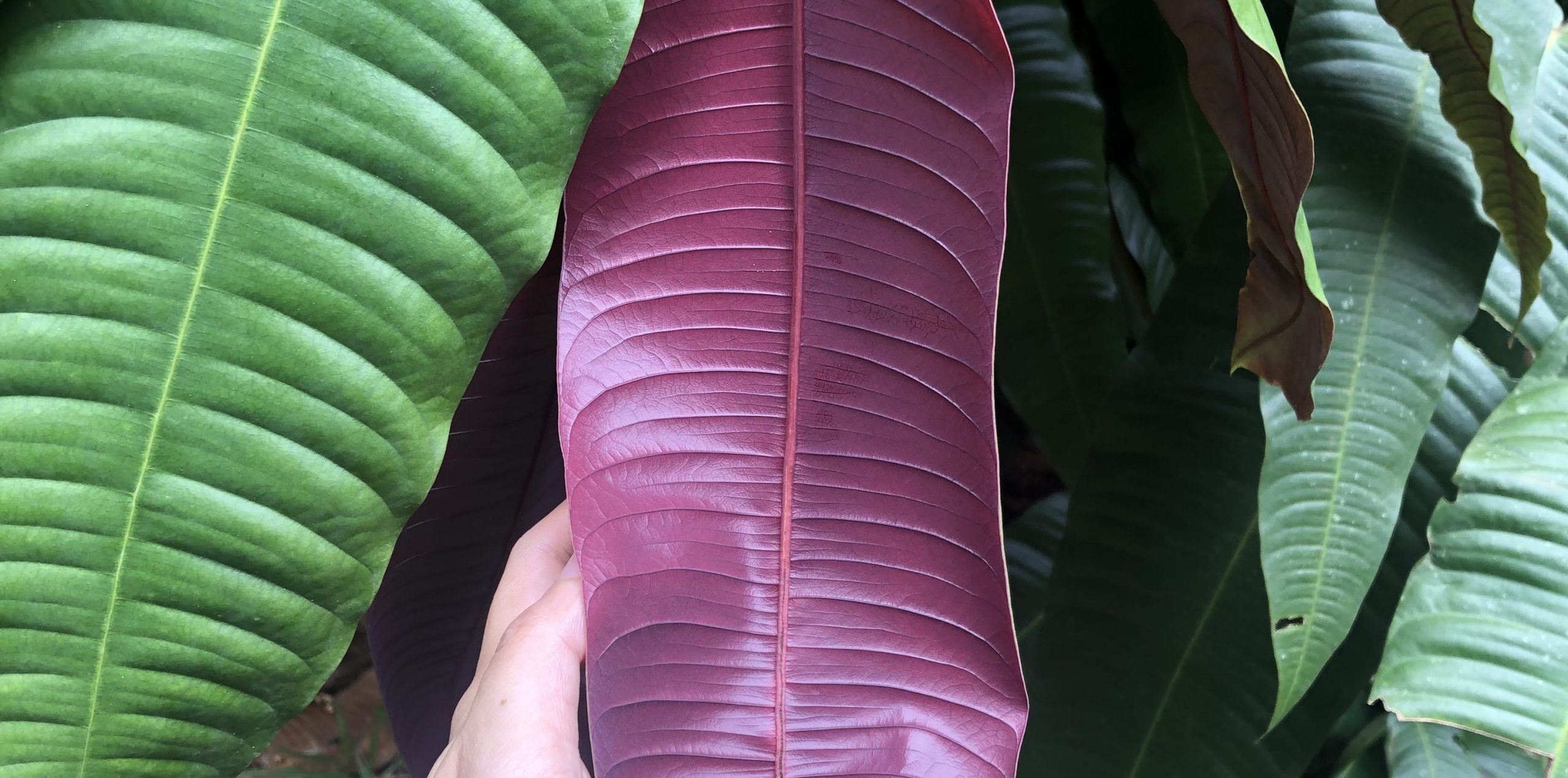
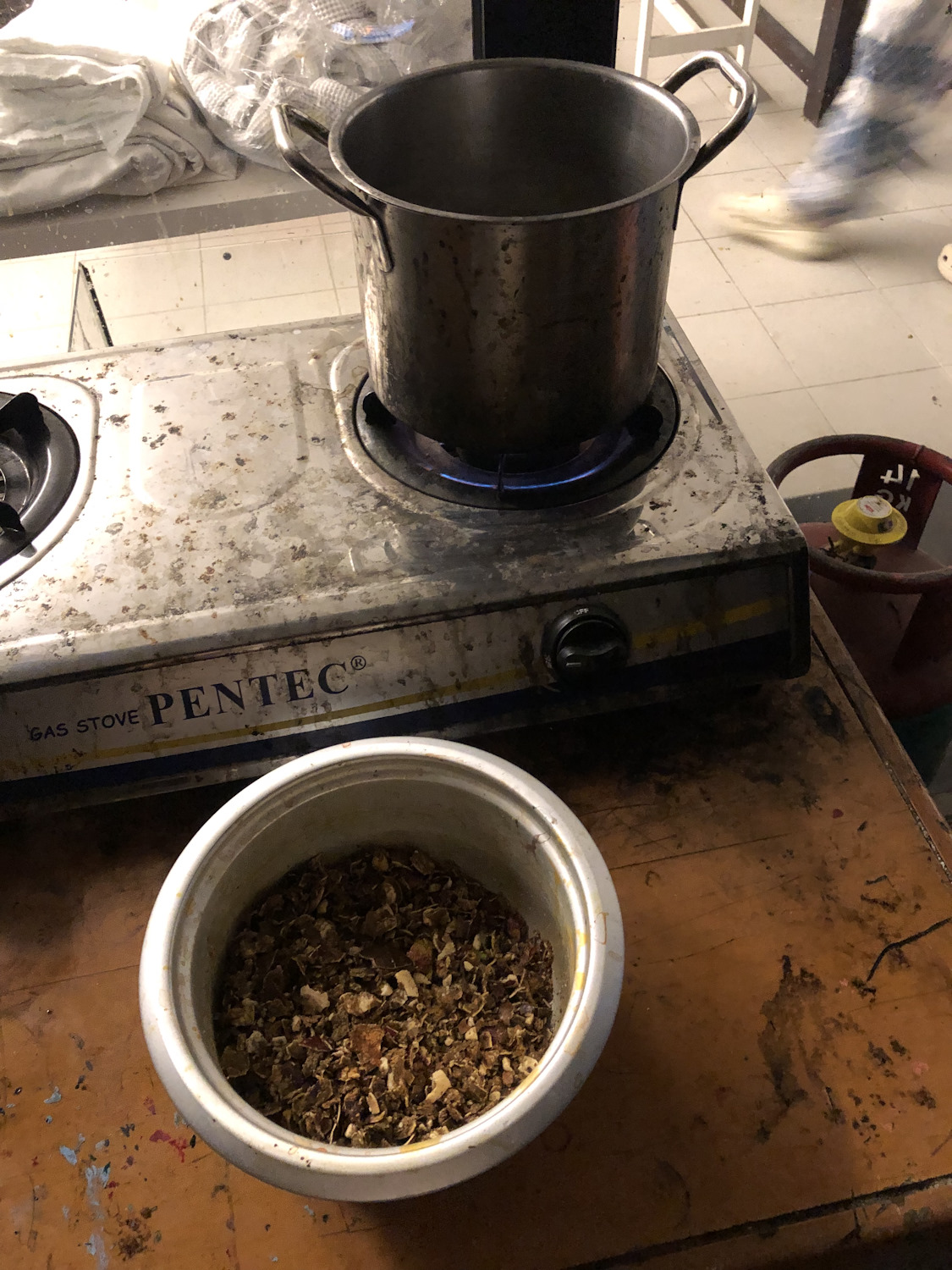
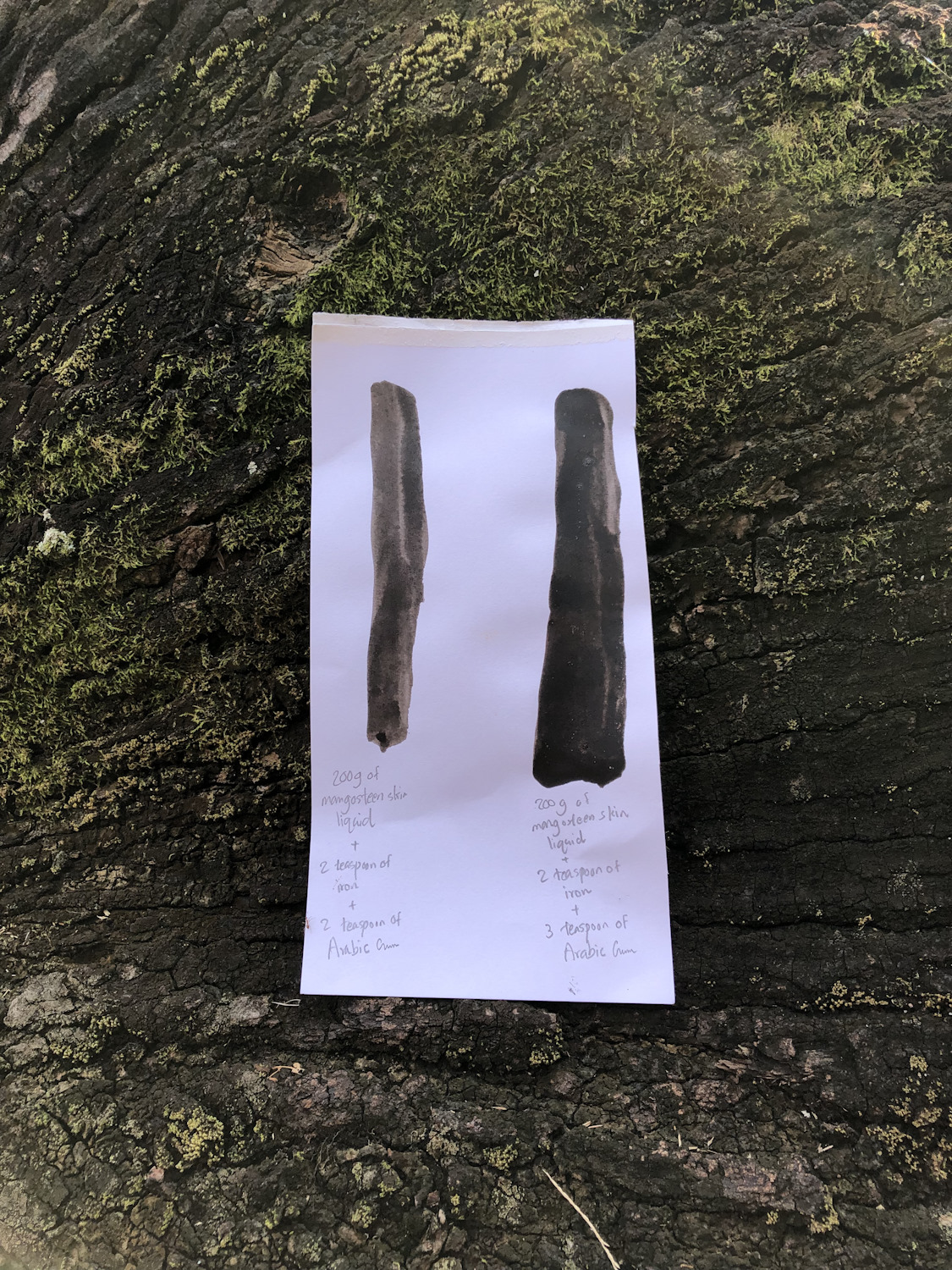
A leaf that fascinated me among the other leaves that I encountered possesses two distinct colors: shades of green on the front and a deep magenta on the back. I used the dual characteristics of this leaf as a visual guide to build my paintings into collages. Through this process, I explore the concepts close to my heart, such as the displacement of urban birds whenever decades-old trees are cut down to gentrify the land. In the second month of my residency, I collaborated with Haya Ibrahim of Waste to Weft to create my own ink using bamboo charcoal and mangosteen combined with store-bought ink, translating these environmental friction points into illustrations.
At the open day, I plan to present all these bundles of thoughts into installation pieces, with the hope of creating an interactive experience using the handmade ink.
On Sunday 26 July 2026, our current resident artists will be sharing the results of their residencies with the public.
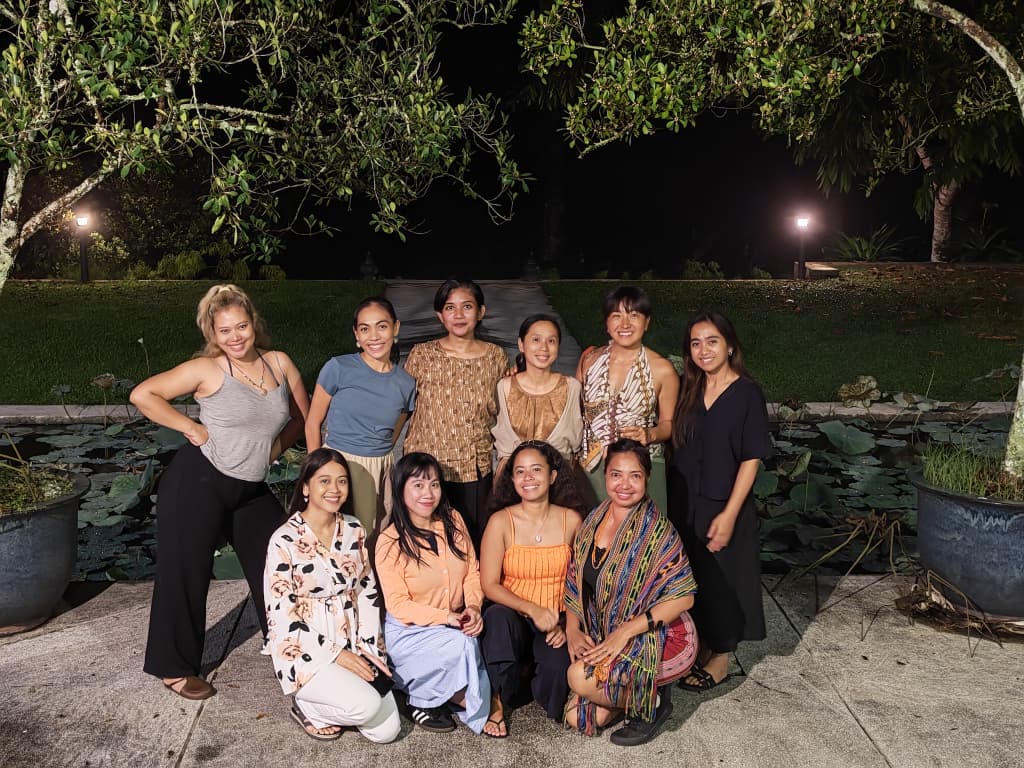
Visual artists Brisa Amir (Philippines) and Khin May Moe (Myanmar), with recent resident artist Anas Afandi (Malaysia), will present their works in open studios. You can also meet current resident writer Raka Ibrahim (Indonesia).
Waste to Weft, a project by No Time to Waste and supported by Yayasan Hasanah, will present a documentary film about textile waste in Indonesia, alongside their weaving works in progress.
The Underground Gallery at Rimbun Dahan will be open, showing a selection of works from our Permanent Collection, and you can also explore our heritage houses.
Entry is free, no registration required.
Please bring your own picnic!
Schedule
9am-11am Garden Tour. [Garden tour signup is FULL! Please drop-in for other Open Day activities, no registration required.] 11am-2pm Open Studios [Menolak Punah documentary screening 11am-12pm] 2pm-3pm Lunch break — please enjoy your BYO picnic in the gardens! 3pm-6pm Open Studios [Menolak Punah documentary screening 3pm-4pm]
Travelling Directions
Address: Rimbun Dahan, Km. 27 Jalan Kuang, Mukim Kuang, Selangor, 48050.
Landmarks: Our front gate is opposite Warung Selera Ria and also next to the start of Lorong Belimbing. Do not enter Lorong Belimbing, please enter the front gate from the main road.
Tips for Visitors
We have parking inside the compound, along the driveway. Just drive in the front gate and park as indicated along the drive.
Bring your own mosquito repellent!
We are sorry, Rimbun Dahan is not a fully wheelchair accessible venue. Wheelchair access is possible to the artists studios and some of the outdoor areas, but not to the underground gallery or the heritage houses.
Wear practical shoes if you are planning to walk around the garden.
Bring an umbrella in case of rain.
No refreshments or water provided. Feel free to bring your own picnic, and enjoy it in the gardens; please clean up all your trash.
No pets, no swimming — thank you for your cooperation.
If you have any questions, please email arts@rimbundahan.org or WhatsApp Bilqis at +6017-3103769.
About the Artists
Malaysian visual artist Anas Afandi has used his 2-month residency at Rimbun Dahan in 2026 as a period of research and experimentation, cultivating a daily practice of collecting fallen kemboja flowers and conducting fieldwork in the Taman Sari, while experimenting with collecting and documentation methods from botanical and archaeological practices. Anas works across drawing, painting, sculpture, and installation. His practice examines the relationship between the natural world, history, and cultural identity, and he is interested in the garden at Rimbun Dahan as a model for thinking about culture. Read more about Anas and his residency…
Visual artist Brisa Amir from the Philippines has been in residence at Rimbun Dahan for two months in 2026, working with the garden’s flora and handmade ink as her primary material to explore the displacement of nature in urban settings. A BFA Painting graduate from the University of the Philippines, Diliman, Brisa held her first solo exhibition at Artinformal in 2018, followed by a solo presentation at S.E.A. Focus in Singapore (2019), a feature in Artforum, and a cover feature in Vogue Philippines (2023). She received the Ateneo Art Awards Embassy of Italy Purchase Prize in 2021. Her work features tactile, collage-based paintings rooted in paper’s fragility and resistance. Read more about Brisa and her residency…
Khin May Moe, a visual artist from Yangon, Myanmar, has been in residence at Rimbun Dahan for two months in 2026. Her work with watercolour and ink has expanded from urban sketching to plumbing the depths of her insomnia, expressed through mysterious creature-like forms. May graduated with a Bachelor’s degree in German from Mandalay University of Foreign Languages (MUFL) and worked as a German-speaking tour guide from 2018 to 2020. Having loved drawing since childhood, she graduated with a Diploma in Painting from the National University of Arts and Culture, Yangon (NUAC). In 2024, she spent six months as a resident artist in Saint-Nazaire, France, through the EMPM programme. Read more about May and her residency…
The project Waste to Weft 3.0 is wrapping up their five-month residency at Rimbun Dahan with a showcase of their works at Open Day. Visitors will have a chance to take a look at several handwoven works that were completed for the Waste to Weft program. Learn how the program’s participating artists from across Southeast Asia incorporated textile waste and natural dyes as material, alongside weaving and ikat techniques within their practice. Waste to Weft is also presenting two screenings of Menolak Punah, a compelling documentary by filmmakers Dandhy Laksono and Aji Yahuti which exposes the dark side of the fast fashion industry and its devastating environmental toll, while highlighting the inspiring movement to revive Indonesia’s sustainable textile heritage. Waste to Weft is a project by No Time To Waste, and is supported by Yayasan Hasanah.
About Rimbun Dahan
Rimbun Dahan is the home of Malaysian architect Hijjas Kasturi and his wife Angela. Set on fourteen acres outside Kuala Lumpur, Malaysia, the compound of Rimbun Dahan is a centre for developing traditional and contemporary art forms. It features buildings designed by Hijjas Kasturi, as well as two early 20th century traditional Malay houses from Perak and Penang, in an indigenous Southeast Asian garden environment which has been awarded arboretum status. Rimbun Dahan is private property, and is only open to the public on Open Days.
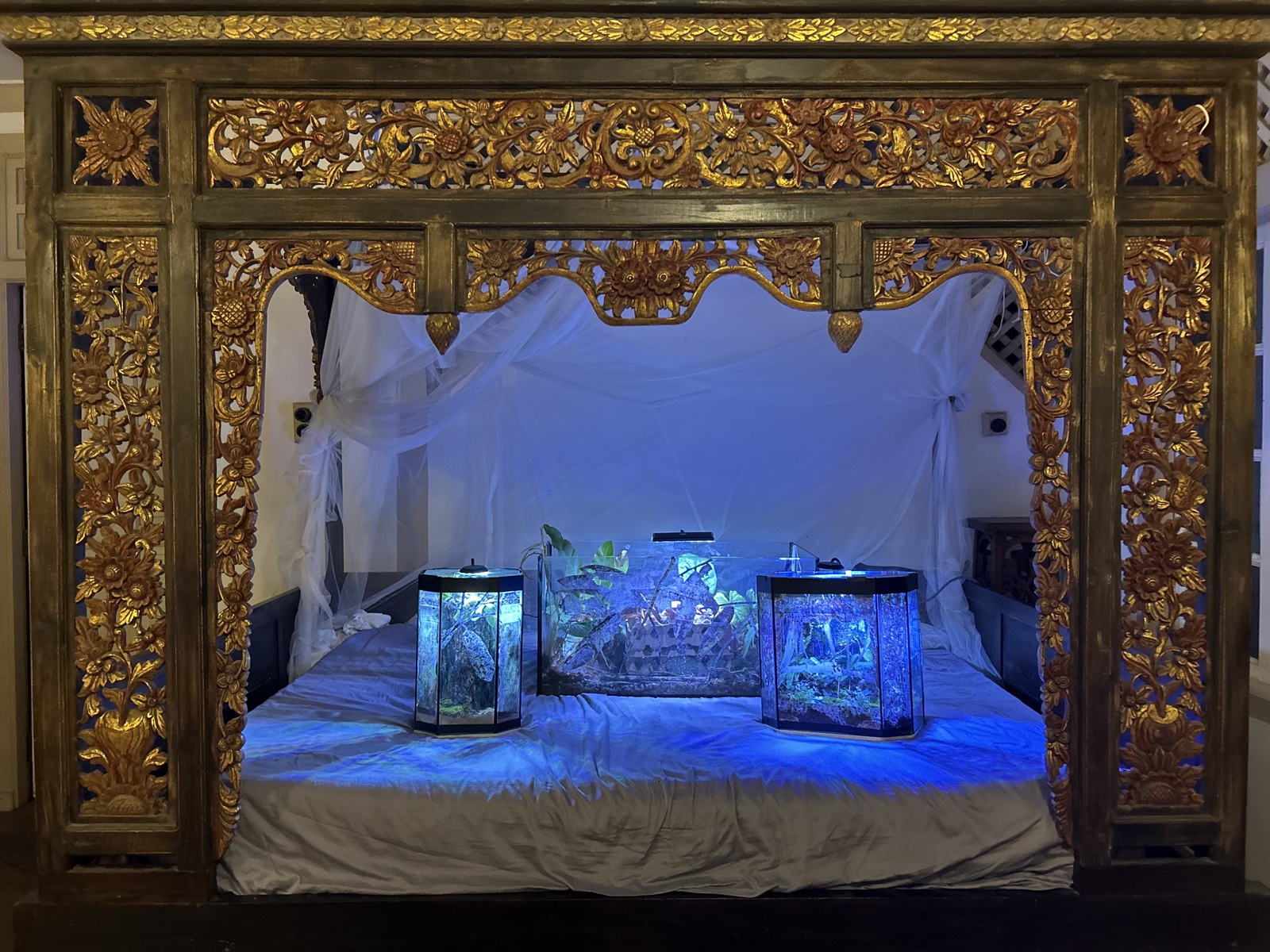
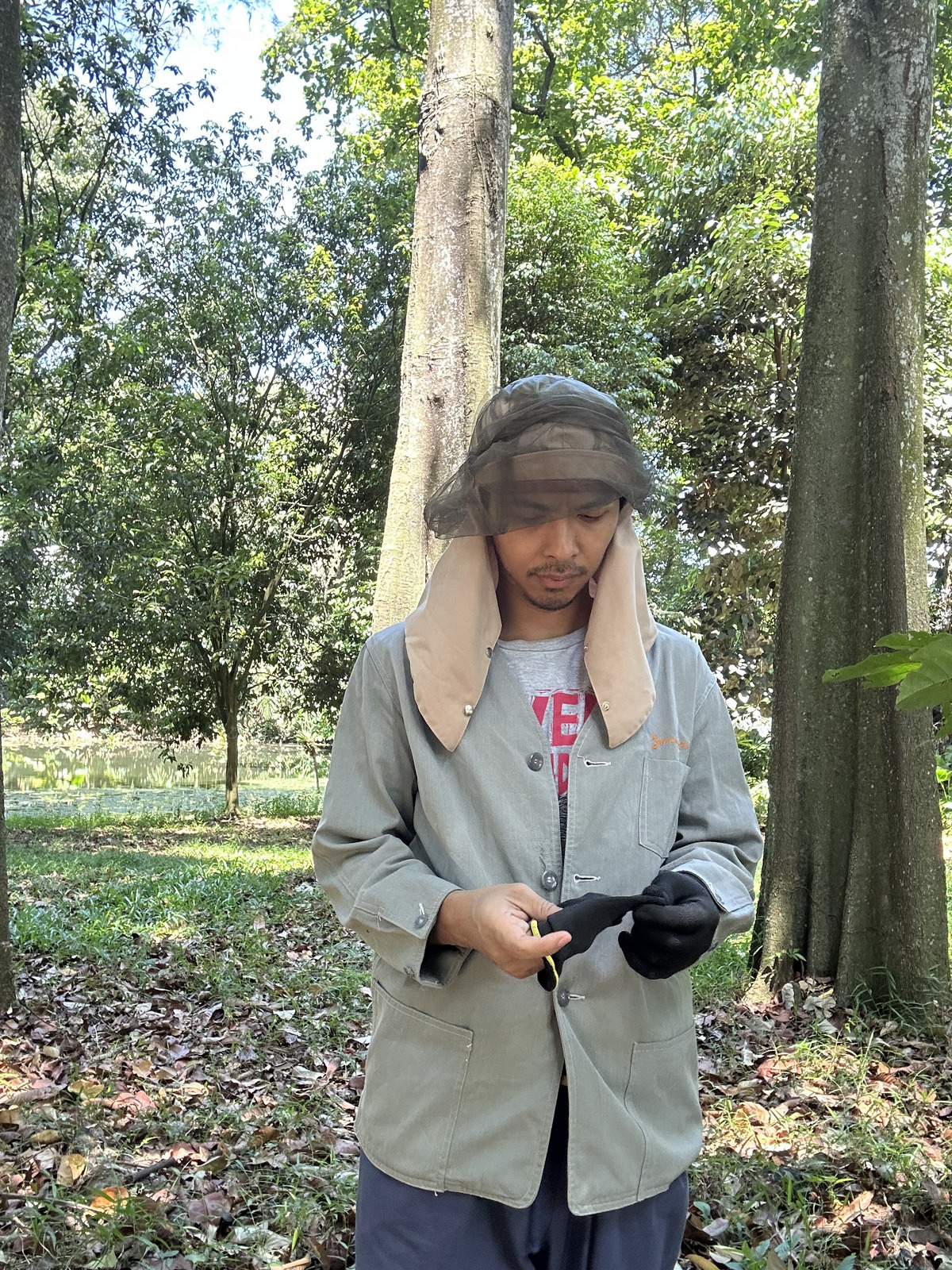
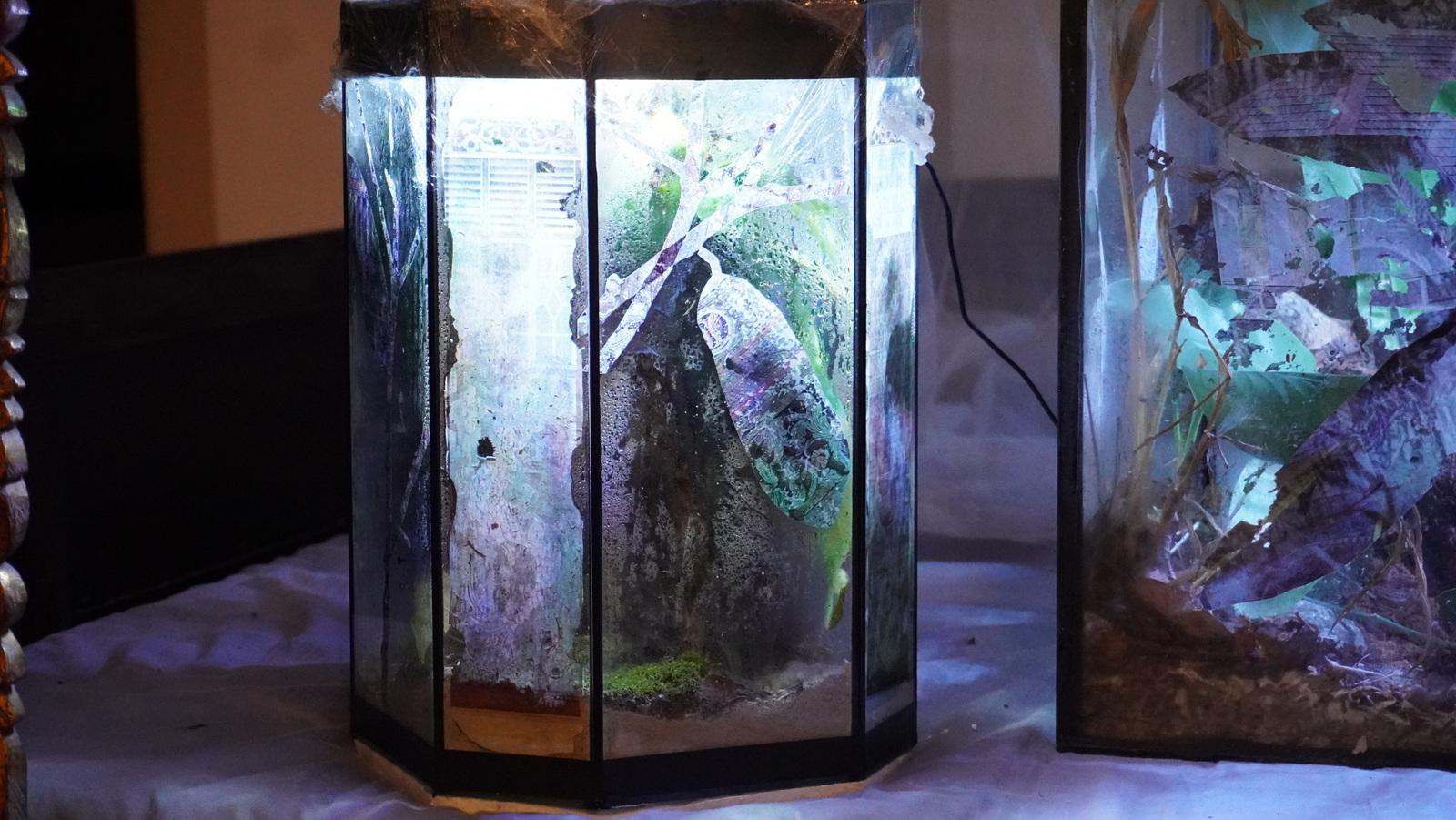
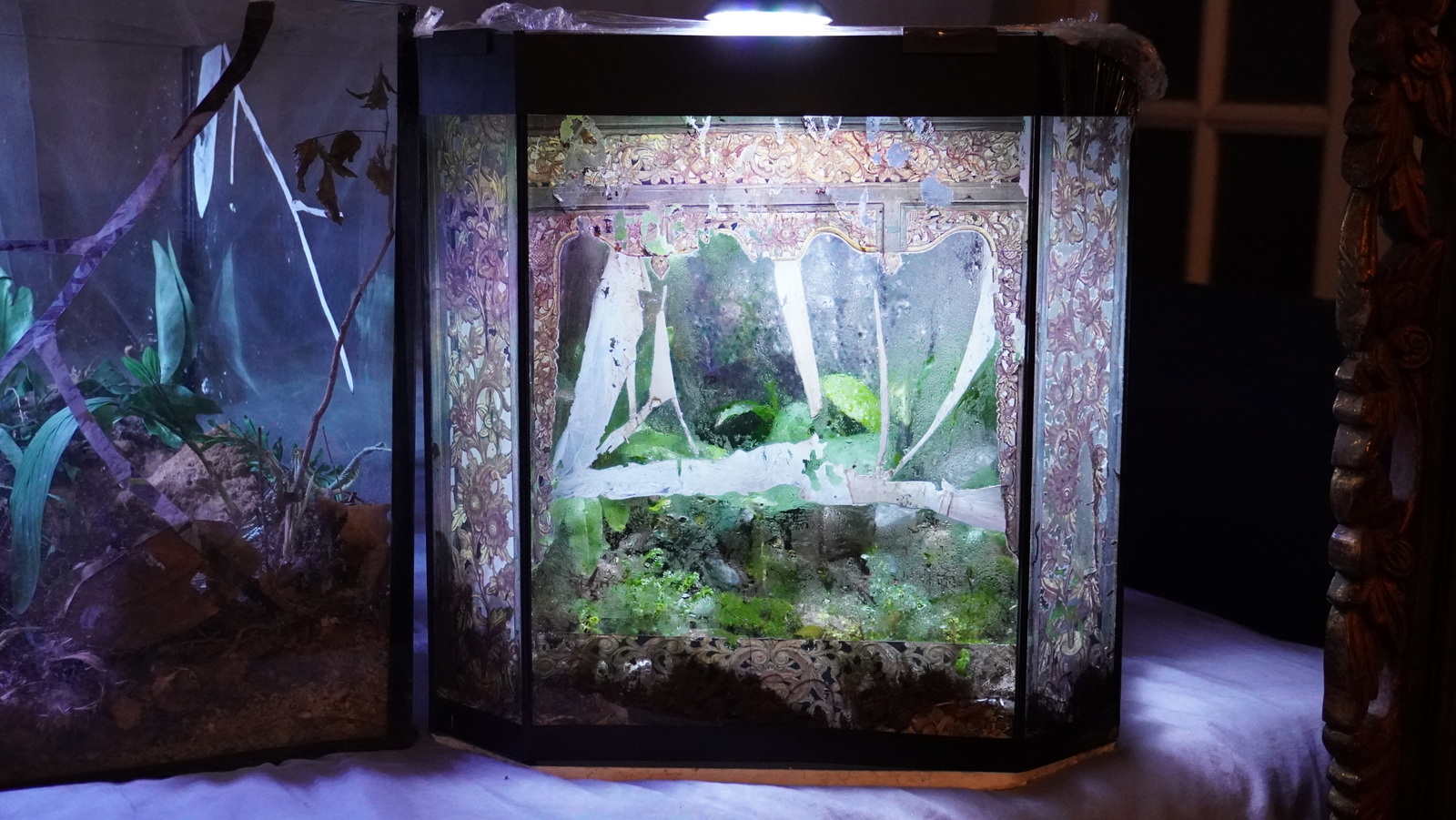
Interdisciplinary artist Anusorn Tunyapalit, from Chiang Mai, Thailand, presented a trio of terrariums at the KL Festival in May 2026, as the outcome of his 2-month residency at Rimbun Dahan.
About the Artist
Anusorn Tunyapalit (born in Phrae, 1992; lives and works in Chiang Mai) is an interdisciplinary artist who works across various media, primarily installations art. His practice aims to stimulate or create new sensory experiences by translating, transforming, and manipulating information across different mediums. He also employs intense research into history, culture, and society to distill large-scale narratives into detailed and complex objects or processes, rich with layers of thought for exploration.
His interests span environmental ecology and politics, ethnology, beliefs, local wisdom, and contemporary crises, and the study of ethnographic knowledges linked to reflection and critique of power structures, analyzing their impact and presenting them through art forms. He was selected for the Brandnew Art Project in 2017, Guandu International Nature Art Festival in Taipei, Taiwan, in 2019 & 2024, GMS Artist Residency 2024, and co-founded Pootorn Connect, a decentralized art operation network, in 2022. In the same year, he was chosen to present the exhibition ‘Point of No Concern: return to the rhizoic state’ at MAlIAM Pavilion for the Thailand Biennale, Chiang Rai 2023. Most recently, he has expanded his curatorial concepts and established the Rhizomia Art Network.
Anusorn presented the outcomes from his residency at the Tiffin Picnic on 23 May 2026, part of KL Festival 2026, coordinated by Greenpeace Malaysia.
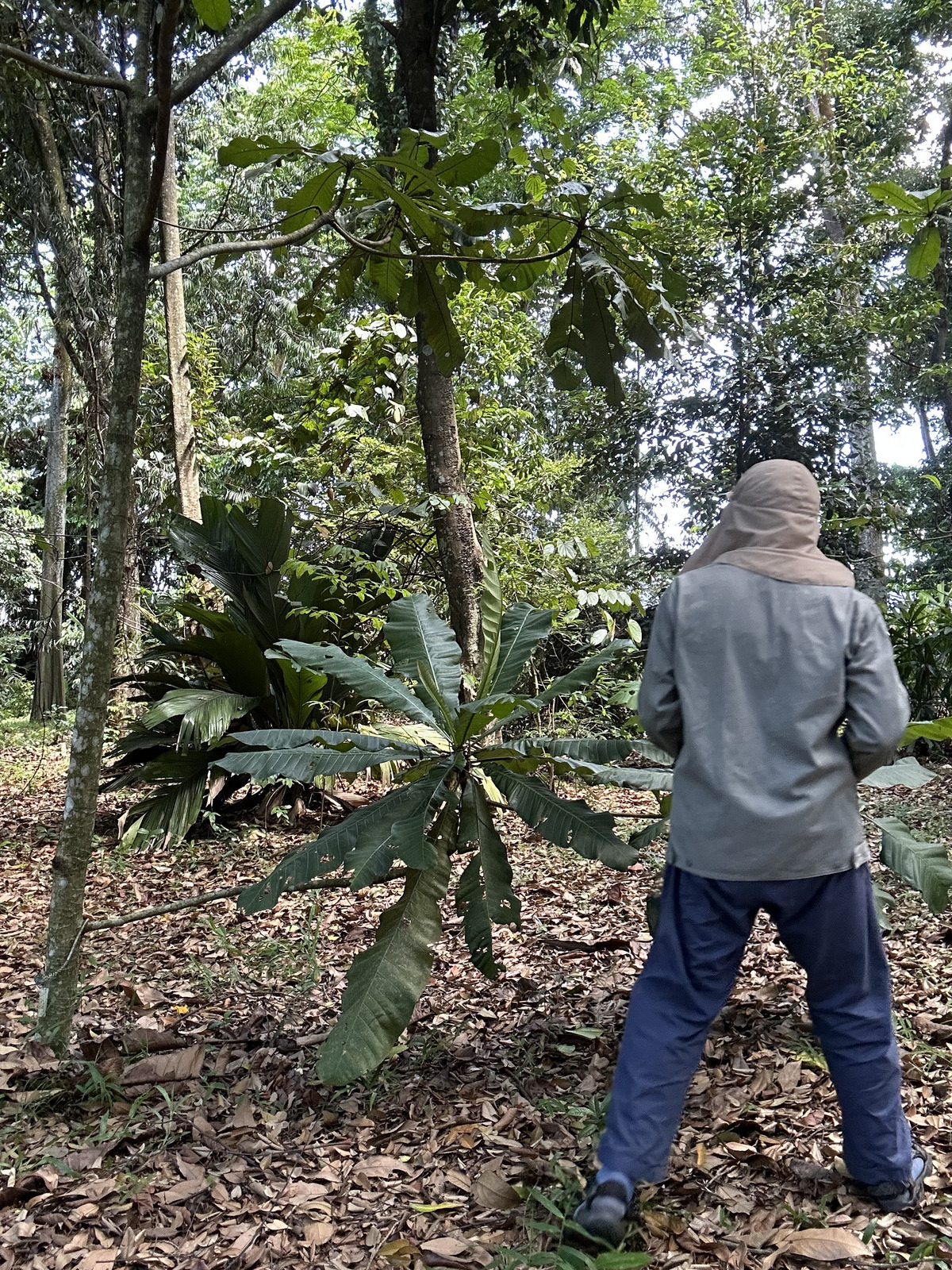
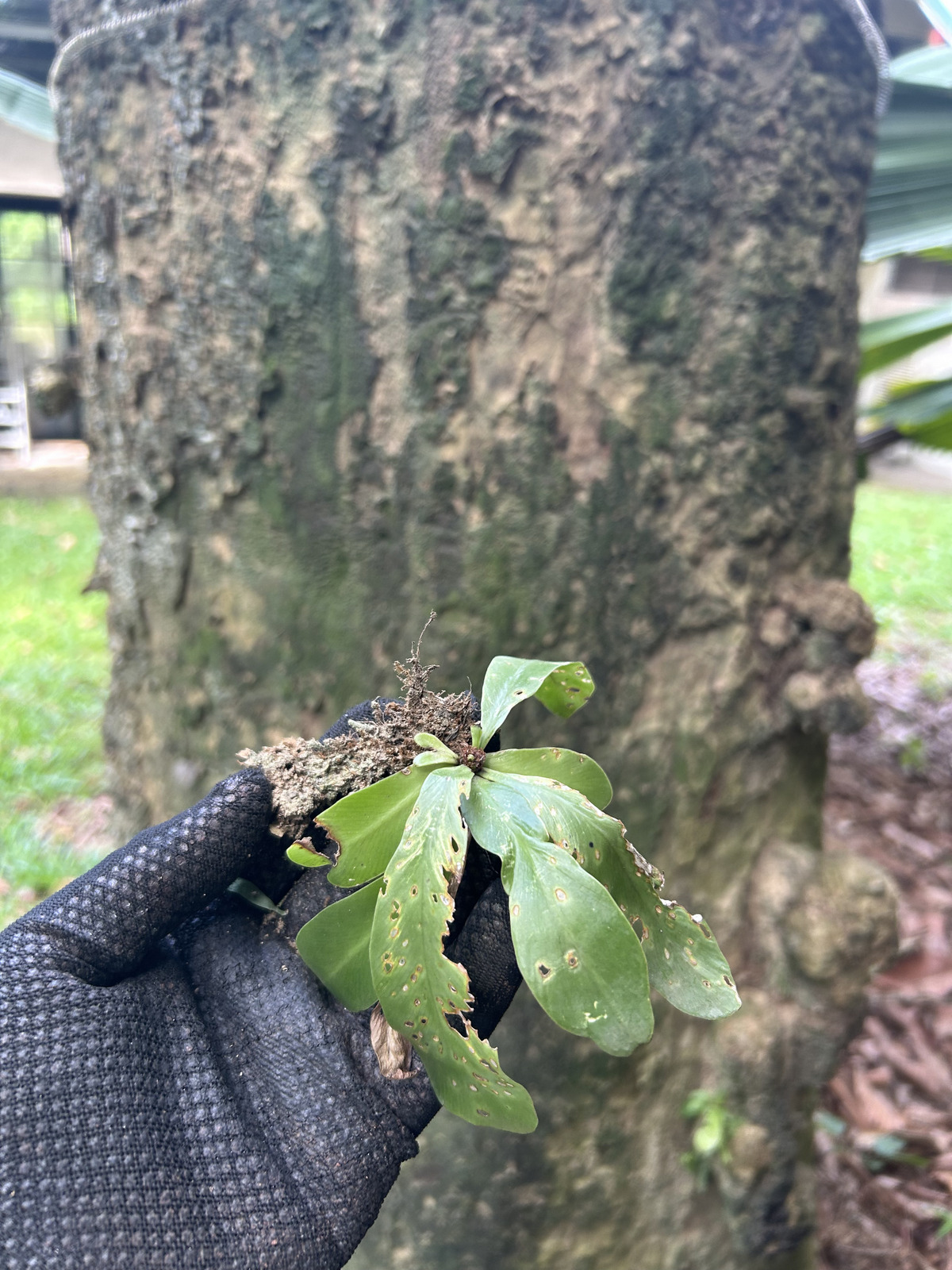
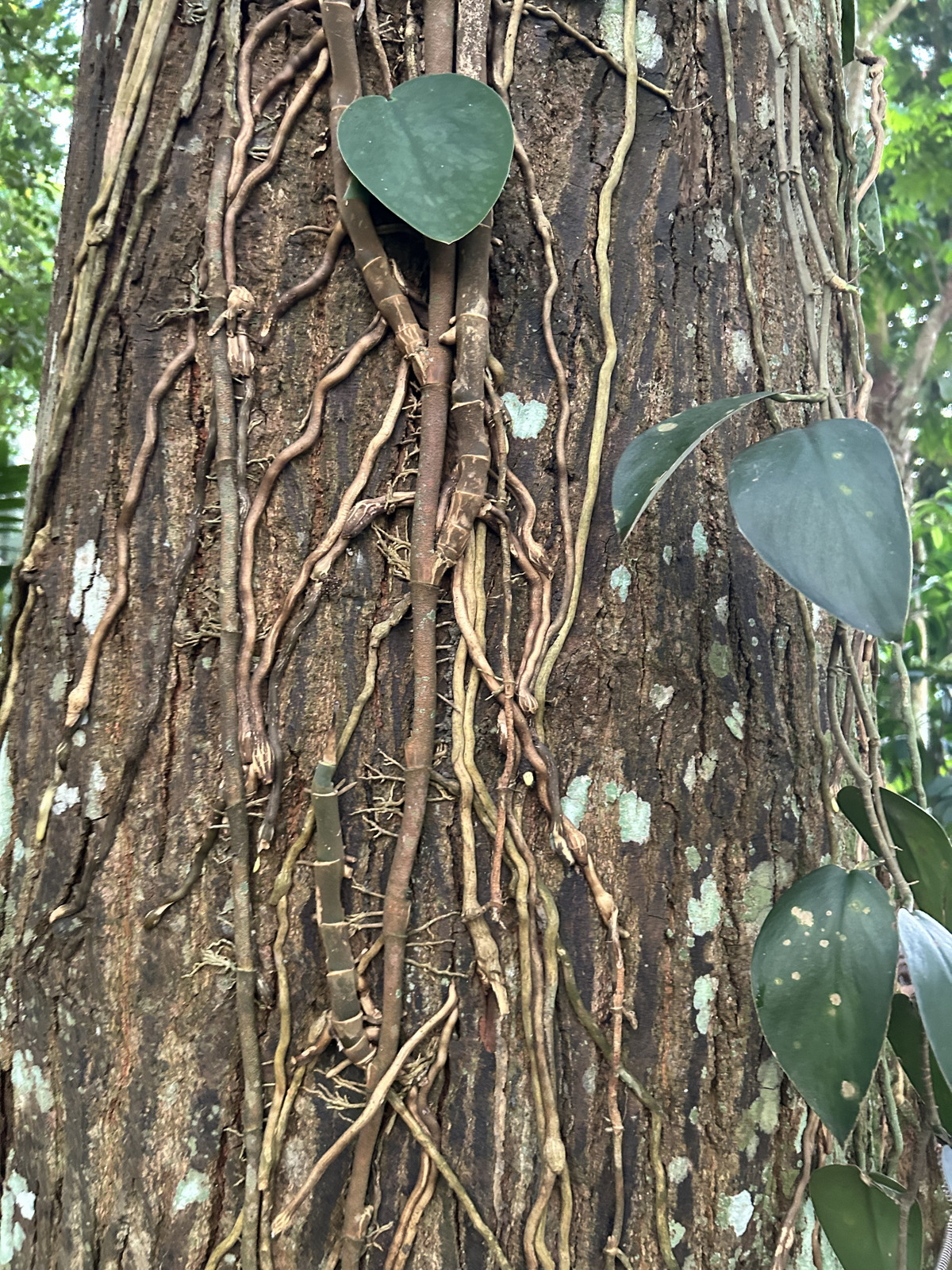
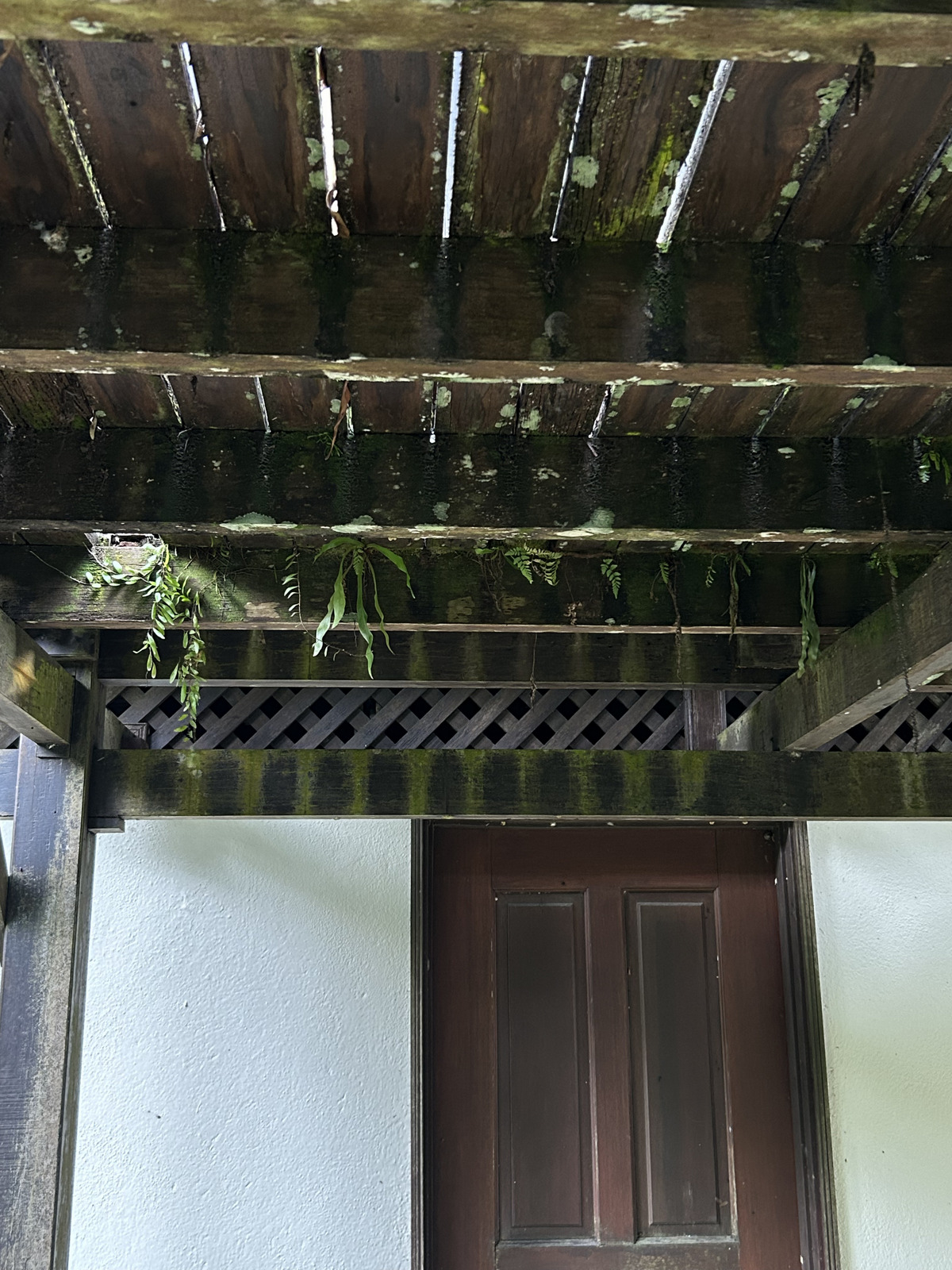
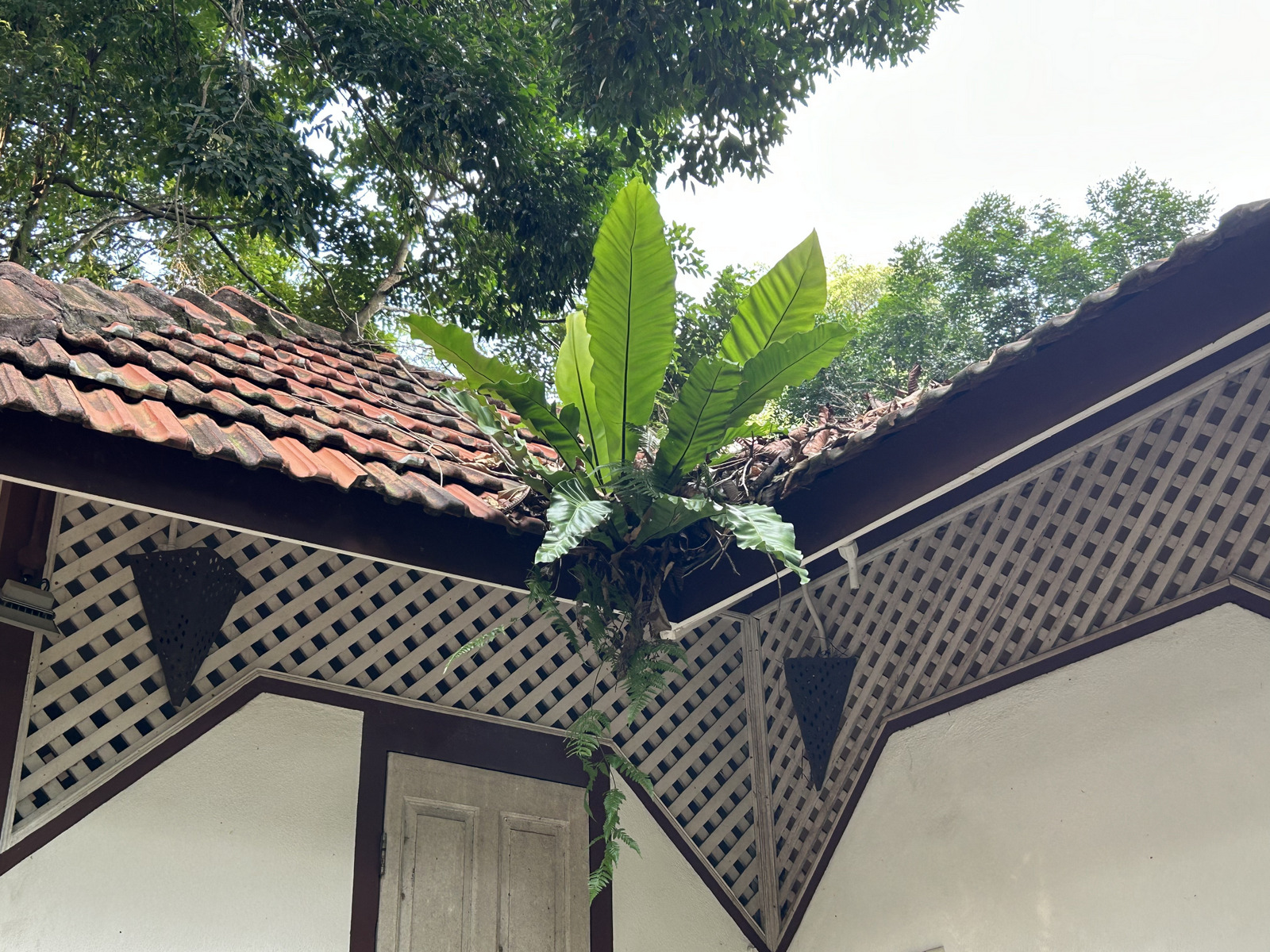
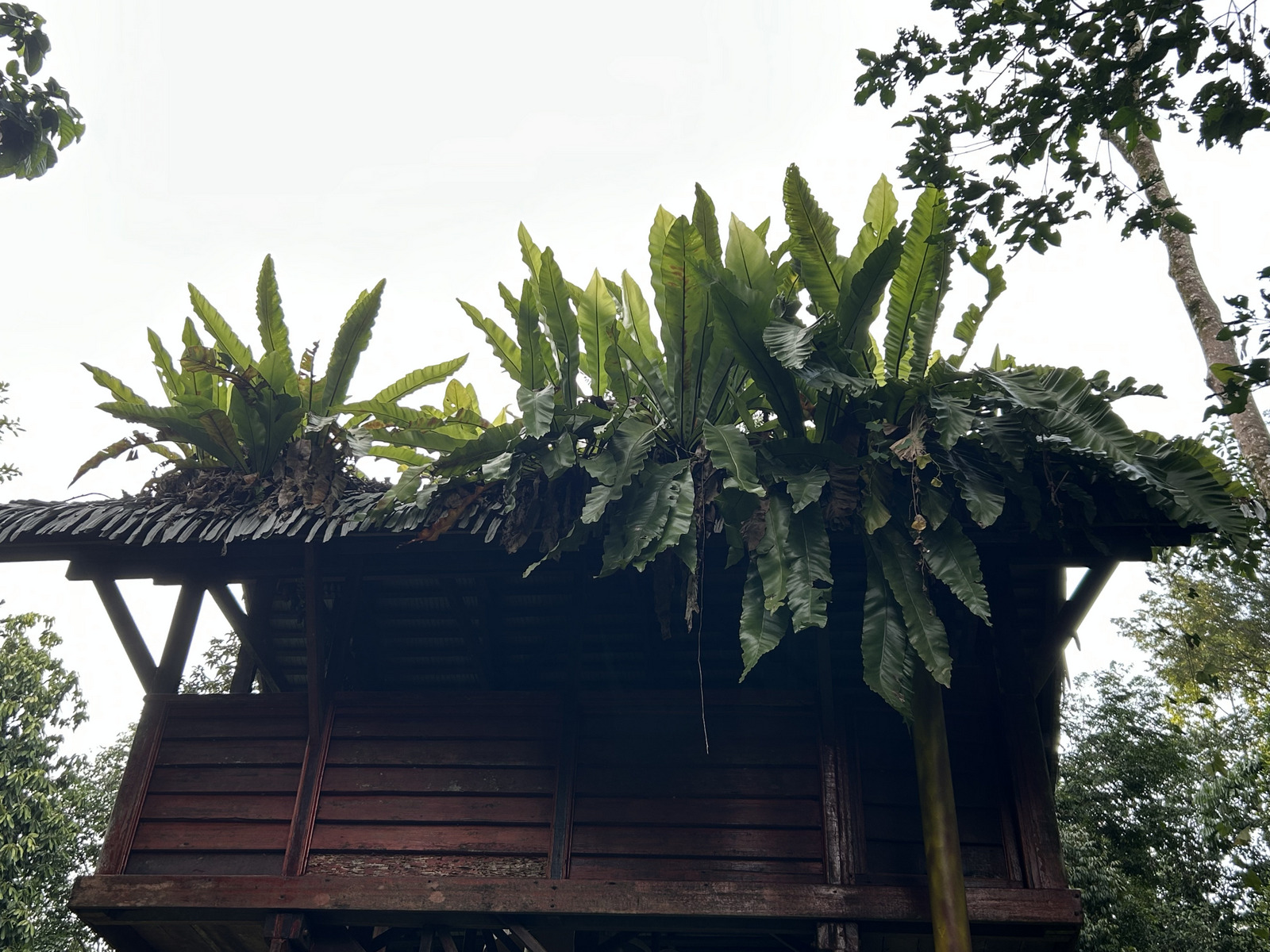
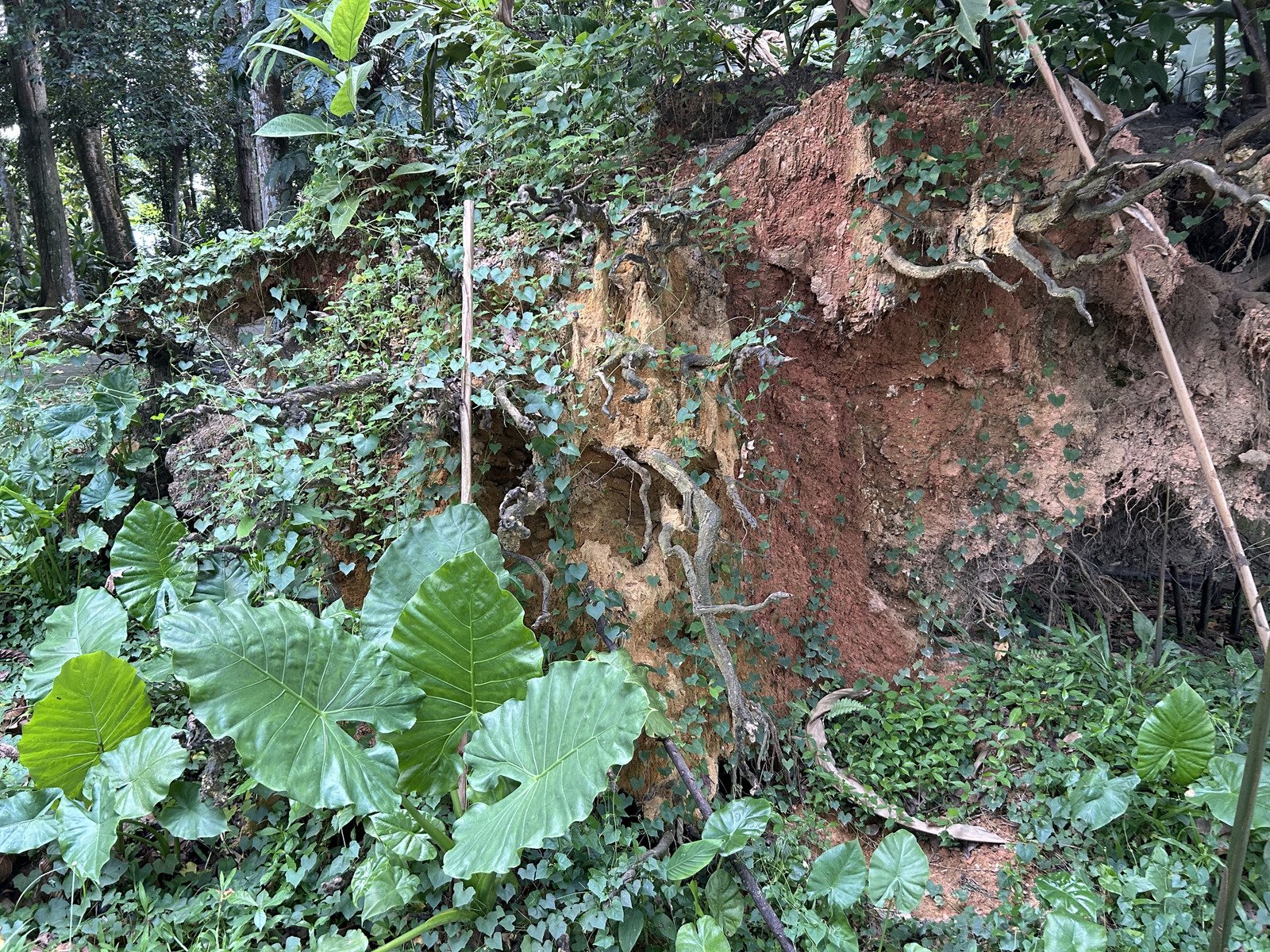
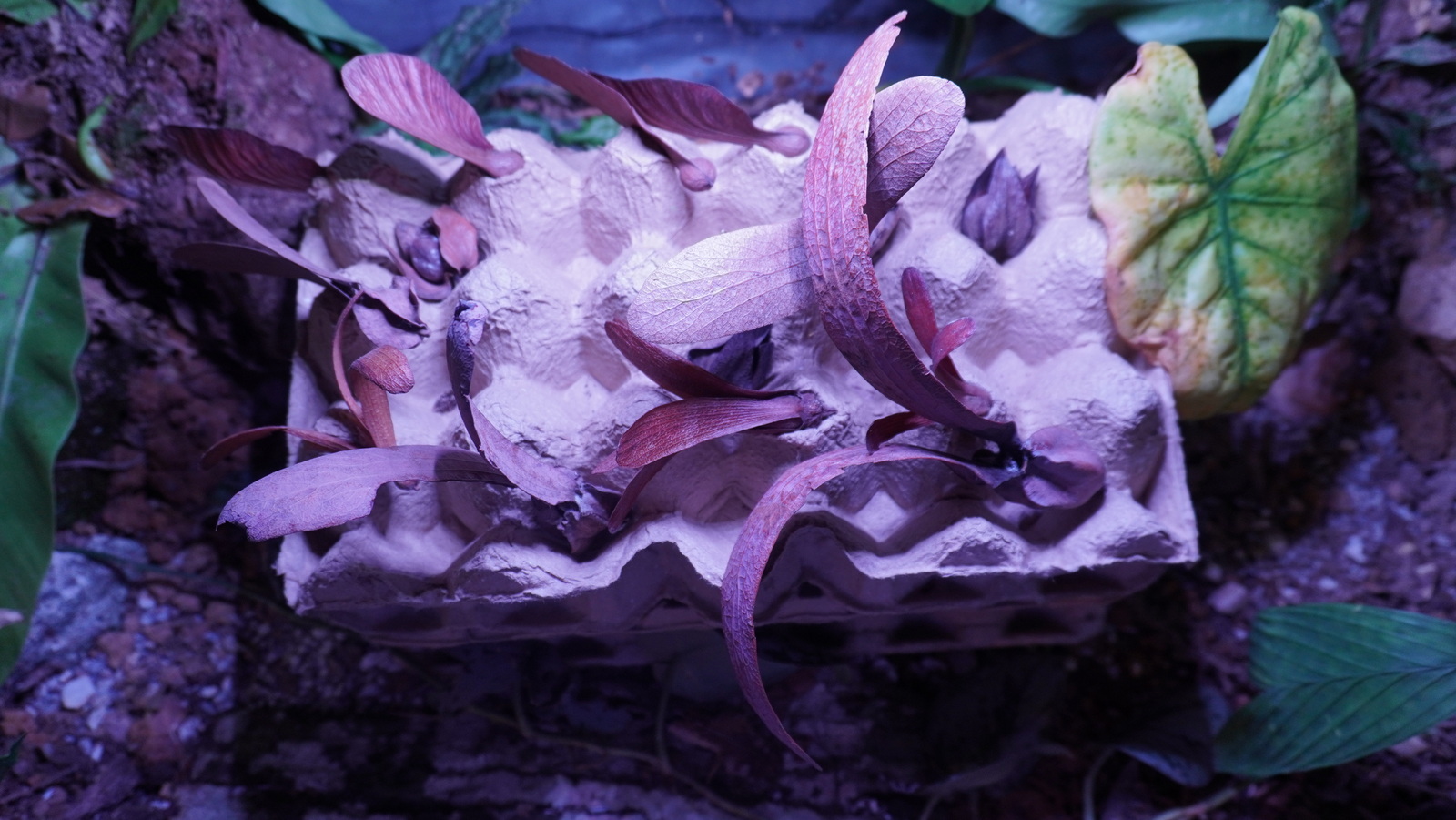
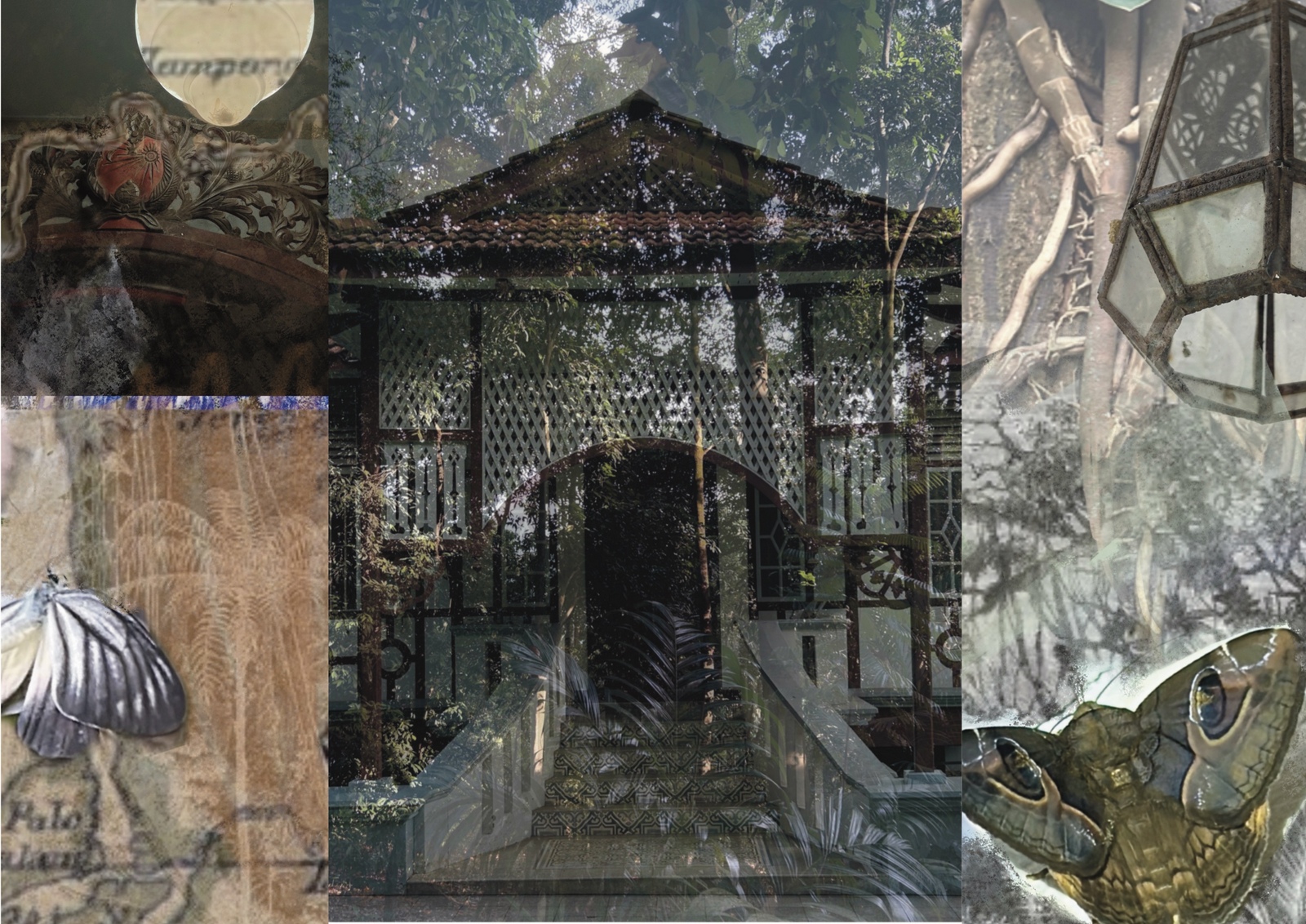
Anusorn”s installation project explored the relationship between the native flora of Southeast Asia and the heritage wooden architecture at Rimbun Dahan. The installation — a series of terrariums containing found material — traced the transformation of wood from living trees that once hosted smaller plants and other living organisms, to its conversion into buildings and furniture.
The native plants at Rimbun Dahan signify botanical locality, and the heritage houses represent cultural identity. Both use wood for shelter. In this artwork, Anusorn looked at questions of interdependence, locality and migration, and the roles of host and guest in cultural exchange.
Emerging contemporary dance choreographers from Southeast Asia have been selected to attend a 9-day intensive residency at the private arts centre of Rimbun Dahan from 13 to 21 June 2026, exploring art and biodiversity.
The program consists of 7 work days with 2 days of excursions to arts spaces or recreational spaces in Kuala Lumpur. Work days in the Dance Studio at Rimbun Dahan consist of sessions exploring choreographic methods, analysis and movement techniques led by invited guest artists and by the participants themselves.
Other activities include live performance viewing, informal socializing and discussions, and networking events. The program will conclude on Sunday 21 June, with a studio showing to share the creative process and artistic development from the Choreolab with the Malaysian dance community and the wider public.
Selected participants must support their own travel costs/airfare to Kuala Lumpur. The project provides local transport, meals, accommodation and access to all activities during the Choreolab.
SEA Choreolab 2026 Participants
Hannah Moujing (Malaysia)
Farahani binti Mahdi (Malaysia)
Trina Acacia (Bali, Indonesia)
Melynda Adriani (Berau, Indonesia)
Ela Mutiara (Jogjakarta, Indonesia)
Bjork Calao (Philippines)
Gia Gequinto (Philippines)
Lena Caminha (Timor Leste)
Linh Trinh (Vietnam)
Prapassorn Konmuang (Thailand)
Project Aims
To support and enable emerging Southeast Asian contemporary dance choreographers to
Adopt new choreographic tools and physical, thematic and conceptual approaches to enrich their artistic practice;
Develop regional networks among their peers and with regional dance institutions, for knowledge sharing, future artistic collaboration and touring;
Experience works of art, cultures, places and histories beyond their home, to increase international understanding and to help contextualize their artistic practice.
Work with established artists to delve deeper into the choreographic process, and to benefit from their insights, advice and experience.
We hope the participants will have a positive and enjoyable experience at the SEA Choreolab, which will reenergize them and help reaffirm their commitment to their artistic practice. We would like the SEA Choreolab and the networks established here to be an ongoing resource to which the participants may return for inspiration, refreshment, respite and a sense of continual community.
The Artists’ Role in the Biodiversity Crisis
In 2026, the SEA Choreolab will focus on the artists’ role in relation to the global biodiversity crisis. The Choreolab will explore how we can use art as activism to address the loss of non-human species in our own biodiversity-rich region, and whether we should. We will spend time analyzing existing choreographic models and dreaming of new ones. We will also dive into bodily practices embracing the natural elements and transcending the human-nonhuman divide. Invited guests including established choreographers as well as writers, musicians, scientists and environmental conservation workers will bring their perspectives and practices to the studio.
SEA Choreolab 2026 is Edition #8 of the Southeast Asian Choreolab series which started in 2014. For more information about other editions of the SEA Choreolab, click here.
The Southeast Asian Choreolab is a project by Rimbun Dahan and MyDance Alliance, and is Inspired by Iconic Fishes. It is supported by Laura Fan & Claire Barnes.
Mao Sovanchandy, a multidisciplinary artist from Cambodia, and her collaborator Yuryphal Tum, spent two months at Rimbun Dahan in 2025, drawing inspiration from the regenerative nature of mulch, with experiments with water hyacinth pulp, plaster, photography, food and performance.
About the Artists
Mao Sovanchandy (b. 1998) is an independent multidisciplinary artist exploring mixed-media works that reflect environmental and social issues, as well as societal norms, drawing from self-reflection and personal experience. A self-taught artist with a B.A. in Architecture, Sovanchandy’s practice is deeply informed by the rapid transformation of Phnom Penh — a city where historical, cultural, and ecological values are constantly shifting. Her practice evolves installation, performance, moving image, and social engagement, often centered on the tension between what is visible and what is forgotten. https://www.instagram.com/sovanchandymao, https://shorturl.at/TUjNk
For her residency at Rimbun Dahan, Sovanchandy has invited Yuryphal Tum to be her collaborator.
Yuryphal Tum (b. 1992) is an independent artist and architect from Cambodia. She earned her Bachelor’s degree in Architecture and Urban Planning. As the daughter of a sculptor, Yuryphal was surrounded by art from an early age, which deeply influenced her creative journey. Her practice encompasses sculpture, installation, architecture, and archival work, often assembling meaning from small fragments and found materials. She values the hand-crafted process and the sculptural quality of her work, always striving to capture the beauty and integrity of handmade art. https://www.instagram.com/yury.tum, https://shorturl.at/l4o7r
About the Residency
Chandy was accepted into a two-month residency at Rimbun Dahan in 2024, which coincidentally overlapped with her participation in the Maybank Fellowship Program 2025. She later invited her collaborator, Yury, to join her at the residency. Their time at Rimbun Dahan became a period of reflection on their recent developments and future direction toward establishing an artist-run space. It envisions a space that would eventually become an artist collaboration, residency, library, and kitchen in Phnom Penh, Cambodia, where they now live and work.
Within Malaysia’s cross-cultural environment, Chandy and Yury explore community work and personal experience on how trace, memory, and transformation shape connection through dialogue and experimentation. Their practice interlaces folklore, belief, and fragments of the past to reveal how time, place, and identity intertwine—drawing inspiration from the mulch process and its regenerative nature.
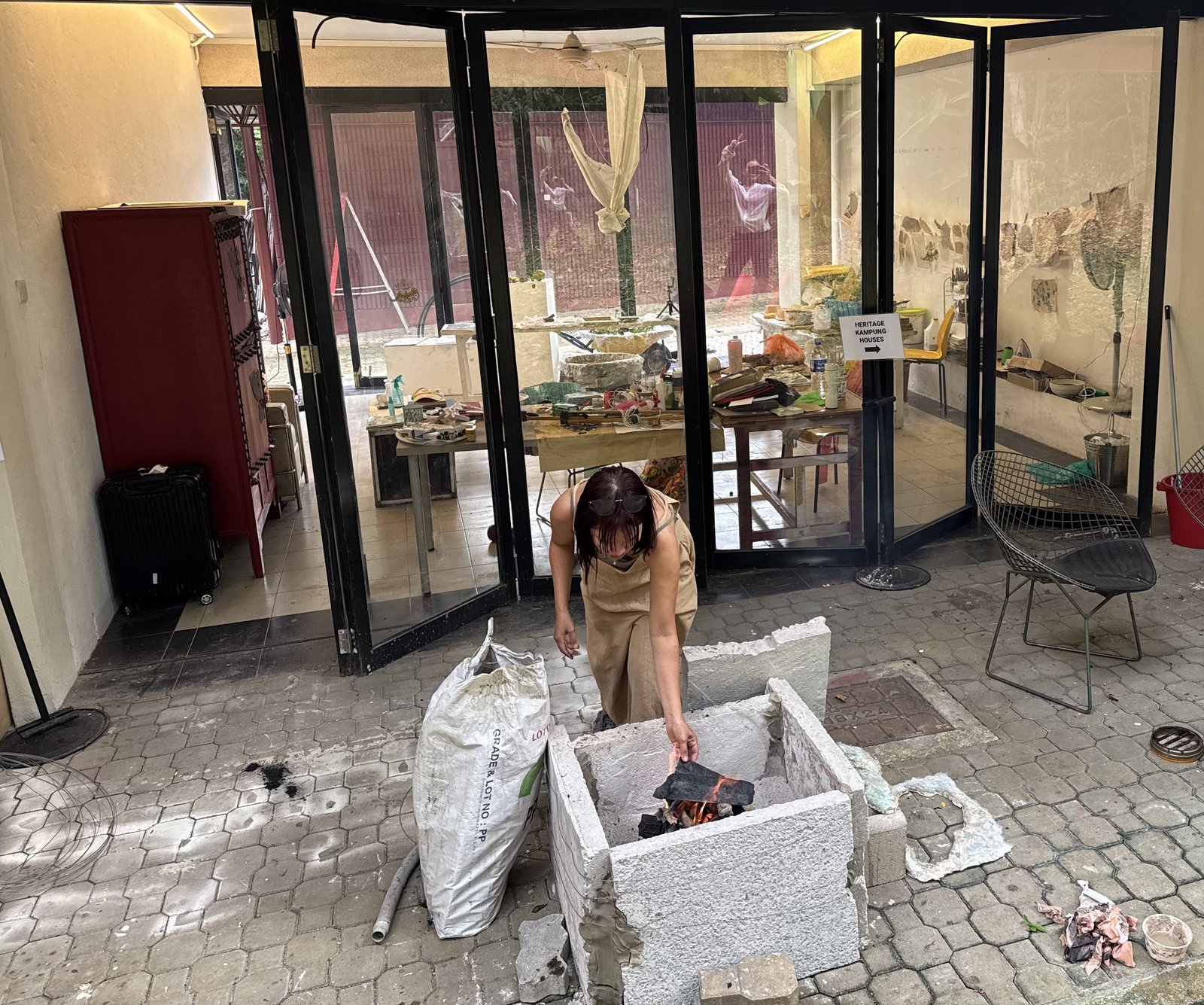
About a five-minute walk from Rimbun Dahan, they discovered a low-lying pond filled with water hyacinth and its purple blossoms—a plant that grows wild in Cambodia and throughout Southeast Asia’s freshwater ecosystems. Locals called it keladi bunting, meaning “pregnant yam.” We brought the plant back to the studio and experimented with transforming every part of it—from root and stem to flower—into handmade paper. Working in the kitchen, we cut, cooked, blended, pressed the fibres under weight, dried them in the sun like laundry, and even ironed them to counter the humidity of the rainy season. The process taught us patience, impatience, time, and a feeling of the timeless. This led us to further experiment with photography, collage, and layering prints on tracing paper, fabric, and our handmade water-hyacinth paper.
Education and exchange formed the core of their residency. They hosted the Re:Present workshop with 13 students at Buku Jalanan Chow Kit — an alternative school in Kuala Lumpur — where students aged 9 to 17 imprinted found objects brought from home and school onto clay, then cast these impressions in plaster. Through this process, everyday materials became moments of formation, unfolding like a mechanical dialogue. The resulting works will be presented at the open studio at Rimbun Dahan.
Meeting people here and travelling to nearby islands — such as Langkawi and Pulau Ketam (Crab Island) — has inspired Chandy and Yury to write stories and poems in their tracking journal, in which they collage photography, drawing, and handwriting created from handmade water-hyacinth paper and found fabric from the Cambodian community. This journal is currently on display at Balai Seni Maybank until 12 December 2025, as part of the Maybank Foundation Artist Fellowship Programme. Inspired by their poems and daily experimental photography during the residency at Rimbun Dahan, Chandy and Yury also compiled their work-in-progress into a video art piece shot inside and outside Rimbun Dahan, involving body performance and a poem-reading voice-over, collaborating with local residents and friends, which will also be shown at the Open Studio.
Just five kilometres from their studio, Chandy and Yury found a small Cambodian market—a pocket of home in an otherwise unfamiliar place. Speaking their own language with the people there helped them understand the community’s daily struggles, their resilience, and the paths that brought them to Malaysia. With familiar ingredients close by, they began cooking and sharing meals with residents and guests on-site. It became a simple way to ease homesickness and to stay connected to their food roots.
Here at Rimbun Dahan, nature, forest, and art blend in a beautiful dance, surrounded by a flourishing garden, giving us a sense of peace and home. Chandy and Yury swam in the pool and the lotus ponds, where the otters live, and one day we discovered a sunken boat beneath the deck. It somehow evoked a sense of longing, as if they had finally found a hidden treasure beneath the water—a dream come true. The boat later became part of their installation and inspired a section of their poem.
Lastly, Kantael Komplork (Keladi Bunting’s mat) is the title of an interactive installation inspired by traditional Khmer living practices. In Cambodia, almost every family owns a mat—an object used for many purposes: sleeping in place of a mattress, welcoming guests, or kneeling in prayer at the temple. The cooked, ground, and pressed water hyacinth in this work becomes a delicate illustration of migration, displacement and geopolitical history—echoing land movements that stretch and disperse along the waterways. By inviting people to sit on the floor and engage with the handmade water-hyacinth paper, the installation encourages visitors to touch, draw, relax, and interact with the artwork through their bare feet, hands and body. This collective act of gathering on the ground evokes the intimacy of family, warmth, and a profound sense of home—an environment where people come together, share space, and feel deeply connected.
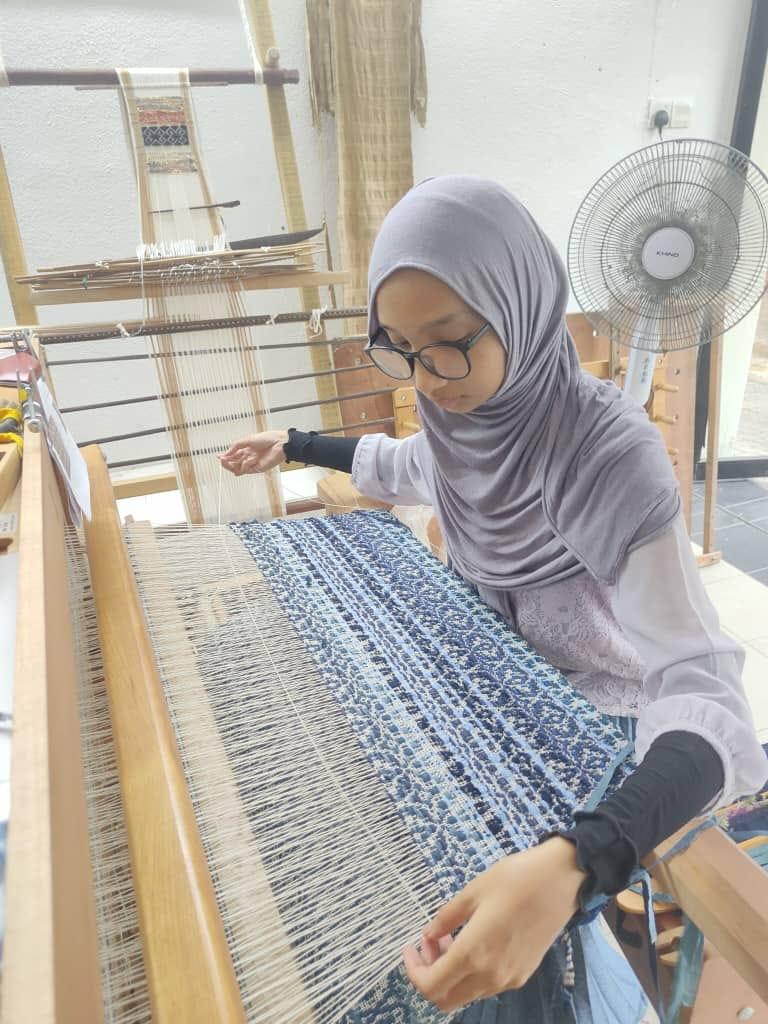
Thai textile artist Awika Samukrsaman was in residence at Rimbun Dahan from September to November 2025, creating site-specific weaving projects which make visible lines and trajectories that once existed, whether of humans on the pickleball court or of plants interacting with manmade structures.
About the Artist
Awika Samukrsaman (b.1991, Surin, Thailand) received her Bachelor of Fine and Applied Arts (BFA), Thammasat University, residing and working in Ratchaburi, Thailand. She is interested in learning and developing basic weaving for everyday use and communication which is rooted from traditional culture and has been a part of everyday life. Awika’s interest in texture in textile works has brought her into folk wisdom among local ethnic groups. She has been a member of Baan Noorg Collaborative Arts and Culture since 2018 and was a manager in 2018-2019. Awika co-founded Wisdomative* in 2019, a platform for developing local weaving art and crafts and in 2021 she co-founded PhiFa collective that runs art-based research projects to retrace, reinterpret and restore Thai northeastern (Isaan) ancestors and heritage.Co-founded Yoonglai Collective,and t-rex veggie brand.
She was a representative artist of Baan Noorg Collaborative Arts and Culture in Churning Milk: the Rituals of Things project for documenta fifteen, Kassel, Germany (2022), Jakarta Biennale, Jakarta, Indonesia (2021), and artist in residency program at Bamboo Curtain Studio, Taipei, Taiwan (2019). In 2020 Awika participated in the Exhibition and a prize winner of the Early Year Project by Bangkok Art & Cultural Centre, Thailand (2020), joined Klongsan Fest, Suvarnabhumi Mosque and Charoen Rat, Bangkok, Thailand (2019), Bangkok Layers contemporary art exhibition curated by Baan Noorg Collaborative Arts and Culture, Bangkok Art and Culture Center, Bangkok, Thailand (2017) and Pop Up Museum project curated by Baan Noorg Collaborative Arts and Culture, Nong Pho, Ratchaburi, Thailand (2014).
Traces of What Once Existed and the Conditions of Allowing Relationships to Form
This project explores the “conditions of coexistence” between human–human, human–structure, and human–nonhuman life forms. It draws on ecological modes of relating — ranging from mutual support (Mutualism) to restricted, competitive, or extractive forms of connection (Competition / Parasitism) — as a way to think about the varying degrees of benefit, loss, and negotiation embedded within every relationship. At the same time, it engages with the sensibility of Object-Oriented Ontology (OOO), which regards all things as possessing their own agency and ontology. Walls, fences, grids, branches, and threads each have histories, capacities, and ways of acting upon one another.
Here, “traces” are not treated as mere residues of the past, but as evidence of collision, contact, exchange, permission, and proximity. They function as markers of where something was once allowed to exist, and where it was denied.
Certain human relationships resemble plants that are “allowed to grow only in some directions”—not because the relationship lacks authenticity, but because invisible systems, circumstances, and timings quietly govern the shape it is permitted to take. This project investigates these “traces of permission”: moments of connection that once took place—clear or faint, intentional or incidental—and asks what form a relationship might assume if it were never cut back, redirected, or prematurely pruned.
Work 1: Tracing the Intrusions of Boundaries
This piece begins with the relationship between human-made structures and the plants that attempt to grow alongside them. Fences, grids, and walls become objects with agency structures whose functions, limits, and permissions are defined by human hands. In contrast, branches and vines navigate those limits, seeking small openings through which to enter, attach, spread, or slowly encroach upon spaces that were never built for them.
The threads in this work act as an “extension” of branches that have been cut away. They return possibility to what has been silenced. By weaving new paths beyond the point where growth was interrupted, the work temporarily restores visibility to life that once occupied the space but has since been removed. It becomes a record of intrusion, resilience, and the desire to exist within a system that grants only partial permission.
Work 2: Do you see the line between us?
This piece shifts toward human-to-human relationality, articulated through the language of textile processes. The weaving process as metaphors for the fiber of relationships, tight, loose, fluid, obstructed, directionless, patterned, intermittent, responsive, or delayed. Each thread reflects a rhythm and the frequency of exchanges, the pace of response, the distance one person allows, and the extent to which another is permitted to enter their emotional space.
In the ongoing project Social Weaving, the warp functions as the net of a Pickleball court, while bundled threads (Weft yarn) act as the movement of the ball being hit back and forth. This recreates conversation as an energetic exchange. Each passage of a thread (Weft yarn) through the warp becomes a “sentence,” an action, or an emotional gesture. The gaps between threads, the tension and looseness of the textile, record the intervals, uncertainties, and shifting stability of communication.
Together, they form a tactile archive of a relationship that once existed.