In 2010, Brussels-based choreographer Arco Renz and dancers from Amrita Performing Arts, Cambodia, spent an intensive residency at Rimbun Dahan developing the new work Crack, commissioned by the Singapore Arts Festival 2011.
The development concluded with a work-in-progress showing, “Cracking in Progress” at The Actors Studio Theatre @ Lot 10 Rooftop, on 27 March 2010. During the showing, Arco will presented and explaiedn the movement material created so far and the dance tasks he has set for the Cambodian dancers. Arco and the Amrita dancers also discussed and took questions on their work.
Crack is a performance about the developing individuality of a new generation of Cambodians after their civil war – their conflicts, hopes, dreams, and desires. Physically exploring the themes of emergence from isolation towards integration in the complexities of the contemporary world, this performance promises to ascribe and describe through contemporary dance, music and performance the zeitgeist of a new country.
About Arco Renz
A protegee of famed Belgian minimalist dance artist Anne Teresa De Keersmaeker, Arco Renz’s productions reveal an intense physicality and explore the emotional force of abstraction. In his creations he consistently broadens the principles of Abstract Dramaturgy to light, sound and multimedia interfaces. Kobalt Works is the production organization founded by Arco Renz. Since the establishment of Kobalt Works in 2000, Arco Renz has developed a successful artistic track, creating and touring several performances as well as developing transcultural and multidisciplinary research and exchange programs. He presented ‘heroine’, a solo work by Taiwanese dancer Wen-Chi Su, at the Singapore Arts Festival 2010.
About Amrita Performing Arts
Amrita Performing Arts is an international NGO based in Phnom Penh whose mission is to preserve the spectrum of Cambodia’s traditional performing arts, while nurturing contemporary artistic expression. In 2011 they presented ‘Khmeropedies I & II’ at the Esplanade, Singapore, created by former Baryshnikov dancer Emmanuèle Phuon.
Alice comes from Texas, but lives in Portugal. Sometimes her English is perfect, and sometimes it isn’t. She won a million dollars in a lottery and every day she paints her fingernails red. She might be someone you know, or perhaps you have never heard of her. So does she really exist?
Singaporean choreographer Joavien Ng and Spanish choreographer Paloma Calle are currently undertaking a one-month residency at Rimbun Dahan supported by the Asia-Europe Foundation. During their residency, Joavien and Paloma are collaborating to create a new performance work entitled ‘The Diary of Alice’, intertwining the concepts of fiction and identity.
A 3-hour performance laboratory exploring creative processes associated with the body, objects, space, image and sound will take place on Sunday 14 March, from 12pm to 3pm, at The Annexe Gallery, Central Market Annexe. Artists in all genres are invited to participate, while Paloma and Joavien facilitate a development process involving their new work, ‘The Diary of Alice’.
Each participant should bring a digital camera (a mobile phone with camera is suitable), and an object with special meaning to the participant, either positive or negative. Participants are requested to wear loose comfortable clothes, as some movement will be involved.
A lecture presentation of the artists’ previous works will take place at The Annexe Central Market on Monday 15 March, from 8pm to 10pm, followed by a discussion and Q&A session.
About the Artists
Photo of Joavien Ng by Matthew G. Johnson.
Joavien Ng began her choreographing and performing career in 1997, after graduating from La Salle School of Performing Arts in Singapore. Her works have since been presented by various Singapore and international arts organisations such as Esplanade Theatre (Singapore), Singapore Arts Festival, Kampnagel (Hamburg), Contemporary Dance of Fort Worth (USA), Little Asia Dance Exchange Network (Asia), Alkantara (Portugal), and Singapore Art Museum.
Joavien’s most recent work, Body Swap, in which she collaborated with Germany-based American choreographer Dani Brown, was presented at Kampnagel and Esplanade Theatre in 2009. Other works include LAB at the Esplanade Theatre in 2008 and Body Inquireat Singapore Arts Festival 2008.
Paloma Calle was born in Madrid in 1975. After training and working for more than 10 years as a performer in experimental dance and theatre companies in Spain, Germany and Italy, she began to develop her own projects in performance art, staged performances and video in 2004. Her work is usually based on autobiographical material that she explores and reconstructs from an ironic and artifactual perspective. There is a constant questioning and experimenting with the conventional use of space, resulting in works in different formats conceived for diverse spaces ranging from a theatre to a walk with the audience through the periphery of a city, or a performance in a private house. Paloma also regularly questions the role of the audience in her work, encouraging the audience to enter a state of alertness and activity.
Paloma’s work, presented in a number of centres and festivals in Europe and in Spain, include des-trozos, lovely epi-ladies, parlez moi d’amour, ZOO, simple present, SECRET, territorio: sad y k, DE MANO, 1, 2, 3, 4 partes, EVEREST/príncipes, 100 cosas que hacer la noche en blanco mejor que ver la noche en blanco, concierto y subasta, and hello myself.
This residency is supported by the Asia-Europe Foundation as a follow-up to ASEF’s Point to Pointe dance forum in Portugal last year.
Gecko on My Shoulder
The 16th Rimbun Dahan Residency Exhibition
6th to 20th March 2011 in the Underground Gallery at Rimbun Dahan
‘Penang Cloud’, 2010, fabric ink & silk embroidery thread on cotton, 56 x 142 cm.
Acknowledgements: Hijjas Kasturi and Angela Hijjas, my partner Alex, my daughter
Jacqui, my parents Sue and Geoff, Marianne Erikson, and the Swedish Arts Grants Committee.
Textile Art with glowing colours, growing in Jessica B Watson’s concepts
“…Into the future I would like to continue working with costume, sculptural textiles and art as a profession. I’d like to continue developing and exploring – methods and paths may change along the way but I’m sure that something shall glow and grow…”
These were the words Jessica wrote ten years ago, concluding the report of her Masters’ Degree in 2000. Her project then was called “Flickers” — a colourful swarm of mushroom-like figures, entering trams and spreading out in Gothenburg City, Sweden, as homage to spring, blowing into the gloomy infrastructure after a long winter. — What is this? Confused people asked. This playful group in Jessica’s designed outfits also took part in the Gothenburg Dance and Theatre Festival, which led to further engagements in the international field.
Nature seems to influence Jessica wherever she goes in this world: The structure of the squiggly bark of the eucalyptus trees in her native Australia, the bright red mushrooms with white dots in Swedish forests, the vivid yellow lichens of the grey rocks at the Scandinavian coast and here the tropic vegetation of Malaysia. What inspiration do they bring out in an artists’ mind?
Her motifs are, however, not only aesthetic or decorative, they also reveal a concept. That is what makes them soimaginative. They deal with different phases of human relationships. Some phenomena in nature take a long time to grow; sensitive textile art is indeed time-consuming and sincere relationships between people need time to build up. All to be handled with care!
Characteristic for Jessica are bright colours which vibrate through layers of different materials and are accentuated through light and a number of techniques. Embroidered simple lines or sketchy, but dramatic stitches show an expressive movement in her pictures such as the ambulating salesmen with their dangling goods on the beaches of Rio or heavily falling rain where she is now. Motifs are emphasized, being worked in series and different scales. Her three-dimensional forms show connection to wearable art and costume design.
For an observant and aware artist like Jessica the environment of Rimbun Dahan ought to be stimulating. Her residence is in an old traditional Malay house, surrounded by a large garden. The multicultural society, where Muslim arabesques and lattice screens meet ancient Chinese symbols and Indian kolam applications are incorporated in Malaysian daily life. Here the skilled handicraft is the base of a fascinating blend. The blue sky holds changing dragon-clouds, bringing cosmic energy to people on the earth. Look up and you will see!
Jessica’s titles are often subtexts. “Good things happen in threes” is among her recent works. The three fertilefig trees, supported by the screen, are individuals, each carrying an ethnic issue. Delicate embroidered lines, like nerves in a leaf, shape shou — the sign of long life, still beloved by the Chinese. The polychrome segmented leaves are influenced by the colourful Indian kolam floor decorations. The third plant with translucent, fluorescent flowers is like an attractive part of Malaysian songket (weaving with gold or silver thread). It is a piece of beauty, but it also points at some global complications. People from different regions and religions live together and have to face the problems of coping with each other. Hopefully they will grow together, glow side by side, like the art of Jessica. Intentionally she uses a combination of frottage, songket, screen-printing, hand painting and embroidery to achieve a richness more expressive than in a painting. Being open-minded the spiritual fire will be maintained, developed by concentrated work to multifarious flowering.
Marianne Erikson
Textile historian, Head of the Textile collections at the Röhsska
Museum of Arts & Crafts and Design, Gothenburg Sweden
between 1974-1999.
Jessica Watson embroidering ‘Rain Falling on Butterflies’, a work for Art for Nature 2010 ‘SURVIVAL’. Photo by Noor Mahnun Mohamed.
About Jessica Watson
Jessica Watsons’ work is a fusion of 2-dimensional textile art and wearable art. Her interest in the human body, both covering and depicting it, has taken her into the fields of art, costume design and fashion.
Surface, identity and contact are reoccuring themes in her artwork and as a textile artist she subconsciously investigates the boundaries imposed upon textile art from the fine art world. Working predominantly in series, Watson develops and enhances her ideas through repetition and scale.
In 2003 Watson spent three months in the Australian Snowy Mountains where she developed embroidered screenprints based on the squiggly bark eucalyptus for the joint exhibition wouldwork. In 2006 and 2007 she travelled to Rio de Janeiro, Brazil, dividing her time between ritzy Ipanema and the Rio slums developing the embroidered series Sketches from Rio based on the salespeople of Rio de Janeiro’s beaches and the traditional ‘plein-air’ sketch.
Her interest in textiles, the human body, clothing and movement has also led her into costume design where she has worked with childrens productions, musicals and provocative political drama/dance with Swedish, African and Iraqi choreografers.
Watson started her visual art studies at Newcastle University in 1995 and in 1996 travelled to Sweden as an exchange student. In 2000 she graduated with a Masters Degree in Textile Art from Gothenburg University, School for Design and Crafts in Sweden (HDK). Since graduating she has been exhibiting in Australia and internationally.
She has been teaching fashion drawing and screenprinting for the past seven years and is represented at the Gothenburg City Arts Council, in private art collections and has received the Swedish Artists Associations (KRO) One Year Artists Working Grant and the Gothenburg City Arts Grant among other grants and prizes for her work.
The patterns, colours and textures of plants inspire me; enlarging these to create compositions I move the identity of the plant into another context. I have previously worked with cold climate plants and am now interested in looking at the tropical plants of Rimbun Dahan and what they reveal. I aim to continue exploring the themes of identity, surface and contact using the garden plants of Rimbun Dahan and Malaysian butterflies as sources of inspiration.
Cover of Jessica’s catalogue for Gecko on My Shoulder, featuring Surviving Paradise (detail), 2010, fabric ink, oil pastel, pencil & cotton embroidery thread on cotton, 60 x 140 cm.
‘Good things happen in threes’, 2010, watercolour & gouache on paper, 21 x 15 cm.
Curriculum Vitae
2000
1998
1996-97
1995-96
Education
Master of Fine Arts and Applied Crafts HDK, Göteborgs Universitet
Bachelor of Textiles, HDK, Göteborg Universitet
Undergraduate Student, HDK, Göteborg Universitet
Undergraduate Student, Newcastle University Australia
Exhibitions
Sketches from Rio, Art in Motion, Frank & Ernest
Sketches from Rio, Galleri mitt i centrum, Gothenburg, Sweden
Sketches from Rio, Galleri Mosebacke, Stockholm, Sweden
Broderia Fantasia, Floras Rike Gallery, Botanical Gardens, Gothenburg
Butterfly Stomach & Hunter, Gothenburg City Library
Hunter, Galleri D Lyx, Malmö, Sweden
wouldwork, Knot Gallery, Sydney, Australia
Watt Space, Newcastle, Australia
Omfång, 25m2 Stockholm, Formargruppen Malmö, Galleri 5 Visby
flickers, Gothenburg, Sweden
Talente, Munich, Germany
Omfång, Galleri Koch, Stenungsund, Sweden
Masters Exhibition, Rohsska Museét, Gothenburg, Sweden
Under det blå tacket, Magnus & Magnus, Gothenburg, Sweden
Centrum, Frölunda Kulturhuset, Frölunda, Sweden
HDK 150 år, Rohsska Muséet, Gothenburg
Karin and Carl Larsson, Nordiska Museét, Stockholm, Sweden
Suecos, Centro Cultural La Santa, Barcelona, Spain
Den Lilla Svarta, Rohsska Muséet, Gothenburg
Grants
Konstnärsnämnden (Swedish Artists’ Committee) One year Artists’ Working Grant
Företagarna (Association for small businesses in Sweden)
Konstnärsnämnden (Swedish Artists’ Committee)
Gothenburg City Arts Grant
Markarna Lindeqvists Scholarship
Estrid Ericsons Scholarship – group
Slöjdskolans Scholarship
Anna Ahrenbergs Scholarship
Goteborg&Co sponsorship
Stiftelsen Erik och Lily Philipsons Minnesfonds’ Scholarship
Theodor och Hanne Mannheimers fund
Slöjdskolans Scholarship
University of Newcastle Student Exchange Scholarship
2008
Represented
Gothenburg City Arts council
2007
2000
1999
1998
1996
Prizes
Golden needle, Täcklebo Embroidery Academy, Sweden, silver needle prize
World Wide Wool, Australia
Near Distance, Lochem, The Netherlands, 2nd prize
Fashion Design Competition, Barcelona, Spain, 1st prize
Hunter Institute of Technology, Mardi Gras Costume Design, 3rd prize
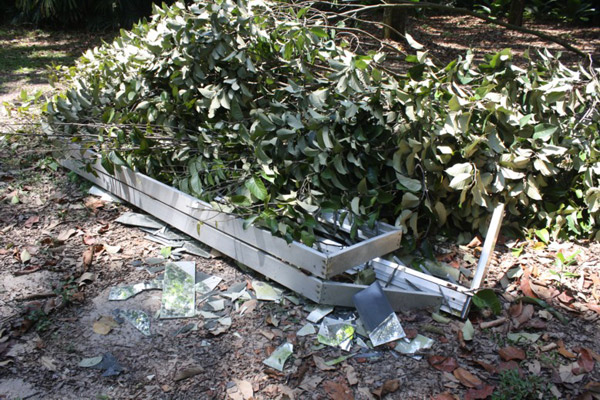
The louvred sculpture by Darwin artist Brian Ash was destroyed in early February by strong winds that broke a branch from one of the Shorea materialis trees near the front fence. Asialink resident artist Brian Ash created this untitled work in 1999 from aluminium and mirror louvres to reflect the vertical nature of the young dipterocarp grove in the southwest corner of the garden. The long tailed macaques had repeatedly damaged the sculpture in the past, presumably because of the mirrors, or perhaps they just thought it a different kind of climbing frame.
S. materialis is an extremely heavy balau timber that used to be fairly common on the east coast of the peninsula from Terengganu to Endau, on low-lying usually sandy soil near the coast or on tidal reaches of rivers. Ten were planted at Rimbun Dahan where the soil is sandy and most have thrived. The tree which is the culprit of this artistic attack will be pruned further to reduce the canopy load, and a creeper will be planted at the foot to reinforce it and counter lightening strike.
For more information about the Shorea at Rimbun Dahan, see the plant list of Dipterocarps. For other outdoor sculptures, see selections from the permanent collection.
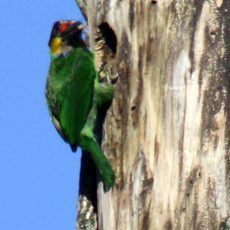
The gold-whiskered barbet excavating its hole and spitting out the debris.
The second interlopers: a pair of dollar birds.
The black-thighed falconets who won the day.
Breeding season is coming, and good nesting property is in short supply.
Our sole gold-whiskered barbet (Megalaima chrysopogon) industriously excavated a hole in the dead tree trunk near the main house, which is a favoured perch of all species of birds.
The family of black-thighed falconets (Microhierax fringillarius) then decided to move in, but were chased off by a pair of dollar birds (Eurystomus orientalis). However, the dollar birds found the hole too small for them and they in turn were forced off by the tenacious falconets. What is possibly the male falconet sits at the top of the tree on the lookout, with the female going in and out of the hole, resting in an adjacent tree before entering hole to make sure no one is watching.
Malaysian Artist for the Malaysia-Australia Visual Arts Residency 2010
Exhibition of Ilham Fadhli’s Work
The 16th Rimbun Dahan Residency Exhibition
6th to 20th March 2011 in the Underground Gallery at Rimbun Dahan
The cover of Ilham Fadhli’s catalogue for his exhibition at Rimbun Dahan in March 2011, featuring Seasonal Abyss, 2010-2011, oil & collage on canvas, 229cm x 305 cm.
When we look at various artworks, a certain definite chemistry sparks our senses. An artwork (should) never lie. Time spent on its surface, every moment of neglected emotions and
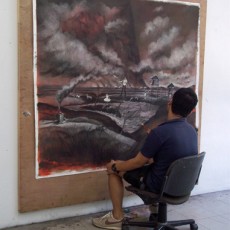
Ilham Fadhli Shaimy in his studio at Rimbun Dahan at work on a mixed-media on paper artwork for his contribution to Art for Nature 2010 ‘SURVIVAL’.
unspoken words turns into images that represent the maker’s sentiments. Again, only interesting artists produce interesting artworks. I find Ilham Fadhli a.k.a. Kojek an interesting person. From his ‘dark realms’ university days back in year 2000 up until now, he is, in my own three words – fascinating, promising and uncertain. These words describe his artworks too.
Some viewers may be interested in his landscapes, while others are more into his cynically narrated paper collages. He seldom sketches. If he did, the drawings were then overlaid with final images on the same canvas. When he starts to paint, I noticed he would almost constantly choose a central dominant image and with this, he keeps the enthusiasm or momentum going by rendering clouds and smokes. The images change so rapidly within just one day that it makes me eager for the final outcome. Small figures against vast landscapes remind one of J.W.M. Turner and Kalkitos (the 1980’s version) game. Kojek would totally immerse himself in the paintings. The artworks are visions of the things that he can never say in words directly. His “apocalypse and the end of the world whilst little people continue to survive” idea is a reflection of what we are today; whatever and however the outcome, we have to make good if not the best.
His current works is similar in concern and stylistically familiar but Kojek has started to insinuate more hope through his selection of images and colours. We can also trace these subtle transitions from the titles and the figures collaged onto his canvases. At first few glances, the viewer often thought that the small figures were painted. This approach with collages blends well with his chosen media. It has become his trademark to merge the smokes from burning buildings or fields with the clouds in the sky. He also develops a habit to watch the clouds while driving from home to Rimbun Dahan and vice versa. His favourite would be the biggest and darkest cumulonimbus against the clear blue sky. Cloud watching has become our pastime and breaks the unspoken silence between husband and wife.
He works every day, at home or at the studio, now or before this residency. Making artworks puts his mind at ease. He is definitely absorbing and benefiting from Rimbun Dahan’s positive atmosphere of fresh oxygen, loyal crew of dogs and his new circle of friends. Kojek’s debut in manipulating oil paint gave him certain pleasures. At first, his oil palette seems more vibrant. However, when the works were completed it looks almost exactly as his acrylics. Talking about such discoveries has become part of our lively discussions and dialogues in the studio at home.
A multi-faceted artist, making little trees or buildings for his (miniature world) dioramas is one of his interests. He also does stop-motion videos. In fact, he co-directed MONOPOL, my instructional video for the Fukuoka Triennale in 2005. Artists have the pleasure of creating and engrossing themselves in their own invented world. Some people may enter this realm, with open arms invitation and some with an extra effort. We can expect a more varied approach from Kojek in the future. Anyway, I saw him first.
Azliza Ayob, Equine Park, 5th January 2011
‘Collapse 2,’ 2010-2011, acrylic & collage on paper, 41cm x 31 cm.
‘Collapse 1,’ 2010-2011, acrylic & collage on paper, 41cm x 31 cm.
‘Dog, Father, One, Two and Tree,’ 2010, oil & collage on linen, 213cm x 213 cm.
‘Kandas,’ 2010-2011, charcoal & collage
on paper, 76cm x 56 cm.
About Ilham Fadhli
Born in Pasir Mas, 1980. Lives and works in Selangor, Malaysia.
Kojek graduated from UiTM Shah Alam with Bachelor Degree in Fine Arts in 2003. After winning the Major Prize for Young Artist Award 2006 and Consolation Prize for Mekar Citra, Merdeka Show, Galeri Shah Alam, Selangor 2007, his paintings and dioramas were exhibited at renown galleries such as Kebun Mimpi, Pace, RA Fine Arts and Galeri Nasional, Jakarta. Most of his works deals with contemporary issues in an absurd/surrealistic setting with collages of delicate figures. He is nominated for five awards at the IMCAS Iskandar Malaysia Show, to be announced soon. He is currently having his first solo show at PACE Gallery in October 2009. He is married to installation artist Azliza Ayob and blessed with 3 children.
Art Exhibitions & Activities
2010
SPICE Show, PACE Gallery, Kuala Lumpur
MATAHATI ArtTriangle, National Art Gallery, Kuala Lumpur
Anniversary Show, PACE Gallery, Kuala Lumpur
Once Upon A Time in Malaysia, SOLARIS Kuala Lumpur
WWF Art For Nature – SURVIVAL, Rimbun Dahan, Selangor
2009
Unfolding, RA Fine Arts, Ampang, Kuala Lumpur
Living Room: Art Couple Project, The Annexe Central Market & Jendela KL
IMCAS Iskandar Malaysia Art Exhibition, Danga Mall, Johor Baharu
WWF Art For Nature, Rimbun Dahan, Selangor
2008
Force of Nature, Pace Gallery, KL
Palestine Fund Raising Show, The Annexe, KL & National Library KL
Anniversary Show, Pace Gallery, KL
NIKE Pop Up Space Exhibition, Pavilion, KL (Beijing Olympics)
Rapat Umum Merdeka Show, RA Fine Arts, Ampang, KL
Friction, Two-Man Show, KebunMimpi, Bangsar, KL
Mea Culpa, RA Fine Arts, Ampang, KL
BANGUN, LostGenSpace, Taman Seputeh, KL
2007
Mekar Citra, Merdeka Show, Galeri Shah Alam, Selangor (Consolation Prize)
Jejak, Galeri Nasional, Jakarta, Indonesia
Not That Balai Art Festival (Performance), Annexe, Central Market, KL
SUPERSTAR 00:15, Rimbun Dahan, Selangor
Exhibition of Young Artist, Jeri’s Studio, Bangsar
Bau-Bau Café Opening Exhibition, Annexe, CM, KL
2006
Young Artist Award KLPAC/Gudang/Arts&Earth (Major Prize)
TABIK JERI, Balai Senilukis Negara
Mural Relief PROJEK 49 Merdeka, Balai Senilukis Negara
OPEN SHOW GUDANG
MINIATURE SHOW, GALERI SENI MAYA, KL
KARNIVAL KARNIVOR Group show, GALERI SENI MAYA, KL
POPCULTURE show, GALERI SENI MAYA, KL
Video art director & technical assistant for MONOPOL interactive installation, Fukuoka Asian Art Triennale, Japan
2004
performance & video art : DIGEST THIS, notthatbalai art festival, Taman Seputeh, KL
Art4All international : artist & art donation, Bangkok, Thailand
video art director & technical assistant for SO, WHY SO SAD? :Footsteps, NAG, KL
set designer : Hari Keputeraan Sultan Pahang, Dewan SUKPA, Kuantan.
mural artist : Sek. Men. Sains Ulu Yam, NAG outreach programme.
interior & logo designer : Treehouse art & craft studio, Sri Hartamas, KL.
Art4All special needs children : volunteer, Arab Women Association & NAG, KL.
facilitator assistant : Gombak district art teacher refresher course, NAG, KL.
set design : PAHANG TOURISM CENTRE.
2002
VOLUME Fine Arts Degree show, UiTM Shah Alam.
technical assistant for RETURN TO INNOCENCE, the young contemporaries, NAG, KL.
2001
IDENTITI, NAG, KL.
crew : SITI DI ALAM FANTASI, Istana Budaya, KL.
ADA LANG ADA SIPUT ADA BAKAU ADA KITA, galeri SENIKA, Pahang
Two students from the second year of the degree program at ASWARA, Malaysia’s national arts university, spent a month as work placement students at Rimbun Dahan as part of the requirements for their course.
Sufinah Abu Bakar and Shafirul Azmi were linked with the dance programme at Rimbun Dahan from 14 Dec to 8 January. During their time at Rimbun Dahan, they worked on several new dance works, including one for a book launch by the Centre of Orang Asli Affairs and another to ring in the New Year.
Gesek-Gosok was performed on New Year’s Eve in and around the reflective pool at Rimbun Dahan. To Indochine-themed music, the group of seven dancers from ASWARA and Balletbase paraded with parasols, lowered themselves into water troughs, and paddled serenely through the waterlilies, to the great delight of the onlookers. Photographs below by Akshay Sateesh.
Sufinah binti Abu Bakar, now 24, was born in Kuala Lumpur and is currently living in Sungai Buloh. A second year student in the Bachelor of Dance program at ASWARA, Sufinah has been trained in classical Malay dance as well as Chinese dance, Bharatanatyam, folk dance, ballet, contemporary and modern. She has worked with local choreographers such as Joseph Gonzales, Umesh Shetty, Zhou Gui Xin, A. Aris A. Kadir, Shafirul Azmi, Choo Tee Kuang, Loke Soke Kim, and Gan Chih Pei. She has danced in various local ASWARA performances including Jamu, Stepping Out, Langkah, traditional Mak Yong theatre, Randai, Bangsawan, the dance drama Huminodun and Asyik. Sufinah has performed in the musicals Puteri Gunung Ledang, Rubiah and Ibu Zain, and has also performed overseas in ASWARA collaborations in Singapore, with RTM in Brunei, Festival Tari Nusantara in Palembang, Indonesia, and the 6th and 8th Asian Art Festivals in Beijing. Sufinah’s television work includes video clips for Hafiz AF7 and Pisau Cukur, commercials for Mummy Slrpp and BOH Tea, and RTM and TV3 programs.
Originally from Sabah, Shafirul Azmi bin Suhaimi began his career in art when he was 18 years old, as a cultural artist for Lembaga Kebudayaan Negeri Sabah (1998) and Badan Kesenian Negeri Kedah (1999). After receiving his diploma in choreography from ASWARA, Shafirul choreographed for Badan Kesenian Negeri Kedah in 2005 and Majlis Perbandaran Ampang Jaya before continuing his studies at ASWARA for his Bachelors. Shafirul in currently a lecturer at ASWARA as well as a dance artist in the local industry. He has been involved in many contemporary performances including Gerak Angin (Sutra Dance Theatre), Jamming The Box (Nyoba Kan and The Actors Studio), Curfew (Five Arts Center), Spring In Kuala Lumpur (Japan Foundation), AWAS (ASWARA) and The Light Show (Annexe Central Market). His musical work includes Ronggeng Rokiah, ANTARA, P. Ramlee, Kasih Menanti and Tun Abdul Razak at Istana Budaya, and TUNKU at KLPac. His own choreographic works are IBN, Let’s Swim, Kabur, Tabung Uji, Niaki, Pipit, Hari+Hari, Escape, Typhoon, Transporter, Shakti, Tapak 4 and Cik Mah. Shafirul is always looking for unusual ideas for traditional-based art works, and favours productions with a collaborative element.
Felicity Fenner is an Australian curator of contemporary exhibitions including Primavera 2005 at Sydney’s Museum of Contemporary Art, the 2008 Adelaide Biennial of Australian Art and Once Removed, Australia’s group exhibition at the 2009Venice Biennale. She is a contributing editor of Art Asia Pacific and publishes regularly in a variety of journals including Art in America and Art and Australia.
Felicity is Senior Curator at the College of Fine Arts, University of New South Wales and Deputy Director of UNSW’s Centre for Contemporary Art and Politics. She is completing a PhD on curatorial strategies in major international exhibitions. During her time at Rimbun Dahan, Felicity is continuing her ongoing research into contemporary Asian art in preparation for a major exhibition exploring how artists and designers envisage our future urban and social environments in the context of global warming and climate change.
Rochelle Haley drawing during a rehearsal of ‘Strings’ in the dance studio at Rimbun Dahan.
Rochelle Haley was one of the Australian resident artists of the year-long Malaysia-Australia Visual Arts Residence at Rimbun Dahan in 2009. In addition to her practice creating works for the joint exhibition with Australian artist Monika Behrens and Malaysian artist Shamsudin Wahab which was presented in the Underground Gallery at Rimbun Dahan from 28 February to 14 March 2010, Rochelle also participated in the contemporary dance performance Strings at The Actors Studio Theatre in January 2010.
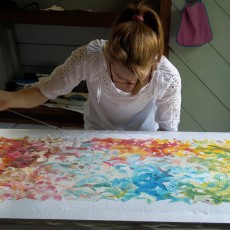
The exhibition at Rimbun Dahan included the ancillary event, ‘High Tea at the Pleasure Garden’, a discussion moderated by the managing editors of online arts writing platform ARTERI (Eva McGovern, Simon Soon & Sharon Chin) based on the site-specific installation Pleasure Garden by Monika Behrens and Rochelle Haley in the newly constructed Penang House at Rimbun Dahan.
Bio
‘Pendulous Heart’. 2009. Reflective film, metallic paint and etching on glass. 30 x 21 cm.
Rochelle Haley is a Sydney based artist working broadly within the fields of experimental drawing and installation. She has recently completed a PhD at the College of Fine Arts, University of New South Wales where she also holds a Bachelor of Fine Arts Honours degree. Haley has held several solo exhibitions of her work the most recent of which in February 2009 titled Land Incorporated at the Ivan Dougherty Gallery, Sydney. She has also shown extensively in group exhibitions in Australia and abroad including the Helen Lempriere Travelling Art Scholarship at Artspace, Sydney, CIGE, Exhibition Hall China World Trade Centre, Beijing, Fading Lines, Nomad Gallery, Islamabad and the 3rd International Triennial, Marmara University, Istanbul.
Central to Haley’s work is the exploration of the relationship between the human subject and their physical and social environment. Recently this concern has been expressed through a series of incised paper works investigating the relation between the land, the body and its representation. Imaging the landscape using unusual methods of ‘drawing’ with blades and carving into heavy white paper, Haley creates artworks that require a viewer to negotiate light and texture. The appearance-disappearance of the landscape is dependant upon the proximity and changing position of the viewer as they attempt to achieve a clear view. The drawings create awareness in the viewer of the position and movement of their body in relation to the work. The subjects Haley primarily takes for her work are landmarks of great cultural value recognised by their inscription on the UNESCO World Heritage List.
Strings
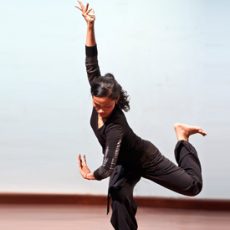
In a collision between dance and drawing, the movements of a dancer are transformed into a series of lines drawn live by Rochelle Haley. Other dancers then use these visual cues to interpret their own movement. A unique performative process which changes every time it is performed, Strings gives us insight into new ways to produce art and movement.
Performed by Australian visual artist Rochelle Haley and dancers of Rimbun Dahan and ASWARA, at The Actors Studio Theatre at Lot 10, 23 January 2010.
Moves & Sorts is part of FUSED, a bi-monthly experimental series at The Actors Studio Lot 10, hoping to bring new audiences into theatres and to give emerging talents a chance to perform. Moves & Sorts is a joint production of The Actors Studio and MyDance Alliance.
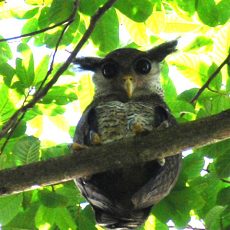
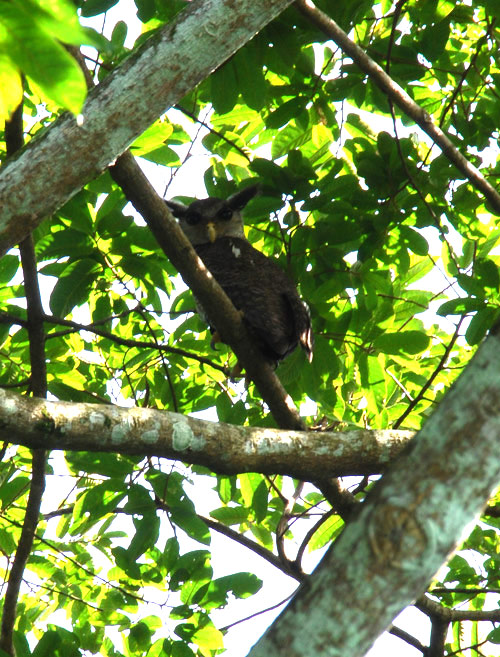
The 16th of December was a red-letter day for birdwatching at Rimbun Dahan — we got our first good photographs of a barred eagle-owl. Our first sighting of this impressive predator had occurred at dusk several days before, when the alarm screeches of drongos alerted us to its presence in a tree in the Taman Sari. The three drongos were swooping and calling around the owl, but none dared to get very close.
The owl was very tolerant of our staring, and even more so when we finally caught it on camera a few days later while disturbing its daytime nap. We were lucky enough to have our friends Akshay Sateesh and Brooke Resh visiting with their digital SLR to take some good shots.
The eagle-owl has been seen several times resting in the same ipoh tree, Antiaris toxicaria, beside the steps of the dance studio, gripping the branches with its enormous yellow feet. Once two individuals were observed sharing the same tree, enjoying a communal snooze.
The barred eagle-owl using its flexible neck to look over its shoulder.
Strong yellow feet armed with formidable claws keep its grip on its perch.
The barred eagle-owl does its best gremlin impression.
Fluffy butts! A pair of barred eagle-owls seen from below.
The barred eagle-owl (Bubo sumatranus) is found in Myanmar, Thailand, Malaysia, Indonesia and Brunei, and is now thought to be extinct in Singapore. It is a resident from low elevations up to 600m, and frequents forests, the forest edge, overgrown plantations and heavily wooded suburbs of towns and cities. Like other typical owls it is nocturnal, hunting from perches and flying low to locate prey after dusk. (Jeyarajasingam & Pearson, 1999)
The barred eagle-owl is the largest of several species of owl occasionally encountered at Rimbun Dahan. Other owls that have been seen include the barn owl (Tyto alba) and a smaller scops-owl.
The drongo cuckoo showing the diagnostic white barrings on its vent and undertail coverts.
On the same day as the owl sighting, a drongo cuckoo flew into the main house at Rimbun Dahan and became disoriented and trapped in the television room. After barging about and crashing into the walls and ceiling, it finally managed to find its way out through an open window, and flew off apparently none the worse for wear.
The drongo cuckoo (Surniculus lugubris) is a glossy black bird with a down-curved bill and a forked tail. It is a resident, passage migrant and winter visitor to Malaysia, inhabiting the forest and the forest edge. Usually keeping to the canopy and the crowns of tall trees, it does not chase insects from an open perch in the manner of real drongos. A parasitic cuckoo, it has been known to lay its eggs in the nests of the Striped Tit-Babbler, leaving the foster parents to incubate the eggs and raise the young. (Jeyarajasingam & Pearson, 1999)
Silly as a drongo, bashing into the glass.
A brief rest at the open window, before flying off.
Another day of dance at Rimbun Dahan, this time with British dance teacher Karen Lacey.
Still trying to nail those fouettes? Don’t know your layout from your lying down? Or just want to hone the skills you have and learn some slick sassy new repertoire while you’re at it?
10 – 10.30 — Registration and warmup
10.30 – 11.45 am — Contemporary class
11.45 – 1 pm — Contemporary repertoire
1 – 2 pm — lunch
2 – 3.15pm — Jazz class
3.15 – 4.30pm — Jazz repertoire
Price: RM 50 for whole day, RM 30 for either morning or afternoon session, lunch included.
For intermediate to advanced dancers, aged 14 and above.
Places are limited. To register, please contact Bilqis at bhijjas@gmail.com or 017 310 3769, with your name, age, email address, phone number and dietary restrictions, if any.
ABOUT KAREN LACEY
Karen is the Artistic Director for professional group RE-Creation UK www.myspace.com/re_creationuk which has received national and International acclaim. She has been awarded various choreography awards for her Jazz, Musical Theatre and Fusion styles, including Champion Place for Contemporary at the Tuscany International Dance Festival and Artistic Direction award at the Barcelona International Dance Festival this year. Her choreography has been seen in the commercial world for clients such as the BBC, Ribena, Pearsons Publishers and Italian television.
After completing her BA Hons in Performing Arts – Dance in 2002, Karen started work as manager for the Beverly Marks Stage School, where she is responsible for the coordination of the school’s competitive events calendar and choreography for the teams, director of the bi-annual shows performed at local professional theatres and the teaching of Jazz, Contemporary and Dance Technique.
Karen’s skills are ensuring strong basic technique is in place for all her students and then working with the varying strengths of each individual group to create exciting, interesting choreography that both the performers and audience can engage in and fitting the brief for the competitive floor, theatrical performance or television.


















 The exhibition at Rimbun Dahan included the ancillary event, ‘High Tea at the Pleasure Garden’, a discussion moderated by the managing editors of online arts writing platform ARTERI (Eva McGovern, Simon Soon & Sharon Chin) based on the site-specific installation Pleasure Garden by