Nov 2009 — Danger in Pradise

Nov 2009 — Danger in Pradise

The stormy season is in full sway in mid November with rain every day; often it’s dark by 5 as the clouds close in and the dogs all go to ground. It’s a wonderful time for the garden, although it has its dramatic moments.

Lightening strike is something I have long been aware of, as our trees are now the highest things around, but we are making progress there. My theory is that with creepers, big or small, going up and through the trees, any tall tree is effectively earthed. The only problem is getting them established without engulfing the tree with exuberant growth. On last week’s walk in Rimba Ilmu, we noted a terap tree that had been struck, but it was dead just at the top; where the lower branches touched adjacent trees it was still alive. That connection is what protects trees in forests, otherwise we would see far more lightening damage than there is.

I am constantly aware too that wind loosens and breaks fruits and branches, so it’s not a good idea to walk in the garden at Rimbun Dahan just before a storm hits when the wind has considerable force. A bunch of old coconuts landing on you is not a healthy proposition.

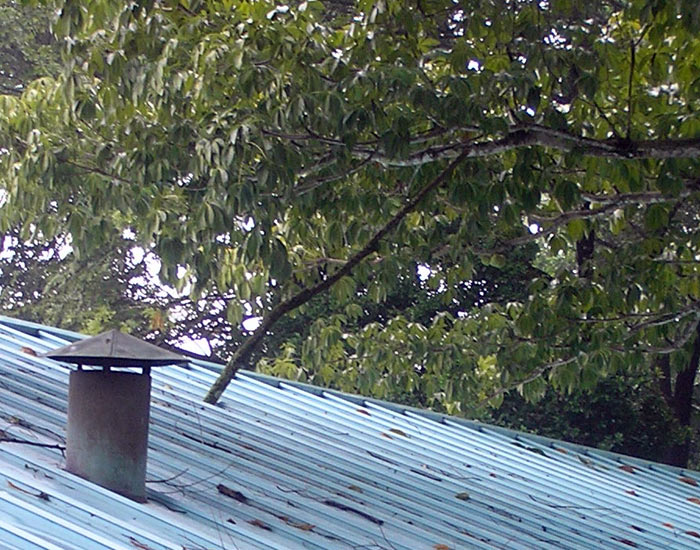
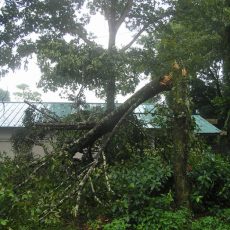
On Friday 13th, we should have been prepared. Our only Shorea sumatrana, one of our first plantings, near the staff houses, was snapped in two by a strong wind. Fortunately it fell away from Effendi’s house towards the garage, but a piece of branch from another tree fell onto the roof of the garage and skewered right through! Some of the trees have extremely heavy wood, and a fall from some height at the right angle is extremely hazardous. We considered leaving it as a natural installation, but that would have been more hazardous to my stores inside!

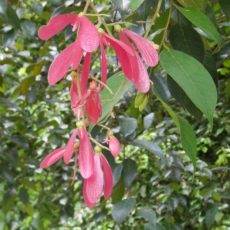
This is the same tree that recently flowered in a veil of pink. It was one of the first Dipterocarps planted at Rimbun Dahan, and is critically endangered in the wild. Luckily we have recently propagated 10 seedlings from this tree, when Lauren Black drew and painted its botanic features. We were also able to collect several seeds from the fallen branches. I’ll have to plant them away from the buildings and make sure they have structural support. Creepers tie the trees to each other and provide stability as well as grounding them from lightening strike.

 
Landscape design in the tropics has to factor in protecting buildings, as the plants do present danger. Similar to kampong adjacent to forest, you don’t want to be too close: snakes, wild boar, centipedes and monitor lizards have all found their way into our house, and ants are an every day problem, but these are not the only issues. In the tropics, houses are more comfortable away from overhanging trees, and this is where I have an issue with the enveloping nature of the Bali style of planting, the tropical version of an English cottage garden.

Overhanging trees do shade a house, but they don’t make it any cooler. Instead they prevent it from drying out during the day when the sun has full force and from cooling quickly at night. Humidity increases, much to the detriment of the building and things inside. Trees too limit the amount of air movement through a building, and if you want natural ventilation to substitute for air conditioning, trees in close proximity will block the little air flow there is.

Another reason for planting away from buildings relates to viewing the trees. Tropical plants do not have spectacular displays of flowers that one associates with an English garden. Flowers are small and only occasionally do they appear en mass for a dramatic display. In a forest, fragrance is more important to advertise the readiness of flowers for pollination when vistas are blocked all around. A lavish display of blossom would be wasted if it can’t be seen. When considering placing tropical trees to view any flowering, they are better positioned away from the house as flowers are on the outside of the canopy; if a tree is adjacent to a house all you see is its underside and not any display of flowers or changing foliage.

The gardens at Rimbun Dahan surround the buildings, but wherever possible there are spaces between buildings and plants, including those in pots. Early plantings though, like the Shorea sumatrana, were carelessly placed close to houses, only to crash down decades later. I guess too, I never appreciated how big they grow in relation to the domestic scale.
Nov 2009 — Lime Butterfly

Nov 2009 — Lime Butterfly

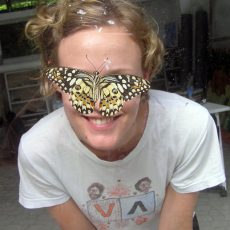
A Lime Butterfly, Papilio demoleus malayanus, was resting on the glass door of Rochelle and Monika’s studio, and was much admired by all. Unfortunately for the butterfly, 5 minutes after it posed for photographs, a cheeky gecko came and ate it.

This, a familiar butterfly of gardens and villages, is one of a group all of which have remarkably similar caterpillars which feed on kinds of citrus. P. demoleus is the commonest: almost every small lime bush seems to have larvae.

The eggs are usually laid upon young leaves; the larvae first resemble bird-droppings, later becoming green with grey oblique markings which effectually disguise them. The pupa, like those of many Papilionid and Pierid butterflies, is able to adapt its colour, within limits, to its surroundings.

Common and widely distributed in S.E. Asia, New Guinea and Australia, this insect is not found in Java, Sumatra or Borneo.

From Common Malayan Butterflies, R. Morrell, Malaysian Nature Handbooks

Nov 2009 — Black-Thighed Falconets and Grammatophyllum

Nov 2009 — Black-Thighed Falconets and Grammatophyllum

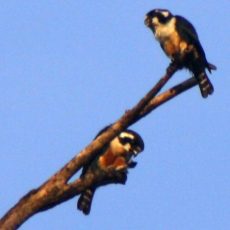
According to Wikipedia, The Black-thighed Falconet (Microhierax fringillarius) is one of the smallest birds of prey. It is typically between 14 to 18 centimetres long. It can be found in Thailand, Malaysia, Singapore and Indonesia. It breeds in tree holes. It feeds on small birds and insects. The typical habitat is forest, forest edge and wooded open area. Our pair of falconets was photographed while feasting on dragonflies.


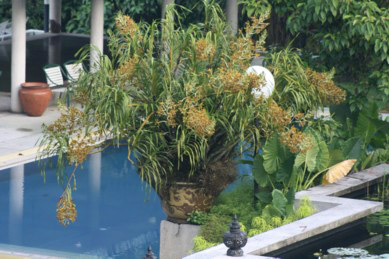
The Grammatophyllum speciosa orchid is once again flowering, for the third time in its life, and the first since 2005.

Sept 2009 — Fruiting Shorea acuminata

Sept 2009 — Fruiting Shorea acuminata

September 2009

BY ANGELA HIJJAS

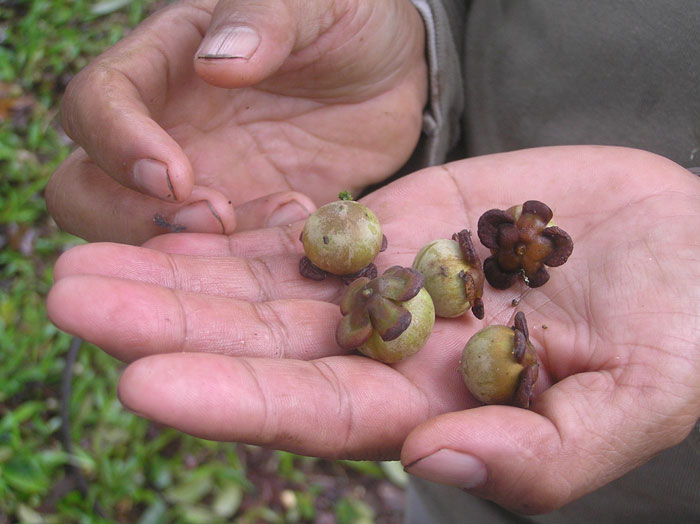
Shorea acuminatameranti rambai daun, is in the red meranti group of Shoreas. It is a tree of the southern half of the peninsula, most common in Negeri Sembilan and Melaka. It prefers low lying well-drained land and is often the most abundant meranti in the forest. Although greatly reduced by forest conversion, this species is not currently at risk. This species was planted at Rimbun Dahan about 12 years ago and is fruiting for the first time, but very sparsely.

See other dipterocarps in the garden at Rimbun Dahan.

Sept 2009 — Pig-Tailed Macaque

Sept 2009 — Pig-Tailed Macaque

by Angela Hijjas

We already have two species of primates at Rimbun Dahan, without counting humans — the common, gregarious and inquisitive long-tailed macaques, Macaca fascicularis, and the shy and retiring langurs who frequent the treetops in smaller family groups.

We have had occasional sightings recently of a pig-tailed macaque, Macaca nemestrina, or beruk in Malay, a very large monkey that has been traditionally used to pluck coconuts and throw them down to their handlers on the ground. You could once see them being taken from grove to grove on the owner’s bicycle, sitting on the handlebars, holding on and staring grimly ahead.

E. J. H. Corner, the famous botanist of the ’40s and ’50s, trained them to pluck samples from trees in the forests of Johor, but apparently they had to be trained only in Kelantanese dialect, as that was all they understood! Eventually one of Corner’s beruk attacked him, landing him in hospital for several months, but probably saved him from being killed by the occupying Japanese during the World War II. Beruk are known to be aggressive; Corner himself noted that one of his specimens would, if allowed, “savage small children.” Our dogs at Rimbun Dahan are taking care to remain deliberately aloof.

July 2009 — Baby Wild Boar

July 2009 — Baby Wild Boar

by Angela Hijjas

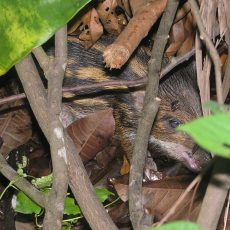
No sooner did the pig tail macaque make an appearance than a real one pig came along — a baby wild boar, Sus scrofa, separated from its mother. The dogs cornered it apparently but because it bites they didn’t want to know much more about it. Sham, our handyman, heard the ruckus and found it, but it tried to bite him too!  Bad photos because I needed a flash, and it was wriggling a lot…

We have had occasional instances of wild boars at Rimbun Dahan, although these are fewer now that we have fixed a few holes in the fence. They come from the surrounding abandoned rubber estates, where they are hunted by weekend warriors for food. Wild boar piglets are striped, whereas adults are not — this is thought to help them stay camouflaged. Usually wild boar sows with piglets are particularly defensive of their young, and can inflict ferocious wounds although, unlike the male boars, they have no tusks.

Sites for Dancing in Place

Sites for Dancing in Place

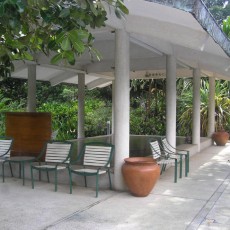
Potential sites for site-specific dance works. Click on the thumbnails to view larger versions.

Angela Goh

Angela Goh

Angela

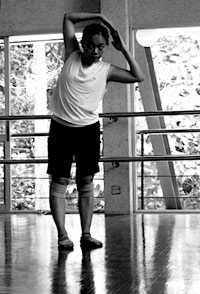
The current choreographer-in-residence at Rimbun Dahan, Australian dancer-choreographer Angela Goh graduated with a Bachelors in Fine Arts (Dance) from Queensland University of Technology (QUT) in 2007. Since then, she has performed in Lisa Wilson’s Elbow Room and in Soft Landing directed by Solon Ulbricht. As a founding member of the independent dance collective little moving poets, Angela has choreographed and performed in three shows at The Judith Wright Centre of Contemporary Art in Brisbane. She also created Like No Place for the Judith Wright Centre last year.

Angela previously performed in Kuala Lumpur with QUT at Tari! 07, and is excited to return to explore her Malaysian heritage through new choreography. She presented a site-specific solo performance entitled Octagon in the Round for ‘Dancing in Place‘ at Rimbun Dahan from 23-24 May.

After two months of physical and conceptual experimentation and investigation as resident choreographer at Rimbun Dahan, Angela presented the new works she created at Rimbun Dahan — see I’m seen it seems and filled and spilt — at a work-in-progress performance at KLPac on 11 July.

The Choreographer’s Residency at Rimbun Dahan provides accommodation, studio space and limited funding and production support for contemporary dance choreographers from Southeast Asia and Australia to live and work in Malaysia. For more about the residency, click here.

Workshop

Angela will conduct a contemporary dance workshop in the main dance studio at ASWARA on Friday 17 July from 10am to 12.30pm. During the workshop she will teach a class and excerpts of her new group work, see I’m seen it seems.For more information about the time and location of the workshop, contact Yunus 012 332 1657.

Performance

Angela will perform the solo work she created at Rimbun Dahan, filled and spilt, in a group show at ASWARA:

Lepas….tetap menari
17-19 July 2009
8.30PM
Experimental Theatre, ASWARA
Entrance free

The show will also feature work by Liu Yong Sean, Kim Jungyeon, James Kan, Wendy Rogers and Jennifer Twilley (guest lecturers at ASWARA from UC Riverside), Shafirul Azmi, Naimsyahrazad, Melinda Kwong and Fairul Zahid.

For more information, please contact Bilqis Hijjas at 017 310 3769 or bilqis@rimbundahan.org

Cathy Brooks

Recent work draws on the ideas of both physical and metaphorical ‘interiors’. I merge the flatness of wallpaper patterns with a view of a built interior, where a door or window may offer a view into an illusory space and operate as a metaphor for perception, memory and the body. This has led to new work that is influenced by organic imperfection; warped thinking processes and the idea that pattern is just one layer in a multi-dimensional world. There is also a sense of longing, of perhaps trying to find that ‘unthought-of’ thought.

My current research is in the area of pattern, script, pseudo-script and graphic symbols in traditional and contemporary Malaysian culture. I am developing ways to incorporate printmaking into my painting and stitching work. I am also currently working on a collaborative project with Mike Ladd involving still photography, video, sound and text, drawing on the pantun form.

About the Artist

Adelaide-based visual artist Cathy Brooks graduated with a B.A. in Fine Arts from the S.A. School of Art in Photography and Sculpture, followed by a Master of Visual Art and Design in Painting at UniSA in 2007. She has participated in numerous group exhibitions, and her solo exhibitions in Adelaide include IMAGINARIUM at the Prospect Gallery in 2008, Waves at Tin Cat Gallery in 2005 and High Road at Greenhill Gallery in 2002. Her work appears in collections at the Art Gallery of New South Wales, Mortlock Library in South Australia, Trades Hall in South Australia, Prospect Council, and Chroma Colour Photographics. Cathy has come to Malaysia as the recipient of a Professional Development Travel Grant from Arts SA. Her work combines media and techniques from photography, fabric design and printing, and drawing and painting.

Dan Wollmering

Dan Wollmering

Dan Wollmering was born in St. Paul Minnesota, USA and immigrated to Australia in 1975. He is currently Senior Lecturer in the Department of Fine Arts and Sculpture Studio Coordinator, Faculty of Art and Design, Monash University.

Wollmering holds the following degrees: BA, MFA and PhD and has held 25 solo exhibitions and work included in over 40 group exhibitions internationally. Completing major public artworks in Australia, China and the USA, he was recently awarded the prestigious Contempora Sculpture Award for a socio/political work that part sculpture and part architecture. He has participated in overseas residencies including Malaysia, USA, and the Ninth Guilin International Sculpture Symposium in Southern China. A recipient of the Dame Elizabeth Murdoch Sculpture Award (CSA), he also received a Nomination Award for the Beijing Olympic Park Sculpture Design Competition. His work is represented in private, corporate and public collections including Regional Galleries and Universities in Victoria. The artist is represented by Flinders Lane Gallery, Melbourne and BMGArt, Adelaide.

He was one of the resident artists for Rimbun Dahan’s residency in 2009, and did a short residency in Hotel Penaga in 2014.

Rimbun Dahan Artist Statement (2009)

danLately, I have been trying to reduce the clutter that inundates our lives. Whether its junk mail, email spam or just ‘things’ that build up over time in the bottom kitchen drawer, the backyard shed or those items that suddenly make their appearance when rifling through the wardrobe, closet, bookshelves or unopened boxes − throwing out is satisfying.

As a sculptor, clutter is a constant companion in the studio. I find it difficult to depose of anything that inhabits a sense of wonder and aesthetic potential – compounded by the fact that someday, it could form the basis of a new sculpture.

For the last five years or so, much of my practice has followed suit; whereby, my aim is to reduce and crystallise the essence of the form and thus the concept. It follows in the tradition of Minimalism – perhaps less of the ‘hard edge’ and more of the ‘organic’ type.

In this manner, the work is abstract, sometimes familiar and sometimes ambiguous in their final character. Stable and unstable, expanding and contracting, the forms may also suggest references to a secret and mysterious life form; one of less perplexity and in keeping with the forces of a self-ordering system of modular construction and organic unity.

As a sculptor, I am forever cognisant of the rich and marvellous history of both eastern and western sculpture traditions, and to that end, my small gestures and contributions to an expanding and vibrant culture and arguably, one of the most challenging disciplines in the visual arts.

clutter

Penaga Residency Artist Statement (2014)

During his stay, Wollmering will be researching and documenting architectural forms from a variety of sources in George Town − as a catalyst for new abstract sculpture. Using the rich and diverse cultural make-up of Penang and the built-environment structures emanating from Malay, Chinese and Indian influences, Wollmering will be locating and referencing unique constructs as a conduit to new sculptural forms in his practice. Using mainly cardboard and low-tech construction methods, he will be creating hypothetical sculpture maquettes with a chosen few being made in steel by a local sculpture fabrication firm in Penang. These new works will then be exhibited in the Penaga Hotel and at Flinders Lane Gallery; a commercial gallery in Melbourne that he has been exhibiting with since 1990.