March 2009 — Baya Weavers

March 2009 — Baya Weavers

by Angela Hijjas

The only good Acacia…

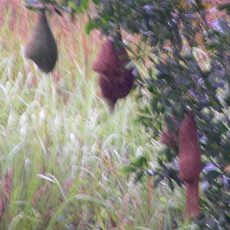
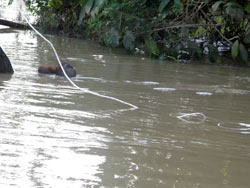
… is a dead Acacia? Not this time…. In the middle of a traffic interchange on the Guthrie Corridor just near Rimbun Dahan, a solitary Acacia is hosting about eight Baya Weaver nests (Ploceus philippinus). In a completely open space, surrounded by what Guthrie considers landscaping (a sparse sprinkling of non-indigenous palms) is one Acacia draped and decorated with these ingenious nests.

On showing it to my grandchildren, I speculated why they had chosen this site rather than elsewhere: it’s out in the open and predators are readily seen, there’s safety in numbers, they are surrounded by open land where grasses can grow, and that’s what they feed upon. According to Allen Jeyarajasingam they frequently nest in association with nesting red ants and hornets, and the characteristic nest is a neatly woven flask shaped structure with a long downward tubular entrance, suspended from branches. We were too far to see the birds, and it was raining, hence the bad photo quality.

Rather than cropping this photo, and in view of our coming exhibition entitled Tanah Air, I let it stand as a record of our common landscape: oil palms forever in the background (it used to be forest), cleared and cut land where nothing can grow except for the admirable lalang and Acacia, an invasive species from Australia, and highways. Welcome to the new Malaysia.

Opening of Lisa Roet’s Exhibition at the Annexe

Opening of Lisa Roet’s Exhibition at the Annexe
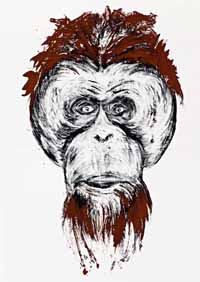
Above: ink on paper, 1500 x 1000mm

IN SIGHT: New Works by Australian Artist Lisa Roet 

Wed 4 to Sun 22 Mar, 11am to 7pm 
The Annexe Central Market

Presented by the Australian High Commission 
Admission Free   

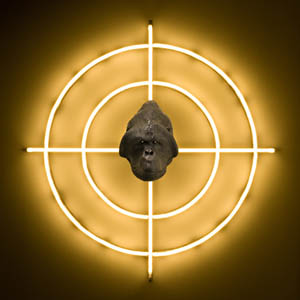
The Australian High Commission is proud to present In Sight, a solo art exhibition featuring new works by Australian artist Lisa Roet. Inspired by her lifelong interest in primates, Lisa’s neon and LED light sculptures, audio-video works and drawings address the demise of wild orangutan populations in Borneo. Also featured are a series of 10 portraits of orangutans that Lisa has worked with in zoos and laboratories over the past 15 years. This exhibition represents an exciting cross pollination between environmental awareness and contemporary art practices. In Sight is a sequel to two previous exhibitions held at the National Art Gallery in 2000 and 2001. 

Work by Lisa Roet

Opening Speech by Angela Hijjas

Congratulations to Lisa for creating such a challenging exhibition on such a large scale that we are forced to look at urgent issues. We think these things are peripheral to our survival, but in reality they are too big to ignore, and too big for us to escape unscathed…  

In fact it is our own future that is predicted by the fate of primates.  If they go, so ultimately do we; that may sound melodramatic but not so…  if endangered mega-fauna are lost it demonstrates our ambivalence to the issues of the state of our world. The short rationale is that if we cannot act soon on the degrading environmental situation, our habitat will be destroyed, by our own action, or inaction. Climate change is the single most threatening environmental issue in the world today, and protecting existing forests, the homes of these animals, is an essential part of a solution to that huge problem.

Recent political and economic changes that have been forced upon us may indeed lead to a new beginning of an environmental resurgence, I hope so. Because now is the time to begin to rectify the damage we have caused with our market based economics… forests must be protected and rehabilitated, poaching and hunting must be stopped, priorities on economic growth must be superseded by repairing our own environment and assessing other values apart from GDP. Health care, poverty, environmental degradation, water and food security, cultural development and many more issues are more important, they add to quality of life rather than the amount of money we have in our pockets.

Orang utan and baby stuck in a tree
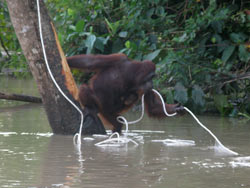
Orang utan accepting help with a rope
Orang utan swimming

I hope that Malaysians will see this exhibition and question what our government is doing for the protection of these primates and our national heritage to ensure the long term survival of our mega biodiversity… Unfortunately procrastination and corruption in the political and administrative processes have meant that the Malaysian environment has paid an awful price over recent years: illegal logging, trafficking in wildlife, fragmentation of our remaining forests, over fishing, clearing of land for indiscriminate development and plantations, unrelenting land fill… the list goes on. We must put a stop somewhere, and now that prices of our commodities have dropped may be, must be, the time to start.

To me, these strong works raise all of these questions. I remember one of Lisa’s previous shows at the Malaysian National Gallery after her residency there in 2000… she had created huge drawings of the anatomical details of orang hutan, larger than life sized hands, each hair, wrinkle of skin and torn nail exquisitely rendered in charcoal, and surrounded by Lisa’s own finger prints… small smudges that put our similarities and differences into a unique perspective. These works too link our lives to theirs, each is an individual, and we are so closely related.

When family tends to define who we help and who we don’t, I think these works make it quite clear: we are their family, they are ours, and it is our responsibility to do something about their place in the world. 

Just this week at WWF, I saw photos of a female orang hutan and her baby stranded up a dead tree in a flood. Orang hutans don’t swim, and she had been there for a week, according to estate workers who had seen her and reported her predicament to the WWF project officers, who came to see what could be done.  A rope was tied from the shore to her tree, another one was about to be pulled to reinforce it, but she decided one was enough and quickly descended, gripped the rope as she entered the water and pulled herself and baby across. Her intelligence cannot be denied, and her predicament mirrors our own. We must find the will to save her and all endanged species, and in doing so we will save ourselves, because unfortunately for us, when our environment becomes uninhabitable there won’t be anyone around to throw us a line. 

Thanks and congratulations to Lisa Roet for this timely and challenging show. 

Angela Hijjas
Rimbun Dahan 

Lynyrd Arwyn Paras

Lynyrd Arwyn Paras

lynyrd

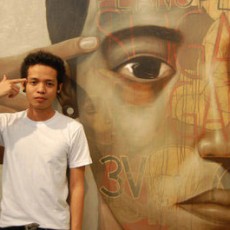
Painter Lynyrd Arwyn Paras from the Philippines stayed for a short residency at Rimbun Dahan from January until the end of March 2009.

Lynyrd Arwyn Villanueva Paras (b. 1982), graduated with a Bachelor of Fine Arts from the Technological University of the Philippines. Since then his work has been shown in numerous solo and group exhibitions in the Philippines and Malaysia. A finalist of the Philip Morris Philippine Art awards, Lynyrd also took second place in the Metrobank Art & Design Excellence competition in 2007, and received the grand prize in the First GSES Museum National Painting Competition in 2004. This is Lynyrd’s second arts residency, following a six-month stint at the Blanc Compound in Mandaluyong City at the end of 2008.

Lynyrd will return to Kuala Lumpur to take up the TARP (Taksu Artist Residency Program) in preparation for his fourth solo exhibition, at Taksu Gallery in September 2009.

February 2009 — Pied Hornbills and Ashy Minivets

February 2009 — Pied Hornbills and Ashy Minivets

by Angela Hijjas

A small group of Oriental Pied Hornbills (Anthracoceros albirostris convexus) has recently been seen around Rimbun Dahan. Like all hornbills, they have large bills topped with a hollow casque. This species is resident up to 150m, where it frequents forests, the forest edge, plantations and beach scrub. Although it feeds mainly on insects and other small vertebrates, it gathers in groups to feed in fruiting trees, as it did at Rimbun Dahan to feed on the fruits of Kelompang jari (Sterculia foetida).

Oriental Pied Hornbills are a noisy species, whose flight consists of rapid flaps followed by short glides. It is also remarkably tame — large groups can often be observed by vacationers gathering in beach-side trees on Pulau Pangkor.

In other bird news, Rimbun Dahan usually hosts a group of Ashy Minivets (Pericrocotus divaricatus) during the northern winter. The first two arrived on 3rd November 08, and more the next day. I have been observing them easing because the tree they favour was struck by lightning a few months previously, and has little vegetation. Fortunately there are three other trees close by of the same species, Terminalia bellirica, so the group of winter migrants had alternatives.

On the morning of 29th January, I saw an unusually large number, at least 25, in the same tree, with others flitting around and feeding on insects in the other trees. Then a second flock of possibly 40 birds (from the corner of my eye, I initially I took them to be mynas) flew past. Most of those in my tree took off and followed them, heading northwest. I suspect I witnessed the departure for the north – what a moment!

The Wknd Sessions recording at Rimbun Dahan

The Wknd Sessions recording at Rimbun Dahan

In February 2009, local music show The Wknd Sessions recorded a shoot of independent Malaysian musicians at Rimbun Dahan.

The Wknd Sessions is a weekly online music and interview show that focuses on the fast-growing Malaysian independent music scene. A self funded / independent project, you can view The Wknd Sessions online and via podcast, and now you can catch it on Xfm, 103.0 FM, every Saturday from 5 to 6pm.

The team from the Wknd Sessions will be back later this month to continue their shoot!

January 2009 — Copperhead Ratsnake

January 2009 — Copperhead Ratsnake

Our snake of the month is the Copperhead Ratsnake (Elaphe radiata Boie 1827), otherwise known as the Radiated Ratsnake. A fine specimen of this large non-venomous snake, over a meter long, was found this week in one of the artists’ studios.

Copperhead Ratsnake

According to Klaus Dieter-Schulz, who has published a monograph on the Elaphe genus, many snakes of this type are associated with water and swim very well, which has been confirmed with findings of the Copperhead Ratsnake far out to sea. It is thought that this helps them colonise offshore islands, and the snake is well distributed across Asia. Other typical ratsnake habitats include fallow land and scrub edges, interspersed with rubble and larger rocks, like abandoned quarries and refuse disposal sites. Many species of the genus also favour man-made environments, where they prey on newborn and subadult rodents. The Copperhead is sometimes encountered in piles of coconut shells, leading to its local name in Thailand of ‘Coconut Snake’.

When agitated the Copperhead Ratsnake assumes an interesting defence mechanism. It inflates the front half of its body, not width-wise like the cobra, but in height, meanwhile rearing up in an s-shape, in order to appear much bigger than it really is. “They literally dive towards the apparent aggressor with their mouth agape,” Dieter-Schulz writes, “The inflation of the neck causes the often differently coloured interstitial skin to become visible between the scales and the snake immediately assumes a different appearance.” However, if this attack is ineffective, the snake will also play dead, laying limp and motionless on the ground for some time.

Reference:
A monograph of the colubrid snakes of the genus Elaphe Fitzinger, by Klaus-Dieter Schulz, André Entzeroth. Published by Koeltz Sceintific Books, 1996.

A Delicate Situation

A Delicate Situation

banner

The contemporary dance work A Delicate Situation was created by Australian choreographer Lina Limosani. It was first developed during Lina’s Asialink residency at Rimbun Dahan in 2008, and was aso redeveloped with a short residency funded by Arts SA in 2012.  Lina initially worked with four Malaysian dancers to create the version of A Delicate Situation which was performed at Kuala Lumpur Performing Arts Centre, 12-14 December 2008.

A Delicate Situation (2008) was nominated for 3 awards at the 7th Annual BOH Cameronian Arts Awards:

  • Best Featured Performer — Elaine Pedley
  • Best Choreographer in a Feature-Length Work — Lina Limosani
  • Best Costume Design for Dance — Eve Lambert

Performance Notes

In the darkness, things are waiting. Their past is sorrow, their
future is pain, and their hunger cannot be satisfied.

In an empty house, a cold room, they cling tenaciously to the walls.

Are her fears normal, or is her imagination running away with her? Is
he a prisoner or merely insane?

Choreographed by Lina Limosani (and dancers)

Performed by Malaysian dancers Suhaili Micheline, Rathimalar Govindarajoo, Elaine Pedley and Low Shee Hoe
Sound design by Hardesh Singh
Costume design by Eve Lambert
Photography and graphic design by David Loke

12-13 December 2008 (8.30pm)
14 December 2008 (3pm)
Pentas 2, Kuala Lumpur Performing Arts Centre,
Jalan Strachan, off Jalan Ipoh,
Sentul 51100 Kuala Lumpur.

Supported by MyDance Alliance, KLPac, Asialink, Arts South Australia and Scottish Arts.

Promotional Images

Photos by David Loke

In Rehearsal

Photos by Bilqis Hijjas.

Media

Check out the photos of ‘A Delicate Situation’ in performance, taken by Philip Craig.

November 2008

Photo: Lauren Black

November has been wet. Last night we had 35 mm of rain in an hour, and over the month a total of 437 mm, and still one day to go. Since we started recording rainfall in 2005, the wettest month ever was in November 2006 with 446 mm, and November 2008 may yet be more. A pity we can’t export to Australia…

A snake was found this morning on the road, apparently washed out of a tree and drowned in the deluge (picture below). It has been identified as a White-Spotted Slug Snake, Pareas margaritophorus, another new addition to the snake population at Rimbun Dahan. Lauren Black, whose room is in the guest house, had a tiny Paradise Tree Snake, Chrysopelea paradisi, on her balcony the other day, poking its head up through the floor slats (see images at right).

The population of macaques is thriving, but causing some damage to new plantings, although like the birds they feasted on buah salam, Eugenia pseudosubtilis (see image below left) . The newly planted Dipterocarpus crinitus, keruing mempalas, have had to be caged as the monkeys constantly pull off the new pink shoots thinking it is something to eat. Other Dipterocarps, like the Shorea gratissima, left, are establishing well. A new addition to the Dipterocarp collection is Shorea henryana, pictured at right.

It has been hard to find any colour in the garden with the constant rain, but the flowering ginger Hedychium coronarium (below right) is fruiting, and the Ixora schortechinii (below middle) is flowering; one must search the whole 14 acres for these small flashes of colour.


The birds, though, make up for this. The birding has been excellent this last month, made even better with the perch provided by a dead tree in front of the house. ‘Lifers’ in the last week were a Ruddy Kingfisher, Halcyon coromanda, and a Red-bearded Bee-eater, Nyctyornis amictus (right) and there was much excitement among the staff when four Oriental Pied-Hornbills, Anthracoceros albirostris, (left) perched on said dead tree for a few minutes.

October 2008 – New Planting

October 2008 – New Planting

BY ANGELA HIJJAS

The main objective in the planting programme at Rimbun Dahan is to develop the highest canopy possible, not always easy when trees tend to branch out as soon as they reach clear light. To encourage monopodial structure for as long as possible, we prune side branches and force the trees up by dense planting. Inevitably this has made them the tallest structures in the neighbourhood, apart from the DiGi tower on an adjacent block, and they are vulnerable to lightening. Two trees were lost on different occasions, a durian on the right-hand side and a Sterculia (fortunately not an indigenous species). We lose four or five trees a year, but then we have an open space where we can plant something else, in a ready-made ‘tube’ for rapid vertical growth.

The notes on Shorea sumatrana last month generated an interesting response on its rapid growth, spurring me on to measure more of Rimbun Dahan’s dipterocarps, although not all of them have a definite planting date. The following species have been measured this month, and the dates of planting noted where they are known. Measurements are in inches GBH, or girth at breast height.

1992, Shorea materialis, balau pasir, 10 saplings were planted in a sandy area of the garden and now measure between 18″ and 58″. There is no apparent reason why some have done better than others, but it seems where there is under planting and the trees are perhaps less disturbed they do better, but this is not always the case… the biggest of them all is out in the open.

Sizes of the ten trees are: 18″, 20″, 30″, 38″, 43.5″, 44″, 46″, 46″, 50.5″ and 58.5″.

A Terminalia foetida planted in the same vicinity at the same time measures 55″.

Three Hopea nutans, also planted at that time, or earlier, measure 30″, 21″ and 25″. Another four planted a few years later, measure 17″, 17″, 17″ and 15.5″. Planting dates are uncertain.

Beside the dance studio there are three Dipterocarpus dyeri trees, planting dates unknown, and they now measure 46″, 51″ and 52.5″. There is one 44″ Hopea nutans in the same area.

Three Dipterocarpus baudii planted in 1990, now measure 34″, 36.5″ and 28″. The last fell over at some point and was tied up to other trees for support, so that must have affected growth.

The row of Hopea odorata planted along the front drive in 1990 vary in size, the biggest being a princely 68″, but the others vary leading me to think that some seedlings are less successful than others.

Five Shorea roxburghii were planted in 1996 and they now measure between 31″ and 50″ (31, 33, 38.5,48.5, 50).

The following are not dipterocarps, but have done well:

A row of ten jelutong, Dyera costulata, was planted in 1999, but only six survive. Their dimensions range between 24″ and 50″ (24, 37, 42, 44, 47, 50).

Five ipoh trees, Antiaris toxicaria, were planted in 1989, and they measure between 53″ and 85″ (53, 59, 62, 62, 85). The 59er was struck by lightening about 5 years ago but recovered.