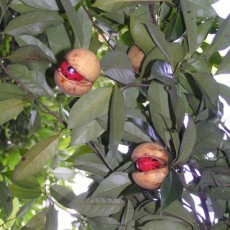
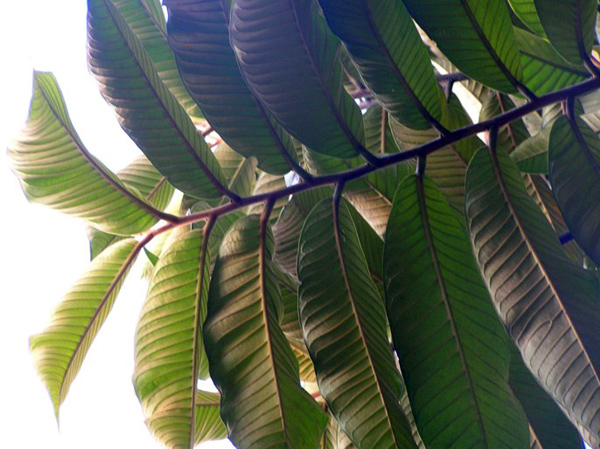
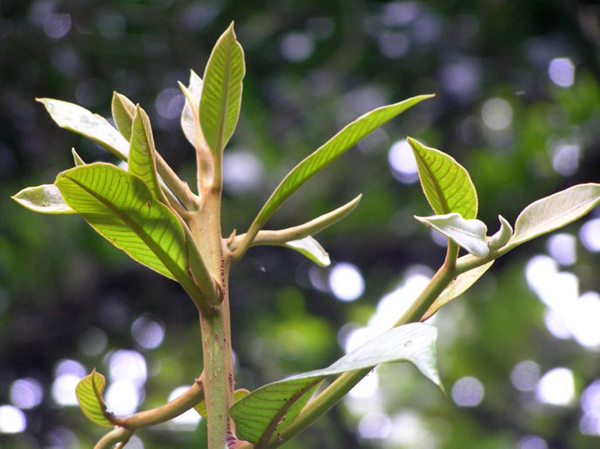
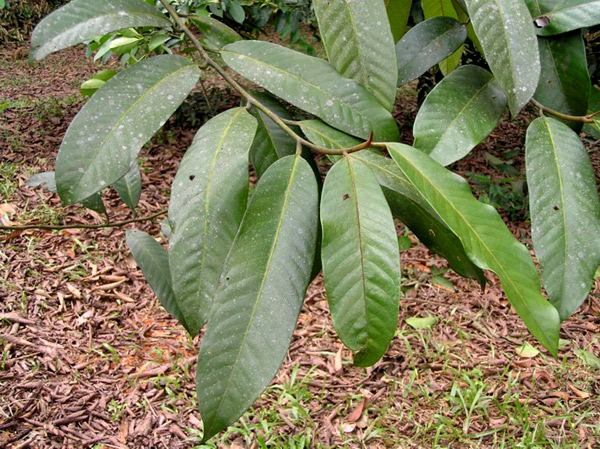
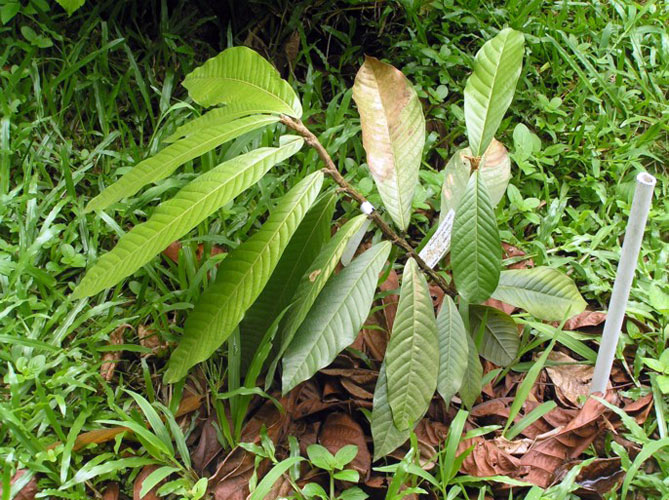
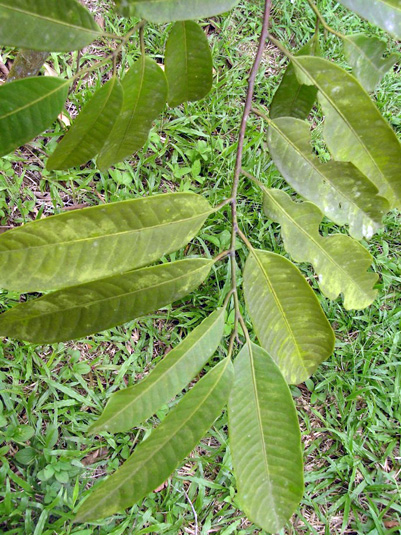
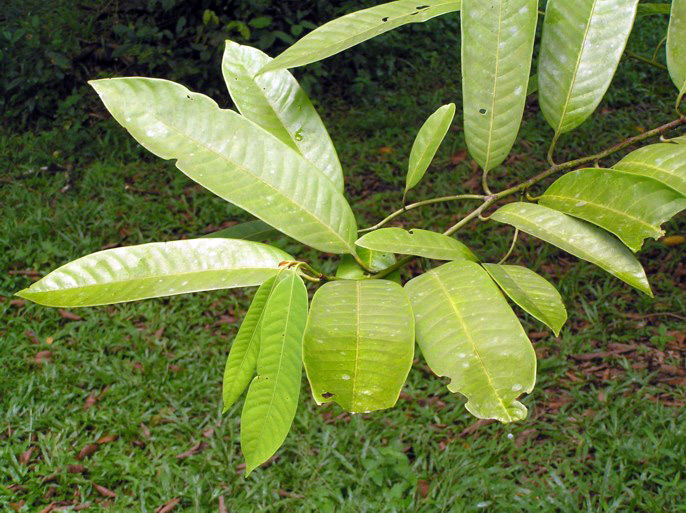
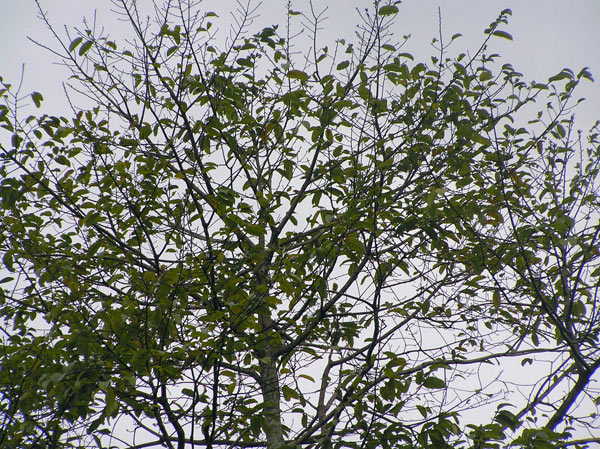
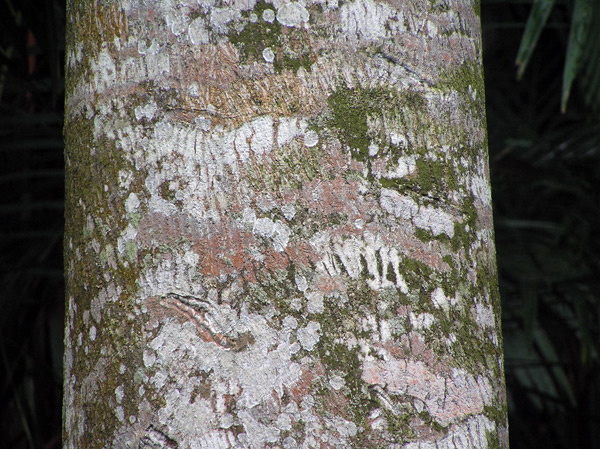
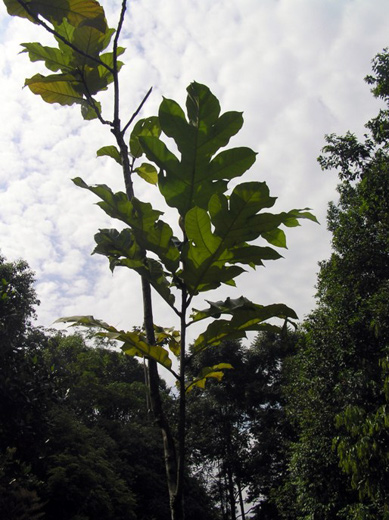
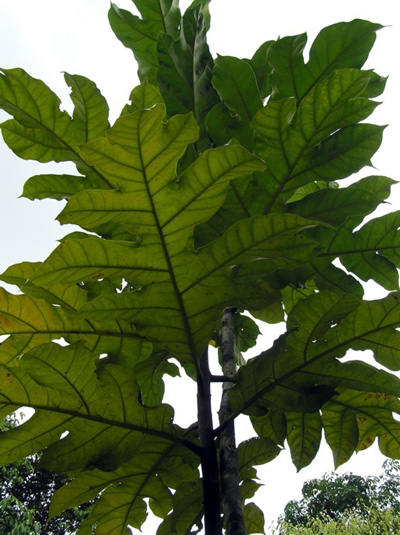
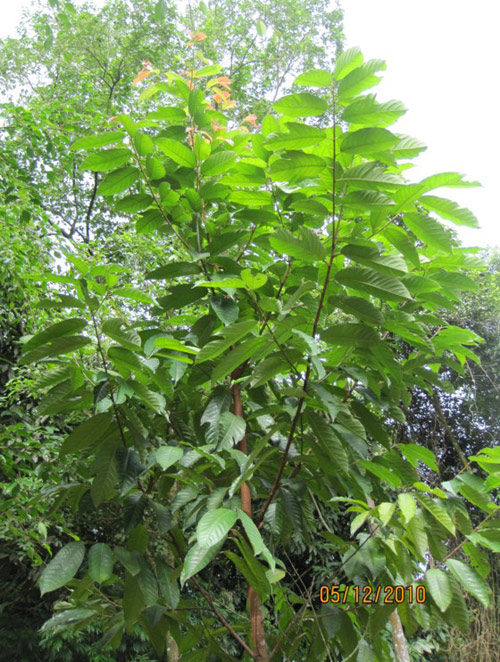
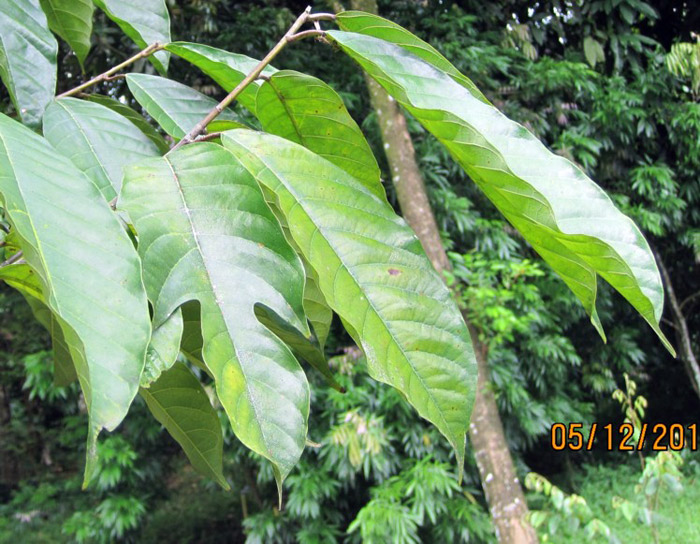
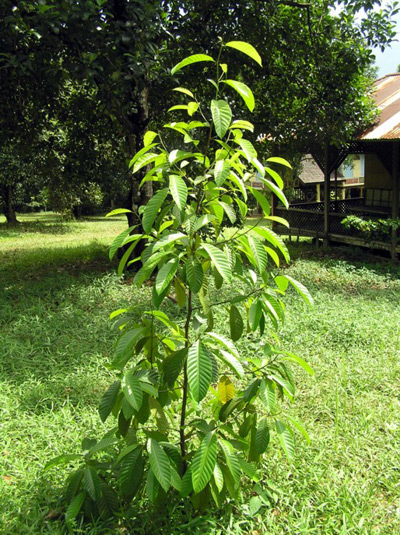
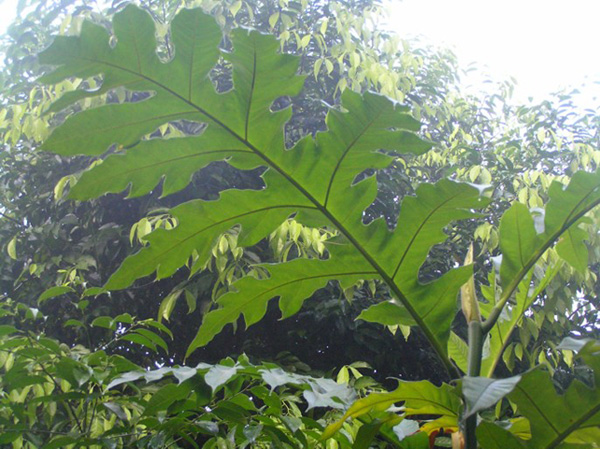
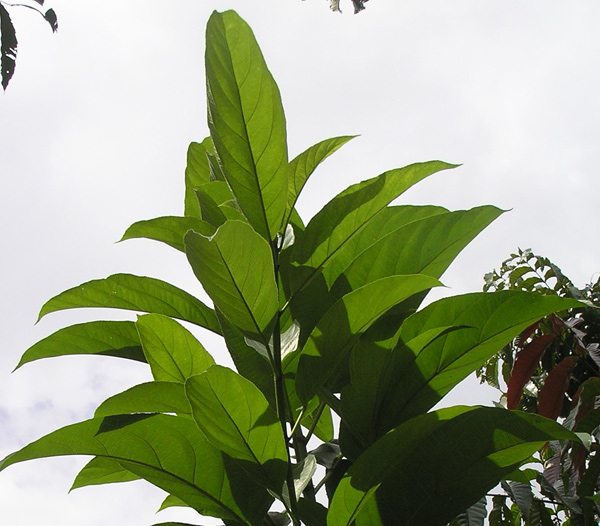
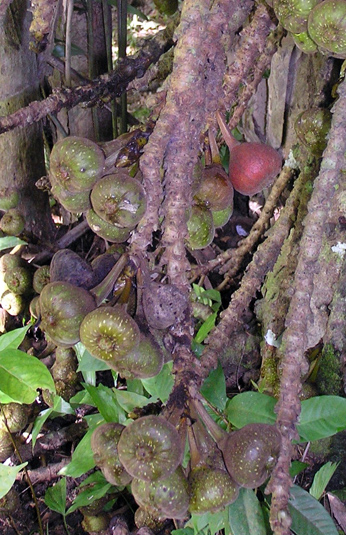
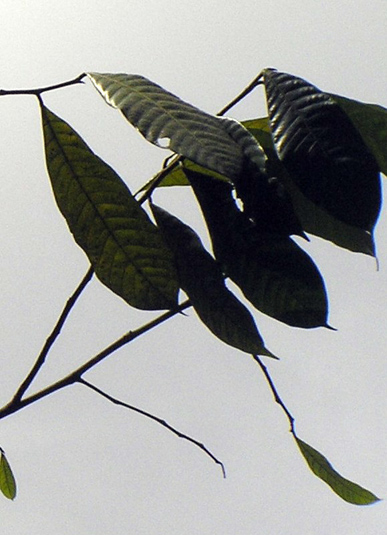
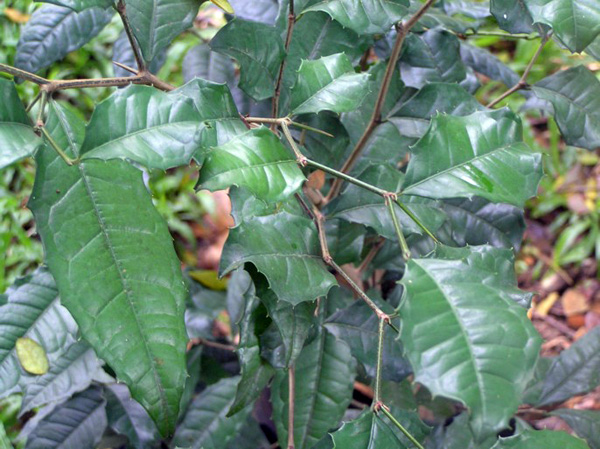
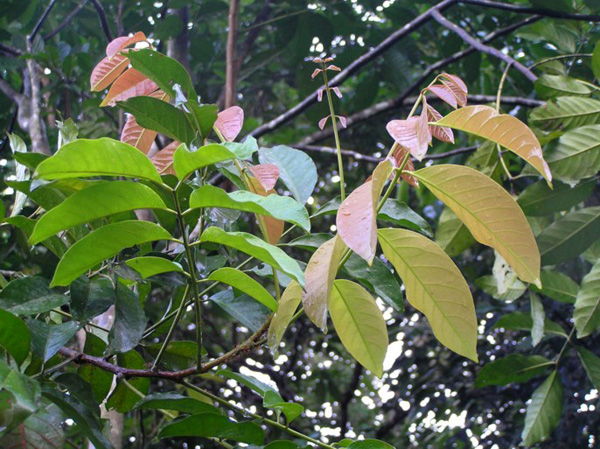
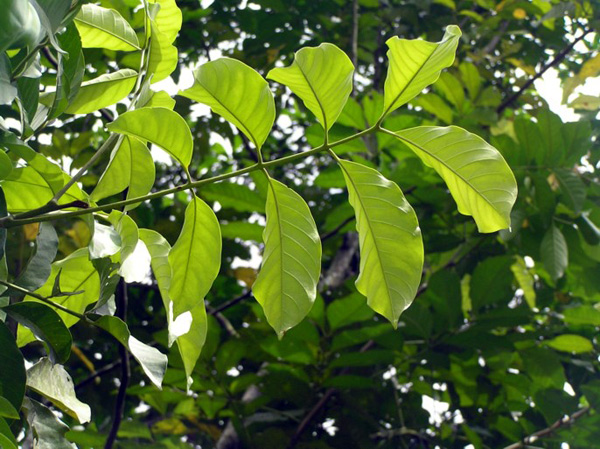
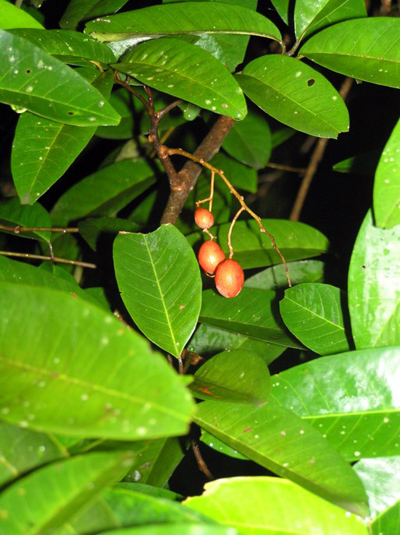
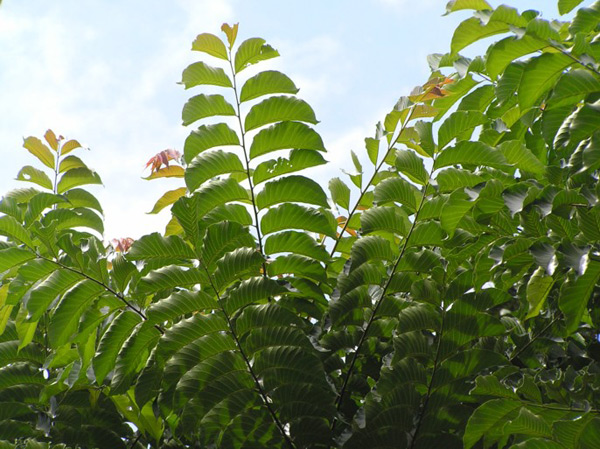
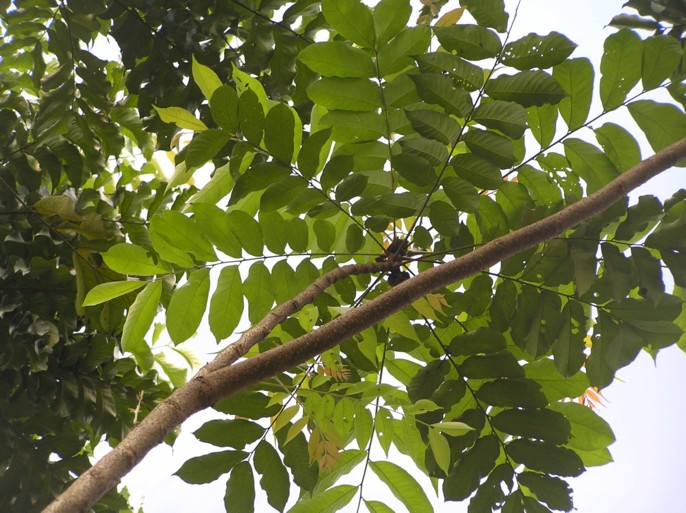
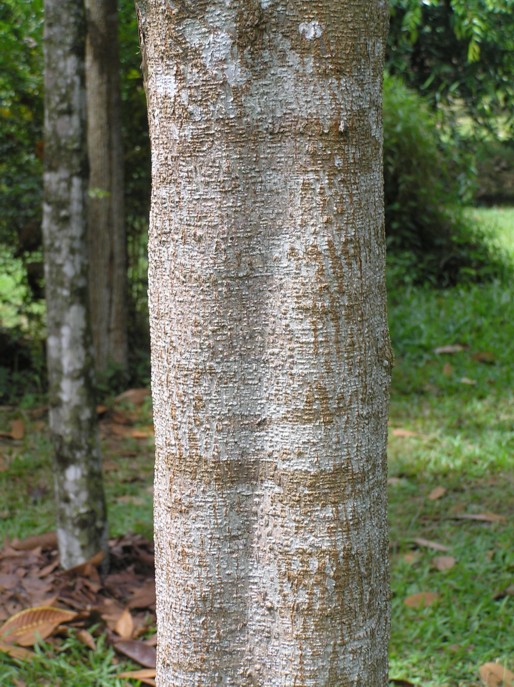
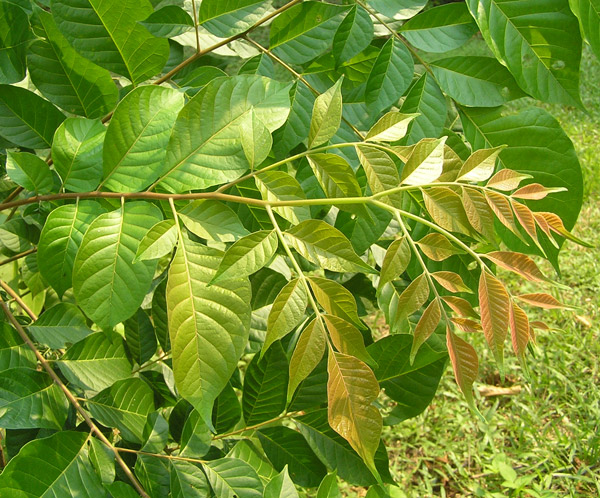
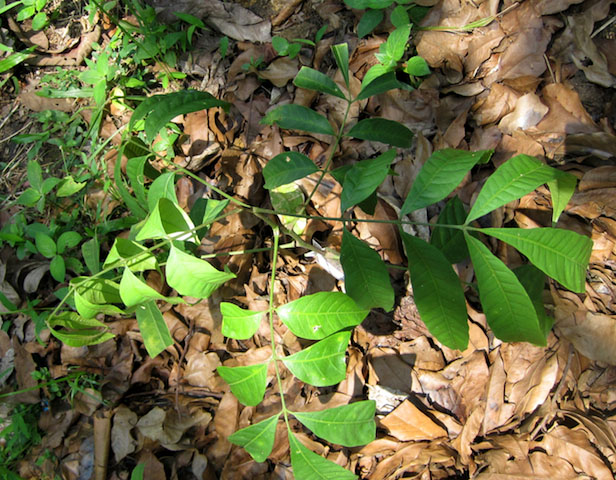
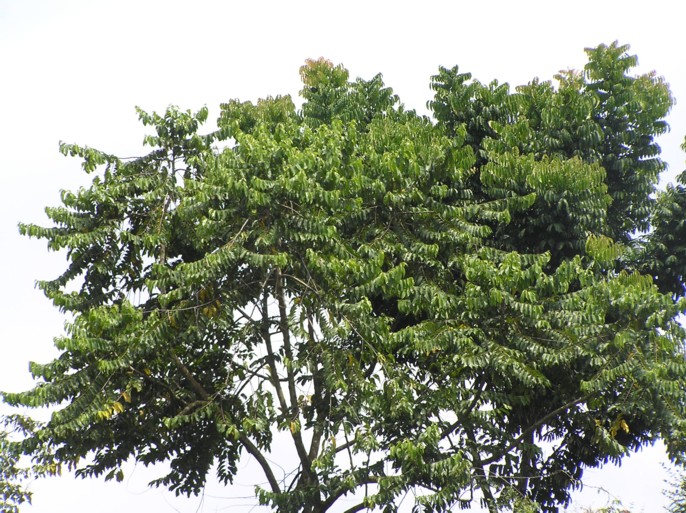
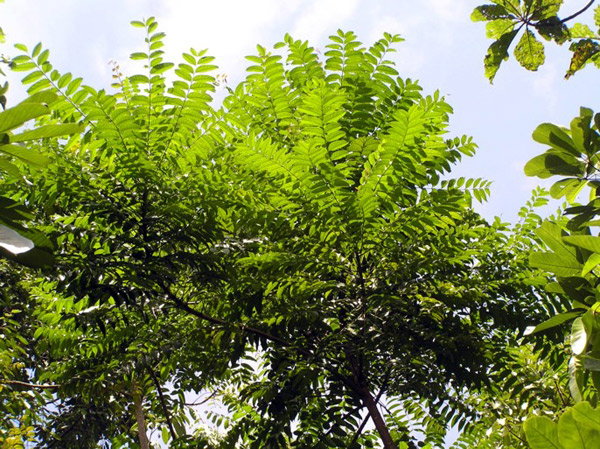
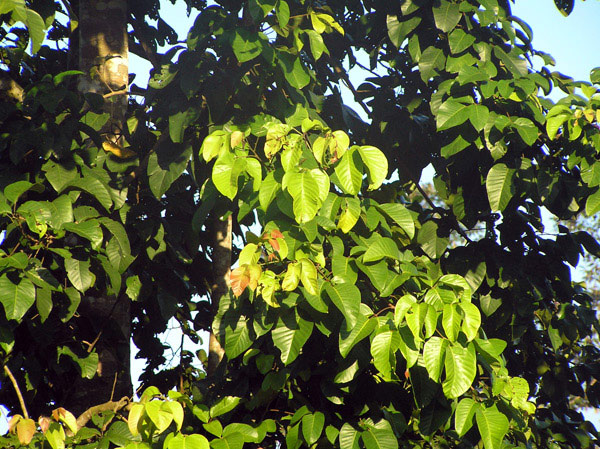
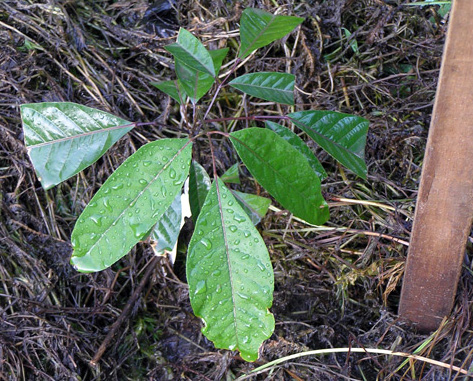
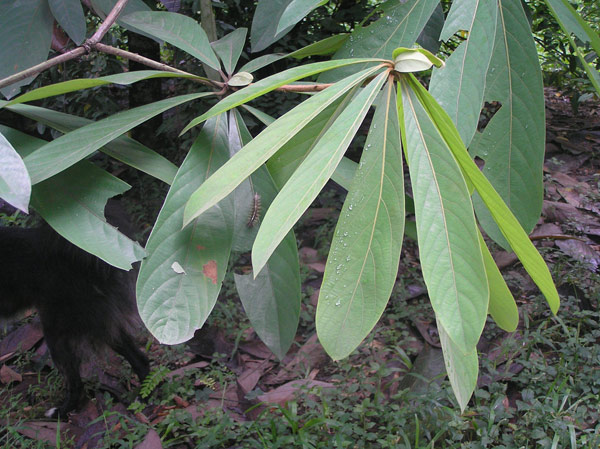
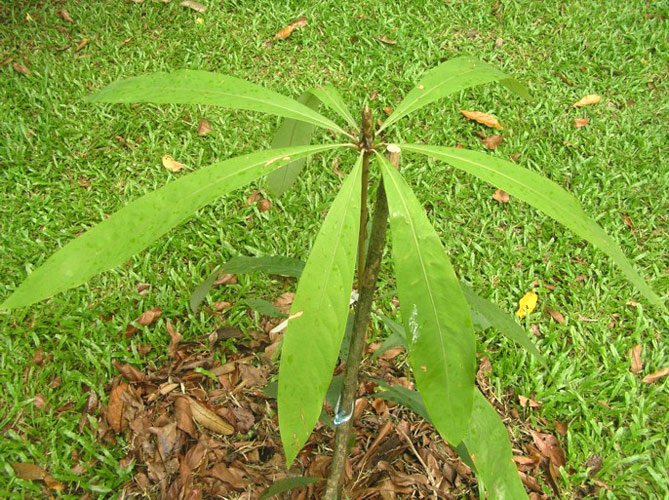
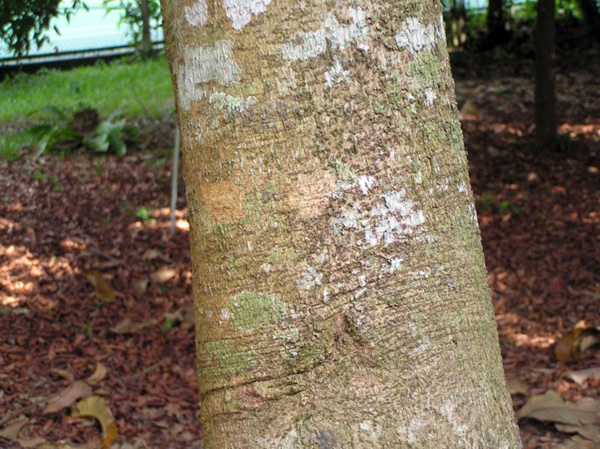
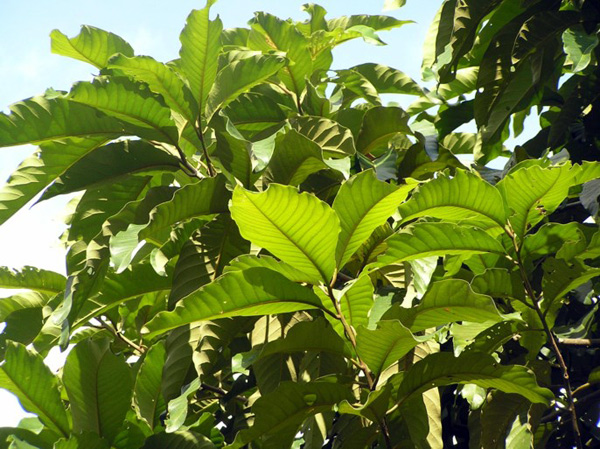
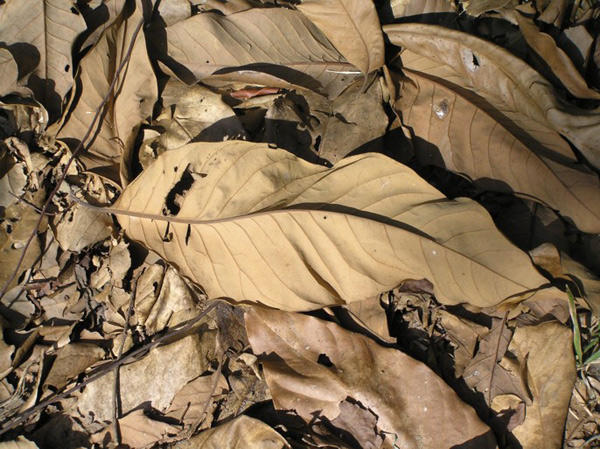
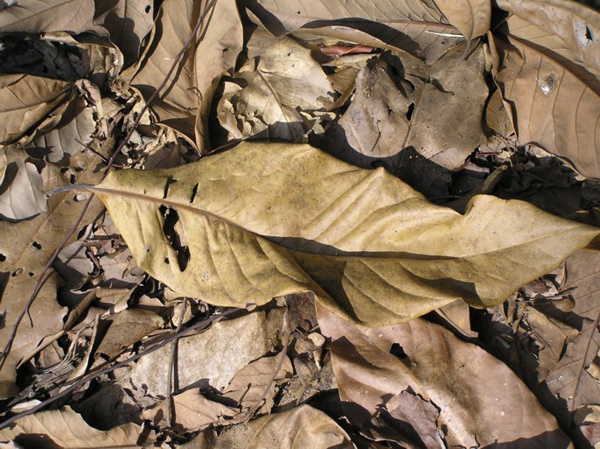
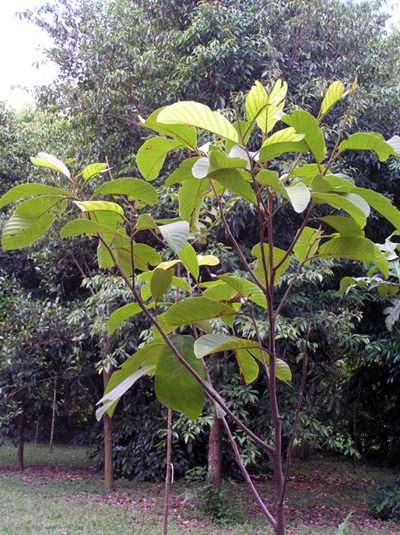
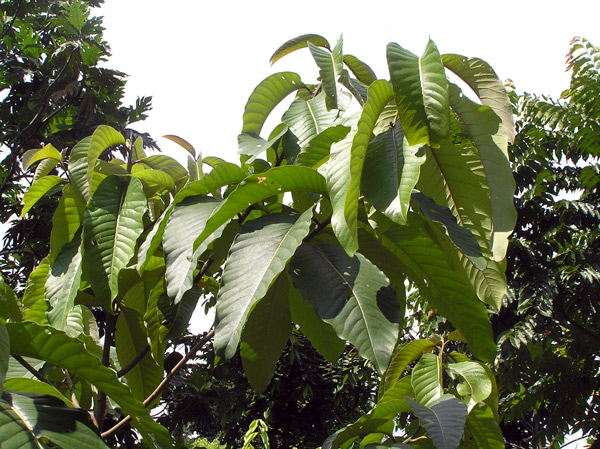
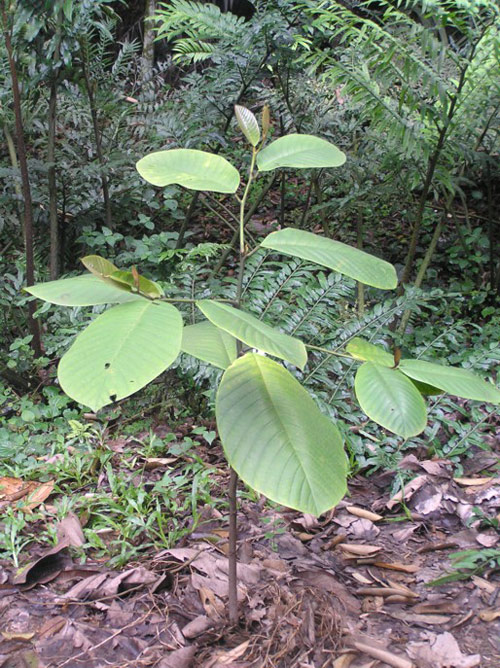
Horsfieldia superba (or Harmsiopanax sp.) MYRISTICACEAE (or now ARALIACEAE) cabbage leaf nutmeg Medium to big tree, up to 100 ft., young twigs and leaves rusty wooly. Not infrequent throughout Malaya in lowland forest.
Horsfieldia sucosa samak pulut, penarahan gajah Tree to 25m, common, scattered through Malaya, endemic. Lowlands & hills, undulating & plains. Leaves spirally arranged, crowded at twig tips, fruit pear-shaped 3 x 2″, pink, shiny, succulent. Lat sucosus, juicy. 1 fr TH 11.09
Horsfieldia tomentosa (or Harmsiopanax sp.) MYRISTICACEAE (or now ARALIACEAE) penarahan Lowlands to mts. Flowers appear as bunches of tiny yellow or orange grapes from the branches behind the leaves, citron-fragrant. Fruit med-lge, with juicy rind, yellowish-green to orange or pink, aril completely covering the seed.
Knema hookeriana
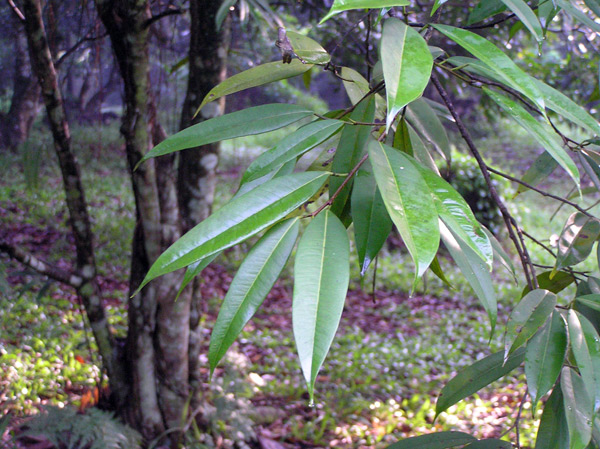
penarahan arang Malaya, Sumatra. Slender tree to 30m, crown deep, dense, conical, branches droop, foliage pendent. Leaves v. long, flowers large, fruits big ellipsoid, woolly, red aril. Twig tips wooly. Possibly the commonest wild nutmeg in Malaya.
1 new specimen from Johor, June 2008, pictured below.
Myristica fragrans pala, nutmeg Maluku. Fruit is pickled as food. Shoots eaten as vegetable with rice to treat hypertension. Red mace for flavouring fish and cakes. Seed kernel gives commercial nutmeg. Oil is medicinal and used to flavour tonics.
Myristica gigantea penarahan arang Borneo, Sumatra, Malaya. Common lowlands, hillsides to 200m. To 50m spreading plank and flying buttresses, stilt roots, fissured black bark. Fruit scurfy, endosperm contains oil and starch.
India, S. China, Malesia. Scattered in lowland forest in Malaya. Sap an important ingredient of arrow poison. Bark grey, slightly fissured. Male and female flowers on same tree, male on lower twigs, females grouped in leaf axils. Fruit pear shaped, pulpy, crimson to black.
Artocarpus anisophyllus keledang babi
The family includes cempedak and nangka; this species rare, in lowland forest of Negri Sembilan, Johor, Sumatra to Borneo. No other plant has leaflets arranged in this manner: large and small in regular order.
Artocarpus glaucus terap
Sumatra, Borneo, Java, Malaya. Small tree to 18m, underside of leaf glaucous. Uncommon in hill & lowland forest. 1 fr TH 11.09
Artocarpus lanceifolius keledang
Widely distributed in Malaya but not abundant. Sumatra, Banka, Rhiau. Medium to tall trees, bole with short buttresses, often hoop marked. Seed covered with bright orange edible aril. Wood used for heavy construction and Chinese coffins.
Artocarpus nitidus spp. griffithii tampang
Siam, Indo-China, Sumatra, Borneo. In Malaya frequent in lowland forests, occasionally in villages. Medium tree, bole w/ short buttresses. Inflorescence solitary or paired in leaf axils, edible but gummy fruit w/ bright pink flesh.
Artocarpus rigidus temponek, tempunai
Frequent in lowland & hill forest all SE Asia. Thick white latex in all parts, juvenile leaves lobed. Flowers unisexual, male (smaller) & female heads on same tree. Fruit up to 15 cm Ø, ripening orange, stiff conical spines (Latin name).
Artocarpus scortechinii terap hitam, nangka pipit
Sumatra, Lingga. Scattered throughout Malaya in lowland forest. V. similar to A. elasticus but bole darker, leaves not so large; upper surface of leaves glabrous, lower densely hairy.
Ficus hispida ara
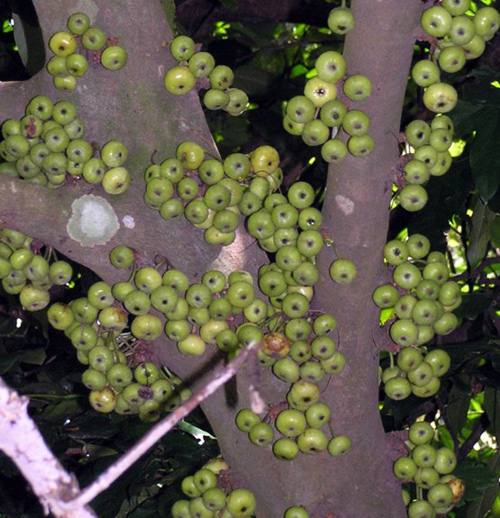
S. Asia to Australia. Common in the middle or north of Malaya, but not reported south of Selangor. These self-sewn. Twigs, leaves and figs set with short bristly white hairs. Figs on leafless hanging twigs from the trunks and main branches; ropes of figs up to 90 cm long, sometimes trailing on ground. Figs with 7-9 deeply coloured faint ribs radiating from the mouth, ripening greenish yellow.
Ficus fistulosa ara
India, s. China, Malesia. Very common. Small tree to 15m. Young twigs hollow, easily broken. Figs borne in clusters on woody knobs on trunk and main branches, ripening pale yellow.
Ficus maclellandii ara
Assam, Burma, Thailand. Listed by Corner of local interest in Perlis: “By the road at Bukit Ketri, where guano is collected from the precipitous sides, there is a large but rare strangling fig.” Twigs dark brown with white spots.
Ficus roxburghii ara
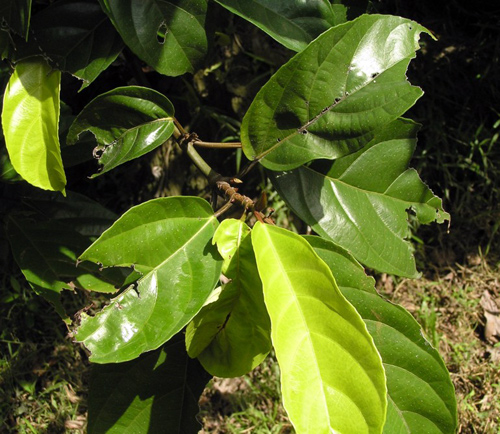
Himalayas, South China, Thailand. Figs have latex, twigs marked with ring like scar at each node. Stem fig with large leaves and large reddish figs in short ropes from the branches to the base of the trunk. Edible fruit of these specimens sterile as it lacks its fertilizing wasp.
Ficus roxburgii is the most palatable fig to humans, but being a native of Burma in Malaysia it lacks the essential wasp to render it fertile. One fruit has been half eaten by bats.
Ficus sp. ara
Twigs with ring stipule scar at each node. Latex. Flowers small, 3 kinds: male, female and gall (sterile female on which wasp develops) set inside fleshy figs. Huge genus, each sp. having unique wasp (Blastophaga), female exits fruit (male dies inside) after mating carrying pollen & enters another fruit to lay eggs in gall flower.
Morus alba Indian mulberry, besaram
North India. Leaves fed to silk worms or cattle. To Chinese, all parts medicinal: restorative, tonic & astringent for nervous disorders. Young leaves good for nursing mothers. Leaf decoction treats the blood, gonorrhoea, & poisoned wounds.
Prainea limpato var. longipedunculata from Sumatran name limpatoe
V. rare, from Ulu Gombak FR, Selangor. Dioecious trees, male head w/numerous flowers, female head has fewer. Peduncles (female flower stem) of this var. up to 25 cm long. 3 new specimens Dec 2007.
Streblus elongatus tempinis
Malaya, Sumatra, Borneo. Frequent in open country, often coppiced. Bushy evergreen tree to 15m, high rounded crown. Young leaves pinkish brown, flowers in hanging green spikes or catkins 3-8″ long, singly or 2-4 together in leaf axils. Ripe fruit sweet.
Lowland forest throughout Malaya, from Burma to the Solomon Islands. The lower leaflet surface is covered by white or pale brown peltate scales which gives them a silvery appearance.
Aglaia coriacea
kiat
Thailand, Sumatra, Java, Borneo, Philippines. Lowland hill forests to 1,000m. Small tree to 10 m, twigs slender with dense reddish brown stellate haris, dense on the midribs, less so on the veins. Fruit to 2cm diameter, one seed.
Chukrasia tabularis
surian batu
Single sp. China, India, Indonesia, thru Malaya. Colonizes open areas, exc. south. Big (to 40m), deciduous. Leaves asymmetric, white flowers, fruit woody capsule. Lat. flattened, ref. to seeds.
Dysoxylum cauliflorum Hiern
Common in W Malesia. Tree to 30m, flowers creamy white very fragrant, spicate, appearing on older branches. Fr Tunas Harapan 6.2012.
Melia azedarach
mindi kecil, Persian lilac
Nowhere wild, foothills of the Himalayas? Cultivated for scent and shade. Arabs and Persians use leaf juice as vermifuge and diuretic. Used as fish poison, 6-8 seeds will kill a man. Poultice of leaves used for headaches, of flowers kills lice.
Melia excelsa sentang
Malaya, Sumatra, Borneo to New Guinea. Often in villages north from Malacca, occasionally in lowland forest. Tall evergreen tree to 50m, leaves tufted at end of long sloping branches. Leaves edible, but bitter. Good timber for houses.
Melia indica
neem
Wild in India & Java, otherwise cultivated for medicines. All parts of tree effective. Dried leaves in books deter insects. Identified by delicate and curiously curved toothed leaflets. Root bark for fever and anti-malarial, leaf poultice for ulcers.
Sandoricum koetjape sentol
About 5 species, all in Malaya in lowland forest. Leaves trifoliate, flowers green slender panicles fruit large, round, fleshy, not splitting. Tree to 50m tall, buttressed when old. Bark smooth with faint raised circular patterns.
Walsura pinnata
bekak
Indo-Malesia 14 spp, 2 in Malaya. Perak, Melaka, Johor, Selangor, Pahang. Small tree to 20m. White flowers in panicles, fruit dull green, oblong to 2cm with 2 seeds, reported poisonous. Seeds dispersed by birds.
Actinodaphne macrophylla medang payong Malayan lowland to mountain forests; very common at Frasers Hill. Java. Twigs reddish brown hairs, leaves in whorls of 6-12, reddish brown hairy below.
Actinodaphne sesquipedalis medang paying, pedalis Tenasserim to Borneo. Widely found thru Malaya. Leaf under yellowish brown hairy, apex usually pointed. Fruits poisonous?
1 from Elango 6/08
Cinnamomum mollissium medang wangi Endemic, common, except in Kedah and Perlis. All species have aromatic crushed leaves, this one distinguished by hairy leaves and twigs.
Cinnamomum verum kayu manis, cinnamon India. Cooking spice. Roots treat rheumatism and fever. The tree bark is used in many medicinal powders and tinctures, tonics for diarrhea and colic.
Litsea castanea medang About 400spp., thru tropics, except Africa. In Malaya, 54 spp. Sumatra, Borneo, Java. Common in Kota Baru and widely distributed. Tall tree, to 33m, bole with spreading thin buttresses to 1m ht. frequently coppiced for construction material. Bark reddish, smooth with horizontal rings. Large leaves, completely deciduous in the north.
Litsea myristicaefolia medang asam, medang baros, medang kelaya Widely distributed from mountain to lowland forests, Burma to Singapore. Leaves alternate, spirally arranged, midrib sunken above. Flower clusters from leaf axils, fruits 1cm globose white with green perianth cup.
1 fr TH 11.09
Litsea robusta medang About 400spp., thru the tropics except Africa. In Malaya, 54 spp. Burma, Java. Tall, to 36m, bark fawn smooth w/many corky lenticels. Leaves spirally arranged, uncommon, on low hills by streams. Acorn hemisphere, green ripening blue.
Clerodendrum bungei (Previously Clerodendron bungei in Family Verbenaceae) China. Cultivated. Many tropical species from this genera are attributed with spiritual & magical properties.
Clerodendrum fragrans (Previously Clerodendron fragrans in Family Verbenaceae) popkok rabu kambang, exhilaration tree China. Used by Malays for rheumatism and ague, or with other substances for treating skin diseases.
Clerodendrum paniculatum (Previously Clerodendron paniculatum in Family Verbenaceae) panggil panggil Burma, s. China to Java, but not known in the wild. Summons spirits. One of the plants used to sprinkle tepung tawar in weddings, blessing fish stakes & ‘in the taking of the rice-soul’ (Burkill). Infusion is purgative. Elephant medicine, to protect them from harm.
Peronema canescens (Previously in Family Verbenaceae) sungkai Malaya, Sumatra, Java, Borneo. Common in secondary forest and near rivers and clearings in primary forest. Small tree. Compound leaves increase in size from basal pair upwards, leaflets sessile, young leaves rich purple.
Premna foetida (Previously in Family Verbenaceae) buas buas Malay peninsula, Java, Borneo. Straggling shrub, twigs and stalks finely hairy. Coastal forests, used to treat fever, asthma.
Tectona grandis (Previously in Family Verbenaceae) jati India, Siam, W. Malesia to the Philippines, not wild in Malaya. Large deciduous tree, prefers open monsoon forest where a dormant period is forced by dry weather. Flowering and fruiting after new leaves emerge with wet weather.
3-8pm,7-8 August 2010 Entrance free to the general public.
In the midst of a 14-acre indigenous Malaysian garden, and in the shade of contemporary and traditional architecture, 13 Malaysian and international choreographers presented a collection of site-specific contemporary dance works for Dancing in Place.
The 2010 theme for Dancing in Place was Cross-Pollination. It encouraged choreographers to consider how difference – working with artists from other disciplines, working with people from other cultures or abilities, or working in new environments – creates the potential for rich and vigorous hybridities.
Performers at Dancing in Place this year included Kristine Nilsen Oma (Norway), Elysa Wendi (Singapore), Donna Miranda (Philippines) and Scarlet Yu (Hong Kong), as well nine choreographers from Malaysia including Rathimalar Govindarajoo, Gan Chih Pei, Nurulakmal Abdul Wahid, Muhaini Ahmad, Leng Poh Gee, Fahmi Fadzil and January Low.
‘In Spirit’, staged at Rimbun Dahan by choreographer Rathimalar Govindarajoo on the lawn in front of the art work ‘Sixty Turns.’
SCHEDULE
Time
Item
3pm
Arrival & introduction
3.15pm
The Campus ThoughtChoreographed by Leng Poh Gee & Kathyn Tan Chai Chen
Performed by Lim Siew Ling, Lim Hooi Ming, Lim Shin Hui, Tan Shiao Por & Pan May Tzy
A work by LAPAR LabAt the same time we are doing this particular performance, a batch of new graduates of the dance degree from University of Malaya is celebrating their graduation. We sincerely dedicate this performance to those who are ready to embark upon their journey into professional dance society, and wish them luck.
3.30pm
13 Knots to HomeCreated and performed by Scarlet Yu Mei Wah
Having left her home in Hong Kong ten years ago to live in Singapore, Scarlet Yu has moved from one room to another, one house to another, in a foreign land that has accepted her as an adopted child. In the past ten years, she has made exactly thirteen trips back home to Hong Kong, only to feel more and more distant from the place she once regarded as home.
3.45pm
Dreams InterruptedChoreographed by Elysa Wendi (Singapore)
Performed by Ren Wei ChenInspired by the Kun Opera Peony Pavilion, choreographer Elysa Wendi
investigates the idea of intangibility and the power of dreams in our life. Dreams
interrupted is performed in a series of 5 short segments. Like a dream that happens over a number of days, the audience will slowly find out the full story at the end.
3.54pm
In SpiritChoreographed by Ramli Ibrahim, reworked by Rathimalar Govindarajoo
Performed by Michelle Chang, Revathi Tamilselvam, Sivagamavalli, Tan Mei Mei, Divya Nair, and Rathimalar Govindarajoo.An ode to women who celebrate the rhythm of life.
4.15pm
KapayapaanChoreographed and performed by Wong Oi Min & Gan Chih Pei
Music by Razali bin Abd. RahimA piece about the celebration of life, conservation of nature and cultivation of compassion.
4.40pm
Similar
Choreographed by Nurulakmal Abdul Wahid
Performed by Ahmad Zaki B. Mu Salleh @ Musleh, Muhaini Ahmad & Nurulakmal Abdul Wahid
A man wears women’s clothing, but he is not a woman. No matter how much he imitates her lovely or sexy movements, he can only be similar. He is only an outline. She fills in the gaps.
4.55pm
ChimeraCreated by Kim Kyungmi, Sasha Ratnam & Mathieu Castel
Performed by Kim Kyungmi
Music by Mathieu CastelIn the quirky circle of life, we begin as simple cells awakened by meeting each other. Moulded by genetics over which we have no control, we evolve and mutate through human socialisation, finally leaving nothing behind. No predictions, rules or even will can exist in this cycle of energy. The same clone but different mutants, we are born and fade away within this energy of evolution.
5.10pm
Divide & ConquerChoreographed by Fahmi Fadzil
Performed by audience volunteersMalaysians love polls. Malaysians love being together. Let’s see if this “poll” performance can keep people together. Or not.
5.20pm
Intermission
5.40pm
SweetChoreographed & performed by January Low
Music by Reza Salleh
6.05pm
AchilotCoordinated by Elaine Pedley
Assisted by Muhammad Syaffiq bin Hambali
Choreographed and performed by the young participants of the Rimbun Dahan Dance WorkshopThe workshop is based on basic movements pieced together by the kids through
games and exercises. The focus is on play, hence achilot, a Malay term for various children’s games.
6.30pm
Biji IIChoreographed by Chai Vivan
Performed by Fione Chia Yan Wei, Caren Yap Chai Wen, Denny Donius, Chew Sie Theng, Sufi Asyraf b. Mohd Azman, Woo Yan Ten & Anna Lee See Wan.Something small springs into growth. From the seed comes life.
6.50pm
Anything less is less than a reckless actChoreographed and performed by Donna Miranda
Dramaturgy by Angelo V. Suarez
Featuring (on video) PJ Rebullida & Marah ArcillaTo go to the theatre, to go shopping, to watch a dance performance or the latest Hollywood movie—any aesthetic experience is informed by a decision-making process. This entails a necessary foreclosure: to choose one experience means not experiencing another. With the use of two rooms that cannot be experienced by the audience simultaneously—one with a video featuring two dancers in a duet, another where Miranda talks about the video’s context—Anything less is less than a reckless act allows room for participation. This in turn exposes the futility of the concept of participation in theatre, a prohibitive system designed to distinguish performer from audience. To risk the audience’s subjectivity by giving them a measure of activity is to risk theatre itself.
7.40pm
Marilyn Monroe’s last 20 minutes before committing suicide
Created and performed by Kristine Nilsen Oma
Video art by Kok Siew Wai
The work is an experiential exploration of the Buddhist concept that earthly desires can lead to enlightenment. The work is a response to meeting a whole new environment and culture, and a personal quest to understand both my own desires and how to make them come from a higher perspective. In the context of the Third World certain neuroses becomes ridiculous. Yet they were created as a response to the Western world I have lived in all my life. How do I cope in the Third World? How will my neuroses behave? Is there a control in this experiment?
This last item is not appropriate for children.
Artists in Dancing in Place 2010 observing the performances from their green room.
Burmese visual artist Khin Zaw Latt was resident at Rimbun Dahan in May 2008. Following his residency, he returned home where he was awarded the first prize at the Myanmar Contemporary Art Award 2008 competition, a prestigious achievement which has greatly increased the selling price of his work in Myanmar.
Khin Zaw Latt then travelled to Laputta, in the Burmese south, an area devastated by Cyclone Nargis at the beginning of May. Armed with a donation from Rimbun Dahan, he provided the inhabitants of Laputta with aid in the form of clothes, food and help building houses, as well as books and school materials for children.
The work by Khin Zaw Latt which won the Myanmar Contemporary Art Award 2008.
Artist-in-residence at Rimbun Dahan from March to June 2007, Donna created new performance piece bringing together local Malaysian dancers, video and sound artists to explore the idea of waiting, passing time, momentum and interruption in Extended Periods of Waiting, which was performed on June 8 2007 at The Annexe Central Market. The work featured live sound by SiCKL, video projection by Saiful Razman and Au Sow Yee, lighting by Roman Cruz and performance by Donna Miranda, Bilqis Hijjas, Yuka Tanaka, Louise Yow Sing-Hwa, Low Shee Hoe, Shaifuddin Mamat and Chan Seau Huvi.
The trio section from Extended Periods of Waiting was performed again as part of the Tari! 07 festival at ASWARA in July 2007.
During her stay, Donna also created I Will Think About It, a contribution to the 2007 Art for Nature exhibition in collaboration with visual artist Saiful Razman, and featuring Poodien. She also conducted a workshop in contemporary dance, creative process and free movement improvisation at the Annexe Central Market in June 2007.
Donna and Poodien creating I Will Think About It.
Donna received dance training as national government scholar of the Philippine High School for the Arts, pursuing professional practice and further training with Ballet Philippines, Philippine Ballet Theater, Myra Beltran’s Dance Forum and specialized training in contemporary dance at the 2005 DanceWEB Europe Scholarship Programme, in Vienna, Austria. She has since been actively involved in multimedia projects that explore new possibilities through works that combine contemporary dance, new media, fashion, physical theater, spoken word and sound. In 2000, she co-founded Green Papaya Art Projects, building a research platform for contemporary dance in Manila through its Anatomy Projects (AP+). Her solo ‘Beneath Polka-dotted Skies’ recently received 2007 Jury Prize Award in the Yokohama Solo X Duo Competition in Japan.
I Will Think About It, choreographed by Donna Miranda.
Low Shee Hoe and Donna Miranda in a duet from Extended Periods of Waiting.
A scene from Extended Periods of Waiting at the Annexe Central Market.