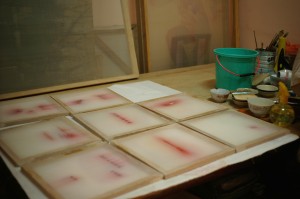
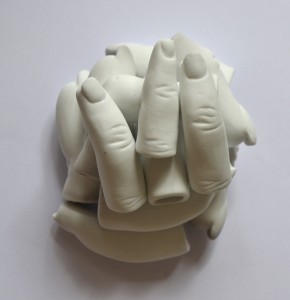
Now that I have begun my one-month residency at Rimbun Dahan, the quietness, seclusion and
darkness at night is a complete contrast to living in the hustle and bustle of Singapore. Being a
distance away from the city and its conveniences in getting my photographic work made is a new
challenge for me, in making work and would involve working out of my comfort zone. On a
positive note, Rimbun Dahan’s living environment surrounded by nature is the ideal residency
space for me to work therapeutically without the noise and daily stresses whilst engaging with
the emotional themes of death and loss.
Ever since I adopted my second senior dog, Milo, in August 2013 from an animal shelter, I had
been his caretaker till his sudden and painful passing from Cancer in December 2015. Going
abroad or even for a day out was no longer an option due to his separation anxiety and other
existing medical issues. Looking after Milo was the priority. Making work took second place.
This residency is my first proper trip out of Singapore since I returned from London in 2012. I
am now able to dedicate the time and focus in making this new work – a personal book as a form
of catharsis, documentation and in memory of “man’s best friend” – my best friend – which will
involve confronting my fears and coming to terms with the traumatic experience of Milo’s
passing. Travelling across to Malaysia is symbolic for Milo and myself; it’s like going on a road
trip together.
________
Audrey Tan is an international award-winning Singaporean photographic artist who received
her MFA from the Slade School of Fine Art, University College London in 2008. Her work has
been exhibited in the United Kingdom, Ukraine, Switzerland, Israel, Japan and Singapore.
She has a self-published book titled, ‘You see me, I see you’, which is a chronological visual record
of work made in London over a seven-year period showcasing the artist and various muses in
making the ‘Artist and Model’ series using conceptually experimental and technically playful
processes involving sight/intuition in the photographic process, analogue/digital mediums, and
progressing to 2D/3D modes of representation.
A. Cut Out (2009) / C-Type Print mounted on glass / 51 x 61cm / Edition of 3
C. Curve (2012) / Fibre Based Print / 22 x 22cm / Edition of 1
I See You, You See Me #2 (2008) / Platinum Palladium Print from a 4×5 Polaroid negative / Edition of 1
Twelve A. (2011) / Inkjet Print on Hahnemuhle Fine Art Pearl Paper / 20x20cm / Edition of 3
The Unconscious (2007) / Inkjet Print on Somerset Velvet Paper / 61x51cm / Edition of 3
Rimbun Dahan presents Everlasting Love, a showcase of recent works made by Malaysian artist Azliza Ayob who, in her 16 year career, has worked in many mediums such as collage, painting, sculpture, and installation. She has spent her year in residency exploring the possibilities of creating art from discarded and unwanted daily items to sustain and survive in the field that she loves most, which is making art. The exhibition also ties together the themes of labour, community, tradition, and sustainability.
DATES: 27 November – 4 December 2016
OPENING HOURS: Weekends 10am – 6pm, Monday to Friday by appointment
Admission is FREE. For the event page on Facebook please click here.
There will also be a free guided tour of Rimbun Dahan’s grounds and traditional village houses at 9am on 27 November, conducted by Angela Hijjas. Our other current resident artist, Si Jie Loo, will also be having an open studio 10am to 6pm on Sunday, 27 November.
Nature plays a strong part in her work and like many previous Rimbun Dahan resident artists, Azliza took inspiration from the surrounding grounds and the various types of flora and fauna growing in the gardens, using her time cleaning the lawns in front of her cottage to understand different types of leaves. In that process, she also got acquainted with the inorganic things accumulating (and “growing”) within the grounds as well as in the surrounding village. Azliza started out with one studio and a small collection of plastic bottles made of polyethylene terephthalate (PET). One year on, the scale of her work has required her to utilize two studios to house pieces made from an estimated 2000 PET bottles and other materials. The bottles were either handpicked from the roadside and the trash or donated by fellow artists, friends, family, and eateries and shops from Kuang all the way to Kuantan.
“I am fascinated with the transparency of PET bottles,” says Azliza. “I’m fascinated by its longevity and how it’s so easily accumulated to the point where it is ‘haunting’. [Through working with the material], I became more sculptural. The process is so tedious, but the result is satisfying.”
HIGH, 2016, 122cm x 122cm, Acrylic, collage, and glitters on wood
PLEASURES, 2016, 122 x 122cm, Acrylic, oil, collage, and glitters on wood
ETERNITY, 2016, 214cm (diameter) x 40cm
PET bottles, spray paint, beads, and glitters on wire mesh
SERENITY, 2016, 78cm x 183cm, PET bottles, spray paint, glitters, and beads on wire mesh
Azliza learned various traditional crafting techniques from a young age and put this knowledge to use to both figuratively and literally weave together her unconventional and modern materials into softer forms, organic shapes, and detailed sculptures and collages. She has used plastic bottles in an interactive site-specific installation titled For Our Daughters (2011), glitter to fill thousands of mushroom forms and pink rain drops for her residency exhibition at Fukuoka Art Museum in 2012, and paper collages in her 2014 solo at Wei-ling Gallery, All That Glitters. New materials joined her repertoire in making work for Everlasting Love.
“I made weavings by substituting plastic strips, wires and wire mesh for traditional mengkuang, I incorporated glass and plastic beads, rhinestones, oil paints mixed with spray paints, recycled printed items, glitters, stuff from local hardware stores and all-in-one convenience shops. The materials [I use] must be considered trash, unwanted, or too ordinary and unimaginable to create art, it must show the laborious process of art.” She supplements these with the inclusion of a more sentimental material – batik cloths from her own personal collection, mostly wedding presents from her mother-in-law’s Kelantanese family. Ordinary perhaps, but certainly not trash or unwanted. “These batik cloths have gone through and withstood the vigorous activity of a mother, wife, artist, and best preserved in art.”
DELIGHT, 2016, 78cm x 183cm,
Acrylic, collage, glitters, rhinestones & batik stretched on wood
WHERE WE BELONG, 2016, 244cm x 122cm,
Acrylics, collage, glitters, rhinestones & printed fabric stretched on wood
FIRST CLASS, 2016, 77cm x 57cm, Acrylic, collage & glitters on paper
HARVESTING, 2016, 52cm x 37.5cm, Acrylic, collage & glitters on paper
The use of everyday materials was both a matter of principle and necessity. Azliza says, “I find being creative is somehow connected with being frugal. Working with limited finances is possible with good interpersonal skills and when you work together in a supportive community. In this way, I think of creating art as a way to empower our economy, to live cleaner and greener, to help us think of sustenance and sustainability as a way to maintain our freedom (to love, to be, to do).”
Rimbun Dahan is also a proud participant of Gallery Weekend Kuala Lumpur, a festival tour of the rich and innovative arts and culture scene of the city happening 25 – 27 November 2016.
The Res Artis Meeting of Southeast Asian Arts Residencies 2016 was a 4-day regional meeting of arts residency representatives held on July 20 – 23 2016 at Rimbun Dahan outside Kuala Lumpur, Malaysia. The participants consisted of 20 representatives from 19 residencies and organizations from 7 Southeast Asian countries, as well as outside SEA, from Australia and China. The meeting was facilitated by Jean-Baptiste Joly, founding and artistic director of Akademie Schloss Solitude in Germany, and Res Artis board member.
The meeting was a joint project by Rimbun Dahan, a private arts residency centre in Malaysia, and Res Artis, the largest global membership based residency network headquartered in the Netherlands, and was supported by Goethe-Institut Malaysia as the main sponsor.
The idea for the meeting arose from a feeling of disconnectedness as an operating arts residency within the Southeast Asian region, and was envisioned to foster stronger ties with arts residencies in neighbouring countries and in the general region, which would in turn strengthen ‘residency culture’ and its sustainability in Southeast Asia. Participants presented different models of running residencies, shared their different cultural contexts and traded ideas to troubleshoot issues and concerns. We hope the connections and networks developed during the meeting feed back into the development of programs that cultivate artistic talent and practice in the region, stronger and more productive external and internal exchange programs , and into building ongoing resources for the development of more residencies in the region.
The meeting was produced and project managed by Syar S. Alia, Arts Residency Manager at Rimbun Dahan, with an organizing team consisting of Bilqis Hijjas, Dance Program Director at Rimbun Dahan, Eliza Emily Roberts, Vice President of Res Artis and Arts Residencies Manager for Asialink, Mark Venegoor, Director of Res Artis, and Birte Gehm, Communication Manager/Web Editor for Res Artis. Documentation during the meeting was carried out by ARTERI and Malaysian Art Archive.
A short write-up on the meeting was also published on the Res Artis website, and can be read here.
Program
Three of the meeting days were dedicated to roundtable discussions and panels, with the third day set aside for an excursion to three different residency spaces in and around Kuala Lumpur: Lostgens Contemporary Art Space, Shalini Ganendra Fine Art, and Toccata Studio.
Day 1Sessions
Community engagement and the social responsibility of artist residencies
Residencies rooted in ‘place’
Thinking outside the field: Alternative approaches & residency spaces
Institutional programming: The role of artist residencies in the broader arts eco-system
Day 2 Sessions
Artist-Residency Relationships & Alumni
Residency Resources
Glocal Networks
Day 3 Excursions
Day 4 Sessions
Interdisciplinary Residencies; Keynote by Jean-Baptiste Joly (followed by a meet and greet for guests from the public to speak to meeting participants and ask about their residency programs)
Participant-Led Open Sessions
Facilities vs Programming
Feedback and Evaluation for Residencies
Virtual Residencies
Residencies as Soft Power
Participating residencies/organizations
Participants were invited from a compiled list of Southeast Asian residencies, with Res Artis members being given priority. The organizing team also prioritized getting representation from as many countries in the region as possible before opening up the meeting to Res Artis members from other countries that had an investment or interest in the Southeast Asian region. As Rimbun Dahan could only provide accommodation for a certain number of people, spots were limited. We hope that more residencies and countries can be represented in any future iterations of the meeting.
Si Jie Loo is a multi-disciplinary artist who is interested in capturing the spirit of humanity, primarily with Chinese Ink. She graduated from Dartmouth College in New Hampshire, USA with an honors in Studio Art and has since lived and worked in both US and Malaysia. As an artist in the diaspora, she is constantly on the move between places, cultures, music genres and languages. She inks down captivating people, musicians, dancers and nature during her travels, most recently the Tibetan plateau and the Silk Road in Northeast China. She calls this body of work INKounters and further develops larger abstract paintings that convey that essence in another series INKnovations.
Her spontaneous and dynamic strokes are generated from her ever-wandering eyes and ready-to-go ink brush and paper in her pocket. Behind the scenes, she eagerly search for inspirations, whether it is from traveling, reading, calligraphy, visits at the museums and art galleries, music, drum or dance sessions, concerts, and/or art residencies.
Si Jie hopes to use this residency to ask questions such as: What’s the future of Chinese Ink Painting? If it were an important Nanyang (Southeast Asian) heritage and legacy, how can it blossom and grow beyond the Malaysian Chinese art circle? How can she innovate within a tradition that has once inspired the likes of Van Gogh and Paul Gauguin? How can she expand the medium’s limitations by collaborating with other artists of dance, music and theater background?
Southeast Asia is an exciting hub of trades and inter-cultural exchange. Its tropical colors and wide array of craft and folk arts were subjects of studies for many foreign scholars and local artists. Si Jie wishes to immerse herself at her residency at Rimbun Dahan, to share her understanding of the new and the old based on her own cultural roots that she re-discovered upon returning from abroad, thereby expanding her repertoire to a contemporary Malaysia that she and many other artists aspire to shape.
Si Jie’s work can be found online at her website. Footage of her painting processes and interviews can be found on her YouTube channel. She has also posted her residency statement of purpose in full here. Si Jie will be a resident artist at Rimbun Dahan from October to December.
Si Jie Loo with her mentor Malaysia’s Chinese Ink Painting Master Dr. Cheah Thien Soong
Le Hoang Bich Phuong (b. 1984) is a visual artist based in Ho Chi Minh City, Vietnam. Her art is an outlet for expression and a means to deliver her concerns regarding sexuality and eccentricity. Recently, Phuong’s focus has shifted more toward nature, time, space and social awareness in her country, Vietnam.
Even though Vietnamese culture doesn’t emphasize on individuality, I often wonder about the state of individuality in the other countries. My works are usually a blend of imagery of human sexual organs twisted into seemingly familiar distortions and contrast elements that do not seem to belong together. For me, these unlikely combinations often create the perfect piece. I have been using Vietnamese traditional silk paintings as my primary medium, but I always experiment with new mediums as it could be the new language in my art. I enjoy reflecting my thoughts on contemporary issues through art, using traditional medium and materials as a way to challenge to the dogmas of society.
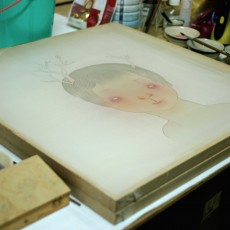
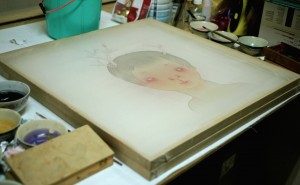
To view more of Phuong’s work, visit her website. You can also view the process of making one of her works (pictures below), here on YouTube.
Paeonia Dream (2013) by Le Hoang Bich Phuong
The Milky Way (White, Black, Gold, 2015) by Le Hoang Bich Phuong
Rimbun Dahan is now accepting applications for a year-long residency from January to December 2017 for visual artists from Malaysia. We have hosted year-long residencies from 1994 up to the end of 2013, and have seen Malaysian artists use their time with us to further their practice and become illustrious names in the local art scene and beyond. We hope to continue this tradition in 2017, alongside our growing Southeast Asian Art Residency program. Read below for more information.
We’re looking for artists interested in expanding their art practice, exploring new ideas/themes in their work, producing a new body of work, establishing themselves even further in the field of art, or all of the above. We’re looking for engaged and motivated artists who are looking to commit themselves to investing the time and resources provided by this residency into pushing themselves somewhere they couldn’t otherwise go. The year-long residency will culminate in an exhibition* held at Rimbun Dahan’s underground gallery in November 2017.
* This exhibition could be a solo or could feature work by other artists in residency at Rimbun Dahan
Expectations of the residency
The resident artist must stay and work full time on-site in the accommodation and workspace provided and engage with the other resident artists
The resident artist must make themselves available for student groups visits, general visitors, and other outreach events (artist talks, showcases, etc) organized by Rimbun Dahan throughout the year
The resident artist must produce work for the exhibition and work together with Rimbun Dahan’s administrative and groundskeeping staff in putting together the show
What’s provided by the residency
Monthly living and materials allowance of RM1000
Private accommodation with access to a kitchen and private bathroom
A private studio
Access to washing machine, exercise equipment, communal garden, swimming pool, and our library and artist lounge
Weekly grocery shopping trips
Administrative support
Eligibility criteria
Artists must be from and based in Malaysia
Artists must be working in a visual medium; writers, curatorial researchers, choreographers, performance artists and artists/creatives not working in a visual medium should look at our other residency opportunities
It is preferred for artists to have a tertiary education in art from a certified institution and some exhibition experience
Former Rimbun Dahan resident artists are not eligible to apply
Applications from former Hotel Penaga resident artists will be reviewed on a case by case basis
If you would like to apply, please send the following:
Biodata/CV
A selection of images/samples of recent work
An artist statement telling us how a year-long residency at Rimbun Dahan will benefit your art practice and why we should consider you as a resident artist
Please send in COMPLETE applications only. All applications are due by Sunday, October 30 2016.
Send electronic applications via email (preferred method) to
Ms Syar S. Alia, Arts Manager
Rimbun Dahan
c/ Hijjas Kasturi Associates Sdn.,
23rd floor Menara Promet,
Jalan Sultan Ismail,
50250 Kuala Lumpur
Malaysia
Hard copy application material will be returned after selections are made.
ERYN uses a combination of pen and marker drawing, watercolour, acrylic painting and papercutting techniques to create meticulously detailed compositions filled with strange creatures in an otherworldly setting. Her use of fine lines to create form is largely inspired by book illustrations and the comic and animation industry. She focuses on themes of introversion and looking inwards to reflect on the interactions she experiences in her daily life.
These themes of introversion plays out in imaginary landscapes inspired by lush tropical rainforests, the frozen arctic plains, and even the dry unforgiving desert. Each landscape is shaped by thoughts and emotions in her mind and the process is at once aware yet unconscious. These landscapes are also removed from the mundane laws of physics, gravity, and proportion. Through this the artist creates a dreamlike quality in order to bring the viewer into an inner space to experience both the mysterious and the extraordinary.
ERYN was in residency at Hotel Penaga from September to November 2016. Her residency culminated in a one day exhibition, Strange Botanicals, in the hotel’s Reading Room. You can view photos here on Facebook.
Grace Blake is a visual artist working between Canberra and Sydney. She is currently completing a Bachelor of Visual Arts in printmaking and drawing with a Bachelor of Arts art history from ANU.
Her fascination with the virtual landscape manifests in works that map the line between real and simulated. Blake acts as a cartographer of boundless digital space where the tension between the natural dimensions has been compressed into binary logic.
Currently Blake’s studio practice is working to examine ecologies, resulting in attempts to parallel dense natural ecologies with those that exist in data centers and online. Trans-humanism and future predictions of dense mega-city infrastructure lead toward an interest in arcologies. Various Archo-structures will be examined across animation, installation and interactive web platforms with using both recorded-footage and 3D generated material.
Blake was recently included in group show ‘My Feet Would Hurt If They Still Existed’ at Alaska Projects, ‘Personal Geographies’ at the ANU School of Art Foyer gallery and ‘SafARI 2016’.
She is currently on the Australian New Colombo Plan Scholarship studying and interning in Thailand and Singapore and will undergo a three month residency at Rimbun Dahan from August to October.
Java-topia, still from interactive web platform, 2016
Section from Broken channel, 80cm x 7m metallic foil print, 2016
Stills from Untitled video, 3 channel colour video, 9:16, 2016
Truss/Trust, metallic photo print, A0, 2014
Untitled, metallic foil print, A1, 2015
I fear how similar we are and You found me, 80cm by 5m, Metallic foil print, 2015
Soraya Abidin (b. 1971) is a textile artist based in Sydney, Australia. The subjects and materials she uses to create her works are born of a love for the Primitive and Spiritual practices within her Malay cultural heritage. Soraya embroiders in natural raffia representing matter from the jungle and embellishes with gold leaf, as a mark of status and the prestigious gold culture worn by her aristocratic ancestors. During as recent visit to Malaysia, where her father is from, interpreted inquiries of her family members revealed her art making practice as an inherent genetic trait directly traceable to her Malay culture, which the artist expands on below:
“I am an Embroidress, the only member in the entire family that has inherited the passion for Benang Emas Sulaman from my Opah (grandmother). I have studied my parents wedding photos for many years, loving and attempting to recreate the motifs seen on all the wedding decorations. I had no idea these works even still existed, till I showed copies of the wedding photos to my family and the next thing I knew these incredible items where in front of me, in my hands to touch and marvel at the perfection of each piece. It was then that I learnt all the embroidered pieces in the photographs had been made by my Opah.
I never could have imagined what this information would do for me, so astounding that I am finally able to make this connection. Now I understand my passion for Embroidery has a strong thread directly linked to my inherent bloodline. This may seem simple but to me it provides powerful and auspicious meaning to the medium I have always instinctually gravitated towards as an artist. Now I have found the origins of my practice and that I am the one to carry on the family tradition.
Flower for Peace by Soraya Abidin
Messenger by Soraya Abidin
Peace Leaf by Soraya Abidin
Gunung Sari by Soraya Abidin
Work by Soraya Abidin, as part of the Seed Stitch Contemporary Textile (SSCT) exhibition
During the residency I would like to study the use of motifs in traditional Malay textiles, Tekat and Songket, and gather motifs and their meanings to create a glossary for reference in my artmaking. I would like to create an artwork representing my cross cultural parentage, by use of the Traditional Quilting practices of my Australian mother, layered and embedded with embroidered Islamic Arts motifs of my Malay father.
The work will be embroidered with natural raffia and pure white silks and embellish with gold leaf, metallic threads and glass beads. My focus will be on the selection and placement of motifs that are layered over a quilt top created by my mother. The base cloth will be embellished with a combination of appliqued silks motifs then layered with interconnecting embroidered Malay motifs, intentionally leaving gaps and spaces to create a cross cultural conversation in both the positive and negative space.
The intention of the work is to portray a new found clarity and definition in my identity. Through the layering of motifs and utilisation of the powerful meanings in their symbolism to bind together the genetic behavioural traits of my two cultural heritages.”
Soraya will be in residency at Rimbun Dahan for the month of August. You can find more of Soraya and her work on Instagram.
Riel Jaramillo Hilario (b. 1976) is a Filipino visual artist and curator, and was born in Vigan, Ilocos Sur, Philippines, which like George Town, is declared a UNESCO Heritage Site. He is a sculptor, painter and an art historian and was the curator for the Pinto Art Museum in Antipolo, Rizal.
Hilario’s main body of work are hand-carved wood figures inspired by rebultos, a colonial art form of religious statuary that was introduced from Spain to the Philippines by way of Mexico in the 1600s to the late 1900’s. Hilario uses the rebulto depicting subjects that are “para-psychological” phenomena, such as presences, place memories, popular mythologies and dreams. For the artist this practice fulfills the need “to render visual” that which are unseen. For his residency at Hotel Penaga in the month of August, Hilario will deploy “Place Memory” – a project that attempts to collect and take note of, occluded and manifested presences and psychic histories in and around spaces in George Town.
Hilario is a Cultural Center of the Philippines Thirteen Artist Awardee (2012). His work has been shown in several exhibitions in Adelaide, Jakarta, Hong Kong, Singapore, London, Basel, Delhi, New York, Paris and Berlin. He has been artist-in-residence in Paris at the Cite Internationale des Arts (2012) and in New York at the Lower Manhattan Cultural Council (2013) as a fellow of the Asian Cultural Council.
Riel was a Hotel Penaga resident for August 2016. For more information on Riel’s work, please visit his website.