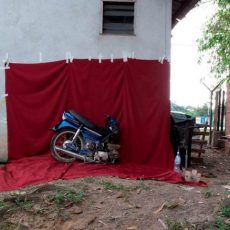
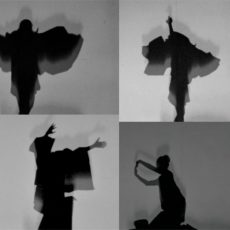
French-Moroccan dancer and choreographer Soufiane Karim spent a short residency at Rimbun Dahan in October and November 2013, en route to the Melaka Art + Performance Festival. During his residency, he was developing his next full-length work entitled Kaly-Graffyk. He also collaborated with New Caledonian hip hop dancer Ludovic Simane Wénéthem and Indonesian dancer Gita Kinanthi (site-specific performance at Rimbun Dahan pictured below).
During his residency, Soufiane was interviewed on Capital FM and on BFM 89.9: https://www.bfm.my/soufiane-karim.html. He also conducted a dance workshop at ASWARA, the national academy for arts and heritage.
All photos below by Leocampo Yuen Hon Wai.
About Soufiane Karim
A young Frenchman of Moroccan origin, aged twenty-eight, Soufiane Karim had been dancing since his early childhood when, at sixteen, he discovered hiphop. The experience was life-changing and, as soon as he had finished studying communication, he launched straight into creating a life of dancing. He learned various dance techniques and styles in Paris and developed a keen interest in hip-hop culture. As he honed his skills, he set up the Boogalizzle group and together they discovered the techniques and magic of show business, winning several battles and contests, including choreography.
He met some good dancers teachers in Paris during his early hip-hop training-the-trainers sessions, and developed a taste for skill transfer and teaching. Pursuing his love of travel, he continued his search, leaving Paris for New Caledonia to attend a three-part training programme organised by French contemporary dancer and pedagogue Mic Guillaumes at the Noumea Centre de Développement Choréographique. Keen to share his travel and new friends, he put together his own solo production, “Sweet Hõm”. In the third unit of the training session, he participated as a trainers’ trainer, while continuing with his plans to develop dancing in New Caledonia and the Pacific. He travelled with several New Caledonian dancers to Vanuatu, Fiji and New Zealand to organise courses and shows. On his return, he decided to set up the Posuë Dance Company. He is now artistic director, dancer, choreographer and teacher of Posuë Dance Company.
Queensland-based dancer-choreographers Caitlin Mackenzie and Gabriel Comerford spent an Asialink residency at Rimbun Dahan in 2013, developing the duet work Uncommon Ground.
Gabriel and Caitlin studied together at Queensland University of Technology, where they were featured as a duo by various choreographers including Csaba Buday, Vanessa Mafe and Alice Hine. Since university they have established a professional partnership and work together on several platforms. They are founding members of emerging dance collective MakeShift, and were selected to perform in Backstage at the Ballet Russes at the National Gallery of Australia, performing an excerpt of an adaptation of The Ballet Russes’ Petrushka. They have choreographed for QL2’s Chaos project and have performed in Toowoomba, in the Ausdance Queensland Bell Tower II Series, the Brisbane Festival, and at the Judith Wright Centre for Contemporary Arts.
Uncommon Ground is a cross-cultural, interdisciplinary work that depicts a story of two identities coming together in one place, transitioning through friction, destruction, compromise and progression, concluding with something that extends beyond the sum of its parts. This concept speaks to an internal and external landscape; a personal struggle to discover and understand oneself and the realities of living in a diverse and ever-changing society.
Uncomfortable within your own skin.
Uncertain of the land beneath your feet.
A place to call home.
Indigenous to where.
Uncommon Ground was performed on Wednesday 4 December 2013 at the Fonteyn Studio Theatre in Petaling Jaya. A site-specific version was presented at the Melaka Art + Performance Festival. The performance included live music by Malaysian musician Gideon Alubakhan Chen.
This is an Asialink Arts Residency Project supported by Arts Queensland and the Australia-Malaysia Institute.
The Rimbun Dahan dogs cornered this small specimen in a drain and dispatched it, but not before it reared, displaying the diagnostic cobra’s hood. The single circular marking on the back of the head identifies it as the Monocled Cobra, Naja naja kaouthia, a venomous snake which is fairly common, occuring in a range of habitats, including those impacted by humans, and usually feeding on rodents.
The exhibition Rimbun Dahan – Cultivating the Garden features the work of Australian artists who have been beneficiaries of the residency programs in Malaysia, and acknowledges and celebrates the contribution that the experience has made to their creative lives. Cross cultural pollination at its finest.
ARTISTS:
Cathy Brooks
Melanie Fulton
John Foubister
Rob Gutteridge
Jumaadi
Mike Ladd
Tony Twigg
Jessica B.Watson
28 August – 19 September 2013 Light Square Gallery, Adelaide College of the Arts, 39 Light Square, Adelaide Monday – Friday, 9am – 5pm
Presented by Adelaide Festival Centre, John Foubister and Melanie Fulton.
May I Take a Bath?
Catalogue Essay for the Exhibition, by Gina Fairley
“In a new and exotic environment there is a lot to look at, but what was I looking for?”
This diary entry of Cathy Brooks (2009) described the question faced by all residents as they arrive at Kuala Lumpur’s international airport filled with anticipation, hope, and vague thoughts of what might await. It is the answer they carry on their return, however, that best captures the ethos of Rimbun Dahan. It is a door swung wide to a raft of new questions, intrigues that continue to surface long after the journey. It is what pulls this group of artists back, through their memories, their work, and their persistent journeys north. Simply, ‘something’ was answered for each of them, be it ‘jamming with an anonymous maker through found objects’ as Tony Twigg described, or Mike Ladd falling in sync with the rhythms of pantuns, those poetic couplets that seemingly penetrate to the soul. The pulse of this residency continues to be felt.
The climate of artist residencies has changed greatly since 1994, when Adelaide artist John Foubister was the first to sign on for a year ‘in the garden’. The frequency of movement and the networks brokered by artists today – especially in this region, which has become blatantly aware of its global currency under the banner of contemporary Asian art – are highly sophisticated, expected, and somewhat viral in reach. While Rimbun Dahan has also expanded during that time, its programming more ambitious, diverse, and exponentially larger, there is one thing that remains unique to Rimbun Dahan and that is its gift of time; its stillness in all this push.
Brooks’ diary described a “looking for things to hang something on to.” Assuming the habit of bowerbirds, each artist in turn collected fragments of this new place in a ritualistic practice of nesting or courtship; patterns, objects and conversations picked over, arranged, and accumulated as a summation of self there. Rimbun provided that rare space to distill this cache of stimuli, filtered at the pace of kampong life. One is not competing with institutionally driven outcomes, bright lights, or history’s overwhelming footprint on a city, like many international residencies that seemingly insert the artist into ‘the role’ like a cut-out, only to be superseded by the next edition. “What am I looking for?” is a question answered on very individual terms.
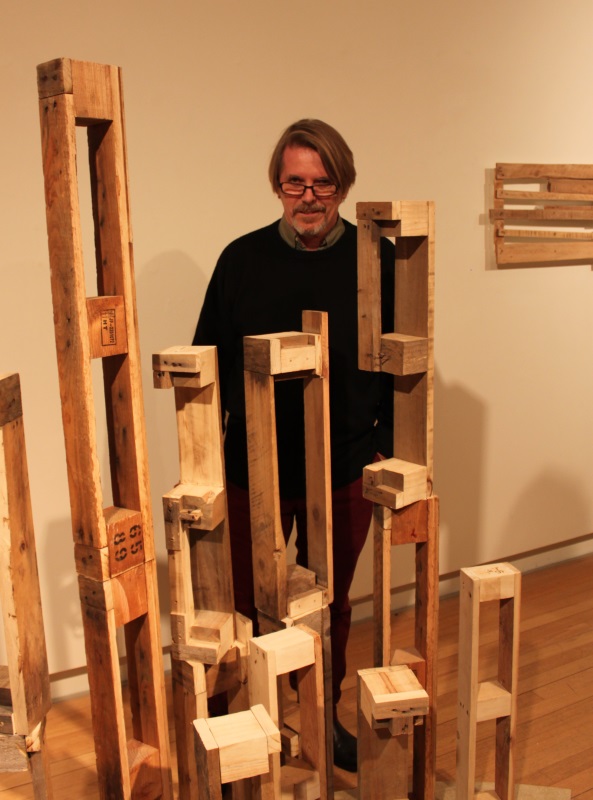
The eight artists in this exhibition made that journey across time: John Foubister (1994 & 2011), Tony Twigg (2005), Cathy Brooks (2009), Mike Ladd (2009), Jessica B. Watson (2010), Melanie Fulton (2011), Rob Gutteridge (2011), and Jumaadi (2012). Their work is diverse and, yet, their cues are surprisingly similar. Both Brooks and Twigg collected detritus along Jalan Kuang, the street that runs as an artery through Kampong Plong to the Komuter train’s distant outpost. Twigg explained, “A lot of time was spent looking for a mark that comes from here, that is Malaysia not just KL. It turned out that mark for me was the fish box found beside a pasaraya. I started working with the ‘physical’ line of the object rather than its inspiration. I found the subtle and random shifts in colour and texture of the timber aesthetically moving, so I began using thinner and thinner paint until I had the courage to use none.”
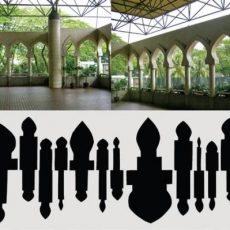
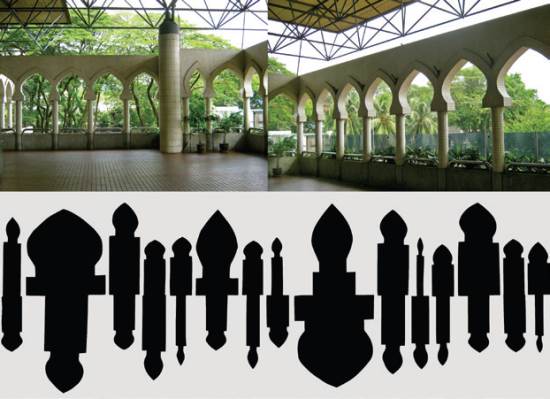
Similarly, Brooks gathered neighborhood detritus that echoed patterning in Muslim architecture and script, traditional fabric design and natural forms, fragments that became a pseudo script or alphabet. She chose “to build a language from the ground up, words straight from the street, and make meaning for myself out of it. How do you read these found ‘symbols’ if you don’t know which way up they read?” Rather than being lost in translation they assume a meaning as form. Separated from their original context they take on the vernacular of art, assemblage, and installation. It is an age-old tradition of storytelling with a contemporary inflection.
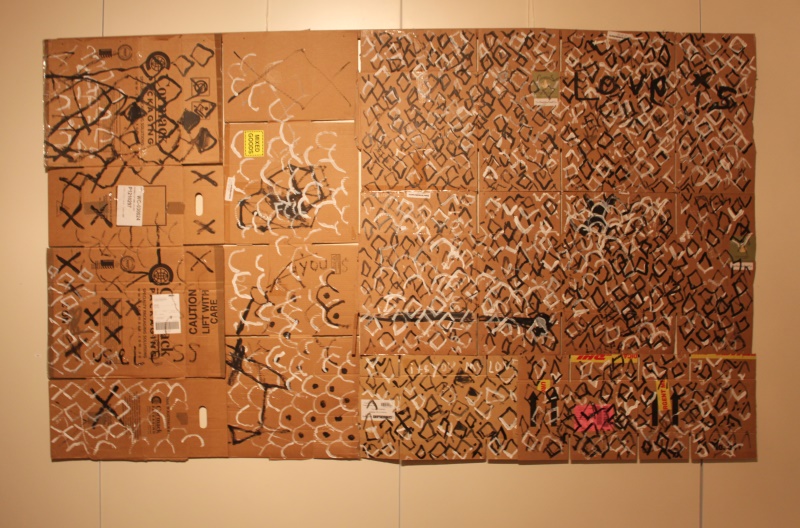
Australian-based Indonesian artist Jumaadi continued that dialogue but pushed its implication a step further. Known as a contemporary story-maker, his wall drawing made from cardboard supermarket boxes not only speaks of package goods moved between places – a metaphor for the peripatetic artist today – but acts as a frame for ‘his story’ as a cross-cultural artist. Simply, the site that the work is specific to is in fact Jumaadi’s own story – not Adelaide, not Moscow, or Penang.
Storytelling is so ingrained in him that, as viewers, we walk into that narrative and are transported. Locals in Penang had a similar experience during Jumaadi’s stay at Hotel Penaga (2012). Adding a twist to the wayang kulit, the shadow puppet tradition associated with the Malay culture, Jumaadi turned to a Chinese folk tale and performed it in Chinese. That arrival at something entirely new, yet carrying the resonance of familiarity, underscores the potency of the residency experience and its ability to cut through observations and allow a cross flow across otherwise segmented territory.
Mike Ladd found it also. His series Book of Hours (2009) produced during his residency, explored ideas of layering, consciously, subconsciously, and sensorially. Staying in Rumah Uda Manap, a Malay kampong house decorated with Chinese fretwork and skirting the east boundary of the estate, Ladd described the stereophonic broadcast of maghrib (evening prayer) from three local mosques, overlapping and fusing into a singular, and momentary, cohesion. It was an aural imprint of this place shared by Brooks, Twigg and Watson. Watson further blended experience, architecture and histories through rubbings taken from the house. Time was both a meter for the minutiae of now and a sense of an all-encompassing timelessness.
Ladd set himself the task of writing a pantun a day; four iambic lines that paired observations of nature with introspective musings on human relationships, their ulterior motive to find maksud, purpose or connection. He added, “They are small poems, but risky.” It is this embrace of risk that is key here, not only for an artist to pack up from work and home for a year, but the inherent risk in confronting their own creativity.
It is reiterated by Rob Gutteridge, who stepped outside his academic life in Adelaide to immerse himself in this pungent, saturated landscape. His first impressions described, “…a pale milky wash over the landscape, softening the contrasts and bringing distant colours closer together.” It was the antithesis of Australia, but in a strange way nature softened the blow. He added, “If one is alert, the ambient has a character, providing a starting point and a foundation.”
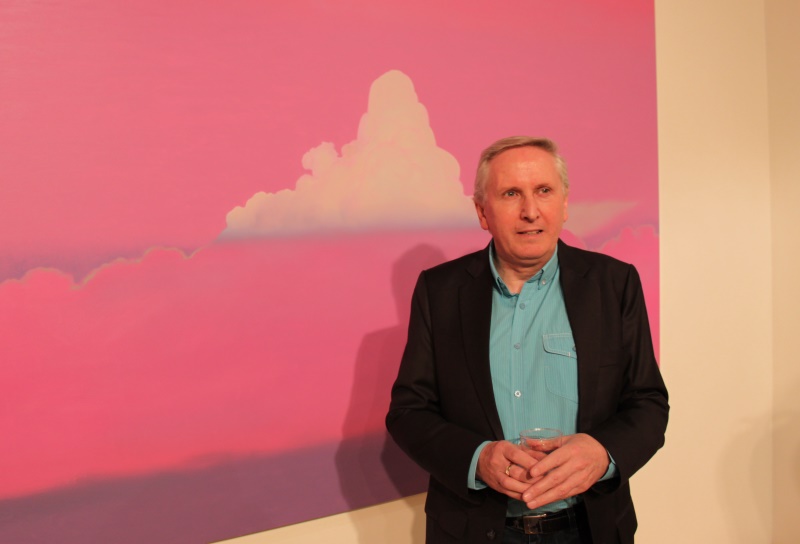
Gutteridge’s found his language in clouds, billowing and morphing as a ready metaphor for the human condition, described as ‘environmental portraiture’. Reflecting on what connects rather than divides, Gutteridge asked, “What is the threshold of recognition?” He continued, “I have become interested in what constitutes the conditions for visual suggestion, or resemblance.” It is a view particularly shared by Brooks’ pictograms and this new sculpture by Twigg constructed from shipping palettes.
Jumaadi pondered similar questions of nature as Gutteridge and Foubister. Inspired by early evenings spent at the jetty, near the ferry crossing from Penang to Butterworth, he produced a body of small paintings. He recalls, “The sea and sky often merged into a mist. This mist created by so many colours reminded me of the paintings of Caravaggio and Rothko, stories hidden in the drama of flickering light and lyrical ambience.”
Is it alchemy? Foubister’s residency paintings described a vivid internal world of swirling pools, atmospheric perforations, and dark organic abstractions. He described, “In 1994 I was preoccupied with the existence of the infinite, and in response wanted to make images that were a celebration of doubt as a virtue. The ideas were broad and inclusive and I wasn’t seeking local influence or engagement. But it occurred mostly by osmosis.”
They were, as are his new gestural landscapes, about finding his own landscape. I see in them a conversation with Ken Whisson and William Robinson’s creation paintings, the sheer physicality of the landscape, its emotional and territorial navigation. To quote Robinson, “There are things all around you and you are in it. Everything is constantly moving…We don’t really have an orientation in this infinity.” [1]
Melanie Fulton sought to anchor that engagement. Turning to the writings of British and European explorers and botanists, as well as novels and poetry by Indigenous Malay and Indian writers, she approached her “residency in the spirit of those early observers and record as much as possible.” Her delicate watercolours carry that expeditionary tone, specimens both timeless and contemporary. Fulton was drawn to the cultural fusion of plant forms incorporated into decorative patterns, temple carvings, embroidered and printed fabrics, resilient both in their traditional reference but also their urban reality. It was a cue Watson also picked up on. Her screen print, Good things happen in threes (2010), inspired by a small fig tree growing out of a crack in the concrete under the kampong house, became a metaphor for cultural resilience. Combining textile techniques, motifs and images associated with Chinese, Malay and Indian traditions, she used the sensitivity and time-consuming quality of her medium – textile art – as a bridge between histories and futures. They are as painterly as Foubister’s brooding landscape or Gutteridge’s anthropomorphic clouds urging connections, and clearly as alert as Brooks’ ‘found’ pictograms and Twigg’s fish boxes in finding a spirit of connection. Is it a garden cultivated? This pantun shared with Ladd best surmises the sentiment.
Kalau ada sumur di ladang, Boleh hamba menumpang mandi?
Kalau ada umur yang panjang, Boleh kita berjumpa lagi?
If there’s a pond in the field may I take a bath?
If I live long enough can we meet again?
The intimacy of that elementary, somewhat raw, engagement of laying oneself bare to take a bath in an open field, mirrors the trust shared between artist and hosts. It also captures the deep connection such an experience affords, and continues to reside in all these artists. Ladd translated the pantun as ‘a proposal of love’ a future shared, a garden that continues to flourish.
Gina Fairley was at Rimbun Dahan in 2005 as accompanying spouse of Tony Twigg.
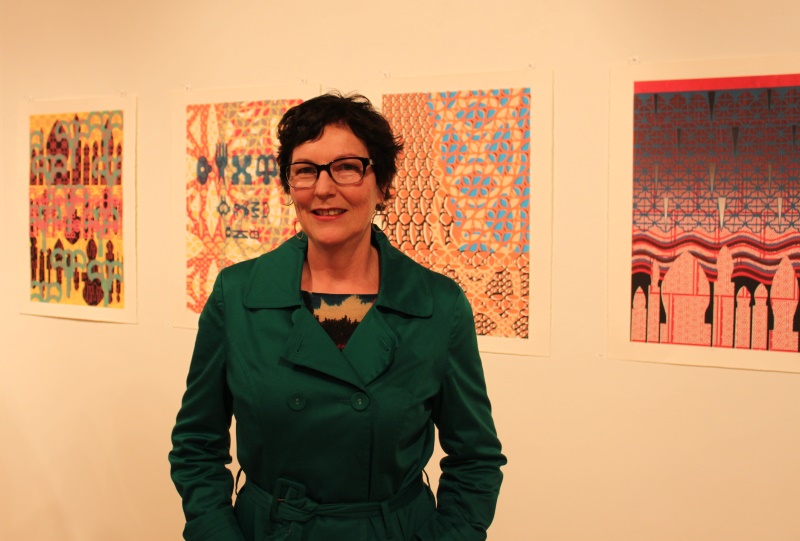
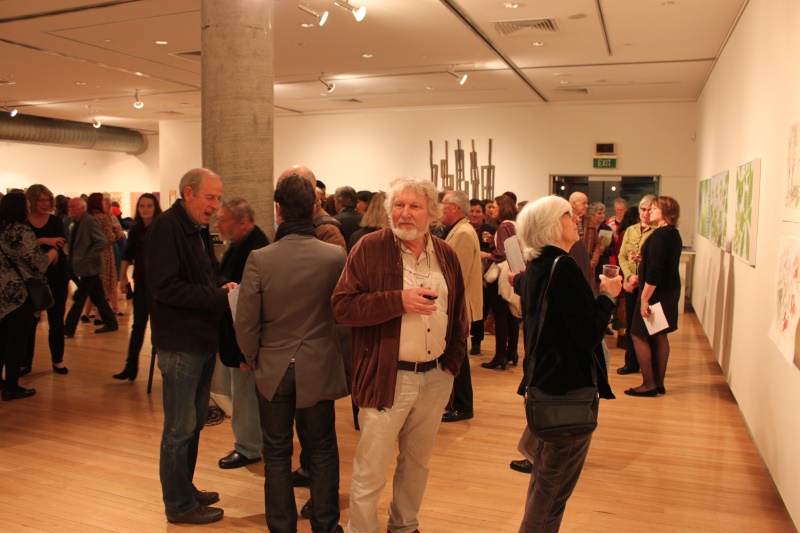
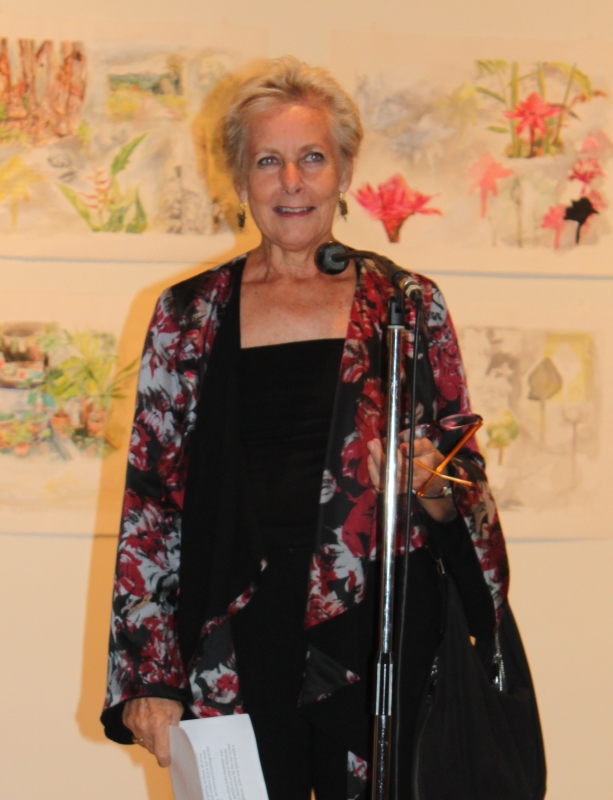
The exhibition was opened by Angela Hijjas, Visual Arts Program Director at Rimbun Dahan, on 28 August at the Adelaide College of the Arts.
Cultivating the Garden
When we started the residency I knew it was an important idea, but really I only considered it from our own perspective: we had benefited greatly from Australian and Malaysian opportunities, and had always wanted to “pay back”. Hijjas’ choice was to start the residency for Australian and Malaysian artists, and my job was to organize it. Probably it wasn’t until Gina and Tony repeatedly mentioned what a gift a year away from normal life was, that I too appreciated what an impact it was having on people’s lives.
So while I was pre-occupied pushing round saplings in a wheelbarrow for my Southeast Asian garden, there was a lot happening in the studios. The artists had a whole year to work on ideas, and that year was long enough for us to form lasting friendships. That was a great bonus for me, having been out of Australia for so long; conversations over drinks or dinner, or on the way back from the tennis court, greatly enriched our lives. As a practical sort of person, I had seen my job as glorified housekeeper, but I had the privilege of getting to know all of our guests over their year and realized that it was more than just housekeeping: we were participating in the actual creative process.
It is now almost 20 years since John Foubister was persuaded to take the gamble on a trip to Malaysia. He was “found” at very short notice by the son-in-law of a friend, Keith Neighbour. John was paired with a Malaysian artist, Yuande Zheng, who had presented himself as the answer to our search for a Malaysian artist. I didn’t know how to consider the talents or the pairing, but we learned a lot along the way! Definitely one has to provide separate accommodation and studios for each artist, and never get involved in personalities or disputes! Keep a professional distance, and just make sure they have everything they need to do what they are there to do. I learned that quite quickly after a particularly difficult year early on, and although Hijjas’ advice was to drop the residency if it was too much trouble, by then I had realized that it was important.
Now fortunately we have daughter Bilqis taking an active role, and as her expertise is in contemporary dance the programme now includes lots of that, and the dance studio is in constant demand.
The renovated heritage houses have been an added bonus, as without the residency there would have been no use for them, and no incentive to buy and restore them, so it’s thanks to the programme that they too have been saved.
Another direct result of the residency has been our interest in Georgetown, Penang. It was because of the hugely positive response to the city from all the artists who went there that I started looking for a house there to use for a residency extension. It was Hijjas who eventually found the site of what would become Hotel Penaga, but had the artists’ interest not been so intense, I probably would have overlooked the possibility of having anything there at all…. So the entire process has been a very reciprocal engagement: a Colombo Plan scholarship for Hijjas in the 50s enabled his career, he then contributed to the careers of artists in both Australia and Malaysia, the artists enriched our lives in huge ways, enabling the development of Rimbun Dahan with the old houses, and the hotel in Penang, quite apart from the personal links, like Gina helping us with the book for Hijjas’ 70th birthday, or this exhibition in Australia!
Now after 20 years, we have to make a few changes. Unfortunately we won’t be funding Australian residencies as before, and we will concentrate more on inviting and funding Southeast Asian artists who wouldn’t have the chance to travel otherwise.
The most exciting development recently is in Horsham, Victoria. Many of you know that we have had a project going there since the Asian Currency Crisis in 1997… again it was a stroke of luck to invest there, and we have since bought a beautiful paddock on the Wimmera River where Hijjas had the idea of building a residency. We have commissioned Glenn Murcutt as architect, and it will accommodate Australian and Asian artists. It is just a small programme, only for two, just as Rimbun Dahan was at the beginning, but the idea developed with the input of one of Asialink’s artists, Anthony Pelchen, who lives near Horsham and who assures me it’s not the artistic wilderness that it may appear to be! In fact his work from his Malaysian residency opens at the Horsham Regional Gallery on Friday, and the Horsham Regional Gallery will manage the residency for us. Hijjas has visions too of architecture camps in Horsham where students can connect with landscape and design.
So the garden has grown, and I always knew that the key would be diversity: plant as much as you can, as many species as possible, and see how it turns out. That has been my modus operandi for our 14 acres at Rimbun Dahan, and it seems to have worked for the residency as well: it may have been a trifle disorganized, and certainly random, but what an exciting 20 years it has turned out to be, and for that I cannot thank our artists enough, in particular Melanie and John who had the idea of doing this show, and Allison Carroll who has encouraged us from very early days. And thank you all too for coming this evening, I just wish we could stay a bit longer.
Carlo “Caloy” Gernale (b. 1979) is a Filipino visual artist based in Southern Tagalog, Philippines. As a contemporary social-realist artist, he attempts to articulate not only his personal views, but more importantly, the collective stand and the national democratic aspiration of the marginalized.
As an artist, Gernale is driven by the past and present events that mould Philippine history; he also has a penchant for indigenous and contemporary myths, fables, and banter, and tries to incorporate them into his works of art. Guided by his socio-political leaning, he attempts to come up with a cohesive body of works that are visually and semiotically potent.
Gernale studied Bachelor of Fine Arts in Philippine Women’s University. In 2006, he mounted his first solo exhibit “Ispup.” His most recent exhibit titled “Allegories and Allergies” was held in May 2013 at West Gallery, Philippines.
Kuang Road Prayer – work in progress, Malaysia, July 2010 C type print, 29.9 x 42cm. By Anthony Pelchen
In 2010 on an Asialink artist residency at Rimbun Dahan, Malaysia, Australian artist Anthony Pelchen witnessed life in the balance and produced the foundation of a body of work titled Kuang Road Prayer.
Through reflection and continued artistic engagement with Malaysia, Pelchen has expanded this evocative body of work. Issues of change, vulnerability and resilience, at the core of Kuang Road Prayer, are explored in this exhibition through drawing, photography, video and sculpture.
The exhibition entitled Kuang Road Prayer was opened by Angela Hijjas at the Horsham Regional Arts Gallery in Horsham, Victoria, Australia, on 18 August 2013.
Opening Speech by Angela Hijjas
Thank you for this invitation to speak today at the opening of Anthony Pelchen’s show at the Horsham Gallery. This event marks the convergence of many coincidences that have brought Hijjas and me to Horsham. We have been coming here regularly for the last 16 years, working on the Southbank project, but never staying long enough to develop personal links until recently, when an amazing array of pieces fell into place.
Since 1994 we have been running a residency for Australian and Malaysian artists at our home, Rimbun Dahan, outside Kuala Lumpur. It was a way for us to “pay back” for the many advantages our family had enjoyed from both Australia and Malaysia: Hijjas had been given a Colombo Plan scholarship in the 1950s to study architecture in Australia, and it turned his life around, from a poverty of opportunity to a richness he could never have imagined; and Malaysia enabled him to develop an extremely successful professional practice.
We had moved out of Kuala Lumpur in 1991 to Rimbun Dahan, and as this exhibition makes clear, we live in an urban fringe area that is mainly populated by a low income Malay Muslim community, known in Malay as “kampong”, or village.
Rimbun Dahan is fortunate in having 14 acres of garden surrounding it, but as Anthony’s experience shows, the hard lives of those around us is not so easily obscured, and it marks a significant cultural difference even from Kuala Lumpur, just 27 kilometers distant, let alone from Australia or Horsham.
Part of life in Malaysia is seeing the most awful road accidents. I see one about every 6 months in which someone must have died, and certainly the statistics bear this out, but no one is unduly concerned about this, possibly because of an inherent fatalism amongst the Malays, that whatever happens is the will of god, and that it has to be accepted without question.
This is one of the biggest culture shocks for foreigners arriving in Malaysia: why don’t we do something about this is never really a serious question, it’s just the way things are. In Jonathan Nichols’ essay description of our junction and the school, he appropriately neglects to mention the police station right next to the school… as only once in 23 years have I ever seen a police officer emerge from his enclave not in a car.
So life on the Kuang Road is far from the galleries and studios that most people assume artists haunt, but a residency is an opportunity to explore and experience something new that is outside normal life, to expose you to a new way of looking at things, and to give you new things to look at. We didn’t really think about that when we started the residency programme, in fact I was a bit concerned that there was nothing in Kuang to interest anyone, let alone artists, but nothing could be further from the truth.
We have just come from Adelaide, where on Wednesday night we attended an opening of a show celebrating the Rimbun Dahan programme. Two of the artists exhibiting, who had stayed with us for a year and 3 months respectively, literally drew their material from the rubbish they found around them, either discarded fish boxes for Tony Twigg, or the residual rubbish on the ground that you never see in Australia, for Cathy Brooks. Others sometimes come with ideas already formed that they want to work on, but inevitably these preconceived plans are subverted by the environment in which they find themselves, and the experiences they have with people from a different culture, and in their space.
I remember Anthony showing me the series of photographic portraits that he had taken of people he had met in Kuang who had lost relatives and friends in road accidents. Anthony was concerned about exhibiting photographs of people without following the proper protocol of seeking their approval, and I was struck by how different this concern was from the Malaysian norm where no one’s private space is really private, and all is considered legitimate fodder for public discussion. Anthony did take his concerns to his subjects, and that meant they too participated in this wondrous thing where someone was asking their permission before using their image… no Malaysian would have ever thought that to be a legitimate issue; even I thought does this really matter? But I have been immersed in Malaysian culture for so long, I didn’t see the issue clearly either. So the exposure of artists in Kuang goes both ways, all of the locals who meet our artists share an experience that broadens their view too, and that’s what it’s all about, trying to break down the barriers between cultures that more often than not are based on preconceived givens, allowing us to explore common human experiences like loss and grief.
The main thing we provide our artists at the residency is time and space: separate from the kampong, behind the fence and surrounded by trees, they have time and space to work and think about new possibilities for their practice. They emerge each day seeking food and relief, and there come into contact with the real world.
Currently in residence we have five artists: a Sydney couple, Sean Cordiero and Claire Healy, Asialink textile artist Julie Ryder from Canberra, Malaysian artist Sabri Idrus, and Carlo Gernale from the Philippines. Every year we probably host 8 to 10 artists for anything from 3 months to a year, and many more dancers and choreographers who come for shorter periods. All benefit from interactions with other artists from different backgrounds as well as the chance to make new friendships and professional links in the region, and of course from the experience of living in this corner of Malaysia that is far from the city’s malls and hotels.
For us personally, the artists have enriched our lives enormously: not just in terms of friendships formed over their stay, but they have helped to shape physically Rimbun Dahan in significant ways. We would never have considered moving heritage houses to the compound and restoring them if we had had no use for them, but the residency provided the justification that saved these beautiful old houses from decay and loss, as we use them for artists’ accommodation. Nor would we have ever gone looking for property in Penang, except that all the artists loved the city and enthused over what a great site for a residency it would be, so we then found a property in Georgetown that we converted into a hotel that includes a residency. Although it began as a way to pay back for everything we have enjoyed, the residency continues to enrich us.
And this is where Horsham comes in. Your position midway between Melbourne and Adelaide is significant to us, Hijjas studied in both places and commuted for a while between them, so he must have driven through Horsham in the early 60s in his VW or Morris Minor, or whatever he drove in those days.
Decades later we buy land here, and have the chance to extend something we have established in Malaysia to Australia: Melbourne and Adelaide are already saturated with artists so there is little point going there, so why not Horsham? So as many of you are aware, we are planning to build a residency here, and with Adam’s help in running it I’m sure Horsham will benefit as much as we have done at Rimbun Dahan.
A country town may not be where you expect artists to gravitate, same as the urban fringe of Kuala Lumpur, but if you provide the opportunity, they will come, and you don’t have to worry about them taking advantage of your generosity for anything other than doing the work that they have been itching to do for years. We have almost never been disappointed by the work ethic of our artists, they treasure the opportunity to develop their practices, and they will enrich your lives as ours have been. Artists always bring new ideas, not always the ideas you think they should bring, but certainly something that may jolt you out of the complacency of normality.
Anthony’s experiences in Kuang are now brought to you, in Horsham. Who would have thought that a body bag from Bukit Aman, our somewhat feared police headquarters, would be a subject of artistic interest? But here it is: reconsidered, reworked, and representing a lovingly woven carapace for someone who was loved but has been lost.
We can all share in this, it is our worst nightmare, but like a Malay funeral, where the body is bound in white cloth and laid directly in the earth, we all come to this ultimately, this is the human experience, for better or for worse, no different in Australia or Malaysia.
In July 2013, Ng Mei-Yin, a Malaysian choreographer based in New York, and Cathy Seago, dancer and dance scholar from the UK, conducted a version of their ongoing performance work, the BOW Project, at Rimbun Dahan. The development concluded with a showing on 12 July 2013 at Damansara Performing Arts Centre.
BOW 2013 brought together choreographers/dancers from different dance forms to workshop together to explore starting points and ways in to dance-making, according to their tradition/practice. The aim was to create a number of short works from shared starting points, and to trace the journey in a meaningful and embodied way.
This was a creative and playful opportunity for inquisitive/ imaginative choreographers to develop their art, their perception and their network. Through exposing, sharing and exploring some of the innate mysteries of dance work with other artists and with a wider community we might find a greater depth to our understanding of dance, our own work and of each other.
Lead artists: Mei-Yin Ng (USA/Malaysia) & Cathy Seago (UK)
Malaysian choreographers: Christine Chew, Maniyarasi Gowindasamy, Rithaudin Abdul Kadir
Music performers: The Music Professional Academy. Project partner: Damansara Performing Arts Center and ASWARA.
This project is supported by grants from the University of Winchester, MEI-BE WHATever, kakiSeni and JKKN (Jabatan Kebudayaan dan Kesenian Negara).
Barbara Wildenboer was born in Pretoria, South Africa in 1973. She completed a BA (Ed) with majors in English literature, Psychology and Pedagogics at the University of Pretoria in 1996. In 2003 she obtained a Bachelor of Visual Arts from UNISA followed by a Masters in Fine Art (with distinction) from the Michaelis School of Art at the University of Cape Town in 2007.
Wildenboer has been awarded several international residencies such as the Unesco-Aschberg residency (Jordan, 2006), the Al Mahatta residency (Palestine, 2009) and the Red De Residencias Artisticas Local (Colombia, 2011) and the Hotel Penaga artist residency (Penang, Malaysia, 2013). In 2011 she was nominated and subsequently selected as one of the top 20 finalists for the Sovereign African Arts Award for which she received the Public Choice Prize.
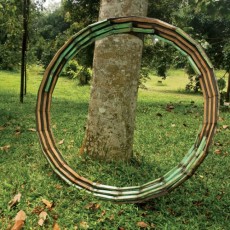
Canggai. 2014. Wood, metal, copper & charcoal. 200 cm (diameter).
Sabri Idrus was the Malaysian Artist for the Malaysia-Australia Visual Arts Residency 2013.
Artist’s biography:
Sabri Idrus, (b. 1971, Kedah, Malaysia) is an artist best defined by his compulsion to experiment with media. Oscillating between a career as an artist and a successful graphic designer, Sabri studied fine arts at UiTM from 1995-1998. Received The Malaysia Young Contemporary Art Award in the painting category in the year 2004 and A Special Mention Award for the UOB Art 2011. Sabri’s works are held in private and public collections in the United Kingdom, Poland, Singapore, America, India, Hong Kong, Indonesia and Malaysia. He has participated in residencies in Poland, Indonesia and Rimbun Dahan, Malaysia. Sabri Idrus lives and works in Kuala Lumpur, Malaysia. Sabri is a constant researcher in the process of art making, specifically in his endless search in the production of prints, marks and traces as the notion of visual representation that operate as his medium in conveying his research and thoughts.
Disruptive Nature
Disrupting materials and surfaces are the main interests for the development of this series, simply entitled Disruptive Nature. Further developing his interest in mark making – a preoccupation with surfaces, spatial stacking, temporality and organic fluid forms (The Search of the Uncertainties, 1999), Sabri Idrus continues his semiotic-reference in art making by tracing down patterns of nature. Leaves, trunks and twigs were scanned and studied in order to understand the basic properties of these elements of nature. From his earlier experimentation with industrial materials, that had the objective of venturing into alternative media such as painted surfaces, this series of works marks a comeback for Sabri and his object making exercise. These processes of experimentation are a statement that echoes his search for creating new marks on new surfaces. How to create a desired effect on a particular material with its own specific characteristics, to be able to re-produce similar effects on different materials has been explored by Sabri in his long process in art making, and is further demonstrated this interpretation of ‘shadows’ as themed for the Rimbun Dahan showcase.
Taking advantage of his discoveries with industrial materials, Sabri, again, marks a change from his normal material play, venturing into the more subtle realm of natural patterns, forms and characteristics. The natural patterns he has discovered and mimicked on his choice of surfaces reveal their latent qualities in a two-dimensional manner. Sabri’s series of studies were then reconstructed using a very similar method to his deconstruction in order to transform them into three-dimensional sculptures. Only this time, the traces of patterns and surfaces were extruded to create solid forms coupled with the real natural patterns that originated from the material itself. These processes are not an escapism from his earlier ‘difficult’ process in producing his works, but rather should be seen as a new adventure of developing a more advanced understanding of the manifestation of moments that reconcile nature with the unnatural.
Researching within the natural context of Rimbun Dahan, coupled with his seminal research on natural and man-made elements from his residency period in Poland, and through in-depth studies of the architectural works of Anthony Viscardi, Sabri’s latest works examine the qualities shared between art and architecture through explorations of solid and void, presence and absence, static and dynamic, and material and ephemeral continuums. His daily observation of the site-specific elements of his work place at Rimbun Dahan has allowed him to capture measurable details in nature’s natural moment, where tactility and space-time relation of the natural evolution are always visible. The nature of observation places one’s visual sense in an almost circular perspective (looking at the surrounding in 360 degrees) and has been recorded, photographed, memorized and sometime distorted into the physical being of the artwork itself. Sabri’s observations have been replicated in the form of circles, reflecting the way he looks at things around him. The conflicting elements of the natural and unnatural characteristics of these objects were further elaborated through detailing and specific material usage, hoping the artwork would be able to present itself as a signifier of the context that they represent.
What Sabri is interested in is that the work should not represent itself as an object to be confronted, making the viewers merely face the subject, but rather to create a feeling of being wrapped in it, as though it were our shadow.
Shadow and light is a dual reality, the hypertrophy of a double sensation: there can be cavernous, dark, soft, humid, sensorial, crystalized, cold, luminous, and all this can be used like an individual zapping of perception. Return to text…
Tiga Tiga, video and sculptural installation, Blue Mountains, Australia.
Dr Lisa Anderson works across a broad range of media creating images, films and prints that explore issues of weather and its consequences including the movement of peoples and animals, the shifts in legends and mythology specific to locations, and the effects of climate change in our global environment.
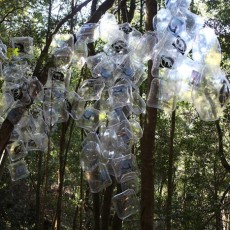
Recent exhibitions include Huldefolke, a photographic series in Skargarstrond, Iceland, working with the mythology and religious beliefs in the unseen or hidden folk, Beneath the Architecture of Beauty which comprised neon and photographs in London, and a sculptural intallation in Beijing, Clouds in the Beijing Breeze, which references childish joy with gifts and the abundance of stories with clouds of gold. Further sculptural work includes a temporary installation work Precious that uses 4,000 wine glasses to use a fairytale ambience to capture water and light in a forest beside the sea in Arhus in Denmark, andTiga Tiga, a video and sculptural installation at Scenic World in the Australian Blue Mountains and in Contested Landscape for Ten Days on the Island, Tasmania. Tiga Tiga will also form a part of the Lorne Sculpture Biennale in 2014.
Anderson exhibits regularly in Sydney, London and Beijing and is included in major private and public collections. Her residencies include Arctic adventures as artist on a Russian icebreaker, as well as exploring UNESCO sites in the Bay of Biscay and, more recently, the Antarctic aboard the MV Fram, travel in remote Australia, Central java, the UK and other sites with weather-specific stories as the stepping point for the works Dr Anderson creates with her company The Shiny Shiny World.
Anderson spent three months at Rimbun Dahan in 2013, creating 3D video pieces for installation in various locations using the unique gardens, water features and dancers of the area in the final work.