May 2012 — Otters again!

May 2012 — Otters again!

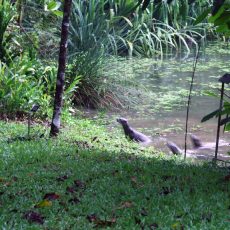
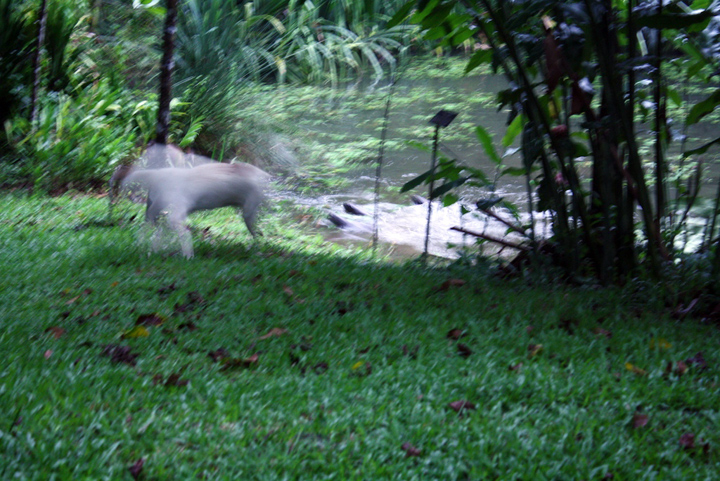
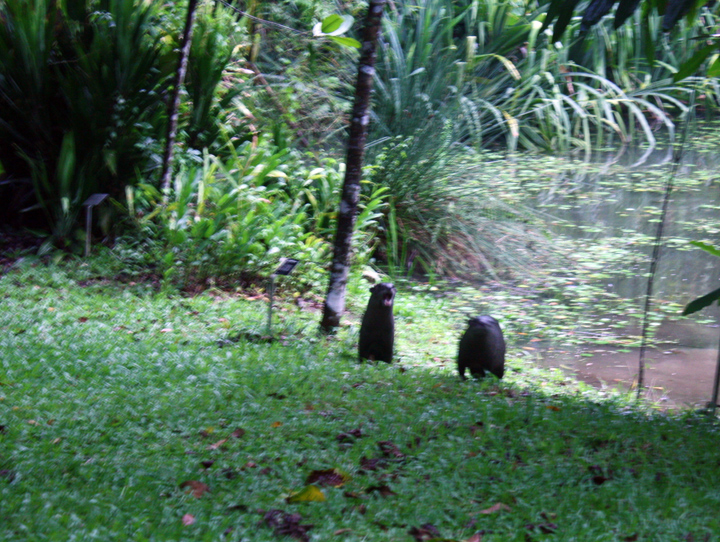
The otters are back, and they are bristling! Having been our occasional visitors for a few months, we are no longer surprised by the odd spraint by the side of the swimming pool, but so far direct contact between humans and otters at Rimbun Dahan has been rare. This morning Angela Hijjas had a thrilling encounter with our fish-eating friends:

“I woke with the azan this morning to hear desultory barking by Samson and Santan… I went out because it sounded a bit odd, and when I turned on the loggia light a big splash near the blue pots indicated something large in the water. It had to be an otter. I turned off the light and retreated with dogs in the house.

“I watched for the next 45 minutes and then gave up, but it was starting to get light and from upstairs I could see waves in the lower pond, so I got my camera and went down even though it was still dark. The dogs didn’t see me as I was behind the hedge, and I could see there were about 6 of the otters cruising around in formation. I think they hunt together by herding the fish into a corner and then attacking. They were catching fish but I didn’t see any eating.

“It quietened down, and I realised they were in the upper pond so I followed via the edging of the reflective pond and of course Santan and Samson saw me and followed. I thought the game would be up if the dogs got wind of the otters, but no indeed!

“The dogs went down to the divide between the ponds and the otters attacked! Four of them, heads rearing out of the water simultaneously towards the dogs, and then advancing out of the pond and onto the grass! Of course my faithful dogs retreated and were going to go home, but it would have been a huge loss of face with me there to protect. I had my SLR camera, and was clicking continuously although not with the camera to my eye, so most of the shots were out of focus but I was so close I had to get something, and I felt that if the noise of the camera continued they wouldn’t bother with me, but eventually when I was thinking I should retreat they realised I was there and disappeared.

“What an exciting morning!”

A group of otters is variously called a family, a bevy, a lodge or a romp, or, when in the water, a raft. At Rimbun Dahan, we might call ours an attack.

Lina Limosani

Lina Limosani

lina

Australian dancer and choreographer Lina Limosani undertook an Asialink residency at Rimbun Dahan in 2008, during which time she developed and presented the full-length contemporary dance work A Delicate Situation. Lina returned in 2012 for a short redevelopment of the work, with Australian dancer Carol Wellman-Kelly.

About the Artist

Lina Limosani graduated from the Victorian College of the Arts in 1999 and became a member of the Australian Dance Theatre (ADT) from 2000-2005. In 2003 she was awarded the Emerging Artist award by the Adelaide Critics Circle for her works in ADT’s in-house choreographic seasons of Ignition. In 2004 Lina was nominated for a Green Room Award for her performance in The Age of Unbeauty at the Melbourne Festival. She also featured in Anton’s dance film When You’re Alone, which was a finalist in the 2004 Reel Dance International Dance on Screen Awards.

After leaving ADT Lina worked with artists including Narelle Benjamin, Lucy Guerin and Gideon Obarzanek. She has since maintained a performance career both in Australia and New Zealand, and gone on to create her own works independently. Lina’s works are known for their fast, aggressive movement style, as well as their humour, and use of speech and theatre.

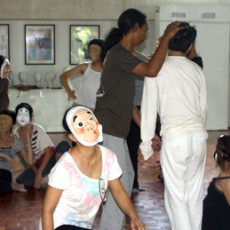
Below: Suhaili Micheline rehearsing for the redevelopment of ‘A Delicate Situation’ in the studio at Rimbun Dahan.

Residency in 2012

Australian choreographer Lina Limosani has returned to Rimbun Dahan on a short redevelopment of the work A Delicate Situation, which she created at Rimbun Dahan in 2008.

Accompanied by Australian dancer Carol Wellman-Kelly, and reconnecting with Malaysian dance Suhaili Micheline Ahmad Kamil who was involved in the original work, Lina reformed A Delicate Situation to confront different cultural approaches to death, dying and the afterlife.

The original work investigated Malaysian superstition through the story of the pontianak, a female vampire ghost believed to have died at childbirth. The redeveloped version is also set in Malaysia, but is the story of a Western woman’s struggle to come to terms with death surrounded by a culture saturated in legend, myth and superstition.

“What I found compelling [with the pontianak] is the seemingly universal necessity for humans to personify death,” says Lina. “This tendency became central to A Delicate Situation and it was through the character of Death that I invite the viewer to be deeply drawn into the work. Death, its personification in the lore surrounding it, and the fear that accompanies it remain fundamental in A Delicate Situation.”

The finished work will premier in the inSPACE program at the Adelaide Festival Centre in August 2012. Lina Limosani and Carol Wellman-Kelly’s residencies at Rimbun Dahan in May 2012 are supported by Arts SA.

govt-sa-arts-sa

Below: Lina Limosani, Carol Wellman-Kelly and Suhaili Micheline learning the classical Malay dance tari inai from Malaysian dancer Hasmizan Abdul Hamid from ASWARA.

Residency in 2008

Lina was resident at Rimbun Dahan from September to December 2008, with the support of a performing arts grant from Asialink. During her stay, she created a new contemporary dance work for performance in December 2008. She collaborated with physical theatre artist Al Seed and costume designer Eve Lambert who were resident at Rimbun Dahan for short periods.

Lina Limosani worked with four accomplished local dancers — Elaine Pedley, Suhaili Ahmad Kamil, Low Shee Hoe and Rathimalar Govindarajoo — to create A Delicate Situation, a full-length performance with a strong visual and emotional impact, which was performed at Kuala Lumpur Performing Arts Centre in December 2008.

Ashly Nandong

Ashly Nandong

ashly-performing-close-up

Ashly Nandong is a thirty-year old artist from Kuching, Sarawak who joins us for three months as short-stay artist-in-residence at Rimbun Dahan.

Ahsly completed a Bachelor’s degree in Mechatronics and Robotics Engineering at Swinburne University, in Victoria, Australia in 2009, returning to Malaysia in early 2011. However, it was his informal art education and exposure to traditional dance and music during his formative adolescent years that marked him for quite a different life direction. Eventually, and inevitably it seemed, what placed him firmly on this different road was his continued active involvement in the performance and visual arts, while living in Melbourne. Having been taught the sapeh lute as a teenager under different gurus, the traditional Dayak dance of the Orang Ulu and Iban people, and now as painter, Ashly crosses from performance to visual arts and back with ease.

A strong sense of his Iban cultural heritage is what binds; one medium of expression inspires the other in a non-hierarchy. Traditional motifs and metaphors make for meaningful markers and anchor him along the way in his berjalai, an ancient Iban custom of roaming or journeying in search of greener pastures of knowledge and hopefully the ‘wisdom’ that comes from hands-on experience.

At Rimbun Dahan, Ashly is given a much-needed time for contemplation in an important  part of his berjalai; an introspective time to connect with his creative aspirations in response to his current ‘spiritual’ situation. Ashly is presently working on a painting depicting the Tree of Life, a motif found in Iban symbolism and in religions, mythologies and philosophies throughout many different cultures, in varying permutations.

A unifying principle that unites all cultures and religions is something Ashly gravitates towards, being very keen to understand deeper the creative force that at core animates all living entities with spirit. The living tree, rooted in earth but with branches reaching upwards for the heavens is aptly symbolic of Ashly’s current station of berjalai at Rimbun Dahan, a place of lofty trees and sounds of ancient cicadas and birdsong.

Rebecca Stevens

Rebecca Stevens

Bec_portrait

Bec Stevens undertook a three month residency at Rimbun Dahan in 2012, in association with Asialink. Bec is a Hobart-based visual artist whose work is underpinned by studies in Architecture and Horticulture. She graduated from the University of Tasmania’s: School of Art in 2003 and School of Architecture and Design in 1999.

Her practice is site-responsive and inter-disciplinary, using a range of mediums as tools to respond to the social and historical nuances of constructed environments. More specifically she is interested in, and responds to public spaces that are left-over, in-between states or unplanned, often resulting in works that reflect on processes of development or entropy.

Bec frequently uses plant material within works, and during her time at Rimbun Dahan she intends to respond directly to the garden of indigenous Southeast Asian species. She is interested in the garden as an island of biodiversity in the context of the surrounding area of Kuala Lumpur, particularly in light of the rare and endangered species it holds; and in the social customs and specific relationships to botanic species. Alongside this she is interested in the rates of change, growth and decay in the region, in terms of the inherent maintenance required for living in a place that sits in close proximity to the equator, and she intends to use this as impetus for developing work.

Bec Stevens recent projects and exhibitions include: ‘STOP. REST. PLAY.’ (2011) commissioned as an activity of the CWA CBD Branch; ‘Lookout’ at the Tasmanian Museum and Art Gallery (2010) and ‘Canopy’ (2008) commissioned for the Royal Tasmanian Botanical Gardens. She has received funding from Arts Tasmania for numerous projects and in 2009 was the recipient of a New Work Grant through the Australia Council for the Arts. In 2010 she completed a Studio Residency at Contemporary Art Spaces Tasmania and she is currently the recipient of the Curatorial Mentorship through Contemporary Art Spaces Tasmania. She is an active member of the CWA CBD Branch, see www.cwa-cbdbranch.com.

Jonathan Nichols

Jonathan Nichols

Australian Artist for the Malaysia-Australia Visual Artists’ Residency 2012

jonathan_nicholsAbout the artist

Jonathan Nichols lives in Melbourne, where he works as an artist, and sometimes as a curator and writer. He has maintained a studio-based painting practice since graduating from the School of Art at the Australian National University in 1988 and completing postgraduate studies at the University of NSW in 1989. He has exhibited widely in Australia, including at private art galleries, public museums and artist-run spaces.

About the art

Although the process of his paintings begins by sourcing and selecting digital images that are first collaged on the computer screen, Nichols’ work takes a painterly form that is fundamentally connected to manual ability and his own creative desires—establishing a clear aesthetic distance from more technologically complex methods of production. He is interested in painterly ground rules and ideas as well as the potential for new motifs and chance associations.

Using the computer technology in this way allows Nichols a certain level of introspective inquiry that then independently affects the look and feel of each finished painting.

Nichols is interested in the possibilities that connect and run between people. His subjects found in various digital media or other research material or in person generally maintain their anonymity, however. His paintings have been described as conveying ‘the experience of seeing someone at a distance’, which is recorded ‘as a sort of touch or feeling of proximity’. Jonathan Nichols uses the human figure as a point of correlation or orientation – the figure becomes both cipher and affect.

jonathan's-studio-1

Residency plans

At Rimbun Dahan, drawing from his experience in Malaysia, Nichols plans to research and develop new figurative motifs which would be sourced from street scenes and popular media; thinking about culture and history, everyday society and forms of portraiture. He is interested in figurative studies (or visual storytelling) that can bridge or define cultural traditions and aesthetics, for example those associated with the Malay, Chinese, Indian and indigenous people. Nichols is keen to spend time discovering how these interconnect with his own knowledge of Western painterly traditions; to learn what is held in common between artists and what is not.

For more information visit http://www.jonathan-nichols.blogspot.com/

Helmi Azam B. Tajol Aris @ Azam Aris

Helmi Azam B. Tajol Aris @ Azam Aris

Malaysian Artist for the Malaysia-Australia Visual Artists’ Residency 2012

Azam Tajol Aris in his studio at Rimbun Dahan with some of his army of clones.

Azam Tajol Aris is Rimbun Dahan’s Malaysian year-long artist-in-residence. He graduated in Fine Arts from Universiti Institut Teknologi Malaysia, in 2007. Born in Perak in 1985, and growing up into the digital age of internet technology, it is the popular-culture world of graphic novels, anime and internet ‘ready-made’ third-hand or regurgitated information that informs Azam Tajol Aris’ art practice. In the current state of information saturation, a threat that ‘all is rumour’ requiring a challenging critical response is what seems to push Azam towards the satirical in his work in a light-hearted social commentary.

Azam’s current work at Rimbun Dahan is in three-dimensional form. It is the first step in a slight shift in direction. He has made multiple plaster casts of a male figure resembling a soldier to create an army of ‘clones’. There is also a cast plaster figure of one clone-member who must be the general, his mouth in an ugly gape, shouting out an order for conformity.  Instead of a helmet though, the clones all have their hair gathered into a peak at the top, a cross between a headgear found on ancient Ramayanawayang kulit characters and a popular latter day hair style.

As ‘puppet master’ or dalang, Azam himself acts as a conduit for the rapid re-processing and disseminating of information. Gathering a patchwork of data, he re-creates ‘still-life’ mute scenarios or vignettes in three-dimensions. The germ for Azam’s three-dimensional ‘stories’ is information that had already been pre-processed and then re-processed and re-translated. Azam completes the mythologizing process by re-packaging the pieces of information into a critique.

CV

Born 15 December 1983, Taiping Perak.

Address Studio Sebiji Padi, 19A Jalan Unyang, Taman Alam Megah, Seksyen 27, 40000 Shah Alam.
Contact 0125785405, Azam_aris@yahoo.com.

Education

2005 – 2007 BFA (hons.), UiTM Shah Alam.
2004 – 2005 Skim Latihan Graduan, PESDC, Tronoh Perak – MMU
Cyberjaya, 7 Month Training in Video.
2001 – 2004 Diploma in Fine Art, UiTM Sri Iskandar.

Solo Exhibitions

2010 ‘PARANOIA’ R.A Gallery, Ampang, Kuala Lumpur.
2008 ‘FLOAT’ House Of Matahati, Taman Cempaka, KL

Selected Group Exhibitions

2011 Vertical-Horizontal, House of Matahati, Kuala Lumpur.
2010 The Young Contemporaries Competition, National Art Gallery, Kuala Lumpur.
Art Triangle, National Art Gallery, Kuala Lumpur.
BAD@MAP, Solaris, Kuala Lumpur.
2009 Malaysian Contemporary, Conpenhangen, Denmark.
MEA Award, Sokka Gakai Malaysia, Kuala Lumpur.
B.A.C.A , R.A Gallery
2008 Young n New part 1, HOM KL.
2007 Degree Show, TNZ Galeri, UiTM Shah Alam

 Awards

2010 Juror Award, Young Contemporaries 2010, National Art Gallery, KL.
2008 Artist in Resident, House Of Matahati.
2007 8th Prize, SCHENKER, Future Transportation Competition.

T.H.E. Dance Company

T.H.E. Dance Company from Singapore enjoyed a short residency at Rimbun Dahan in January 2012, rehearsing new works for premieres. During their residency, artistic director Kuik Swee Boon and T.H.E. Dancers conducted a workshop in the Dance Department at ASWARA, and generously included Malaysian dancers in their daily company class. Malaysian tai chee master Tangkok Lee was invited to teach occasional company class during the company’s residency.

January 2012 — Otters

January 2012 — Otters

Over the new year, we restocked the reflective pool between the main house and the guest house with baby koi. At the time, the reflective pool was home to a vast hoard of black tilapia, as well as five or six mature koi over a foot long.

Shortly after the introduction of the baby koi, all the mature koi and a number of the baby koi disappeared. At first we suspected infection. Ragged remains of koi were found near the swimming pool, suggesting that monitor lizards — of which we have many, and some very large — had been making free with the fishy remains. However, members of the staff at Rimbun Dahan said it was the work of musang (civet cats, or mongoose). Musang? we queried, but musang don’t swim! Oh yes, replied the staff knowingly, musang swim very well, and when there is food for them they call all their friends!

Mystified and doubtful, we held onto our first infection theory. A few days later, the staff clarified: No, we didn’t mean musang, we meant memerang. Otters? Even less likely.

Then early one morning Angela caught a glimpse of massive disturbance in the swimming pool, and then spotted two very large otters, one of them devouring the last of the koi. Characteristic spraints (otter droppings) have also been discovered on the swimming pool edge. The animals are so large that the Rimbun Dahan dogs have so far left them prudently alone.

From our brief sighting, it is impossible to accurately define what species of otter these are. There are several species native to Peninsula Malaya, including the Eurasian otter (Lutra lutra), the endangered hairy-nosed otter (Lutra sumatrana), the smooth-coated otter (Lutrogale perspicillata) and the Oriental small-clawed otter (Aonyx cinerea). All are very similar, and some can only be distinguished by careful analysis of nose hairs and skull specimens.

No matter their species, the voracious animals have effectively cleaned out the fish population of the reflective pool. All the koi are now gone, and the tilapia population more than decimated. In order to cater to their enormous appetites, otters are required to have a huge territory, so it may be likely that our furry swimming visitors have come and gone… until we restock the pond for their dining pleasure.

Riki von Falken

Riki von Falken

Echo II

EchoII

From 9 to 10 December 2011, German choreographer Riki von Falken and the Dance Programme at Rimbun Dahan presented a new dance work performed by eight Malaysian dancers.

riki_portrait_th“The language of my body echoes a special experience: working with the students at the ASWARA, the national arts academy in Kuala Lumpur, in 2010. For me, there is a connection between the energy of the martial art Silat and my abstract form in dance. I use the particular expressions of the dancers for a meeting of cultures in these two different forms.” — Riki von Falken, dancer & choreographer from Germany

Riki arrived at Rimbun Dahan in mid-October 1011, having already led an audition for her work at Rimbun Dahan and ASWARA earlier in August. The eight Malaysian dancers whom she chose worked intensively with her in the process of creating this work. Echo II followed Riki’s creation of the original Echo work with four dancers in New Zealand earlier in 2011.

Performed by Bilqis Hijjas, Dayang Norinah, Khairi Mokthar, Naim Syahrazad, Ng Xin Ying, Nur Ekmal bin Yusof, Pengiran Khairul Qayyum & Rabiatul Adawiah.

8.30pm Friday & Saturday, 9 & 10 December 2011
3pm Sunday, 11 December 2011
Experimental Theatre, ASWARA, 464 Jln Tun Ismail, Kuala Lumpur
Every performance followed by Q&A with the choreographer and performers

Produced by Rimbun Dahan. Sponsored by the Goethe-Institut Kuala Lumpur.

EchoII_flyerfront

Zedeck Siew

Zedeck Siew

zedeck

In 2011, Malaysian writer Zedeck Siew spent three months in residence at Rimbun Dahan.

Bio

Zedeck Siew has been a journalist, editor and critic for art journal Kakiseni, news website The Nut Graph, lifestyle magazine Klue, and community-level information portal Poskod Malaysia. He has written about bad lobby art at the UMNO General Assembly, seen some truly horrendous theatre, and covered a by-election in rural Kelantan. He has also dabbled in performance – most notably in Five Arts Centre’s 2009 experimental shadow-puppet play Wayang Fajar. In 2011, he left gainful employment in media to work on fiction.