Jonathan Nichols

Jonathan Nichols

Australian Artist for the Malaysia-Australia Visual Artists’ Residency 2012

jonathan_nicholsAbout the artist

Jonathan Nichols lives in Melbourne, where he works as an artist, and sometimes as a curator and writer. He has maintained a studio-based painting practice since graduating from the School of Art at the Australian National University in 1988 and completing postgraduate studies at the University of NSW in 1989. He has exhibited widely in Australia, including at private art galleries, public museums and artist-run spaces.

About the art

Although the process of his paintings begins by sourcing and selecting digital images that are first collaged on the computer screen, Nichols’ work takes a painterly form that is fundamentally connected to manual ability and his own creative desires—establishing a clear aesthetic distance from more technologically complex methods of production. He is interested in painterly ground rules and ideas as well as the potential for new motifs and chance associations.

Using the computer technology in this way allows Nichols a certain level of introspective inquiry that then independently affects the look and feel of each finished painting.

Nichols is interested in the possibilities that connect and run between people. His subjects found in various digital media or other research material or in person generally maintain their anonymity, however. His paintings have been described as conveying ‘the experience of seeing someone at a distance’, which is recorded ‘as a sort of touch or feeling of proximity’. Jonathan Nichols uses the human figure as a point of correlation or orientation – the figure becomes both cipher and affect.

jonathan's-studio-1

Residency plans

At Rimbun Dahan, drawing from his experience in Malaysia, Nichols plans to research and develop new figurative motifs which would be sourced from street scenes and popular media; thinking about culture and history, everyday society and forms of portraiture. He is interested in figurative studies (or visual storytelling) that can bridge or define cultural traditions and aesthetics, for example those associated with the Malay, Chinese, Indian and indigenous people. Nichols is keen to spend time discovering how these interconnect with his own knowledge of Western painterly traditions; to learn what is held in common between artists and what is not.

For more information visit http://www.jonathan-nichols.blogspot.com/

Helmi Azam B. Tajol Aris @ Azam Aris

Helmi Azam B. Tajol Aris @ Azam Aris

Malaysian Artist for the Malaysia-Australia Visual Artists’ Residency 2012

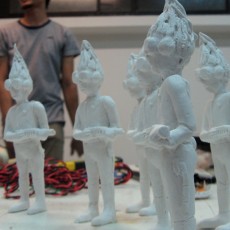
Azam Tajol Aris in his studio at Rimbun Dahan with some of his army of clones.

Azam Tajol Aris is Rimbun Dahan’s Malaysian year-long artist-in-residence. He graduated in Fine Arts from Universiti Institut Teknologi Malaysia, in 2007. Born in Perak in 1985, and growing up into the digital age of internet technology, it is the popular-culture world of graphic novels, anime and internet ‘ready-made’ third-hand or regurgitated information that informs Azam Tajol Aris’ art practice. In the current state of information saturation, a threat that ‘all is rumour’ requiring a challenging critical response is what seems to push Azam towards the satirical in his work in a light-hearted social commentary.

Azam’s current work at Rimbun Dahan is in three-dimensional form. It is the first step in a slight shift in direction. He has made multiple plaster casts of a male figure resembling a soldier to create an army of ‘clones’. There is also a cast plaster figure of one clone-member who must be the general, his mouth in an ugly gape, shouting out an order for conformity.  Instead of a helmet though, the clones all have their hair gathered into a peak at the top, a cross between a headgear found on ancient Ramayanawayang kulit characters and a popular latter day hair style.

As ‘puppet master’ or dalang, Azam himself acts as a conduit for the rapid re-processing and disseminating of information. Gathering a patchwork of data, he re-creates ‘still-life’ mute scenarios or vignettes in three-dimensions. The germ for Azam’s three-dimensional ‘stories’ is information that had already been pre-processed and then re-processed and re-translated. Azam completes the mythologizing process by re-packaging the pieces of information into a critique.

CV

Born 15 December 1983, Taiping Perak.

Address Studio Sebiji Padi, 19A Jalan Unyang, Taman Alam Megah, Seksyen 27, 40000 Shah Alam.
Contact 0125785405, Azam_aris@yahoo.com.

Education

2005 – 2007 BFA (hons.), UiTM Shah Alam.
2004 – 2005 Skim Latihan Graduan, PESDC, Tronoh Perak – MMU
Cyberjaya, 7 Month Training in Video.
2001 – 2004 Diploma in Fine Art, UiTM Sri Iskandar.

Solo Exhibitions

2010 ‘PARANOIA’ R.A Gallery, Ampang, Kuala Lumpur.
2008 ‘FLOAT’ House Of Matahati, Taman Cempaka, KL

Selected Group Exhibitions

2011 Vertical-Horizontal, House of Matahati, Kuala Lumpur.
2010 The Young Contemporaries Competition, National Art Gallery, Kuala Lumpur.
Art Triangle, National Art Gallery, Kuala Lumpur.
BAD@MAP, Solaris, Kuala Lumpur.
2009 Malaysian Contemporary, Conpenhangen, Denmark.
MEA Award, Sokka Gakai Malaysia, Kuala Lumpur.
B.A.C.A , R.A Gallery
2008 Young n New part 1, HOM KL.
2007 Degree Show, TNZ Galeri, UiTM Shah Alam

 Awards

2010 Juror Award, Young Contemporaries 2010, National Art Gallery, KL.
2008 Artist in Resident, House Of Matahati.
2007 8th Prize, SCHENKER, Future Transportation Competition.

T.H.E. Dance Company

T.H.E. Dance Company from Singapore enjoyed a short residency at Rimbun Dahan in January 2012, rehearsing new works for premieres. During their residency, artistic director Kuik Swee Boon and T.H.E. Dancers conducted a workshop in the Dance Department at ASWARA, and generously included Malaysian dancers in their daily company class. Malaysian tai chee master Tangkok Lee was invited to teach occasional company class during the company’s residency.

January 2012 — Otters

January 2012 — Otters

Over the new year, we restocked the reflective pool between the main house and the guest house with baby koi. At the time, the reflective pool was home to a vast hoard of black tilapia, as well as five or six mature koi over a foot long.

Shortly after the introduction of the baby koi, all the mature koi and a number of the baby koi disappeared. At first we suspected infection. Ragged remains of koi were found near the swimming pool, suggesting that monitor lizards — of which we have many, and some very large — had been making free with the fishy remains. However, members of the staff at Rimbun Dahan said it was the work of musang (civet cats, or mongoose). Musang? we queried, but musang don’t swim! Oh yes, replied the staff knowingly, musang swim very well, and when there is food for them they call all their friends!

Mystified and doubtful, we held onto our first infection theory. A few days later, the staff clarified: No, we didn’t mean musang, we meant memerang. Otters? Even less likely.

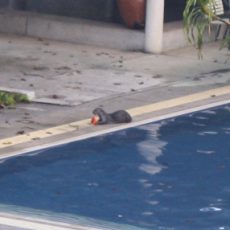
Then early one morning Angela caught a glimpse of massive disturbance in the swimming pool, and then spotted two very large otters, one of them devouring the last of the koi. Characteristic spraints (otter droppings) have also been discovered on the swimming pool edge. The animals are so large that the Rimbun Dahan dogs have so far left them prudently alone.

From our brief sighting, it is impossible to accurately define what species of otter these are. There are several species native to Peninsula Malaya, including the Eurasian otter (Lutra lutra), the endangered hairy-nosed otter (Lutra sumatrana), the smooth-coated otter (Lutrogale perspicillata) and the Oriental small-clawed otter (Aonyx cinerea). All are very similar, and some can only be distinguished by careful analysis of nose hairs and skull specimens.

No matter their species, the voracious animals have effectively cleaned out the fish population of the reflective pool. All the koi are now gone, and the tilapia population more than decimated. In order to cater to their enormous appetites, otters are required to have a huge territory, so it may be likely that our furry swimming visitors have come and gone… until we restock the pond for their dining pleasure.

Riki von Falken

Riki von Falken

Echo II

EchoII

From 9 to 10 December 2011, German choreographer Riki von Falken and the Dance Programme at Rimbun Dahan presented a new dance work performed by eight Malaysian dancers.

riki_portrait_th“The language of my body echoes a special experience: working with the students at the ASWARA, the national arts academy in Kuala Lumpur, in 2010. For me, there is a connection between the energy of the martial art Silat and my abstract form in dance. I use the particular expressions of the dancers for a meeting of cultures in these two different forms.” — Riki von Falken, dancer & choreographer from Germany

Riki arrived at Rimbun Dahan in mid-October 1011, having already led an audition for her work at Rimbun Dahan and ASWARA earlier in August. The eight Malaysian dancers whom she chose worked intensively with her in the process of creating this work. Echo II followed Riki’s creation of the original Echo work with four dancers in New Zealand earlier in 2011.

Performed by Bilqis Hijjas, Dayang Norinah, Khairi Mokthar, Naim Syahrazad, Ng Xin Ying, Nur Ekmal bin Yusof, Pengiran Khairul Qayyum & Rabiatul Adawiah.

8.30pm Friday & Saturday, 9 & 10 December 2011
3pm Sunday, 11 December 2011
Experimental Theatre, ASWARA, 464 Jln Tun Ismail, Kuala Lumpur
Every performance followed by Q&A with the choreographer and performers

Produced by Rimbun Dahan. Sponsored by the Goethe-Institut Kuala Lumpur.

EchoII_flyerfront

Zedeck Siew

Zedeck Siew

zedeck

In 2011, Malaysian writer Zedeck Siew spent three months in residence at Rimbun Dahan.

Bio

Zedeck Siew has been a journalist, editor and critic for art journal Kakiseni, news website The Nut Graph, lifestyle magazine Klue, and community-level information portal Poskod Malaysia. He has written about bad lobby art at the UMNO General Assembly, seen some truly horrendous theatre, and covered a by-election in rural Kelantan. He has also dabbled in performance – most notably in Five Arts Centre’s 2009 experimental shadow-puppet play Wayang Fajar. In 2011, he left gainful employment in media to work on fiction.

Dancing to Connect

Dancing to Connect

‘Dancing to Connect’ is a five-day dance workshop program that Battery Dance Company, New York, has been introducing all around the world as a mean to provide teenagers with the tools for getting in touch with the dancer within and choreographing their own performances. It aims to engage international youth in creativity and team building through the American art form of modern dance. DtC was launched in Europe in 2006, Asia in 2008 and Africa in 2009.

At the end of September 2011, five teams of teachers combining members of Battery Dance Company and dance students fom Malaysia’s national arts academy ASWARA ran Dancing to Connect workshops in Malaysia. One of these teams was centered at Rimbun Dahan, and was attended by students from Harvest School in Sentul and Sekolah Menengah Kebangsaan Tuanku Abdul Rahman in Batu Arang.

The students from Harvest School stayed in accommodation at Rimbun Dahan, accompanied by Jade Ong from Lotuspond Outreach. Led by Bafana Matea of Battery Dance Company, and Murni Omar from ASWARA, the students rehearsed for six hours every day to prepare for their final showcase performance which took place at Mong Kiara International School.

Support for Battery Dance Company and for meals for the Dancing to Connect participants was provided by the American Embassy, Kuala Lumpur.
Melanie Fulton

Melanie Fulton

mel1

John_Foubister__Melanie_Fulton


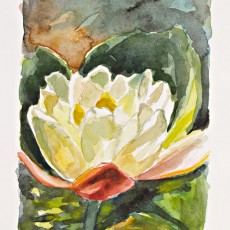
Melanie Fulton was in residence at Hotel Penaga in Georgetown, Penang, from September to November 2011, in a joint residency with her partner John Foubister. Some of the work which Melanie created during her residency was exhibited in the joint exhibition ‘Cultivating the Garden’.

Bio

mel2Melanie graduated from the South Australian School of Art in the late 1980’s. Since then she has maintained her art practice while also working in visual arts related areas. These have included Artist-in-Schools programs, numerous Community Arts programs and Diversional Therapy in Aged Care. Since 2005 Melanie has Coordinated the Tutti Visual Arts and Design Program, a professional program for Artists with Disabilities. Tutti Inc. is a leading Multi-Arts Disability and Community organization in South Australia.

Melanie’s own work has included the themes of “Home” and the duality of sanctuary and prison; Fairytale and Myth; “Exotic” cultures through the decorative arts and associated natural motifs. Currently Melanie is exploring plant and tree motifs with multiple view-points. Melanie works in a variety of mediums, with a special interest in watercolour painting.

Melanie has exhibited in private and civic galleries since graduation and has work in private collections in Australia, Britain, Sweden and Belgium.


Opening of APIDC 2011

Opening of APIDC 2011

nana_lg

Rimbun Dahan hosted the participants of the Asia-Pacific International Dance Conference 2011 for a welcome dinner in the Underground Gallery on 21 September 2011.

Dancers from the KESUMA Ensemble from University of Malaya provided a post-dinner show in the Dance Studio at Rimbun Dahan for the assembled guests, displaying the grace and diversity of classical and folk Malay dances to live musical accompaniment. The evening closed with an impromptu joget party, with audience members joining in!

The Asia-Pacific International Dance Conference brought more than 200 local and international dance academics together to discuss the theme of hybridity in dance, and how it is transmitted, performed, researched and written. The conference was organised by the Cultural Centre, University of Malaya, and Jabatan Kebudayaan & Kesenian Negara, and was held at the Royale Bintang Hotel from 22 to 25 September.

All photos by Syaffiq Hambali.

Rob McHaffie

Rob McHaffie
Pave Paradise and Put Up A Pavilion. 2011, oil on board, 31 x 23cm. Contributed to the fundraising event Art for Nature 2011.

Australian artist Rob McHaffie undertook a 3-month Asialink residency at Rimbun Dahan in 2011.

“Each day at Rimbun Dahan I am making a drawing that responds to a verse in the Tao te Ching, Lao Tsu’s book of wisdom. The Tao could be said to be the way of nature and is a guide for people to live in harmony with the universe. Drawing inspiration form Malaysia’s fantastic but depleting wildlife and the spirituality of people living here I hope to find some interesting imagery and stories that will illuminate where we are heading and the possibility of living sustainable peaceful lives.”

rob_in_studio2

Biography

Rob McHaffie is a Melbourne based artist, having graduated from Victorian College of the Arts drawing department in 2002.The images in McHaffie’s paintings are often derived from shapes formed from roughly assembled and seemingly mismatched objects. Rather than paint from life, McHaffie chooses what could be described as the poor man’s life model, sculpting characters from modeling compound and adding scraps of fabric, discarded clothes and bric-a-brac to create imagined portraits and tableaus. This method contributes to an unusual mixture of pathos and amusement in the paintings. The scenes depicted might simply be laughable, if it were not for the fact that the artist has captured within each scene (and echoed within each title) certain life truths.

Rob’s daily practice consists of diary and journal work, and collecting found and personal imagery to form the basis of his drawing, painting and sculpture. Rob participated in exhibitions and residencies in Australia, New Zealand, France, and the USA and is represented by Darren Knight Gallery in Sydney, and Brett McDowell Gallery in Dunedin.