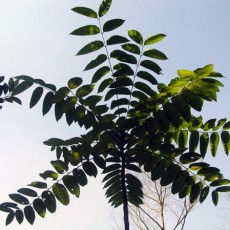
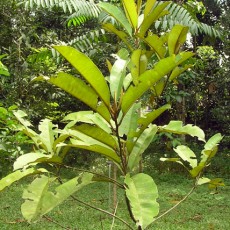
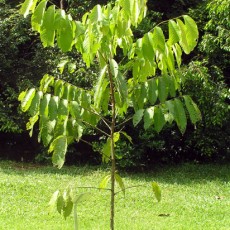
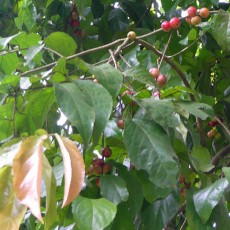
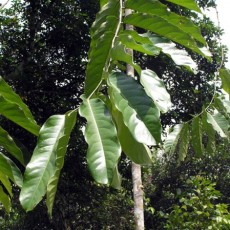
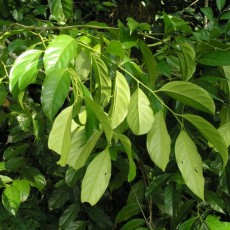
Tropical and sub tropical. From Turkestan to NSW. 2 spp in Malaya, both rare. Tall dioecious trees. Resin used for incense & for medicine, Bark and leaves for tonic after child birth, and used as febrifuge. This sp distinguished by glands scattered under leaflet.
Lg. genus of 115 spp. in SEAsia, about 22 spp. in Malaya. Sumatra, Java, Borneo, all states but Perlis, Kedah, Trengg. Med. tree to 25 m., scattered in lowland forest, sometimes planted for gutta percha, tapped in fish-bone pattern.
Palaquium sp.
nyatoh
Payena lucida
nyatoh?
Burma, Siam, Sumatra, Borneo, Malaya exc. Perlis. Common in understory. 10 spp. in Malaya, recognized from descending tertiary nerves & strong tendency for leaves to occupy an alternate rather than spiral position on twigs.
Java, Borneo, Philippines. Small trees, twigs glabrous, rachis distinctly winged (Lat. alata). Mainly cultivated in villages on east coast.
Lepisanthes rubiginosa kelat layu, mertajam
Small white fragrant flowers, fruit ripening from yellow, red, purple, to black. Common in K. Baru.
Mischocarpus sundaicus
sugi
Common on sandy coasts, islands & estuaries or coastal swamps. India to Australia. Small tree to 6m, bushy crown. Young leaves pinkish and edible. Fr Tunas Harapan 6.2012.
Sumatra, Java, Malaya. Lowland forest.To 30m tall, 3-7 prs leaflets. Fruits slightly flattened ellipsoid. Lat. leaves like the walnut Juglands.
Nephelium mutabile
pulasan
Like rambutan, but leaflets narrower, dark glossy green above, pale & glaucous beneath. Crimson to purple fruit with blunt fleshy spines. Pulp pale yellow, separates cleanly from seed.
Pometia pinnata kasai
Sri Lanka, Andamans, S. China. Malesia. Leaf margins dentate, every other secondary nerve ending in a tooth. Spreading crown. Three forms recognised, edible fruits, young red foliage.
Pometia ridleyi
kasia daun licin
Malaya, Sumatra. Perak, Pahang, NS, Selangor. Large trees to 50 m. Boles with 2 m buttresses, bark dippled brown. Primary forests, hill slopes, by streams. Leaf secondary veins sunken above, looping up without ending at the margins under.
Xerospermum laevigatum Radlk.
rambutan pacat, gong
Burma, Malaya, Sumatra, Borneo. Lat. smooth. Syn. with X. acuminatum Radlk. Lowland forest. To 30m, leaflets opposite, monoecious. Flesh around seed is edible, pulped stone/leaves are used to alleviate stomach ache.1 from TH 11/09.
Xeropspermum noronhianum Bl.
rambutan pacat, kikir buntal
2 spp, Bangladesh-Indo China. Common in low lying forest in Malaya. To 25m, leaves w/1/2/3 prs opposite leaflets; flat glands above axis of veins or scattered over leaf. Fruit yellow. 2 specimens June 2008.
Flacourtia rukam Previously family Flacourtiaceae rukam
Difficult family to define because of minute variations in flower structure. Scattered throughout Malaya in rain forest, occasionally cultivated. Fruits edible, made more palatable by rubbing between the hands, but best cooked.
India, Burma, Siam, Malaya. Common on rocky and sandy coasts from Penang northward and all east coast. Thorns and notched leaf tip distinguish it from Suregada sp. In habit looks much like Citrus, leaves standing obliquely erect.
Burkillanthus malaccensis
I H Burkill, 1870- 1965, director Singapore Botanic Gardens. Small tree to 12m, one sp in Malaya & Sumatra. Large fruits, thin peel rough with oil glands. Fr Rimba Ilmu 2011.
Citrus aurantiifolia var. microcarpa
limau kasturi
Up to 4m. small fruits used for juice. These planted in memory of Hj. Kasturi Hj. Idris.
Citrus hystrix
limau purut
Leaf blade 1 -2″ long, almost as wide, slightly toothed: leaf stalk widely winged, as to appear like the other half of a blade divided in two. Fruit has wrinkled skin, used for ritual bathing. Rind used in ubat jamu to drive away evil spirits, worms in children and headache. Leaf an essential ingredient in cooking.
Citrus sp.
limau purut
This unidentified hybrid is more hardy than the common limau purut, but retains the strong pungency of leaves and fruit, and produces excellent juice.
Clausena excavata semeruIndia, S. China, Malesia, common especially to north and at edge of forest. Small tree, laxly branched and spreading, branches ending in tassels of long slender leaves. Crushed twigs have a nauseous smell of resin & lime, loose bunches of pink or whitish berries.
Glycosmis pentaphylla kemotak, kenapehCommon village shrub from Perak & Kuantan to north. Sprawling evergreen, crushed leaves smell lemony. Small white flowers, axillary panicles. Fruit edible & sweet but resinous.
Limonia acidissima
belinggai, gelinggai
India, Burma. Common in Perlis villages, needs monsoonal climate to fruit, slow growth and fruiting, brown pulp edible but resinous.
Triphasia trifolia
limau kingkip, bird lime
Philippines, China? Indifferent fruit, but used to be boiled by Malays in sugar syrup. Useful small timber, good for hedging.
Malaya, Andamans, Sumatra, Borneo. Througout Malaya, lowland to mountain forest, also on limestone. Showy fragrant inflorescence. Two planted on corners of plaza 07.
Anthocephalus chinensis kelempayan, kelampai
Deciduous monopodial to 30m, stiff outstanding limbs, drooping at ends. Common in secondary forest & on river banks. Branches in alternating pairs like mangosteen. Minute seeds, <1mm. Flowers in stalked round bur-like heads, but each flower separate from others.
Gardenia carinata mentiong Kedah
Thailand, throughout Malaya, common in north. Small tree to 15m. Leaves obovate, lower surface hairy. Flowers solitary or clustered, calyx tube shields a third of the corolla tube.
Gardenia pterocalyx
mentiong
Small tree found in swampy habitat, at Tasek Bera, gelam forest in Trengganu and at G. Ulu Kali. Calyx tube with 7-10 narrow wings, fruits with wings down from calyx cup.
Gardenia tubifera mentiong
Sumatra, Java, Borneo and Thailand. Throughout Malaya in lowland and hill forests. Terminalian branching, shoots often resinous. Flowers solitary, calyx tube truncate, corolla tube length variable, opens white turning orange. Fruits split to expose seeds in orange pulp.
Gardenia tubifera, with the distinctive scent of the genus, flowers prolifically but for just a week, and by the time I took the photo the tree was well past its best.
Ixora scortechinii
pecah periok/piring/pasu, jenjarum
120 spp, generally tropical, 20 spp in Malaya. Flowers in clusters at branch ends, long corolla tube, 4 spreading petals. Attracts butterflies. 2 new specimens December 2007.
Timonius wallichianus
triang, silver timon
Sumatra, Banka, Riouw, Anambas. In secondary lowland forest up to 500m. Lower leaf surface completely covered by silvery appressed hairs. Flowers unisexual, plants dioecious. 160 spp from Sri Lanka to Pacific, 14 spp in Malaya.
Shrub or tree to 33m. Two spp in Malesia, one in New Guinea and Moluku, this in Malaya, Sumatra & Borneo. Lowlands, river bank, peat swamp. Small fruits 1cm, ripen pink. 1 fr TH 11.09.
Pale flowers in stalked clusters, fruit pink to red, pulpy. Tree to 25m., commonly called false kelat. Hard heavy wood, horizontal branches, twigs solid prominently swollen at nodes. Leaf midrib sunken above, secondary nerves joined near margins as double loops.
Drypetes pendula (previously family Euphorbiaceae) lidah lidah
Lat. hanging, leafy branches. Common in Malaya, low undulating land. Monopodial tree to 20m, 1m girth, deep dark pyramidal crown, leafy branches drooping, sinuous. Leaves lying flat, spirally attached, young in purple red tassels.
Genus of about 60 spp., from India to Solomon Islands; W. Malesia development epicentre for genus. 21spp. in Malaya, inland in primary forest, fairly common in understorey. Flowers infrequently, possibly triggered by dry periods.