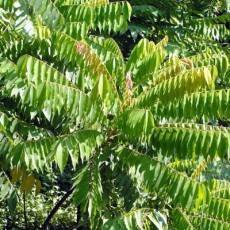
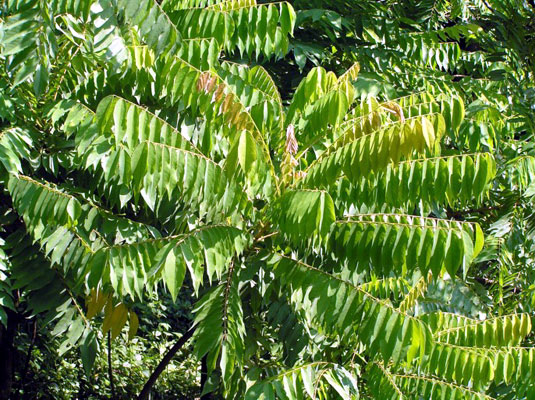
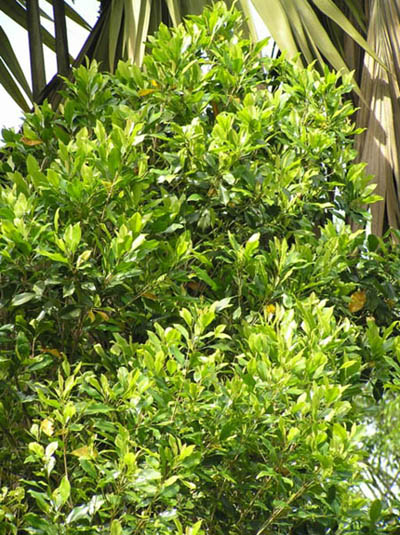
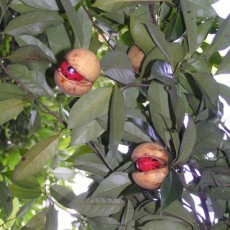
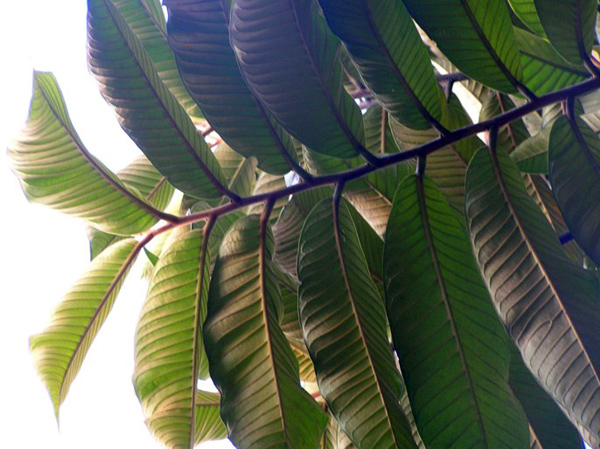
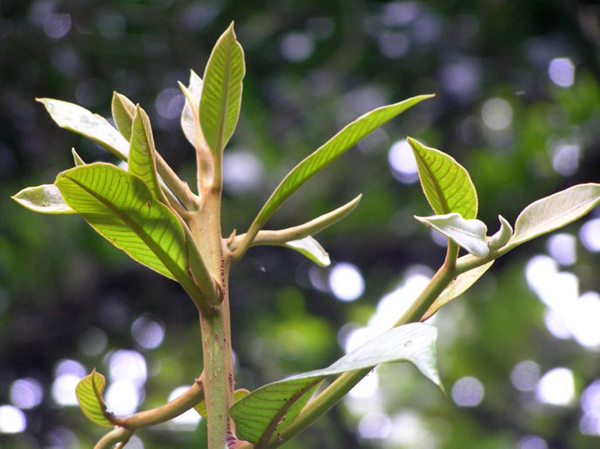
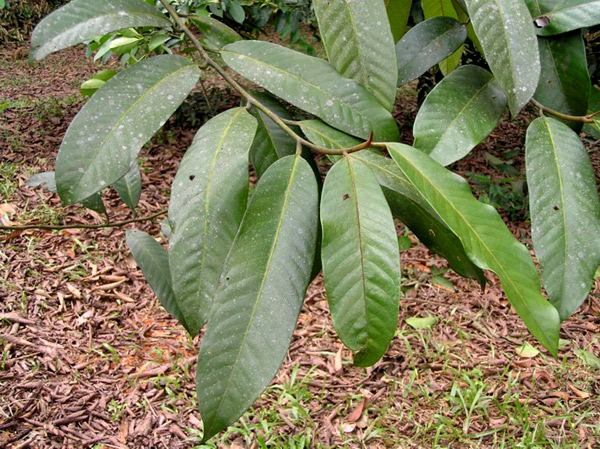
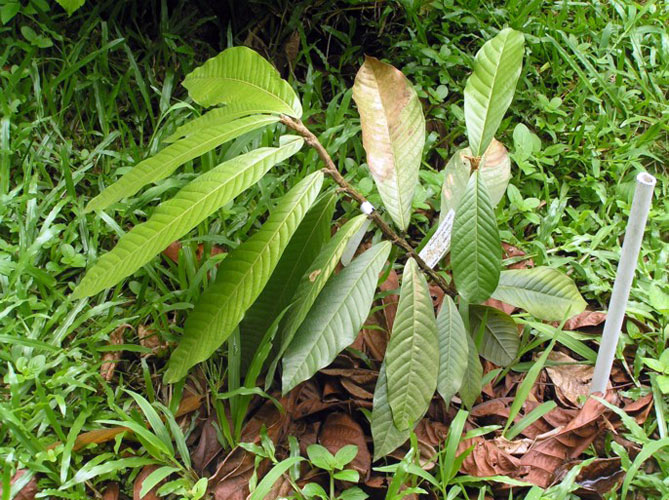
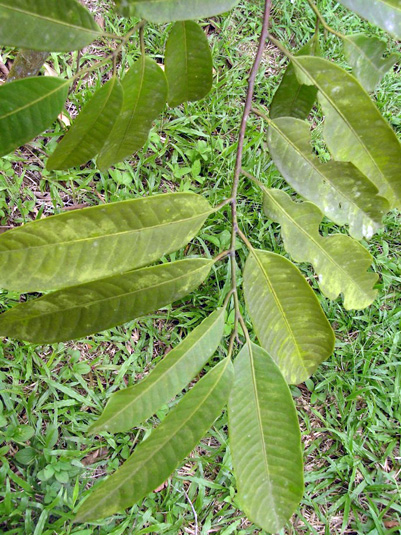
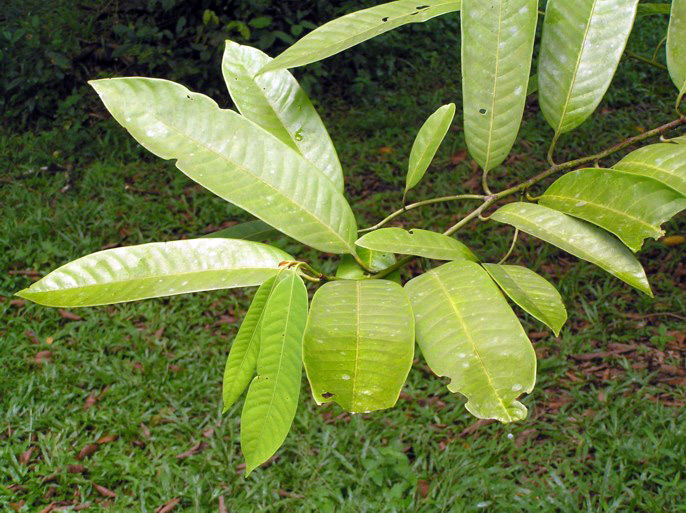
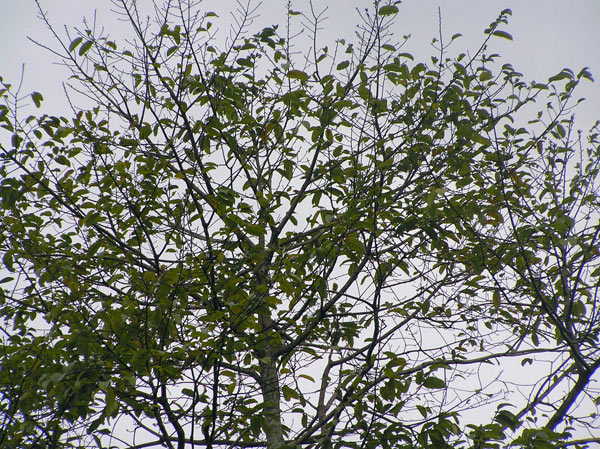
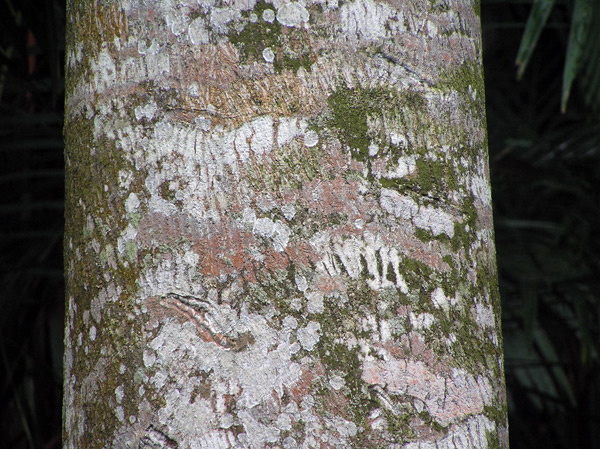
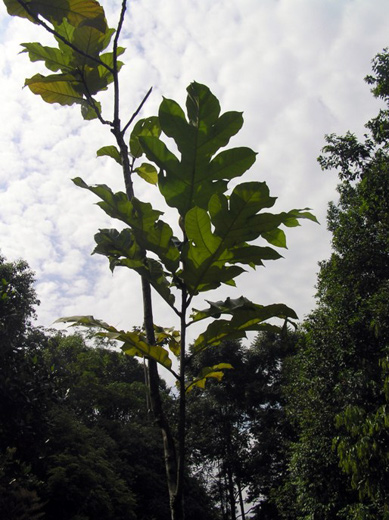
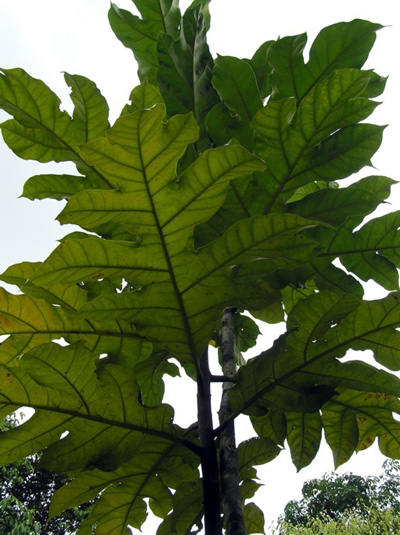
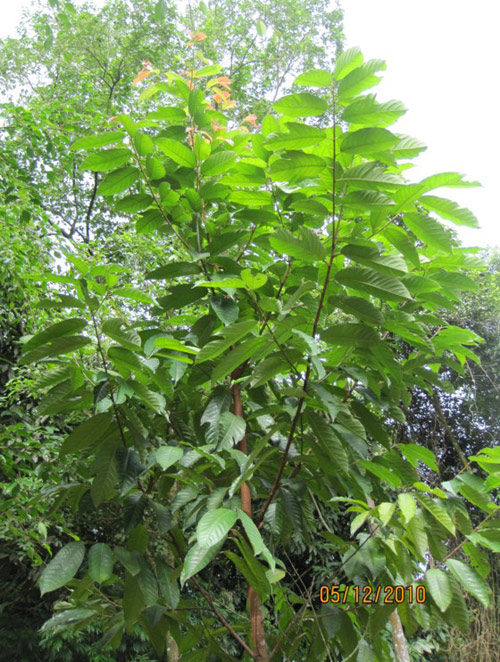
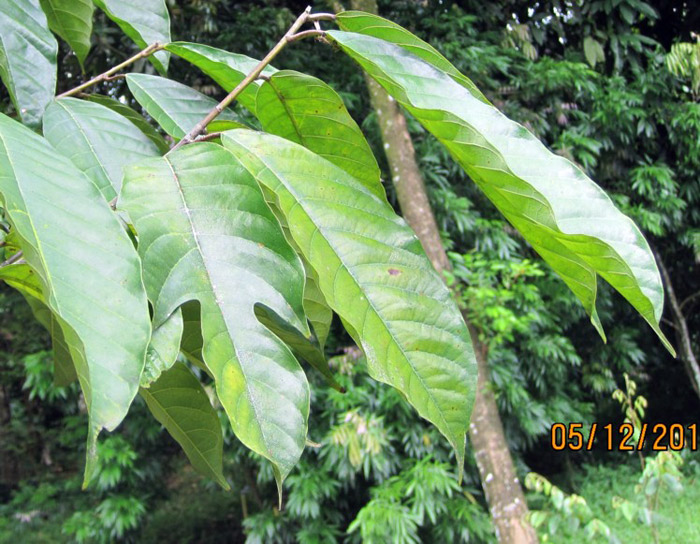
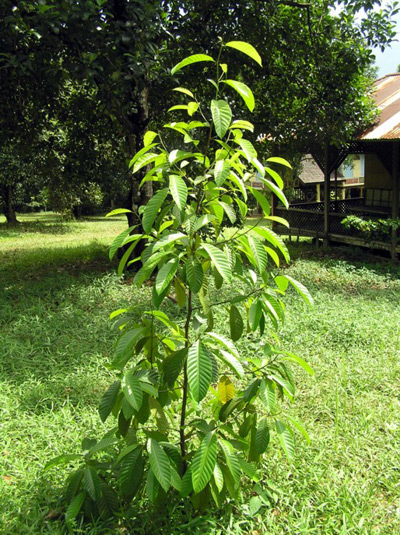
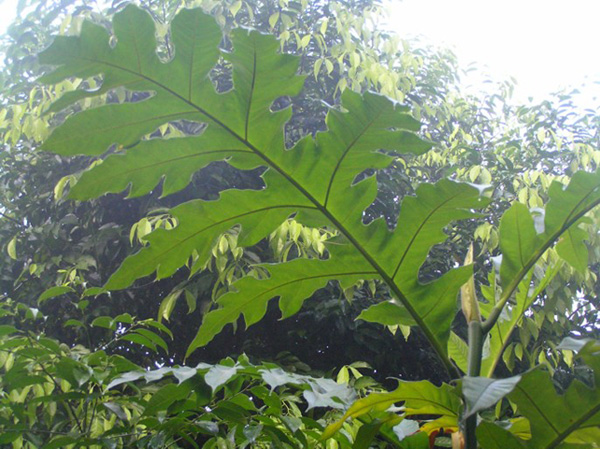
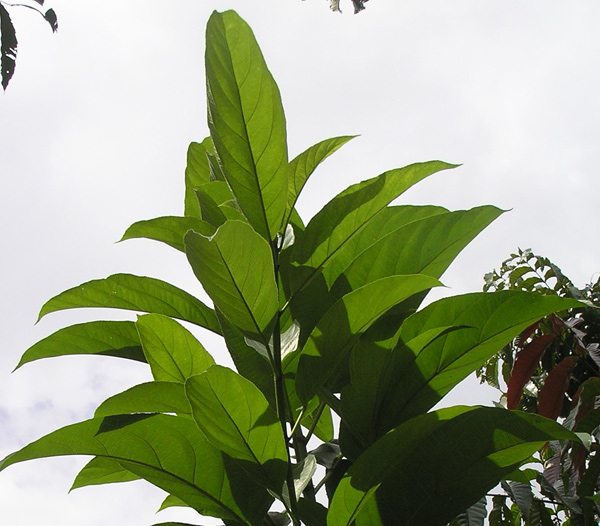
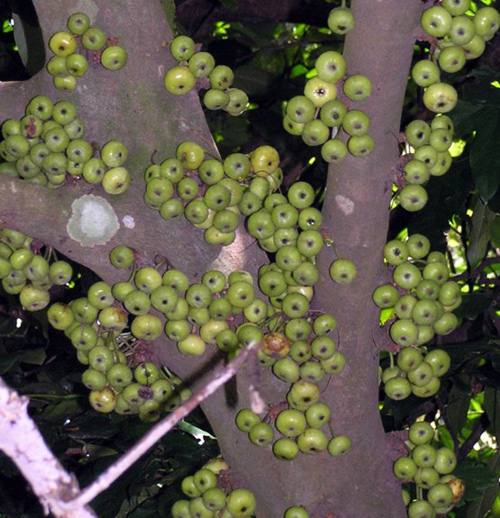
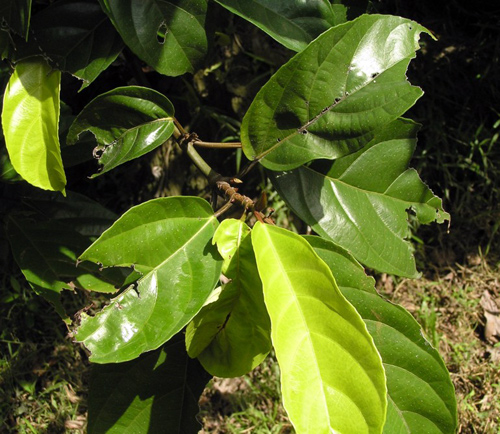
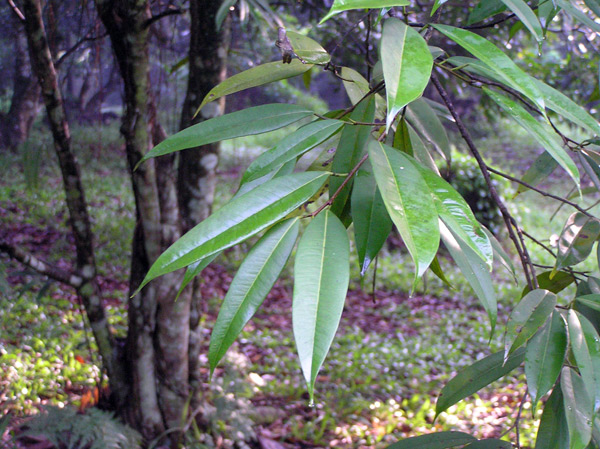
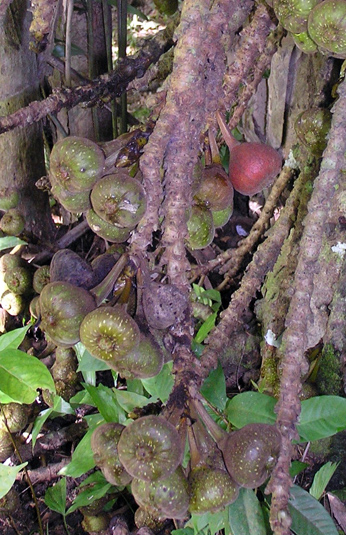
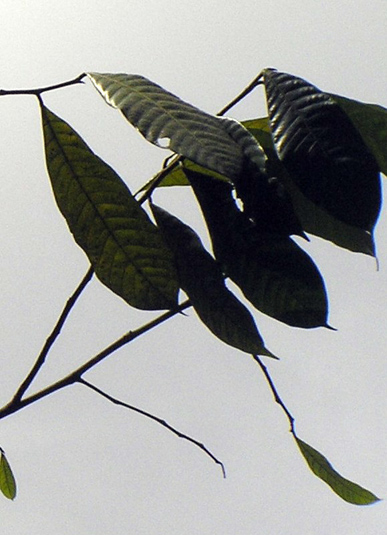
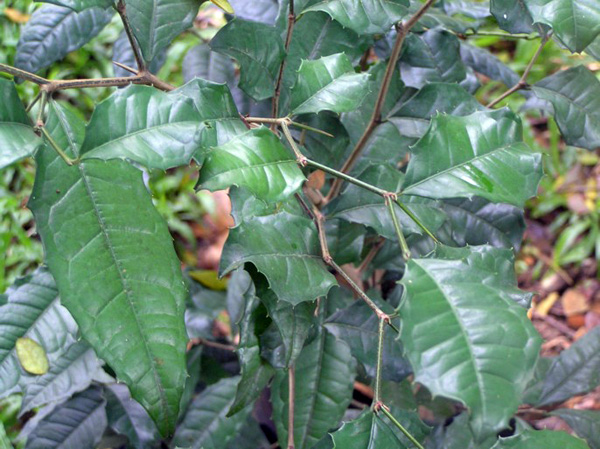
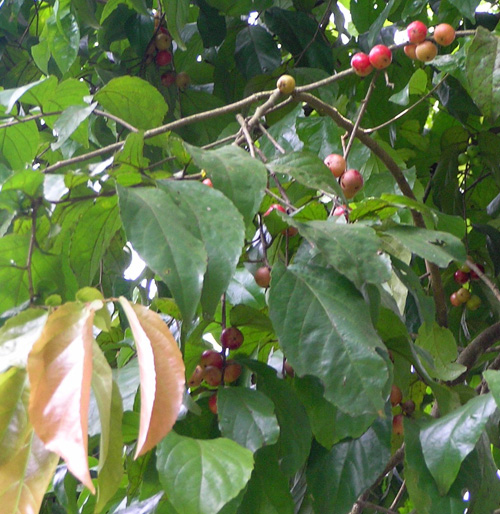
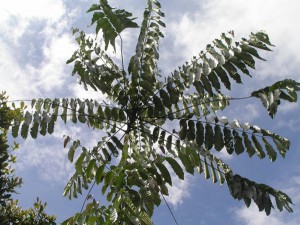
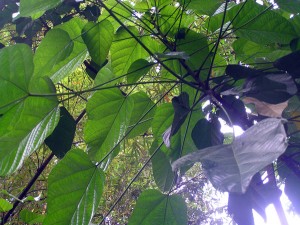
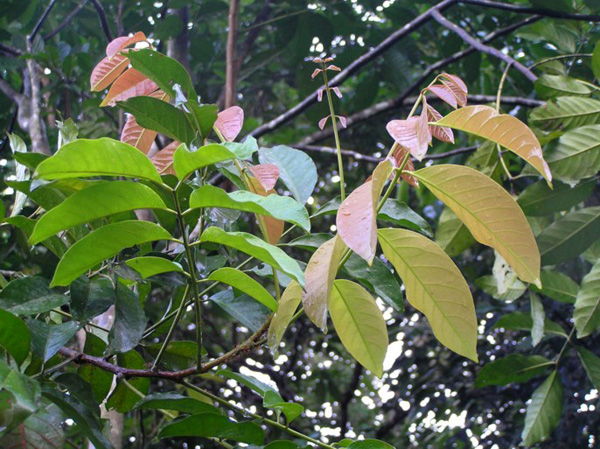
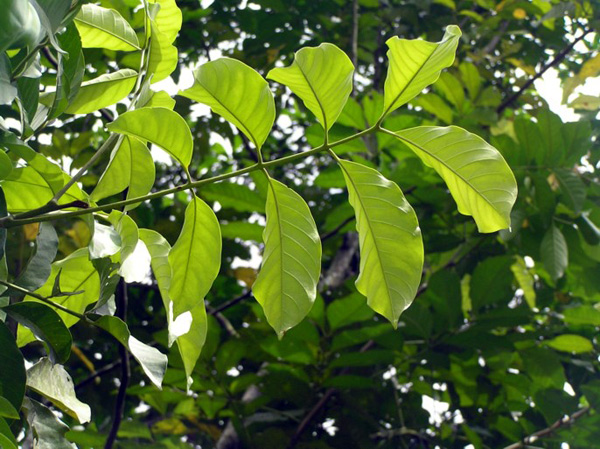
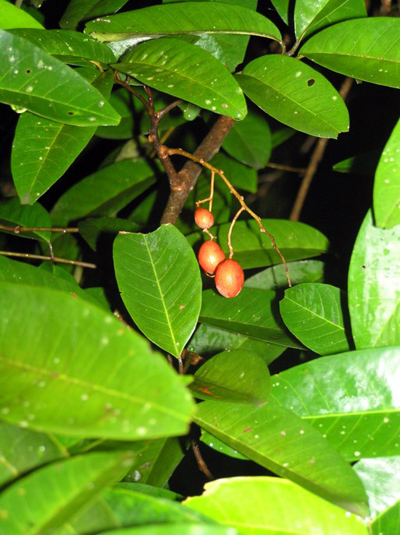
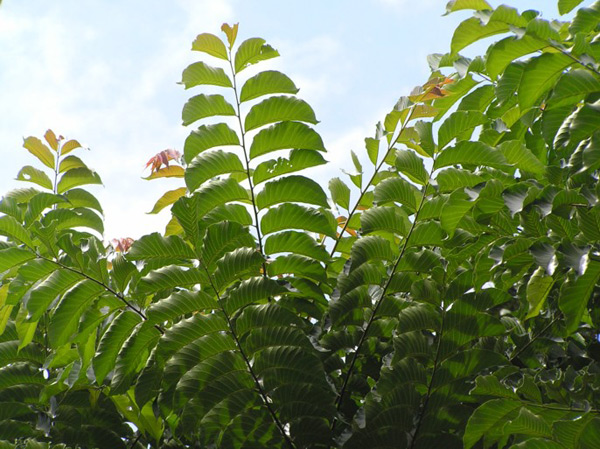
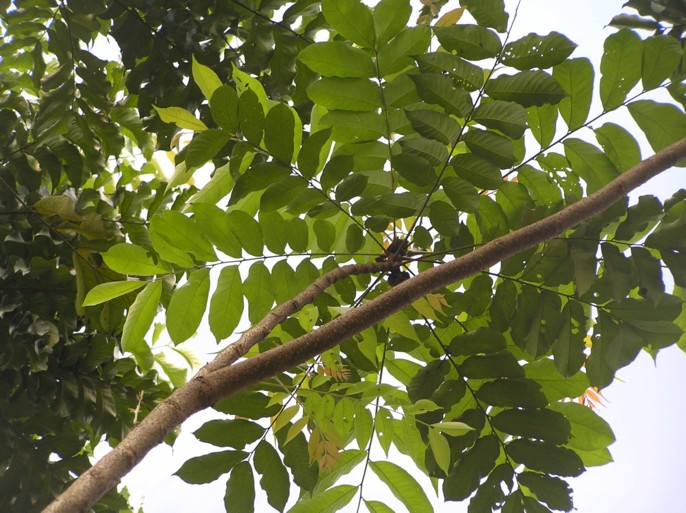
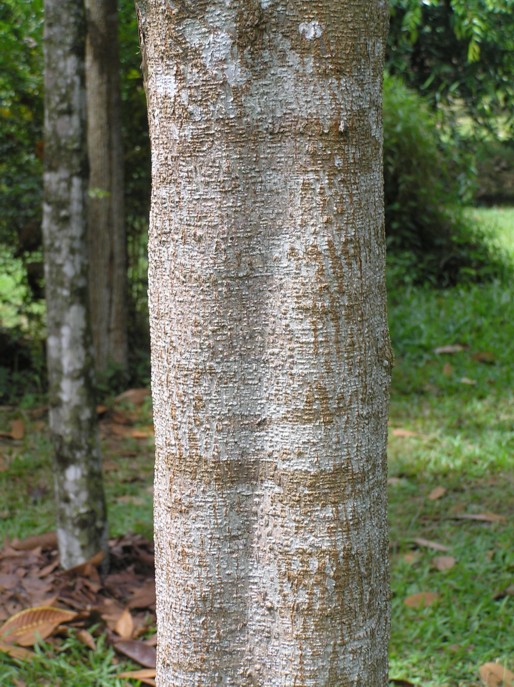
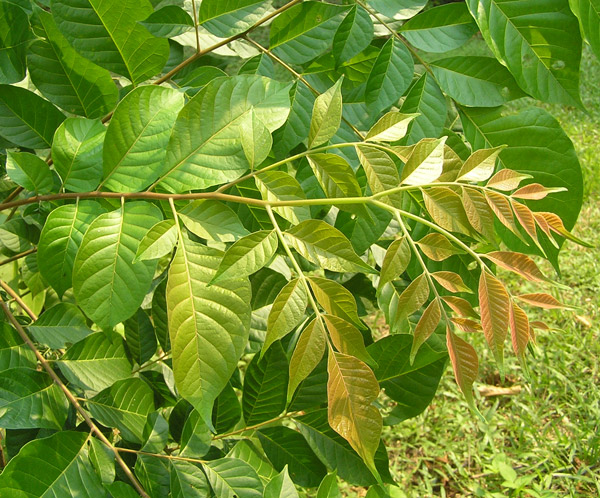
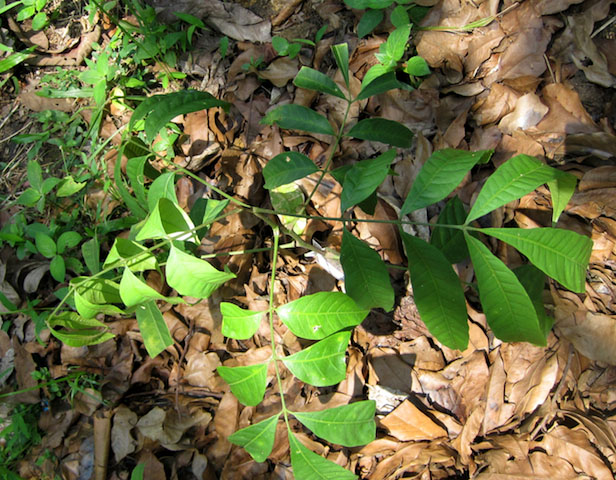
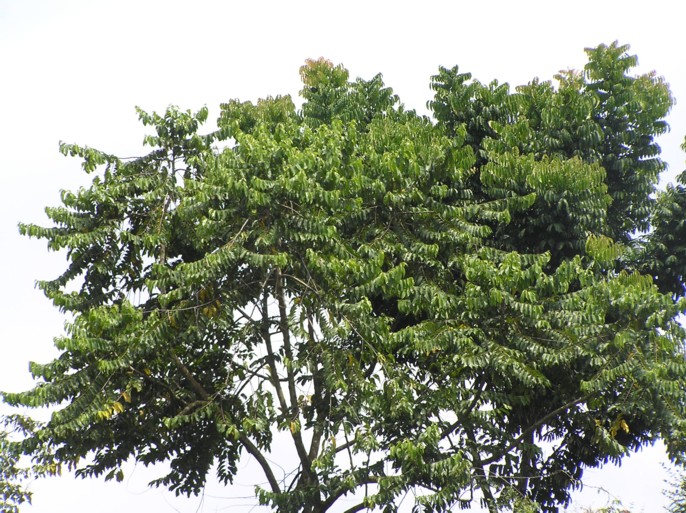
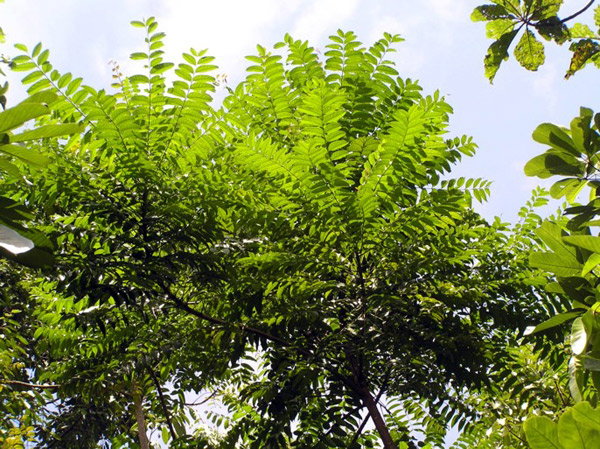
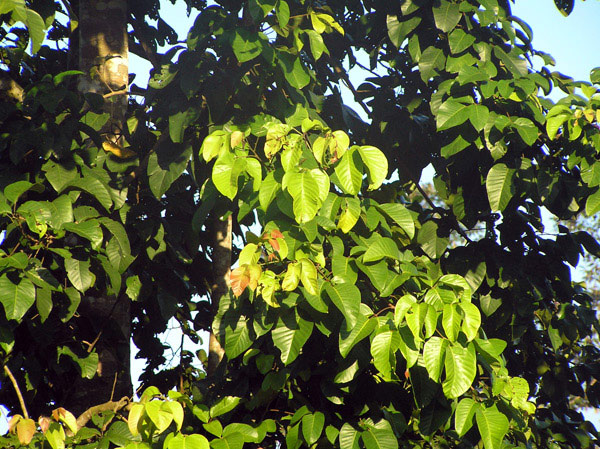
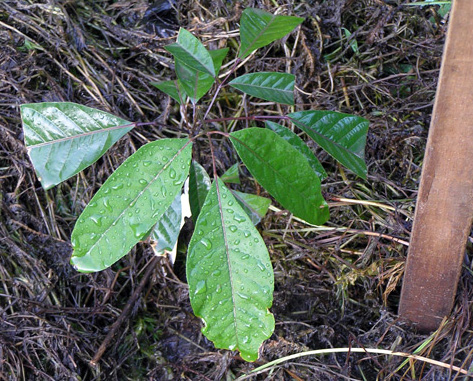
Indo-China, Thailand, Malesia; mountain forests (2,500-6,000ft). Kedah, Pahang, Perak, Selangor. Crown conical or cylindrical, leaves 2 forms awl-shaped or linear blade) Seed globose, back ribbed, and slightly beaked. 2 new specimens June 2008.
Podocarpus neriifolius podo bukit
Not distinguishable from P. polystachus (podo laut) except from habitat. From Kedah to Fiji. Of conifers, there are 3 gen. and 12 spp. in Malaya, compared with 50 gen. and 550 spp. worldwide.
Podocarpus phyllocladus
Leaves alternate or spiral. Cones dioecious. Genera mainly in S. hemisphere, 100 spp., 6 in Malaya, this a very rare endemic from Sabah. 1 specimen Dec 2007.
Genus of distinctive shrubs and small trees, common all over Malaya, name refers to use in India as anti-snake venom. In Malaya 27 spp of 170, most in Asia. This sp. common, fruit a juicy red or black drupe with thin pitted stone.
Antidesma ghaesembilla
guncak, balong ayam (Penang)
Treelet to 6m, Malacca-Pekan northwards. Often by rivers, or in open, usually secondary, forest. Lowlands to 1200m. Most trees male or female. Edible fruit & leaves, but acid, used medicinally. 1 fr TH 11/09.
Antidesma salicinum
mempunai
Sumatra, Malaya, Borneo. Flood resistant shrub along fast streams, adapted to open conditions. burkill says many in genera have edible shoots and fleshy fruits, many with medicinal properties. Name refers to use in India for anti-snake venom. This from Rimba Ilmu 11/06.
Baccaurea brevipes rambai tikus
Throughout Malaya, Borneo. Small tree, seldom more than 9m. Common in lowland forest, often near rivers, occasionally in seasonal swamps. Leaves elliptic ovate, long tapering. Fruits round, 17mm diam. Seeds with translucent white pulp.
Baccaurea kunstleri
jintek bukit
Siam, N and E Borneo, Kelantan, Trengganu, Selangor southwards. Lowland forest, uncommon. To 20m, steeply buttresses, fruits to 25mm, splitting, seed jacket cream.
Baccaurea lanceolata
asam pahong
Sumatra, Siam, Java, Borneo. Malaya, mainly to south. Common small to medium trees, lowland rainforest. Terminalia branching, distinctive, big elliptic leaves. Fruits clustered w/translucent, juicy, sour, edible jacket. Trees monoecious.
Baccaurea motleyana rambai
Thailand, peninsula Malaysia, Sumatra, Borneo. Fruits popular. Sap from bark treats sore eyes, sometimes used with leaves of Mimusops elengi.
Baccaurea ramiflora pupor
Genera description: Leaves spirally arranged, simple. Flowers tiny, yellow/green in unbranched spikes drooping from branch/trunk. Fruit medium to large berry. Male and female flowers on separate trees; rambai and pupor the only spp. cultivated, 21 spp. in Malaya, lowland.
Baccaurea sumatrana
jintek-jintek
Malaya, Sumatra, Banka, Borneo. Medium tree to 30m. Fruits ovoid, 10mm long yellowish with thin wall, seed jacket orange, fruiting racemes 8cm amongst the leaves.
Glochidion superbum
ubah
Siam, Malaya, Sumatra, Banka, Borneo. Common in primary & secondary lowland forest, straggling shrubs, leaves big, base heart shaped, velvety below. Fruit stalked woody capsule, seeds smooth often with thin fleshy red or orange skin.
Phyllanthus acidus
cermai, Malay gooseberry
One species, cultivated, origin unknown. Common village tree, especially in north. Fruits cooked as a sour flavouring or acar; root is medicinal but poisonous: boiled and steam inhaled for cough, weak infusion drunk for asthma.
Australian-based Japanese choreographer/performer YumiUmiumare undertook a short residency at Rimbun Dahan in 2010, working with and mentoring performer Natalie Kim Kyungmi, towards a solo work for the Melaka Art+Performance Festival. Yumi also conducted a workshop on 21 November 2010 at The Annexe Central Market.
Yumi is at the forefront of Butoh fusion in Australia, with work across genres, including ‘Butoh Cabaret’. She works internationally and performed first in Australia in the early 90’s with Tokyo Butoh company DaiRakudakan. She has had a commitment to teaching and mentoring for over a decade, initiating with Tony Yap the Beyond Butoh series of annual showings in Melbourne.
Widely cultivated throughout SE Asia. Edible sour fruit, eaten raw as ulam, & in curries to give sour taste. Leaf infusion treats cough, & as tonic after childbirth; flower infusion for cough and thrush. Leaves treat venereal and rectal disease.
Nicobars, Andamans, Sumatra, Malaya, Banka, Lingga, Borneo, one sp. Common except in north. To 30m, bole poorly formed, fluted. Flower spikes simple or branched, like a catkin (amentacea). Fruit oval green, 2 cm across.
Scorodocarpus borneensis kulim
Sumatra, Malaya, Borneo. Common exc. Perlis & N. Kelantan. Tree, spiral leaves that periodically reek of garlic, esp. after rain & without tissue damage. Leaves 5-6 prs secondary nerves, curving up towards margin, v. prominent below.
Melaleuca cajuputi gelam, kayu putih Tenasserim to Maluku. Tall tree with narrow crown, often twisted trunk. White bark, fissured and papery-flaky in elongated shaggy pieces, used for caulking. Young leaves silky. Common in coastal swamp. Medicinal oil from leaves.
Rhodomyrtus tomentosa kemunting SE Asia, common Malaya, esp. in open sandy ground. Sweet edible fruit. Leaves opposite with 3 distinctive longitudinal veins, underside thinly white, woolly (tomentosa).
Syzygium aromaticum cingkeh, clove Traditionally added to cigarettes (kretek) and food for fragrance. Shoots and leaves chewed for bad breath and to relieve toothache. Sun dried flower buds are the cloves of commerce.
Syzygium borneense (previously Syzygium microcalyx) kelat Endemic, from Penang to Singapore, west of ranges. Not uncommon. Leaf margin curls inwards. Flowers yellow white, fruit waxy white tinged red, globose, 5mm. Single seed.2 from TH 11/09.
Syzygium pseudosubtilis (previously Eugenia pseudosubtilis) kerian Thailand, Malaya Sumatra, common in swampy forests and near padi fields. Up to 80 ft., flowers 1/4″, green, red after opening with strange sour fragrance. Green fruit ripens through red to black, sweet and juicy.
Syzygium campanulatum kelat jambu Not listed in Tree Flora of Malaya; possibly a recently described species.
Syzygium chloranthum kelat merah
Annam, Siam, Sumatra, Borneo. Lowland and hill forests from Kedah to Singapore. Flowers green white with red stamens, fruit sub-globular, to 2cm, green flushed rose purple. 2 from TH 11/09.
Syzygium claviflorum jambu arang, kelat merah Family: leaves opposite, elliptic or oblong, usually pointed, shortly stalked with distinct marginal veins. Flowers fluffy with stamens. 1,000 species in the tropics, 150 in Malaysia. Largest genus in Malaya in species & individuals. This sp. leaves wither scarlet.
Syzygium cumingianum kelat
Assam, Burma, Siam, S China, Malesia to Solomon Is. Medium tree to 20m, white flowers, fruit depressed globose, white ripening blue black. Single seed. 2 from TH 11/09.
Syzygium cumini
Syzygium grande jambu laut Malaya, Siam, Borneo. Common on rocky and sandy coasts, never wild inland, but now commonly planted. Large broadly elliptic leaves with distinct down turned tip. Fruit oblong with green leathery rind, but edible. Thick bark can stand lalang fires.
Syzygium jambos
Syzygium malaccense jambu bol Origin uncertain cultivated. Up to 18m., very large leaf blade, large crimson flowers, pear shaped variegated crimson/white tasteless fruit.
Syzygium pyrifolium kelat
Siam, Malaya, Borneo. Common from Kedah to Singapore. Tree to 18m, grey brown bark, smooth to cracking. Fragrant flowers, calyx tapered to base with a constriction the middle. Very close to S. longiflora. 2 from TH 11/09.
Syzygium spicatum
Syzygium zeylanicum syn S. spicatum
gelam tikus
India, China, Malesia. Shrub to 18m, common from Kedah & Trengganu to Singapore, by sea and rivers. Flowers white sessile, terminal; white fruit oblong globose, 6mm, sweet periocarp. 2 from TH 11/09.
Syzygium sp. kelat, jambu Unidentified sp from peat swamps of Pekan. 4 from Elango 6/08.
Syzygium sp. Previously S. bonsai. Hybrid?
Tristaniopsis merguensis pelawan, pahlawan, keruntum From Mergu, Burma. Widely distributed fromrocky coasts to mountains. Bark orange to grey, peels like Eucalyptus in spiraled scrolls. Yellow flowers in compact clusters. 1 from TH 11/09.
Tristaniopsis pontianensis pelawan S Johor, endemic, but this fr Trengganu FR. Young leaves densely coppery red pubescent.Fr Tunas Harapan 6.2012.
Tristaniopsis obovata pelawan Malaya, Rhiau, Sarawak. On rocky headlands from P.D. to Singapore & along east coast of Johor. Characteristic peeling bark, twigs with smooth blood red bark.
Tristaniopsis sumatrana pelawan, seluncur W. Malesia. Common riverside tree up to 25m. often arching over water. Saplings have grey bark eventually peeling to reveal smooth orange trunk, glossy green crown. Leaf blade distinctly tipped, tapered to 1cm. stalk. Note: this species does not exist on The Plant List. References exist that T. sumatrana is a synonym for T. whiteana.
Horsfieldia superba (or Harmsiopanax sp.) MYRISTICACEAE (or now ARALIACEAE) cabbage leaf nutmeg Medium to big tree, up to 100 ft., young twigs and leaves rusty wooly. Not infrequent throughout Malaya in lowland forest.
Horsfieldia sucosa samak pulut, penarahan gajah Tree to 25m, common, scattered through Malaya, endemic. Lowlands & hills, undulating & plains. Leaves spirally arranged, crowded at twig tips, fruit pear-shaped 3 x 2″, pink, shiny, succulent. Lat sucosus, juicy. 1 fr TH 11.09
Horsfieldia tomentosa (or Harmsiopanax sp.) MYRISTICACEAE (or now ARALIACEAE) penarahan Lowlands to mts. Flowers appear as bunches of tiny yellow or orange grapes from the branches behind the leaves, citron-fragrant. Fruit med-lge, with juicy rind, yellowish-green to orange or pink, aril completely covering the seed.
Knema hookeriana
penarahan arang Malaya, Sumatra. Slender tree to 30m, crown deep, dense, conical, branches droop, foliage pendent. Leaves v. long, flowers large, fruits big ellipsoid, woolly, red aril. Twig tips wooly. Possibly the commonest wild nutmeg in Malaya.
1 new specimen from Johor, June 2008, pictured below.
Myristica fragrans pala, nutmeg Maluku. Fruit is pickled as food. Shoots eaten as vegetable with rice to treat hypertension. Red mace for flavouring fish and cakes. Seed kernel gives commercial nutmeg. Oil is medicinal and used to flavour tonics.
Myristica gigantea penarahan arang Borneo, Sumatra, Malaya. Common lowlands, hillsides to 200m. To 50m spreading plank and flying buttresses, stilt roots, fissured black bark. Fruit scurfy, endosperm contains oil and starch.
India, S. China, Malesia. Scattered in lowland forest in Malaya. Sap an important ingredient of arrow poison. Bark grey, slightly fissured. Male and female flowers on same tree, male on lower twigs, females grouped in leaf axils. Fruit pear shaped, pulpy, crimson to black.
Artocarpus anisophyllus keledang babi
The family includes cempedak and nangka; this species rare, in lowland forest of Negri Sembilan, Johor, Sumatra to Borneo. No other plant has leaflets arranged in this manner: large and small in regular order.
Artocarpus glaucus terap
Sumatra, Borneo, Java, Malaya. Small tree to 18m, underside of leaf glaucous. Uncommon in hill & lowland forest. 1 fr TH 11.09
Artocarpus lanceifolius keledang
Widely distributed in Malaya but not abundant. Sumatra, Banka, Rhiau. Medium to tall trees, bole with short buttresses, often hoop marked. Seed covered with bright orange edible aril. Wood used for heavy construction and Chinese coffins.
Artocarpus nitidus spp. griffithii tampang
Siam, Indo-China, Sumatra, Borneo. In Malaya frequent in lowland forests, occasionally in villages. Medium tree, bole w/ short buttresses. Inflorescence solitary or paired in leaf axils, edible but gummy fruit w/ bright pink flesh.
Artocarpus rigidus temponek, tempunai
Frequent in lowland & hill forest all SE Asia. Thick white latex in all parts, juvenile leaves lobed. Flowers unisexual, male (smaller) & female heads on same tree. Fruit up to 15 cm Ø, ripening orange, stiff conical spines (Latin name).
Artocarpus scortechinii terap hitam, nangka pipit
Sumatra, Lingga. Scattered throughout Malaya in lowland forest. V. similar to A. elasticus but bole darker, leaves not so large; upper surface of leaves glabrous, lower densely hairy.
Ficus hispida ara
S. Asia to Australia. Common in the middle or north of Malaya, but not reported south of Selangor. These self-sewn. Twigs, leaves and figs set with short bristly white hairs. Figs on leafless hanging twigs from the trunks and main branches; ropes of figs up to 90 cm long, sometimes trailing on ground. Figs with 7-9 deeply coloured faint ribs radiating from the mouth, ripening greenish yellow.
Ficus fistulosa ara
India, s. China, Malesia. Very common. Small tree to 15m. Young twigs hollow, easily broken. Figs borne in clusters on woody knobs on trunk and main branches, ripening pale yellow.
Ficus maclellandii ara
Assam, Burma, Thailand. Listed by Corner of local interest in Perlis: “By the road at Bukit Ketri, where guano is collected from the precipitous sides, there is a large but rare strangling fig.” Twigs dark brown with white spots.
Ficus roxburghii ara
Himalayas, South China, Thailand. Figs have latex, twigs marked with ring like scar at each node. Stem fig with large leaves and large reddish figs in short ropes from the branches to the base of the trunk. Edible fruit of these specimens sterile as it lacks its fertilizing wasp.
Ficus roxburgii is the most palatable fig to humans, but being a native of Burma in Malaysia it lacks the essential wasp to render it fertile. One fruit has been half eaten by bats.
Ficus sp. ara
Twigs with ring stipule scar at each node. Latex. Flowers small, 3 kinds: male, female and gall (sterile female on which wasp develops) set inside fleshy figs. Huge genus, each sp. having unique wasp (Blastophaga), female exits fruit (male dies inside) after mating carrying pollen & enters another fruit to lay eggs in gall flower.
Morus alba Indian mulberry, besaram
North India. Leaves fed to silk worms or cattle. To Chinese, all parts medicinal: restorative, tonic & astringent for nervous disorders. Young leaves good for nursing mothers. Leaf decoction treats the blood, gonorrhoea, & poisoned wounds.
Prainea limpato var. longipedunculata from Sumatran name limpatoe
V. rare, from Ulu Gombak FR, Selangor. Dioecious trees, male head w/numerous flowers, female head has fewer. Peduncles (female flower stem) of this var. up to 25 cm long. 3 new specimens Dec 2007.
Streblus elongatus tempinis
Malaya, Sumatra, Borneo. Frequent in open country, often coppiced. Bushy evergreen tree to 15m, high rounded crown. Young leaves pinkish brown, flowers in hanging green spikes or catkins 3-8″ long, singly or 2-4 together in leaf axils. Ripe fruit sweet.
Difficult family to define because of minute variations in flower structure. Scattered throughout Malaya in rain forest, occasionally cultivated. Fruits edible, made more palatable by rubbing between the hands, but best cooked.
Occasional village tree, wild in Selangor, Perak, Pahang. All parts poisonous, but treated seeds can be eaten and cooking oil extracted. Large long stalked leaves spirally arranged to avoid over shadowing others.
Lowland forest throughout Malaya, from Burma to the Solomon Islands. The lower leaflet surface is covered by white or pale brown peltate scales which gives them a silvery appearance.
Aglaia coriacea
kiat
Thailand, Sumatra, Java, Borneo, Philippines. Lowland hill forests to 1,000m. Small tree to 10 m, twigs slender with dense reddish brown stellate haris, dense on the midribs, less so on the veins. Fruit to 2cm diameter, one seed.
Chukrasia tabularis
surian batu
Single sp. China, India, Indonesia, thru Malaya. Colonizes open areas, exc. south. Big (to 40m), deciduous. Leaves asymmetric, white flowers, fruit woody capsule. Lat. flattened, ref. to seeds.
Dysoxylum cauliflorum Hiern
Common in W Malesia. Tree to 30m, flowers creamy white very fragrant, spicate, appearing on older branches. Fr Tunas Harapan 6.2012.
Melia azedarach
mindi kecil, Persian lilac
Nowhere wild, foothills of the Himalayas? Cultivated for scent and shade. Arabs and Persians use leaf juice as vermifuge and diuretic. Used as fish poison, 6-8 seeds will kill a man. Poultice of leaves used for headaches, of flowers kills lice.
Melia excelsa sentang
Malaya, Sumatra, Borneo to New Guinea. Often in villages north from Malacca, occasionally in lowland forest. Tall evergreen tree to 50m, leaves tufted at end of long sloping branches. Leaves edible, but bitter. Good timber for houses.
Melia indica
neem
Wild in India & Java, otherwise cultivated for medicines. All parts of tree effective. Dried leaves in books deter insects. Identified by delicate and curiously curved toothed leaflets. Root bark for fever and anti-malarial, leaf poultice for ulcers.
Sandoricum koetjape sentol
About 5 species, all in Malaya in lowland forest. Leaves trifoliate, flowers green slender panicles fruit large, round, fleshy, not splitting. Tree to 50m tall, buttressed when old. Bark smooth with faint raised circular patterns.
Walsura pinnata
bekak
Indo-Malesia 14 spp, 2 in Malaya. Perak, Melaka, Johor, Selangor, Pahang. Small tree to 20m. White flowers in panicles, fruit dull green, oblong to 2cm with 2 seeds, reported poisonous. Seeds dispersed by birds.