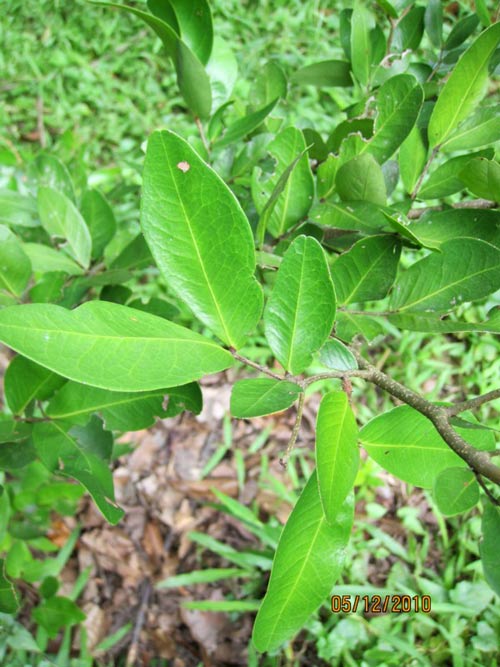
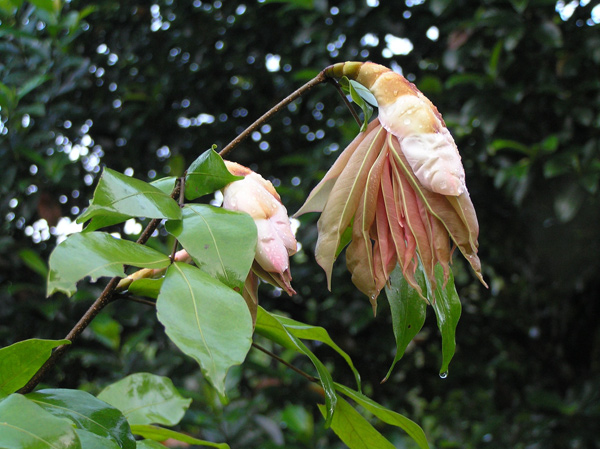
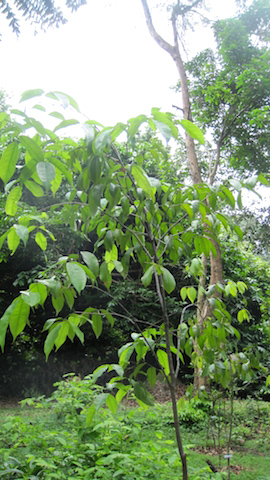
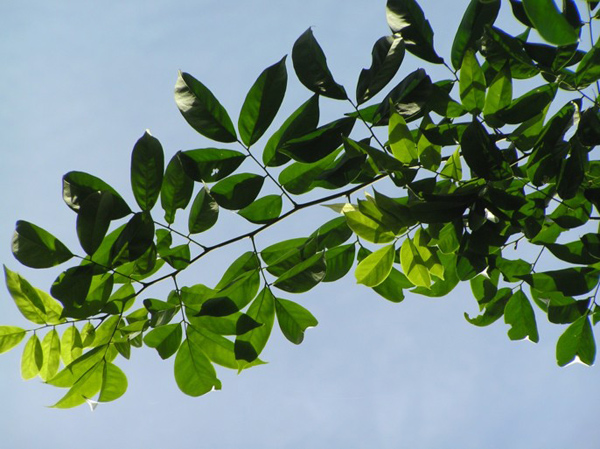
Madagascar, India to Australia. Common in open places, always flowering. Species very variable. Gr., melas (black) stoma (mouth), from the berries blackening the tongue.
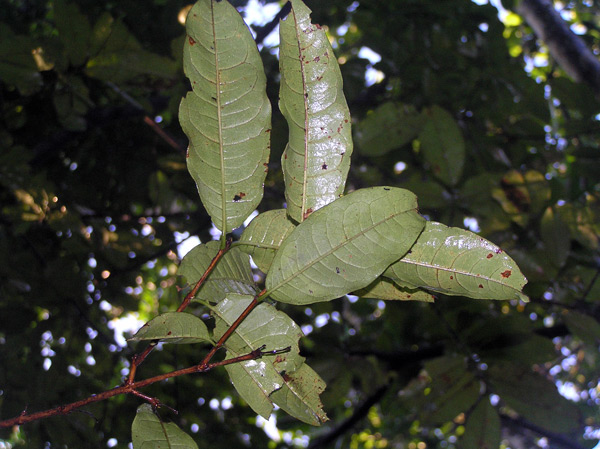
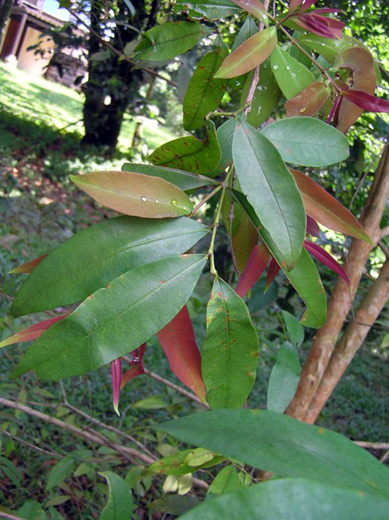
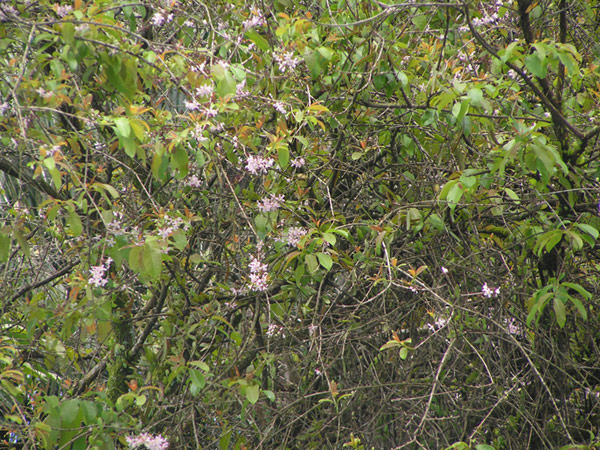
Memecylon coeruleum nipis kulit
300 spp. Old World tropics, 35 spp. in Malaya. Small flowers clustered in leaf axils, blue <1cm, stamens deep blue. Calyx cup bright pink, fruit oblong pink then deep purple.
Memecylon edule nipis kulit
India, Siam, Malaya, Sumatra, Java. Common on rocky shores. Smaller leaf blade than M. coeruleum. Tiny blue flowers, fruits pulpy when ripe, go from green to black, never red or purple.
Memecylon oligoneurum Bl. syn. Lijndenia laurina nipis kulit
Malesia, primary forests from Kedah to Johor. Tree to 15m. Fruit lobose, green to blue finally black, sometimes 2 seeds. J 37. Tunas Harapan 6.2012.
Durio lowianus (May also be family Bombacaceae or Durionaceae — disputed) durian daun
Sumatra, Malaya (all states exc Perlis, Penang, Malacca). Big tree to 50m, flowers sometimes have bright red petals, fruits green to yellow; closely resembles D. malaccensis. 1 fr TH 11.09.
Durio lowianus.
Durio malaccensis durian batang (May also be family Bombacaceae or Durionaceae — disputed)
Terengganu, Selangor, NS, Melaka, Johor; Sumatra. Med. tree to 35 m,1m girth. Flowers mainly on trunk, esp. lower part. Petals white tipped with pink. Fruits red, globular.
Durio malaccensis.
Durio zibethinus durian kampong (May also be family Bombacaceae or Durionaceae — disputed)
Widespread in cultivation in the Asiatic tropics, possibly wild in Sumatra and Borneo. Large tree to 40 m and 3m girth. Lower surface of leaf blade densely covered with silvery or golden scales.
Firmiana malayana mata lembu
Only one species in Malaya, recognized by membranous fruit dispersed with seeds attached while Sterculia fruits and seeds are dispersed separately. Deciduous after dry, then orange flowers (Corner’s cover) quickly followed by fruit.
Heritiera javanica mengkulang jari
Indo-China, Siam, Malesia to Celebes. Widely distributed through Malaya, except Perlis, Penang, Malacca.Lowland & hill forests to 600m. Lg. tree to 43m and 3m girth. Thin buttresses, bark grey fawn , cracking scaly. Terminal bud pointed, covered w/powdery hairs.
Pterospermum diversifolium bayur
About 20 spp. from India to Moluku, 6 spp. Malaya. Leaves alternate, asymmetric with obliquely heart-shaped base, coppery/rusty under. Young twigs hairy, stipules entire, sapling leaves like adult but with brownish tomentum. Uncommon, not south of Negri Sembilan.
Pterygota alata kasah
To 50m, dense crown, plank buttresses. Old World tropics, 1sp. Malaya, leaves spiral simple, heart shaped, stalk kneed, flowers unisexual, 5 sepals, no petals. Fruits roundish with long stalk, woody, split along one side. Many seeds, with long wing.
Scaphium linearicarpum kembang semangkuk bulat
Malaya, all states exc Melaka and Negeri Sembilan. Tree to 36m, sapling leaves very large, 5-7 lobed, 30cm stalk. Fruit follicle 25 x 6cm, yellowish, hairy. Seed hairy, 25 x 15 mm. 1 fr TH 11.09.
Scaphium macropodum kembang semangkuk jantong
Cambodia, Siam, Sumatra, Borneo, Malaya; most common and widespread sp, on well drained land and ridges; macropodum, long foot, ie fruit. Inflorescence panicle red tomentose. 1 fr TH 11.09.
Scaphium sp. kembang semangkuk
Large trees with short thick buttresses. Leaves spirally arranged, sapling leaves v. large & palmately lobed. Spp. apparent when mature. Flowers small, cream, upright. Fruit large green pod splits on one side before mature. A seed cut and soaked in water makes mucilage to fill a cup.
Scaphium sp. kembang semangkuk
4 spp in Malaya, this v rare endemic, from Parit FR, not yet described. Large deciduous trees with thick buttresses, leaves spiral, simple, v long stalks. Sm pale green fragrant flowers, seeds swell when soaked; edible, medicinal. 3 specimens Dec 2007.
East Africa to Queensland, on rocky and sandy coasts. Palmate compound leaves; flowers 2 cm crimson foetid wooly in loose green panicles. Deciduous after dry weather, flowers before or with new leaves. Saplings like huge ubi kayu.
Sterculia macrophylla kelompang
W. Malaysia, common in lowland and swampy forest. Deciduous every 7 to 9 months, flowers before new leaves develop. Spreading sharp buttresses, bark smooth silver grey, massive twigs. Large leathery leaf, hairy under. Flowers tiny, greenish yellow, in hanging racemes 30cm.
Sterculia monosperma kelompang
Not indigenous to Southeast Asia.
Sterculia parviflora kelompang burung
NE India to Singapore, common. Flowers pale yellow and pink at base, becoming reddish, hairy. Fruit velvety pods, yellow flushed pink, ripening brilliant orange-red, black seeds.
Sterculia parvifolia kelompang
Small tree. Endemic, Penang, Perak, Selangor, on hills. Narrow leaf blade, flowers 1cm, reddish pink, pods to 4cm.
India to Sulawesi. Deciduous, shedding leaves, every 9 months or so, leaves wither red. Flowers deep mauve pink. Inner wood, next to bark, turns distinct mauve/purple if exposed to air. Growth of branches is checked at each terminal flowering, so crown tends to be low and bushy. In forest, when flowering is delayed, a very tall tree.
India, SE China to Maluku, wild on rocky headlands of east coast and forest with Eugenia grandis and Sterculia foetida. Hard red heart shaped seeds, said to be used for weighing gold. Name from Latin ‘pavo’ peacock.
Archidendron jiringa / Pithecelobium jiringa
LEGUMINOSAE subfamily Mimosoideae
jering
Burma, Thailand, W. Malesia. Fruit eaten raw or blanched. Pounded with ginger and boiled, to eliminate bladder stones. Purple dye from pods.
Caesalpinia sappan
sepang
Cynometra iripa
katong laut
Shrub or small tree to 8m, mainly coastal but also inland, from India to Micronesia. Knobbly pod with lateral beak. 1 fr TH 11.09.
Cynometra malaccensis
kekatong, katong katong, belangan
India, Siam, through Malaya, common exc. Johor. Big, up to 40m, straight bole, sometimes fluted, like sepetir (Sindora), buttress like keranji (Dialium). Crown dense with numerous sub crowns, new foliage in dry season pink then pale green tassels.
Dialium indum
keranji kertas besar
Uncommon, Malaya, Sumatra, Banka, Java, Borneo. Found west of Wallace’s Line. Big slender trees. Pod roundish, brittle, one seeded; aril function transferred to the endocarp, pulpy and edible. Fruits traded to Singapore (Burkill).
Dialium patens
keranji paya
S Malaya, Billiton, Banka, Borneo. Locally common, esp coastal Pahang. In low lying areas incl peat swamp. Fr Tunas Harapan 6.2012.
Dialium platysepalum
keranji kuning besar
Common throughout Malayan lowland forest. Sumatra and Borneo, genus only west of Wallace’s Line. Edible fruit in a pod unusual for the family: small, roundish and brittle, the one seeeded structure does not break open.
Dialium wallichii keranji kuning kecil
In Malesia all spp. west of Wallace’s Line. Big slender trees, to 40m & 3m girth, mature crown shallow domed, diffuse. Leaves simple pinnate w/ terminal leaflet. This sp. leaves velvety under, dull brown or golden with a beautiful silky sheen.
Intsia palembanica
merbau
Throughout Malaya, Siam, Andamans, Malesia to W. New Guinea. Common in inland lowland forests, associated with tualang. V. big to 60m, bole often slightly sinuous, big plank-like buttresses. Domed crown with ascending big limbs. Very heavy hard wood. Leaves pinnate opposite leaflets, no terminal leaflet. Small but showy flowers in terminal panicles. Saplings to 10m straggly.
Koompassia malaccensis
(Caesalpiniaceae) kempas
Malaya, Sumatra, Borneo. The outstanding tree of Malaysia’s forests, extremely large, strong buttresses, v. hard heavy wood. To 60m. Used for railway sleepers ‘thus are the mighty subjugated’ (Corner). Deciduous Jan & June. In swamps kempas buttresses much larger than on dry.
Koompassia excelsa
tualang
V. big, to 80m, columnar bole, crown bright to pale green, sub-crowns small and numerous. Central to northern Malaya, valleys and lower slopes of hills. Fairly common and locally abundant. Not found south of KL-Kuantan line.
Milletia atropurpurea
tulang daing
Common throughout Malaya, Burma, Siam, west Malesia. To 30 m, crown dense, bole form often poor. Flowers in terminal panicle, deep purple. Large pods, splitting open when fallen on ground. 1 or 2 seeds per pod.
Ormosia bancana
saga hutan
Malaya, Sumatra, Banka, Borneo. Scattered in coastal forest and along rivers, uncommon. Leaflets like kempas (Koompassia malaccensis) thinly gold and velvety to glabrous below.
Tunas Harapan 6.2012.
Parkia speciosa
petai
Frequently planted in villages, also wild scattered in lowland forest. Pods 12 to 16″ long, straight, wavy or twisted, strongly swollen at the seeds. Young pods and mature seeds esteemed as vegetable, reeking of garlic.
Pithecellobium clypearia (Mimosaceae)
petai belalang, cahar
Abundant in belukar (secondary forest) India to Borneo.
Sindora coriacea
sepetir licin
Malaya, Sumatra, Borneo. Huge column-like trees, to 50m, massive bole and crown. Deciduous for a few weeks, flowering soon after, fruiting 2 months later. Common. This species recognized by glabrous leaves and smooth pods.
Sindora echinocalyx
sepetir daun nipis
Malaya and Riau, on hillsides and ridges, sometimes coastal. Big trees, massive crown, deciduous, clear growth rings, light hardwood.
Tamarindus indica
asam jawa
Africa; introduced by Arab traders to India & SEAsia (tamar-ul-Hind, ‘the date of India’). Young shoots eaten raw; decoction of leaves treats fever. Pulp of fruit added to curry for sourness; bark a poultice for sores and boils.
Throughout Malesia. Malaya exc. Perlis. Coastal, or along rivers. Bole and crown often gnarled. Leaf margin serrate-crenate (toothed-wavy), flowers showy, fluffy w/ stamens. Fruit ovoid.
Actinodaphne macrophylla medang payong Malayan lowland to mountain forests; very common at Frasers Hill. Java. Twigs reddish brown hairs, leaves in whorls of 6-12, reddish brown hairy below.
Actinodaphne sesquipedalis medang paying, pedalis Tenasserim to Borneo. Widely found thru Malaya. Leaf under yellowish brown hairy, apex usually pointed. Fruits poisonous?
1 from Elango 6/08
Cinnamomum mollissium medang wangi Endemic, common, except in Kedah and Perlis. All species have aromatic crushed leaves, this one distinguished by hairy leaves and twigs.
Cinnamomum verum kayu manis, cinnamon India. Cooking spice. Roots treat rheumatism and fever. The tree bark is used in many medicinal powders and tinctures, tonics for diarrhea and colic.
Litsea castanea medang About 400spp., thru tropics, except Africa. In Malaya, 54 spp. Sumatra, Borneo, Java. Common in Kota Baru and widely distributed. Tall tree, to 33m, bole with spreading thin buttresses to 1m ht. frequently coppiced for construction material. Bark reddish, smooth with horizontal rings. Large leaves, completely deciduous in the north.
Litsea myristicaefolia medang asam, medang baros, medang kelaya Widely distributed from mountain to lowland forests, Burma to Singapore. Leaves alternate, spirally arranged, midrib sunken above. Flower clusters from leaf axils, fruits 1cm globose white with green perianth cup.
1 fr TH 11.09
Litsea robusta medang About 400spp., thru the tropics except Africa. In Malaya, 54 spp. Burma, Java. Tall, to 36m, bark fawn smooth w/many corky lenticels. Leaves spirally arranged, uncommon, on low hills by streams. Acorn hemisphere, green ripening blue.
Clerodendrum bungei (Previously Clerodendron bungei in Family Verbenaceae) China. Cultivated. Many tropical species from this genera are attributed with spiritual & magical properties.
Clerodendrum fragrans (Previously Clerodendron fragrans in Family Verbenaceae) popkok rabu kambang, exhilaration tree China. Used by Malays for rheumatism and ague, or with other substances for treating skin diseases.
Clerodendrum paniculatum (Previously Clerodendron paniculatum in Family Verbenaceae) panggil panggil Burma, s. China to Java, but not known in the wild. Summons spirits. One of the plants used to sprinkle tepung tawar in weddings, blessing fish stakes & ‘in the taking of the rice-soul’ (Burkill). Infusion is purgative. Elephant medicine, to protect them from harm.
Peronema canescens (Previously in Family Verbenaceae) sungkai Malaya, Sumatra, Java, Borneo. Common in secondary forest and near rivers and clearings in primary forest. Small tree. Compound leaves increase in size from basal pair upwards, leaflets sessile, young leaves rich purple.
Premna foetida (Previously in Family Verbenaceae) buas buas Malay peninsula, Java, Borneo. Straggling shrub, twigs and stalks finely hairy. Coastal forests, used to treat fever, asthma.
Tectona grandis (Previously in Family Verbenaceae) jati India, Siam, W. Malesia to the Philippines, not wild in Malaya. Large deciduous tree, prefers open monsoon forest where a dormant period is forced by dry weather. Flowering and fruiting after new leaves emerge with wet weather.
Medium to large tree, very hard wood, with steep plank buttresses up to 6m high. Locally common in Selangor and Malacca. Fruit resembles mango (pauh), apparently eaten by barking deer (kijang).
Common except Perlis and Kedah. Burma, Sumatra, Borneo. Seasonal flowering, once or twice a year after dry weather. Greek name: kratos (strength) xulon (wood).
Cratoxylum cochinchinense derum seluncur, mampat
Malesia. Throughout Malaya. A variable sp. with two extremes, shrub or a large tree, ornamental. Flowers dark red to pink, bark smooth light buff, peeling off in pieces or strips as in Tristania (pelawan).
Cratoxylum formosum mempat
Indochina, w. Malesia, Philippines. Common through Malaysia in belukar or forest. Like almond blossom, flowers after leaves fall. Flowers borne in axils of old leaves.
Named for A.C. Maingay (1836-69) sometime gaoler at Malacca. Endemic to Penang Hill, Perak (Gg. Bubu) to elev. 600m., only 10 collections, all 19th century except one in 1971. Leaves entire, pinnately nerved; flowers bisexual, dense round yellow heads.
This specimen from Mr. H. Barlow, c. 1995.
Rhodoleia championii
kerlik
Large shrub/tree to 20m. Showy flower heads, to 15mm across, red petals; fruit to 2cm. Malaya, esp lowlands of Selangor, on quartz dykes at Klang Gates. Attracts birds & bees. 1 fr TH 11.09.