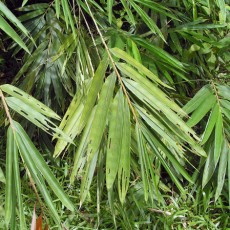
Thailand, Malaya, all states. Culm sheaths green base, intense orange at top, covered with irritant hairs. To 20m. Rare in primary forest, common at margins. Uses handicrafts, chopsticks, skewers. Gr. gigantos huge, chloa grass.
W. coast, in swampy ground. Med tree to 23m, 1.5m girth, crown big leafed, open, flat topped with stiff spreading branches. Minutely toothed leaves. Terminal inflorescence, cream flowers, corolla thick, stamens not projecting from tube.
Fagraea fragrans tembusu padang
Lwr. Burma, Malesia to New Guinea. In open and swampy lowlands. To 30m, terminalia branches have upturned ends. Irregular fissured bark. Fine leafed crown, conical when young. White fragrant flowers 4 months after dry season, then red berries, seeds dispersed by bats.
Fagraea racemosa
kopi kopi
Malesia to northern Australia, Solomon Islands. Shrub to small tree, or straggling climber. Frequent in secondary forests, sometimes in wet places.
All states except Malacca. Sumatra. Fruit can be eaten after cooking. The flowers smell of rancid fat like those of wild cinnamon, their nectar attracting many insects.
Castanopsis megacarpa
gertak tangga
Common in lowlands of Malaya, except for Penang, Perlis. Borneo. Malay name from the creaking of the house ladder, when one has been so unfortunate to have eaten the chestnut-like but poisonous fruit. Med tree to 25m, bole hooped, buttresses rare. Stipule acorn shaped, cupules to 3″ dia covered w/close branching spines.
Lithocarpus eichleri
mempening
Perak, Selangor, Johor. Sumatra. Often in swamps. Rare. 8-15 pairs secondary nerves, tertiaries ladder like. Cupule saucer shaped.
Fr Tunas Harapan 6.2012.
Lithocarpus elegans mempening
India, Indo-China, Malesia. Wide ranging, variable sp., shiny fawn leaves, glabrous, same colour on both sides. Common on degraded sites. Distinct from Quercus by erect spikes, thick leaf stalk, entire leaf margins.
Lithocarpus lucidus mempening
Sumatra, Borneo, all states Malaya. Common. Lat. fr. shiny acorns and leaves. Big tree to 50m, bole often fluted, plank buttresses. Big acorns.
Lithocarpus maingayi
mempening
Endemic in Malaya, in hill forest above 1,000 ft. Cupule completely encloses fruit. Fr Tunas Harapan 6.2012
Lithocarpus rassa rasa
Malaya, Sumatra, Borneo. To 25m, but shorter with increasing altitude. Leaf blade 1-5″ long; fruit spikes up to 3″ long; cup half inch wide, broader than long. From mountains to coast.
Lithocarpus wallichianus mempening
Gr. lithos-stone, carpos-fruit. Big tree, Peninsula Siam, Malaya, Sumatra. Flat cup shaped fruit encases acorn. Distinguished from Quercus by erect spikes, leaf stalk thickening, entire leaf margins, bisexual inflorescences.
Quercus gemelliflora
mempening
Lat. oak. Sumatra, Borneo, Malaya exc. Perlis. Terminal buds in rows of scales, leaves spiral margin toothed, esp. towards apex. 400 spp. in tropics and north temp., Malaya 8 spp. This sp. underside of leaves glabrous. Tree to 30m. Bole oft. fluted & hooped. 2m buttresses steep & thick.
Quercus spp. mempening
Oak, 400spp world wide, 8 in Malaya where they are forest trees that seldom reach the canopy. Distinguished by acorns.
Botryophora geniculata Gapis miang / putat miang Burma, Siam, Malaya, Sumatra, Borneo, Perak, Kelantan, Selangor, Pahang, Johor. Small tree to 12m. No close relatives peculiar stamens, leaves like Sterculaiceae. Fruit woody capsule. Packed tight in a dense mass. From Tunas Harapan 11.09
Croton argyratus Burma to Moluku. A remarkable genus in Malaya w/ common species and others v. rare endemics. Tree to 18m, common through Malaya. Similar to balek angin, but not scurfy. (The widely cultivated garden ‘Croton’ is Codiaeum variegatum.)
Drypetes pendula lidah lidah Lat. hanging, leafy branches. Common in Malaya, low undulating land. Monopodial tree to 20m, 1m girth, deep dark pyramidal crown, leafy branches drooping, sinuous. Leaves lying flat, spirally attached, young in purple red tassels.
Elateriospermum tapos perah Malay peninsula, Sumatra, Borneo. Copious white sticky latex in bark, leaves and fruit stalks. Long slender leaf stalk kneed at top. Bark sloughs to leave scroll-marks. Crown deeply conical, briefly deciduous. Young leaves bright red, in flushes. Edible seeds induce dizziness.
Emblica officinalis melaka SE Asia, frequent in villages and lowland forest. Cooked fruits eaten as a sour relish. Bark is used for tanning and dyeing. Leaves, roots and raw fruits are medicinal & rich in vitamin C. Slow growing to 20 m. Burkill states the name of the river and town is believed to have come from this tree & that origin is Sanskrit.
Pimelodendron griffithianum perah ikan Malaya, Borneo. Common in all states exc Perlis, Kedah and Penang. Locally abundant as in Bt. Lagong FR. To 21 m, leaves crowded at twig tips, oblong obovate suddenly narrow to protruding tip. Yellow flowers on racemes crowded on twigs behind leaves. Fruits round to 5cm, shiny green, ripening yellow, at first tipped by persistent style.
Burma to Japan, Sumatra to Java. Small tree to 6m on sandy coasts Singapore to Kelantan. Leaves often with basal marginal gland on each side of midrib. Fruit edible but insipid. Cranberry genus. Rompin 004. TH 6.2012.
About 200 spp., Indo- Pacific, 27 in Malaya. Shrub or small tree, common throughout Malaya in secondary and primary forests.
Elaeocarpus stipularis mendong, medang kelawar
Burma to Indo-China, Java, Borneo, Philippines, Bali. Med. tree to 30m, 2m girth, sm. buttresses. V. common in secondary and primary forests fr. seasonal swamps to 1,200m. Lat. having stipules.
Elaeocarpus sp. mendong
About 200 spp., Indo- Pacific, 27 in Malaya. Shrub or small tree, common throughout Malaya in secondary and primary forests.
Malaya, Borneo, Sumatra, Bangka. Medium tree to 27m and 1.3m girth. Separate male and female flowers, fruit a berry with fibrous to fleshy pericarp, ovoid and curved to one side.
Diospyros diepenhorstii kayu arang
Malaya, Thailand, Borneo, Sumatra, Philippines. Uncommon, scattered in lowland forest. Small tree to 17m. Separate male and female flowers, fruit a berry with fibrous to fleshy pericarp.
Diospyros discolor
buah mentega
Native to Philippines. Twigs velvety, Occasionally cultivated in Malaya for edible fruits. Separate male and female flowers, fruit a berry with fibrous to fleshy pericarp. (Lat. having many colours).
Diospyros sp.
kayu arang, buey, tuba buah
70 spp. in Malaya, in all habitats exc. mangroves. An extraordinary 22 spp. endemic, this one not yet described. Fruits of several used as fish poison.
Diospyros sp (ismailii?)
kayu arang, buey, tuba buah
Trees without latex, black bark; terminalia like Myristicaceae, but no red sap in bark. >70 spp in Malaya, many endemic. Some w edible fruit, berry w fibrous-fleshy pericarp.
Diospyros ‘kluang’
kayu arang, buey, tuba buah
70 spp. in Malaya, in all habitats exc. mangroves. An extraordinary 22 spp endemic, this sp. as yet undescribed. Fruits of several used as fish poison.
Ten species in Malaya. Cut wood hisses loudly, twigs leave prominent horse-shoe shaped leaf scars. Large tree, deciduous after dry weather, buttresses merge into stilts. Flowers without petals. All states but Perlis. Sumatra, Borneo.
Dillenia philippinensis
simpoh
Philippines. (J.J. Dillenius, 1684-1747, German botanist, professor at Oxford). Flowers large, solitary, petals falling first day, fruit covered by thick fleshy edible sepals that make cough syrup & shampoo. Bark yields a red dye.
Dillenia flowers are spectacular, even if never prolific and not long lasting, opening before dawn and dropped by evening.
Dillenia reticulata simpoh gajah
Malaya, Sumatra, Borneo. To 40m ht & 3m girth. Flowers, 7cm, at end of leafless twig or with new leaves, petals yellow. Leaf base broadly tapering to round or heart shaped; 16-45 prs secondary nerves & fine tertiary network, raised on under surface, covered with velvety hairs.
Dillenia suffruticosa simpoh air
Large evergreen shrub to 7m, often forming thickets. Common in secondary forests, esp. swampy ground, most in the south. Flowers continuously, each open for just a day. Fruit ripe in 36 days.
The common simpoh air, Dillenia sufruticosa, flowers and fruits prolifically soon after planting. As a garden species, it is pretty but can quickly squeeze out less aggressive competitors and form dense thickets.
Dillenia sp.
simpoh
Ten species in Malaya. Bark rich orange brown, large white flowers, edible fruits, dispersed by elephants or water. From India to W. Malesia, often near streams.
Burma to Java, Indo China, China. From Kedah to NS, only west coast, to 15m w/ short buttresses. Lowland forest. Soft dense tomentum under leaf. One genus family in Old World tropics, temperate Asia to Aust. 7spp. in Malaya of 21 total.
Alangium ridleyi mentulang daun lebar
Endemic. All states exc. Kelantan and Johor, big tree to 40m and 2m girth. Flower calyx deeply ridged, petals fleshy if fresh, fruits ovoid with 12 ridges, seeds with white translucent juicy aril.