Nageia motleyi
podo kebal musang gunung
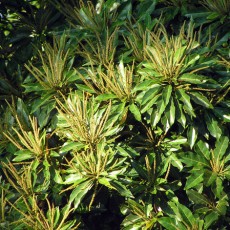
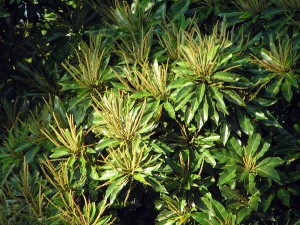
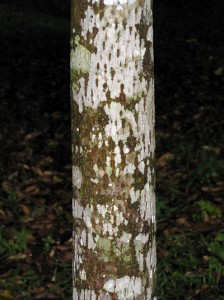
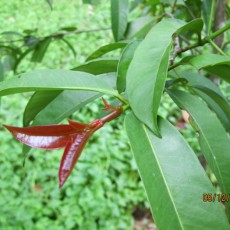
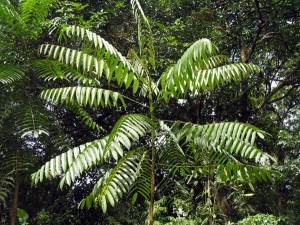
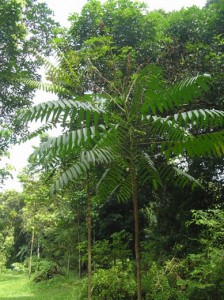
From E India through Malesia. Highlands, not common, solitary. To 40m straight no buttresses. Terminal bud conical, pointed. Leaves in 2 ranks, opposite or sub-opp.


A private arboretum & arts centre in Malaysia


Nageia motleyi
podo kebal musang gunung
From E India through Malesia. Highlands, not common, solitary. To 40m straight no buttresses. Terminal bud conical, pointed. Leaves in 2 ranks, opposite or sub-opp.
Terminalia catappa
jelawai ketapang
Rocky and sandy coasts all round Malaya. Tropical Asia to N. Australia
and Pacific. Up to 30m. Leaves crowded at end of twigs, spiral, brilliant
red before falling twice a year, fruits ripen yellow with inner corky
wall for flotation.
Terminalia calamansanay
jelawai mentalun
Indo-china, Siam, Burma, Malesia, Solomons. Common in Kedah and Langkawi. Large trees to 30m, flat topped crown, bole frequently fluted, buttresses tall, thin, spreading. Flowers sessile, cream on hairy spikes. Fruits two winged.
Terminalia subspathulata
jelawei
From Perak south, big tree, tall spreading buttresses, small leaf blade obovate & bluntly tipped. Fruit flat, spindle shaped and winged.

Garcinia atroviridis
assam gelugor
Malay peninsula, Burma. Edible fruit, dried segments used as condiment. Leaf sap used in post natal tonics.

Garcinia cowa
kandis
NW India to Malaya. Slender tree to 30m, common in low undulating country. Young red leaves edible, fruits ripening dull orange yellow, seeds embedded in pale orange pulp.


Garcinia hombroniana
bruas
Around Malayan coast and islands up to a few miles inland. Inland
in lowland Kedah, Ulu Perak & Pahang, and in lower montane forest in Frasers Hill, Cameron Highlands.

Garcinia nervosa
kandis
Malaya, Sumatra, Rhiau, Borneo, Philippines. Scattered in Malaya, uncommon. Flowers in big clusters, fruit pear to round, seeds red with thin white flesh. ‘By far the noblest species of the genus’, J.D. Hooker.

Garcinia parvifolia
kandis
Malaya, Sumatra, Borneo. Sm – med, monopodial, dense, leaves without stipules. Saplings often w/ linear leaves unlike adult form. Lat. small leaf. Fruit round-elongate, ungrooved, sm. seeds embedded in much pulp. Common.


Garcinia prainiana
cherupu, kechupu,
menchupu
Sm. tree to 10m, crown narrow, dense, bushy. Scattered and uncommon in lowland forest south to NS. Sometimes cult., fruits yearly. Fruit 4cm across, bun like, smooth ripening yellow. Seeds embedded in sweet or sour pale orange pulp.

Parastemon urophyllus
nyalas, kelat putih
Shrub or tree to 33m. Two spp in Malesia, one in
New Guinea and Moluku, this in Malaya, Sumatra & Borneo. Lowlands, river bank, peat swamp.
Small fruits 1cm, ripen pink. 1 fr TH 11.09.
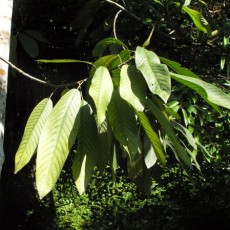
Bhesa paniculata
biku biku
S. India to Philippines. One of most widespread trees in Malaya. Up
to 40m tall and 2m girth.
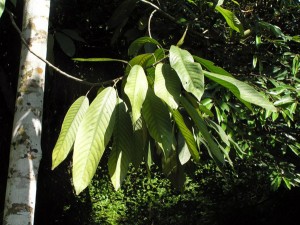
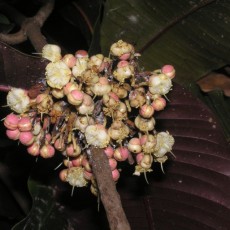
Calophyllum curtisii
bintangor bunga
Large genus mostly tropical Asia to Pacific; in Malaya 45 spp. Canopy,
but not emergent, and mostly slim girth. This sp. common throughout
Malaya except Perlis, on hillsides and ridges.
Calophyllum floribundum
bintangor kuning
Large genus of more than 120 species; mostly in tropical Asia. This
one is common throughout Malay and Borneo.

Calophyllum inophyllum
bintangor laut
Big tree, massive girth, often leaning, branching low. Rocky and sandy
coasts, widespread, a member of the Indo Pacific strand flora, ranging
from India to Fiji.

Calophyllum macrocarpum
bintangor bunut
Large genus mostly tropical Asia to Pacific; in Malaya 45 spp. Throughout
Malaya, commonest in centre. Borneo. This sp. v. big, to 45m and 5m
girth, no buttresses. Squirrels eat the large, ellipsoid- ovoid, juicy
& fragrant fruit.

Calophyllum retusum
bintangor gambut
Endemic, Pahang, Selangor, southwards. Peat and fresh water swamp forest. Big tree to 50m, no buttresses, leaf stalk long & slender, midrib narrowly channeled at base above, prominent below.

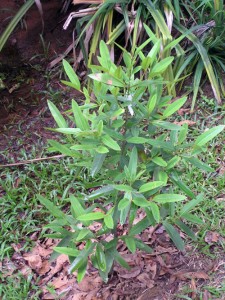
Calophyllum sclerophyllum
bintangor jangkang
Malaya, Borneo. Coastal, Trengganu to Johor; these from Pekan FR. Big tree, often w/stilt roots, twigs stout 4 angles, leaf stalk dries black, very leathery.
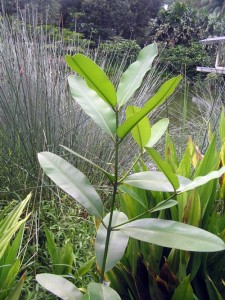

Calophyllum sp.
bintangor
Large genus of 120 spp, most in tropical Asia to Pacific, 45 in Malaya, this one not yet described. Leaves distinctly stalked, fruit a drupe. 3 new specimens Dec 2007.
Kayea grandis (previously Mesua grandis)
penaga bayan, penaga sabut
Borneo. Trengganu, Perak southwards. To 33m, but flowers at 3m. Bark
smooth becomes cracked and fissured, ridges adherent scaly. Flowers
tight terminal clusters. Fruit in 4 thin woody sepals.
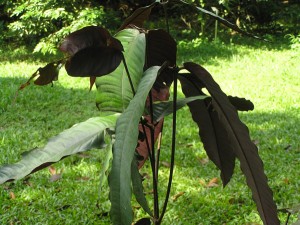

Kayea lepidota (previously Mesua lepidota)
penaga bayan, penaga tikus
Sumatra, Malaya (exc. north). Lowland. Small, to 20m, bole fluted
at butt, bark adherent scaly, sometimes dippled. Flowers in axillary
and terminal umbels, black woody fruits. Stout leaf stalk, to 5mm. 2 new specimens June 2008.
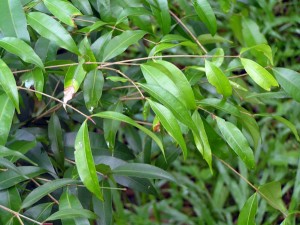

Mesua ferrea
penaga
SW India to peninsula Siam. Throughout Malaya, but rare south of NS. To 24 m, 4m grith. Common and sometimes gregarious, on thin well drained soil. Bole fluted at butt. Leaves elliptic (6-12cm long) tapered to apex and base. White flowers fragrant, showy to 9cm across. Fruits ellipsoid, slightly beaked.

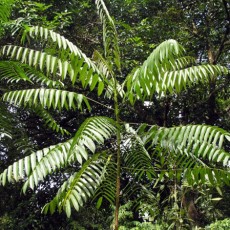
Canarium littorale
kedondong bulan
Sumatra, Indo-China, Borneo, Java. Commonest Canarium from all states. Up to 40m and 2m girth. Bark grey green to yellowish brown, dippled and scaly, many small lenticles.
Dacryodes kingii
kedondong
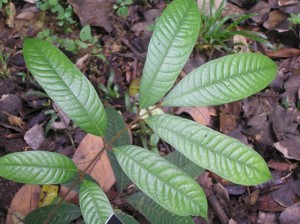
Throughout Malaya, common, endemic. Small tree or large shrub in lowland and hill Dipterocarp forest. Name from Greek, dakruon, a tear, referring to resin droplets on bark surface. Located NW of Bulatan Plong.
Dacryodes rostrata
kedondong kerut
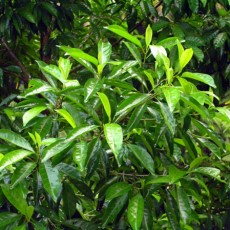
Indo-china, Indonesia. All states exc. Kelantan. 12 spp. in Malaya, in lowland and hill Dipterocarp forests, & swamp. Large tree w/small buttresses. Leaf rachis strongly swollen at junction with leaf stalk; flowers Mar-Oct, fruits Sep-Mar. Leaflets rigidly papery.

Pteleocarpa lamponga
lamponga, singha
Medium to large trees. Bole dark brown , smooth with pale lenticels in perpendicular rows. Leaves without stipules, obovate, flowers bright yellow in many branched panicles. Fruit flat, winged. In Pasoh FR, found in swampy habitat.
Ploiarium alternifolium
reriang
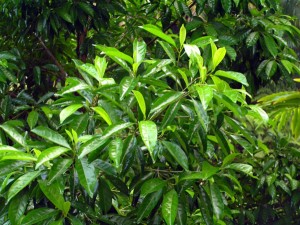
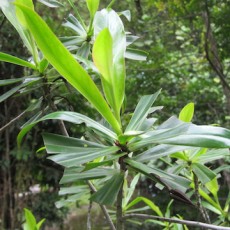
Few spp confined to Malesia & Indo-China. Shrub or tree to 10m in secondary and swampy forests, and occasionally on isolated mountain tops.
Fr TH 6.2012.
Bombax valetonii (Gr., bombux – silk)
wild kapok, kekabu hutan
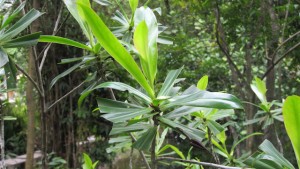
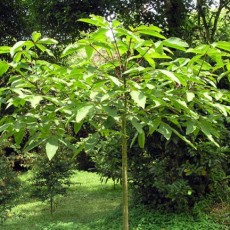
Frequent in forest north of KL. Deciduous with thorny trunks & twigs; leaves palmate spiral, flowers Nov-Feb before new leaves; fruit large capsule full of down, used as kapok. To 45m.
