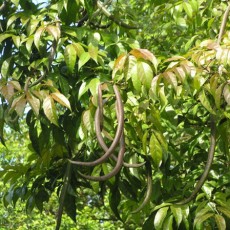
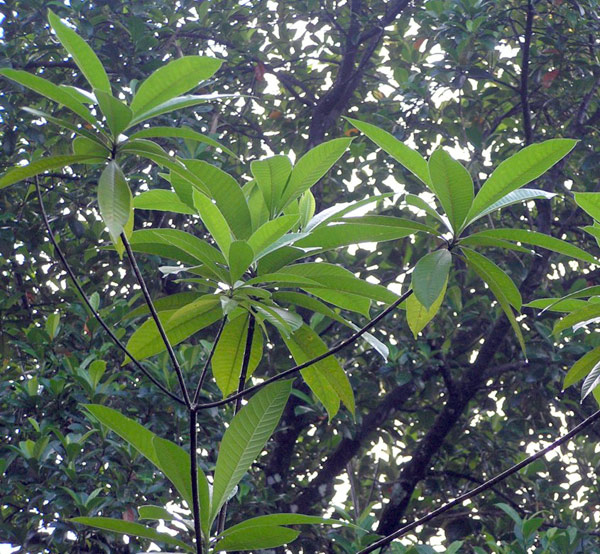
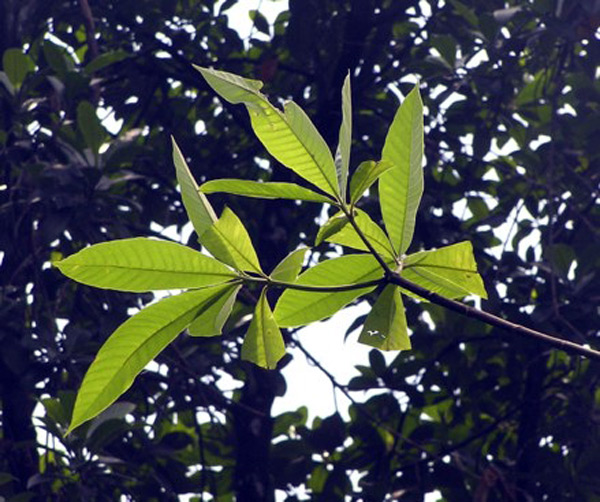
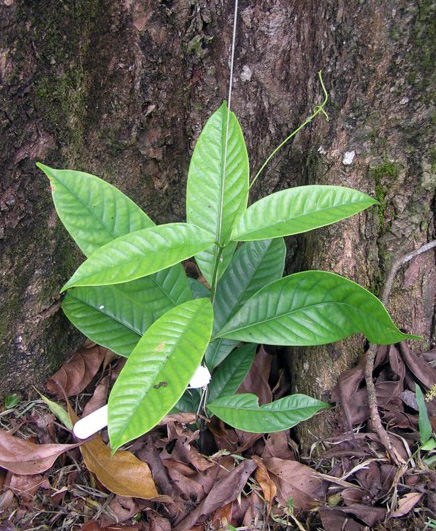
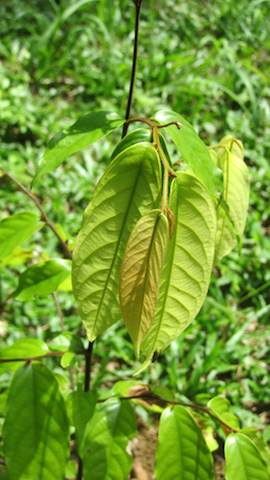
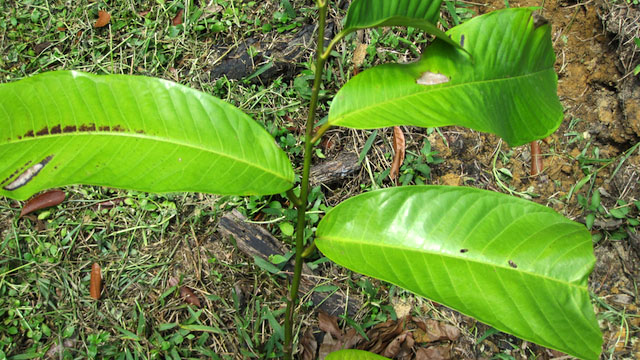
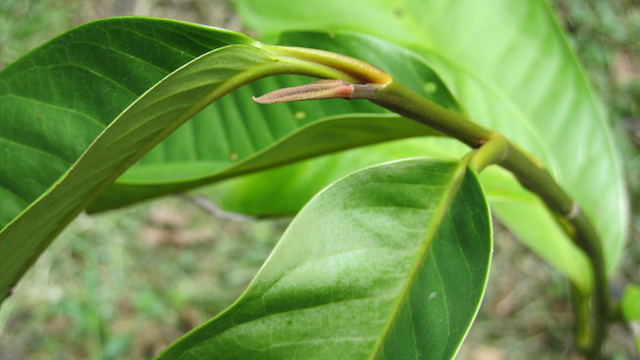
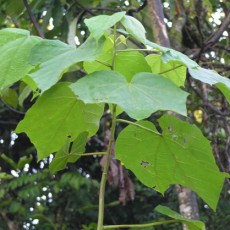
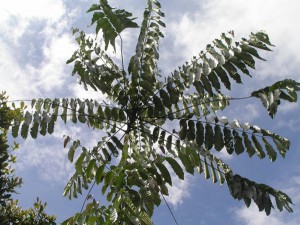
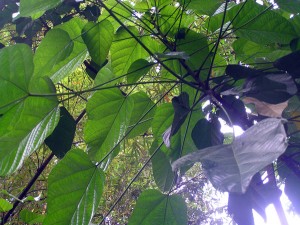
India to New Caledonia. Tree of swampy low ground adjoining rice fields and mangroves, especially in Perlis and n. Kedah. Evergreen to 24 m, but generally smaller. Opposite leaves once pinnate with terminal leaflet. White fragrant flowers with long pipe-like corolla tube. Fruit to 45 cm long, curved, green to brown. Many seeds with thin corky wings.
White latex, leaves opposite, simple. Flowers waxy, radially symmetrical. 300 genera, 2,000 spp in tropics and subtropics, 32 genera and 155 spp in Malaya. 1 specimen December 2007.
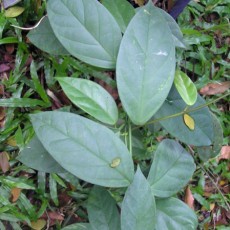
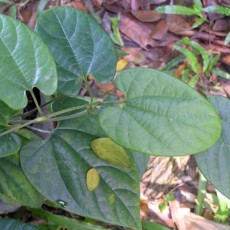
Perennial herbaceous woody climber, leaf margins usually entire, no stipules. Bizarre flowers grow in leaf axils. Leaves toxic, but eaten by swallowtail caterpillars, butterflies then protected by toxin. 3 new specimens December 2007.
SE Asia. Widely cultivated. Seed treats diarrhea, half-ripe seed pounded for skin ointment. Mild narcotic, sliced endosperm of the seed eaten with betel leaves, lime, gambier or cutch.
Areca catechu var. alba
pinang putih
This specimen from Dato Lim Chong Keat 6/05.
Arenga caudata
(tailed, bearing a tail)
Thailand. Distinctive wedge shaped leaflets with variously lobed and lacerated margins and long drawn out tail at apex. Glossy green above, glaucous below. Dense clumps to 2m. Previously known as Didymosperma caudata.
Arenga pinnata
Thought to be wild in Assam and Burma, widely cultivated for gula melaka. Massive solitary palm to 20 m with steeply ascending plume-like leaves to 15m x 3m. Massive inflorescence, flowers from top to bottom then trunk dies. Cabbage edible, fibre important.
Areca triandra
pinang
India, Andamans, Indo-China, Sumatra, Borneo, Philippines. Common Areca in mountain forest. Solitary or in small clumps, rarely 7m, crown shaft slightly swollen, green. Leaves with broad prominently nerved, v. dark green leaflets. Pale inflorescence conspicuous and lemony fragrant.
Arenga hookeriana
Borassodendron machadonis
Subfamily: Borassoideae
S.Siam, N. Malaya, NE Borneo . Stout solitary fan palms, broad flopping leaflets. Dioecious. Inflorescences stout, little branched, amongst leaves hanging from leaf axils. Male flowers in groups of 2-6, covered in overlapping bracts, female much larger. Beware sharp leaf stalks.
Borassus flabellifer lontar, tal, shu tou chung
One variable species from Africa to New Guinea. Not wild in Malaya, monsoonal. Solitary fan palm to 20 m, dense stiff blue green crown. Fruits to 8″ across, ripening yellow, with 3 hard seeds. Inflorescences hang through split leaf bases, produce toddy & sugar.
Borassus palms, toddy on tap year 2020.
Caryota mitis rabok, tukas
Indo-China, Burma, Thailand, Andamans, Malaya. Lowlands. Clumping fishtail palm. Poisonous with irritant crystals. Leaves twice pinnate with fan like terminal leaflet. Only palm common in secondary forest. Fluff from leaves and sheathes is used for tinder. Flowers down from stem tip.
Caryota no no
Borneo. Solitary fishtail palm, leaves bi-pinnate. Tree up to 20m. Strongly ascending leaves up to 5m long & 4m wide. Lateral stalks but not midribs often drooping, leaflets semi-pendulous. Inflorescence 2m long, cream flowers, fruits ripen to purplish black. Edible cabbage.
Cocos nucifera niyor/kelapa
Pan tropic. Unknown in the wild. To 30m or more. Leaves 7m with over 100 close regular pointed leaflets held flat in one plane. Inflorescences over 1m, flowers fragrant, attract bees. Produces material for all purposes: building, medicinal, food, fibre. Can produce 365 fruits a year.
The inflorescence of the common coconut Cocos nucifera is a spectacular and fragrant cut flower.
Corypha utan
(previously Corypha elata syn.) gebang, ibus
S. India, Sri Lanka, drier Malesia to Australia. Huge solitary fan palm, dies after fruiting once. Tree like terminal inflorescence. Trunk to 20m, persistent leaf bases. Contains up to 70kgs sago, lives 50 to 70 years. Leaves used in India for permanent documents, finer than B. flabellifer.
Cyrtostachys renda
(previously Cyrtostachys lakka) pinang raja
Malaya, Borneo. Common in peat swamp forest, clump forming feather palm with scarlet crown shafts. Stems hooped, leaves stiffly oblique. Inflorescence below crown shaft, branches, bearing sunken spirally arranged flowers in triads, female flanked by twinning males.
Iguanura geonomiformis terunok
Genera c. 20 spp., c. 6 in Malaya. This sp. endemic Malaya. Small clustering, in forest undergrowth, leaves simple with deeply forked tip. No visible crown shaft Narrowly branched inflorescence. Fruits ellipsoid, white.
Iguanura sp.
Johannesteijsmannia altifrons
sal
Thailand, Malaya, Sumatra, Borneo. With tall fronds. Threatened by forest disturbance, seed harvesting, land conversion. Creeping sub-terranean trunk & cluster of up to 30 leaves up to 6m ling with petiole of 2.5m. White sour smelling flowers, corky fruits.
Johannesteijsmannia lanceolata
Johannesteijsmannia magnifica sal, koh, lak
N. Sumatra, Malaya, Borneo. Stemless solitary, huge entire diamond shaped leaf, glaucous back. Flowers spiral, white. Fruit dull brown, thick wall, corky, knobbly. Largest undivided leaf blade of any Malayan plant, used for Orang Asli houses. Inflorescence shown in the image on lower right.
Johannesteijsmannia magnifica, the most beautiful palm in Malaysia’s forests, has leaves up to 3 meters long and a silvery, or glaucous, back to the leaves.
Licuala grandis
New Hebrides, widely cultivated, ornamental. Solitary fan palm.
Licuala spinosa palas
SE Asia, coastal, often on landward margin of mangroves. Leaf blades up to 1m across, radiating segments, narrowly wedge shaped and pleated with central blades longest and broadest. Long arching inflorescence, white flowers, red ovoid fruit, spinosa bearing spines (stalk).
Licuala spinosa, the mangrove fan palm, known in Malay as palas, is common in open coastal areas.
Licualasp.
Licuala khoonmengii, 2008, Watercolour on paper, 87.2 x 66 cm, RM 7 200. Part of the Rimbun Dahan Permanent Collection.
Livistona endauensis
Livistona saribus serdang, sar
SE Asia, in Malaya but absent from Negri Sembilan, Melaka and Johor. To 20m. Leaves usually with some lower divisions down to central rib. Fruits round 1-2cm, with thin fleshy blue green wall. Cabbage and fruits edible.
Oncosperma horridum bayas
Malaya, Borneo, Philippines. Leaflets held stiffly, whole blade vertical or nearly so, lowland forest to 500m. Like nibong but clumps smaller, often only 4-6 stemmed, young leaves held flat, while O. tigillarium droops immediately.
Oncosperma tigillarium nibong
Many stemmed clumps to 7m across, leaves arching, all leaflets drooping. Coastal, and in hutan darat, brackish inland mangrove edge. Wood resistant to salt water borers, used for coastal construction eg. kelong stakes. Flat trunk strips for flooring. Fruit substitutes for betel.
Pholidocarpus macrocarpus kepau
Malaya. Lowland seasonal swamp forest, along valleys, scattered, endemic. Like Livistona exc. stamens form long tube free from petals, fruits with thick corky cracked outer wall. Flesh orange with strong apricot smell (edible?). Not all leaf divisions to centre, some only 1/3 way in to stalk.
Pinanga disticha legong
Malaya. Common in dryland forest undergrowth. Leaves V-shaped, simple, dark green, marbled with paler patches. Fruiting head below crown shaft (fruits in 2 ranks: disticha). Inflorescence simple, slender, spreading spikes, fruits red, ellipsoid, spike axis sometimes red.
Pinanga disticha, one of the most common understorey palms in the forest.
Pinanga malaiana legong
Malaya, Sumatra, Borneo. Small clumps to 7 m. Leaves spreading, equally spaced equal broad leaflets, 2 main nerves. Crown shaft prominent, fawn flushed pinkish. Inflorescences pendulous with 2-5 stout flattened 8″ spikes. Flowers yellow-cream, fruits in 2 ranks, ripening purple red.
Pinanga riparia
Thailand, Malaya, Singapore, Sumatra. Borneo? Clustering, to 5m. Leaves 60-90 cm, w/3-7 prs. falcate (sickle shaped) leaflets. Fruit white-green, ripening red-black. Riparian, can stand periodic submergence. From Datuk Lim Chong Keat 5.05.
Pinanga simplicifrons
Thailand, Malaya, Sumatra, Borneo. Miniature clustering palmlet to 1.5m. Few leaves at crown, blades entire, oblong, bifid at apex. Fruit proportionately large, green to scarlet. Basal shoots/seedlings?colonies in lowland wet/dry forest. From Datuk Lim Chong Keat 5.05.
Ptychoraphis singaporensis
(ke)rinting
Singapore, Johor, Dindings. Endemic. Slender clustering stems and feathery leaves. No crown shaft. Inflorescence with 2 spathes & several slender spikes developing in axils of hanging dead leaves. Flowers sessile, yellow. Fruit fleshy, yellow to red. Seed linear groove on one side.
Rhapis excelsa China Cane, partridge cane
Sub-family Coryphoideae. SE China? widely cultivated. Origins unclear, plants in Malaya infertile and believed to be all male. Propogated for centuries from sucker shoots & used for umbrella handles and walking sticks.
Salacca edulis salak
Lowland, cultivated throughout Malesia, in Malaya rare. Clump forming, prickly, undergrowth palms, growing as big dense rosettes. Leaflets flat in 1 plane, evenly spaced but in sub-opposite groups of 1-3 with irregular gaps between, ashy grey on lower surface. Dioecious. Edible fruit.
Native to the Philippines. Conifer tree, to 50m, monopodial with whorls of branches. Massive trunk tapers to top. Terminal buds rounded. Pollen cones cylindric in leaf axils. Mature seed cones massive with many winged seeds solitary on median woody scales.
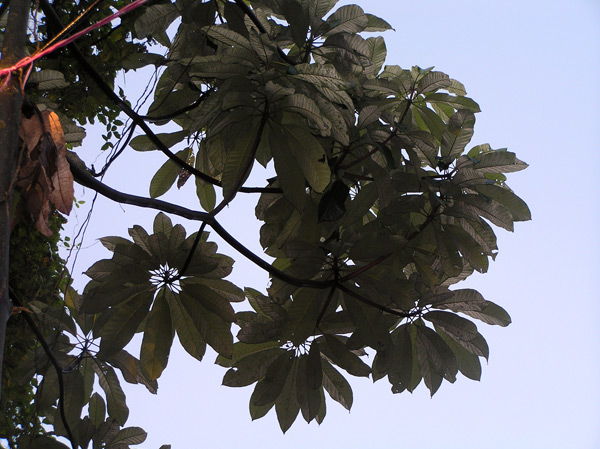
W. Malesia, common in open country. Up to 40m. Pagoda tree with terminalia branching, buds concealed beneath bases of leaf stalks, often coated with white or yellow resin. Flowers small, white and v. fragrant, fruit a pair of long hanging pods, containing many small silky haired seeds.
The fragrance of Pulai, Alstonia angustiloba.
Alstonia macrophylla
pulai penipu bukit
Malesia. Selangor, Trengganu northward. To 30m, 2m girth. Crown dense, deep, not spreading or tiered. Leaves mostly in whorls of 4 (rarely 3), with distinct slender stalk.
Alstonia spatulata
pulai basong
Throughout Malaya, except the north. Lowlands and seasonal swamp; common on deep peat in Pahang, and as small tree on old tin mines. Young trees have beautiful pagoda shape. Root wood, one of the world’s lightest (3 lb/cu. ft), used for ‘pith’ helmets. Tapped for latex for alkaloids in native medicines.
Dyera costulata jelutong
Big to huge unbuttressed tree. Terminalia branching, leaves in whorls of 6-8, thin papery wing surrounds seeds. Crown up to 45m across, emergent tree, yearly deciduous for a few days. Only species in the family to yield commercial timber. Latex for chewing gum during Prohibition, wood for pencils & picture frames.
Kibatalia maingayi jelutong pipit
Common just north of Kuala Lumpur where forest remains. Soft and light timber, easily staining blue. Bark contains medicinal alkaloids.
Plumeria rubra
bunga kemboja
Central America. Flowers sweet, cool, fragrant. Used to prevent heat stroke & to treat enteritis & dysentry. Helps indigestion and poor absorption of infantile nutrition.
Shrub or small tree, 8 of 60 spp in Malaya. This sp endemic, in Perak, Pahang & Selangor. Leaves abruptly narrow from middle to base.
Fr TH 6.2012.
Polyalthia glauca
mempisang paya
Malesia. Rare but widespread, usually in swamp forest. Leaves glaucous below, midrib sunk on upper surface. Fragrant flowers in clusters on tubercles. Polyalthia: many cures. TH 6.2012.
Polyalthia rumphii
mempisang?
W Malesia, all states exc Perlis & Penang. Tree to 20m. Closely related to P. jenkensii. Leaves to 20cm. 1 fr TH 11.09.
Polyalthia stenopetala
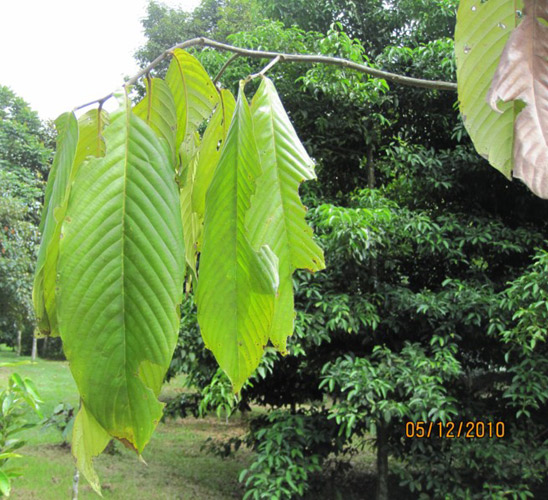
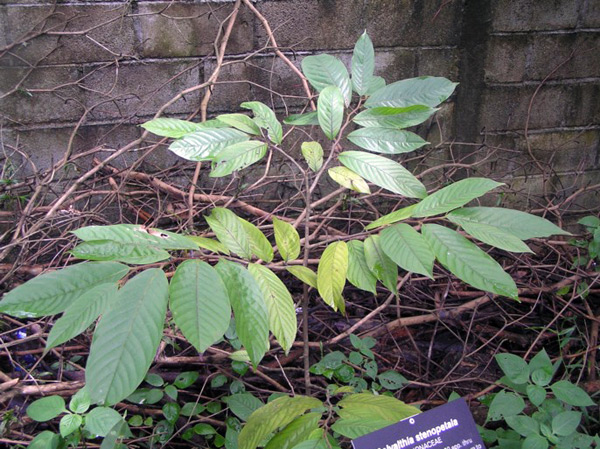
One of the largest genera, with over 100 spp. thru old world tropics and centred in SEAsia, 28 spp from Malaya, more to describe. Occur thru Malaya in lowland forests in understory as small trees or shrubs. Leaves glabrous with simple hairs. This sp. common except in Perlis and Penang.
Stelechocarpus cauliflorus
mempisang
Siam, Malaya, Sumatra. W coast & Pahang, rare. Lowland forest. To 15m. Leaf midrib raised above; flowers cluster on trunk or old branches behind leaves. Brown fruit ovoid, dispersed by animals.
Xylopia ferruginea
jangkang bukit
Siam, Borneo, Sumatra. Common all states exc Penang & Perlis. To 25m, fruits numerous, elongate, cylindric, like a string of beads with longitudinal folds when dry. 1 from TH 11/09.
Common to 700m. Edible but acid fruit, can be eaten raw or steamed. Resinous smell of crushed leaf distinguishes it from Eugenia and Mesua.
Buchanania arborescens otak udang tumpul
Common fr. Andamans to Australia on coasts and river banks. Crown conspicuous with cream flowers between April and June. Leaf apex obtuse, rounded or emarginated, young leaves pink. Drupe green to red, green flesh.
Campnosperma squamatum terentang daun kecil
Malesia. Widely distributed from mountains to swamps. Trees to 30m with distinct terminalia branching. Buttresses short, rarely stilt roots. Leaves spiral, short stalk. Flowers yellowish green, drupe green speckled white.
Dracontomelon dao sengkuang
Indo-Malesia, frequent in Malaya by rivers and in forest or planted in villages. Common in north. Similar to sentang except for leaf stalks stouter. Leaves large (12-22″), 5-11 prs leaflets. Up to 30m, deciduous, dense rounded crown. White flowers in hanging panicles.
Mangifera caesia binjai
Malaya, Sumatra. Common in orchards, esp. in Melaka. Flowers palelilac in pink panicles.
Mangifera foetida macang
Siam, Malaya, Sumatra, Borneo, Java, Indochina. Common in orchards and forests to 600m. To 36m, drupe long 7-10cm, ripening green, yellow, strong smell of turpentine when ripe. Edible. 2 fr TH 11.09.
Mangifera macrocarpa
15 spp in Malaya. Thailand, Cambodia, Malesia. Rare. Lowland forests Kelantan, Trengganu, Perak, Pahang, Malacca & NS. Big tree, to 33m . Leaf stalk 3-6cm, blade long & narrow with long petiole. Drupe 80-12cm, yellow fibrous flesh.
Mangifera magnifica
Common, widely distributed in lowland and hill forests, expect Perlis & Penang. Endemic. To 54m, 3m girth. Leaves closely spirally arranged, blade stiffly leathery (thickest leafed Mangifera in Malaya). Drupe oblong, 11x 7cm when dry, fibrous.
Mangifera pentandra Hook. mempelam bemban
Occasionally in villages, common in Kedah. Very similar to Mangifera indica. Fr TH 6.2012.
Mangifera quadrifi sepam, asam kumbang
To 40m, bark brown fissured, scaly. Flowers greenish white, fragrant. Drupe dark purple when ripe, flesh fibrous, sweet to sour. Cult. in villages, wild throughout Malaya, Sumatra, Borneo.
Parishia insignis surian, sepal
Large buttressed forest trees, Andamans to Borneo. Uncommon. Apparently deciduous, flowers and new leaves together, but this spp, matures its fruits while the crown is bare.
Parishia maingayi surian, sepal
Malaya, Sumatra, Borneo, Philippines. Perak, Terengganu, Johor, Selangor. Scattered but locally abundant on ridges to 600m. Flowers white in long hairy panicles, fruit brown velvety, with long enlarged calyx wings. 1 fr TH 11.09.
Parishia paucijuga surian, sepal
To 40m, widely distributed Malaya, Singapore, Sumatra, Borneo. Genus has white latex, leaves spirally arranged, pinnate w terminal leaflet, yellow flowers w parts in 4s, hairy fruit w 4 winglike enlarged sepals, ‘shuttlecocks’. 1 fr TH 11.09.
Pentaspadon motleyi plong licin
Malesia, Solomon Is. Swampy forest, by streams. Once common here in Sg. Plong. To 36m, 2m girth, thin spreading buttresses. Bark grey, dippled to scaly. Deciduous, then cream fragrant flowers in branched panicles in March and Oct. Young leaves pink. Wood oil treats skin diseases.
Burma to Java, Indo China, China. From Kedah to NS, only west coast, to 15m w/ short buttresses. Lowland forest. Soft dense tomentum under leaf. One genus family in Old World tropics, temperate Asia to Aust. 7spp. in Malaya of 21 total.
Alangium ridleyi ALANGIACEAE mentulang daun lebar
Endemic. All states exc. Kelantan and Johor, big tree to 40m and 2m girth. Flower calyx deeply ridged, petals fleshy if fresh, fruits ovoid with 12 ridges, seeds with white translucent juicy aril.
Hydnocarpus sp. setumpol About 40 species, India to Sulawesi, in Malaya 12 spp. Seeds have curative properties, especially for leprosy.
Pangium edule payang, kepayang Occasional village tree, wild in Selangor, Perak, Pahang. All parts poisonous, but treated seeds can be eaten and cooking oil extracted. Large long stalked leaves spirally arranged to avoid over shadowing others.