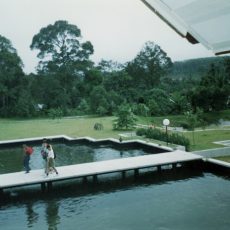
Over the course of seventeen years, the constant planting, pruning, sun and rain have done their work in the garden at Rimbun Dahan. What was once hot bare expanse has become cool and crowded with greenery, as the before and after images below show.
1991
2008
The view above, taken from the dining room, looks out diagonally across the reflective pond to the balai beside the swimming pool, and to the rambutan orchard beyond, all of which can be clearly seen in the 1991 image. In the more recent image, the reflective pond is planted with papyrus grass, waterlilies and lotuses, which obscure the view. The lawn beside the house has been maintained, to prevent creepy-crawlies from having too easy access to the house. A rain gauge has been installed on the lawn. Note that the cool marble floor beneath the dining table continues to be a popular haunt for the household dogs.
1991
2008
The view above is from the guest house looking across the reflective pond back towards the main house and the durian orchard beyond. A hill of a palm oil estate can been seen in the far background, as well as a neighbour’s roof. The growth of the garden has increased the privacy at Rimbun Dahan, as well as reducing noise from the nearby main road. The 1991 image shows the emptiness of the lawn in front of the main house, with only a few small saplings. In the recent image, the trees are much bigger. The row of colourful canna lilies, native to South America, that lined the reflective pool has long since been replaced, and now a large specimen of the indigenous Congea tomentosa, a climbing vine with purple flowers, has taken over the plants beside the reflective pool.
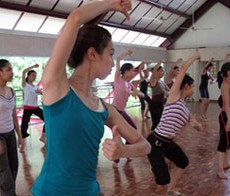
Suhaili Ahmad Kamil and other Dance Day participants in Rathimala’s workshop.
Over twenty experienced dancers assembled in the dance studio at Rimbun Dahan on 1 May to celebrate International Dance Day with four workshops: Cunningham technique conducted by Yuka Tanaka, ballet performance skills by Kim Long, Shobana Jeyasingh repertoire by Radhimala, and Horton technique by Joey Chua.
From 9.30am to 5pm, the dancers sweated it out in the studio, trying a host of techniques that are rarely taught or practiced in Malaysia. They broke for lunch and a cooling-down session with dance videos in the underground gallery before returning to the studio.
Dance Day was free for all Balletbase dancers, and RM 50 for the day for all other participants.
ABOUT THE WORKSHOPS
Cunningham Technique, taught by Yuka Tanaka, 9.30-11am
Choreographer and dancer Merce Cunningham has been a driving force in modern dance for over 50 years. His choreography introduced the idea that music and dance can be independent of each other. He also introduced the use of chance in developing choreographic phrases. Cunningham technique emphasises a strong sense of spine and the ability to quickly change direction.
Yuka Tanaka received her Bachelors (Hons) in contemporary dance from Laban in London, with an emphasis on Cunningham and Graham technique. In London, she worked with choreographer Lea Anderson and performed at the Soho Theatre. She has recently performed in Malaysia with Balletbase.
Above: Dance Day participant Cecilia Yong trying new movement in Rathimala’s workshop.
Ballet performance skills, taught by Kim Long, 11.15am-12.45pm
Kim Long was trained in Australia and directed Kim’s School of Ballet in Ulu Klang for many years. She is much loved and respected by her previous students for her patience, personal attention and eye for developing the whole dancer. Kim Long will give a ballet class emphasising style and presentation, and the techniques of projecting to an audience. Kim is now a competitive golfer while teaching casual ballet classes at the International School of Kuala Lumpur.
Repertory class, taught by Rathimalar, 1.45-3.15pm
While Rathimalar is best known to Malaysians as a star dancer with Ramli Ibrahim’s Sutra Dance Theatre, she also worked for five years as a professional dancer for the Shobana Jeyasingh Dance Company. In her own work, she combines the Indian traditional styles of Bharata Natyam and Odissi with contemporary dance. She is currently making a duet work with Suhaili Ahmad Kamil for performance this July.
Horton Technique, taught by Joey Chua, 3.30-5pm
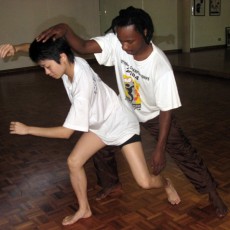
Above: Joey Chua conducting a workshop in Horton technique on Dance Day.
Horton technique was developed by American dance, choreographer and teacher Louis Horton in the 1940s and 50s, and is most visible today in the works of the Alvin Ailey American Dance Theatre. Horton technique is based on anatomically-conscious corrective exercises and emphasises the use of flat backs and lateral stretches. It encourages the development of strong flexible dancers.
Joey Chua is a Singaporean choreographer who will be resident at Rimbun Dahan from April to July 2008. She will be creating a solo work to be performed as a work in progress in Kuala Lumpur in July. Joey studied dance at the University of Adelaide in Australia, and followed this with a Master in Arts (Research) at Queensland University of Technology. She has been involved in implementing dance curriculums in secondary schools in Singapore. Joey has recently participated in the 10th Seoul International Dance Festival 2007 and the FNB Dance Festival in Durban, South Africa.
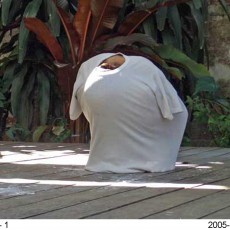
Moe Satt, a performance artist from Yangon trained in zoology and community development, was in residence at Rimbun Dahan for three months, from February to April 2008.
Bio
Moe Satt (b 1983) lives and works in Yangon, Myanmar (Burma). In 2005 he graduated from East Yangon University with a Bachelor of Sciences (Zoology). Since then, he has participated in over 25 performance events and four solo shows as well as digital art exhibitions.
In his art works, Moe Satt tries to reflect the order and disorder surrounding people and the neverending justification in terms of human internal validity. He started out as a performance artist showing his work in the galleries and on the pavements of Yangon. In April 2007 he attended a certificate program in Community Development and Civic Empowerment at Chiang Mai University, Thailand. He exhibited his first solo art work abroad at Chiang Mai University in June 2007. He has participated in international performance art festivals including Performance Site Myanmar 05, 8th Open International Performance Art Festival in Beijing, China and 9th Asiatopia International Performance Art Festival in Chiang Mai, Thailand.
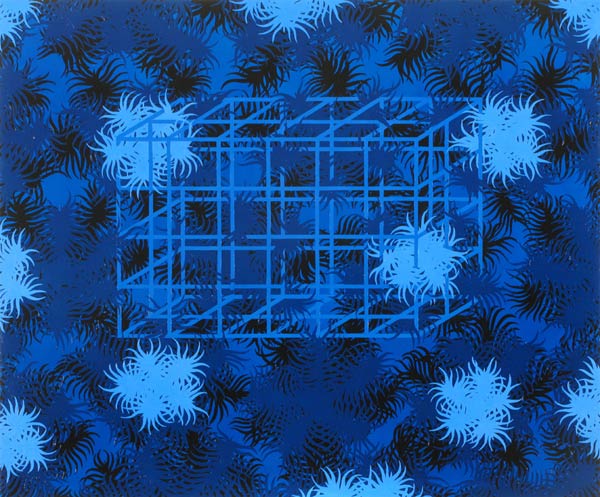
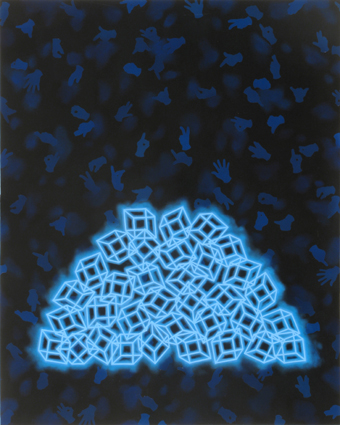
Dr Megan Keating was one of the Australian artists of the year-long Malaysia-Australia Visual Artist Residency at Rimbun Dahan in 2008. At Rimbun Dahan she created Plantation Nation, a body of large-scale oil on canvas works, which explores the idea of “home” and how we cultivate an environment to ‘ manufacture’ this idea.
About the Artist
Megan Keating was born in Sydney, Australia where she worked in a design studio before attending the National Art School. She holds an Honours degree (first class) (1998) and a Doctorate of Philosophy in Fine Art (2002) from the University of Tasmania.
She is a multidisciplinary artist crossing installation, painting, and paper cutting. Her practice explores the nature of extremes. These extremes or conflicts can be seen as conditions and consequences of contemporary living; such divergences include tradition and modernity, beauty and terror, craft and technology, media and reality, nature and culture. Within this forum Keating often uses motifs that nudge at the edge of acceptability such as bombs, military iconography or pornography, which she renders as elegant silhouettes.
She has exhibited extensively since 1999 with recent solo projects including Different Reds, Gallery 4a, Asia- Australia Arts Centre, Sydney (2001); And then there were none… Gowlangsford Gallery, Sydney (2003); In Dreams Begin Responsibilities, 2-28 Memorial Museum (curated by Yaohua Su), Taipei (2006); The Year of the Rat, Xue Xue Institute, Taipei (2007); Deep Water Dark Water, Criterion Gallery, Hobart (2007); and Hard Love, Devonport Regional Gallery (2008). Group exhibitions include Papercuts, Monash University Museum of Art, Melbourne (2003); Love Letters to China, Ivan Dougherty Gallery, Sydney (2003); Drawn Out, Perth Institute of Contemporary Art (2005); Her name is Tan Hua, collaborative performance with Mei Li, Taipei (2006); This Crazy Love, Linden Gallery, Melbourne (2007); Loop, Barry Room Gallery, Taipei (2007); Under My Skin, Asialink touring exhibition to Manilla, Hanoi and Singapore (2008). Keating has also been the recipient of numerous awards including an Asialink Residency to Beijing (2000); Australia Council Residency, Tokyo (2003); Arts Tasmania Research and Development Grant (2003); Australian Council New Work Established Grant (2005); Asialink Residency, Taipei International Artists Village (2006) and Artist–in-residence, The European School, Taipei (2007). In 2008 Keating was the recipient of the year-long residency at Rimbun Dahan, Malaysia. Her work is held in the collections of Artbank, BHP Billiton, Pat Corrigan Collection, Australia, Australian Embassy, Beijing, National Gallery of Australia, Rimbun Dahan, Malaysia, Taipei Artists Village, Taiwan and the University of Sydney.
Keating currently lives and works in Hobart where she lectures in painting and graphic design at the Tasmanian School of Art. In 2009 Keating will return to Tasmania to curate an exhibition of contemporary Taiwanese art for the 10 Days on the Island Festival and the University of Tasmania.
Plantation Nation is a body of large-scale oil on canvas works, which explores the idea of “home” and how we cultivate an environment to ‘ manufacture’ this idea. Images and inspirations have been taken from observations of Malaysia, especially around the locality of Rimbun Dahan whilst concurrently thinking about the issues related to being away from home, what is a home, returning home and trying to establish a sense of home in a foreign environment.
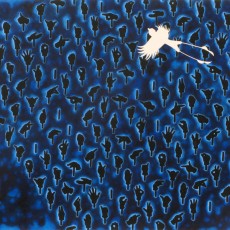
The Aquarium, 2008, Oil on canvas, 153 x 183 cm, RM 8 500. Part of the Rimbun Dahan Permanent Collection.
A Beautiful Cage, 2009, Oil on canvas, 183 x 153 cm.
Flagland, 2008, Oil on canvas, 183 x 152 cm.
The Hearth, 2008, Oil on canvas, 153 x 122 cm.
Home, 2009, Oil on canvas, 183 x 152 cm.
The Orchard, 2008, Oil on canvas, 122 x 153 cm.
Plantation Nation, 2009, Oil on canvas, 183 x 306 cm.
The Pyre, 2008, Oil on canvas, 153 x 122 cm, RM 7 000. Part of the Rimbun Dahan Permanent Collection.
Separate Rooms, 2008, Oil on canvas, 153 x 183 c.
An Unsustainable Weight, 2008, Oil on canvas, 153 x 122 cm.
Lauren Black (b.1971) is a contemporary botanical artist from Tasmania, Australia. During her residency at Rimbun Dahan her work has focused around the theme of disappearance; exploring themes such as rare and endangered species, the relationship between human culture and botanical life and, the transient beauty of plants.
Works on exhibit will be in watercolour and pencil.
Musa gracilis, 2008, Watercolour and pencil on paper, 87.2 x 66 cm, RM 6 000. Part of the Rimbun Dahan Permanent Collection.
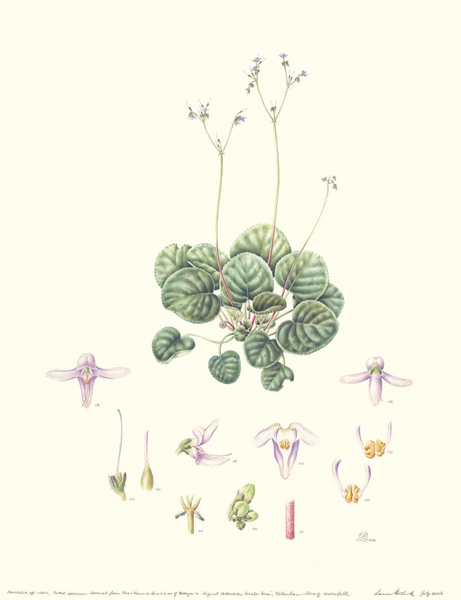
Henckalia sp.nova, 2008, Watercolour on paper, 87.2 x 66 cm.
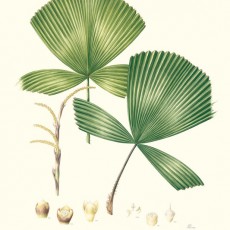
Licuala khoonmengii, 2008, Watercolour on paper, 87.2 x 66 cm, RM 7 200. Part of the Rimbun Dahan Permanent Collection.
Macodes petola, 2008, Watercolour on paper, 87.2 x 66 cm.
Nepenthes ramispina, 2008, Watercolour and pencil on paper, 87.2 x 66 cm.
Shorea siamensis, 2008, Watercolour and pencil on paper, 87.2 x 66 cm
Ephemera 1, 2008, Pencil on paper, 92.5 x 71 cm.
Ephemera 2, 2008, Pencil on paper, 92.5 x 71 cm.
Ephemera 3, 2009, Pencil on paper, 92.5 x 71 cm.
Forgotten flora 1- confined, 2008, Gouache and pencil on paper, 69 x 51.6 cm.
Forgotten flora 2- exodus, 2008, Gouache and pencil on paper, 69 x 51.6 cm.
Forgotten flora 3 – palmed, 2008, Gouache and pencil on paper, 69 x 51.6 cm.
Forgotten flora 4 – executed, 2008, Gouache and pencil on paper, 69 x 51.6 cm
Heaven in a wildflower 1, 2008, Gouache and pencil on paper, 92.5 x 70.5 cm.
Heaven in a wildflower 2, 2009, Gouache and pencil on paper, 92.5 x 70.5 cm.
Artist’s Profile
Lauren Black is a leading figure in contemporary Australian botanical art. Her career in this specialised field commenced in 1997 with studies at the Royal Botanic Gardens Melbourne. Currently working as a freelance artist and teacher she has been involved in many projects and commissions including collaborations with botanists, artists, universities, community and government organisations. As well as exhibiting regularly as both a solo artist and as part of group exhibitions in Australia, Lauren has also curated numerous botanical exhibitions of historical and environmental importance.
In 2004 Lauren won the inaugural Margaret Flockton Award for excellence in botanical illustration, NSW, Australia. In 2005 she was awarded an Asialink visual arts residency to develop her practice further in Sri Lanka.
Lauren’s residency at Rimbun Dahan has introduced her to the rich and diverse flora of the tropics. She hopes to continue this relationship with tropical flora; developing projects that can reveal both the extraordinary beauty and precarious nature of this region for a wide audience.
Lauren’s work is held in numerous collections including:
HRH Crown Prince and Princess of Denmark
Queen Victoria Museum and Art Gallery, Tasmania, Australia
Allport Library and Museum of Fine Arts, Tasmania, Australia
University of Tasmania Fine Art Collection
National Library of Australia, ACT
Royal Botanic Gardens Library, Melbourne, Vic. Australia
Justin Lim (b. 1983 Kuala Lumpur, Malaysia) completed his postgraduate studies in 2006 with the Master of Art (Fine Art) programme by The Open University UK conducted at Lasalle-SIA College of the Arts, Singapore after obtaining a BA(Hons) Fine Art majoring in painting. He has exhibited widely in Malaysia and Singapore in various solo and group exhibitions. In 2007,he was the Artist-In-Residence at TAKSU, Kuala Lumpur and was awarded the 2008 Malaysia-Australia Visual Artist Residency at Rimbun Dahan, Malaysia.
His new body of works examines the connection between existence, religion, politics and its relation in our contemporary social context. Using painting as a medium, Justin’s residency exhibition entitled Gods, Heroes & Myths represents and questions the human capability to distort the truth. Inspired and conceived between the 50th Merdeka celebrations and the 12th Malaysian General Elections, Justin uses random people and fictional characters to question various events surrounding the nation and people’s perception towards them. In relation, the works also explore subjects like manipulation, power and religion.
Detail from Gods, Heroes & Myths, 2008, Acrylic on canvas, 244 x 914 cm.
Hantu Air, 2008, Acrylic on canvas, 183 x 152 cm.
Hantu Tetek, 2008, Acrylic on canvas, 183 x 152 cm.
In Oil We Trust, 2009, Acrylic on canvas, 183 x 152 cm.
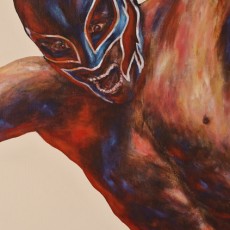
Orang Minyak, 2008, Acrylic on canvas, 183 x 152 cm.
Part of the Rimbun Dahan Permanent Collection.
Toyol, 2008, Acrylic & charcoal on canvas, 183 x 152 cm.
Warfare series 1, 2009, Acrylic on canvas, 122 x 152 cm.
Warfare series 2, 2009, Acrylic on canvas, 122 x 152 cm.
Warfare series 3, 2009, Acrylic on canvas, 122 x 152 cm.
We Want You!, 2008, Acrylic on canvas, 61 x 54 cm (set of 9).
Secret Identities, 2008, Acrylic on canvas, 122 x 244 cm.
Animal Farm, 2008, Acrylic on canvas, 122 x 244 cm.
Part of the Rimbun Dahan Permanent Collection.
The Last Supper was contributed by Justin Lim to ‘Shifting Boundaries’, the 2008 Art for Nature Exhibition. It is currently in the collection of Ng Sek San. 2008, acrylic on canvas, 102 x 102 cm.
Gods, Heroes & Myths, 2008, Acrylic on canvas, 244 x 914 cm
About the Work: Some Thoughts on Gods, Heroes and Myths
For Justin Lim’s third and latest solo exhibition, figures have literally come to the fore. In fact, they loom large on the canvasses. The interest in figuration is not a recent or sudden one. His formal training in figuration could be traced to when he was studying visual and digital arts in Malaysia from 2001 to 2003.1 This was later overshadowed by his interest in abstraction when he pursued his fine arts degree in Singapore from 2006 to 2006.
However, when Lim returned to Malaysia in 2007, he was caught up by what was happening around him, especially the political and social events of the time such as murder scandals2, the 50th Merdeka Celebrations3, the HINDRAF controversy4and the 12th Malaysian General Elections. The latter proved to be particularly momentous as popular dissatisfaction led to the loss of the ruling party’s two-thirds parliamentary majority as well as five states to the opposition. Lim recalled the almost ‘festive’ air during the election period when his neighbourhood was festooned with posters and banners, and the gripping political drama was the topic of constant conversation. This was also a period when Lim was questioning the reality of the ‘festivity’. Issues such as the role of religion, the influence of social structures and conditioning, and the relationship between power and truth were pondered upon. How much autonomy do we really have in life? And how do we relate to and perceive the people around us? This then led Lim to reflect on the political and social changes occurring in his midst. What is the relationship between power and politics, race and religion? How does the mass media influence public perception? How much should we believe of what we read? Can we really trust what we see? And how does one make sense of this paradoxical, topsy-turvey world that we live in?
Questions like these are explored through the use of figuration in Lim’s new works. In the case of the largest painting Gods, Heroes and Myths, the figures press upon the viewer, popping to life from a pristine flat background. Using the parade of characters, Justin highlights a number of ambivalences and paradoxes. Sumo and American wrestlers are a source of entertainment but are also treated as heroes by many in their home countries. So, how seriously should they be taken by us? Two other figures strike dance-like poses with eyes half-closed. Are they dancing or going into some sort of trance – one is never quite sure. There is a man sporting a Mohawk haircut and punk clothing. As an icon of anti-establishment counterculture, he takes silent aim at the central figure in the picture. A butcher, with knife in hand, who stands amidst hanging carcasses, looks at the viewer quizzically. He wears a white rounded cap, usually associated with the taqiyah worn by Muslim men. How do we regard this enigmatic character? In an age when terrorism-driven fears have exacerbated irrational exaggerations and stereotyping, where is the place for truth and tolerance? In the work Animal Farm, Lim takes inspiration from the book by George Orwell, a cautionary tale about power and corruption. Featuring a line-up of animal carcasses stripped of all marks of identity, the painting seems to be reminding us that regardless of our desires, convictions and achievements, this is the ultimate destiny for everyone – to become mere remnants of anonymous flesh, nothing more, nothing less.
The notorious murder of a Mongolian woman with its lurid headlines of a gruesome murder using explosives, allegations over a shady purchase of submarines, and the involvement of the police and prominent political individuals, had transfixed the public for much of late 2006 and 2007.5 In addition, the turmoil on the international front, ranging from Gulf War to the oil crisis, provided much food for thought. The use of ghosts as a metaphor by Lim is an interesting one. Ghosts are said to haunt the living, just as the excesses of Malaysian politics continue to make their presence felt throughout the past 50 years.6 Ghosts are also sometimes regarded as the repositories of our irrational fears and suspicions. One characteristic of Malaysian politics has been the periodic resurrection of the so-called ‘bogeyman’. Referring to a terrifying spectre used as a threat to misbehaving children, politicians often resort to racial issues to incite popular unease or unrest within a particular ethnic community, thereby manipulating them to behave in ways which have not been helpful in fostering greater trust and understanding within a plural society like Malaysia.7 Lim has, though his canvases, created a disturbing world where ghosts such as the Toyol (slave ghost used for stealing money), Hantu Air (water ghost), Hantu Tetek (breast ghost) and Orang Minyak (oil man) collide with the submarines, warplanes, suited businessmen, petroleum kiosks and hand grenades from our world. The atmosphere evoked in these works is certainly nightmarish and unreal, but is it any worse than the times which we live in?
Lim is an artist who has always been curious to question and investigate the world around him. As his personal circumstances changed, so did his field of exploration, and the means of his investigation also varied accordingly. The forms may be different but his investigative and creative spirit remains the same.
Low Sze Wee (Assistant Director – Curation & Collection) Singapore Art Museum
1 Interviews with artist on 6 June and 27 December 2008.
2 This refers to the trial of a political analyst over the murder of Mongolian woman in October 2006. The case became a political scandal because the defendant had close ties to the governing party as well as Malaysian Deputy Prime Minister Najib Razak.
3 This refers to a series of private and public activities which celebrated Malaysia’s 50th Independence Day in 2007.
4 HINDRAF refers to the ‘Hindu Rights Action Force’ – a coalition of non-governmental Hindu organisations – which had initiated protests and rallies to preserve their community rights in late 2007. These later led to several arrests and detentions without trial by the government.
5 This refers to the same scandal mentioned in footnote 2.
Joey Chua (Singapore) and Mcebisi Bhayi (South Africa) were resident choreographers at Rimbun Dahan in 2008. Mcebisi and Joey’s collaboration was the first recorded instance ever of a female Asian choreographer working with a male African choreographer to produce a single work.
Tracing: Dance Dialogues in Singapore and South Africa
Mcebisi, a South African Xhosa man who swears by his customs, and Joey, a Singaporean woman who can barely speak her Chinese dialect Hakka, decided to start a dialogue. After months of letter writing and intimate sharing of childhood memories, their exchange shifts to the present as they come face-to-face, finding both common ground and contrasts in each other’s dance background, personality and physicality. In tracing the minds and bodies of one another, they hope a new dance vocabulary emerges on their creative journey together.
The dance collaboration between Joey Chua and Mcebisi Bhayi continues to evolve as a work-in-progress showing in KL followed with appearances in Hong Kong and at Singapore Esplanade’s dan:s festival. The finished work will premiere at the FNB Dance Umbrella 2009, a major dance festival in South Africa. Chua, one of Singapore’s rising young dancer-choreographers, has been involved in many collaborative projects that have taken her to festivals around the world. Bhayi is a dancer, choreographer and educator who has been nominated as Most Promising Male Dancer in Contemporary Style at the FNB Dance Umbrella 2001.
Tracing was performed at the Fonteyn Studio Theatre, FAB, Section 14, Petaling Jaya on 1-2 August 2008.
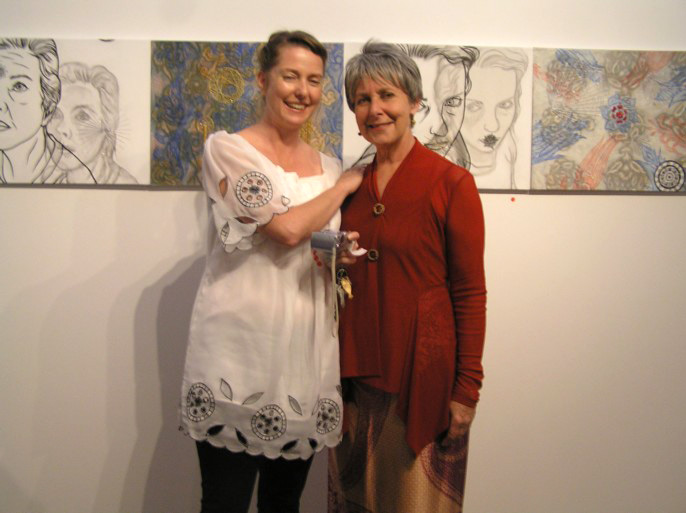
Gabrielle Bates exhibited work she had made during her residency at Rimbun Dahan in 2007 in an exhibition at Trocadero Art Space in Footscray, Melbourne. Angela Hijjas was invited to give the opening speech.
Opening Speech by Angela Hijjas
I am delighted to be here at Trocadero Art Space, Footscray, Melbourne for Gabrielle Bates’ opening, and honoured to have the chance to say a few words about her practice in Malaysia and the immense pleasure we had in hosting her.
Gabrielle was Rimbun Dahan’s Australian resident artist for 2007, and she created this body of work in our Malaysian compound. She is an honours graduate from the University of Sydney and has been exhibiting since ’93. Early in her career, she experimented with conceptual video and mass media work, but she re-discovered that an important medium for her is painting, to which she returned when she had a residency at Hill End in 2000. From then on, she started developing her own style of layering, colour and form, highlighted by an echoing effect that reinforces the themes of her paintings, but at the same time seems to place her subjects in a different dimension.
Gabrielle’s experience at our residency in Malaysia has, I hope, had a similarly seminal effect on her art practice as did Hill End, certainly when she first arrived in Kuala Lumpur there was much to experience in S E Asia that was new to her, not least our political and cultural climate. She started out with a series of three small works for an annual charity show that we do each year for WWF Malaysia. The show was entitled ‘Superstar!’, and was about the cult of celebrities and how it now shapes so much in popular culture. Gabrielle was thinking about how we make gods of celebrities, so she decided to create some celebrities out of gods… She took religious figures from Hinduism, Christianity and Buddhism, and transposed them into tabloid front page bad boys, and girls… Gabrielle herself has said that such an approach would not have raised an eyebrow in Australia, but she hadn’t counted on Malaysian “sensitivities”! Portraying a god as a rock star, giving the finger to the paparazzi, was shocking – people in India might have rioted over less, I was told – so the curator decided to pull the work from the show.
This could have been a very disturbing introduction to a residency in a new country, but Gabrielle turned it to her positive advantage as she thought about boundaries and freedom of expression, and she recognized that the issues of censorship, in particular self censorship, are everywhere, even entwined in her own life pattern. Despite these concerns, Gabrielle isn’t delivering any judgements about our cultural paraphernalia, and yet she still manages to create works with a mesmerising impact that is due entirely to their rhythm and sheer beauty.
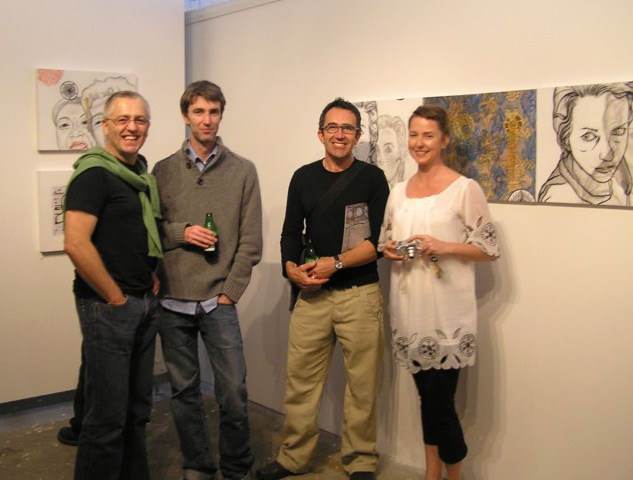
The audience at the Trocadero.
Gabrielle Bates and Angela Hijjas at the opening of ‘Mouth of Flowers’ at Trocadero.
A reunion of participants from the residency at Rimbun Dahan. L-R: Tim Craker, David Jolly, Martin Paten (all 2006) and Gabrielle Bates.
Pattern making had already become an important element of her work, and she began to investigate Malaysia’s symbolism, its fabrics, wood carvings and plants. These cultural symbols, woven into patterns that embellish her figures, emphasise how a particular culture can consume us and be a sole reflection of who we are if we allow that to happen, rather than enabling us to express ourselves individually.
As well, Gabrielle used new materials in her Malaysian work: Chinese ink, water colour, even pond water, and finally piercing her works with needle and thread, superimposing yet another layer of meaning onto her subjects. She attached bells to some of these embellishments, influenced I think by a more Malaysian aesthetic, and symbolically enlivening the work and calling the figures back to life and action.
Gabrielle’s subjects were people she met over her year in Malaysia, many of them other resident artists or performers who stayed at Rimbun Dahan. Donna Miranda is a choreographer with whom she had a close daily relationship, and Donna appears in many of these works, with the slackness and tension of her dancer’s body patterned, echoed and stitched, to bring out the dynamic and multi-faceted nature of her life, distorting the familiar and transforming it to the curious.
In addition to the works here today, there were several more of Gabrielle’s works that I’m pleased have stayed in Malaysia. We have kept two of her pieces, one of my daughter Bilqis, who co-ordinates the choreography residency that we host, and another of Donna Miranda. Amongst others, the piece that is featured on the cover of her catalogue was acquired for an important Malaysian collection. And there is yet another work that she has made for the next Art for Nature exhibition that came out of her year with us at Rimbun Dahan. It is an extension of her embroidery that evolved into a community project, in which she recruited all her Malaysian friends to work on a grid she devised… this work will be assembled for our next exhibition in May, and I’m sure this time that it won’t be pulled from the show!
We have been running our programme since ’94, and have hosted about 60 artists, sculptors, writers, dancers, choreographers and performance artists, some of whom are here this afternoon, and I must express my appreciation to Gabrielle and all the others, who have enlivened our programme with their energy and imagination, as they have developed their practices. It is never an easy option, being an artist, and I hope that our small effort helps to encourage greater creativity and awareness of each other in our respective communities in Australia and Malaysia.
As I see it, Gabrielle has coped with the initial strangeness of it all, adapted to it, and taken elements of her Malaysian experience and utilized them for her own expression. She has given us all we could wish for in her year at Rimbun Dahan, and I know she will most likely be developing these ideas in her next residency, in Penang at Malihom later this year, so I look forward to welcoming her back to Malaysia, and congratulate her on combining her Australian and Malaysian experiences in such a significant manner.
I would also like to thank the organizers here at Trocadero, for giving her the opportunity to show this body of Malaysian works, and hope that you will all enjoy the exhibition as much as I have enjoyed seeing these works evolve over the past year. Thank you.
Over the last few weeks, four new bird species have been spotted in the garden at Rimbun Dahan.
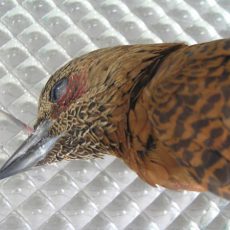
The first, and the one with the closest encounter, is the Rufous Woodpecker (Celeus brachyurus), pictured below. This specimen was found dead on the driveway and covered with ants — an appropriate end for a bird that apparently excavates its nest cavities in the nests of tree ants, according to Jeyarajasingham and Pearson’s field guide to Malaysian birds. It is surprisingly difficult to correctly identify a dead bird. Although its plumage can be examined in detail, it lacks the posture, behaviour, and context so vital for identifying a bird in the wild. This particular species also has a very weak bill for a woodpecker, but its identity was at last given away by its zygodactylous feet (two toes to the front and two to the back, to allow it to grip vertically on tree bark) and its stiff stubby tail which it uses as a prop.
The Rufous Woodpecker in death. Note stiff stubby tail.
Detail of the Rufous Woodpecker’s feet, showing zygodactylous nature.
Rufous Woodpecker head, showing diagnostic red patch under the eye.
The Rufous Woodpecker is a resident at low elevations in the Indian subcontinent and southern China through South-East Asia to the Greater Sundas. It frequents forests, the forest edge, scrub, plantations and gardens, and is reportedly generally unobtrustive but very vocal.
The second new bird is Hodgson’s Hawk-Cuckoo (Cuculus fugax fugax). A single individual flew past my mother’s balcony and roosted quietly in the Congea creeper by the reflective pond. It was identified by the vertical stripes on its breast and the pale patch at the back of its head. According to J & P, this species is a resident from low elevations up to 300m, and may well be a winter migrant to the area.
The third new bird on our list is the Stripe-throated Bulbul (Pycnonotus finlaysoni), a pair of which was seen sitting in a kenanga tree on 3 Dec. It is a common resident, inhabiting principally hilly country, moving around in small parties.
The last new bird, and the most impressive, is the Purple Heron (Ardea purpurea), almost a meter tall. On walks in the garden accompanied by the dogs, my mother flushed this bird twice from the thick vegetation surrounding the upper pond, from which it went to roost in a nearby tree, extending and retracting its long neck. According to J & P, this is the only large heron occurring inland, and at low elevations it may be a resident or winter visitor. It is usually solitary, stalking its prey in shallow water.
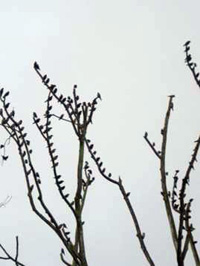
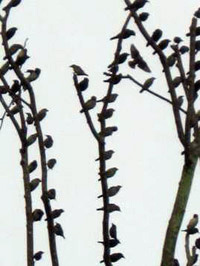
The flush of new bird sightings at Rimbun Dahan may be caused by the seasonal arrival of winter migrants as well as several trees on site which have been fruiting vigorously. Last week the salang trees by the back driveway (Syzygium sp.) were producing copious amounts of small red fruit, snapped up by a large flock of presumably Philippine Glossy Starlings — see images below, (no larger image available). As the garden matures and more plant species are introduced, it also provides more cover and habitat for shyer species.
We are working on a list of resident and visiting birds at Rimbun Dahan to post on our website, so keep watch!
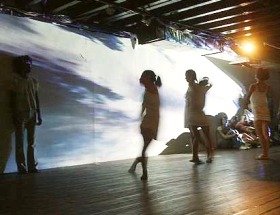
Artist-in-residence at Rimbun Dahan from March to June 2007, Donna created new performance piece bringing together local Malaysian dancers, video and sound artists to explore the idea of waiting, passing time, momentum and interruption in Extended Periods of Waiting, which was performed on June 8 2007 at The Annexe Central Market. The work featured live sound by SiCKL, video projection by Saiful Razman and Au Sow Yee, lighting by Roman Cruz and performance by Donna Miranda, Bilqis Hijjas, Yuka Tanaka, Louise Yow Sing-Hwa, Low Shee Hoe, Shaifuddin Mamat and Chan Seau Huvi.
The trio section from Extended Periods of Waiting was performed again as part of the Tari! 07 festival at ASWARA in July 2007.
During her stay, Donna also created I Will Think About It, a contribution to the 2007 Art for Nature exhibition in collaboration with visual artist Saiful Razman, and featuring Poodien. She also conducted a workshop in contemporary dance, creative process and free movement improvisation at the Annexe Central Market in June 2007.
Donna and Poodien creating I Will Think About It.
Donna received dance training as national government scholar of the Philippine High School for the Arts, pursuing professional practice and further training with Ballet Philippines, Philippine Ballet Theater, Myra Beltran’s Dance Forum and specialized training in contemporary dance at the 2005 DanceWEB Europe Scholarship Programme, in Vienna, Austria. She has since been actively involved in multimedia projects that explore new possibilities through works that combine contemporary dance, new media, fashion, physical theater, spoken word and sound. In 2000, she co-founded Green Papaya Art Projects, building a research platform for contemporary dance in Manila through its Anatomy Projects (AP+). Her solo ‘Beneath Polka-dotted Skies’ recently received 2007 Jury Prize Award in the Yokohama Solo X Duo Competition in Japan.
I Will Think About It, choreographed by Donna Miranda.
Low Shee Hoe and Donna Miranda in a duet from Extended Periods of Waiting.
A scene from Extended Periods of Waiting at the Annexe Central Market.