Dance Day 2007

Dance Day 2007

DanceDay2On the 2 May holiday, dancers braved the heat to enjoy a day of dance workshops at the studio at Rimbun Dahan.

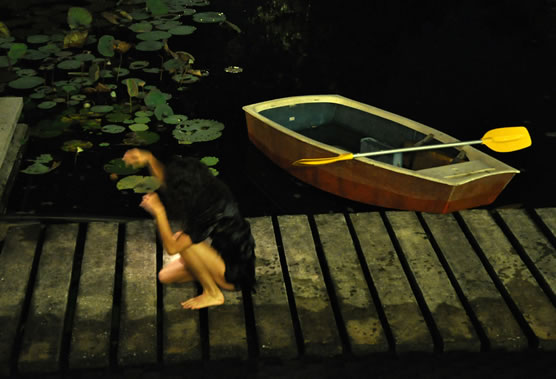
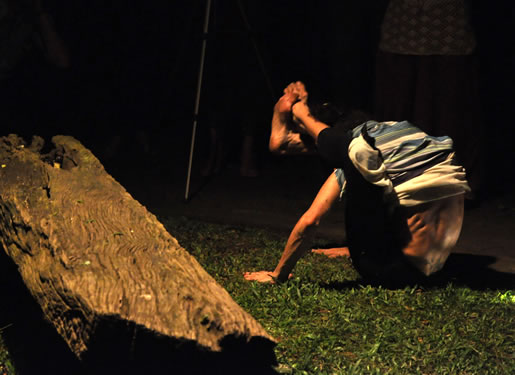
The day started with a release technique class by Rimbun Dahan resident choreographer Donna Miranda. Balletbase dancer Yuka Tanaka, who has recently graduated from the Trinity Laban in London, followed up with a Martha Graham technique class. During lunch, Donna Miranda presented videos of her recent works and plans for upcoming work. Shaking off any afternoon lethargy, the Balletbase dancers sweated under Misato’s hip hop class. The final workshop was contact improvisation, presented by KL choreographer and dancer Low Shee Hoe, who was also the lighting designer of the last Balletbase show,Take Flight!.

Balletbase Dance Days are intended to introduce Balletbase dancers to different forms of dance and dance training, to broaden their experience and understanding of dance. The first Dance Day, with classes in yoga, release technique, performance skills and Isadora Duncan technique, took place in 2006. Dance Days are free for Balletbase dancers.

April 2007 — Arrival of Rare Water Plant

April 2007 — Arrival of Rare Water Plant

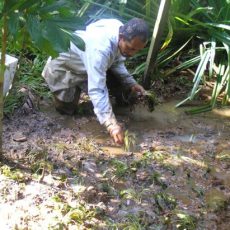
Cryptocoryne minima, an exceptionally rare water plant, was recently found in the Sungai Buloh Forest Reserve, and some of it has been moved to the water garden at Rimbun Dahan. The Curator of the Fresh Water Plant Collection at Zoo Negara, Mr Herman Bernard, retrieved the plant with volunteers from the Malaysian Nature Society, when it was announced by the press that the Selangor State Government is planning to spend up to RM 100 million on ‘development’ in the park. MNS has been trying to have the reserve protected as a Community Forest Park. Currently the area has no clear planning status, and despite the protests of the Kota Damansara community, the State seems intent on going ahead with its ‘development’ plans.

The most upsetting part of the State’s campaign must be the fact that they are playing the religious card, allocating a huge proportion of the rocky reserve for a Muslim graveyard. Has the Muslim community been consulted on this? The State says yes, but advocates for the park say they are yet to find anyone who knows about this.

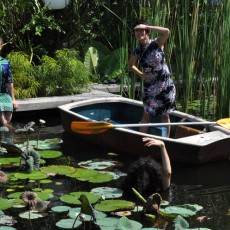
In the meantime, Cryptocoryne minima has been moved to several alternative locations such as Rimba Ilmu at Universiti Malaya, and Rimbun Dahan. It likes a shady location, but can also thrive in full sun. At Rimbun Dahan it has been planted under the shade of a large Pandanus where a stream comes into a pond, above the open water where it could be damaged by Tilapia. The photographs show Raslan Hamzah planting ‘sama padi’, as he put it, in knee deep mud.

Gabrielle Bates

Gabrielle Bates

Malaysia-Australia Visual Artist Residency 2007

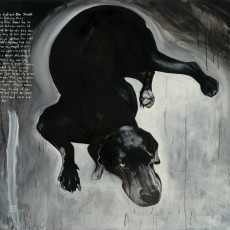
BatesG1The 2007 Australian artist in residence at Rimbun Dahan is Gabrielle Bates (6. 1967). An honors graduate from the University of Sydney, New South Wales, she has exhibited professionally since 1993 and is the recipient of a number of awards, grants and residency placements. Gabrielle’s works have been acquired for corporate, institutional and private collections in Australia, UK, USA and Malaysia.

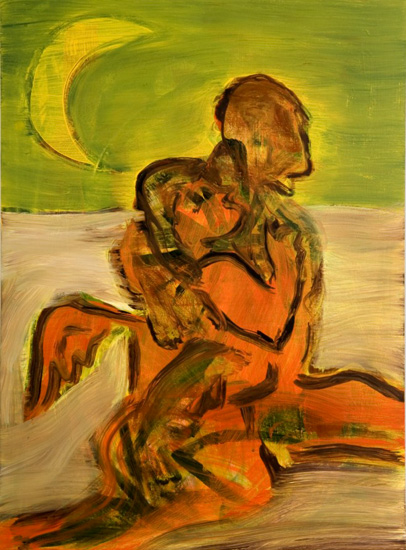
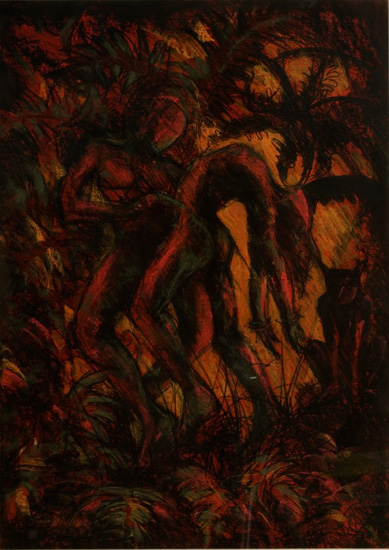
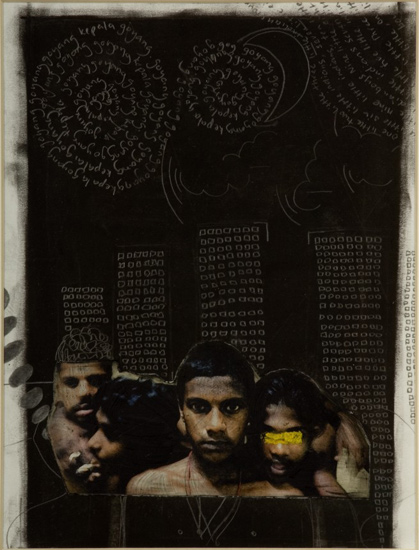
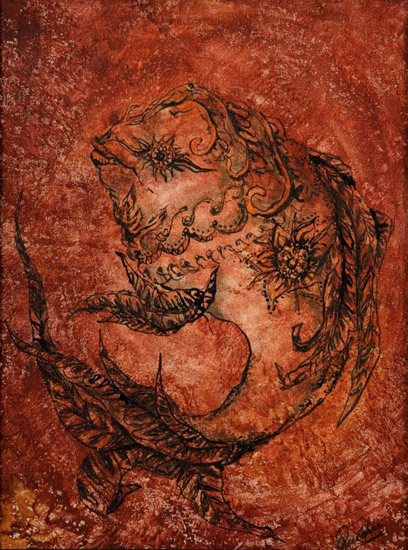
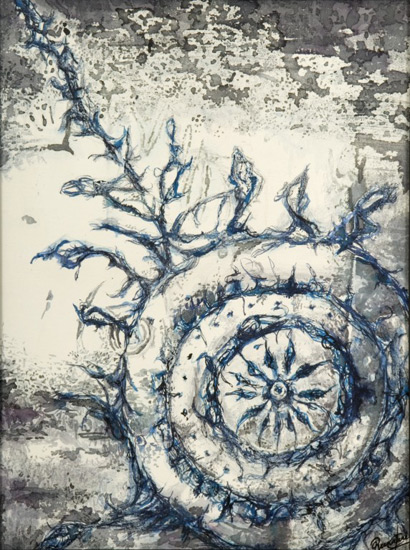
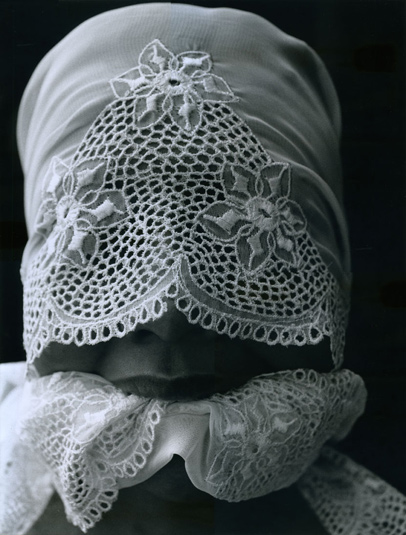
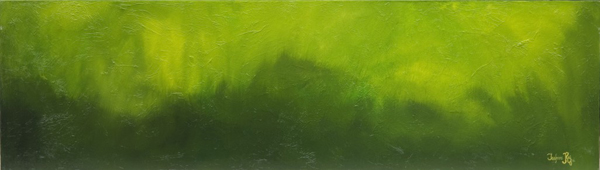
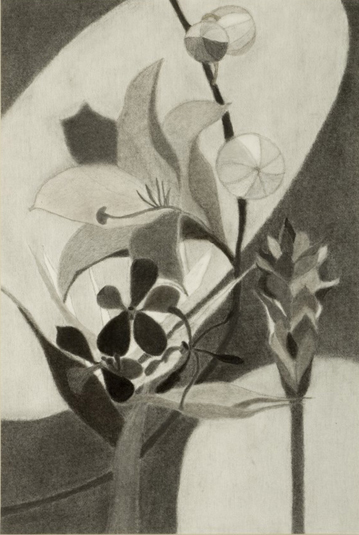
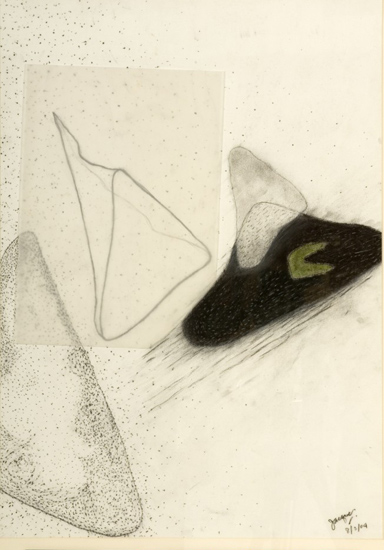
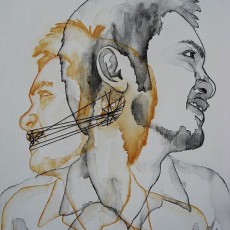
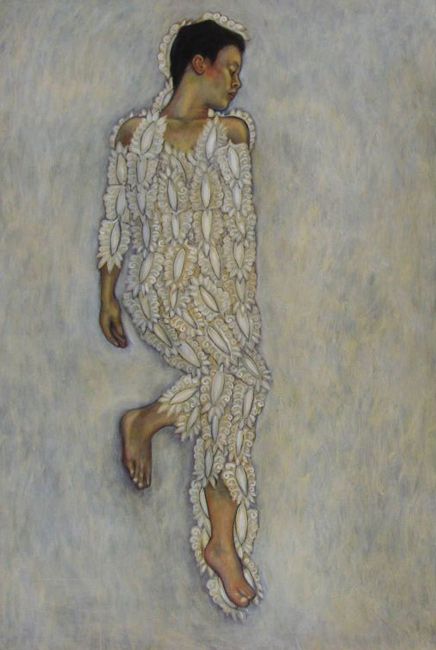
‘Mouth of flowers’ is Gabrielle’s new body of experimental paintings, objects and video work produced this year while in residence at Rimbun Dahan, Kuala Lumpur. Gabrielle’s exploration of patterns and figuration has produced a series of canvas-based works that combine water colour, Rimbun Dahan pond water, hand-embroidered nylon thread, Chinese ink and synthetic polymer paint. The works combine Southeast Asian motifs, signage and local media with figuration to explore the political and poetic subtleties of life for artists in Malaysia and southeast Asia.

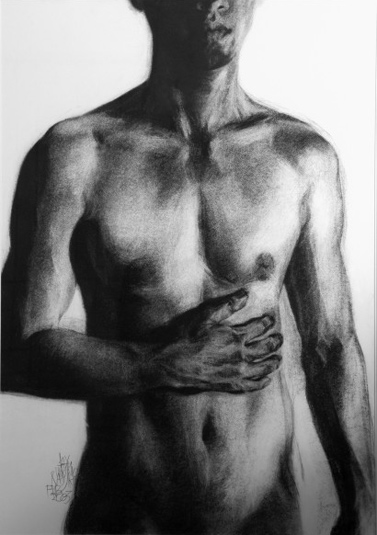
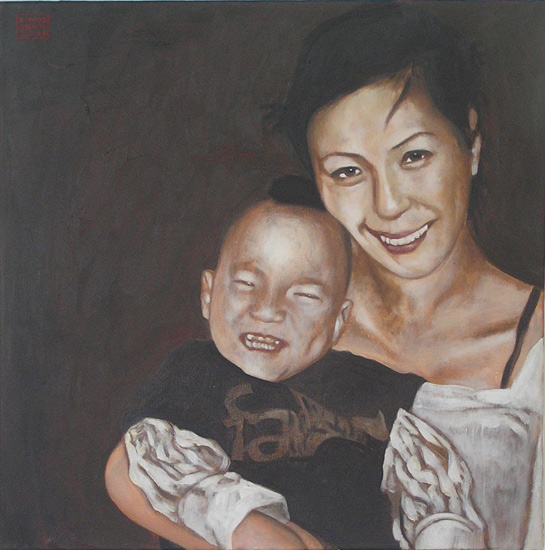
Artists such as Saiful Razman, Noor Mahnun Mohamed, Husin Hourmain, Donna Miranda, Ahmad Fuad Osman, Shaffudin Mamat, Low Shee Hoe, Lau Mun Leng and Bilqis Hijjas have all posed for Bates during her residency. In turn, she has transformed them into players within a fictional narrative that circles the conflicts, anxieties, insights and advantages of (self) censorship.

Her objects, collected from the ordinary Kelompang jari (Sterculia foetida) pods, have been reconfigured with nylon thread and decorative elements such as sequins and velvet appliqué, morphing the pods into a collection of anthropomorphous objects.

Gabrielle presented ‘Mouth of flowers’ at the 13th Rimbun Dahan Residency Exhibition, alongside the work of Malaysian resident artist Ahmad Fuad Osman, 13 to 27 January 2008, at the Rimbun Dahan gallery.

The elasticity of a golden thread

by Gina Fairley

Our lives are filled with pattern: The patterned regimentation of our actions; our personal ‘style’; the family that frames us; our cultural fabric; conservatisms and beliefs. We wear an invisible code that defines who we are, our DNA. Collectively, this is ourpattern.

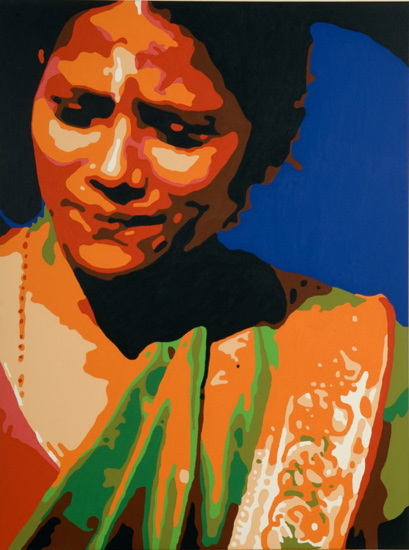
Gabrielle Bates has long used quasi-ethnographic motifs as a device to transfer information about the people she paints. In her earlier portraits the sitter reverberated across the canvas, floating on a flat colour field. Like a print slightly out of register, their ghost-like repetition, or flaw, reaffirmed their humanity. Bold black outlines held their pattern allowing us to decode who they might be.

While these early portraits offer a clear trajectory to these new works, the “Mouth of Flowers” series comes from a very different position: psychologically, emotionally and culturally. Their patterning goes beyond a descriptor to physically consume the form. The body and pattern have fused as one.

Malaysia’s hybridity makes an indelible impression on every artist visiting Rimbun Dahan. For Bates that engagement was filled with multiplicity: it offered an organic tangibility to the work spawned from its bounty of pods, natural patterns and pond water; it provided the solitude to rediscover embroidery, sewing a personal and emotional narrative; and it offered the gift of insight, journeying beyond perceptions.

Finding Malaysia’s pattern is complex. At an elementary level it lies in its graphic traditions of batik, henna decoration and Islamic geometry. At a cerebral level it is the patterning of socio-political / religious striations of a nation at a time when it is asking ‘what is its contemporary identity?’ Bates’ work traces a thread across these ideas, oscillating between reverie and bounce. Remove the exotic ‘pattern’ and it is a narrative caught in a web of time, territory and transition.

Bates found this narrative in a coterie of artists, dancers and musicians who explore the peripheral through their creativity. The narratives are dense but less self-effacing; the ‘outlines’ have become diffused. She replaces ethnographic patterning with a floral fragility, caught between romantic apparition and an earthy reality. Often clothed in little more than an organic epidermis, her players are exposed. But these characters are not vulnerable. If we look at the painting “Armour”, banana flowers (bunga pisang) rise up like a noxious weed, beautiful but threatening, clutching at a woman’s neck rendering her speechless. But she does not turn away; her gaze does not flare in distress – it is a knowing censure.

In “Stir” she sleeps enveloped by the same flowers. Is it the peace of submission, death or sleep? Is she weightless or weighted by her floral shroud? Paired with a mirror-image caught between cartoon and apparition, it sits against a brave white ground acting as a stark alter-ego to the velvety, painterly background of the sleeping figure. It is a kind of intermezzo between figuration and the ephemeral.

“KL-ing me softly” is equally charged from the outset, challenging protocols and permissions. But there is an inherent softness that sits counter to any overt act or statement. It mixes memory and ambivalence with a restless exoticism. These works are about a visual psychology. Just as a Rorschach drawing triggers association but has no one reading, Bates has moved beyond the clarity of descriptors to an elasticity of meaning. She pushes us beyond the desire to translate and give over to poetic nuance.

The materials of these new works take on a symbolism we have not seen before. Her stitched portraits have a latent violence or emotional trigger. The act of piercing the surface of a painting has that same duality as a tattoo; it is branding and an aesthetic expression. “First cut” captures this tension, the thread’s assertive lines slashing the canvas. The figure turns from himself but is denied a freedom, anchored by his own voice. Rendered speechless, we ask who has the power of censure over this voice? Caught in the strain between a sewn and brushed mark, it is a courageous embrace of new materials.

Bates similarly plays off the organic purity of seed pods against lurid plastic flowers and synthetic thread. The pods disgorge their floral centres, over-ripe with fleshy fertility. These are incredibly sensual objects that Bates lashes into control. The synthetic materiality of the flowers beg the question, are we fooled by beauty? It is another veil seemingly ‘natural’ yet contrived, controlled and plastic?

Many of these works teeter on the edge where things are raw and flirt with the unknown. To quote writer John Barrett-Lennard, “Accent can be thought of as a kind of excess, a disturbance in the smoothness of sound and communication.” (1.) An accent, like a pattern, has a personal intonation. It is about reading between the lines; it is the place of hyphens. Sometimes it is barely audible; sometimes it has the gentleness of a lover and at others the affirmation of belief. “Mouth of Flowers” is a place to hear things.
Gina Fairley

1. John Barrett-Lennard “Here and Now” catalogue essay for Simryn Gill, PICA exhibition, Perth 2001.


Open Studios for Tim Craker, Patricia Sykes, Chang Yoong Chia and Helen Bodycomb

Open Studios for Tim Craker, Patricia Sykes, Chang Yoong Chia and Helen Bodycomb

As another cycle of visiting artists’ comes to a close, all the current residents of Rimbun Dahan had an open studio day in early November to share with each other, as well as Angela and guests at Rimbun Dahan, how they have been developing their art practices while at Rimbun Dahan.

Visits to the studios of Tim Craker ( a Melbourne painter turned sculptor on a 3-month self-funded residency), Patricia Sykes ( the Asialink writer for 2006), Chang Yoong Chia (the Rimbun Dahan year-long Malaysian resident), David Jolly (the Rimbun Dahan year-long Australian resident), and Helen Bodycomb (a Melbourne mosaicist on a 3-month self-funded residency) gave all an opportunity to share insights into their practices and to the experience of being at Rimbun Dahan.

Chang Yoong Chia and David Jolly will be showing their work in the Underground Gallery at Rimbun Dahan from 28 January 2007. The Gallery will be open to the public for two weeks from that date.

Above: Helen Bodycomb discussing her work in Rumah Uda Manap.
Helen’s mosaics in progress.
Above: Author Patricia Sykes discussing the ideas inspiring her work.
Above: Martin Paten and Tim Craker in Tim’s studio.

Patricia Sykes

Patricia Sykes

Australian poet and librettist Patricia Sykes spent her 2006 residency at Rimbun Dahan working on the libretto for a full-length opera, The Navigator, a collaborative work with composer Liza Lim. Sykes travelled through Malaysia and to Cambodia’s Angkor Wat researching culture and society in order to enrich her libretto and develop the theatrical aspects of the opera. Sykes is the author of two poetry collections and has edited four books of poetry.  Her work focuses strongly on the interactions between people and their contexts and her residency helped explore how a host culture nurtures itself, its people and the environment.

Supported by the Australia Council.

August 2006

August 2006

BY ANGELA HIJJAS

I spent last weekend at the trustees’ retreat for WWF Malaysia in the rainforest of Belum. Despite many hours spent in meetings, we managed some brief expeditions into the jungle. The Lantern Bug, pictured right, was spotted during one such walk.

Lantern bug seen during a walk in Belum rainforest.

The elaborately patterned Lantern Bug (Fulgora spinolae) uses its strange elongated forehead as a sense organ and for balance. It is one of a small group of brightly coloured insects, the lantern bugs, that are particularly diverse in the Belum-Temengor rainforest.

A few days after my return from Belum, on the morning of 17 August, a large python was found stuck in the well at Rimbun Dahan. On placing an escape route of a wooden stake in the well, the snake had escaped by the afternoon. Just goes to show that to see some large wildlife, you don’t have to be in the jungle!

“Reticulated python, Python reticulatus, the longest of all snakes, attains a maximum length of between 10 and 15 m. Its normal prey consists of warm blooded animals from chickens, pigs, goats and monkeys to small deer which it can subdue. The prey is swallowed whole; the snakes’ jaws are not rigidly joined and thus can be stretched wide to accommodate bulky food items. Normally found in the jungle, especially close to water, also in rural and urban settlements. Small pythons can easily be captured and tamed, but adults are dangerous as they can deliver vicious bites, and their powerful coils may be too much for a man to handle. The female python lays from 20 to 50 eggs, rarely up to 100. The eggs adhere together in a mass, which the female coils around and incubates for a period of between 75 and 90 days. Baby pythons look similar to adults and measure about 60 cm in length.”

Fascinating Snakes of Southeast Asia – An Introduction, by Francis Lim Leong Keng and Monty Lee Tat-Mong.

Unsustainable logging of Temengor lags behind international precedent

Unsustainable logging of Temengor lags behind international precedent
Published 15 August 2006
Above: A view of the Temengor rainforest, courtesy of KH Khoo and the Malaysian Nature Society.

Recently there was news that the Gola rainforest, an important biodiversity site in Sierra Leone, in Africa, was to be set aside for conservation, and logging was to stop. His Excellency Alhaji Dr Ahmad Tejan Kabbah, President of Sierra Leone, commented: “This is a new approach in forest protection that will address not only the protection of the forest and its biodiversity, but will also provide sustainable benefit to the local community in perpetuity.”

And why would this be of interest to Malaysian readers?

Sierra Leone is ranked 170 in the World Bank’s list of 179 nations, with a GDP of just $903 per capita. Malaysia is ranked 61, with a GDP per person of $11,201. There is obviously a huge difference between the two, and yet a nation as poor and troubled as Sierra Leone is can still see the importance of protecting its forests.
Malaysia, despite its development, is still logging critically important biodiversity hotspots, in particular the Temengor Forest Reserve just south of the East West Highway. This is one of the last bastions of virgin forest, home to tigers, elephants, gaur, seladang, leopards and our almost extinct Sumatran rhinoceros, that is large enough to provide sufficient space for these animals when combined with Belum to the north and the Hala Bala sanctuary across the border in Thailand.

Temengor presents our last chance to protect a sufficiently large swath of landscape scale forest that is 130 million years old, older than the Congo and older than the Amazon, and therefore much more complex in its biodiversity. We cannot pin all our hopes on Taman Negara as the only reserve for our biodiversity, especially as the forests of the north harbour different species, particularly in the plant kingdom. The Federal Government’s National Physical Plan recognizes the importance of Temengor as a protector of soils, water, biodiversity and our landscape, but state politicians hold the key to the future of our forests, not the federal government.

The Perak Integrated Timber Complex (PITC), the only timber company in peninsula Malaysia to have been certified by the Forest Stewardship Council (FSC) recently had its certification suspended, meaning that it no longer meets international standards for sustainable logging. PITC operates, along with other concession holders, in the Temengor Forest Reserve, extracting the big trees that anchor the structure of the forest.

The state government of Perak says that the logging must go ahead to support the state’s timber industry that employs 9,000 people; but there are also approximately 10,000 Orang Asli living in the area who depend on the same forest reserve for their livelihood.

The forest is worth far more as an intact organism, than if it is turned into tables and doors. Malaysia has developed at a massive rate in recent years, and now it is time to consider our priorities, and protect what we have left rather than see it damaged, perhaps irreparably, for the sake of keeping the timber industry in business. They should, in an ideal world, be employed instead in restoring the landscapes that they have worked over, so that our already logged forest reserves can be harvested profitably in the future.

If we don’t protect our irreplaceable natural assets we may face the ironic situation in which Sierra Leone’s drive for sustainable development may be more successful than ours.

Angela Hijjas
Chairman, Steering Committee,
Malaysian Nature Society Temengor Campaign 2006

June 2006 — Dusky Leaf Monkey

June 2006 — Dusky Leaf Monkey

A new camera with a zoom lens brings us Rimbun Dahan’s very own peanut gallery – a selection of intimate portraits of the local troupe of leaf monkeys.

Dusky or Spectacled Leaf Monkey
Cengkong, lotong bercelak
Trachypithecus obscurus or Presbytis obscura.

Burma and Thailand to Malaya, widespread in forest at all elevations. Coloration is rather variable, most individuals have back and shoulders grey or dark grey, legs and the crest of longhairs on top of the head paler grey, the breast and belly usually appear pale grey or whitish, with a sharp line of demarcation between this shade and the darker back. Distinguishing feature on adults is the bold white interrupted rings around the eyes and a white patch over the mouth, including both lips. In new-born young the fur is pale orange or reddish buff, and the skin of the face entirely pink.

Arboreal in groups of 5 to 20 (the group at Rimbun Dahan is estimated at about 12 adults). Home range of a group is 5 to 17 hectares. When traveling troops usually move in extended line, each monkey following the same general route through the treetops running quadripedally along branches, climbing creepers, or leaping from one tree across to the canopy of the next.

At rest, the long tail hangs straight down and is often conspicuous when the monkeys’s body is hidden. In motion the tail although not prehensile is important in maintaining balance. Natural diet consists of young leaves and shoots; these may be plucked by hand (see image of mother with clasped fist holding leaf), but more often the monkey pulls down leafy branches and browses directly on the terminal shoots (hence the defoliation of the assam gelugor trees at Rimbun Dahan). Oestrus every three weeks, gestation 20 weeks.

The Wild Mammals of Malaya and Singapore,
by Lord Medway, Oxford University Press, 1969.

Tim Craker

Tim Craker

pail_studio
Tim Craker in his studio room at Hotel Penaga, Penang, with ‘Beyond the Pail’.

Australian artist Tim Craker undertook a 3-month residency at Rimbun Dahan in 2006. In July 2011, he returned to Malaysia to take up the first artist’s residency at Hotel Penaga in George Town, Penang. During the residency he created the installation sculpture Beyond the Pail, now on display in front of the main hotel entrance.

Beyond the Pail, plastic buckets & cable ties, ca. 160cm diameter, 2011.
Artist’s statement:

Beyond the Pail is an assemblage of twelve ten-gallon yellow translucent plastic buckets, suspended in space and able to rotate about its vertical axis. The works’s construction is based on the dodecahedron, one of the five Platonic solids, each side of which is a pentagon.
The work stems from a fascination with both the everyday object, released from its usual purpose, and the possibilities of combination that it may offer. The bucket, in this case, is no longer a functional object, but becomes an element of a larger construction that refers to the basic geometry of the natural world – the underlying patterns that are both decorative and seminal – the perfection of which is alleviated by the random positioning of the buckets’ handles.

Suspended and rotating gently in passing breezes, Beyond the Pail provides gentle subversion of quotidian functionality, while making visual reference to – amongst other things – viral particles, Buckminster-Fuller’s geodesic domes (a local example of which is situated adjacent to the Komtar tower here in Georgetown), pollen grains and spaceships.

Beyond the pail, certainly! Beyond the pale, I hope not.

Tim Craker
July 2011

In 2008, Tim’s joint exhibition dot-net-dot-au (with Louise Saxton) toured to Malaysia and Singapore, including works he had conceived at Rimbun Dahan.

Artists’ Statement from the Travelling Exhibition dot-net-dot-au, 2008

In 2006 I was very fortunate to spend three months in Malaysia as a full-time artist. The residency – at Rimbun Dahan, a private estate on the outskirts of Kuala Lumpur – was a fantastic and intense period of sensory stimulation, reflection, artistic exploration and creative production, in a luxurious and supportive environment. This series of work stems from that time.

My overwhelming impression of Malaysia – gathered from many previous visits, as well as my residency – was primarily pattern, both natural and man-made. From the tiling of Kuala Lumpur pavements to the lattice of tropical vegetation against the sky, my eye was taken by the prevalence and variety of pattern – botanical, Islamic and industrial.

Pattern is by definition repeated units, and a pattern is discerned through identification of these units, their repetition and interrelationship. Patterns can be merely decorative – children make patterns with seashells at the beach, for example – but we also talk of seeing a pattern, when we discern a connection between disparate objects or events, which hints at a meaning behind them.

One stimulus for the work is a fascination with pattern and how it “works”; another is the excitement of generating substantial pieces from myriad small, unregarded and everyday objects and things.

Several months ago I read in one of the weekend newspaper magazines a regular article about someone’s “favourite things”. This particular week one of the objects was a small length of an enormously long daisy chain, made as an entry in a sculpture competition by the person’s nine-year-old daughter, Lola. Part of Lola’s artist’s statement was: “I like daisy chains because you start with something little and end with something big.” I tore the page out, took it to my studio and stuck Lola’s quotation in my journal.

The materials themselves – objects by which we are surrounded but of which we rarely take notice – are also a stimulus, coupled with a desire to transform or release them from their expected role.
What if a plastic spoon is released from mere function and becomes part of a huge cargo net, screen or trap, for example? A single disposable plastic cup is just a plastic cup; hundreds of cups tied together become something else altogether, and many things at the same time. Dull practicality cedes to other ways of using objects, subverting or ignoring their actual purpose – less serious, unpredictable, more interesting….

though_pattern

Above: detail of ‘Thought Pattern’, plastic chinese soup spoons, nylon thread. 250 x 400cm. 2007

Plastic disposable materials have been chosen not only for their “transformative potential”, but because they are cheap (nine hundred plastic cups are still affordable, for example!), readily available, light, durable and easily worked. Safety fencing is also a cheap and abundant material – what excitement to buy fifty metres of it! The materials one uses carry a whole set of meanings, though, which are part – even if on a subconscious level – of why they are chosen and the meanings the work may suggest.

In Malaysia during my 2006 residency, I was invited to be part of an exhibition entitled “Feed Me!”. The curatorial theme was an exploration of food and its cultural and social significance. I thought of the role that a common interest in food – recipes, ritual, preparation, eating – has played (and continues to play) in the successful meeting of my family with my Malaysian partner and his family. I considered, on a broader scale, the importance of food – in all its various manifestations – in intercultural relations. Food is sustenance, embodies tradition, and demonstrates familial love and care. It also epitomises cultural difference – while offering the means of transcending it…

Food utensils have been objects and subjects I have often returned to – I realise, in retrospect – in my work. Aside from the tactile attractions of the immediately-recognisable and particular shapes, maybe what I return to is the symbolic representation of order, of ritual, of “civilised” ingestion, of the set table, of sitting down to dinner and conversations over a meal – and what that might stand against.

The materials are plastic and non-degradable – symptomatic of a throw-away society. They have little aesthetic value – their design criteria value low cost first, then functionality. They are disposable and “single-use”, yet fill kitchen cupboards, builders’ skips and landfill everywhere. They are the products of a petrochemical industry itself responsible for vast environmental damage – in accessing raw materials, in the by- products of manufacture and in the consumption of the end-product hydrocarbon fuels.

In a gentle subversion of the dictates of hyper-consumerism, the worthless, “unfriendly” and disposable is assembled in these works on a monumental scale, and invested with new aesthetic worth: the mundane is transformed, the banal subverted. Myriad units are assembled together; grids are formed piece by piece according to certain rules; lattices of both two and three dimensions are captured or created. The construction process becomes meditative – repeated actions of drilling, placing, threading, knotting or trimming are performed, but create an unpredicted and organic result, a molecular array, a crystalline lattice. The grid is also approached from the opposite direction: units of a “found” plastic lattice are selectively deleted to reveal a leaf shape in outline, a botanical silhouette – the plastic scoop removes the fallen leaf from the swimming pool. The contrast between medium and message is between the un-aesthetic, unregarded industrial fencing, used for protection, exclusion and visibility, and the living natural biodegradable leaf, between one pattern and another, between design and evolution. Offcuts, like dead leaves, fall below the screens.

What information might a pattern contain, and how is it encoded?

Does the botanical information always lie within the plastic screen?

Is the screen something we see through, or something that prevents our access?

Patterns are perfect, geometric and regular. More fascinating, however, is the disruption of the pattern: the net sags, stretches and folds; segments of the pattern are excised; the repetition is imperfect; the regular structure is deformed. The perfect geometry of a spiderweb only becomes useful when a fly has infringed its meticulous structure. [Alan Fletcher, “The Art of Looking Sideways”, Phaidon Press 2001]. Pristine rigidity morphs into organic imperfection; patterns and their shadows superimpose in Moire interference: perfection is both an illusion and much less interesting than reality.

At what point does a disrupted pattern become mere chaos?

When do patterns within patterns become too complex to apprehend?

My work in dot-net-dot-au refers to – amongst other things – genetic codes and their transcription errors, to cellular arrays and honeycomb, to the computer-drawing of three-dimensional objects and surfaces, to molecular models. It subverts the original use for everyday objects and materials, and in a gentle way addresses issues of biodegradability and permanence, of the culture of the disposable, of our cultural culinary appetites and of the occident and the orient. The motivation for the work is intuitive rather than primarily conceptual. The works arise from a response to materials, and from a desire – shared with Lola – to make something big out of something little, something valuable out of something worthless, something you want to keep from something you throw away.

Tim Craker
April 2008

Photography for dot-net-dot-au, except profile image of Tim, by Andrew Wuttke & Gavin Hansford.

Above: Tim Craker’s open studio at Rimbun Dahan during his first residency in 2006.