Garden Colour

Garden Colour

by Angela Hijjas

From The Malaysian Naturalist, vol. 54 no. 2, 2000.

As I have often noted in this column, Malaysian species are not known for colour, unless you are fortunate enough to see the huge Rafflesia in full bloom on the forest floor, or Bauhinia kockiana (left) enveloping a tree canopy on the other side of a valley. Most are more discrete in their display and the naturalist gardener has to find satisfaction in other detail of form and habit.

However, in the attempt to convert as many as possible to the naturalist approach, it is worth noting that there are some remarkable coloured features that can be introduced to a garden that are also indigenous to the region.

Tall trees, like the perah, Elateriospermum tapos, have a wonderful red flush of new leaves that immediately identify it in the forest, as does the Pometia pinnata, or kasai, but few urban gardens have the space to plant such trees and to view this colour requires a separation of distance. Mertajam, Erioglossum rubiginosum, is a smaller tree that has ruby red berries that develop after the creamy pannicle of tiny blossoms. The leaf shafts of the so-called sealing wax palm, Cytostachus renda, create beautiful columns of scarlet and a strong vertical rhythm for a planting arrangement thus providing a double contrast.

A very successful and colourful climber is the Congea velutina (left), with its pink orchid-like sprays that provide a mass of colour which actually comes from the flower bract, as the flower itself is visually insignificant. Its scrambling habit requires something sturdy to climb on and should you be tempted to cut it back, it will not flower for another year until it has developed sufficient mass to cover a whole tree. I have sacrificed a Filicium decipiens to this creeper and fear that underneath, the poor tree has quietly died, discretely taking care of a non-indigenous whim planted in the early days! I have seen Congea flowering near a salt lick in the Ulu Muda forest reserve in Kedah, an experience I recall as I see the same plant in my garden. It makes an excellent cut flower, an added bonus when most tropical flowers rapidly wilt.

On a smaller scale, there seem to be many indigenous plants that provide purple to pink hues that can be combined to create a mixed planting to some effect. The smallest and easiest to grow must be the tiny ginger Kaempferia pulchra, which can be readily divided for a low ground cover and always has a fresh display of mauve flowers each morning. It does die back for a few months during the wet season, but it will come good again. This can be planted with the Persian shield, Strobilanthis dyeranus (pictured left, which I believe is indigenous to Burma), or combined with the silvery purple leaves of Hemigraphis alternata in dappled shade. A recent find is Pyllagathis rotundifolia, which I have seen growing by the waterfalls in Templer Park. The large round leaves are a feature in themselves, but there is a pretty cluster of tiny pink flowers that emerges at the centre. Cat’s whiskers, Orthosiphon stamineus, have a lilac form and it flowers well in fairly open positions. The common coconut orchid will grow in full sun and provides a constant supply of purple flowers if it is fed frequently with chicken dung, preferably composted so that it doesn’t smell.

The humble kantan, Etlingera elatior, makes a magnificent flower and splash of colour if left to open rather than cutting it for the laksa pot. There are many varieties ranging from the palest pink to scarlet and coral red. Other Zingibers, like the shell ginger, Alpinia latilabris, have short lived flowers but the orange fruit provides a more durable display.

Bananas come in a wide range of forms, many of which are very ornamental, pink, orange or purple, but not edible except by wildlife. The burgundy splattered leaves of Musa sumatrana provide an interesting foliage contrast. Musa bactris (below), a Sabahan, has a wonderful red flower whose ‘petals’ are edged in yellow, and another variety from Endau has white flowers and white fruits…. and there lies my problem, I get carried away with so many varieties and forget about colour, but white is a colour when you consider it against lush green foliage.

From the botanical point of view, the banana ‘flower’ that provides the coloured display, is once again the flower bract. As each one opens it first reveals the female or bisexual flowers that develop into the fruit. As more bracts fall away, rows of tiny male flowers are displayed well after the female flowers have developed into the fruit further back on the stem, so the plant cannot fertilize itself.

Other foliage contrast can be achieved using Pisonia alba, although I have had very mixed results planting this difficult species. It seems to like some protection and constant dampness. The yellow Pandanus also presents its share of problems but when established it provides a wonderful contrast, not just of colour but also of form.

Leafing through the tropical gardening books at the wonderful pictures of lush gardens and planting arrangements, obviously I am not alone in finding it difficult to get enough colour to contrast against the mass of tropical green. Visual interest for the photographer is provided by coloured walls, the sparkle of water, the incredible range of plant forms providing artistic compositions, the inclusion of interesting pots and fountains, paving stones and of course the ubiquitous bougainvillea or heliconias, those foreign devils that are so tempting with their colourful splash of the exotic.

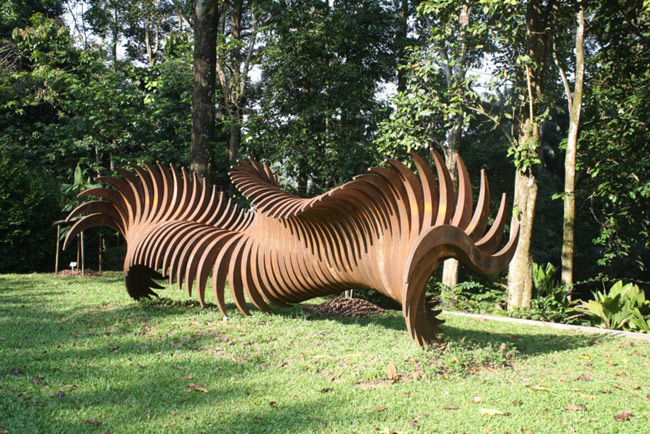
But if all else fails, a discrete piece of coloured sculpture may do the trick.

A Tropical Fragrant Garden

A Tropical Fragrant Garden

by Angela Hijjas

From The Malaysian Naturalist, vol. 54 no. 1, 2000.

Perfumed plants should be included in a naturalist’s indigenous garden to make up for the lack of colour in Malaysian species. Fragrance adds a delightfully unique character to a tropical garden, but the plant’s utilitarian ‘objective’ for creating perfume is to attract pollinating insects, justifying the complex chemical process.

Fragrance advertises free nectar, a cheap commodity for the plant to produce, being just sugar syrup, and it is enough to attract insects, bats or birds. Often the plant is choosy about the pollinator and will release perfume only at certain times of the day or night when the desired visitor is around.

Fragrant plants include climbers, shrubs, trees and palms. Many have white or cream flowers that suggests that they are pollinated at night, and for most fragrance does seem more pervasive then than in the full heat of the day.

Jasminum sambac, the popular jasmine (pictured above), ‘bunga melor’ or ‘melati’, was brought from India, and is a restrained creeper that likes full sun and support for climbing. A recent perfume success in my garden is the very robust vine Chonemorpha macrophylla (left), just two plants would be enough to take care of a tennis court fence, so it needs lots of space and a strong support to climb on. Another popular and fragrant climber that is not so invasive is the drunken sailor or Rangoon creeper, Quisqualis indica, whose drooping fragrant flowers are red in bud, appearing white when first opened, before aging to pink and crimson.

The ‘chempaka’ tree (Michelia champaka) has ivory flowers (the orange variety is not so fragrant) that offer another exotic scent. This tree could be planted as a roadside tree or in a smaller garden, being a slower grower. Not so for the huge Dryobalanops aromatica, or ‘pokok kapor’. I planted a row nine years ago along the front fence, they are now 40 feet high with trunks about 6 inches in diameter. Fortunately the tree retains its lower branches as it grows, thus providing a good screen as well as allowing leaves to be picked and crushed, releasing the camphor fragrance that has made the tree an object of desire since the Arabs traded for it in the sixth century.

Perhaps my favorite fragrant tree is the ‘tembusu’, Fagraea fragrans (above). It is a tall forest tree that provides not only fragrant flowers that attract insects but also a red fruit that feeds bats, birds and other mammals.

The ‘kenanga’, Canangium odoratum (pictured above), is not so handsome a tree. With its drooping branches and habit of constantly dropping leaves it looks a bit unkempt, but its fragrance is the epitome of the ‘exotic’ east. The flowers are greenish, but fully fragrant when more yellow, and although it is hard to reconcile the two perfumes, apparently ‘ylang ylang’, or ‘kenanga’ oil, is a principal ingredient of Chanel No. 5. There is a dwarf variety of the tree that is good for mixed hedging and in smaller gardens.

The most successful hedge plant for fragrance must be ‘kemuning’, Murraya paniculata, its only disadvantage being unpredictable flowering. Left alone it will form a small tree with branches arching out and up, but planted densely in a trench and then pruned to create a fence, it creates a beautiful dark wall of foliage that is periodically lit by panicles of star-like white flowers with the sweetest of perfumes.

Vallaris glabra, or ‘kesidang’ (left), is more ‘oriental’ in character, and perhaps a liking for it is acquired. Burkhill describes the smell as ‘mousy, but agreeable to the natives of the east who like it’! To me it has the perfume of cooked pandan, and certainly when in bloom (once again an inconspicuous panicle of small white flowers) visitors exclaim at the smell of pandan, planted just beneath as a perfume puzzle. An essential ingredient of the ‘bunga rampai’, the finely sliced pot-pourri of fragrant plants used for Malay weddings, ‘kesidang’ is now unfortunately replaced by cheap scent.

For a cut fragrant flower, nothing is quite as spectacular as the entire inflorescence of the common coconut, and it makes a beautiful sculpture laid on a table. This flower may well have been the original ‘bunga manggar’ (right), tied at the top of a bamboo pole and carried at the head of a bridal procession.

Herbs and spice plants also have strong concentrations of the essential oils that make perfume. Crushing leaves of cinnamon, cloves and nutmeg, or plucking the many varieties of basil whose perfumes range from lemon to aniseed, tearing citronella and lemon grass, turmeric and ‘kesum’, all make for a heady experience. After inhaling several it becomes increasingly difficult to identify anything, but having such plants adds as much to your life as to your garden. With plants like these, one should never need aroma therapy!

Gardens and perfume are about reinforcing a sense of place. A Balinese statue garlanded in jasmine recalls our common Hindu traditions and the many fragrant and useful plants that have been brought to Malaysia by migrants from all over Asia.

Common fragrant trees, such as frangipanni or Plumeria, are only rarely planted in Malay gardens because of their association with burial grounds, where they readily strike in exposed and open positions. This Mexican tree, brought by the Spanish, has been known in South East Asia since the seventeenth century when it was noted by the botanist Rumpf. Even I have accorded a place to this tree in my ‘indigenous’ garden, as its flowers dropped on the footpaths of PJ formed one of my early impressions of Malaysia when I barely knew one plant from another.

Certainly perfume can provide an intriguing trail through the plant kingdom, and a developed nose can analyze the characteristics of smell for yet another key to identifying plants that may otherwise be difficult to place. Specific species in the family of Zingiberaceae, the gingers that occur throughout the Malaysian forests, are particularly difficult to identify because they only occasionally flower, but the essential fragrant oils may provide a clue for taxonomic identification.

For anyone interested in fragrant plants, an indispensable reference is the Dictionary of Economic Products of the Malay Peninsula by Burkhill, who was Director of Gardens in the Straits Settlements between 1912 and 1925. With 2,400 pages its coverage is encyclopaedic, and includes information on perfume extraction. Priced at only $150 for both volumes it is matchless value. A limited number are available at the Malaysian Nature Society bookshop.

Noor Mahnun Mohamed

Noor Mahnun Mohamed

Noor Mahnun Mohamed (Anum) was the Malaysian artist of the year-long Malaysia-Australia Visual Arts Residency in 2000. The works from her exhibition were presented in the Underground Gallery at Rimbun Dahan from 16 February to 14 March 2001.

Anum was also the Visual Arts Residency Manager at Rimbun Dahan for several years, and curated the annual fundraising Art for Nature exhibition.

Conversation with the artist

Laura Fan talks to Noor Mahnum Mohamed about the body of work produced during her residency at Rimbun Dahan. This is an excerpt of their conversation.

How has your time in Rimbun Dahan influenced your work?

Being at Rimbun Dahan settled me down and got me back on the track of working as a painter again. I returned from Germany to Malaysia at the end of 1997 and stayed in Kelantan for a year to be with my family. There I had a studio but I did not produce any significant work – only one small oil portrait of my dad’s goat. In my second year I moved to Kuala Lumpur, bunked in at a friend’s apartment, didn’t have a studio and didn’t paint much that year either. By the time I moved to Rimbun Dahan for the residency program, I was eager to work again, to smell oil and turpentine.

Rimbun Dahan provides me with just the right environment and facilities. Here I find myself getting back into my usual work habits. I feel at home here and I’m at peace which is necessary for me to paint, be productive, and develop my ideas.

These paintings are a continuation of what I have done before. For example the Karaoke singers are figures in a room, isolated and dominant, in a composition using flat perspective. On the other hand, being in a tropical climate there is much more human activity happening outdoors, in the open. And being at Rimbun Dahan I am surrounded by nature so I become interested in going ‘back to nature’ and landscapes, such as the painting of a lady looking out the window. Nature or landscape is reflected in the window pane. She wants to be in the landscape, but not yet. The painting is self referential because that is how I feel.

In what other ways has that outdoor shift influenced your work?

At the moment, the landscape appears only as a detail or as a background to a painting (for example the lady by the window), or the three faces. I put each face in a different location, one in a room, one outside by the pool and one underneath the trees in the orchard. I am still getting to know the landscape in itself: the horizon, the sky and the ‘geological drama’ of the ground. At the moment I feel it is much more comfortable to look at a landscape through a frame, a window view.

But if you look at it through the window you’re always looking at a framed view and not the entire scene. Isn’t that limiting?

I am interested in window views because frames have a relationship to the framed structure of a painting. The window is like a viewfinder where I can analyze a scene. It’s a controlled image with different qualities of light and colour depending on which time of the day I look at it, from the glaring to the sublime. And I sometimes find so much visual sensation that I have to close the folding doors of my apartment or studio.

This aspect of control is very interesting, especially in relation to your figurative paintings. Looking at your preliminary sketches, I can see that your initial figures re much more emotive, but in the final work the emotion disappears and the figures are very controlled – event though sometimes there’s a sense that the emotion still exists under the visible surface. Your work creates a relationship between coldness and emotion.

The figures in my work are in their own world and they do not need to communicate with the audience. The emotional distance creates a space between the painted figures and the viewer; it is deliberate, so the emotion is a tension beneath the surface. I prefer these undercurrents rather than a direct emotional confrontation.

To create this distance I manipulate shapes and colours. Using flat perspective as a structure in my composition, the choice of colours applied becomes important to convey the pictorial space. A wall can look as it if has no depth or is very solid depending on my intention as I use layers of colours to get to the right hue.

Why is it so important for you to create distance?

Because I find buffer zones necessary.

Is there a relationship between your desire to create distance and your interest in still life paintings?

When I do figures, they tend to be narrative. With figurative themes, I will be distracted by other concerns such as the expression of the figure in relation to the whole colour compostiion. Still life is much more neutral as a subject, it can tell a story, but while painting a still life, my main concern is the painting process and how painterly I want the work to be. In my still life, I just focus on how it is presented through colour, texture, shadow, luminosity, shape and brushstroke.

For me painting is about exploring things. It is like being a traveler, where covering distance is more important than the destination. I feel like a traveler all the time.

Gary Proctor

Gary Proctor

Gary Proctor was the Australian artist in residence in the year-long Malaysia-Australia Visual Arts Residency in 2000. In addition to his own arts practice, during his residency he started a project with members of the Orang Asli community of Kampong Peta, Endau, Johor, making slumped glass art works. The project was similar to previous projects he had been involved with, with Australian Aboriginal communities in Warburton, Western Australia.

gary

Towards an Art of Habitation

notes for Gary Proctor’s exhibition catalog, by John von Sturmer

This is sincere art. There are multiple impulses. Some of it may be closer to art brut than first meets the eye. The orderliness may be deceptive; the high design value may value design less than first appears. There is an edginess, maybe a prevarication, which is disconcerting.

If an idea works in art it’s not because of the worthiness or the strength of the idea but because of how it is worked. This is not just about how it is rendered or translated into art. Instead, it is how it works within the activity of art-producing, how it twists, deforms, regulates, directs, translates, frees, re-works the very intentionality and capacity of the artist. Unless it has the capacity to make and to unmake the artist it’s a waste of time. For ‘idea’ to become ‘truth’ it has to be taken into the very body of the artist, and there exposed ruthlessly to what we might call the ‘real’, the whole weight of the artist’s biography as lived and, more than that, to the very possibility of the artist as a living being. Unless the artist can engage with the idea, unless the artist can approach the idea through that thing they inhabit, their body, the idea is unworkable and useless. This is not to say that the useful idea must be easily approached or even that the art work should exhaust its potential. We must allow that the gap between the idea and truth may be rather large, and full of shadows and ‘unknowing’. The artist ‘revels’ – a form of play. It may be hard and it moves us rapidly beyond any conscious pursuit, whether this be of pleasure, pain, release, calm, revelation, an active ‘dumbing down’. Such things may be brought to bear – indeed, it is hard to avoid them. I shall call them orientations; but any claim that they can be willed to constancy must be greeted with extreme dubiousness.

* * *

To work in a new context, surrounded by different stimuli, smells, tastes, sounds, colours, textures, manners, attitudes, different ideas of all kinds, is to enter a whole language of otherness. Mr Proctor is, of course, not new to the new. His experiments are broad and wide-reaching, both within art practice itself, moving with confidence from medium to medium (in this he is happy to have a high aptitude for things technical and practical), and within the politics of art practice.

Lest the phrase ‘politics of art practice’ offend, let us substitute what hopefully is more accurate: namely, a conscious reflexion on the contexts and conditions and purposes of art practice. This almost obsessive interest has, within my certain knowledge, involved this artist in working with street artists in Sydney and with the Ngaanhatharra people of the Western Desert, as well as maintaining a formal exhibition path. In all situations, let me suggest, issues of personal and group identity have been involved; also, the transfer of designs developed in accordance with the dictates and possibilities of one medium to other media. This has not been about forging new identities so much as widening the capacity of this or that image-producer to engage with new materialities of expression. Let me venture to suggest that it is in this ‘shifting’ or ‘displacement’ that the image-producer has the opportunity to become an artist for the first time. In pursuing these goals Mr Proctor has deliberately eschewed the commercial – a strategic decision which raises serious questions about the capacity of any individual regardless of ethnicity or point of origin to maintain identity (already a difficult notion) in the face of the insistent urgings of the cash nexus and the process of commodification.

I do not wish to judge on these matters. It is important only to indicate certain tendencies – tendencies which, while they may appear conservative, have nonetheless led, in the case of this artist, to radical innovations sustained by intense commitment and drive. I refer notably to the creation of an enormous ‘archive’ of Western Desert paintings, designs, objects, stories, oral accounts, social record, photographs of the Ngaanhatharra Aboriginal people – selected components of which have been made available at public exhibition in many parts of Australia, as well as overseas.

One might expect that such activities might leave a large, even a transparent trace in his own work. Outside the production of glass pieces, this appears by and large not to be the case. Certainly at first glance. Moreover, it is easily argued that glass was always one of his interests. At a deeper level, there is no conspicuous impact of Ngaanhatharra visual or representational traditions; nor is there any apparent reliance on Ngaanhatharra narrative devices. Yet the Ngaanhatharra influence may be there, not so much in the elements of his work, but increasingly insinuating itself as a working method. Mr Proctor has told me as much and willingly acknowledges the ‘message of trust’ – the necessity to trust the self – imparted to him by the late Mr Holland, an artist of rare talent and worldly insight. I may also be remiss in ignoring the impact of rock painting – and the way they disburse disparate elements over large surfaces.

I make these remarks only to get at the ‘truth of the work’. What they suggest is that this artist has a rather watertight set of concerns which have maintained a high biographical constancy. The same may hold true to what he might consider a proper context or politics of art production. In other words, the twin tendencies to experiment with new media and to engage with new and rather large projects are keyed to rather fixed concerns. Watertight does not mean static – for it is clear that there is an unfolding. And while the overt content may appear to be about protest, let me suggest that a more productive reading might be to consider the notion of living spaces. I would like to suggest that there is a profoundly architectural impulse to his work. The body – his body – is never far away. This involves more than furthering the range of expressive possibility; there is a desire for completion if not closure. The idea has to be made concrete; he surfs ideas not quite sure what shore he might land on or what dangers lie in his path. The ‘letting go’ involved, the sense of abandonment, always involves, however distantly, a notion of home. This is more than mere habitus.

Art glass panels designed by Orang Asli in collaboration with Gary Proctor

* * *

Somewhere between the pathology and earnestness of ‘the great public issues’ and the quiet interstices of ‘the inner life’, there is a third space, more humdrum, so ‘usual’ its value is apt to be totally discounted: the everyday. It is here that ordinary people seem most intent on sustaining themselves. It demands no grand vision, it pleads no special causes – but satisfies itself with the steady accumulation and sifting and retaining and disposal of the elements of life as they arise. It operates close to the ground; it does not pride itself on its utility yet it is ‘useful’ precisely because it is there.

The problem lies in how to give the ordinary value – or perhaps more accurately, how to participate in it, as an artist, without distorting its value. This is a tricky business. Any inflation of the lifeworld immediately makes it uninhabitable. Conversely, any retreat from the lifeworld surely treats it as already uninhabitable. Put simply, the task is to keep the habitable habitable.

We might think that the habitable should be able to look after itself but it doesn’t. Unless it can be made constant with our ordinary concerns it is gone – in all likelihood forever. It is the most endangered of all endangered species. To survive it requires careful attention: almost a tending. For it is never just there; it isn’t a constant in itself but subject to the most subtle modulations as well as the most devastating happenings. The habitable is constant in its need for constant adjustment.

* * *

How do we inhabit these times – or are they merely to occupy us? Are we all just engines running together, pretending to the illusion that we are all radios intended for tuning to the same frequency band? Is speed to substitute for our inability to inhabit memories, or is it the agent of loss? Does the rain soothe our naked skin or should we protect our full body suits as a matter of routine self-protection? What, are we to be locked within an Eternal Doomsday (what I call ‘the economy of remedy’) or shall we trust to the progress of ‘Progress’? To occupy the bland, repetitive, sterile spaces we have created for ourselves will we need somehow to develop the ‘art of self-ignition’ – endlessly pushing ourselves to responsiveness as if, somehow, we were little ‘generators of meaning’? Is meaning just to be another word for shock?

These images come from the artist. In the same spirit I would like to conclude with a passage in his words which links the elements of play, discipline, technique, a coming-into-knowing through activity:

I have canoes for the sea. Away from the ocean I work to maintain body strength for the return. I can roll upside down and watch things underwater, and then roll back up with a flick of the paddle. In a Malaysian swimming pool I practiced my rolls for a year, all a matter of knowing what a paddle is doing. I can do five different rolls …

I like this notion of differentiation through practice, a practicing which engenders its own carefully calibrated experience, a working at being at home that can be anywhere. I had thought of habitation as rooms – rooms to be designed, used, filled with familiar things. But activities, too, can be habitations.

Remembering, too, that not all of us yearn for the sea.

John von Sturmer
Sydney
10 January 2000


Art glass panels designed by Orang Asli in collaboration with Gary Proctor.

Neo-Colonisation

Neo-Colonisation

by Angela Hijjas

From The Malaysian Naturalist, vol. 53 no. 3.

For the naturalist gardener to transform a bare patch of ground to forest, one needs to simulate the natural processes of plant colonization. The inexperienced gardener who plants durian seedlings and expects the fruit exactly on cue seven or so years later invariably finds that the tree does poorly unless it has lots of company around to shade and protect it. For a forest species, an exposed site has too many extreme conditions of light and humidity, as well as being the most succulent thing around for the local munchers.

In the natural system of plant regeneration in Malaysia, lalang (Imperata cylindrica) and ferns are usually the first plants to colonize an exposed patch; wind delivered seeds and spores set quickly and cover the entire area, anchoring the soil and providing an acceptable environment for the next wave of colonists, like senduduk, or Melastoma (below), which will find a niche amongst the tough grass roots to emerge another foot or so higher than the lalang. Their seeds are dropped by birds like the yellow vented bulbul that frequent open spaces. Trees that can tolerate the hot extreme conditions, like Macarangga, Malotis and Pulai, are the next species on the scene with their energy concentrated on producing soft, light timber to gain a height advantage.

These colonists are not long livers but they attain maturity quickly and can flower and fruit within a short space of time, exploiting the window of oppor tunity as well as modifying the environment for the next succession of plants. In a way, the success of the colonizing individuals does not bode well for successive generations of the same species, as the parents change the habitat so that it is not so suitable for their offspring, a process not unlike pushing the young out of the nest. The successive waves of colonizing plants are constantly on the move, seeds transported by wind or animals, distributed widely to take advantage of any suitable forest opening.

Then come the herbaceous creepers, creating a net that encloses the planting that has emerged so far, providing soil litter, shade and higher humidity for the germination of seeds blown or brought in from surrounding forest.

Like every species the creepers exploit a competitive advantage over other plants, but can only achieve it within the timetable of regeneration. Before there is any height provided by the colonizing soft woods, their climbing habit provides no advantage, and once the canopy is too high they lack the structural strength to reach the sunlight. However, within that opening they are well nigh impossible to eradicate.

In the replanting programme of the Sabah Foundation’s reserves around the Danum Valley, saplings are not planted o ut for two decades after logging, as the foresters wait for the creepers to subside, a long time when considering the growing period required before harvesting, but an essential duration to restore the appropriate conditions for soil and micro-climate.

The common simpoh air, Dillenia sufruticosa, flowers and fruits prolifically soon after planting. As a garden species, it is pretty but can quickly squeeze out less aggressive competitors and form dense thickets.

With each successive stage of colonization, there is a gradual increase in two important factors: the number of species present in the area, and the height above ground of the vegetation, representing the slow but inexorable progress back to forest status. However, this makes the assumption, not often fulfilled in the real world, that there is a source of seeds within a reasonable distance so that new species can be reintroduced when the time is appropriate.

In Malaysia, we are led to believe that we inhabit a green nation because we have a such a large proportion of country side covered by plants, but these figures include mono-cultural plantations that are mocked by the diversity of a true forest. If we are concerned about conserving natural habitats, the rule of thumb is that the height of the canopy will determine the conservation potential or the richness of species and habitat diversity present on a given site. This is the information that should be mapped, not a mere swathe of plantations, to give a true indication of how green is our country.

As a gardener, my life span cannot be measured along side the forest and I am impatient to see results sooner rather than later; short cuts are in order. I weed away the creepers and hope that lavish spreadings of cocopeat will simulate a natural environment for soil formation and water retention; I plant bananas as a ‘nurse species’ around the durian seedlings but I suspect this is not enough and that before too long I will have to relent and interplant with some ‘temporary’ shade trees.

All this leads to a ‘garden’ that could not be further from the DBKL landscape, in fact many would not even consider it to be a garden but an illogical mass of impossible mix. I plant densely in full knowledge that perhaps only a handful will ultimately flourish and carefully protect anything that somehow finds its way into the garden without me having to introduce it. So far my only prize in this category is the lembah, a small herb with palm-like pleated leaves; its fruit is eaten by the Orang Asli to stimulate the taste for sweetness.

Unfortunately my kampong is too far from any remaining forest to benefit from the natural progression of colonizing plants, so I manually introduce everything from all stages of the colonization spectrum, including the forest hardwoods that are so slow to grow as they concentrate their energy in producing the hardest timber for long term structural strength and leaves with complex chemicals that prevent insect attack. A belian tree in Rimba Ilmu that is a quarter century old is barely 30 feet high with a trunk of only 6″ diameter; its leaves are not attacked at all, but it offers a critical clue to the time span necessary to reach fruiting maturity.

My efforts are trying to short cut the natural progression of the colonizing species, even though I know it is illogical and that I am trying to control nature by eliminating even the first process of lalang: cow grass demands more nutrients than lalang and can be a major drain on the soil placing other plants at a disadvantage, so then one must clear around the saplings and ensure that there is some nutrient substitution. Gardening is all about controlling nature, but on the grand spectrum I see my process being a little closer to nature than the clipped minutiae of DBKL, my version of neo-colonization.

The round of the naturalist gardener becomes a routine one, but the rewards are immense: to enjoy the shade of a tree planted just a few years earlier, to watch birds feed on its fruit, even to begrudgingly admire the tenacity of the squirrels as they penetrate the durians or coconuts to reach the succulent flesh, provides the greatest satisfaction.

Palms

Palms
Licuala spinosa, the mangrove fan palm, known in Malay as palas, is common in open coastal areas.

by Angela Hijjas

From The Malaysian Naturalist, vol. 53 no. 1.

Of all tropical plants, palms are the most mysterious. Their appearance indicates a primeval history that predates the usual trees and flowering shrubs that comprise the bulk of most garden planting. Their form and structure are exotic and offer the focal point or essential contrast that gives a garden character. Palms make excellent avenues or solitary specimen plants, and the smaller clumping varieties can be combined with others for contrast.

One of their great advantages is that growth habits and dimensions are entirely predictable; a species can be chosen with a particular requirement in mind, and assuming growth conditions are satisfactory, it will behave exactly as expected.

Malaysia is blessed with an unmatched variety of palm species that have inevitably caught the imagination of landscape designers and gardeners. Different varieties can fulfill all roles for plant mass or shape, texture and contrast, but like all plants they must be used in an appropriate fashion.

Johannesteijsmannia magnifica, the most beautiful palm in Malaysia’s forests, has leaves up to 3 meters long and a silvery, or glaucous, back to the leaves.

The palms I remem ber from my Melbourne childhood filled me with an unpromising distaste for the plant: huge, bulky varieties of Phoenix (date) palms that completely filled a suburban front garden and permanently blocked any welcome sun, but in that climate I suppose the owner regarded this as an achievement rather than a liability.

The first thing I planted in my garden was a roadside avenue of the red clumping palm, Cytostachus renda, a plant I had long admired. It was possibly the delight they provided that persuaded me to restrict my plant choice to indigenous species, although some irregularities have crept into my palm collection, often from faulty identification when the plants were young.

A second avenue that was to have been a variety of Corypha, seeds suppose dly collected in the forests of Pangkor, turned out to be a central American Sabal instead, and of course there were the Latanias I put in when I was tempted to gerrymander my geographic boundaries to include the Indian Ocean. The rhinoceros beetles resolved the indiscretion by rendering them so unsightly that it wasn’t hard to give them a final nudge.

It was not so easy with another blunder. My architect husband loves colour and form, and one of the few plants he can recognise is the Travellers ‘palm’. Closer to a banana and certainly not a palm, its leaves create a generous gesture of welcome or farewell, so they now occupy the main entrance avenue, to my continued annoyance. However, one gets one’s way eventually: They are now getting so leggy and ragged, few having suckered, that it may be possible to eliminate them, one by one, and he will never notice.

Right at the front gate are three Corypha elata that will flower just once before they die. The inflorescence is the largest of any flowering plant in the world, made up of millions of bisexual flowers in a single crowning pannicle towering about 7 meters above the top of the palm, not unlike a huge regal umbrella; these flowers could well be the original prototype for the bunga mawar, used to escort the bridal couple at a Malay wedding.

The inflorescence of the common coconut Cocos nucifera is a spectacular and fragrant cut flower.

The flowers of most palms are spectacular but not readily seen. The humble coconut has the sweetest fragrance and the whole inflorescence makes a spectacular cut flower. Most palms have separate male and female flowers on the same plant (monoecious) but others have male and female on separate plants (dioecious). Where both sexes exist in the one flower they are known as hermaphrodite. Borassus flabillifer, the lontar plam, is an example of a dioecious palm, so for fertile fruit (used for making drinks and kueh) one needs several plants as the sex cannot be determined before it flowers. The flower stalk, or inflorescence, can be bound tightly, bruised and cut while still on the tree to yield a sweet juice (up to 20 litres a day for months) that can be fermented into toddy or reduced for gula melaka (jaggery). Otherwise, they are a great food source for insects and birds.

The usual species for making sugar in Malaysia is Arenga pinnata, the huge kabong that looks spectacular as a gothic avenue but less attractive as it fruits and thins. Perhaps one of the most beautiful palms amongst the Arengas is the clumping A. undulatifolia, with its lustrous blue-green fronds (silver underneath) that have wavy margins, a spectacular addition to any garden.

Licuala is another popular landscaping genus with many species, all with large fan shaped leaves. Licuala saribus has a solitary trunk with impressive undivided and pleated leaves, while Licuala spinosa, common in more exposed areas on the east coast, has divided leaves in a clumping form.

One of Malaysia’s most familiar palm fruits is known as pinang, although it belongs to the Areca genus. The Pinanga genus applies to a completely different group of palms. In the early days of taxonomy, the genus of Areca was apparently a “dumping ground for many palms which are now placed in other genera” so the result is that a particular palm’s local name now applies to another genera. In fact the name Arecaceae (or Palmae) applies to the entire palm family, just to make it more confusing.

Pinanga disticha, one of the most common understorey palms in the forest.

The members of the Pinanga genus are mostly understory forest palms that need complete shade and high humidity. The leaves are sometimes mottled in different shades of green, giving them landscaping potential for very shaded areas. By contrast Areca catechu (Malay name pinang) is the tall slender palm that provides the slightly narcotic fruit for chewing, and many other varieties in the same genus provide useful medicines in kampongs throughout Southeast Asia.

Collecting and learning about palms is a fascinating hobby if one has space to plant them. Otherwise, the best public collection can be seen at Rimba Ilmu, the botanic garden in the grounds of Universiti Malaya, where most of the plants are labeled. I constantly refer to a publication by the Smithsonian Institution Press, Palms of the World, by David L. Jones, and look forward to MNS producing a definitive guide to the palms of Malaysia.

Tropical Water

Tropical Water
Nelumbo nucifera, the sacred lotus, makes a spectacular display when flowering.

by Angela Hijjas

From The Malaysian Naturalist, vol. 52 no. 4.

Water and its lack or excess has become a much debated topic in KL, where floods alternate with droughts, and taps droop to a drip when rains miss the catchment and fall in the city heat sink instead. I am responsible for the supply of and demand for water over my 14 acres and have taken a deliberate role in retaining and modifying runoff so that it does not become a problem for others downstream.

My objective is to create a garden and landscape that is sustainable and can tolerate periodic dry periods or deluges. The basic pre-requisites for a tropical garden are plenty of both sunlight and water, combined to create the natural hot house. The strength of the sunlight is modified by shady trees that shape the landscape and give an important dimension of height as well as retaining humidity, but the appearance of water is the next most important element in fashioning a sense of landscape.

Two ponds, dredged along a natural stream and dammed at one end, contain a fair amount of flood surplus and retain enough in the dry season to maintain a lotus garden. In other areas of the garden, water is directed to long ‘soak aways’, sand and rubble drains buried in the ground that encourage water to soak into the ground rather than run off too quickly.

Salvinia, the floating fern that soaks up nutrients but can easily choke a water garden.

Not only am I trying to reduce runoff, but also to contain the loss of nutrients that can be dissolved and lost in just one heavy storm. An interesting lesson about the retention of nutrients came from my unwitting introduction of a floating fern, a variety of Salvinia, a pretty thing, thought I, that innocently came along with a water lily from a nursery.

I let it float off into the sunset, never imagining that it could propagate so rapidly that in a few months my pools were completely choked. Other plants that depend on sunlight were destined to die if we did nothing, so we started to scoop it out by the boat load and were surprised to find that the water underneath was crystal clear. The reduced sunlight had restricted algae and the plants had taken up much of the dissolved nutrients washed into the water from chicken dung fertilizer. Of course it grew back again, but it seems to be seasonal and at the moment is in remission.

The lesson learned was to make use of the scoopings for compost and mulch, thus harvesting the nutrients from the water rather than have it wash away. I would imagine water hyacinth would perform the same role. The collecting is labour intensive, but as in all gardening there is something very satisfying in making the most of what is available in the garden to improve it in some way, rather than merely buying a solution.

The main water feature is in front of the house where a raised reflective pond uses water from the dam to create a more formal pool. An architectural cascade draws water through a coral filter, installed ages ago more for fish rearing than planting. As the coral dissolves it makes the water too alkaline for plants. Water lilies and other plants will not thrive in alkaline water although it suits fish well enough. By contrast, the two natural pools had acidic water so now we mix the two. Submersible electric pumps draw water from the dam to the reflective pond, compensating for evaporative loss and balancing the pH of the water, maintaining more acidic than alkaline levels. The circulating and mixing also reduces the problems of stagnation, maximizing the effect of the reed beds around the dam to clean the water.

Water lilies, Nymphaea sp., come in many forms, that are either day or night flowerers.

We made planting beds in the reflective pool, using laterite for the planting medium as water plants prefer a high iron content. Planting holes were enriched with compost and muslin bags of chicken dung provide slow release nutrients beside each plant. The water depth for plants is about 30cm, but if you want to rear fish the water should be about a meter deep to ensure that the water does not get too hot from exposure to the sun. As the temperature increases the amount of oxygen available to fish is reduced, causing distress or death.

In keeping with my indigenous theme I have tried to limit myself to indigenous plants and fish, but with the inevitable invasion of tillapia that objective has been foregone. One of the most important lessons I learned, albeit too late, was never allow anyone, no matter how well meaning , to introduce this dreaded scourge into your pond; they breed prolifically from a young age and are near impossible to eradicate. The only way to control them is not to feed the fish and hope that a natural balance will be restored. Introducing a predator such as haruan or toman into the pool may help, and take heart in the assurance that some will be taken by kingfishers.

I restrict garden watering to a handheld hose, and then only in the vegetable garden and for the ferns around the house. Everything else has to survive on rainfall. Too much watering will encourage surface rooting amongst plants that would normally dig deeper and tap into more reliable ground water supplies. Mulching is critical to retain moisture, so don’t burn off leaves: either compost them or pile around a tree or shrubs that can do with the protection. Don’t, however, heap mulch close to tree bark as it encourages fungal attack; make sure there is breathing space around it. New plantings need water, of course, so try to plant in the wet season, or if in the dry dig your planting hole and fill it with water. Wait until it soaks away and then plant; at least the surrounding ground will not draw from the plant. And don’t forget to mulch; when it rots away do it again, and again! Not only will the soil develop a higher content of organic matter, it will retain moisture better and provide a perfect environment for micro organisms that work in soil to release nutrients for the plants.

Combined with the intense sunlight of Malaysia, an ill-conceived water garden can soon become an eyesore of algae and mosquitoes, with pumps clogged and filtration overwhelmed. I have been playing around with pumps and stuff for some time, and although my water garden is not yet the show piece I hope for, I am still learning. Playing with water is such fun, as my 3 year old grandson will attest, and to nurture damsel and dragon flies, lotuses and water lilies, and to see the flash of an occasional fish, must be the ultimate gardening reward.

The World’s Largest Garden Gnome

The World’s Largest Garden Gnome
The fibreglass tree-stump fountain erected on Jalan Parlimen by Kuala Lumpur City Hall.

by Angela Hijjas

for The Malaysian Naturalist vol. 52 no. 3

For gardeners (and this is the MNS gardening column), the tropical rain forest presents an ideal of wild perfection whose luxuriant growth we try to emulate on our small plots. It provides the inspiration for the landscapes of our imagination, but without having seen a forest, how could we understand the potential of the material we work with? The height of towering trees, their natural spacing and the effect of irregular features like rocks and rivers feed the well spring of illumination for artists and poets trying to recreate something of this natural wonder in their own idiom. Where do we go for inspiration when the forests cease to exist? To the saw mill, it seems.

The erection of this appalling monument (ab0ve) commemorating the destruction of forests is cause for as much anguish as the actual cutting. As a nation, we seem yet to see reason for reflection or shame at the desolation we have wrought in the name of economic growth. The survival and prospering of our own species has become sacrosanct and the rights of non humans, either plant or animal, have obviously never been considered.

The location of the monument, at the very heart of our capital city, where we revere national traditions and history with great formality, fills me with despair. I have learned to overlook the periodic concrete stump that welcomes me to small towns on the edges of recently leveled forests, but I was naïve enough to think that city people were a bit different and never imagined that such alarming ethnocentric chauvinism would mushroom on the Padang. Just as KL was reaching city greatness with the hosting of world events, the concert hall and philharmonic orchestra, a growing network of public transport and walkable foot paths, we tripped ourselves up again. How can we possibly believe that a destroyed tree is something to celebrate?

Economic development must be financed by using resources, and forests are an important source of materials and revenue, but we must acknowledge that this is a necessary compromise, an unfortunate step that has to be taken because we have no other alternative. This monolith illustrates that we have forgotten that inherent compromise. The forest is something we should use and re-use over time, but instead its best fate in the minds of Malaysians is the sawmill. This enormous concrete tree commemorates conquest over a destroyed enemy, rather than a monument to a beloved friend who died, quite unnecessarily, in action.

The belief that we have the right to destroy and then commemorate harks back to a colonial mentality where conquest was all and the rights of the native amounted to nothing. The innate sense of superiority of the Englishman over the native was not questioned until writers like George Orwell in his book “Burmese Days” placed these constructs of colonialism in a different light. What right did a white man have to determine the lives of other races? Dickens broke the same ground in the previous century by questioning the class system that denied all rights to much of English society. Surely by now we should be questioning the rights that humanity has assumed with regard to its power over other species.

We will not diminish ourselves by realizing that we are a smaller part in the scheme of things than we previously imagined. In fact our human potential would be enhanced by adopting broader goals to allow society to sustain itself within its natural environment. Dickens and Orwell foresaw as untenable a society dependent on the conquest of the minority over the majority, so must we acknowledge that our human role must integrate the natural world and ensure its survival as intrinsic to our own.

Thus the news that Belum, one of our last great forests, was to be logged stirred great discomfort. Belum, in northern Perak, was isolated by the communist Emergency for decades and was first explored by the Malaysian Nature Society expeditions only in 1993. A beautiful book published by MNS records the research, but photographs can never convey the powerful presence of old forest growth. Hopefully the book may not be all that remains in a few years time. Signs have been posted in Sungei Halong, where the first MNS expedition surveyed the forest and found many new plant and insect species. It seemed that an area of possibly 2,000 hectares was to be logged, but now the State government of Perak has responded that it was only for a stock survey and that there is a chance that Belum will be turned into a State park. This will indeed be cause for commemoration.

Obviously every government has to make use of its forest resources, and it is hoped that they become more sensitive in their policies and enforcement. We are unsure how much of Belum will be reserved, and I am concerned that logging, if it has to take place in some other area, should aim to sustain the forest for future use. Timber could be extracted by helicopter, as has already been done in Sarawak in areas that even the earth movers could not access. It can be done and it is financially feasible. Do we merely hope that the state governments will ensure that forests will be allowed to regenerate without the damaging incursion of miles of erosion prone roads with impenetrably compacted soils? Or should we express our fears and hopes to the authorities?

We do not know whether it was the timely notification of the Kedah MNS branch who first found the logging notices in Sungai Halong and the subsequent letter campaign that erupted in just a week, that changed the course of events. Perhaps the government was already acting in the interests of conservation, and I salute the change in approach.

We must acknowledge the forest as a creation of the greatest power, and recognize that it is defenseless in the face of economic development, just as our currency was defenceless in the face of speculators. Rather than pose for photographs in front of fountains, write a letter to the Mentri Besar of Perak to thank him for the promise he made in the preface to the book on Belum for sustainable forest development and for his acting on that initiative. If we applaud his efforts maybe there will be less support for garden gnomes and more appreciation for the real thing.

Tan Sri Dato Seri Ramli bin Ngah Talib,
Mentri Besar,
Jabatan Mentri Besar,
Ipoh
30000 Perak

The Interactive Garden

The Interactive Garden

by Angela Hijjas

From The Malaysian Naturalist, vol. 52 no. 2.

Gardening is essentially a manipulation of the natural environment. We elect to save or eliminate, plant and nourish or neglect, and the result is a man made garden. For the naturalist, there is the added objective of nurturing as much of nature as possible, and this includes species other than plants. I have managed to educate the rest of the family that one does not have to kill snakes, bats or lizards; they do more good than harm, but at the same time I keep a close eye on the new puppy to make sure she isn’t taken by the biawak, the large monitor lizard that lives near the pond.

A large biawak, or water monitor, on the steps by the pond.

Birds win people over much more easily and do not evoke the same primal fear as reptiles. The brilliant flashes of colour as they swoop through the garden and fill another dimension with song ringing back and forth arouse a reaction in all humans, whether interested in the natural world or not.

I have perhaps thirty varieties of birds in my garden and they provide me with the greatest delight. The largest is probably the crested serpent-eagle, although the fish owl would be a close second. The eagles regularly launch themselves on the heat generated from a large paved area by the house, whistling to each other as they glide the thermals. The fish owl’s tawny beige is noticeable in low light and can sometimes be seen perching on the house beams over the fish pond or in the top of a flowering durian waiting for bats. Much more common are the white breasted waterhens who inhabit the pools and drains and are fascinating to watch as they hide their coal black young in bushy cover while both parents hunt for food. They breed prolifically, but numbers never seem to increase so the monitor lizards must be harvesting their share. These interactions between species make the life of a garden so interesting and reminiscent of our own lost habitat that we must unknowingly miss.

My early garden planting failed to consider other life groups so much, keen as I was to plant a forest of dipterocarps, the tallest fo rest giants. Unfortunately, most of these huge trees take years to mature and the seasons of flowering and fruiting are so irregular and unpredictable that they cannot be relied upon by wildlife for a regular source for food. Perhaps the plants that encourage birds most would be from the Ficus family, they fruit early and constantly and are sought by bats, mammals and birds. Unfortunately most planted by landscapers tend to be hybridized varieties that don’t fruit, wasting a great opportunity. Feeding animals can make a mess, but if they are well established they can also help with insect and pest control. With more predators to keep down the pests, plants and people suffer less from insect damage than they would otherwise.

Swifts and bats alternate between day and night harvesting flying insects, and the change of guard at dusk is remarkably precise: one never sees swifts in the sky with bats, nor is there a moment when there is nothing flying and swooping.

A reticulated python, in the well at Rimbun Dahan. Pythons help control the rat population.

The naturalist’s garden has to develop on the awareness that we share our space with other creatures. I may own the land, but other residents predate my claim so allowances have to be made. All species are an asset in one way or another, even the weeds in the vegetable garden can camouflage tender species. Snakes keep down the rat population and birds harvest insects and fruit, spreading seeds and fertilizing as they go as well as providing an important dynamic aesthetic. The final result may seem a bit chaotic but a growing understanding of the interactions greatly broadens the definition of ‘gardening.’

The birds are definitely the star performers. A huge colony of yellow vented bulbuls nests happily in a grove of red sealing wax palms and sends squadrons out each morning. A more individual character is the pied triller chooses to call from under a roof where its voice is effectively amplified, as it (presumably male!) competes with its own kind for dominance. The black-naped orioles offer flashes of brilliant yellow as they carol and swoop through the trees, and the white-throated kingfisher provides the contrasting blue, accompanied by its typical raucous shriek. A seasonal visitor is the tiny blue-eared kingfisher, arriving in pairs and identifying itself by its whistle but difficult to see. Only once have I seen the stork-billed kingfisher. Two varieties of woodpeckers and bee eaters, owls, swifts, spider hunters and sunbirds add to the population.

There are many shy small varieties that we occasionally glimpse but can rarely identify, and they tend to be eclipsed by the louder more spectacular species. Seeing a pair of racket tailed drongos cavorting around an old durian tree as their tails wove patterns in the air is an indelible memory. We also have a family of hill mynas, only visitors before but now resident, whose calls whistle and echo throughout. I occasionally see malkohas and the greater coucal, the former very discrete, the latter lumbering through the foliage in a rather ungainly manner. Often we get swooping formations of long tailed parakeets, shrieking loudly, and reminiscent of my ‘great parrot homeland,’ as David Attenborough called Australia.

Recently I visited Endau Rompin and was overwhelmed by the vegetation in the forest, especially seeing trees that I have as saplings and being able to identify the mature specimens. Bird life, though, was not visible although very much in evidence from the morning calls; the forest was too dense for a good view. A well established garden can be very rewarding for bird watching, especially if it is close to forested areas. Recently a sighting of a vigorous patch of brilliant red feathers sent me scrambling for the bird book; I fear I saw a trogon, an inhabitant of primary forest, and I can only surmise why it was in my garden. I have not seen it since and fear for its welfare, but I guess I must focus on what I can provide and keep planting as much as possible.

So many ills of living in a developed society seem to stem from losing touch with natural surroundings in terms of sharing one’s habitat with other species. Whether it is the occasional whiff of perfume from a flowering tree, the sight of a biawak catching the morning sun on a coconut trunk, the texture of a leaf or the flash of a bird swooping past, the experience tends to place one’ s sense of being into primal mode; another part of the brain takes over when recognition takes place.

The solely urban habitat does not seem varied enough for healthy populations of birds or humans. To belong to a place that i s sufficiently diverse and to interact with our environment seems to be intrinsic to the healthy ‘lifestyle’. How I hate that word, but perhaps it reflects the loss of our own habitat, to be replaced by a mere style, a loss that takes its toll on us as much as it does on the rest of creation.

Naturalist Gardening Tips: I have had trouble establishing a Cassia fistula for its wonderful cascades of golden flowers. Every time a new show of leaves sprout, white moths appear and lay eggs. Within days the leaves are destroyed by caterpillars. For some reason the garden birds have shown no interest in grooming the tree or catching the butterflies, but a recent innovation at organic pest control was to introduce a nest of kerengga, the large red ants that inhabit fruit trees. The ants attack the caterpillars and although there is still some damage, the trees are doing much better.

To move a kerengga nest requires determination, as they bite. Our method is to pull it off the tree with a fruit harvesting hook, and tie it in a plastic bag (as quickly as possible!) Hang the bag in the caterpillar infested tree and then break it open. The ants will quickly establish their territory. Should you wish to remove the ants, the nest can be burned by tying oils oaked rags on a bamboo pole, and setting it alight under the nest.

Birds are just as useful, but they cannot depend on a few plant species as food supply is too cyclical. A good variety of birds requires a wide variety of plants. The booklet produced by WWF Malaysia, ‘Bring Back the Birds’, is an excellent guide on what species will attract birds, either because they provide nesting materials, fruit or insects on which the birds can feed.

Helen Crawford

Helen Crawford