Ahmad Osni Peii

Ahmad Osni Peii
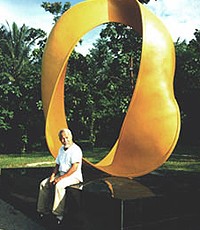
Pak Ahmad and his creation.
Pak Ahmad and his creation Sakinah.

Indonesian sculptor Ahmad Osni Peii was resident at Rimbun Dahan for 6 months in ’99 when he returned to Southeast Asia after living in the States for 40 years.

While he was at Rimbun Dahan, he embarked on the creation of several large-scale outdoor sculptures in painted aluminium, which were produced with the help of a team at a studio off-site.

“…This see-through spatio-shell structure is not mathematically formulated as many may assume.  It is simply an intuitive discovery, so to speak, in mathematical sense for I believe all forms created knowingly or unknowingly are not absent of judiciously purposeful plan unless unconsciously or deliberately done, in other words unaccountably playful, cynical or whimsical.  This is not so with my work.  It is a medium discovered, precise and fit, I think, for the theme of ‘formal allegory’, a visual suggestion on harmonious relationship, a Gestalt, between ‘things’ as a whole in unity, rhythm, order, contrast, balance, proportion, to name a few, just as one would reflect on or appreciate the unarbitrary composition of all immeasurably diverse living things interactively created in nature…”

Sakinah (above and below) was the first large outdoor sculpture by resident artist Ahmad Osni Peii to be installed at Rimbun Dahan, in the Bulatan Plong in 1999. Two other pieces — Geliat Nusantara (red piece, below) and Gelang Serai (white piece, below) — were installed in 2005. All three are made of painted aluminium.

Adam Aitken

Australian poet Adam Aitken undertook an Asialink Residency at Rimbun Dahan in 1998. Adam spent his residency working on his poetry and researching Malaysian cabaret. The resulting collection, Romeo and Juliet in Subtitles, was published to critical acclaim by Brandl and Schlesinger.

During his residency, he also wrote the catalogue essay for the exhibition of fellow Asialink artist Matt Calvert.

Adam Aitken is a NSW based poet and fiction writer who has had two books of poetry published, Letter to Marco Polo and In One House. He was also the associate editor of Australian literary journal HEAT.

View the artist’s website: adamaitken.wordpress.com

Mutalib Mann

Mutalib Mann

mutalibMutalib Mann was the Malaysian resident artist of the Malaysia-Australia Visual Arts Residency at Rimbun Dahan in 1998. The exhibition of his works took place in the Underground Gallery at Rimbun Dahan from 28 August to 27 September 1998.

Mutalib Mann is an artist based in London, born in Alor Setar, Malaysia. He was trained at The MARA University of Technology, Kuala Lumpur, Malaysia and The London College of Printing in Graphic Design.

Mathew Calvert

Mathew Calvert

Glass_shards1

mattTasmanian sculptor Mathew Calvert was an Asialink resident artist at Rimbun Dahan in 1998.

Curriculum Vitae

Born Smithton Tasmania, 1969

Exhibition

1997      Poets and Painters, Dick Betts Gallery, Hobart

1996   Survivability, Hobart GPO

Pulp, Burnie, Regional Art Gallery

1995   Bubble Rap, M&B Motors, New Cross, London

1994   Selected Works from the 1993 Anne & Gordon Samstag International Visual Arts Scholarships, Adelaide

1993      Group 16 Exhibition, Long Gallery, Hobart

1991      National Student Exhibition, Exhibition Building, Melbourne

1990      Insitu Fine Arts Gallery, University of Tasmania

Residencies

1998      Asialink Rimbun Dahan Malaysia

1994      McCulloch Studio, Cite International des Arts, Paris

Commmissions

1997      Art for Public Buildings Scheme, TAFE Training Facility Prince of Wales Bay, Hobart

1991      Installation for Fletcher Construction at the ANZ Centre, Hobart

Scholarships and Awards

1992      Samstag International Visual Arts Scholarship

Dean’s Role of Honour, University of Tasmania

Education

1995      MA Goldsmith’s College, University of London

1993      Graduated with Honours (First Class)

1994      1992   Bachelor of Fine Arts, Tasmanian School of Art, University of Tasmania

matt1

Notes on the Asialink Rimbun Dahan Residency Exhibition

by Adam Aitken

Kuang Malaysia
28th August to 27 September 1998

In the six months Tasmanian sculptor Mathew Calvert has resided at Rimbun Dahan, his glass monoliths have attracted the attention of his fellow artists and visitor alike.  Within the Balinese Hindu-inspired water temple surroundings of Rimbun Dahan’s guest-house studio, these pieces are quasi-architectural forms which reflect the on-going modernist desire for pure clean forms, that comment upon eclectic post-modernity and the trace of Asian ideals inherent in their setting.

Each sculpture is composed of up to a thousand pieces of broken plate glass formerly used as building material which Calvert salvaged from a nearby kampung dump (below).  These pieces tell the story of their own salvation from the melancholy fate of rejected industrial materials.  Each piece extends our perceptions of how these materials can be used and viewed, as objects with intelligence and meanings they would not have enjoyed had they fulfilled their original utilitarian purpose as glass for high rise.

matt4

Each piece attests to the artist’s ritual of collection, cleaning and sorting the colour and thickness of each single shard before its actual placement. Such a process requires the will to discipline the chaos of the dump, to arrest the process of decay, to rescue perfectly usable material from industry’s unthinking wastage. Each piece yearns to be something spiritually complete, an ideal which an industrialising landscape struggles to realise.

From the detritus of a boom gone bust Calvert has transformed the ugliness of broken 10 millimetre plate glass into things conventionally beautiful on the outside, but haunting and threatening inside, a solid oblong and two “sarcophagi’.  Each piece seems to mourn at the unmarked grave of an industrial disaster.  Over the largest piece hangs a billboard sized back lit photograph of a landmark familiar to the KL commuter, a large abandoned skeleton of what could have been just another condominium.  Its bare stairwells and lack of cladding reveal the emptiness of real-estate denuded of its “face”, its loss of status as well as the evidence of KL’s suddenly arrested modernisation.  Through its empty floors one can view bare laterite hills and the transient outlands of the shabby city fringe.  The building has colonised what was once a useful, perhaps picturesque space with its own semi-rural complexities of people, space, work and environment.

matt2This juxtaposition of image and glass pike is a reflexive gesture and a reanalysis of the urban environment, as well as a poignant commentary on the history of all overreaching development.  A wan fluorescence lights this edifice t0 failed vision, each piece emanating the same milky-white pallor of transience, decay, vacancy.  Twentieth century modernity seemed to promise a simple mode of being, but is this  an empty promise after all, a conceptual dead end?

The material to a certain extent has dictated Calvert’s choice of form, and every shard has been placed carefully to achieve a layer-cake of fractured light and resonance.  Through judicious placement of each shard, Calvert has captured both the beauty and the ugliness of glass, which lies in its unpredictable nature:  two perfectly flat surfaces, but the edge can be either ruler-straight, or jagged and chaotic depending how the sheet breaks.

Like Petronas Towers, the viewer is astonished at the weighty impact of something so abstract, single minded, and virtually colourless.  But Calvert’s pieces are ironic commentaries on ideals of giantism, purity and perfection.  Like the generic office tower of curtain glass the surfaces of these sculptures shine with autonomy, and a power expressed through total dominance of medium.

matt5Most of the shards have had minimal but intensive handling, with no intentional breakage.  The edges of each fragment are aligned in perpendiculars, each a brick in the wall that might go on forever if the artist had given full rein to his obsession.  In “Recovery” (right), the viewer, from a confident position of privilege, seems to be walking around disciplined walls of glass, only to find this complacency shaken on looking down into a menacing shark’s mouth of broken edges.

Glass is fragile yet potentially dangerous to the flesh.  Each piece says, “come and view me, but keep your distance!”

The paradox of glass is the fact that it is both solid and transparent, and each piece exploits this double identity.  There are no false bottoms or hollow spaces in “Platform” yet the sarcophagus hints at containing the organic trace of life (below).  But what life?  Does the oblong bury a living thin, an essence of life?  Like Narcissus, we gaze from Rimbun Dahan’s soft watery surrounding, we run aground o the force of these surfaces.  The viewer apprehends the work as a sublime force, both beautiful and terrifying; it promises everlasting life for itself, more permanent and immutable than us.  It refers to a technological future which is frightening, because the abandoned building signifies the incompletion of human creativity and our loss over control.  The abandoned structure will never know the warmth and familiarity of human activity, and is haunted by the disquietude of ghosts.

matt3Ross Wolfe, director of the Samstag Program wrote of Calvert’s early work as being in the nature of “a barricade which assaults and offends the aesthetic, rendering itself unapproachable through gross physical attributes alone.  It’s spirit is open.  As art, it is naked and vulnerable” (Samstag catalogue 1994). In this installation Calvert has disciplined his earlier sense of violence and grossness.  Perhaps these pieces carry a new subliminal message:  that meaning lies beyond cliches of economic rationalism.  It’s wastefulness, is revealed, when the “used” must pay as much as the user in terms of lost space, lost greenery and blotted out horizons.  One question Calvert’s work asks is whether the broken and rejected junk of a throw-away culture can be redeemed.  Calvert’s pieces make us look at the piece itself, and contemplate the labour that makes it a thing in itself with its own aesthetic value, but they also express the human yearning for permanence.  It is also art that risk ugliness and generates a slight feeling of repulsion and alienation one much feel when confronted by effective political art.  These sculptures, born of the scrap heap, are perhaps windows, or more mysteriously looking-glasses for those who can read their destiny, but all they reveal is the law of their own grim presence, one a lot less illusory and therefore more strikingly truthful than the vision of “development” has every quite promised.


Adam Aitken has published two books of poetry, he is associate editor of “HEAT”, the Australian literary journal and was the Asialink Writer in Residency at Rimbun Dahan during Matt Calvert’s residency.

This is an Asialink project assisted by the Commonwealth Government through the Australia council, its funding and advisory body;  Arts Tasmania and the Australian High Commission, Kuala Lumpur.

Plant Indigenous

Plant Indigenous

by Angela Hijjas

With the accelerated loss of forest habitats gardeners can try to make a difference to the survival of birds and other small creatures by selecting indigenous species to enrich urban habitats. Most Malaysians only have small gardens or make do with a few pots on a balcony, so making the planting choice is critical, plants should be an appropriate size and be ‘interesting’ to human and animal alike.

The joy of gardening is not merely ‘growing’ plants and savoring their flowers. Living with plants is about seeing the wider world as birds catch pollinating insects and collect fruit, or butterflies and moths feed on nectar, as well as the shade, perfume, colour and texture of plants that we particularly enjoy. Sharing a garden with other species gives us a real sense of our place on earth.

Malaysia has some of the greatest biodiversity of species known anywhere in the world, but we are in danger of losing much of it before we even know about it. The easiest way to learn something of this richness is to live with some of these plants, read about them and observe. Enriching the soil with kitchen waste and watering when necessary give us an active role, but humanity is part of a much larger scheme that we appreciate better as we share our space with other species.

The plant offered for sale to raise funds for MNS on World Environment Day ‘98 is Murraya paniculata (above), kemuning or Mock Orange. This single example provides lessons in Malaysia’s culture, history and the diversity of life. It is a shrub or small tree, of the same family as the curry leaf plant, that is occasionally seen wild in the drier parts of the north and on the east coast, or on limestone hills. Because of the fragrance of its flowers it is often planted in kampong gardens. The dense erect leaves resemble citrus, and the yellow root wood is favoured for making kris handles because of its beautiful figuring. The name apparently is derived from this yellow colouring, kemuning from kuning or yellow.

Kemuning has medicinal uses as well. An infusion of the leaves is included in a tonic for ‘young women’s irregularities’, or a decoction of the leaves may be used for toothache. The flowers used to be sold in the markets to perfume women’s hair, much as jasmine is sold today. Their fragrance, particularly in the evening, is magnificent and attracts pollinating insects. The red berries are relished by birds and bats.

As a garden species, kemuning makes an excellent single or hedged specimen for screening that can be heavily pruned with no ill effects. It quickly generates new growth and a flush of flowers if there is generous watering and composting after the cut-back. It is not attacked by munching insects, never needs chemical intervention and possibly protects tender species planted nearby.

By learning about Malaysia’s own plants we learn to recognise the individuals and families that make up the primary and secondary forests. Unique plants help us develop a sense of place which will be all important in the coming age of globalisation when standardisation will diminish the particular for the sake of world wide uniformity. To understand our own place in the universe means to appreciate the uniqueness of this particular land and have a strong sense of belonging here.

It is mainly an awareness of plants and landscape that ensure this continuity. The hillside kampongs shaded by tall fruit trees interspersed by riverine padi fields, much of which is already lost, the miles of rubber and oil palm estates and the forested hills as a backdrop, are a landscape made of the geography of plants. Place names in Malaysia are generally named after plants or characteristic geographic features. Street names follow this tradition, but rarely today is the named tree included in the landscaping. With the rush for foreign/exotic species such as traveler’s palms (from Madagascar), and heliconia (from central America) it is easy to forget the plants and landscape that have shaped Malaysia’s culture and traditions. When we learn how to name the trees we will know who and where we are, an important rediscovery with globalisation upon us.

For a wealth of information on all things related to Malaysia’s indigenous species, two excellent reference books on the importance of Malaysia’s plants should be included in every home library. Professor E.J.H. Corner’s Wayside Trees of Malaya and I.H. Burkill’s Dictionary of the Economic Products of the Malay Peninsula have been reprinted by the Malaysian Nature Society and the Government Printer respectively and give rare insight into forests, plants and Malaysian economic history.

Join the Malaysian Nature Society and take advantage of members’ discounts to buy these heritage titles.

Stephen Turpie

Stephen Turpie

steveStephen Turpie was the Australian artist of the year-long Malaysia-Australia Visual Arts Residency at Rimbun Dahan in 1998.

Stephen’s is currently a lecturer of painting and drawing at LaTrobe University, Bendigo, and his qualifications include DipArt (Painting-VCA), GradDipFine Art (VCA), MVA (RMIT). Stephen has a range of interests that include sculpture, installations and time-based work along with his continuing practice as a painter. His research involves major phenomenological questions about the self, visual analogy and the engineered world, expressed in a metaphorical and sybolic format. Stephen Turpie has undertaken numerous other residencies, including at Green Street Studios , New York (1986) and Padiès Château , Lempaut, France (2008).

Catalogue Essay

In these new works, Stephen Turpie explores the evasive qualities of appearances; the ambiguity of things which have not come into sharp focus, but are demanding of our attention and ‘as through a glass darkly’ we try to make sense. Fusing imagery from biology, construction and abstract thought (mathematics, physics and philosophy) he traverses the natural and cultural worlds. This symbolic play in the metaphorical landscape resonates with an emotional intensity gained only from personal and ontological inquiry.

Turpie’s visual themes are influence by a diverse array of artists and works: from Joseph Beuys’ conceptual investigations into the fundamental principles of energy and the effects of both natural forces and of art, to Jean Miro’s symbolic innovations and Ken Whisson’s abstract treatment of the landscape.

The formal concerns of past works in painting, as well as sculpture and performance, recur again in this new series. His painted forms display the solidity and presence of three dimensional objects which are poised in ambiguous landscapes and receding intimate spaces. These arrangements are reminiscent of Turpie’s sculptural works of over a decade and a half ago in which clusters of discarded objects were delicately balanced in small museum boxes. These curious objects were the decaying leftovers of another time whose concealed histories conferred a certain dignity to their presence, the significance of which remained quietly elusive.

Stephen Turpie’s work contemplates ancient modes of thought alongside modern and contemporary ideas which reflect something of the all-at-once attempts to render life and appearances in theoretical guises. The use of the landscape genre is a significant choice for this subject as the natural cycles and biological processes have been commonly employed as metaphors for psychological and social phenomena in both ancient and contemporary descriptions. Turpie’s images are carefully constructed between the borders of figuration and abstraction, as such, his ‘figures’ are neither fixed in meaning nor anchored in the landscapes over which they hover.

Turpie’s choce and use of symbols reflect the flavour of Pre-

Socratic and Platonic modes of analogical thought. The invisible correspondences by which “all things pass through all things”; the similarity in dissimilars, were uncovered by the principle of analogy, for example, almonds are good for the eyes, walnuts for the brain, the seven planets with the sun and the moon relect the nine portals of the body (macrocosm=microscosm). The ephemeral nature of these protean transformations was underpinned by the notions of singularity and duality, sameness and difference, harmony and strife.

Throughout these works, T-junctions, chromosomes, blue intruding figures, houses and wedges group together in pairs, clusters or alone, their identity of difference forming the basis of their relation. For example, the house stands in relation to the cultural landscape as the chromosome to the internal microcosm of the body, as the defining points of civilization and humanity. These symbols display simultaneous features of singularity, self-same duality and multiplicity, yet, their identities are never simple: a T-junction can be a signature (of the artist perhaps), a letter referring to the building blocks of language and representation, it could be a telephone pole signifying energy and communication grids imposed on a barren landscape, or perhaps it represents the junction of various levels of existence, the organic and inorganic, or the biological and social. Two T’s join together to form a gateway, a bridge or a simplified dog. The chromosomes sometimes curiously look like two copulating figures, in other places like a solitary floating character. Electric blue figures invade the picture plane resembling cells in mitosis, ovum or phallus, or perhaps neurological cross sections indicating either the dualistic tension of creativity, the genesis of life, of the beginnings of intelligence and complexity.

Turpie’s imagery concurs with Richard Long’s description of his work as “a balance between patterns of nature and the formation of human abstract ideas”. Lattices, webs and branching structures are observed throughout the natural world from biology to chemistry and the mathematical descriptions of contemporary physics. The ambiguity of the brain/cell division when juxtaposed with such structures also brings into question the relationship between the structure of the world and the structure of our perceptions. The extent to which these patterns of order are inherent in the world or are imposed on sensations by the brain remains in question. In natural and human sciences as well as in art, the dividing lines between invention and discovery are hazy. For over a century, these issues have been hotly debated through the perennial questions of evolution theories and their explanatory metaphors.
Turpie’s depiction of the wedge/arrow, indicates the dark underbelly of evolution theories (competition and biological arms races) as well as the teleological notions (arrow of the Great Chain of Being) which Darwin’s wedge had overturned. The patchwork effect of some of the larger works reflect the newer modes of describing evolutionary change (and perhaps the creative process of the artist) as ‘biffrucation, tinkering and bricolage’. In biological terms, these notions emphasise the historical contingency and the exquisite imperfections of the actual structures which developed by chance from the myriad possible alternatives which had insufficient opportunity to develop. It also provides an apt metaphor for the artist and his work. According to evolutionary biologist, Francois Jacob:

“…often without knowing what he is going to produce, he (the tinkerer) uses what ever he finds around him, old cardboards, pieces of strings, fragments of wood or metal, to make some kind of workable object. As pointed out by Claude Levi-Strauss, none of the materials at the tinkerer’s disposal has a precise and definite function. Each can be used in different ways. What the tinkerer ultimately produces is often related to no special project. It merely results from a series of contingent events from the opportunities he has to enrich his stock with leftovers.”

The historical result of this process of tinkering is not a seamlessly engineered creation, but as Jacob proposes,

“a patchwork of odd sets pieced together when and where opportunity arose. For the opportunism of natural selection is not simply a matter of indifference to the structure and operations of its products. It reflects the very nature of historical processes, full of contingency.”

Turpie is both a tinkerer of symbols and a bricoleur of ideas. His fascination with the processes of nature, thought and art are both hidden and revealed in the verdant ‘openness’ of his paintings which allows us to explore the question of how ideas and experience are ordered in our attempts to apprehend the world. To the Appolonian urge for clarity and definition, Turpie’s fuzzy chromosomes reply,

“Do not befriend an elephant keeper,
if you have no room to entertain an elephant”.

Rumi.

Catalogue by Elizabeth Thomas

Gardening’s Current Affairs

Gardening’s Current Affairs

by Angela Hijjas

from The Malaysian Naturalist, vol. 52 no. 1, March 1998

After six years, parts of my garden are beginning to fulfill imagined promises: a wider variety of birds and insects come part and parcel with more species of plants and the growing trees stretch the canopy to greater heights, enlarging the mass and volume of the garden enormously. Fourteen acres of stunted orchard is evolving into the forest I imagine, but it will remain the human domain as long as I continue to plant and transplant, nurture and prune, select and reject; the process of gardening is very much a current affair. Shown’s article in the last issue about pruning and ‘surgery’ highlighted this role of the interventionist gardener, but so much, at least for me, is more a matter of chance rather than choice.

Pruning can have dramatic effects on tropical plants that are otherwise only affected by subtle climatic change that human minders do not detect. In anticipation of the festive season, we pruned our kemuning (Murraya panniculata) hedge at the beginning of puasa, the fasting month, hoping to revitalise its formal shape while giving it time for more leaf growth to conceal any exposed woody stems, but a fortnight later (combined with a lot of rain) the hedge flowered profusely and also sprouted new growth. Next year the time to prune would appear to be in the middle of the fasting month, so that the magnificent fragrance can be a feature of our open house; but then again the season will be a few weeks earlier and the rhythm may be different.

Part of the chance element of gardening can be reduced if one keeps records. It is essential to observe carefully a plant’s habits, how it performs in different conditions. Otherwise it is so easy to forget. This was my New Year’s resolution; keep records and update them diligently.

A plan of the garden has to be made before the records can mean much, especially if you intend to plant vegetables and follow a proper rotation of ‘crops’. The PC can be an invaluable tool in updating and referring to old records. When was the bed composted last? What was planted before? What’s the record of pests and problems? A rain gauge is a good idea, and daily records can be graphed and compared in the PC; and in no time you will have a full-time hobby, perfect for the economic downturn!

Observing, recording and remembering have developed our gardening and agricultural expertise over the millennia, but in the tropics where there are few seasonal variations, it is critical to continue recording and interpreting, especially as so little is really known about our unique conditions. Temperate gardens with their seasonal changes and preparations are more predictable, daffodils flower in spring and roses in summer and autumn is the ‘season of mists and mellow fruitfulness’.

Perhaps Malay folk lore could give valuable insight into the habits of plants, but much traditional knowledge has already been lost with the changes in the kampung environment. It is barely viable to maintain the family plot when the younger generation is working in the factories that have sprung up all over the peninsula while the older generation looks after the children. A cash economy has replaced the need to depend on the products of small-scale agricultural labour, but the present crisis may re-introduce many of us to the rewards and delights of growing our won produce as we are being urged by politicians and the media.

Hydroponics seems a popular solution, possibly because of the marketing angle involved in selling all the paraphernalia that is required to get a simple crop of kangkung, but I am more concerned about the requirement for unnecessary chemical additives when most of what is needed is just outside the back door or on a piece of neighbouring wasteland that can be co-opted for vegetables. Instead of buying packaged additives for hydroponics, start a compost heap and get some exercise with the cangkul.

A single family generates a lot of vegetable refuse that can be recycled. You can use a large covered garbage bin with holes melted in the sides for ventilation. It will not be smelly as long as no animal products are thrown in, and a few shovels of soil to cover anything you suspect may attract flies will keep down the vermin. Cover the pile to prevent tropical rain from leaching out nutrients, but ensure it is just damp enough to allow the enrichment of rot. When the heap is finished, keep it for a few weeks and turn it to aerate and ensure it all decomposes evenly. Pile, cover and keep again until it is a rich black organic mass that bears no resemblance to the original material. Additives like dry chicken dung will greatly enrich the brew.

Making compost is much more satisfying that buying a produce to do the same thing, and there is nothing quite as pretty as a garden bed of vegetables rather than growing them in a plastic container. Perhaps my main complaint about hydroponics is influenced by its aesthetics just as much as by the commercialisation of something that can be a totally natural experience.

For anyone interested in growing vegetables organically, I can recommend an invaluable booklet that has been prepared by Siew of Cetdem, the Centre for the Environment, Technology and Development in Malaysia; send $5 and a stamped, self-addressed A4 envelope, for an excellent guide to growing vegetables organically in Malaysia. Siew previously ran an organic farm in Sungai Buloh and will be conducting courses in my garden later this year. In the meantime, study the leaflet, start the compost, set aside some garden space for produce and enjoy the results, which you will, of course, observe, record, assess and quantify. Good luck.

Cetdem’s address is P.O. Box 382, 46740 Petaling Jaya.

A Sense of Place in the Landscape

A Sense of Place in the Landscape

by Angela Hijjas

from The Malaysian Naturalist, vol. 51 no. 3&4
The new Visitors' Centre of Kuala Selangor Nature Park
The new Visitors’ Centre of Kuala Selangor Nature Park

The new facilities at Kuala Selangor Nature Park were opened with some fanfare last month, complete with the attendance of the Minister for Housing and Local Government, Dato Dr. Ting Chew Peh. The function also served to launch Hari Landskep, and a selection of native trees were duly planted. Hopefully this choice of indigenous plants heralds a new approach by the National Landscape Department. A 1997 booklet distributed on the occasion illustrates the projects they commended in fulfilling “the Government’s vision to transform Malaysia into a garden nation by the year 2005.” Judging by the photos of severely clipped multi coloured plantings, neat edges and exotic species, we are to effect a transformation from the natural to the wholly artificial.

Landscaping competitions organised by the department covered all categories, from condo to kampong, and the winners all presented versions of the potted and de/formed interpretation of a for ceful control over nature. The towering grandeur of our natural landscape has provided no inspiration to the designers, despite the fact that we have inherited a country with the greatest biodiversity of plant material in the world. By choosing to ignore this wealth in favour of the imported and exotic, the designers are definitely experiencing the throes of some post colonial “cultural cringe.”

To develop a national concept for landscaping is more complex than merely taking elements of what designers have seen overseas and recreating it here. To recognise what is unique and beautiful in our own landscape is the beginning of the process and you build on that, assuming that the landscape one creates is intended to reinforce Malaysia’s unique sense of place, because we do have nationalistic objectives at stake.

The beautiful Saracca, definitely a candidate for the national flower.

Unfortunately, we have used foreign symbols in the past and no one has questioned those choices and in the process we have lost opportunities to present Malaysia as unique. Nationalism should be b ased on a solid understanding of where and who we are, and the place we occupy should be our source of inspiration for the symbols and images that represent us. Two examples of inappropriate and unimaginative choices should suffice.

Firstly, the hibiscus, the honored Bunga Raya, is not indigenous to Malaysia, but to southern China. When we have in our forests such magnificent botanical wonders as Rafflesia (although the name may not be politically correct) why would we select for our national flower s omething that is so pan-tropic it evokes no sense of place at all?

The flag may have got it wrong, but the crest didn't.
The flag may have got it wrong, but the crest didn’t.

My second example definitely locates our sense of place in the wider world. The new crescent moon in Malaysia is a slightly skewed smile on the horizon as it sets in the west immediately after sunset at the beginning of each new lunar month. Why, then, does Malaysia’s flag tilt the moon as if it were being viewed from Saudi Arabia? Being Australian, I can relate to this dilemma, as the British Union Jack still graces the top left corner of that flag, but hopefully not for much longer. I accept that the crescent moon is the symbol of Islam; I acknowledge that Mecca should be venerated but I see no reason why the angle of the moon should not be on the flag as we see it in Malaysia, slipping over the horizon every month, reminding us all of the passage of time and exactly where we are. And what a great gesture it would be to salute all Malaysians by realigning the sabit bulan, in acknowledgment of that special place we all occupy.

Malaysia is a tropical country, Kuala Lumpur is just three degrees north of the equator. Our sense of belonging is reflected in how we recognise where we are. To me, trees are the first indicator of location. Australia is perfumed by eucalyptus, Malaysia by durian when you are lucky and motorbike fumes when you are not, but identifying the trees that belong to this place alone confers a precise sense of place and belonging, something that our national landscaping policy should certainly address. With the relent less pressure to globalise, we surely wish to retain some uniqueness that other places do not have and landscaping with native species must enhance this.

Indigenous people have always identified location with the prevailing flora, by naming the places after the plants. Ipoh is a tree with toxic bark, used to tip hunting arrows. The Pinang palm provides the mildly narcotic fruit that has been used for centuries in South East Asia for a multitude of medicinal purposes. The feathery Melaka tree is believed to have provided the place name for river and town. The name is from Sanskrit, possibly given by visitors from the subcontinent centuries ago. Just as names keep our language and history alive, so does a knowledge of our own unique plants.

A very significant book has just been reprinted by the Malaysian Nature Society that will provide hours of fascinating browsing for anyone interested in indigenous species and their relevance on a daily and historic basis. Professor E.J.H. Corner compiled a remarkable survey of Malaya’s trees that was first printed in 1940, ‘The Wayside Trees of Malaya’, in two volumes. Its importance has not diminished over half a century and there has never been anything else close to replacing it. The contents cover a broad selection of plants encountered in the peninsula, illustrated by old but excellent photographs and line drawings that make identification easy for the amateur. Precise botanical information is mixed with interesting anecdote and opinion, and one can easily dip in and out of its masses of information. The sections on the characteristics of each of the plant families provide an easy introduction to botany, and simple keys help in identification. Particular trees are noted with an ironic eye, like this Sindora wallichii: “The tall tree at Changi that, as a feature on pre-war charts for over a century, marked the eastern approach to the Straits of Johore was felled early in 1942 to prevent Japanese forces ranging on the useless guns of the fortress of Singapore. Sic transit gloria mundi.” Corner’s immense knowledge and forthright opinions should be included on every Malaysian book shelf.

Trees and the natural surroundings mark the uniqueness of place and deserve to be noted in our man-made landscapes as they bear witness to our history and who we are. By learning about local plants and recognising them we become more aware of ourselves and our singular identity. Malaysia is unique and the propagandists would do well to draw our nationalist symbols (and our landscaping styles) from those elements that make this place so special.


The Malaysian Naturalist
vol. 51 no. 3&4

Taman Sari

Taman Sari

by Angela Hijjas

for The Malaysian Naturalist, vol. 51 no. 2, December 1997.

The name ‘Taman Sari’ evokes the fragrance and grace of a lush Javanese garden, with bees probing for nectar in masses of flowers. The first Sultan of Jogjakarta, Mangkubumi, the ‘guardian of the earth,’ chose the name for the walled pleasure garden adjoining his kraton in the mid-eighteenth century. He spared no expense on walls, tunnels and waterworks, while the Dutch complained that he placed more priority on this self-indulgence than on their fortifications. If only all kings were so wise!

The intricate irrigation channels of the original Taman Sari flowed through a series of pools and courtyards, complete with a fountain of youth, the Umbul Binangan. Spice, vegetable and fruit gardens, terraces, staircases and pavilions made up what must have been a wonder of its time. But the beauty of any garden is transitory; earthquakes and neglect reduced this garden to ruin by the end of the century and today all that remains are walls and a labyrinth of sunken passages.

Two centuries later, inspired by the romance of Javanese palaces, I adopted the name Taman Sari for my herb garden. Like the Sultan, I wanted the garden to be an integral part of our home, while developing a strong sense of its place within Malaysia. The most promising site for it lay behind the house, an area of about half an acre.

The so-called ‘hard landscaping’ elements, the paths, furniture and sculpture, are an essential part of any garden, particularly a herb garden, and their added detail helps to compensate for the predominant lack of colour in Southeast Asian species. As the herb garden is a meld of East and West, the landscape design laid out the paths and beds in the European style, with crossed paths dividing the area into four quarters. Bali supplied the stone sculptures of winged lions for the entrance and a garuda to animate the garden, providing an aesthetic and spiritual link to the animist past. The pathways themselves are pure KL, the indispensable interlocking concrete pavers: cheap, durable and practical.

My criteria for selecting plants were that they either be Southeast Asian in origin, or of some culinary or medicinal significance in the region. Flowers with characteristic Asian fragrances are another feature. Half the garden was to be for useful plants, and the other for more sensual pleasure. Inevitably, this separation has become very blurred, especially since we started companion planting in the vegetable garden, using the pungency of the herbs to protect vulnerable vegetables from insect attack.

I resisted the urge to fill the space with trees as most vegetables need full sun, but some shade is provided by the garden’s main ‘structural’ trees and this creates a variety of habitats. A single tamarind tree is as the centre of the vegetable garden, while the main path is protected by rows of nutmeg and meninjau trees. The entrance is shaded by pinang palms whose narrow canopies do not block too much sun. Another row cinkeh, cloves, has been more difficult to establish and only one tree has done well, but it is backed by a hedge of kemuning, with its periodic flushes of fragrant blossoms. A row of Borassus flabiliffer, the lontar palm, will ultimately provide a source for the toddy of my old age, assuming there is someone around who can still tap by the year 2020. A row of cinnamon trees separates the garden from the old durian orchard and completes the structural framework, leaving plenty of space for the herbs, vegetables, fragrant flowers and medicinal plants that I am still collecting.

While the major plants anchor the structural design of the garden, the smaller ones provide detail and interest which can be manipulated in many way. With the larger trees providing shade, different layers can be planted through and underneath. Vanilla orchids, pepper and sireh climb the trunks, shrubby ground cover is provided by shade-tolerant pandanusi, gingers or costus, while kadok and pegaga are strong covers for shade and sun respectively.

As our land has been a coffee plantation for many years before we acquired it, and because I am interested in the continuity of landscapes, I planted some coffee as a hedge outside Taman Sari before I discovered that coffee flowers have perhaps the most beautiful of all fragrances. The blooming lasts for just a few days ever few months, but the perfume is unforgettable. Other perfumes come from the kenanga, jasmines and gingers, and the many varieties of leaves that have to be crushed to release their fragrant oils. To add to the confusion, occasionally different plants have similar smells: my plot of pandanus (whose smell is only released in cooking) is overhung by kerak nasi, whose perfume is just like pandanus. Many visitors, smelling kerak nasi mistake it for the better-known culinary ingredient.

Some foreign plants, like aloe vera, have become essential medicinal ingredients; they can tolerate full sun and a dry position. But I have given up trying to grow European herbs like rosemary and thyme, as the rain devastates them; they would probably do better in pots. Lemon balm is a useful exception. Other foreign plants that are widely used for herbal preparations, like elderberry (Sambucus nigra) have local equivalents: the entire plant of Sambucus javanica can be used for similar medicinal preparations as the European variety.

Apart from a few simple cold remedies, I haven’t made use of my plants and have collected them purely for the pleasure of seeing them all growing together, appreciating their histories (the tales about nutmeg alone fill volumes), and enjoying the delight of sharing them with others. An evening wander around the paths, interrupted by tastes and smells, is fun and enlightening, particularly for city children, and there is nothing like perfume or flavour to transport you to another part of the world. ‘My Mum uses this’ and ‘my grandfather grew that’ are frequent comments, and even I, from Australia, instantly recall the hot summer nights at my grandparents’ home every time I break a stalk of serai wangi, the citronella that was widely used as an insect repellent in the Fifties and is now in demand again with the organic revival.

We have plenty of kitchen herbs: chilli, serai (lemon grass), limau purut, kasturi and nipis, kunyit (turmeric), curry leaf, lengkuas (galingal), ketumbar (coriander) and mint all do well. Little can substitute for the pleasure of a pungent tom yam made with home-grown ingredients. If the kitchen is the heart of the home, the Taman Sari is the heart of my garden. What better occupation could God have intended for Sultan or commoner?