Moe Satt

Moe Satt

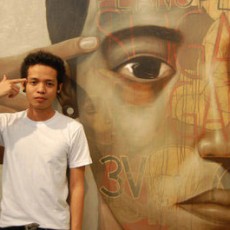
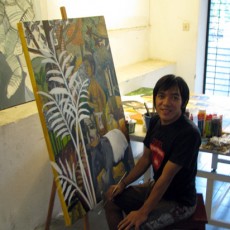
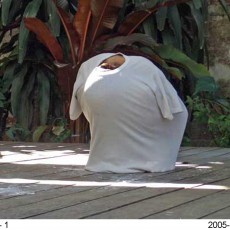
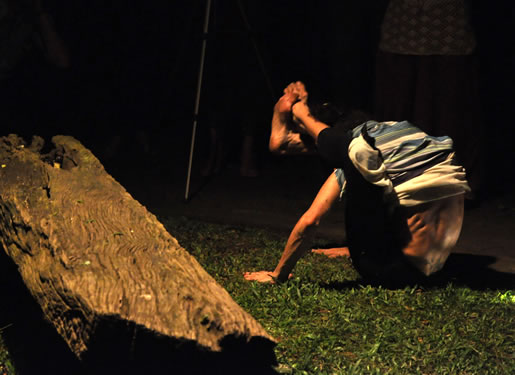
Moe Satt, a performance artist from Yangon trained in zoology and community development, was in residence at Rimbun Dahan for three months, from February to April 2008.

Bio

Moe Satt (b 1983) lives and works in Yangon, Myanmar (Burma). In 2005 he graduated from East Yangon University with a Bachelor of Sciences (Zoology). Since then, he has participated in over 25 performance events and four solo shows as well as digital art exhibitions.

In his art works, Moe Satt tries to reflect the order and disorder surrounding people and the neverending justification in terms of human internal validity. He started out as a performance artist showing his work in the galleries and on the pavements of Yangon. In April 2007 he attended a certificate program in Community Development and Civic Empowerment at Chiang Mai University, Thailand. He exhibited his first solo art work abroad at Chiang Mai University in June 2007. He has participated in international performance art festivals including Performance Site Myanmar 05, 8th Open International Performance Art Festival in Beijing, China and 9th Asiatopia International Performance Art Festival in Chiang Mai, Thailand.

Donna Miranda

Resident Choreographer March-June 2007

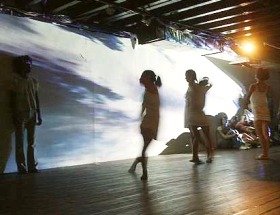
Artist-in-residence at Rimbun Dahan from March to June 2007, Donna created new performance piece bringing together local Malaysian dancers, video and sound artists to explore the idea of waiting, passing time, momentum and interruption in Extended Periods of Waiting, which was performed on June 8 2007 at The Annexe Central Market. The work featured live sound by SiCKL, video projection by Saiful Razman and Au Sow Yee, lighting by Roman Cruz and performance by Donna Miranda, Bilqis Hijjas, Yuka Tanaka, Louise Yow Sing-Hwa, Low Shee Hoe, Shaifuddin Mamat and Chan Seau Huvi.


The trio section from Extended Periods of Waiting was performed again as part of the Tari! 07 festival at ASWARA in July 2007.

During her stay, Donna also created I Will Think About It, a contribution to the 2007 Art for Nature exhibition in collaboration with visual artist Saiful Razman, and featuring Poodien. She also conducted a workshop in contemporary dance, creative process and free movement improvisation at the Annexe Central Market in June 2007.

Donna and Poodien creating I Will Think About It.

Donna received dance training as national government scholar of the Philippine High School for the Arts, pursuing professional practice and further training with Ballet Philippines, Philippine Ballet Theater, Myra Beltran’s Dance Forum and specialized training in contemporary dance at the 2005 DanceWEB Europe Scholarship Programme, in Vienna, Austria. She has since been actively involved in multimedia projects that explore new possibilities through works that combine contemporary dance, new media, fashion, physical theater, spoken word and sound. In 2000, she co-founded Green Papaya Art Projects, building a research platform for contemporary dance in Manila through its Anatomy Projects (AP+). Her solo ‘Beneath Polka-dotted Skies’ recently received 2007 Jury Prize Award in the Yokohama Solo X Duo Competition in Japan.

EU & ME Dance Collective

EU & ME Dance Collective

pond

The four-person dance collective EU & ME (European Union & a little MISTAKE and an EXCUSE) consisting of

Joey CHUA Poh Yi (Singapore, Hong Kong)
Marie CHABERT (France, UK)
Csilla NAGY (Hungary)
Rhys TURNER (Australia)

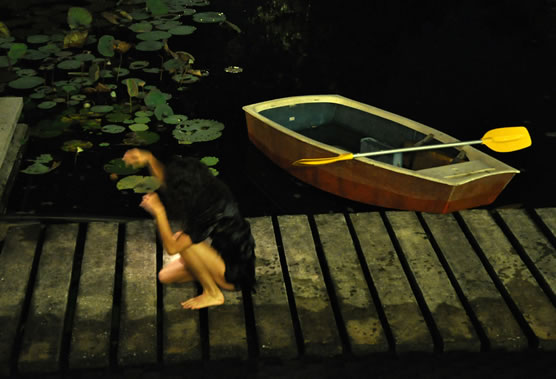
performed their work FIND.MOVE.PLAY, an interactive physical theatre performance with digital art, for the opening night of the Art for Nature Exhibition at Rimbun Dahan on Saturday 24 July 2010. [Photos below by Anthony Pelchen.]

The Collective began in 2008 in New York, in the frame of the Dance Collective programme organised by OMI international Arts Centre. Then the artists collaborated in the Czech Republic as resident artists of CESTA Festival. After four successful presentations in Hong Kong and Singapore this performance at Rimbun Dahan is the closing show of a one-month tour.

EU & ME arrived at Rimbun Dahan on Saturday 17 July, and within the space of a week created a 45-minute work tailored to the specific spaces of Rimbun Dahan as well as inspired by the artists’ own experiences of being on a residency in Southeast Asia and discovering life in Malaysia.

FIND.MOVE.PLAY was performed at 10pm on 24 July as the final event on the opening night of Art for Nature. Information about the performance was provided through an announcement during the opening ceremonies, and by flyers distributed on the dinner tables.

The performers used a number of different sites around the property, including the central space of the underground gallery, the reflective lotus pond, outdoor sculptures and herb garden. The performers invited the audience of 100-200 people to follow them from site to site, linking the vignettes with a narrative about Orpheus and searching for love.

The performance incorporated digital art, with a dance film taking a comic look at residencies at Rimbun Dahan, and an interactive soundscape in which selected audience members wearing headphones heard the accompanying music change as they moved around the space. The audience was also invited to participate in the work, manipulating the dancers, helping them with specific tasks, answering questions and holding flashlights.

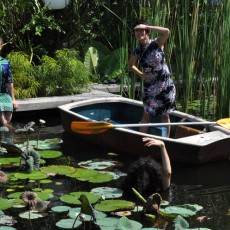
FIND.MOVE.PLAY alternated impressionistic romantic moments – Joey Chua wearing a traditional Chinese cheongsam and singing a Chinese love song while paddling herself about among waterlilies, or Marie Chabert flinging herself about among towered sculptures of lit glass – with moments of slapstick comedy, as when Marie slapped Rhys Turner on the face in retaliation for his bad pickup lines, and moments of unforgettable eeriness, such as Csilla Nagy’s mysterious inhuman emergence from the darkened pool followed by her literally stalking a quivering audience member. The tone of the work transitioned easily, tracing the natural atmospheres of the various different performance sites.

In addition to being a fun, funny and thought-provoking work in its own right, FIND.MOVE.PLAY also functioned perfectly as a teaser for Dancing in Place, a weekend of site-specific contemporary dance performances that will take place at Rimbun Dahan during the final week of the Art for Nature exhibition. By using multiple venues in very different ways, the audience was able to appreciate the potential for site-specific work at Rimbun Dahan. For many members of the audience more used to visual art, it served as an accessible introduction to contemporary dance and audience participation.

This performance was supported by nka and National Arts Council (Singapore).

DSC_0409_JPG

Nadiah Bamadhaj

nadiah

Nadiah Bamadhaj was in residence at Rimbun Dahan in 2005 alongside her spouse Arie Dyanto. A number of Nadiah’s works are in the Permanent Collection at Rimbun Dahan. Angela Hijjas also opened the exhibition of her work, ‘1965 Rebuilding its Monuments’, at Galeri Petronas in 2001.

Bio

Nadiah Bamadhaj (b. 1968, Petaling Jaya, Malaysia) was initially trained as a sculptor at the University of Canterbury in New Zealand but now produces drawings, sculptures, installations and digital images. She has worked in nongovernmental organizations, lectured in art, and has written on both Malaysia and Indonesia. In 2000, she began her fulltime art-practice and was awarded the Nippon Foundation’s Asian Public Intellectual Fellowship in 2002, electing to spend her fellowship period in Yogyakarta, Indonesia, where she currently lives with her husband and son. Her artwork continues to focus on the social intricacies of Yogyakarta’s society, using myth, architecture, and dwelling to articulate her observations.

Exhibition opening remarks by Angela Hijjas

1965: Rebuilding its Monuments
An Installation of Drawings by Nadiah Bamadhaj

I am honoured to be invited to open this outstanding exhibition in Galeri Petronas. I have been intrigued by watching Nadiah weave paper into maps and sculpt forms out of plaster of Paris, but I did not have a clear understanding of the cohesion of the exhibition until I saw the final display of the scale and content of her intentions.

The title Nadiah chose, 1965 Rebuilding its Monuments, unites all the disparate elements into a cohesive creation. I suspect that all of us have a fragmented understanding, at best, of the events in 1965, but this exhibition brings them all together. The exhibition highlights the separate events of the overthrow of Sukarno by Suharto, the subsequent slaughter of suspected Communists in Java and Bali, the split between Malaysia and Singapore, and the foreign construct of the domino theory that overshadowed the entire region. The year 1965 represented a major turning point in the history and culture of this region, and Nadiah’s exhibition forces us to realise not only that no event occurs in isolation, but also that a new marker or monument of 1965 is required.

I would like to note some of my impressions from viewing the exhibition.

The first segment represents the arsenal of Communism in Indonesia, and the wave of revolution and violence from Jakarta which topples the original monument to independence from colonisation. The catastrophe of crisis is brilliantly illustrated by the torn hole of society’s woven fabric, frayed and broken around a black abyss, and the sheer size of the archipelago as it stretches beyond the horizons, with only violence for a compass.

The next segment commemorates the subsequent bloodletting. Half a million people were slaughtered by militant Muslims in the backlash against Communism, while the Indonesian military stood by. In Nadiah’s work, the sparseness of the remaining landscape is haunted by the lack of figures, even the tomb stones are massed together in an unfamiliar and unacceptable way. A single monolithic stone is felled in grief, while Arabic numerals spiral out of control.

The quieter worlds of Malaysia and Singapore were not immune to the upheavals of that year. The declared objectives of ‘peace, tolerance and stability’ were undermined by communal insecurities. In the next sector of the exhibition we see the postcolonial network coming apart in our own country, as Singapore was forced out to find its own way. The emergence of the so-called Malay Ultras effectively destroyed the marriage, and we see the procession of the hantaran (gifts in a traditional Malay wedding) tumble into the crevasse.

The final sector of the exhibition looks at how the rest of the world perceived the region at this time, a perception dominated by the so-called domino theory. Escalating tensions in the region between Communism and the American Way were an unspoken omnipresence in Southeast Asia. Now it is apparent that many events at the time were engineered by the centres of the Cold War. In Nadiah’s work, the tiny local protagonists are surrounded by the interests of these larger powers, disguised in the traditional regalia of the shadow play. The larger powers, like the shadow puppeteers, were supposedly magnanimous, but ignored the needs of Southeast Asia for the sake of their own agendas.

The exhibition comes full circle, returning to the arsenal of Communism and the violence between Right and Left, the recent horrors, and the reactions of neighbouring countries and the international community. After several revolutions of the exhibition, one has an impression of the drama and complexity of those times and of how each event fuelled and influenced the others. Traditional history tends to itemize events on a time scale and from a single point of view, but experiencing the power of these individual events and realizing how they influence each other is the great message of this exhibition.

There is also another imperative in this show: the need to commemorate by reinventing our monuments.

After the First World War between 1914 and 18, monuments sprang up all over England propounding ‘For God, King and Country’, glorifying the dead while while never questioning the responsibility of the existing power structure. But the process of modernization unleashed by the war left people feeling betrayed by the same God, King and Country. The tone of later monuments changed to ‘Never Again’ and ‘Lest We Forget’, which provide none of the comfort of glorious death but reassert the absolute imperative to remember.

The monument to the Vietnam War in the United States is a memorial that was very long in coming. It commemorates a lost war with a discredited cause. It honours individual soldiers who gave their lives, but it still only tells one side of the story. One day I hope there will be a parallel monument to the other sides. Any monument, like the Vietnam War Memorial, reminds us of the imperfections of history and the necessity for constant revision. Periodically we need to recast our monuments in a manner that relates to the changes we have experienced since, because any monument to a major event also marks the beginning of a new era that was built on the past.

Often damage is caused not just by the commemorated events, but by the monuments that remain to perpetuate the old myths. There is no predominantly right way to remember and memories do change over time. Rather than accepting the platitudes of existing monuments and the history books, this exhibition marks a new interpretation of an important period in the history of Southeast Asia, calling us to build again on our new understanding.

Quite apart from the cultural importance of Nadiah’s exhibition, the work is remarkable in Malaysia because it deals not only with visual impact, but with underlying ideas. Betrayed by history as written in books, Nadiah communicates her strong intellectual ideas in a different medium. Not only has she accomplished the presentation of ideas as an art form, but she has built a new monument to remembrance, cast in the idiom of our own time but in memory of all that has gone before.

Angela Hijjas
12 April, 2001

Arahmaiani

Arahmaiani
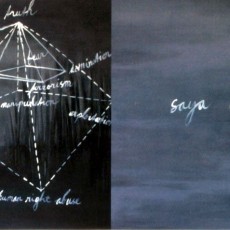
Saya Cinta Kamu, 2005, Acrylic on canvas, 100 x 130 cm x 2.
“Saya Cinta Kamu”, 2005, Acrylic on canvas, 100 x 130 cm x 2.

Arahmaiani’s exhibition, entitled Lecture on Painting, Part I, accompanied by photographs by Bernice Chauly, will be on display at Vallentine Willie Fine art from 24 August 2005 to Saturday 10 September 2005.

The artist will give a talk on her work on Saturday, 3rd SEPTEMBER, 2005, at 3.30 pm. Tea will be served.

Vallentin Willie Fine Art,
1st Floor, 17 Jalan Telawi 3
Bangsar Baru
59100 Kuala Lumpur
Malaysia
Tel: 60 3- 2284 2348
Fax: 60 3- 2282 5190
rachel@artsasia.com.my
www.artsasia.com.my
Southeast Asian Paintings & Works of Art

Gallery & resource room opening hours Monday – Friday: 12 noon – 6pm. Closed on Sundays and public holidays.

About the artist:

Coming soon to VWFA is one of Indonesia’s most outstanding contemporary artists, Arahmaiani (b. Bandung, W.Java, 1961). Working mainly in performance and installation art since the early 80s, Arahmaiani has gained an international reputation for her often provocative work. Her Indonesian
roots, Western art training and humanist concerns has bought Arahmaiani to numerous exhibitions and performances, ranging from those held directly in streets protests in Indonesia, contemporary art museums in Asia, Europe and America, and notably to events as such as the pretigious 50th Venice
Biennale 2003 and the “Breaking Words” Performance Art Expo in Nagano, Japan (2004). More recently, Arahmaini has been working on art and social projects in Kuala Lumpur and Germany.

For her first solo exhibition in Malaysia, Arahmaiani will use this private gallery as a platform to question the mechanisms and politics that govern the making and selling of art. As the artist aptly puts it “I am not against the market, but I hate market fundamentalism, exploitation, monopoly – market terrorism!” To express this delicate negotiation between her needs and personal journeys as an artist with the pressures of mass consumerism, the artist will present a series of painted diptychs and also give a performance. “I want to turn the medium of painting into performance. I want to transform the individual ‘product’ of painting for the commercial art world into a complex question of authorship and its marketability”. Photographs by Bernice Chauly of Arahmaiani’s performance ‘body/text’ will also be on view.

More information on Arahmaiani please visit, http://universes-in-universe.org/eng/islamic_world/articles/2003/arahmaiani.


Ahmad Osni Peii

Ahmad Osni Peii
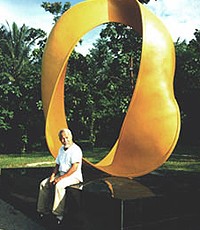
Pak Ahmad and his creation.
Pak Ahmad and his creation Sakinah.

Indonesian sculptor Ahmad Osni Peii was resident at Rimbun Dahan for 6 months in ’99 when he returned to Southeast Asia after living in the States for 40 years.

While he was at Rimbun Dahan, he embarked on the creation of several large-scale outdoor sculptures in painted aluminium, which were produced with the help of a team at a studio off-site.

“…This see-through spatio-shell structure is not mathematically formulated as many may assume.  It is simply an intuitive discovery, so to speak, in mathematical sense for I believe all forms created knowingly or unknowingly are not absent of judiciously purposeful plan unless unconsciously or deliberately done, in other words unaccountably playful, cynical or whimsical.  This is not so with my work.  It is a medium discovered, precise and fit, I think, for the theme of ‘formal allegory’, a visual suggestion on harmonious relationship, a Gestalt, between ‘things’ as a whole in unity, rhythm, order, contrast, balance, proportion, to name a few, just as one would reflect on or appreciate the unarbitrary composition of all immeasurably diverse living things interactively created in nature…”

Sakinah (above and below) was the first large outdoor sculpture by resident artist Ahmad Osni Peii to be installed at Rimbun Dahan, in the Bulatan Plong in 1999. Two other pieces — Geliat Nusantara (red piece, below) and Gelang Serai (white piece, below) — were installed in 2005. All three are made of painted aluminium.