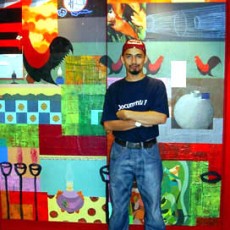
Work by Ahmad Shukri at the Singapore Contemporary Arts Fair, 2002.
Ahmad Shukri’s work for the Rimbun Dahan residency is as profuse and multi-layered as a tropical garden. The artist will exhibit paintings, installations and a large drawing on canvas, all in his highly decorative and richly referential style.
Out of the explosion of work in his studio he identifies four major series. Two installations of ‘incubators’, structures filled with hundreds of white and black plaster eggs, draw on the yin-yang concept to suggest the inevitably heterogeneous nature of the world. As Shukri puts it, within a hundred white eggs there will be a black egg, and vice versa.
The ‘people’s forum’ (sidang rakyat) installation consists of multiple pairs of boxing gloves cast in plaster and set atop a low table covered in a patchwork of textiles. For Shukri, the boxing gloves represent the sparring of politicians, while the textiles are the backdrop of unresolved and perhaps unresolvable situations against which their competitions take place.
A series of diskettes embedded in perspex sheets and overlaid with resin and silk-screen printing point to the irresistible spread of technology, which he sees as again neither wholly good nor bad but always composite. In the voyager series of paintings nature and culture morph into each other: the blades of a ceiling fan echo the petals of a flower and a chicken appears both as a living animal and as a child’s plastic toy. Whereas the installations illustrate socio-political conditions as Shukri sees them, he describes the paintings—featuring paper boats and planes, dragonflies, butterflies, cartoon characters, scrawled scraps of text—as diaries, eclectic personal records of memory and experience.
Many of the motifs—the eggs, the chickens, the fabrics representative of Malaysia’s main ethnic groups, the diskettes—are familiar from Shukri’s previous work, but for the artist the significance of these images is inexhaustible and ever elusive. A thread running through Shukri’s work in this exhibition is precisely this multivalent eloquence of objects: a loosely sketched rabbit in one painting alludes to the rabbit-breeding business started by a friend of the artist, whereas the origami rabbit appearing in the same work is suggestive of Japan’s influence on Malaysia.
An interest in texture and textiles and the play of surfaces also underlies Shukri’s work. His canvases are layered with squares of fabric or cut-out numbers, reflecting, he says, the multi-layered nature of the world. Several of the paintings feature scraps of fabric machine-embroidered with bands of thread in subtle gradations of colour. The use of techniques such as these, from outside the strictly traditional artist’s repertoire, as well as the incorporation of images of found objects like coconut husks and flowers, spring from Shukri’s belief that art is embedded in everyday life. The everyday world revealed in Shukri’s work is one of vibrant, chaotic and constantly changing multiplicity.
‘There is but one truly serious philosophical problem, and that is suicide. Judging whether life is or is not worth living amounts to answering the fundamental question of philosophy’ Albert Camus
‘old Death
Shall dream he has slain me, and I’ll creep behind him,
Thrust off the bloody tyrant from his throne
and beat him into dust, or I will burst
Damnation’s iron egg, my tomb, and come
half damned, ere they make lightening of my soul,
And creep into thy carcase as thou sleepest
Between two crimson fevers, I’ll dethrone
the empty skeleton, and be thy death’. Thomas Beddoes
Enid Ratnam Keese is well known in Australia for her printmaking and her drawing. Her prints in particular are greatly admired and figure in our public museum collections. In the light of these new paintings it is worth considering this background. Printmaking has long been a neglected practice in international contemporary art. But it is often precisely in those areas of apparent neglect, removed from the fashion of the moment, that a great deal of the more interesting thought takes place.
In this exhibition of paintings, constructed in three sections: Connections, Requiem and Out of the nine month midnight ( a line from Walt Whitman), Enid has brought a great deal of the sequential and fragmented nature of the imagery of her printmaking to bear on the subject matter of the paintings. The process of layering images in sequence and allowing for their ambiguous juxtapositions to act on the viewer independently of the general narrative text of the image is much more common in adventurous print works than in painting. In this way Enid has brought a fresh approach to the construction of these images that belie the conservative choice of painting as their media. She has also deployed her images so as to reference numerous icons from the history of western painting: the Birth of Venus, the fish and the cross are part of Western Christian repertoire. Even the manner of isolating the garment of the Kebaya recalls modernist iconography, in the bathrobes of Kim Dine for example.
However these images escape easy associations, for as a Malaysian woman resident in Australia she represents the most interesting contemporary visual phenomena of cross cultural pluralism exemplified by the Asia Pacific Triennial, whose second incarnation will take place in Brisbane later this year. In these paintings she speaks of the difficulties of acceptance in your culture of origin and of the displacement of your culture of acceptance. She is placed in a zone of production where her work could be perceived to be not really Malaysian and not really Australian.
This state of hybridity is characteristic of art itself today, in which significant work arises within the region of this collision of cultures. Previously Enid dealt with these issues through an analysis of the way we gained our perceptions of the Gulf War through the images of satellite television. Her fascination with periods of the human horrors of war are intriguing and ever prescient. At the end of the century art is witness to the excesses of our deterioration as a species. Perhaps it is only in this kind of cross cultural art practice that we see the possibilities for hope and even survival.
Enid’s work has always dealt with signs of the body, particularly the female body. In these paintings she uses the distortion of the body to symbolise the status of sensation within. For her in these paintings the body is absent, but present through its exoskeletal sign of the traditional Malaysian women’s costume of the kebaya. The distortion is both representative of the subjugation of the gendered body from without (the impositions of society on women) and indicative of the distortions of the sensations and aspirations of the person as individuated subject. The body here disappears in this space, crushed as it is between the emotive aspirations of placement from within and the socially driven control imposed from without.
In these paintings the shredded form of the traditional dress wavering under the tension of the space becomes a powerful and resonant image at odds with its historical context. The Kebaya is here depicted as a sinuous set of veins pulsing and contorting both the presence and absence of the human figure. This presence, defined by the metonomic use of the kebaya as icon of traditional culture acts as guardian against reductive gestural expressionism. It has been observed that metonomy, unlike metaphor, is based on a sequential link between the object and its replacement, ‘the record of a move or displacement from cause to effect, container to contained, thing seen to where it was seen, goal to auxiliary tool’. In these paintings metonomy takes the form of the absent or repressed images of memory and displacement.
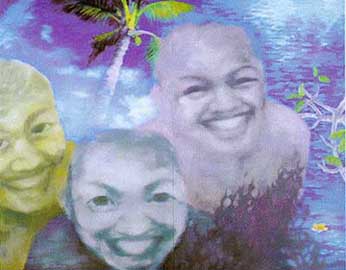
In the large triptych paintings of the series titled “Out of the nine month midnight”, the nine months represent on the one hand the duration of Enid’s residency and the gestation time for both the paintings exhibited here, and on the other the period of solitude experienced by every human child. One triptych titled “Lament for a Solo Performer” has the image of a rock precariously suspended above an egg held outwards by its nurturing hand/cradle. This image recalls Samuel Beckett’s description of life as being the “womb suspended above the tomb”. In this large and impressive painting the landscape is at once solid in its colour and turbulent like a lake of molten rock in which faces loom up from beneath the surface only to disappear like images in the memory. Seated to the left of the painting clutching a hand full of flowers is a figure cut by a mouth that literally slashes the distorted face leaving in its wake a razor like trace.
The ambiguous images that surface from this at times almost violent brushwork evoke a melancholic search for the lost, the loss of identity and of definition of one’s ability to write oneself into culture. Through metonomy Enid forces the viewer back to a re-reading of these sign as though for the first time. The desolate disillusion of the space between is the metier of these paintings. They speak to that hallucination of the will of the other. We want to imagine that we can summon the object of our desire at will, but desires are never determined, they are received.
Donald Fitzpatrick
1995-96 Visiting Scholar in Fine Arts
Queensland College of Art
Griffith University



 Out of the explosion of work in his studio he identifies four major series. Two installations of ‘incubators’, structures filled with hundreds of white and black plaster eggs, draw on the yin-yang concept to suggest the inevitably heterogeneous nature of the world. As Shukri puts it, within a hundred white eggs there will be a black egg, and vice versa.