Gabrielle Bates

Gabrielle Bates

Malaysia-Australia Visual Artist Residency 2007

BatesG1The 2007 Australian artist in residence at Rimbun Dahan is Gabrielle Bates (6. 1967). An honors graduate from the University of Sydney, New South Wales, she has exhibited professionally since 1993 and is the recipient of a number of awards, grants and residency placements. Gabrielle’s works have been acquired for corporate, institutional and private collections in Australia, UK, USA and Malaysia.

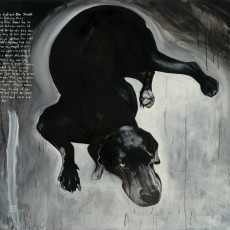
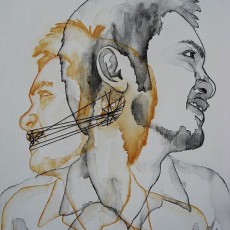
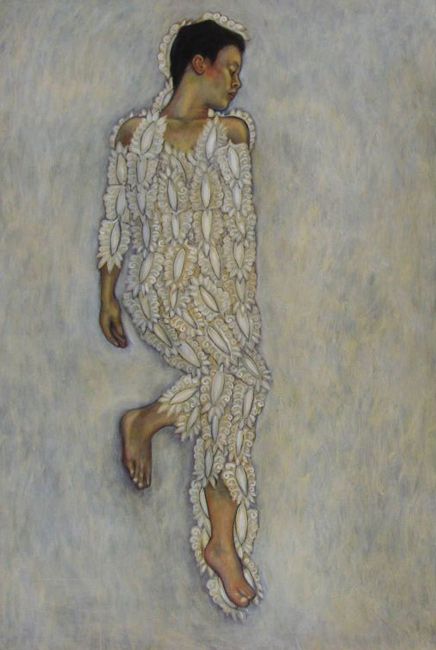
‘Mouth of flowers’ is Gabrielle’s new body of experimental paintings, objects and video work produced this year while in residence at Rimbun Dahan, Kuala Lumpur. Gabrielle’s exploration of patterns and figuration has produced a series of canvas-based works that combine water colour, Rimbun Dahan pond water, hand-embroidered nylon thread, Chinese ink and synthetic polymer paint. The works combine Southeast Asian motifs, signage and local media with figuration to explore the political and poetic subtleties of life for artists in Malaysia and southeast Asia.

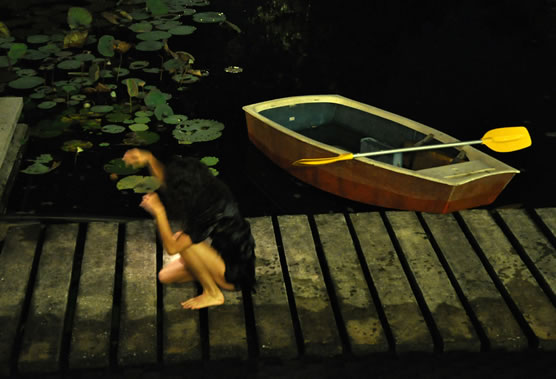
Artists such as Saiful Razman, Noor Mahnun Mohamed, Husin Hourmain, Donna Miranda, Ahmad Fuad Osman, Shaffudin Mamat, Low Shee Hoe, Lau Mun Leng and Bilqis Hijjas have all posed for Bates during her residency. In turn, she has transformed them into players within a fictional narrative that circles the conflicts, anxieties, insights and advantages of (self) censorship.

Her objects, collected from the ordinary Kelompang jari (Sterculia foetida) pods, have been reconfigured with nylon thread and decorative elements such as sequins and velvet appliqué, morphing the pods into a collection of anthropomorphous objects.

Gabrielle presented ‘Mouth of flowers’ at the 13th Rimbun Dahan Residency Exhibition, alongside the work of Malaysian resident artist Ahmad Fuad Osman, 13 to 27 January 2008, at the Rimbun Dahan gallery.

The elasticity of a golden thread

by Gina Fairley

Our lives are filled with pattern: The patterned regimentation of our actions; our personal ‘style’; the family that frames us; our cultural fabric; conservatisms and beliefs. We wear an invisible code that defines who we are, our DNA. Collectively, this is ourpattern.

Gabrielle Bates has long used quasi-ethnographic motifs as a device to transfer information about the people she paints. In her earlier portraits the sitter reverberated across the canvas, floating on a flat colour field. Like a print slightly out of register, their ghost-like repetition, or flaw, reaffirmed their humanity. Bold black outlines held their pattern allowing us to decode who they might be.

While these early portraits offer a clear trajectory to these new works, the “Mouth of Flowers” series comes from a very different position: psychologically, emotionally and culturally. Their patterning goes beyond a descriptor to physically consume the form. The body and pattern have fused as one.

Malaysia’s hybridity makes an indelible impression on every artist visiting Rimbun Dahan. For Bates that engagement was filled with multiplicity: it offered an organic tangibility to the work spawned from its bounty of pods, natural patterns and pond water; it provided the solitude to rediscover embroidery, sewing a personal and emotional narrative; and it offered the gift of insight, journeying beyond perceptions.

Finding Malaysia’s pattern is complex. At an elementary level it lies in its graphic traditions of batik, henna decoration and Islamic geometry. At a cerebral level it is the patterning of socio-political / religious striations of a nation at a time when it is asking ‘what is its contemporary identity?’ Bates’ work traces a thread across these ideas, oscillating between reverie and bounce. Remove the exotic ‘pattern’ and it is a narrative caught in a web of time, territory and transition.

Bates found this narrative in a coterie of artists, dancers and musicians who explore the peripheral through their creativity. The narratives are dense but less self-effacing; the ‘outlines’ have become diffused. She replaces ethnographic patterning with a floral fragility, caught between romantic apparition and an earthy reality. Often clothed in little more than an organic epidermis, her players are exposed. But these characters are not vulnerable. If we look at the painting “Armour”, banana flowers (bunga pisang) rise up like a noxious weed, beautiful but threatening, clutching at a woman’s neck rendering her speechless. But she does not turn away; her gaze does not flare in distress – it is a knowing censure.

In “Stir” she sleeps enveloped by the same flowers. Is it the peace of submission, death or sleep? Is she weightless or weighted by her floral shroud? Paired with a mirror-image caught between cartoon and apparition, it sits against a brave white ground acting as a stark alter-ego to the velvety, painterly background of the sleeping figure. It is a kind of intermezzo between figuration and the ephemeral.

“KL-ing me softly” is equally charged from the outset, challenging protocols and permissions. But there is an inherent softness that sits counter to any overt act or statement. It mixes memory and ambivalence with a restless exoticism. These works are about a visual psychology. Just as a Rorschach drawing triggers association but has no one reading, Bates has moved beyond the clarity of descriptors to an elasticity of meaning. She pushes us beyond the desire to translate and give over to poetic nuance.

The materials of these new works take on a symbolism we have not seen before. Her stitched portraits have a latent violence or emotional trigger. The act of piercing the surface of a painting has that same duality as a tattoo; it is branding and an aesthetic expression. “First cut” captures this tension, the thread’s assertive lines slashing the canvas. The figure turns from himself but is denied a freedom, anchored by his own voice. Rendered speechless, we ask who has the power of censure over this voice? Caught in the strain between a sewn and brushed mark, it is a courageous embrace of new materials.

Bates similarly plays off the organic purity of seed pods against lurid plastic flowers and synthetic thread. The pods disgorge their floral centres, over-ripe with fleshy fertility. These are incredibly sensual objects that Bates lashes into control. The synthetic materiality of the flowers beg the question, are we fooled by beauty? It is another veil seemingly ‘natural’ yet contrived, controlled and plastic?

Many of these works teeter on the edge where things are raw and flirt with the unknown. To quote writer John Barrett-Lennard, “Accent can be thought of as a kind of excess, a disturbance in the smoothness of sound and communication.” (1.) An accent, like a pattern, has a personal intonation. It is about reading between the lines; it is the place of hyphens. Sometimes it is barely audible; sometimes it has the gentleness of a lover and at others the affirmation of belief. “Mouth of Flowers” is a place to hear things.
Gina Fairley

1. John Barrett-Lennard “Here and Now” catalogue essay for Simryn Gill, PICA exhibition, Perth 2001.


Helen Bodycomb

Helen Bodycomb

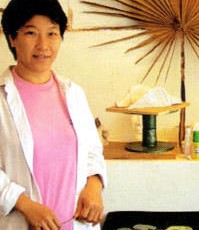
Helen Bodycomb of Castlemaine, Australia, had a residency at Rimbun Dahan in 2006. She returned to Malaysia in 2009 with three other mosaic artists to work on the collaborative artwork ‘The Shyness of Trees’ at Hotel Penaga.

Bio

Helen Bodycomb moved to the Castlemaine area in late 2007 from Melbourne, where she had lived on and off for almost 30 years. Born in Adelaide and raised as a young child in Elizabeth (SA), she went to Uni High and later – to art school – in Melbourne. She completed a BA in Fine Art (majoring in Painting) at Victoria College, Prahran and then a Post-Graduate Diploma at Monash Uni. See http://www.helenbodycomb.com/


Arahmaiani

Arahmaiani
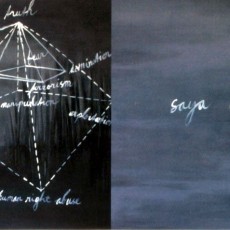
Saya Cinta Kamu, 2005, Acrylic on canvas, 100 x 130 cm x 2.
“Saya Cinta Kamu”, 2005, Acrylic on canvas, 100 x 130 cm x 2.

Arahmaiani’s exhibition, entitled Lecture on Painting, Part I, accompanied by photographs by Bernice Chauly, will be on display at Vallentine Willie Fine art from 24 August 2005 to Saturday 10 September 2005.

The artist will give a talk on her work on Saturday, 3rd SEPTEMBER, 2005, at 3.30 pm. Tea will be served.

Vallentin Willie Fine Art,
1st Floor, 17 Jalan Telawi 3
Bangsar Baru
59100 Kuala Lumpur
Malaysia
Tel: 60 3- 2284 2348
Fax: 60 3- 2282 5190
rachel@artsasia.com.my
www.artsasia.com.my
Southeast Asian Paintings & Works of Art

Gallery & resource room opening hours Monday – Friday: 12 noon – 6pm. Closed on Sundays and public holidays.

About the artist:

Coming soon to VWFA is one of Indonesia’s most outstanding contemporary artists, Arahmaiani (b. Bandung, W.Java, 1961). Working mainly in performance and installation art since the early 80s, Arahmaiani has gained an international reputation for her often provocative work. Her Indonesian
roots, Western art training and humanist concerns has bought Arahmaiani to numerous exhibitions and performances, ranging from those held directly in streets protests in Indonesia, contemporary art museums in Asia, Europe and America, and notably to events as such as the pretigious 50th Venice
Biennale 2003 and the “Breaking Words” Performance Art Expo in Nagano, Japan (2004). More recently, Arahmaini has been working on art and social projects in Kuala Lumpur and Germany.

For her first solo exhibition in Malaysia, Arahmaiani will use this private gallery as a platform to question the mechanisms and politics that govern the making and selling of art. As the artist aptly puts it “I am not against the market, but I hate market fundamentalism, exploitation, monopoly – market terrorism!” To express this delicate negotiation between her needs and personal journeys as an artist with the pressures of mass consumerism, the artist will present a series of painted diptychs and also give a performance. “I want to turn the medium of painting into performance. I want to transform the individual ‘product’ of painting for the commercial art world into a complex question of authorship and its marketability”. Photographs by Bernice Chauly of Arahmaiani’s performance ‘body/text’ will also be on view.

More information on Arahmaiani please visit, http://universes-in-universe.org/eng/islamic_world/articles/2003/arahmaiani.


Choy Chun Wei

Malaysian Resident Artist 2005

Choy Chun Wei is enjoying his time playing the “collector” and the “engineer” in Rimbun Dahan. Look around and you will find his workspace populated by jars and tubes of paint in different degrees of exhaustion, while piles of unidentifiable junk and a plethora of paraphernalia lay scattered across the floor. When I visited his studio recently, he tells me “I still return to the city to collect all this junk”. The process of collecting and constructing, or building, forms the root of Chun Wei’s artistic approach. Whether in the form of photographs, paint, ink, or other found materials, the potential in each of the artist’s materials will be stretched out, deconstructed, reconstructed and layered to present unique views of life within an urbanscape. Those familiar with Chun Wei’s body of work will recall his early photo-collage series such as Citadel and Link House from 2001. They were the result of a morning ritual whereby the artist would walk with his camera to work, photographing random exteriors of homes in Bandar Utama to relieve the monotony of this routine. The collection of photographs captured from these walks later grew into a series of musings about home within our fragmented urban environment seen through the eye of an outsider.

In his latest series, Construction Site, paint and found materials have replaced photographs to become the building blocks in the artist’s work. He tells me that every single paint mark and object is treated as an individual units, “like Lego blocks”, built layer upon layer, one over the other. Each work begins with the overlaying of paint onto the surface ground in broad sweeps. “I rarely know what is going to happen during the early stages so I just let it happen.” Once these initial sweeps have been established, ‘units’ of paint and materials are incorporated into and over the initial foundation through the use of a diverse range of tools – hands included – as well as other media to create a spectrum of marks and textures. It is clear, through this new body of work, that the artist has discovered a more instinctive and energetic process in creating image and texture; there is an obvious sense of play, as well as a newfound confidence in distilling the images to near abstraction.

The urban landscape and mapping continue to figure prominently in Chun Wei’s work. The ritual of returning to the city to collect the artist’s ‘junk’ bears poetic resonance in the artist’s dedication to his subject matter. While his mapping process may have begun within the immediate confines of Bandar Utama, his concerns have since extended into farther reaches, taking on a wider worldview beyond geography and tangible matter. Perhaps this development has been prompted by changes in the artist’s personal life. Marriage and moving out to a new home has shifted his outlook on life; he is no longer the wandering outsider looking in, but rather someone who has found hearth and home.

Construction Site begins with The Construction of Metaphysical Site I. While the spatial arrangement in this painting may appear conventional to the eye, it is nonetheless striking in its composition and form. It recalls the imaginary maps many of us would have drawn during childhood. Colours and simple geometric shapes are employed to demarcate different territories and densities while incidental marks may imply roads, railway tracks or borders. The Construction of Metaphysical Site II suggests a fantastical yet apocalyptic cityscape alluding to Italo Calvino’s Invisible Cities. Vertical forms, or monoliths, grow from opposite directions; they weave in and out of the dramatic foliage, moving towards each other, drawing closer to convergence.

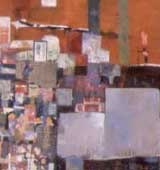
Subsequent works such as The Changing Mindscape, Intimate Dwelling Site and Configuration l, demonstrate to the viewers that the spatial configuration in each painting has grown progressively tighter and denser through the course of development. The drama and density of this series culminates in the epic Big Dwelling Site. Impressive and intense, the painting’s expanse and tight overlapping layers of paint and found materials overwhelm the senses. The eye picks out the random details and unexpected textures as it roves through this dense forest of marks and colours; you will find bits of corrugated board here, unidentifiable slices of plastic and dried materials there, a shaved off bar code somewhere above. The painting possesses a cubistic resonance as the artist breaks up the picture plane to create multiple perspectives. They also remind us of Mondrian’s earlier paintings where grid and lines form the artist’s primary motives. Spaces move in and out, shifting from two-dimensional to three-dimensional planes, taking our eye on a manic ride through tightly wound nooks and crannies, before launching into exhausting claustrophobic areas that slowly ease off towards the edges.

Configuration lll (Breathing Space), one of the later pieces, sees the artist side-stepping his usual media employed in this series. It is perhaps the most carefree piece in this body of work, and as the title suggests, this painting provides a beguiling reprieve from the intense concentration of heavy impasto marks and texture. Here, the brush takes over from the palette knife to create a delicate yet intricate web of lines. They float evocatively in space, layered in muted neutral shades, amidst collaged drawings of furniture culled from the pages of an IKEA catalogue. The minimal treatment draws attention to the construction of the image, allowing the visual narrative and emotional content to exude its understated charm.

Adeline Ooi
December 2005, KL

Garden Objects

This is part of a series exhibited in Art for Nature 2005 that delves into the formation of mental maps to explore human dwellings within the landscape. The garden is a place for tactile and sensory engagement, where one may expand sensibility within space. Click on the thumbnails above to view larger images.

Biodata

Choy Chun Wei (b. 1973) is a graduate and full scholarship holder from the faculty of Graphic Design at Central Saint Martins College of Art and Design, majoring in Illustration. He has been actively painting and exhibiting in a number of exhibitions in Kuala Lumpur and won an Honourable Mention at the Philip Morris Malaysia/ASEAN Art Awards in 2003. In 2004, Chun Wei received the Juror’s Choice Award (2D) at the Malaysian Young Contemporaries Exhibition organized by National Art Gallery. He became the artist-in-residence at Rimbun Dahan Artist in Residence Programme in 2005.

See more of Chun Wei’s work on his blog website http://cwconstructionsite.blogspot.com/

Jasmine Kok

Jasmine Kok
Jasmine in her studio at Rimbun Dahan.

Immersed in the richness and complexity of nature at Rimbun Dahan, Jasmine was searching for a dialectic experience with the plants and objects around her.  Obsessed with the regular pattern of the lines and textures on plants, different sizes of leaves were collected as models and cast with plaster of Paris.  Slabs of soft clay were pressed against the plaster moulds to question the ephemeral nature of the objects and things around us, and render the impermanent permanent.

‘Ceramic by its nature cannot escape medium-hood’. For an artist like Jasmine ‘working in a medium so identified with craft-based procedures, her clay sculpture is immediately subject to sustained discussion on its material language’, challenging the perception of the custody of material use and the art forms in contemporary art practice today in Malaysia.

Installation, as the British writer Michael Archer described it, is ‘a kind of art making which rejects concentration on one object in favor of a consideration of the relationships between a number of elements or of the interaction between things and their contexts’.  In Jasmine’s case, her works were a suggestion of scene and environment, which derived from her memories as well as from reality.  The imprinted clay leaves were glazed with color and scattered on fabric, referring to the changing seasons.  For instance, the imprinted lotus leaves of various sizes mimic the green summer water pond.  All these pieces of work bring the connection of the scene from outside to inside, from exterior to interior.  The relationship of human to nature was revealed through Jasmine’s intellectual interest, her participating in nature and sharing that experience with others.

Stone carving, like clay forming, is a slow and time consuming process.  The physicality of force and the gradual changes of surface and shape were important to Jasmine and can be seen in her stone sculptures.  Inspired by the curved and pointed elegance of the Jade Vine flower, Jasmine used marble to reinterpret her chosen subject through the physical process of carving.  The smoothness and reflective nature of the marble was tarnished, the solid surface was opened and revealed by force.  The original shape of the Jade Vine was copied, altered and magnified.  The meaning of the work lies not in the work itself but in our attitude towards the art work.

Jasmine Kok’s work ‘does not reproduce what we see, it makes us see’.  Her intention is not simply about recording the natural world but in transforming an object, a space and environment into something profound and intellectual.  The work offers a fresh vision to her and to the viewer.  The perceptual knowledge about the place around her, about things and objects she encounters and feels, are shown through her sculpture and installation works in a stage of ‘metaphysics concerned with the nature of existence’.

During her studies in London, Jasmine participated in an organization called ‘Art Express’, where she  taught wood and stone carving within the community for several years.  She was also involved in art therapy projects with problem children and the homeless, and the feedback was positive.  She had some special experiences working with other artists from different countries while in London, and shared different culture experiences when working in the quarries and sculpture parks.

In the past, Jasmine Kok’s sculpture was primarily figurative, but since her residency in Rimbun Dahan, her art practice has embarked on a whole new journey by exploring nature and different materials.  The artist in residence programme allowed her to explore new perceptions within her art, while assisting her to develop and understand the arts of her homeland.

Biography

Jasmine Kok Lee Fong

Date of birth: 28th October 1970

Nationality: Malaysian

Address: C109, Kampung Kundang, 48020 Rawang, Selangor, Malaysia.

Telephone:  0060-3-60341398 / 013- 639 9831

Email: rollingjas@hotmail.com

Education

1993: Diploma in Fine Art (Painting), Kuala Lumpur College of Art (KLCA).

1995 – 1996: Second year BA in Fine Art, University of Wolverhampton.

1996 – 1998: Diploma in Fine Art Sculpture, City and Guilds London Art School.

1998 – 1999: Stone Carving Course, City and Guilds London Art School.

1999 – 2002: MA in Fine Art, City and Guilds London Art School.

Solo Exhibition

August 2002 : Pain and Injury, Broken Spine Series, Life performance at Kennington Sovi Art Centre, London.

Mixed Exhibition

October 1984: The Second Asean Exhibition of Children’s Art at Malaysian National Art Gallery.

April 1993: Life Drawing & Oil Painting Exhibition at KLCA.

May 1993: “Earth Day” Performance Art at Central Market, Kuala Lumpur.

July 1993: Fine Art (Painting) Diploma Exhibition at KLCA.

May 1996: Sculpture Exhibition at Victoria Street Art Gallery, Wolverhampton.

May 1997: Sculpture Exhibition at Lumsden Art Gallery, Scotland.

June 1998: Find Art (Sculpture) Diploma Exhibition at City & Guilds London Art School.

September 2000: Fine Art (Sculpture) Exhibition (First Year MA) at City & Guilds London Art School.

September 2002: Fine Art (Sculpture) Exhibition (MA) at City & Guilds London Art School.

February 2004: Artist Residency Exhibition at Rimbun Dahan, Malaysia.

Awards

1984: The Second Asean Exhibition of Children’s Art, Manila, Philippines.

2003-2004: Resident Artist, Rimbun Dahan, Malaysia.

Jean Weiner

Jean Weiner

Visual artist Jean Weiner was the Australian resident artist in the year-long Malaysia-Australia Visual Arts Residency at Rimbun Dahan in 2002.

The scientist does not study nature because it is useful. He studies it because he delights in it, and he delights in it because it is beautiful.
Jules-Henri Poincaré

Jean_at_work

Jean Weiner’s bold, organic, painted surfaces play on the ambiguity between abstraction and realism, and between art and science. The works are abstract, yet are also re-presentations of physical reality. They are a fusion of art and entomology: an in-depth look at colours and patterns of butterflies, moths and beetles, enlarged so that they impact upon the senses.

The artist’s aim is to encourage the audience to become aware of their physical, intuitive and emotional responses to colour and pattern. To encourage this embodied meditation between a composition and its audience, the artist employs a wet-on-wet technique of blending oil colours through the use of a variety of fine brushes in order to produce his signature-style blurred borders and smooth finishes. This technique arrests focused vision, invoking a momentary feeling of chaos, but ultimately invites a new sense of ‘alive calm’.

Jean Weiner is particularly versed in his subject, bringing together in an interdisciplinary approach: a Master of Art in painting; a Bachelor of Arts in philosophy, for which he received first class honours; and his work as the honorary curator of foreign lepidoptera (butterflies) at the Australian Museum. Like the new theories in science and philosophy, the artist’s practice demonstrates the interconnectedness of both natural and cultural life. His works especially resonate with Chaos Theory’s ‘Butterfly Effect’. This environmental notion of the beating of an insect’s wing in one hemisphere having, through a web of events, possible catastrophic outcomes in another, becomes in the artist’s work a statement of hope, a way of exploring new ways of being. Just as the natural world is interrelated, so are cultures: as an Australian of Czech and French origin who has lived and practised in Sydney, Asia and Europe and exhibited internationally, he lives and celebrates this (bio)diversity.

Ultimately, Jean’s art is about wonder; it reminds us that the world, even in its smallest detail, is extraordinary.

Jean’s work has received growing recognition and acclaim through university conferences, judged and curated exhibitions, government and philanthropic grants, artist residencies and public collections. His paintings have been exhibited in museums and galleries in Sydney, Los Angeles, New York, Aix-en-Provence, Paris and Kuala Lumpur. Recently he was selected by the National Art Gallery of Malaysia to participate in the Alami II Science/ Art conference at Mt. Kinabalu as part of UNESCO’s international year of the mountain. The artist’s upcoming exhibition will show the work – based specifically on Malaysian butterfly, moth and beetle species – that he has produced during his year-long artist residency at Rimbun Dahan.

Paint not the thing, but the effect it produces…
Mallarmé

Ahmad Shukri Mohamed

Ahmad Shukri Mohamed
Work by Ahmad Shukri at the Singapore Contemporary Arts Fair, 2002.

Ahmad Shukri’s work for the Rimbun Dahan residency is as profuse and multi-layered as a tropical garden. The artist will exhibit paintings, installations and a large drawing on canvas, all in his highly decorative and richly referential style.

Shukri_eggsOut of the explosion of work in his studio he identifies four major series. Two installations of ‘incubators’, structures filled with hundreds of white and black plaster eggs, draw on the yin-yang concept to suggest the inevitably heterogeneous nature of the world. As Shukri puts it, within a hundred white eggs there will be a black egg, and vice versa.

The ‘people’s forum’ (sidang rakyat) installation consists of multiple pairs of boxing gloves cast in plaster and set atop a low table covered in a patchwork of textiles. For Shukri, the boxing gloves represent the sparring of politicians, while the textiles are the backdrop of unresolved and perhaps unresolvable situations against which their competitions take place.

A series of diskettes embedded in perspex sheets and overlaid with resin and silk-screen printing point to the irresistible spread of technology, which he sees as again neither wholly good nor bad but always composite. In the voyager series of paintings nature and culture morph into each other: the blades of a ceiling fan echo the petals of a flower and a chicken appears both as a living animal and as a child’s plastic toy. Whereas the installations illustrate socio-political conditions as Shukri sees them, he describes the paintings—featuring paper boats and planes, dragonflies, butterflies, cartoon characters, scrawled scraps of text—as diaries, eclectic personal records of memory and experience.

Many of the motifs—the eggs, the chickens, the fabrics representative of Malaysia’s main ethnic groups, the diskettes—are familiar from Shukri’s previous work, but for the artist the significance of these images is inexhaustible and ever elusive. A thread running through Shukri’s work in this exhibition is precisely this multivalent eloquence of objects: a loosely sketched rabbit in one painting alludes to the rabbit-breeding business started by a friend of the artist, whereas the origami rabbit appearing in the same work is suggestive of Japan’s influence on Malaysia.

An interest in texture and textiles and the play of surfaces also underlies Shukri’s work. His canvases are layered with squares of fabric or cut-out numbers, reflecting, he says, the multi-layered nature of the world. Several of the paintings feature scraps of fabric machine-embroidered with bands of thread in subtle gradations of colour. The use of techniques such as these, from outside the strictly traditional artist’s repertoire, as well as the incorporation of images of found objects like coconut husks and flowers, spring from Shukri’s belief that art is embedded in everyday life. The everyday world revealed in Shukri’s work is one of vibrant, chaotic and constantly changing multiplicity.


Helen Crawford

Helen Crawford