Art for Nature 2005: The Power of Dreaming: Taman Sari, Gardens of Delight & Identity

Art for Nature 2005: The Power of Dreaming: Taman Sari, Gardens of Delight & Identity

WWF_invite_out

This year’s Art for Nature exhibition takes its concept from the gardens of Taman Sari, originally located in the palace grounds of the Sultan of Yogyakarta, and the fragrance garden of the same name at Rimbun Dahan. Both gardens represent the physical manifestation of a set of ideas about man, their place in the world and how they should interact with other humans and with nature.

Taman Sari in Yogyakarta is a vast complex that includes three large swimming pools, water gardens, lakes and pavilions. Built in 1758 by Sultan Hamengku Buwono I of the Kingdom of Yogyakarta, the project was funded by the Dutch, ostensibly to serve as a fort. While seeming to fulfill this project, the Sultan instead focused on augmenting his grounds and strucafnlogoturing the gardens to amplify his spiritual power.

Legend has it that the power of the Sultan is linked to his mystical marriage to the Queen of the South Sea, variously known as Ratu Laut Selatan or Nyai Loro Kidul. The days and nights preceding their union are marked with rituals and meditation in especially constructed chambers. Should he fail to appear, then harm will befall Java. Taman Sari, then, served as no less than a sacred site to facilitate the harmony of the Kingdom.

In a more personal vein, Taman Sari at Rimbun Dahan was built to express many of the ideas that their owners hold dear. Specifically, the concept that indigenous plants and their symbolic, medical, fragrant and edible qualities must be preserved and celebrated inspired the collection. Plants with a strong sense of cultural identity, such as the pinang palms from which the betel nuts integral to traditional hospitality, are features. Fragrance, rather than colour has been emphasized as that is how plants advertise their fertility in the forest. Laid out to provide sustenance, pleasure and a sense of place, Taman Sari at Rimbun Dahan makes visible the ideas that its owners direct their lives by.

Most importantly, the gardens underscore concepts about place, identity and purpose. Their integration and reliance on the natural world is key. Areas to focus on can be how ideas translate into action, how concepts of self, spirituality and community can be expressed in a creative form, whether or not that is two, three or even four dimensional.

The focus on the gardens is not meant to be literal, but rather symbolic. Themes may include how a sense of place is created, harmony with the natural world, integration of spiritual dimensions with a more mundane reality.

Artists are invited to spend time at Taman Sari in Rimbun Dahan and to consider making works that can be displayed outdoors.

— Laura Fan, curator

Contributing Artists:

Abdul Multhalib Musa
Ahmad Fuad Othman
Ahmad Shukri Mohamed
Ahmad Zakii Anwar
Akbar.aka.Bebe
Arahmaiani
Bayu Utomo Radjikin
Bibi Chew
Chong Siew Ying
Choy Chun Wei
Chuah Chong Yong
Eric Chan Chee Seng
Fariza Azlina Ishak
Ili Farhana Norhayat
Ilse Noor
Jailani Abu Hassan
Kolektif Taring Padi
Nadiah Bamadhaj
Noor Mahnun Mohamed
Nur Hanim Mohamed Khairuddin
Noor Azizan Rahman Paiman
Raja Shariman
Ramlan Abdullah
Saiful Razman
Sharmiza Abu Hassan
Terry Law
the clickproject
Tony Twigg
Umibaizurah Mahir
Wong Perng Fey
Yau Bee Ling
Yee I-Lan
Yusof Majid
Victoria Cattoni
Vincent Leong
Zulkifli Yusof
Terry_Law G of D (Garden of Delight) in a Digital AgeTerry LawThe Garden of Delight, the G of D, has arrived in an abstract world of symbols and metaphors. This multi-media installation explores what unites landscape and nature with contemporary perspective, and contemporary perspective with technology.

The kinetic sculptures draw parallel messages from nature and humanity. The diversity of the garden with its variability, eco-dependence and unpredictability, exemplifies the mysterious order of chaos, reflecting the fragility of our existence.

The digital media creates parallel insertions, conflicting images and links between worlds. The absence of a narrative reduces visual activity to optical poetry. This suggests a shift in the way we think about space and time.

Coloured beads and streaks of flickering light create a rhythmic staccato of warm and cool spots, you no longer know where you are, transported to these new experiences of the soul.

 Victoria_Cattoni tree – Victoria Cattoni (in collaboration with Masnoramli Mahmud)tree is a montage of image, sound, text and performance structured around a simple question: ‘if you were a tree, what kind would you be?’ The video acts as an imaginative trigger, inviting the viewer to identify with a tree that becomes a metaphor for human existence, an embodiment of ourselves in relation to others.
 Eric_Chan Deep NightEric ChanThis is part of a series dealing with night, paying attention to the reflection behind the subject that renders the foreground as a mass of dark shadow-like shapes. My visits to Rimbun Dahan have always been at night, surrounded by a lush moonlit landscape. These memories provided the inspiration for the painting.
 Bayu-Utomo-Radjikin--In-Bet  In Between – Bayu Utomo Radjikin

Gantunglah kami sebelum kamu digantungkan... Contributed for the 2005 Art for Nature fundraising exhibition.
Gantunglah kami sebelum kamu digantungkan… Contributed for the 2005 Art for Nature fundraising exhibition.
Gantunglah kami sebelum kamu digantungkan... – Saiful Razman (in collaboration with Bernice Chauly and Rahmat Haron)This work uses Bernice’s text and Rahmat’s poetry that speak of hopes and dreams. The words have been transferred to the cloth, creating an amulet to symbolise protection against evil.
 Birdwing Thompson Birdwing ButterflyTony TwiggShortly after arriving in Kuala Lumpur, I found a very appealing broken wooden box in Chinatown. Back in the studio, I put it together as an ordinary looking thing that I then tried to liven up with yellow paint. A month or two later, I was on a demolition site and found two pieces of circular something in wood. Back in the studio it was a match for my yellow construction. Once it was together I started wondering if a butterfly might be a solution to the picture, inspired by the Art of Nature show. Bee Ling came to my studio and said that I had a word on my box, and it was butterfly. Next Angela was looking at this piece and said, “Look, a yellow and black butterfly,” just like my work, outside the studio, in the garden. It is Troides aeacus Thompsonii, a male Thompson Birdwing.

The Gardener SeriesYau Bee Ling

My garden does not exist in reality but evolved as a mental picture of those who inhabit it; a garden that oscillates between dream and reality. It changes from a site for self-discovery to a place for cultivating personal vision.

Garden Object Choy Chun Wei

This is part of a series that delves into the formation of mental maps to explore human dwellings within the landscape. The garden is a place for tactile and sensory engagement, where one may expand sensibility within space.

Arahmaiani

Arahmaiani
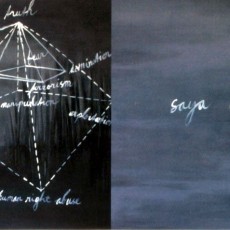
Saya Cinta Kamu, 2005, Acrylic on canvas, 100 x 130 cm x 2.
“Saya Cinta Kamu”, 2005, Acrylic on canvas, 100 x 130 cm x 2.

Arahmaiani’s exhibition, entitled Lecture on Painting, Part I, accompanied by photographs by Bernice Chauly, will be on display at Vallentine Willie Fine art from 24 August 2005 to Saturday 10 September 2005.

The artist will give a talk on her work on Saturday, 3rd SEPTEMBER, 2005, at 3.30 pm. Tea will be served.

Vallentin Willie Fine Art,
1st Floor, 17 Jalan Telawi 3
Bangsar Baru
59100 Kuala Lumpur
Malaysia
Tel: 60 3- 2284 2348
Fax: 60 3- 2282 5190
rachel@artsasia.com.my
www.artsasia.com.my
Southeast Asian Paintings & Works of Art

Gallery & resource room opening hours Monday – Friday: 12 noon – 6pm. Closed on Sundays and public holidays.

About the artist:

Coming soon to VWFA is one of Indonesia’s most outstanding contemporary artists, Arahmaiani (b. Bandung, W.Java, 1961). Working mainly in performance and installation art since the early 80s, Arahmaiani has gained an international reputation for her often provocative work. Her Indonesian
roots, Western art training and humanist concerns has bought Arahmaiani to numerous exhibitions and performances, ranging from those held directly in streets protests in Indonesia, contemporary art museums in Asia, Europe and America, and notably to events as such as the pretigious 50th Venice
Biennale 2003 and the “Breaking Words” Performance Art Expo in Nagano, Japan (2004). More recently, Arahmaini has been working on art and social projects in Kuala Lumpur and Germany.

For her first solo exhibition in Malaysia, Arahmaiani will use this private gallery as a platform to question the mechanisms and politics that govern the making and selling of art. As the artist aptly puts it “I am not against the market, but I hate market fundamentalism, exploitation, monopoly – market terrorism!” To express this delicate negotiation between her needs and personal journeys as an artist with the pressures of mass consumerism, the artist will present a series of painted diptychs and also give a performance. “I want to turn the medium of painting into performance. I want to transform the individual ‘product’ of painting for the commercial art world into a complex question of authorship and its marketability”. Photographs by Bernice Chauly of Arahmaiani’s performance ‘body/text’ will also be on view.

More information on Arahmaiani please visit, http://universes-in-universe.org/eng/islamic_world/articles/2003/arahmaiani.


August 2005 — A Fine Spider

August 2005 — A Fine Spider

The long dry spell has finally broken: there was no rain at all from 26th July until 18th August, a period of 22 days without rain. Hopefully Sumatra had rain too, to quell the peat fires.

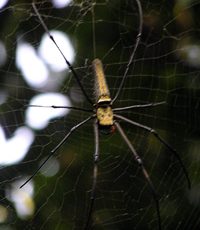
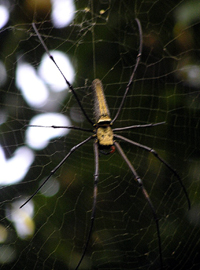
The impressive speciment on the right was seen on a web suspended between two nutmeg trees in Taman Sari, Rimbun Dahan. It is possibly Tetragnatha sp, a large genus containing many long spiders. Tends to be light coloured with a pale yellowish carapace, slightly darker legs, and the abdomen covered dorsally with small closely packed gold or silver coloured plates.

Opening of Collaboration ASEAN, Mager KL-Jogjakarta

Angela Hijjas delivered the opening speech at the opening of this exhibition featuring Malaysian artists from Matahati and Indonesian artists from MIFA Foundation.


Opening Speech by Angela Hijjas

Assalaamulaikum

Tuan Haji Mohd Said Abu, artists, friends:

Thank you for your kind invitation to open this very exciting show.  The work represents a unique collaboration between Indonesian and Malaysian artists executed over an intense one-month period in which the artists have lived and worked together without a break.  They have produced small individuall pieces, and larger works where one artist starts on an idea, and another completes it, and the final collaboration which resulted in the three dimensional sculptures that fill and envelop this space, on which they have all worked.

Everyone agrees that collaborations of artists across national borders are an excellent thing to do, but few really understand why and would actively organise such an event.  I applaud Matahati for taking this initiative, and the Indonesian artists, who with the MIFA Foundaton, raised enough money from their own art practices to finance all the costs involved themselves because they wanted to realise this valuable experience.  Matahati has quite an amazing record of involvement in community arts: another recent event with the National Gallery paired them with school children who were introduced to ideas within contemporary art and helped them to develop their own works.

These are both excellent initiatives to encourage cultural development.  This month-long residency has formed a much closer relationship between Malaysian and Indonesian artists.  Although we share many cultural traditions, it is hard to believe that Malaysia and Indonesia do not have a cultural exchange agreement to improve our common connections.  No doubt this stems from the many difficulties we have had as neighbours in the past, but I think, as is happening with Singapore, it is time to put these differences behind us and to develop the real spirit of ASEAN.

Artists are usually at the forefront of developing new ideas;  they ignore the restraints that hamper the rest of us and take these important initiatives without the sanction of government departments.  Here, I must make a notable exception for Tuan Haji Mohd Said Abu, the Director of Galleri Shah Alam, who has encouraged this project and provided the artists with this most suitable venue to display the results of the residency.

Residencies for artists are important.  They allow artists time to work on new ideas, to mix with new groups of creative people who will help them clarify their thinking and hopefully lead to the creation of new bodies of work for the artist in his own art practice.  New work benefits the community in our search for cultural development, because we draw on artists’ ideas as a means of identifying ourselves and our culture.  Certainly this is true in architecture, where the ideas of artists are sought and drawn upon to develop new approaches to design.  The Telekom tower would not be as significant a building as it is without having had the ideas of Latiff Mohidin as inspiration.

As globalisation makes inroads into our lives, we need to search all the more urgently for our own identity.  Identity is an enormous problem in the face of rapid urbanisation and industrialisation, and now globalisation makes it even more difficult.  If we are going to prevent our young people from being cast adrift with no sense of who they are, other than identified by their religion, then we lose our sense of a multicultural Malaysia.  Religion is important, and culture incorporates religion, but culture also covers the things we do in our creative time, the music we listen to, the paintings we prefer and the books we read.  We need creative people with time to develop new ideas to lead us into a more exciting cultural future than just Play Stations and foreign DVDs.

We must support our artists to develop this new culture, and to do this we need to provide them with places to be creative and to exhibit the results of their work.  They need financial support as well, as there is absolutely no truth in the idea that artists have to starve to produce anything worthwhile.  That is a pernicious lie that somehow we use to justify isolating and ignoring them.

Residencies give artists time, when they can develop new ideas, perhaps just by mixing with other artists and seeing new solutions and new problems.  Stimulating their creativity and allowing them to make the most of their talent is critical, otherwise all that we have invested in educating artists at so many colleges will be wasted.

We Malaysians are exploring a new identity and culture that will be based on traditional values, but it has to change as well to provide a framework for young urbanised Malaysians who are looking for music, paintings, books and plays that reflect and develop their own experience.  We need to invest in our cultural development, we need to invest in our artists to make sure that what we leave behind of our generation amounts to more than an RTM Hari Raya Special version of what the Ministry of Culture thinks Malaysian culture should be.

I think this exhibition shows us the way to go in developing our special version of contemporary southeast Asian culture.  I congratulate the artists from Matahati:

  • Bayu Utomo Radjikin
  • Ahmad Fuad Osman
  • Ahmad Shukri Mohamed
  • Hamir Soib

and the MIFA Foundation artists:   

  • Yaksa Agus Widodo
  • Eddy Sulistyo
  • Agus Purnomo
  • Januri

I hope that the government and the private sector will realise how important it is to support creative people.  They develop our sense of who we are and of our own special culture, and maybe after the election the Ministry of Culture will start its own programme of exchanges and workshops with artists in neighbouring countries.  These artists have shown us the way, now it is up to us to follow.

Thank you, and please enjoy the exhibition.

June 2005 — Dry Season, and Heron Nesting at Tasek Putri

June 2005 — Dry Season, and Heron Nesting at Tasek Putri

BY ANGELA HIJJAS

Concerns about climate change persuaded me to get a rain gauge and I have been tracking precipitation since March. June is always a dry month and this was no exception with a total rainfall of only 59mm. Rain fell on just 6 days, compared with 14, 15 and 16 of the previous three months, and it was concentrated in two of those days when we had 16mm and 37mm. The garden dried out, many trees shed their leaves, but they did not all respond in sync with others of the same species. Only one of the ten Intsia palembanica, a merbau timber tree of the Dipterocarpaceae family, shed its leaves, and the photo on the right shows the new red growth.

Reasons for this typical coloration of new leaves in the tropics vary, but it is plausible that because red leaves have a higher surface temperature than green, the rate of evapo-transpiration and the deposition of nutrients in the new growth is faster, thus ensuring more rapid growth when the leaves are most vulnerable.


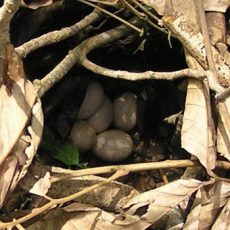
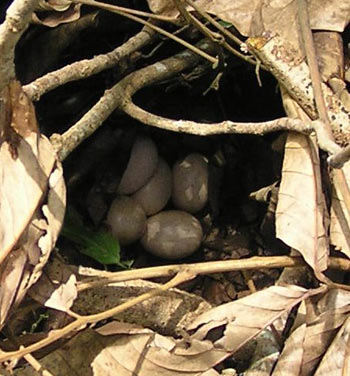
The nesting season is well underway in the heronry at Bandar Tasek Putri to the north of Rimbun Dahan, and west of Rawang. The photo below shows a nest of the black-crowned night heron, one of 39 species identified at the swamp to the left of the access road to the Bandar Tasek Putri housing estate. The developers have built a viewing platform at the roadside for the public to view the birds just meters away, but Selayang Council continues to dump rubbish on the opposite side of this unprotected wetland. Damage to the pandans by the huge numbers of birds is considerable compared with last year, and ultimately the birds will have to move.

The Selangor State government needs to protect similar wetlands to ensure that the birds have alternative sites where they can nest en masse. Birds that nest in isolation, rather than with the huge numbers and species mix at Bandar Tasek Putri, are more vulnerable to predators, hence this preference to nest together. This heronry is believed to be the largest in Peninsula Malaysia and is well worth a visit.

May 2005 — Long-Tailed Macaques

May 2005 — Long-Tailed Macaques

BY ANGELA HIJJAS

We have a large colony of long-tailed macaques in the compound, and they have an interesting social structure. While the adults forage around the trees further afield, they leave the babies in a ‘nursery’ with one or two adults to keep an eye on them. These are not the really tiny ones, but are large enough to play with each other and practice the many skills they will need as adults. One favored location for the nursery is on the ‘assam gelugor’, Garcinia atroviridis, trees outside my bathroom. I think this is because the foliage and branching are dense enough to allow many ready handholds in case of falling. A favorite game is King of the Castle on top of the tree, and as a result the lead shoot is constantly pruned…

Macaca fascicularis or long-tailed macaques, can be distinguished from the langurs by distinctive head shape, more pinkish faces and more muscular bodies. Long-tailed Macaque has the longest tail of any Asian macaque, similar in length to its head and body. Body fur varies from grayish-brown to reddish. In Thailand, these macaques are most common in coastal areas and along large rivers, but farther south they are found in a range of habitats including hill forest, lowland forest, plantations and secondary forest. Diet is omnivorous, including invertebrates such as shellfish or crabs, as well as nestlings, small mammals, fruits and leaves. May become a pest, raiding rice crops, fruit orchards or vegetable gardens and entering towns or houses to scrounge for food. Highly gregarious, being found in troops of up to 70 individuals. Gives birth to a single young after gestation of five or six months. Range is generally south of Rhesus macaque, M. mulatta, in southern Thailand, Laos, Vietnam, Cambodia, Peninsular Malaysia, Sumatra, Java, Borneo and the Philippines.

Fair Dinkum

Fair Dinkum

Former Rimbun Dahan resident artists from Australia return to Malaysia for a joint exhibition. The images below were taken at the opening dinner on 14 June 2005.

Yau Bee Ling

Yau Bee Ling

two_women
‘Two Women’. Oil on Canvas. 79 x 62cm ( 2 Panels). 2008. Exhibited at ArTriangle II in 2008.

Yau Bee Ling was one of the Malaysian artists of the year-long Malaysia-Australia Visual Arts Residency in 2005.

Above: From The Gardener Series – exhibited at the 2005 Art for Nature exhibition in Rimbun Dahan.

Bio

Yau Bee Ling was born in 1972, Port Klang. She graduated from Malaysian Institute of Art (1992-1995) with award of full scholarship in fine art course (painting). Since then, she has been actively practising and exhibiting in Kuala Lumpur since she graduated in 1995. She was selected by the National Art Gallery to represent Malaysia at the 9th Asian Art Biennal in Dhaka, Bangladesh in 1999. In 2000, she was selected by the renowned regional curator T.K. Sabapathy to exhibit at Singapore Sculpture Square. In 2002, her paintings were chosen to exhibit at the 2nd Fukuoka Triennale, Fukuoka Asian Art Museum and her paintings were collected as part of the Fukuoka Museum permanent collection. In 2004, her paintings traveled to Hokkaido Museum of Contemporary Art as part of “Soul of Asia: Fukuoka Asian Art Museum Collection”. In 2005, she was awarded as Rimbun Dahan, Malaysian – Australian Artist-in-Residence programme which was generously supported by Hijjas Kasturi Association/ Rimbun Dahan, Kuala Lumpur.

Exhibition Catalogue Essay

by Sharon Chin

If there is one thing that characterizes moving out of a home and into a new one, it is the humble cardboard box. More than being a container for objects, they also hold memories, histories and hopes for the future. Looking at Bee Ling’s previous works that paint the idiosyncrasies of home life in all its ritual complexity, and now at the new series created during the year-long Rimbun Dahan residency, I am reminded strongly of unpacking a cardboard box in a new house – the jumble of the past colliding with a heady anticipation of new independence.

Rimbun Dahan has been a transition of sorts for Bee Ling. Together with her husband and fellow artist, she has moved out of the old family home into new territories and new roles. What sort of home has Rimbun Dahan provided for the artist? It was always to be a temporary abode, but dwelling somewhere for any amount of time means that habits are developed, certain rituals invented, and time and care is devoted to one’s surroundings. This is the nature of inhabitation. No place is ever neutral, nor stays unchanged if you place someone in it.

Hence we are presented with paintings that act like windows looking in and out. In the foreground, views are framed – here by a stripe of color, there by the cheerful edge of a floor rug. We look in upon traces of life lived at Rimbun Dahan. In Celebration, for example, a multitude of empty glasses tells us light-heartedly of the consumption and chatter that accompany a heightened social occasion. Windows in the background leading to the world outside reinforce the in-between nature of these works, reminding us (and the artist) that all this must sit in context of a wider societal picture.

A period of transition is also one of negotiation. For Bee Ling, there are many roles to play as artist, wife, woman, daughter and now, daughter-in-law. In between must lie the personal search for individuality. As such, in the paintings, tables become platforms for a parliament of objects. It is not so much what is depicted, as the way they are grouped. They crowd each other, jostling for space and prominence, much as one must feel torn between fulfilling the many expectations of society, family and the self. There are quieter dialogues though, such as in Make-up set on Pink Table and Typewriter on Pink Table. These reveal a calmness that exists within the intimate private space of a person.

We could see the home as a container for all aspects of our lives – basically everything we put into a cardboard box upon moving out, as well as our very bodies. There are many symbolic containers in Bee Ling’s works, taking the form of baskets, which sit large upon the aforementioned tables. The objects that fill these containers are less defined, blurring into each other in a riot of color that threatens to overspill the confines of the basket, onto pristine table-tops and into the surrounding environment. These seem to speak of emotions and the sheer energy of living, the fruits of which are naturally a vibrant and at times chaotic harvest.

Here we see the artist pushing the potential of her medium, reveling in paint’s materiality to convey thought and feeling. In Working Hard in the Kitchen, for example, a basket is filled with a jumble of groceries. The brushstrokes overlap each other on a surface that is built and rebuilt again. These painterly gestures are almost self-contradictory – having started by making meaning, the artist proceeds to efface that meaning with other layers. This is reflective of a self-identity that is mutable and in constant change. After all, as any cook will tell you, in the kitchen one must be organizer, toiler, purchaser, and provider!

Moving out also means moving on. It takes courage to do so, to recognize the need for personal privacy, freedom and individuality. These are as important as the familial ties that bond people together. As much as we move into a new place, we carry with us that which has made us what we are. Yet if we hold on too firmly to the past, we can stifle the opportunity for growth. I see these new paintings as a transition between moving out and moving in, a record of the first brave steps into a world and a home of one’s own making.


Sharon Chin is an artist and writer. She majored in sculpture at Victorian College of the Arts in Melbourne, Australia and has been living and working in Kuala Lumpur for the past year.

My garden does not exist in reality but evolved as a mental picture of those who inhabit it; a garden that oscillates between dream and reality. It changes from a site for self-discovery to a place for cultivating personal vision.The Gardener Series – exhibited at the 2005 Art for Nature exhibition.

Tony Twigg

Tony Twigg

Nine

Australian sculptor Tony Twigg was the Australian resident artist of the year-long Malaysia-Australia Visual Arts Residency in 2005.

Bio

Tony Twigg has produced over 40 solo exhibitions of wall-based objects and installations in Australia, Malaysia, The Philippines, Singapore and the U.S.A., and has been included in group exhibitions across Asia and Europe. He received his Master of visual Arts from the City Art Institute Sydney in 1985. He lives and works in Sydney, Australia and Manila, Philippines.

Tony’s numerous exhibitions have been presented in a variety of  disciplines including, performance, film/video, installation, painting and sculpture, as well as curatorial practice. He is represented in private collections and public collections in Australia, Singapore, Malaysia and the Philippines including: the National Gallery of Australia, the Queensland Art Gallery, the Art Gallery of New South Wales, the Ateneo Art Gallery Manila and the BenCab Museum, in the Philippines.

Tony Twigg in conversation with Gina Fairley. Rimbun Dahan December 2005

How did your journey to Rimbun Dahan, from Manila to Ho Chi Minh, up the Mekong to Phnom Penh and Angkor Wat, colour your arrival in Malaysia?

I arrived in Kuala Lumpur with certain expectations of an Asian experience built around the places I’ve gravitated to over the past decade. These are places where people quickly adapt ‘things’ – found objects – into life’s necessities, objects I see as ‘accidental art’. There’s an intuitive creativity in their making which speaks to me passionately of the human spirit. K.L. is a first world city, complete with all the accoutrements of now, where the prerequisites of “life-style” decide how things look rather than human need. Somehow, the first marks I made were ruled lines and then a lot of time was spent looking for a mark that comes from here, that is Malaysia, not just K.L.

Where did you find that Malaysian mark?

Here, along Jalan Kuang, at a demolition site, in discarded fish boxes beside a pasaraya and as crazy looking bottles of Chinese liquor from Kuang. It turned out that the Malaysian mark, for me, was the fish box. I started working with the ‘physical’ line of the object rather than its inspiration. The major impact was the surface. I found the subtle and random shifts in colour and texture of the timber aesthetically moving, so I began using thinner and thinner paint until I had the courage to use none. For me these fish boxes engaged the spirit of the original maker. There are two hands at work in my pictures.

Clearly you have a passion for the found object, but this feeling of a dialogue with the ‘original maker’ is a new development.

It occurred to me while making the works called 30 Fish Boxes. My proposition was simple: join three fish boxes together vertically to make a construction. As I worked the possibilities multiplied and I felt like I was jamming with the guy who made the boxes. The piece MT Madras was an amazing find and the most extreme relationship with the original ‘maker’. I found it in Brickfields during Deepavali and photographed it. The crate collapsed neatly enough to make it back to the studio. Not only did it not need paint, it didn’t need any carpentry either. My role as artist was limited to identifying the object, and conservator. This piece is the end point in the show and it has necessitated relinquishing certain controls over my surfaces and the arrangement of my constructions. Slowly, I’ve become aware of how subversively an object can be spirited. Accidental art has a great deal of beauty that I try to emulate by considering the making process rather than considering what beauty ‘looks’ like. The result is a set of elementary forms that have a certain universal understanding common to places like Chau Doc, Pasir Mas or Manila – the bird cages of Kelantan are a good example of this – but put them in cities like Sydney or K.L., they become exotic.

A dialogue with space is a constant in your work: architectural space, conceptual space, personal space, cultural space – it’s not static. Do you perceive an ‘Asian’ space?

I find the sensation of space physically exciting. I’ve come to realise that the way we perceive space governs our proximity to the objects we encounter. You and I might see U-shaped canyons walking through the city, but a town planner or crane driver would probably see it differently. In that sense, the way we perceive space becomes the operating system of our aesthetic. The idea of stacking space, and how that establishes illusionistic depth without referencing perspective, I think, is essentially ‘Asian’. Seeing Gao Xingjian’s recent show at Singapore Art Museum underlines this and it was also the big discovery for Ian Fairweather, an English artist who worked through Asia in the ‘30s on his way to becoming Australia’s pre-eminent Abstract Expressionist.

Do you consciously push the parameters of space outside the edges of the work to engage the gallery wall?

Yes, it is absolutely vital. It is not a question of an object surrounded by space, it’s a composition of positive and negative space. So, like a doughnut, the defining feature of the work could be an empty space. As a result my works are often multi-panelled because there are moments when the negative space is stronger than the positive space and consequently the work splits in two or perhaps fails to join. In this kind of work there are no right or wrong decisions, and the final relationship of the parts can change as they adapt to the constraints of a location or reflect the taste of a new owner. However, the drawing of the work – its lines, its spaces and its surfaces – remain unchallenged.

Birdwing

About the Work

 Thompson Birdwing Butterfly (above), exhibited at the 2005 Art for Nature exhibition.

Shortly after arriving in Kuala Lumpur, I found a very appealing broken wooden box in Chinatown. Back in the studio, I put it together as an ordinary looking thing that I then tried to liven up with yellow paint. A month or two later, I was on a demolition site and found two pieces of circular something in wood. Back in the studio it was a match for my yellow construction. Once it was together I started wondering if a butterfly might be a solution to the picture, inspired by the Art of Nature show. Bee Ling came to my studio and said that I had a word on my box, and it was butterfly. Next Angela was looking at this piece and said, “Look, a yellow and black butterfly,” just like my work, outside the studio, in the garden. It is Troides aeacus Thompsonii, a male Thompson Birdwing.

April 2005 — Civet Post Mortem

April 2005 — Civet Post Mortem

BY ANGELA HIJJAS

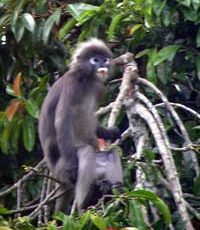
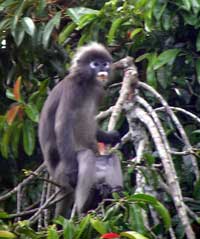
On the morning of 6th April, I took my coffee to my balcony where the sunscreen was down. Just as I went to raise it, I realised monkeys were in the tree immediately outside. They were Banded Langurs, Presbytis femoralis, and thanks to the screen I was able to collect my camera without them seeing me. They are extremely shy and flee at the slightest disturbance. I counted eight, but there could have been more, feeding on the seeds of Terminalia calamansanai, a tall pagoda-shaped tree heavily laden with fruit.

Soon after, I was called outside and noticed our youngest dog Santan carrying an animal that turned out to be a young civet. To be a naturalist and a dog lover is hard sometimes….

This particular specimen was a juvenile female, measuring 63 cm from tail end to ear tip, 9cm from nose to back of skull, with a 32cm long tail.

Common Palm Civet, Paradoxurus hermaphroditus

A widespread civet, varying from olive-grey to cream, with three dark stripes on back and additional dark spots on flanks, sometimes forming indistinct lines. Usually has a dark ‘mask’ highlighted by paler fur on forehead and behind cheeks, and sometimes with a pale spot below eye. Nocturnal and usually solitary, often seen on the ground, but feeds mainly in trees, where it eats fruits and animals. May be an important seed disperser of various forest tree species. Litter size three, born in a den in a hollow tree or under a boulder. Found from India through southern China, throughout mainland South-east Asia, Sumatra, Java and Borneo. Also occurs on the Philipines, Sulawesi and many eastern Indonesian islands where it may have been introduced.

From Mammals of South East Asia by Charles M. Francis.