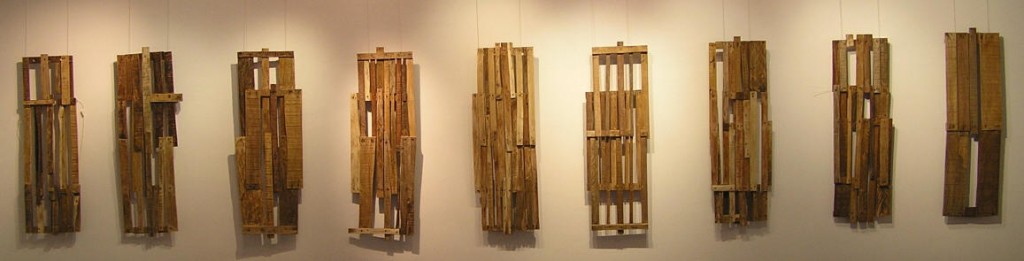
Australian sculptor Tony Twigg was the Australian resident artist of the year-long Malaysia-Australia Visual Arts Residency in 2005.
Bio
Tony Twigg has produced over 40 solo exhibitions of wall-based objects and installations in Australia, Malaysia, The Philippines, Singapore and the U.S.A., and has been included in group exhibitions across Asia and Europe. He received his Master of visual Arts from the City Art Institute Sydney in 1985. He lives and works in Sydney, Australia and Manila, Philippines.
Tony’s numerous exhibitions have been presented in a variety of disciplines including, performance, film/video, installation, painting and sculpture, as well as curatorial practice. He is represented in private collections and public collections in Australia, Singapore, Malaysia and the Philippines including: the National Gallery of Australia, the Queensland Art Gallery, the Art Gallery of New South Wales, the Ateneo Art Gallery Manila and the BenCab Museum, in the Philippines.
Tony Twigg in conversation with Gina Fairley. Rimbun Dahan December 2005
How did your journey to Rimbun Dahan, from Manila to Ho Chi Minh, up the Mekong to Phnom Penh and Angkor Wat, colour your arrival in Malaysia?
I arrived in Kuala Lumpur with certain expectations of an Asian experience built around the places I’ve gravitated to over the past decade. These are places where people quickly adapt ‘things’ – found objects – into life’s necessities, objects I see as ‘accidental art’. There’s an intuitive creativity in their making which speaks to me passionately of the human spirit. K.L. is a first world city, complete with all the accoutrements of now, where the prerequisites of “life-style” decide how things look rather than human need. Somehow, the first marks I made were ruled lines and then a lot of time was spent looking for a mark that comes from here, that is Malaysia, not just K.L.
Where did you find that Malaysian mark?
Here, along Jalan Kuang, at a demolition site, in discarded fish boxes beside a pasaraya and as crazy looking bottles of Chinese liquor from Kuang. It turned out that the Malaysian mark, for me, was the fish box. I started working with the ‘physical’ line of the object rather than its inspiration. The major impact was the surface. I found the subtle and random shifts in colour and texture of the timber aesthetically moving, so I began using thinner and thinner paint until I had the courage to use none. For me these fish boxes engaged the spirit of the original maker. There are two hands at work in my pictures.
Clearly you have a passion for the found object, but this feeling of a dialogue with the ‘original maker’ is a new development.
It occurred to me while making the works called 30 Fish Boxes. My proposition was simple: join three fish boxes together vertically to make a construction. As I worked the possibilities multiplied and I felt like I was jamming with the guy who made the boxes. The piece MT Madras was an amazing find and the most extreme relationship with the original ‘maker’. I found it in Brickfields during Deepavali and photographed it. The crate collapsed neatly enough to make it back to the studio. Not only did it not need paint, it didn’t need any carpentry either. My role as artist was limited to identifying the object, and conservator. This piece is the end point in the show and it has necessitated relinquishing certain controls over my surfaces and the arrangement of my constructions. Slowly, I’ve become aware of how subversively an object can be spirited. Accidental art has a great deal of beauty that I try to emulate by considering the making process rather than considering what beauty ‘looks’ like. The result is a set of elementary forms that have a certain universal understanding common to places like Chau Doc, Pasir Mas or Manila – the bird cages of Kelantan are a good example of this – but put them in cities like Sydney or K.L., they become exotic.
A dialogue with space is a constant in your work: architectural space, conceptual space, personal space, cultural space – it’s not static. Do you perceive an ‘Asian’ space?
I find the sensation of space physically exciting. I’ve come to realise that the way we perceive space governs our proximity to the objects we encounter. You and I might see U-shaped canyons walking through the city, but a town planner or crane driver would probably see it differently. In that sense, the way we perceive space becomes the operating system of our aesthetic. The idea of stacking space, and how that establishes illusionistic depth without referencing perspective, I think, is essentially ‘Asian’. Seeing Gao Xingjian’s recent show at Singapore Art Museum underlines this and it was also the big discovery for Ian Fairweather, an English artist who worked through Asia in the ‘30s on his way to becoming Australia’s pre-eminent Abstract Expressionist.
Do you consciously push the parameters of space outside the edges of the work to engage the gallery wall?
Yes, it is absolutely vital. It is not a question of an object surrounded by space, it’s a composition of positive and negative space. So, like a doughnut, the defining feature of the work could be an empty space. As a result my works are often multi-panelled because there are moments when the negative space is stronger than the positive space and consequently the work splits in two or perhaps fails to join. In this kind of work there are no right or wrong decisions, and the final relationship of the parts can change as they adapt to the constraints of a location or reflect the taste of a new owner. However, the drawing of the work – its lines, its spaces and its surfaces – remain unchallenged.

About the Work
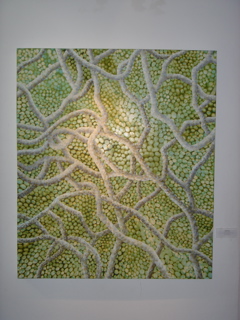
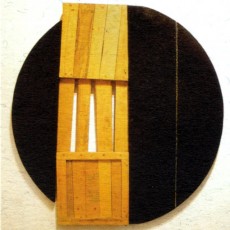
Thompson Birdwing Butterfly (above), exhibited at the 2005 Art for Nature exhibition.
Shortly after arriving in Kuala Lumpur, I found a very appealing broken wooden box in Chinatown. Back in the studio, I put it together as an ordinary looking thing that I then tried to liven up with yellow paint. A month or two later, I was on a demolition site and found two pieces of circular something in wood. Back in the studio it was a match for my yellow construction. Once it was together I started wondering if a butterfly might be a solution to the picture, inspired by the Art of Nature show. Bee Ling came to my studio and said that I had a word on my box, and it was butterfly. Next Angela was looking at this piece and said, “Look, a yellow and black butterfly,” just like my work, outside the studio, in the garden. It is Troides aeacus Thompsonii, a male Thompson Birdwing.


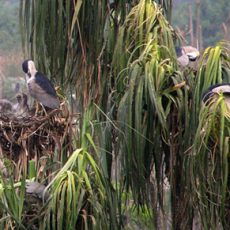
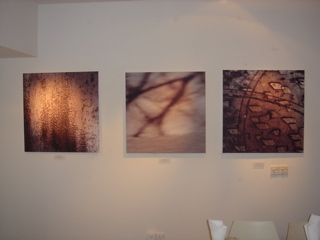
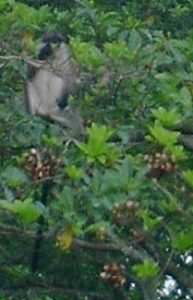
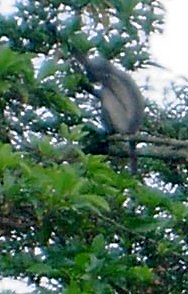
 Intsia palembanica, a merbau timber tree of the Dipterocarpaceae family, shed its leaves, and the photo on the right shows the new red growth.
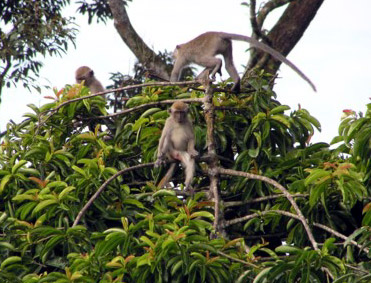




 BY ANGELA HIJJAS


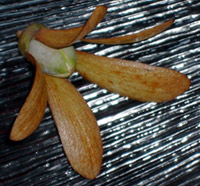 For the first half of February, the weather seemed unusually hot, dry and hazy. Temperatures in KL reached as high as 38C. In the middle of the month the weather broke with windy storms in the late afternoons and night. This morning I walked around the garden looking at broken branches and just relishing the damp again, when I noticed fallen seeds, since identified as Dryobalanops aromatica, known in Malay as kapor. These canopy trees were planted about 12 years ago, and I am delighted to find that they are fruiting so soon, although I have lost several of the original row planted along the length of the front fence to white ants. Ironically, kapor has a strong camphor frangrance and is preferred for making storage boxes that deter insect attack, but the tree itself seems particularly vulnerable. The fruits have five wings that enable the heavy seed to resist falling straight to the ground under the shade of the parent tree. As happened last night, they were dislodged from the tree by the wind and carried at least several meters, although I am unsure which tree produced the fruit. The fruit commences spinning like a helicopter about 1 meter into the drop, and then falls more slowly, carried away by the wind.

 The new planting at the back near the tennis court is settling in, but the previous planting done about two years ago is really starting to go ahead. I have planted three Gondstylus bancanus, known in Malay as ramin melawis, in a low-lying position, and they are now about 5m tall. Native to peatswamps from Perak to west Johor, and in seasonal swamps in Selangor, southeast Sumatra, and Borneo, ramin timber is the main variety that has been illegally logged in Sumatra over recent years and exported through Malaysian ports, although there is now some effort to contain this trade.
