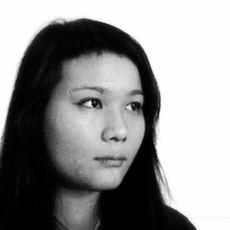
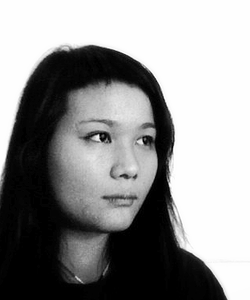
The gift of time and of spaciousness by the Rimbun Dahan residency has opened up new possibilities of exploration for my drawing and painting practice.
The process of exploration for me has been one of allowing and observing visual narratives, characters, expressive impulses that want to emerge from a sea of stories of the world, drawn from experience, the psyche, history, culture, magic, myth and wisdom.
This organic emergence to me is a way to return to feeling, sensing, drawing out pleasure from slowness, from savouring, and creates wholeness while living in a world where it is easy to lose and to drown oneself too much information and stimuli that leads to being dislocated from the self.
My drawings and paintings also reflect my interest in natural yet otherworldly environments that are like an interface or in between dimension where the personal internal world and the external world, the realm of imagination and of reality can come together and are a meditation on my physical travels, as well as traveling through ones own internal landscape and life.
Melissa Lin, ‘Anam Cara’, charcoal on canvas, 84” x 57.5”.
Melissa Lin, ‘Land Escape,’ acrylic on canvas, 20” x 15”.
Melissa Lin. ‘Reverie’, acrylic on canvas, 31″ x 20.5″.
Melissa Lin, ‘The Walk’, charcoal on linen, 67” x 55”.
Artist Bio
Melissa Lin is an artist and astrologer who loves how both disciplines deepen, teach about and reveal the mystery and richness of life and living. Art for her is a process of becoming and of encouraging the intrepid traveler on the way to wholeness and experience, not only for the individual self, but also for the health of the community and collective. Art can be the voice that returns us to our best selves and to the world.
My work extends many of the ideas of portraiture and psychological exploration. The power of the portrait image always fascinates me. But rather than create anachronisms for their own sake, I choose to use such imagery and technique as a point of departure for exploring a world that is idiosyncratic, personal, and capable of transcending time and place. The surfaces of the paintings are varied, but they are always alive. The multiple layers of consciousness are explored as I create, construct, reveal and expose areas of the work. I see myself not just as a portrait painter but rather as a commentator of the histories and experiences of people I know and the community in which I live. I see myself as a contemporary history painter.
During recent years my work has focused not just on portraiture but also on nature as a means of documenting a region that I am visiting. In 2011 I was invited to be artist in residence on a field trip to Rwanda. I joined a team of scientists in the Volcanoes National Park a region that straddles the border between Rwanda and the Congo. These scientists examined the impact of environmental changes on gorillas in the region, and on how environments have changed in the recent past. Inspired by this residency my work looked at the experiences of the people I met in Rwanda and the human- environment interactions researched by the scientists. Many of the paintings are based loosely on real environmental scenarios. The day-to-day challenges faced by those living in poverty, the clearing of forests for subsistence farming and its impact on the mountain gorilla, the impact of the population on the land, and how implementing sustainable forms of development can have beneficial impact the local communities. In these human narratives I try to convey at least a small fragment of the complex story of the people I met in Rwanda. For me, these images I am creating function as reflecting pools of our times.
Helen Dalton is an Irish painter. Her portraits were described by Aidan Dunne in the Irish Times as “exceptionally sympathetic”. She has been awarded residencies in USA, Costa Rica Spain, Ireland and Rwanda. Her residency at Rimbun Dahan in July 2014 was funded by the Irish Arts Council.
In March 2014, Basque artists Naiara Mendioroz and Javier Murugarren spent a short residency at Rimbun Dahan. During their stay, they developed a duet work, also using the traditional wooden Basque musical instrument, the txalaparta, and the recently developed metal drum instruments, the hang.
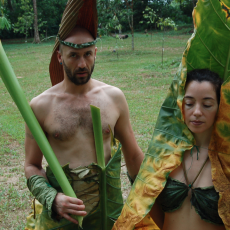
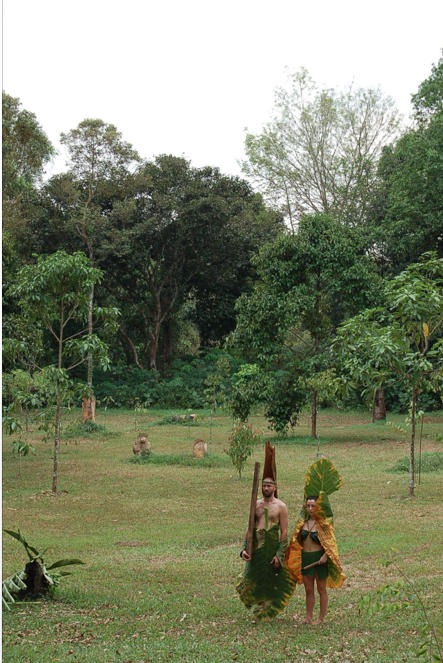
They gave an open studio presentation of the work they created. They also experimented with using materials from the garden at Rimbun Dahan in the creation of costumes.
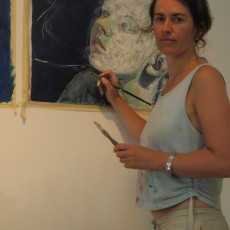
About Naiara Mendioroz
Graduated from the Official Ballet School of Pamplona (Spain) in 2000. In 2003, she graduated at the SNDO “School for New Dance Development” in Amsterdam. Following her graduation from SNDO she was awarded the DanceWeb scholarship for Contemporary Dance taking place at the Impulstanz in Vienna, Austria. She has danced for and toured internationally with various choreographers including Eleanor Bauer, Boris Charmatz, Nicole Beutler (piece based on Lucinda Child’s work), Frey Faust, Keren Levi, Peter Greenaway, Pere Faura, Paz Rojo, Mette Ingvartsen, Juan Dominguez, Beth Gill, Kate Mcintosh, Jefta Van Dinther and DD Dorvillier among others. She also works as a movement assistant for Nicole Beutler in the piece “The Garden”. Parallel to this, she has collaborated in a Dance project in N.Y teaching dance to women victims of domestic violence and at the moment she prepares her next project in Spain.
About Javier Murugarren
Formerly a sea sciences student in the Canary Islands, Javier arrived to the performance world in 1996. A pivotal encounter with El ojo de la Faraona dance company resulted in a decision to pursue performance and movement research. This brought Javier to Amsterdam, where he received a bachelor degree (2008) in dance and choreography from School for New Dance Development (SNDO). Javier’s work draws on a range of performance practices, including improvisation, choreography, cabaret, music, puppetry, video, and costume design. The distinctively eclectic and cross-cultural style of his costume designs has earned them a description as “post-folkloric punk”. Javier understands the performing body as “a mutant tool for an ongoing process of learning and adaptation.” His work has been presented in numerous countries, including Japan, Korea, Hungary, Turkey, Germany, Australia, New Zealand, USA, Spain and the Netherlands. He is a founder member of Instant Collective (2006), an Amsterdam-based performance collective. He also organizes Inkietas, an annual urban performance festival, in his hometown of Estella, in the Basque country of Spain. Other collaborative works have been made with Compaignie faim de siècle / Ibrahim Quraishi (Paris/NY), Trust company (South Korea), Duda Paiva (NL) and Azart-Ship of Fools (NL), Meekers (NL) and Maas (NL)
French-Moroccan dancer and choreographer Soufiane Karim spent a short residency at Rimbun Dahan in October and November 2013, en route to the Melaka Art + Performance Festival. During his residency, he was developing his next full-length work entitled Kaly-Graffyk. He also collaborated with New Caledonian hip hop dancer Ludovic Simane Wénéthem and Indonesian dancer Gita Kinanthi (site-specific performance at Rimbun Dahan pictured below).
During his residency, Soufiane was interviewed on Capital FM and on BFM 89.9: https://www.bfm.my/soufiane-karim.html. He also conducted a dance workshop at ASWARA, the national academy for arts and heritage.
All photos below by Leocampo Yuen Hon Wai.
About Soufiane Karim
A young Frenchman of Moroccan origin, aged twenty-eight, Soufiane Karim had been dancing since his early childhood when, at sixteen, he discovered hiphop. The experience was life-changing and, as soon as he had finished studying communication, he launched straight into creating a life of dancing. He learned various dance techniques and styles in Paris and developed a keen interest in hip-hop culture. As he honed his skills, he set up the Boogalizzle group and together they discovered the techniques and magic of show business, winning several battles and contests, including choreography.
He met some good dancers teachers in Paris during his early hip-hop training-the-trainers sessions, and developed a taste for skill transfer and teaching. Pursuing his love of travel, he continued his search, leaving Paris for New Caledonia to attend a three-part training programme organised by French contemporary dancer and pedagogue Mic Guillaumes at the Noumea Centre de Développement Choréographique. Keen to share his travel and new friends, he put together his own solo production, “Sweet Hõm”. In the third unit of the training session, he participated as a trainers’ trainer, while continuing with his plans to develop dancing in New Caledonia and the Pacific. He travelled with several New Caledonian dancers to Vanuatu, Fiji and New Zealand to organise courses and shows. On his return, he decided to set up the Posuë Dance Company. He is now artistic director, dancer, choreographer and teacher of Posuë Dance Company.
Queensland-based dancer-choreographers Caitlin Mackenzie and Gabriel Comerford spent an Asialink residency at Rimbun Dahan in 2013, developing the duet work Uncommon Ground.
Gabriel and Caitlin studied together at Queensland University of Technology, where they were featured as a duo by various choreographers including Csaba Buday, Vanessa Mafe and Alice Hine. Since university they have established a professional partnership and work together on several platforms. They are founding members of emerging dance collective MakeShift, and were selected to perform in Backstage at the Ballet Russes at the National Gallery of Australia, performing an excerpt of an adaptation of The Ballet Russes’ Petrushka. They have choreographed for QL2’s Chaos project and have performed in Toowoomba, in the Ausdance Queensland Bell Tower II Series, the Brisbane Festival, and at the Judith Wright Centre for Contemporary Arts.
Uncommon Ground is a cross-cultural, interdisciplinary work that depicts a story of two identities coming together in one place, transitioning through friction, destruction, compromise and progression, concluding with something that extends beyond the sum of its parts. This concept speaks to an internal and external landscape; a personal struggle to discover and understand oneself and the realities of living in a diverse and ever-changing society.
Uncomfortable within your own skin.
Uncertain of the land beneath your feet.
A place to call home.
Indigenous to where.
Uncommon Ground was performed on Wednesday 4 December 2013 at the Fonteyn Studio Theatre in Petaling Jaya. A site-specific version was presented at the Melaka Art + Performance Festival. The performance included live music by Malaysian musician Gideon Alubakhan Chen.
This is an Asialink Arts Residency Project supported by Arts Queensland and the Australia-Malaysia Institute.
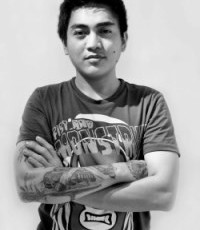
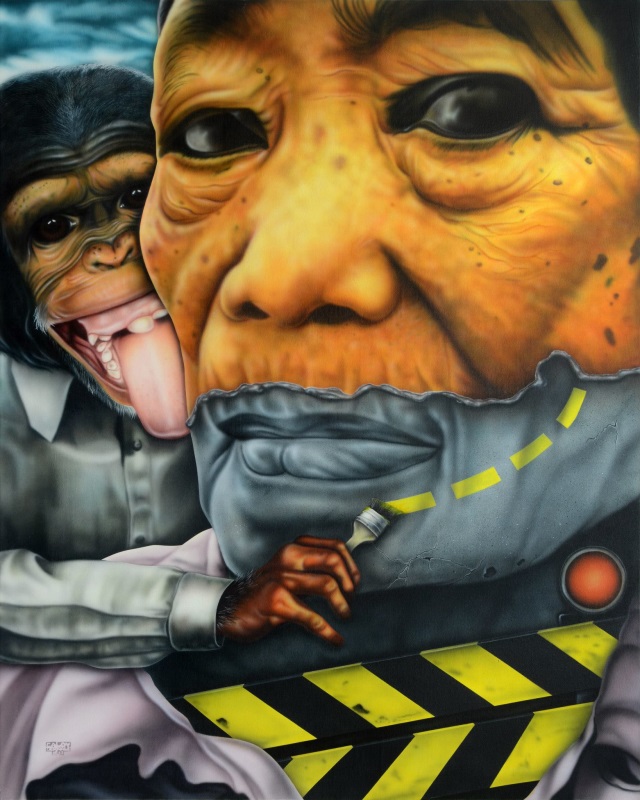
Carlo “Caloy” Gernale (b. 1979) is a Filipino visual artist based in Southern Tagalog, Philippines. As a contemporary social-realist artist, he attempts to articulate not only his personal views, but more importantly, the collective stand and the national democratic aspiration of the marginalized.
As an artist, Gernale is driven by the past and present events that mould Philippine history; he also has a penchant for indigenous and contemporary myths, fables, and banter, and tries to incorporate them into his works of art. Guided by his socio-political leaning, he attempts to come up with a cohesive body of works that are visually and semiotically potent.
Gernale studied Bachelor of Fine Arts in Philippine Women’s University. In 2006, he mounted his first solo exhibit “Ispup.” His most recent exhibit titled “Allegories and Allergies” was held in May 2013 at West Gallery, Philippines.
In July 2013, Ng Mei-Yin, a Malaysian choreographer based in New York, and Cathy Seago, dancer and dance scholar from the UK, conducted a version of their ongoing performance work, the BOW Project, at Rimbun Dahan. The development concluded with a showing on 12 July 2013 at Damansara Performing Arts Centre.
BOW 2013 brought together choreographers/dancers from different dance forms to workshop together to explore starting points and ways in to dance-making, according to their tradition/practice. The aim was to create a number of short works from shared starting points, and to trace the journey in a meaningful and embodied way.
This was a creative and playful opportunity for inquisitive/ imaginative choreographers to develop their art, their perception and their network. Through exposing, sharing and exploring some of the innate mysteries of dance work with other artists and with a wider community we might find a greater depth to our understanding of dance, our own work and of each other.
Lead artists: Mei-Yin Ng (USA/Malaysia) & Cathy Seago (UK)
Malaysian choreographers: Christine Chew, Maniyarasi Gowindasamy, Rithaudin Abdul Kadir
Music performers: The Music Professional Academy. Project partner: Damansara Performing Arts Center and ASWARA.
This project is supported by grants from the University of Winchester, MEI-BE WHATever, kakiSeni and JKKN (Jabatan Kebudayaan dan Kesenian Negara).
Barbara Wildenboer was born in Pretoria, South Africa in 1973. She completed a BA (Ed) with majors in English literature, Psychology and Pedagogics at the University of Pretoria in 1996. In 2003 she obtained a Bachelor of Visual Arts from UNISA followed by a Masters in Fine Art (with distinction) from the Michaelis School of Art at the University of Cape Town in 2007.
Wildenboer has been awarded several international residencies such as the Unesco-Aschberg residency (Jordan, 2006), the Al Mahatta residency (Palestine, 2009) and the Red De Residencias Artisticas Local (Colombia, 2011) and the Hotel Penaga artist residency (Penang, Malaysia, 2013). In 2011 she was nominated and subsequently selected as one of the top 20 finalists for the Sovereign African Arts Award for which she received the Public Choice Prize.
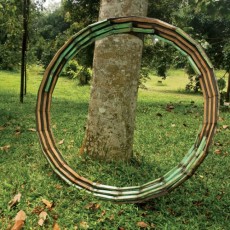
Canggai. 2014. Wood, metal, copper & charcoal. 200 cm (diameter).
Sabri Idrus was the Malaysian Artist for the Malaysia-Australia Visual Arts Residency 2013.
Artist’s biography:
Sabri Idrus, (b. 1971, Kedah, Malaysia) is an artist best defined by his compulsion to experiment with media. Oscillating between a career as an artist and a successful graphic designer, Sabri studied fine arts at UiTM from 1995-1998. Received The Malaysia Young Contemporary Art Award in the painting category in the year 2004 and A Special Mention Award for the UOB Art 2011. Sabri’s works are held in private and public collections in the United Kingdom, Poland, Singapore, America, India, Hong Kong, Indonesia and Malaysia. He has participated in residencies in Poland, Indonesia and Rimbun Dahan, Malaysia. Sabri Idrus lives and works in Kuala Lumpur, Malaysia. Sabri is a constant researcher in the process of art making, specifically in his endless search in the production of prints, marks and traces as the notion of visual representation that operate as his medium in conveying his research and thoughts.
Disruptive Nature
Disrupting materials and surfaces are the main interests for the development of this series, simply entitled Disruptive Nature. Further developing his interest in mark making – a preoccupation with surfaces, spatial stacking, temporality and organic fluid forms (The Search of the Uncertainties, 1999), Sabri Idrus continues his semiotic-reference in art making by tracing down patterns of nature. Leaves, trunks and twigs were scanned and studied in order to understand the basic properties of these elements of nature. From his earlier experimentation with industrial materials, that had the objective of venturing into alternative media such as painted surfaces, this series of works marks a comeback for Sabri and his object making exercise. These processes of experimentation are a statement that echoes his search for creating new marks on new surfaces. How to create a desired effect on a particular material with its own specific characteristics, to be able to re-produce similar effects on different materials has been explored by Sabri in his long process in art making, and is further demonstrated this interpretation of ‘shadows’ as themed for the Rimbun Dahan showcase.
Taking advantage of his discoveries with industrial materials, Sabri, again, marks a change from his normal material play, venturing into the more subtle realm of natural patterns, forms and characteristics. The natural patterns he has discovered and mimicked on his choice of surfaces reveal their latent qualities in a two-dimensional manner. Sabri’s series of studies were then reconstructed using a very similar method to his deconstruction in order to transform them into three-dimensional sculptures. Only this time, the traces of patterns and surfaces were extruded to create solid forms coupled with the real natural patterns that originated from the material itself. These processes are not an escapism from his earlier ‘difficult’ process in producing his works, but rather should be seen as a new adventure of developing a more advanced understanding of the manifestation of moments that reconcile nature with the unnatural.
Researching within the natural context of Rimbun Dahan, coupled with his seminal research on natural and man-made elements from his residency period in Poland, and through in-depth studies of the architectural works of Anthony Viscardi, Sabri’s latest works examine the qualities shared between art and architecture through explorations of solid and void, presence and absence, static and dynamic, and material and ephemeral continuums. His daily observation of the site-specific elements of his work place at Rimbun Dahan has allowed him to capture measurable details in nature’s natural moment, where tactility and space-time relation of the natural evolution are always visible. The nature of observation places one’s visual sense in an almost circular perspective (looking at the surrounding in 360 degrees) and has been recorded, photographed, memorized and sometime distorted into the physical being of the artwork itself. Sabri’s observations have been replicated in the form of circles, reflecting the way he looks at things around him. The conflicting elements of the natural and unnatural characteristics of these objects were further elaborated through detailing and specific material usage, hoping the artwork would be able to present itself as a signifier of the context that they represent.
What Sabri is interested in is that the work should not represent itself as an object to be confronted, making the viewers merely face the subject, but rather to create a feeling of being wrapped in it, as though it were our shadow.
Shadow and light is a dual reality, the hypertrophy of a double sensation: there can be cavernous, dark, soft, humid, sensorial, crystalized, cold, luminous, and all this can be used like an individual zapping of perception. Return to text…
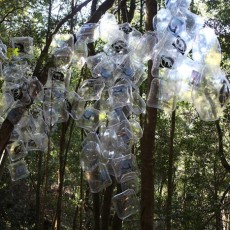
Tiga Tiga, video and sculptural installation, Blue Mountains, Australia.
Dr Lisa Anderson works across a broad range of media creating images, films and prints that explore issues of weather and its consequences including the movement of peoples and animals, the shifts in legends and mythology specific to locations, and the effects of climate change in our global environment.
Recent exhibitions include Huldefolke, a photographic series in Skargarstrond, Iceland, working with the mythology and religious beliefs in the unseen or hidden folk, Beneath the Architecture of Beauty which comprised neon and photographs in London, and a sculptural intallation in Beijing, Clouds in the Beijing Breeze, which references childish joy with gifts and the abundance of stories with clouds of gold. Further sculptural work includes a temporary installation work Precious that uses 4,000 wine glasses to use a fairytale ambience to capture water and light in a forest beside the sea in Arhus in Denmark, andTiga Tiga, a video and sculptural installation at Scenic World in the Australian Blue Mountains and in Contested Landscape for Ten Days on the Island, Tasmania. Tiga Tiga will also form a part of the Lorne Sculpture Biennale in 2014.
Anderson exhibits regularly in Sydney, London and Beijing and is included in major private and public collections. Her residencies include Arctic adventures as artist on a Russian icebreaker, as well as exploring UNESCO sites in the Bay of Biscay and, more recently, the Antarctic aboard the MV Fram, travel in remote Australia, Central java, the UK and other sites with weather-specific stories as the stepping point for the works Dr Anderson creates with her company The Shiny Shiny World.
Anderson spent three months at Rimbun Dahan in 2013, creating 3D video pieces for installation in various locations using the unique gardens, water features and dancers of the area in the final work.


 The gift of time and of spaciousness by the Rimbun Dahan residency has opened up new possibilities of exploration for my drawing and painting practice.




 About Naiara Mendioroz