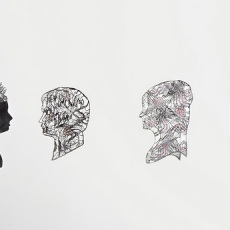
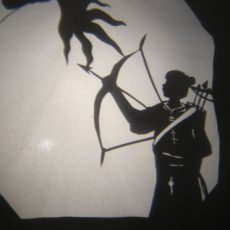
Born in the UK and a graduate of the Royal College of Art, London, Laurence has been working as an artist, curator and visiting academic in Hong Kong. Prior to that he was a Dean at the University for the Creative Arts in the UK. Primarily a painter he also has many years of experience of leading and working with creative teams involved in broader fields of art, architecture, design and music. His work has been exhibited internationally and is included in the collections of the National Trust Foundation for Art UK, HSBC HQ London, and His Royal Highness the Prince of Wales.
Julie Ryder is a textile designer and artist who lives and works in Canberra. Initially trained in science, Ryder graduated from the Melbourne College of Textiles in 1990, and completed a Master of Arts (Visual Arts) degree at ANU, School of Art in 2004. In 2005, Julie was awarded the inaugural ANAT Synapse New Media Artist in Residence at the Australian National Botanic Gardens in Canberra. She has been the recipient of many awards and grants, most notably the Gold Medal at the 1997 International Textile Design Competition in Taegu, Korea, the 2004 CAPO Singapore Airlines Award, a 2006 Australia Council VAB New Work Grant, and several grants from artsACT. She has undertaken several artist residencies, including Hill End, Iceland and Bundanon and is a 2013 Asialink Visual Arts Resident at Rimbun Dahan.
During her 3-month stay at Rimbun Dahan Julie will be completing work for an upcoming solo exhibition later this year, and will be starting new work using the plants growing here as dye sources for both paper and textiles. She will also explore traditional textile and fibre techniques to inform future work.
She has exhibited in many solo and group exhibitions, both nationally and internationally, and is represented in the collections of the NGA; NGV; Powerhouse Museum; AGSA; BRAG; Textile Museum, Tilberg, Netherlands; Tamworth City Gallery, CSIRO, and many other public and private collections worldwide.
See Julie’s blog of experiences at Rimbun Dahan on her website: www.julieryder.com.au
Me, Here and You, There, detail, 2011
Rose petals, wooden forks, rose thorns, hemp, embroidery
Josiah, detail, 2008 hand cut leaf dots collage on tapa cloth, pricking
American choreographer spent a month in residency at Rimbun Dahan in 2013, developing a new contemporary dance duet with French dancers Aimee Lagrange and Martin Harriague.
The work-in-progress of the duet, ‘one day without harming you’, was performed at ASWARA on 30 March 2013.
Stephen Shropshire (b. 26 December 1972) is a graduate of the Juilliard School in New York City. As a choreographer he has created works for o.a. Scapino Ballet Rotterdam, Norrdans,The National Dance Company of Wales, The Holland Dance Festival, and the Iceland Dance Company. In 2003, his work ‘The Piper’s Progress’ was awarded the Grand Prize and the Public’s Prize at the 8th international choreographic competition ‘Tandances’ in Luxembourg. His work ‘sugarwater’ was named one of the top ten dance triumphs of 2008 by the London Telegraph. From 2009 to 2012, Shropshire was the artistic director of Noord Nederlandse Dans.
‘one day without harming you’ is a short study for an evening length work to premiere in 2014 as part of the Holland Dance Festival. The work is an intimate portrayal of love and loss that explores narrative dance structure through contemporary abstract form. Darting between the present and the past, the work struggles to reconstruct fragmented memories in an attempt to come to terms with what it is to love and be loved in return.
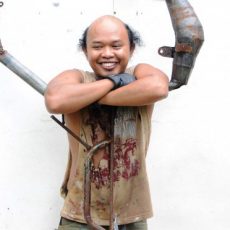
Agustian Supriatna (b. 1981 in Lampung, Sumatra, Indonesia) , an abstract painter with unique compositions. A combination of soft and bright colors, wild lines and brush strokes that create harmony, gives the audience an opportunity to freely explore his paintings. He also creates sculptures out of found metal objects.
Indonesia’s famous abstract painter Affandi the Maestro inspired him to be an artist. He studied with Indonesian elder painters, one of them being Roedyat Martadirejda who gave him the task of sketching every day for the rest of his life.
Agustian currently resides in Bali, having moved there in 1999. His paintings and sculptures have been exhibited internationally and his recent solo exhibition at Art Expo Malaysia 2012 was sold out. He is represented in the following countries all over the world; America, Australia, Belgium, Denmark, France, Germany, Holland, Hong Kong, Malaysia, New Zealand, Singapore, and Thailand. He undertook a three-month residency in 2013 at Hotel Penaga.
Solo Exhibitions
2012 “Unlimited Beauty” G13 Gallery@ Art Expo Malaysia, Kuala Lumpur
2011 “I love you“ Café Des Artistes Restaurant & Gallery, Ubud, Bali
2007 “Dedicated to my Mum Ratu Permai“ Lidya Gallery, Ubud, Bali
2007 “I’m Scooterist not Terrorist“ Sketch journey on my Vespa from Bali to Lampung, Sumatra
2003-2007 “Studio 3 Owner“ Studio 3 Art Gallery & Studio, Ubud, Bali
2006 “Anna I Love You“ Kwezien Restaurant, Lovina, Bali
2005 “I’m Agustian!“ Momentous Art Gallery, Singapor
Le Thua Tien has a diverse art practice that includes paintings, installation, experimentation with sculpture and community based art projects. The direction of Tien’s paintings changed from figurative to abstract when he arrived at the Rijks Academy in Amsterdam in 1995. Some of his most recent works are mixed media and lacquer and can be considered symbolic of his subjects. He is one of Vietnam’s few artists who address the American War in his works. His work also tends to be more conceptual than many other Vietnamese artists. His work has been displayed in the United States, Thailand, the Netherlands, France, Germany, Venezuela, Japan, and Australia. Le Thua Tien lectured at the Fine Arts University in Hue, Vietnam, from 1989 to 2008. He now lives and works in Hue.
About the Residency
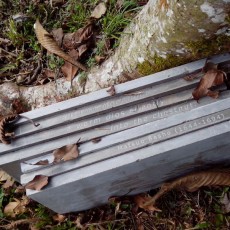
The Haiku Path Project in Rimbun Dahan is a sculpture / installation project. It contains a series of selected haiku poems, engraved onto granite slabs, arranged along the walking paths of Rimbun Dahan’s garden. The granite used in this project is recycled material. By laying it back to the ground; with time, the slabs will embed themselves into the forest.
Create a walking path through Rimbun Dahan’s compound, where visitors can approach the sculpture/poem works in different locations.
The first stage of the project, created in February 2013, features 5 haiku poems written by Matsuo Basho (1644-1694) [with English translation by R. H. Blyth] and two poems by Mike Ladd (b.1959), a former Rimbun Dahan artist in residence. Tien considers The Haiku Path Project an ongoing project and plans to add more poems to the compound.
Poem by Mike Ladd (1959- ). Material: Recycled granite slabs/ sandblasted engraved text (Al Himmah Global, Batu Caves, Selangor). Size: approximately 60 x 40 x 20 cm each; seven pieces.
Poem by Matsuo Basho (1644- 1694) . Material: Recycled granite slabs/ sandblasted engraved text (Al Himmah Global, Batu Caves, Selangor). Size: approximately 60 x 40 x 20 cm each; seven pieces.
The location of the first Basho haiku installation, along the driveway at Rimbun Dahan.
Le Thua Tien with Laila from the Al Himmah Global Batu Caves Engraving Process.
Le Thua Tien working with stickers to design the engravings
Haiku (Hi-koo) is a traditional Japanese verse form, notable for its compression and suggestiveness. In the three lines totalling seventeen syllables measuring 5-7-5, a great haiku presents, through imaginary drawn from intensely careful observation, a web of associated ideas (renso) requiring an active mind on the part of the listener. The form emerged during the 16th century and was developed by the poet Matsuo Basho (1644-1694) into the refined medium of Buddhist and Taoist symbolism.
Sean Cordeiro & Claire Healy. ‘Seal’. 2014. Lego, IKEA foot stool, IKEA glass cup & saucer. Work in Progress for ‘Habitat’
Habitat
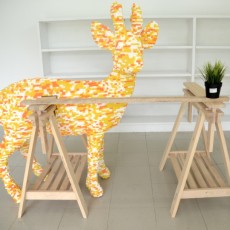
The physical description of the project is relatively straightforward: the exhibition contains Lego blocks and IKEA furniture. Installed within the gallery are life-sized exotic animals sculpturally rendered in Lego bricks. These animals intersect IKEA furniture; giving the impression that the animals and the furniture have simultaneously materialised within the same space. The animals are assembled utilising a randomised reduced palette of between 3 and 5 colours per animal.
The IKEA furniture literally penetrates the animals at random angles. The combination of these two elements creates a viewing space that is part menagerie, part showroom. Just as an entomologist pins beetles or other insects upon a viewing board, like a prized taxidermy trophy, our body of work emulates this using IKEA furniture as the skewering device that penetrates the animal.
This fairly uncomfortable scenario (for the animals, at least) draws visual influence from late nineteenth century hoax photographic documentation of ectoplasmic manifestations in which, foreign objects would appear to reveal themselves on photographic plates during séances.
The project is a natural continuation of our line of investigation illustrated in the work ‘Future Fragment’. This work is a sculpture comprised of neatly stacked and bound IKEA furniture- tables, cupboards, and bookshelves structure that hold together a full-sized replica Monolophosoraus fossil: locating human endeavour within the timeframe of natural history.
The combination of fantastic animals with quotidian furniture creates an uncanny situation that hopefully goes beyond the polar juxtaposition of the man-made with the natural, creating a combined sculptural installation that creates an open-ended question into our relationship with our built and natural world.
Artists’ bio:
The collaborative practice of Claire Healy (b.1971), and Sean Cordeiro (b.1974), began in 2001 while undertaking their Master of Fine Arts research degrees at the University of New South Wales, Sydney. Their collaborative practice brings together ideas of home, movement and destruction. Healy and Cordeiro create sculpture and installation works that re-use and reform the everyday consumables and detritus of modern life.
In 2005 they were awarded Australia Council residencies at Künstlerhaus Bethanien, Berlin, and Tokyo, Japan. In 2006-2007 they were Guest Artists at the Universität der Künste, Berlin, having been both awarded the Samstag Scholarship. In 2010 they participated in the residency program at the Akiyoshidai International Artist Village, Japan. In the same year they took part in the inaugural Art Setouchi Festival, which took place over nine islands in the inland Seto Sea of Japan.
Their solo exhibitions include flatpack at the Künstlerhaus Bethanien, Berlin 2006, The Paper Trail at the Art Gallery of New South Wales 2007, PREMS at La bf15, Lyon 2009, Are we there Yet? at the Corcoran Gallery, Washington DC 2011 and a survey exhibition at the Museum of Contemporary Art, Sydney 2012.
Their work has been included in numerous group exhibitions in Australia, Belgium, China, the Czech Republic, France, Germany, Hong Kong, Italy, Japan, New Zealand, Singapore, Switzerland, Turkey, Taiwan, the United Kingdom and the United States of America. Healy and Cordeiro’s installation Life Span was part of the Australian representation at the 53rd Venice Biennale. Most recently, they took part in the 5th Auckland Triennale, curated by Hou Hanru.
Their works are in public collections including The Corcoran Gallery of Art, Washington DC, The Museum of Contemporary Art, Sydney, The Art Gallery of New South Wales, Newcastle Regional Art Gallery, The Art Gallery of South Australia, The University of Queensland Art Museum and The Gallery of Modern Art Queensland.
In 2012, French choreographer and performer Mic Guillaumes undertook a short residency with opera singer Anne-Laure Poulain, preparing for a performance at the Melaka Art+Performance Festival.
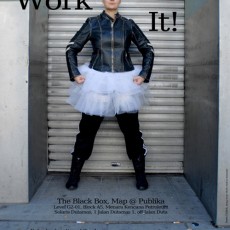
Work It! was a project bringing together female performing artists from Asia and Europe whose work revolves around the gendered depiction of the body on stage. For 10 days in November 2012, these artists met in Kuala Lumpur to share their artistic practice, create new networks and explore their diverse understandings of feminism.
Program A: 8.30pm, Friday 9 Nov
Program B: 8.30pm, Saturday 10 Nov
Venue: The Black Box, MAP @ Publika, Solaris Dutamas
How do you perform a woman onstage? How do you negotiate how a society regulates work, power, sex and truth? What is creativity’s reaction to convention? And how will women thrive in the performing arts in the current global climate?
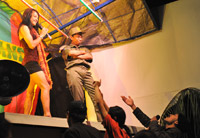
The Work It! public showing tackled these questions with theatre, dance, music and good old fashioned women’s wit.
Entry by donation at the door
RM 20 regular, RM 15 for students, seniors & MyDance Alliance members.
Q&A session with the artists following the performance.
Work It! Open Studio
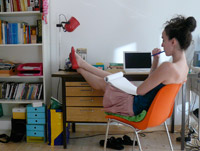
The focus of the Work It! project is on the week of closed-door studio sessions for the participants at Rimbun Dahan, in which they will be sharing and developing their arts practice with each other. For one afternoon only, join the artists in an open studio session to get a taste of the Work It! project. All practicing artists, in visual or performing arts, and both male and female, are invited to attend.
2-5pm, Wednesday 14 November 2012
The Dance Studio at Rimbun Dahan
Free entry, but attendance is limited, so please register by emailing bhijjas@gmail.com with your name, phone number, and brief bio.
Work It! Panel Discussion
At the conclusion of the 10-day project, the participants of Work It! will present a public panel discussion to discuss the process of the closed-door discussions at Rimbun Dahan and to share their findings.
2-5pm, Saturday 17 November 2012
Annexe Central Market
Free Entry
Work It! was co-produced by Bilqis Hijjas of Rimbun Dahan, Anna Wagner (Germany) and Fumi Yokobori (Japan).
Sangeeta Sandrasegar works within a research-based practice, building narratives in which every new work connects to previous projects. Her practice consolidates postcolonial and hybridity theory, exploring her context within Australia and its relationship to migrant communities and homelands. Her work concerns itself within the overlap of cultural structures – sexuality, race and identity, in contemporary society – and interpreting and representing these shifts. These themes are explored through a visual language concerned with shadows. From installations of paper cutouts, material works and/or sculpture, the constructed shadows of the installation become a motif for themes of self-hood, otherness and in-between spaces. By extending the scope of the art object the cast shadows simultaneously engage with the history of the shadow in Art, and hint towards cognitive alternatives and sites of transformation.
In 2004 Sandrasegar completed a Doctorate of Philosophy across the Victorian College of the Arts and the Australian Centre at the University of Melbourne. The content of the exegesis was to formalize a visual practice centred on the creative space of shadows into a theoretical tool. She proposed that the shadow subject could be re-examined and liberated from its historical representations and to be employed as both a positive and salient visual device for representing the ideas being examined in post-colonial and hybridity studies.
Sandrasegar has been represented in group and solo exhibitions since 1996, and is the recipient of several fellowships and prizes. In particular, national showcases for emerging artists: Primavera, Museum of Contemporary Art, Sydney, NEW04, Australian Centre of Contemporary Art, Melbourne. As well as the Auckland Triennial and SCAPE: New Zealand Community Art & Industry Biennial in New Zealand and the Asia-Pacific Triennial of Contemporary Art 05, Gallery of Modern Art Queensland. Last year her work was shown in the Incheon Women Artists Biennale in Korea, and Slash: Paper Under the Knife, Museum of Arts and Design, New York.
Sangeeta was in residency at Hotel Penaga from October to December 2012.
Jumaadi, an artist of Indonesian origin but practicing in Australia, completed a three month residency at Hotel Penaga in 2012 with a stunning performance of wayang kulit, the traditional shadow play of Southeast Asia. This one, though, stretched tradition in a new direction, being based on a Chinese folk tale about the Moon Cake, a timely performance as the festival is just around the corner at the next full moon on 30th September, when children parade through neighbourhoods carrying candle lit lanterns in animal and fantasy shapes. Jumaadi’s wayang was produced with the help of the curator of the Penang State Museum, Puan Haryani Muhamad. Developed with students from KDU and with the puppets made by one of the museum’s janitorial staff, and the gamelan music was provided by museum staff, it was a wonderful collaboration of talent from all directions.


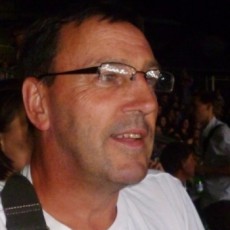
 Visual Arts Resident, 2013


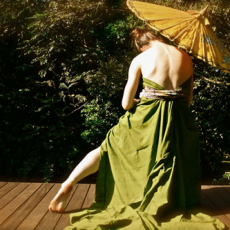







 Public Performances
 Work It! Open Studio