Lynyrd Arwyn Paras

Lynyrd Arwyn Paras

lynyrd

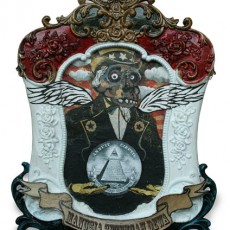
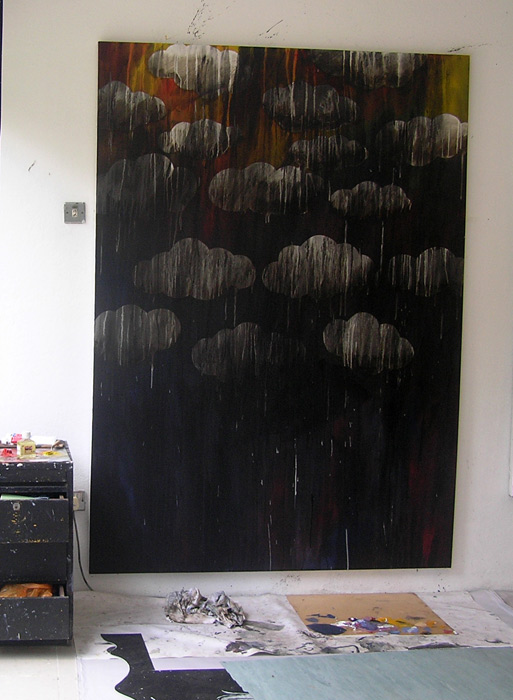
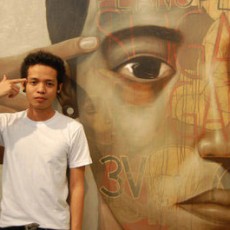
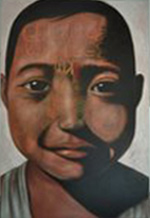
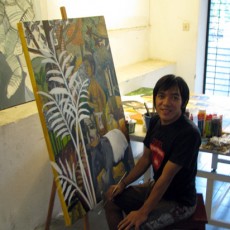
Painter Lynyrd Arwyn Paras from the Philippines stayed for a short residency at Rimbun Dahan from January until the end of March 2009.

Lynyrd Arwyn Villanueva Paras (b. 1982), graduated with a Bachelor of Fine Arts from the Technological University of the Philippines. Since then his work has been shown in numerous solo and group exhibitions in the Philippines and Malaysia. A finalist of the Philip Morris Philippine Art awards, Lynyrd also took second place in the Metrobank Art & Design Excellence competition in 2007, and received the grand prize in the First GSES Museum National Painting Competition in 2004. This is Lynyrd’s second arts residency, following a six-month stint at the Blanc Compound in Mandaluyong City at the end of 2008.

Lynyrd will return to Kuala Lumpur to take up the TARP (Taksu Artist Residency Program) in preparation for his fourth solo exhibition, at Taksu Gallery in September 2009.

Eve Lambert

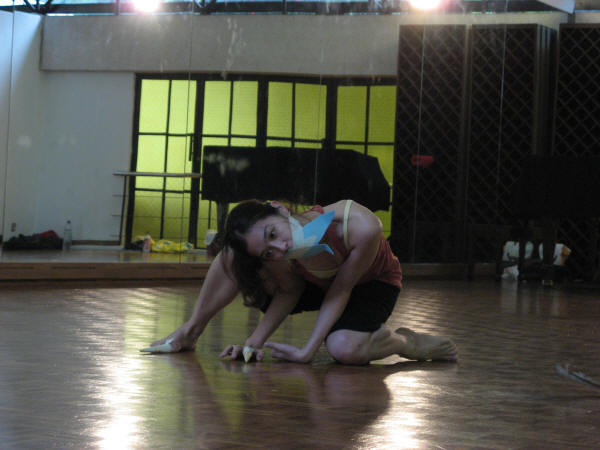
One of Eve Lambert's costume designs, created from a parachute.
One of Eve Lambert’s costume designs, created from a parachute.

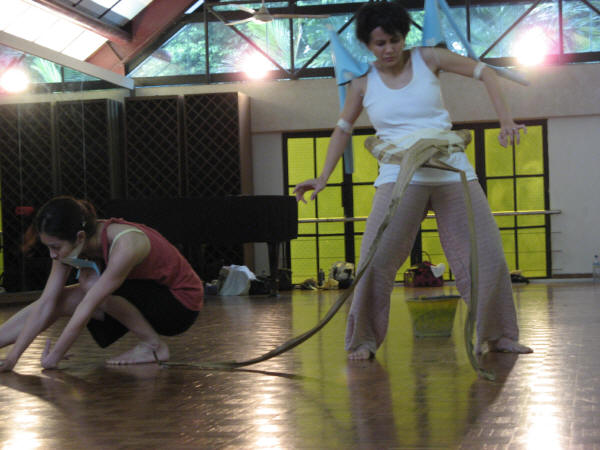
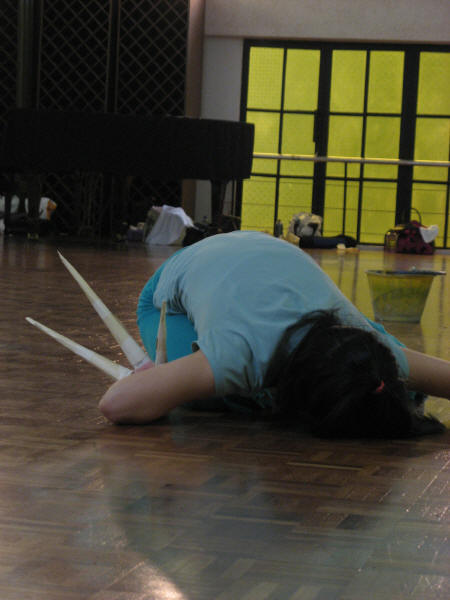
Thanks to the support of Scottish Arts Council, costume designer Eve Lambert spent three weeks at Rimbun Dahan in October 2008, working with resident choreographer Lina Limosani, designing and creating costumes for Lina’s contemporary dance work A Delicate Situation .

Eve Lambert first trained in fashion design at College Marie-Victorin, Montreal. During the course of her studies, Eve was selected for the final of a fashion contest in Paris, to participate in a design seminar in Copenhagen and was granted an award for best student of the Fashion Design Program in both her 2nd and 3rd years. Following this, she was awarded a scholarship from the Fashion Foundation of Montreal to study Performance Costume at the Edinburgh College of Art. Whilst studying, Eve undertook various work experience opportunities in order to gain experience in costume design and construction for theatre, film, television, dance and puppetry, in both Montreal and Edinburgh.

In 2007, Eve was invited to present her degree work at the West Kilbride Gallery, Scotland. Since then, her professional practice has included designing costume for X-Factor Dance Company (Edinburgh) on various productions such as ‘Ragnarok’ (2007), ‘Person or Persons Unknown’ (short film, 2007), ‘Other Voices, Other Rooms’ (site specific, 2008) and ‘Unspoken’ (2008). Other experiences include collaborating with puppet theatre company The Pupper Lab (Edinburgh), on ‘EH3’ (2006), ‘The Big Shop-Inverness’ (2007) and ‘The Gift’ (2008). Her most recent work includes designing costumes for ‘The Red Room’ by David Hughes Dance and Al Seed (Traverse Theatre, 2008). See attached for samples of Eve’s work.

Oceu Apristawijaya

Oceu Apristawijaya

In 2008, Indonesian visual artist Oceu Apristawijaya undertook a three-month residency at Rimbun Dahan, accompanied by his wife Fadilla, who was volunteering at the international development organisation Third World Network.

In February 2012, returned to Malaysia and completed a mural at Hotel Penaga, created during his arts residency in George Town, Penang, under Rimbun Dahan and Hotel Penaga’s cultural program.

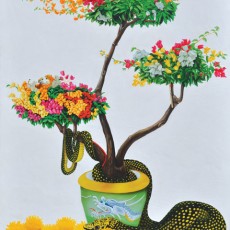
Under Protection presents treasures that need to be protected. “Our environment changes, as our culture does,” says the artist, “In this art work, both of them are in one unity that cannot be separated. Our culture gives us knowledge as our environment gives us life. By giving them space and time, we will always have reflection.”

The enormous mural stretches along an outside wall of Hotel Penaga beside a laneway between Lebuh Transfer and Lebuh Clarke, and is freely visible to the general public.

Bio

Oceu Apristawijaya started working in fine arts when he entered the Fine Arts Faculty of the Jakarta Institute, and was a member of Garajas Studio in Jakarta from 1993 to 1995. In 2002 he received a Bachelor degree in Fine Art with a focus on painting from Jakarta National University. He also studied graphic arts at SUDARFAST-Kraan Graphic Studio in Pondok Gede.

Oceu also volunteers for the non-profit organisation Sokola as an alternative education teacher for marginalized communities. He has taught literacy and alternative art methods for indigenous communities in Jambi and Bulukumba and for poor fishing villages in Flores and Makassar.

Oceu’s works centre around the theme of nature, and man’s relationships with it. He is hoping that his stay at Rimbun Dahan will help him develop the natural mood of his work and explore the diversity of nature, whether in Indonesia or in Malaysia.

Al Seed

Al Seed

From 16 to 21 September 2008, British physical theatre artist Al Seed conducted an intensive workshop for actors and dancers interested in exploring physical theatre.

Al Seed giving feedback during the workshop.

Al Seed is the Artist in Residence at The Byre Theatre, St. Andrews, and a Creative Associate of The Arches, Glasgow. He also works as a free-lance performer, writer and director and hosts master-classes in a range of disciplines.

Al received an M.A. in Theatre, Film & Television from the University of Glasgow before studying Physical Theatre and Contemporary Circus Skills at Circomedia, Bristol. He now creates both solo and collaborative works of theatre drawing on a variety of physical disciplines including clown, buffoon and mask-work and often combines the use of these disciplines ith original text.

Al is an award-winning artist who performances have toured in Europe, and he also has acted extensively for film and television. For more information, see his website http://www.alseed.net/.

Physical Theatre Workshop with Al Seed & Lina Limosani

From 16 to 21 September, British physical theatre artist Al Seed conducted an intensive workshop for actors and dancers interested in exploring physical theatre.

Al was invited to Rimbun Dahan by Australian resident choreographer Lina Limosani, to help her lay the foundations for her new contemporary dancework to be performed in Malaysia in December 2008. A number of the workshop participants will perform in the work.

Eight participants — Low Shee Hoe, Grace Ng, David Lim, Elaine Pedley, Suhaili Micheline bt Ahmad Kamil, Shirley Ng, Mcebisi Bhayi, Lee Hui Ling and Teresa Chian — spent long hours in the Dance Studio at Rimbun Dahan with Al and Lina working with masks and costumes, concentrating on rhythmic isolations, developing movements for inhuman creature characters, and being introduced to the painful and confronting truths of clown work.


Above: First day, taking creature work out into the garden. The task: reacting to every sound.

Below: The last day, creature work with self-made costumes in the dance studio, exploring what a costume wants to do.

Mcebisi Bhayi

Mcebisi Bhayi

South African dancer-choreographer Mcebisi Bhayi first came to Rimbun Dahan on a residency with Singaporean choreographer Joey Chua. He returned to Malaysia for a short residency in September 2008, during which time he taught a workshop in Afro-contemporary dance to members of the local dance community.

Bio

McebisiBhayi was one of the three finalists of the Shell Road to Fame Talent Search in Johannesburg in 1995. In 1999 he participated in the Community Dance Teachers Training Programme at Moving Into Dance. Bhayi was a nominee for Most Promising Male Dancer in Contemporary Style at the FNB Dance Umbrella in Johannesburg in 2001. In 2002, Bhayi won the Peak of the Stepping Stones Award. He attended the FNB Dance Umbrella Young Choreographers’ Residency in 2007 and 2008. His works ‘Free Us Now’ and ‘Muntu’ were featured in FNB Dance Umbrella in 2007. He recently attended the Young Choreographers’ Residency in Senegal in March-June 2008. He performed in Gregory Maqoma’s ‘Skeleton Dry’ at FNB Dance Umbrella in 2008.

Workshop

20 excited dancers filled the dance studio at Rimbun Dahan, to take part in Mcebisi’s Afro-contemporary dance workshop. It was an exhausting high-energy romp of furiously contracting rib-cages, cat-like leaps, and endless sequences. Mcebisi’s constant cheery exhortations — “Keep on pouncing!” — and fantastic accompaniment on the drums by Rimbun Dahan resident artist Justin Lim made it an experience to remember. Afro-Contemporary dance combines the spirit and technique of African, Afro-Caribbean, Afro-Brazilian and Contemporary dance styles. It is a grounded, rhythmic dance form with movements originating from the pelvis and core.

Photos below by Foo Chiwei.

Nicholas Wong

Nicholas Wong

nicholasWong Yoke Hin Nicholas took up a one-month residency at Rimbun Dahan in August 2008. He read some of his poetry in an informal presentation in the Underground Gallery on 25 August 2008. During his residency, he worked on pieces about Malaysian flora and fauna, as part of his first poetry collection.

Bio

Nicholas Wong was born in Selangor, Malaysia. He was a recipient of the 2008 Academy of American Poets Award while at Columbia University, where he will soon commence his second year in Comparative Literature and Society. He has also received the Foyle Young Poets of the Year Award 2006 and the Singapore Young Dramatists Award for playwriting, among other awards.

His publication credits include The Rialto, Softblow, Quarterly Literary Review Singapore, Tablet and he has been featured in several local newspapers and magazines. He has read his poetry at Dram Projects, Seksan Gallery, National University of Singapore, MPH Bangsar Village and No Black Tie. He was also one of the judges for “50 Years, 50 Heroes: Young Malaysians You Need to Know” essay writing competition, and was part of the editorial team for Inkyhands, an e-zine to promote new Malaysian writing. He was proud to host Preeta Samarasan for her reading of her debut novel Evening is the Whole Day at Barnes & Noble, Columbia University. Besides writing, he loves playing the piano and harpsichord, and is currently learning how to cook.

dot-net-dot-au

dot-net-dot-au
Tim Craker, 'Botanical Data File #3'. Plastic safety fencing, hand-cut. 205 x 300 cm. 2008. Now in the permanent collection at Rimbun Dahan.
Tim Craker, ‘Botanical Data File #3’. Plastic safety fencing, hand-cut. 205 x 300 cm. 2008. Now in the permanent collection at Rimbun Dahan.

dot-net-dot-au was an art exhibition by Tim Craker and Louise Saxton, who separately undertook short term artist residencies at Rimbun Dahan gallery in Malaysia in 2006, exploring their most vivid impressions of the time they’ve spent travelling between their home country and Malaysia. dot-net-dot-au is an artistic meditation on the links that bind us geographically and metaphorically.

The exhibition travelled to Malaysia and Singapore. In Kuala Lumpur it was presented at The Annexe Gallery, Central Market, 10-27 July 2008, where it was supported by the Australian High Commission, Kuala Lumpur. In Singapore it appeared at The Substation, 5-17 August 2008.

Tim Craker and Louise Saxton produced two individual series of artworks that surprisingly complement and work in tandem with one another. Put side by side, the collection of works reveal a disarmingly quirky and personal insight into the experiences of two artists exploring Malaysian life and culture as outsiders.

Running through the entire series is Tim Craker’s elaboration of the net, literally and metaphorically. The net describes communication links, the sieve of memory, a tool to capture experiences and also the imaginary walls that separate cultures.

Interspersed among the nets are Louise Saxton’s insects, flowers and human figures meticulously put together from embroidered and quilted fabric. The effect is an artistic reenactment of the two artists’ process as they absorb, understand and meditate on Malaysian life and culture as outsiders.

dot-net-dot-au was also a continuation of their exhibition dot-net-dot-my at the Red Gallery Contemporary Art Space, in Melbourne, Australia, in 2007.

Above: Tim Craker, detail of 'Thought Pattern', plastic chinese soup spoons, nylon thread. 250 x 400cm. 2007.
Above: Tim Craker, detail of ‘Thought Pattern’, plastic chinese soup spoons, nylon thread. 250 x 400cm. 2007.

Exhibition Opening

The exhibition was opened on 10 July at 8pm by Angela Hijjas:

It is a great pleasure to be here to open this show for Louise Saxton and Tim Craker, a show that was partially generated by our Rimbun Dahan residency programme. 2006, when Tim and Louise were resident, was a good year for us as we started inviting artists for shorter periods than the usual year long programme. That year we had a rich assembly of artists, coming and going, overlapping with different experiences from Malaysia and Australia. We hadn’t considered doing this before, as until then we had looked for people who could stay for a year, making organization easier for us, but we subsequently realized how great an impact a shorter stay in a new environment can have on creativity.

Tim and Louise are testament to that. Louise stayed with us for just a month, as that was all the time she could spare from a young family and commitments in Melbourne. For Tim, who was with us for three months, it was a chance for him, as he put it, to live as an artist, and it then precipitated the decision to leave his profession as a veterinarian to embrace his real passion, making art.

It is now obvious to me that life altering experiences don’t necessarily take a year; a month or three can be enough to generate new views of the world and significant developments in an artist’s practice. Subsequently Rimbun Dahan began inviting choreographers and performance artists as well, adding to the variety of interactions and new ideas. So I owe a lot to Tim and Louise for their contribution to Rimbun Dahan, and for their efforts since in developing their early ideas into these works in the Annexe today.  Inspiration can come suddenly, but a solid art practice requires time to digest the concepts into new forms and expression.

I was lucky enough to see the beginnings of this show when it was first exhibited in Australia last year, and the potential was obvious. Despite their very different styles, both artists found common ground, not just in the net, but in the everyday experiences that are so easily overlooked in a world sated with materialism.

Above: Detail of Star Flower, cotton and linen embroidery, steel pins on nylon bridal tulle, 300 x 180cm approx, 2008. Now in the permanent collection at Rimbun Dahan.

Louise takes the delicate hand made laces and embroideries of past decades, pieces that would have been treasured as part of a bride’s glory box, that today we rarely appreciate or examine in detail, sated as we are with too many material possessions. She carefully dissects and recasts these delicate pieces into creatures and installations that are suddenly contemporary, forcing us to look closely, to examine the minute detail and to appreciate such a visual treat in our mass produced world. By transforming lacey detail into fantastic insects, she is making a world of fantasy animals that would do nature proud. Some of her animals are indeed real, like the hornbill and koala, but when she expresses them with just a negative space we are reminded of how ephemeral the real world is, and how linked we are to our short term material possessions rather than to the really important things like birds and animals facing extinction.

By contrast, as if from the other end of the continuum, Tim takes inspiration from mass produced plastic paraphernalia that has never enjoyed much aesthetic appeal… but he transforms it into something unique and stunning, in scale and form. In 2006 he made a work for Art for Nature on the theme of appetites, all about food and its roles in our lives. Tim created a huge net of linked disposable wooden chopsticks draped in the light well of our gallery; like a fishing net it was an immense Chinese banquet “celebrating” our disposable culture. With his pieces here today, he has gone further, by choosing new disposable items and binding and cutting into them to create something beautiful and puzzling. Beautiful because of the shift in scale and the surprisingly tactile effect of plastic, and puzzling because of the complete reversal of ideas of durability and impermanence. I just wish he could do something with the orange plastic barrier blocks that now litter our roads at every turn… being stuck in a traffic jam might be a better experience for some artful transformation of the detritus that surrounds us.

Louise and Tim came to Rimbun Dahan, after being art students in Melbourne together some years before, and again in this show. Their works are from very different perspectives, and yet they reverberate against each other to create a stunning exhibition. We are honoured to have this work visit Malaysia, and for that I would like to thank the Australian High Commissions, both in KL and in Singapore for their support. Unfortunately most of the High Commission staff, including the High Commissioner herself, could not be here tonight because of an official visit from the Australian Prime Minister, but I’m sure Tim and Louise would want to thank them for the support that made the show possible.

Thank you all for coming, and I’m sure you will enjoy the show. Congratulations to both Louise Saxton and Tim Craker for a stunning exhibition that illustrates superbly what both Australian and Malaysian artists are working towards: new expression, new materials and new ideas.   And I’m sure you will all enjoy it. Thank you.

Re-Collection: arachnida bellis perennis – daisy spider, cotton embroidery, silk, steel pins on nylon bridal tulle, approx 300 x 240cm, 2007.

Essay on the Exhibition

by Caroline Jordan

In 2006 Tim Craker and Louise Saxton undertook sequential short-term artist residencies at Rimbun Dahan in Malaysia.Rimbun Dahan is set on fourteen acres of lush indigenous gardens featuring a fully restored nineteenth-century Malay house. The location is beautiful but remote. Craker and Saxton were bodily transported from a cold, grey Melbourne winter into a humid tropical environment and exposed to more extreme contrasts as they moved between the seductive isolation of their garden retreat and the sensory overload of crowded Asian cities.

The work they separately completed on their return to Australia they link, literally and metaphorically, to the net – a term of multiple references. Today, ‘the Net’ is everyday shorthand for the internet and the worldwide web, alluded to in the exhibition’s title dot-net-dot-au. Developed in Malaysia, made in Australia, exhibited in Melbourne and exported for viewing to Malaysia and Singapore, the exhibition is part of this contemporary globalised network of information exchange. The net as a physical entity also figures prominently, albeit very differently, in both artists’ work.

Above: Detail of A bird in the hand #1, cotton and linen embroidery, steel pins on nylon bridal tulle. 300 x 150cm approx. 2008.

The bridal veil, made of the finest, translucent ivory-coloured net, forms the backing of Saxton’s embroidered wall pieces. This net marks a barrier between self and non-self, or, in the case of the bridal veil, a transition between one state of being (or possession) and another.

Psychologically ambiguous when considered in relation to the body, the net signifies protection but simultaneously advertises the presence of danger. The cosseted bride cocooned in her veil, or the baby breathing peacefully beneath a mosquito net, is insulated from threats lurking in the outside world. In other manifestations, like the spider’s web, the net intended to entangle and entrap is the danger.

Insect metaphors abound because the net, in many ways, defines our human interaction with them. The bee keeper goes swathed in net to collect her honey. The insect collector arms herself with the net and the jar to gather her specimens. Saxton uses embroidery pins to skewer her ‘specimens’ to the net for display. As the veil flutters gently and the pieces cast a shadow against the wall, they take on an illusory delicate life.

Saxton draws inspiration from a collection of women’s domestic crafts she has amassed over many years. Items such as hand-embroidered table linen and lace, once treasures destined for a bride’s glory-box, are now culturally obsolete in Australia and are commonly found discarded in charity shops. Saxton has added to this collection aesthetically-related crafts from other traditions, including Chinese papercuts and Indian wall embroidery. In a painstaking process of extraction and reconstruction that takes place over many hours, Saxton cuts, glues, stitches and backs hundreds of the tiny coloured textile or paper fragments into new configurations. Among the more common motifs found in the Western embroideries are butterflies and flowers, based on and debased from natural history prototypes going back to the eighteenth century. Influenced by this and the memory of the Malaysian garden, she transforms them into fantastical individual insects or cloud-like swarms. Lately, these have expanded into more complex compositions drawing on Asian spiritual imagery: henna hand stencils Saxton found in Kuala Lumpur, a seventh-century Cambodian Buddha head, traced from a book, the Yoga Tree of Life, a Chinese Cloud motif and a Star Flower, based on a Malay Islamic design. These compositions contain a motif-within-a-motif in the negative space in the centre of each work. For example, the Malaysian Hornbill sits within A bird in the Hand and the Australian Koala within Home-Tree. Both species are threatened. As Saxton explains: ‘The use of the negative form within the highly decorative outer motif becomes a metaphor of vulnerability and potential loss, (of species and also traditions) common to both our cultures.’

Detail of Tim Craker, 'Botanical Data File #3'. Plastic safety fencing, hand-cut. 205 x 300 cm. 2008. Now in the permanent collection at Rimbun Dahan.
Detail of Tim Craker, ‘Botanical Data File #3’. Plastic safety fencing, hand-cut. 205 x 300 cm. 2008. Now in the permanent collection at Rimbun Dahan.

As far removed from the individuality and preciousness of Saxton’s salvaged, decorative elements as possible, the elements of Craker’s grids, nets and patterns are mass-produced and interchangeable. Craker chooses items such as moulded plastic spoons, cups and lunch-boxes not only for their ‘transformative potential’, but because they are readily available, easily worked and, not least, cheap (650 plastic cups or fifty metres of orange safety fencing are still affordable). The abundance of these cheap throw-away objects gives the artist licence to experiment freely on a larger scale and to explore the potential of the multiple. As he observes, he likes making ‘something big out of something little’, or perhaps even, something out of nothing. Taken individually, these disposable, transparent, almost weightless objects are so self-effacing and familiar that they almost disappear into their surroundings. Taken together, as units linked into wall or floor-sized configurations they become monumental, although not overpowering. They retain a sense of provisional-ness as they buckle or sag, sway in the breeze or gleam in reflected light in response to subtle changes in their environment. By keeping his touch light, Craker draws out of the banality, even abjectness, of his materials an unexpected quality – grace.

Although Craker works within the staple of abstract art, the grid, and preserves and observes the integrity of his minimalist units, he is not interested in ‘pure’ formalism or in creating self-referential, impersonal systems.  Craker’s ‘recycling’ has a humanistic and environmentalist dimension. This is most clearly expressed in his Botanical Data Files series, in which leaves emerge as positive shapes from a snipped-away grid, the orange plastic leaf litter left in untidy drifts on the floor. Craker’s patterns refer to things in the world, among other things: genetic codes and their transcription errors, cellular arrays and honeycomb, three-dimensional computer drawing and molecular models. By juxtaposing the organic with the plastic and non-biodegradable in Botanical Data Files, Craker draws a different affect out of his despised materials, which he acknowledges as products of hyper-consumerism and an environmentally-destructive petrochemical industry. Similarly, his use of food utensils in such works as Cascade, Blanket and Ripple is not purely a matter of the expediency of a cheap available resource. He has said he is drawn to using food utensils, not only for the tactile attractions of their immediately-recognisable and particular shapes, but to what food and the sharing of food represents. Craker mentions the role food – recipes, preparation, eating – has played in the successful meeting of his family with that of his Malaysian partner. Food both epitomises cultural difference and offers the means to transcend it through common civilised rituals.

In dot-net-dot-au Saxton and Craker are concerned with identifying the threads of commonality that link their Malaysian experiences with their Australian lives – from the mutually-sustaining human traditions of ritual, food and the decorative arts to the global stresses on a fragile, shared environment. This travelling exhibition in Malaysia and Singapore brings their work full circle, back to its source. The Malaysian garden that once haunted the Australian studio now frames the work and reveals its hybridity from a different angle.

Photography on this page by Andrew Wuttke & Gavin Hansford.

Khin Zaw Latt

Khin Zaw Latt

Burmese visual artist Khin Zaw Latt was resident at Rimbun Dahan in May 2008. Following his residency, he returned home where he was awarded the first prize at the Myanmar Contemporary Art Award 2008 competition, a prestigious achievement which has greatly increased the selling price of his work in Myanmar.

Khin Zaw Latt then travelled to Laputta, in the Burmese south, an area devastated by Cyclone Nargis at the beginning of May. Armed with a donation from Rimbun Dahan, he provided the inhabitants of Laputta with aid in the form of clothes, food and help building houses, as well as books and school materials for children.


Moe Satt

Moe Satt

Moe Satt, a performance artist from Yangon trained in zoology and community development, was in residence at Rimbun Dahan for three months, from February to April 2008.

Bio

Moe Satt (b 1983) lives and works in Yangon, Myanmar (Burma). In 2005 he graduated from East Yangon University with a Bachelor of Sciences (Zoology). Since then, he has participated in over 25 performance events and four solo shows as well as digital art exhibitions.

In his art works, Moe Satt tries to reflect the order and disorder surrounding people and the neverending justification in terms of human internal validity. He started out as a performance artist showing his work in the galleries and on the pavements of Yangon. In April 2007 he attended a certificate program in Community Development and Civic Empowerment at Chiang Mai University, Thailand. He exhibited his first solo art work abroad at Chiang Mai University in June 2007. He has participated in international performance art festivals including Performance Site Myanmar 05, 8th Open International Performance Art Festival in Beijing, China and 9th Asiatopia International Performance Art Festival in Chiang Mai, Thailand.

Megan Keating

Megan Keating
The Orchard, 2008, Oil on canvas, 122 x 153 cm.

Dr Megan Keating was one of the Australian artists of the year-long Malaysia-Australia Visual Artist Residency at Rimbun Dahan in 2008. At Rimbun Dahan she created Plantation Nation, a body of large-scale oil on canvas works, which explores the idea of “home” and how we cultivate an environment to ‘ manufacture’ this idea.

About the Artist

meganMegan Keating was born in Sydney, Australia where she worked in a design studio before attending the National Art School. She holds an Honours degree (first class) (1998) and a Doctorate of Philosophy in Fine Art (2002) from the University of Tasmania.

She is a multidisciplinary artist crossing installation, painting, and paper cutting. Her practice explores the nature of extremes. These extremes or conflicts can be seen as conditions and consequences of contemporary living; such divergences include tradition and modernity, beauty and terror, craft and technology, media and reality, nature and culture. Within this forum Keating often uses motifs that nudge at the edge of acceptability such as bombs, military iconography or pornography, which she renders as elegant silhouettes.

She has exhibited extensively since 1999 with recent solo projects including Different Reds, Gallery 4a, Asia- Australia Arts Centre, Sydney (2001); And then there were none… Gowlangsford Gallery, Sydney (2003); In Dreams Begin Responsibilities, 2-28 Memorial Museum (curated by Yaohua Su), Taipei (2006); The Year of the Rat, Xue Xue Institute, Taipei (2007); Deep Water Dark Water, Criterion Gallery, Hobart (2007); and Hard Love, Devonport Regional Gallery (2008). Group exhibitions include Papercuts, Monash University Museum of Art, Melbourne (2003); Love Letters to China, Ivan Dougherty Gallery, Sydney (2003); Drawn Out, Perth Institute of Contemporary Art (2005); Her name is Tan Hua, collaborative performance with Mei Li, Taipei (2006); This Crazy Love, Linden Gallery, Melbourne (2007); Loop, Barry Room Gallery, Taipei (2007); Under My Skin, Asialink touring exhibition to Manilla, Hanoi and Singapore (2008). Keating has also been the recipient of numerous awards including an Asialink Residency to Beijing (2000); Australia Council Residency, Tokyo (2003); Arts Tasmania Research and Development Grant (2003); Australian Council New Work Established Grant (2005); Asialink Residency, Taipei International Artists Village (2006) and Artist–in-residence, The European School, Taipei (2007). In 2008 Keating was the recipient of the year-long residency at Rimbun Dahan, Malaysia. Her work is held in the collections of Artbank, BHP Billiton, Pat Corrigan Collection, Australia, Australian Embassy, Beijing, National Gallery of Australia, Rimbun Dahan, Malaysia, Taipei Artists Village, Taiwan and the University of Sydney.

Keating currently lives and works in Hobart where she lectures in painting and graphic design at the Tasmanian School of Art. In 2009 Keating will return to Tasmania to curate an exhibition of contemporary Taiwanese art for the 10 Days on the Island Festival and the University of Tasmania.

She is represented by Criterion Gallery, Hobart. www.criteriongallery.com.au.

Plantation Nation

Plantation Nation is a body of large-scale oil on canvas works, which explores the idea of “home” and how we cultivate an environment to ‘ manufacture’ this idea. Images and inspirations have been taken from observations of Malaysia, especially around the locality of Rimbun Dahan whilst concurrently thinking about the issues related to being away from home, what is a home, returning home and trying to establish a sense of home in a foreign environment.