Wong Yoke Hin Nicholas took up a one-month residency at Rimbun Dahan in August 2008. He read some of his poetry in an informal presentation in the Underground Gallery on 25 August 2008. During his residency, he worked on pieces about Malaysian flora and fauna, as part of his first poetry collection.
Bio
Nicholas Wong was born in Selangor, Malaysia. He was a recipient of the 2008 Academy of American Poets Award while at Columbia University, where he will soon commence his second year in Comparative Literature and Society. He has also received the Foyle Young Poets of the Year Award 2006 and the Singapore Young Dramatists Award for playwriting, among other awards.
His publication credits include The Rialto, Softblow, Quarterly Literary Review Singapore, Tablet and he has been featured in several local newspapers and magazines. He has read his poetry at Dram Projects, Seksan Gallery, National University of Singapore, MPH Bangsar Village and No Black Tie. He was also one of the judges for “50 Years, 50 Heroes: Young Malaysians You Need to Know” essay writing competition, and was part of the editorial team for Inkyhands, an e-zine to promote new Malaysian writing. He was proud to host Preeta Samarasan for her reading of her debut novel Evening is the Whole Day at Barnes & Noble, Columbia University. Besides writing, he loves playing the piano and harpsichord, and is currently learning how to cook.
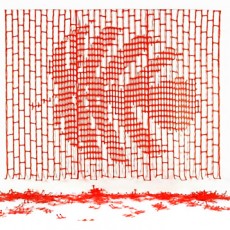
Tim Craker, ‘Botanical Data File #3’. Plastic safety fencing, hand-cut. 205 x 300 cm. 2008. Now in the permanent collection at Rimbun Dahan.
dot-net-dot-au was an art exhibition by Tim Craker and Louise Saxton, who separately undertook short term artist residencies at Rimbun Dahan gallery in Malaysia in 2006, exploring their most vivid impressions of the time they’ve spent travelling between their home country and Malaysia. dot-net-dot-au is an artistic meditation on the links that bind us geographically and metaphorically.
The exhibition travelled to Malaysia and Singapore. In Kuala Lumpur it was presented at The Annexe Gallery, Central Market, 10-27 July 2008, where it was supported by the Australian High Commission, Kuala Lumpur. In Singapore it appeared at The Substation, 5-17 August 2008.
Tim Craker and Louise Saxton produced two individual series of artworks that surprisingly complement and work in tandem with one another. Put side by side, the collection of works reveal a disarmingly quirky and personal insight into the experiences of two artists exploring Malaysian life and culture as outsiders.
Running through the entire series is Tim Craker’s elaboration of the net, literally and metaphorically. The net describes communication links, the sieve of memory, a tool to capture experiences and also the imaginary walls that separate cultures.
Interspersed among the nets are Louise Saxton’s insects, flowers and human figures meticulously put together from embroidered and quilted fabric. The effect is an artistic reenactment of the two artists’ process as they absorb, understand and meditate on Malaysian life and culture as outsiders.
dot-net-dot-au was also a continuation of their exhibition dot-net-dot-my at the Red Gallery Contemporary Art Space, in Melbourne, Australia, in 2007.
Above: Tim Craker, detail of ‘Thought Pattern’, plastic chinese soup spoons, nylon thread. 250 x 400cm. 2007.
Exhibition Opening
The exhibition was opened on 10 July at 8pm by Angela Hijjas:
It is a great pleasure to be here to open this show for Louise Saxton and Tim Craker, a show that was partially generated by our Rimbun Dahan residency programme. 2006, when Tim and Louise were resident, was a good year for us as we started inviting artists for shorter periods than the usual year long programme. That year we had a rich assembly of artists, coming and going, overlapping with different experiences from Malaysia and Australia. We hadn’t considered doing this before, as until then we had looked for people who could stay for a year, making organization easier for us, but we subsequently realized how great an impact a shorter stay in a new environment can have on creativity.
Tim and Louise are testament to that. Louise stayed with us for just a month, as that was all the time she could spare from a young family and commitments in Melbourne. For Tim, who was with us for three months, it was a chance for him, as he put it, to live as an artist, and it then precipitated the decision to leave his profession as a veterinarian to embrace his real passion, making art.
It is now obvious to me that life altering experiences don’t necessarily take a year; a month or three can be enough to generate new views of the world and significant developments in an artist’s practice. Subsequently Rimbun Dahan began inviting choreographers and performance artists as well, adding to the variety of interactions and new ideas. So I owe a lot to Tim and Louise for their contribution to Rimbun Dahan, and for their efforts since in developing their early ideas into these works in the Annexe today. Inspiration can come suddenly, but a solid art practice requires time to digest the concepts into new forms and expression.
I was lucky enough to see the beginnings of this show when it was first exhibited in Australia last year, and the potential was obvious. Despite their very different styles, both artists found common ground, not just in the net, but in the everyday experiences that are so easily overlooked in a world sated with materialism.
Above: Detail of Star Flower, cotton and linen embroidery, steel pins on nylon bridal tulle, 300 x 180cm approx, 2008. Now in the permanent collection at Rimbun Dahan.
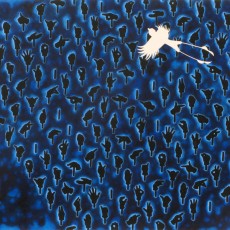
Louise takes the delicate hand made laces and embroideries of past decades, pieces that would have been treasured as part of a bride’s glory box, that today we rarely appreciate or examine in detail, sated as we are with too many material possessions. She carefully dissects and recasts these delicate pieces into creatures and installations that are suddenly contemporary, forcing us to look closely, to examine the minute detail and to appreciate such a visual treat in our mass produced world. By transforming lacey detail into fantastic insects, she is making a world of fantasy animals that would do nature proud. Some of her animals are indeed real, like the hornbill and koala, but when she expresses them with just a negative space we are reminded of how ephemeral the real world is, and how linked we are to our short term material possessions rather than to the really important things like birds and animals facing extinction.
By contrast, as if from the other end of the continuum, Tim takes inspiration from mass produced plastic paraphernalia that has never enjoyed much aesthetic appeal… but he transforms it into something unique and stunning, in scale and form. In 2006 he made a work for Art for Nature on the theme of appetites, all about food and its roles in our lives. Tim created a huge net of linked disposable wooden chopsticks draped in the light well of our gallery; like a fishing net it was an immense Chinese banquet “celebrating” our disposable culture. With his pieces here today, he has gone further, by choosing new disposable items and binding and cutting into them to create something beautiful and puzzling. Beautiful because of the shift in scale and the surprisingly tactile effect of plastic, and puzzling because of the complete reversal of ideas of durability and impermanence. I just wish he could do something with the orange plastic barrier blocks that now litter our roads at every turn… being stuck in a traffic jam might be a better experience for some artful transformation of the detritus that surrounds us.
Louise and Tim came to Rimbun Dahan, after being art students in Melbourne together some years before, and again in this show. Their works are from very different perspectives, and yet they reverberate against each other to create a stunning exhibition. We are honoured to have this work visit Malaysia, and for that I would like to thank the Australian High Commissions, both in KL and in Singapore for their support. Unfortunately most of the High Commission staff, including the High Commissioner herself, could not be here tonight because of an official visit from the Australian Prime Minister, but I’m sure Tim and Louise would want to thank them for the support that made the show possible.
Thank you all for coming, and I’m sure you will enjoy the show. Congratulations to both Louise Saxton and Tim Craker for a stunning exhibition that illustrates superbly what both Australian and Malaysian artists are working towards: new expression, new materials and new ideas. And I’m sure you will all enjoy it. Thank you.
In 2006 Tim Craker and Louise Saxton undertook sequential short-term artist residencies at Rimbun Dahan in Malaysia.Rimbun Dahan is set on fourteen acres of lush indigenous gardens featuring a fully restored nineteenth-century Malay house. The location is beautiful but remote. Craker and Saxton were bodily transported from a cold, grey Melbourne winter into a humid tropical environment and exposed to more extreme contrasts as they moved between the seductive isolation of their garden retreat and the sensory overload of crowded Asian cities.
The work they separately completed on their return to Australia they link, literally and metaphorically, to the net – a term of multiple references. Today, ‘the Net’ is everyday shorthand for the internet and the worldwide web, alluded to in the exhibition’s title dot-net-dot-au. Developed in Malaysia, made in Australia, exhibited in Melbourne and exported for viewing to Malaysia and Singapore, the exhibition is part of this contemporary globalised network of information exchange. The net as a physical entity also figures prominently, albeit very differently, in both artists’ work.
Above: Detail of A bird in the hand #1, cotton and linen embroidery, steel pins on nylon bridal tulle. 300 x 150cm approx. 2008.
The bridal veil, made of the finest, translucent ivory-coloured net, forms the backing of Saxton’s embroidered wall pieces. This net marks a barrier between self and non-self, or, in the case of the bridal veil, a transition between one state of being (or possession) and another.
Psychologically ambiguous when considered in relation to the body, the net signifies protection but simultaneously advertises the presence of danger. The cosseted bride cocooned in her veil, or the baby breathing peacefully beneath a mosquito net, is insulated from threats lurking in the outside world. In other manifestations, like the spider’s web, the net intended to entangle and entrap is the danger.
Insect metaphors abound because the net, in many ways, defines our human interaction with them. The bee keeper goes swathed in net to collect her honey. The insect collector arms herself with the net and the jar to gather her specimens. Saxton uses embroidery pins to skewer her ‘specimens’ to the net for display. As the veil flutters gently and the pieces cast a shadow against the wall, they take on an illusory delicate life.
Saxton draws inspiration from a collection of women’s domestic crafts she has amassed over many years. Items such as hand-embroidered table linen and lace, once treasures destined for a bride’s glory-box, are now culturally obsolete in Australia and are commonly found discarded in charity shops. Saxton has added to this collection aesthetically-related crafts from other traditions, including Chinese papercuts and Indian wall embroidery. In a painstaking process of extraction and reconstruction that takes place over many hours, Saxton cuts, glues, stitches and backs hundreds of the tiny coloured textile or paper fragments into new configurations. Among the more common motifs found in the Western embroideries are butterflies and flowers, based on and debased from natural history prototypes going back to the eighteenth century. Influenced by this and the memory of the Malaysian garden, she transforms them into fantastical individual insects or cloud-like swarms. Lately, these have expanded into more complex compositions drawing on Asian spiritual imagery: henna hand stencils Saxton found in Kuala Lumpur, a seventh-century Cambodian Buddha head, traced from a book, the Yoga Tree of Life, a Chinese Cloud motif and a Star Flower, based on a Malay Islamic design. These compositions contain a motif-within-a-motif in the negative space in the centre of each work. For example, the Malaysian Hornbill sits within A bird in the Hand and the Australian Koala within Home-Tree. Both species are threatened. As Saxton explains: ‘The use of the negative form within the highly decorative outer motif becomes a metaphor of vulnerability and potential loss, (of species and also traditions) common to both our cultures.’
Detail of Tim Craker, ‘Botanical Data File #3’. Plastic safety fencing, hand-cut. 205 x 300 cm. 2008. Now in the permanent collection at Rimbun Dahan.
As far removed from the individuality and preciousness of Saxton’s salvaged, decorative elements as possible, the elements of Craker’s grids, nets and patterns are mass-produced and interchangeable. Craker chooses items such as moulded plastic spoons, cups and lunch-boxes not only for their ‘transformative potential’, but because they are readily available, easily worked and, not least, cheap (650 plastic cups or fifty metres of orange safety fencing are still affordable). The abundance of these cheap throw-away objects gives the artist licence to experiment freely on a larger scale and to explore the potential of the multiple. As he observes, he likes making ‘something big out of something little’, or perhaps even, something out of nothing. Taken individually, these disposable, transparent, almost weightless objects are so self-effacing and familiar that they almost disappear into their surroundings. Taken together, as units linked into wall or floor-sized configurations they become monumental, although not overpowering. They retain a sense of provisional-ness as they buckle or sag, sway in the breeze or gleam in reflected light in response to subtle changes in their environment. By keeping his touch light, Craker draws out of the banality, even abjectness, of his materials an unexpected quality – grace.
Although Craker works within the staple of abstract art, the grid, and preserves and observes the integrity of his minimalist units, he is not interested in ‘pure’ formalism or in creating self-referential, impersonal systems. Craker’s ‘recycling’ has a humanistic and environmentalist dimension. This is most clearly expressed in his Botanical Data Files series, in which leaves emerge as positive shapes from a snipped-away grid, the orange plastic leaf litter left in untidy drifts on the floor. Craker’s patterns refer to things in the world, among other things: genetic codes and their transcription errors, cellular arrays and honeycomb, three-dimensional computer drawing and molecular models. By juxtaposing the organic with the plastic and non-biodegradable in Botanical Data Files, Craker draws a different affect out of his despised materials, which he acknowledges as products of hyper-consumerism and an environmentally-destructive petrochemical industry. Similarly, his use of food utensils in such works as Cascade, Blanket and Ripple is not purely a matter of the expediency of a cheap available resource. He has said he is drawn to using food utensils, not only for the tactile attractions of their immediately-recognisable and particular shapes, but to what food and the sharing of food represents. Craker mentions the role food – recipes, preparation, eating – has played in the successful meeting of his family with that of his Malaysian partner. Food both epitomises cultural difference and offers the means to transcend it through common civilised rituals.
In dot-net-dot-au Saxton and Craker are concerned with identifying the threads of commonality that link their Malaysian experiences with their Australian lives – from the mutually-sustaining human traditions of ritual, food and the decorative arts to the global stresses on a fragile, shared environment. This travelling exhibition in Malaysia and Singapore brings their work full circle, back to its source. The Malaysian garden that once haunted the Australian studio now frames the work and reveals its hybridity from a different angle.
Photography on this page by Andrew Wuttke & Gavin Hansford.
Burmese visual artist Khin Zaw Latt was resident at Rimbun Dahan in May 2008. Following his residency, he returned home where he was awarded the first prize at the Myanmar Contemporary Art Award 2008 competition, a prestigious achievement which has greatly increased the selling price of his work in Myanmar.
Khin Zaw Latt then travelled to Laputta, in the Burmese south, an area devastated by Cyclone Nargis at the beginning of May. Armed with a donation from Rimbun Dahan, he provided the inhabitants of Laputta with aid in the form of clothes, food and help building houses, as well as books and school materials for children.
The work by Khin Zaw Latt which won the Myanmar Contemporary Art Award 2008.
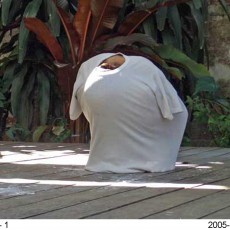
Moe Satt, a performance artist from Yangon trained in zoology and community development, was in residence at Rimbun Dahan for three months, from February to April 2008.
Bio
Moe Satt (b 1983) lives and works in Yangon, Myanmar (Burma). In 2005 he graduated from East Yangon University with a Bachelor of Sciences (Zoology). Since then, he has participated in over 25 performance events and four solo shows as well as digital art exhibitions.
In his art works, Moe Satt tries to reflect the order and disorder surrounding people and the neverending justification in terms of human internal validity. He started out as a performance artist showing his work in the galleries and on the pavements of Yangon. In April 2007 he attended a certificate program in Community Development and Civic Empowerment at Chiang Mai University, Thailand. He exhibited his first solo art work abroad at Chiang Mai University in June 2007. He has participated in international performance art festivals including Performance Site Myanmar 05, 8th Open International Performance Art Festival in Beijing, China and 9th Asiatopia International Performance Art Festival in Chiang Mai, Thailand.
Dr Megan Keating was one of the Australian artists of the year-long Malaysia-Australia Visual Artist Residency at Rimbun Dahan in 2008. At Rimbun Dahan she created Plantation Nation, a body of large-scale oil on canvas works, which explores the idea of “home” and how we cultivate an environment to ‘ manufacture’ this idea.
About the Artist
Megan Keating was born in Sydney, Australia where she worked in a design studio before attending the National Art School. She holds an Honours degree (first class) (1998) and a Doctorate of Philosophy in Fine Art (2002) from the University of Tasmania.
She is a multidisciplinary artist crossing installation, painting, and paper cutting. Her practice explores the nature of extremes. These extremes or conflicts can be seen as conditions and consequences of contemporary living; such divergences include tradition and modernity, beauty and terror, craft and technology, media and reality, nature and culture. Within this forum Keating often uses motifs that nudge at the edge of acceptability such as bombs, military iconography or pornography, which she renders as elegant silhouettes.
She has exhibited extensively since 1999 with recent solo projects including Different Reds, Gallery 4a, Asia- Australia Arts Centre, Sydney (2001); And then there were none… Gowlangsford Gallery, Sydney (2003); In Dreams Begin Responsibilities, 2-28 Memorial Museum (curated by Yaohua Su), Taipei (2006); The Year of the Rat, Xue Xue Institute, Taipei (2007); Deep Water Dark Water, Criterion Gallery, Hobart (2007); and Hard Love, Devonport Regional Gallery (2008). Group exhibitions include Papercuts, Monash University Museum of Art, Melbourne (2003); Love Letters to China, Ivan Dougherty Gallery, Sydney (2003); Drawn Out, Perth Institute of Contemporary Art (2005); Her name is Tan Hua, collaborative performance with Mei Li, Taipei (2006); This Crazy Love, Linden Gallery, Melbourne (2007); Loop, Barry Room Gallery, Taipei (2007); Under My Skin, Asialink touring exhibition to Manilla, Hanoi and Singapore (2008). Keating has also been the recipient of numerous awards including an Asialink Residency to Beijing (2000); Australia Council Residency, Tokyo (2003); Arts Tasmania Research and Development Grant (2003); Australian Council New Work Established Grant (2005); Asialink Residency, Taipei International Artists Village (2006) and Artist–in-residence, The European School, Taipei (2007). In 2008 Keating was the recipient of the year-long residency at Rimbun Dahan, Malaysia. Her work is held in the collections of Artbank, BHP Billiton, Pat Corrigan Collection, Australia, Australian Embassy, Beijing, National Gallery of Australia, Rimbun Dahan, Malaysia, Taipei Artists Village, Taiwan and the University of Sydney.
Keating currently lives and works in Hobart where she lectures in painting and graphic design at the Tasmanian School of Art. In 2009 Keating will return to Tasmania to curate an exhibition of contemporary Taiwanese art for the 10 Days on the Island Festival and the University of Tasmania.
Plantation Nation is a body of large-scale oil on canvas works, which explores the idea of “home” and how we cultivate an environment to ‘ manufacture’ this idea. Images and inspirations have been taken from observations of Malaysia, especially around the locality of Rimbun Dahan whilst concurrently thinking about the issues related to being away from home, what is a home, returning home and trying to establish a sense of home in a foreign environment.
The Aquarium, 2008, Oil on canvas, 153 x 183 cm, RM 8 500. Part of the Rimbun Dahan Permanent Collection.
A Beautiful Cage, 2009, Oil on canvas, 183 x 153 cm.
Flagland, 2008, Oil on canvas, 183 x 152 cm.
The Hearth, 2008, Oil on canvas, 153 x 122 cm.
Home, 2009, Oil on canvas, 183 x 152 cm.
The Orchard, 2008, Oil on canvas, 122 x 153 cm.
Plantation Nation, 2009, Oil on canvas, 183 x 306 cm.
The Pyre, 2008, Oil on canvas, 153 x 122 cm, RM 7 000. Part of the Rimbun Dahan Permanent Collection.
Separate Rooms, 2008, Oil on canvas, 153 x 183 c.
An Unsustainable Weight, 2008, Oil on canvas, 153 x 122 cm.
Lauren Black (b.1971) is a contemporary botanical artist from Tasmania, Australia. During her residency at Rimbun Dahan her work has focused around the theme of disappearance; exploring themes such as rare and endangered species, the relationship between human culture and botanical life and, the transient beauty of plants.
Works on exhibit will be in watercolour and pencil.
Musa gracilis, 2008, Watercolour and pencil on paper, 87.2 x 66 cm, RM 6 000. Part of the Rimbun Dahan Permanent Collection.
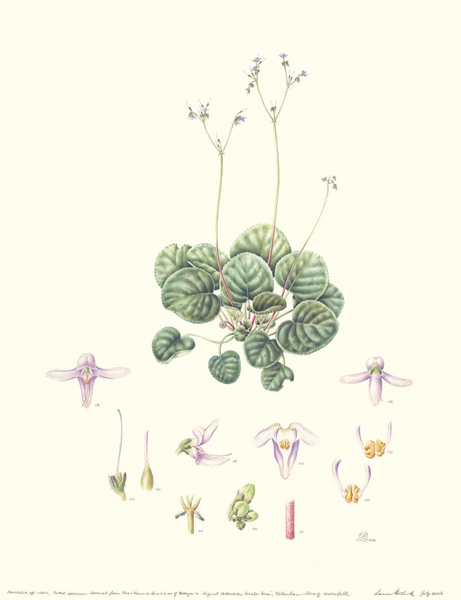
Henckalia sp.nova, 2008, Watercolour on paper, 87.2 x 66 cm.
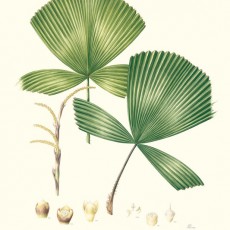
Licuala khoonmengii, 2008, Watercolour on paper, 87.2 x 66 cm, RM 7 200. Part of the Rimbun Dahan Permanent Collection.
Macodes petola, 2008, Watercolour on paper, 87.2 x 66 cm.
Nepenthes ramispina, 2008, Watercolour and pencil on paper, 87.2 x 66 cm.
Shorea siamensis, 2008, Watercolour and pencil on paper, 87.2 x 66 cm
Ephemera 1, 2008, Pencil on paper, 92.5 x 71 cm.
Ephemera 2, 2008, Pencil on paper, 92.5 x 71 cm.
Ephemera 3, 2009, Pencil on paper, 92.5 x 71 cm.
Forgotten flora 1- confined, 2008, Gouache and pencil on paper, 69 x 51.6 cm.
Forgotten flora 2- exodus, 2008, Gouache and pencil on paper, 69 x 51.6 cm.
Forgotten flora 3 – palmed, 2008, Gouache and pencil on paper, 69 x 51.6 cm.
Forgotten flora 4 – executed, 2008, Gouache and pencil on paper, 69 x 51.6 cm
Heaven in a wildflower 1, 2008, Gouache and pencil on paper, 92.5 x 70.5 cm.
Heaven in a wildflower 2, 2009, Gouache and pencil on paper, 92.5 x 70.5 cm.
Artist’s Profile
Lauren Black is a leading figure in contemporary Australian botanical art. Her career in this specialised field commenced in 1997 with studies at the Royal Botanic Gardens Melbourne. Currently working as a freelance artist and teacher she has been involved in many projects and commissions including collaborations with botanists, artists, universities, community and government organisations. As well as exhibiting regularly as both a solo artist and as part of group exhibitions in Australia, Lauren has also curated numerous botanical exhibitions of historical and environmental importance.
In 2004 Lauren won the inaugural Margaret Flockton Award for excellence in botanical illustration, NSW, Australia. In 2005 she was awarded an Asialink visual arts residency to develop her practice further in Sri Lanka.
Lauren’s residency at Rimbun Dahan has introduced her to the rich and diverse flora of the tropics. She hopes to continue this relationship with tropical flora; developing projects that can reveal both the extraordinary beauty and precarious nature of this region for a wide audience.
Lauren’s work is held in numerous collections including:
HRH Crown Prince and Princess of Denmark
Queen Victoria Museum and Art Gallery, Tasmania, Australia
Allport Library and Museum of Fine Arts, Tasmania, Australia
University of Tasmania Fine Art Collection
National Library of Australia, ACT
Royal Botanic Gardens Library, Melbourne, Vic. Australia
Justin Lim (b. 1983 Kuala Lumpur, Malaysia) completed his postgraduate studies in 2006 with the Master of Art (Fine Art) programme by The Open University UK conducted at Lasalle-SIA College of the Arts, Singapore after obtaining a BA(Hons) Fine Art majoring in painting. He has exhibited widely in Malaysia and Singapore in various solo and group exhibitions. In 2007,he was the Artist-In-Residence at TAKSU, Kuala Lumpur and was awarded the 2008 Malaysia-Australia Visual Artist Residency at Rimbun Dahan, Malaysia.
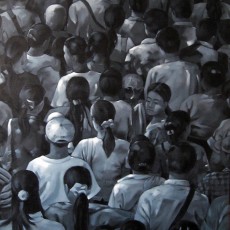
His new body of works examines the connection between existence, religion, politics and its relation in our contemporary social context. Using painting as a medium, Justin’s residency exhibition entitled Gods, Heroes & Myths represents and questions the human capability to distort the truth. Inspired and conceived between the 50th Merdeka celebrations and the 12th Malaysian General Elections, Justin uses random people and fictional characters to question various events surrounding the nation and people’s perception towards them. In relation, the works also explore subjects like manipulation, power and religion.
Detail from Gods, Heroes & Myths, 2008, Acrylic on canvas, 244 x 914 cm.
Hantu Air, 2008, Acrylic on canvas, 183 x 152 cm.
Hantu Tetek, 2008, Acrylic on canvas, 183 x 152 cm.
In Oil We Trust, 2009, Acrylic on canvas, 183 x 152 cm.
Orang Minyak, 2008, Acrylic on canvas, 183 x 152 cm.
Part of the Rimbun Dahan Permanent Collection.
Toyol, 2008, Acrylic & charcoal on canvas, 183 x 152 cm.
Warfare series 1, 2009, Acrylic on canvas, 122 x 152 cm.
Warfare series 2, 2009, Acrylic on canvas, 122 x 152 cm.
Warfare series 3, 2009, Acrylic on canvas, 122 x 152 cm.
We Want You!, 2008, Acrylic on canvas, 61 x 54 cm (set of 9).
Secret Identities, 2008, Acrylic on canvas, 122 x 244 cm.
Animal Farm, 2008, Acrylic on canvas, 122 x 244 cm.
Part of the Rimbun Dahan Permanent Collection.
The Last Supper was contributed by Justin Lim to ‘Shifting Boundaries’, the 2008 Art for Nature Exhibition. It is currently in the collection of Ng Sek San. 2008, acrylic on canvas, 102 x 102 cm.
Gods, Heroes & Myths, 2008, Acrylic on canvas, 244 x 914 cm
About the Work: Some Thoughts on Gods, Heroes and Myths
For Justin Lim’s third and latest solo exhibition, figures have literally come to the fore. In fact, they loom large on the canvasses. The interest in figuration is not a recent or sudden one. His formal training in figuration could be traced to when he was studying visual and digital arts in Malaysia from 2001 to 2003.1 This was later overshadowed by his interest in abstraction when he pursued his fine arts degree in Singapore from 2006 to 2006.
However, when Lim returned to Malaysia in 2007, he was caught up by what was happening around him, especially the political and social events of the time such as murder scandals2, the 50th Merdeka Celebrations3, the HINDRAF controversy4and the 12th Malaysian General Elections. The latter proved to be particularly momentous as popular dissatisfaction led to the loss of the ruling party’s two-thirds parliamentary majority as well as five states to the opposition. Lim recalled the almost ‘festive’ air during the election period when his neighbourhood was festooned with posters and banners, and the gripping political drama was the topic of constant conversation. This was also a period when Lim was questioning the reality of the ‘festivity’. Issues such as the role of religion, the influence of social structures and conditioning, and the relationship between power and truth were pondered upon. How much autonomy do we really have in life? And how do we relate to and perceive the people around us? This then led Lim to reflect on the political and social changes occurring in his midst. What is the relationship between power and politics, race and religion? How does the mass media influence public perception? How much should we believe of what we read? Can we really trust what we see? And how does one make sense of this paradoxical, topsy-turvey world that we live in?
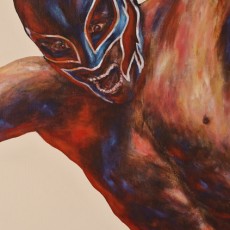
Questions like these are explored through the use of figuration in Lim’s new works. In the case of the largest painting Gods, Heroes and Myths, the figures press upon the viewer, popping to life from a pristine flat background. Using the parade of characters, Justin highlights a number of ambivalences and paradoxes. Sumo and American wrestlers are a source of entertainment but are also treated as heroes by many in their home countries. So, how seriously should they be taken by us? Two other figures strike dance-like poses with eyes half-closed. Are they dancing or going into some sort of trance – one is never quite sure. There is a man sporting a Mohawk haircut and punk clothing. As an icon of anti-establishment counterculture, he takes silent aim at the central figure in the picture. A butcher, with knife in hand, who stands amidst hanging carcasses, looks at the viewer quizzically. He wears a white rounded cap, usually associated with the taqiyah worn by Muslim men. How do we regard this enigmatic character? In an age when terrorism-driven fears have exacerbated irrational exaggerations and stereotyping, where is the place for truth and tolerance? In the work Animal Farm, Lim takes inspiration from the book by George Orwell, a cautionary tale about power and corruption. Featuring a line-up of animal carcasses stripped of all marks of identity, the painting seems to be reminding us that regardless of our desires, convictions and achievements, this is the ultimate destiny for everyone – to become mere remnants of anonymous flesh, nothing more, nothing less.
The notorious murder of a Mongolian woman with its lurid headlines of a gruesome murder using explosives, allegations over a shady purchase of submarines, and the involvement of the police and prominent political individuals, had transfixed the public for much of late 2006 and 2007.5 In addition, the turmoil on the international front, ranging from Gulf War to the oil crisis, provided much food for thought. The use of ghosts as a metaphor by Lim is an interesting one. Ghosts are said to haunt the living, just as the excesses of Malaysian politics continue to make their presence felt throughout the past 50 years.6 Ghosts are also sometimes regarded as the repositories of our irrational fears and suspicions. One characteristic of Malaysian politics has been the periodic resurrection of the so-called ‘bogeyman’. Referring to a terrifying spectre used as a threat to misbehaving children, politicians often resort to racial issues to incite popular unease or unrest within a particular ethnic community, thereby manipulating them to behave in ways which have not been helpful in fostering greater trust and understanding within a plural society like Malaysia.7 Lim has, though his canvases, created a disturbing world where ghosts such as the Toyol (slave ghost used for stealing money), Hantu Air (water ghost), Hantu Tetek (breast ghost) and Orang Minyak (oil man) collide with the submarines, warplanes, suited businessmen, petroleum kiosks and hand grenades from our world. The atmosphere evoked in these works is certainly nightmarish and unreal, but is it any worse than the times which we live in?
Lim is an artist who has always been curious to question and investigate the world around him. As his personal circumstances changed, so did his field of exploration, and the means of his investigation also varied accordingly. The forms may be different but his investigative and creative spirit remains the same.
Low Sze Wee (Assistant Director – Curation & Collection) Singapore Art Museum
1 Interviews with artist on 6 June and 27 December 2008.
2 This refers to the trial of a political analyst over the murder of Mongolian woman in October 2006. The case became a political scandal because the defendant had close ties to the governing party as well as Malaysian Deputy Prime Minister Najib Razak.
3 This refers to a series of private and public activities which celebrated Malaysia’s 50th Independence Day in 2007.
4 HINDRAF refers to the ‘Hindu Rights Action Force’ – a coalition of non-governmental Hindu organisations – which had initiated protests and rallies to preserve their community rights in late 2007. These later led to several arrests and detentions without trial by the government.
5 This refers to the same scandal mentioned in footnote 2.
Joey Chua (Singapore) and Mcebisi Bhayi (South Africa) were resident choreographers at Rimbun Dahan in 2008. Mcebisi and Joey’s collaboration was the first recorded instance ever of a female Asian choreographer working with a male African choreographer to produce a single work.
Tracing: Dance Dialogues in Singapore and South Africa
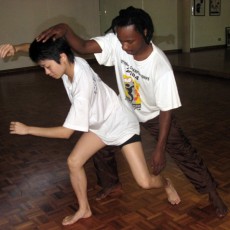
Mcebisi, a South African Xhosa man who swears by his customs, and Joey, a Singaporean woman who can barely speak her Chinese dialect Hakka, decided to start a dialogue. After months of letter writing and intimate sharing of childhood memories, their exchange shifts to the present as they come face-to-face, finding both common ground and contrasts in each other’s dance background, personality and physicality. In tracing the minds and bodies of one another, they hope a new dance vocabulary emerges on their creative journey together.
The dance collaboration between Joey Chua and Mcebisi Bhayi continues to evolve as a work-in-progress showing in KL followed with appearances in Hong Kong and at Singapore Esplanade’s dan:s festival. The finished work will premiere at the FNB Dance Umbrella 2009, a major dance festival in South Africa. Chua, one of Singapore’s rising young dancer-choreographers, has been involved in many collaborative projects that have taken her to festivals around the world. Bhayi is a dancer, choreographer and educator who has been nominated as Most Promising Male Dancer in Contemporary Style at the FNB Dance Umbrella 2001.
Tracing was performed at the Fonteyn Studio Theatre, FAB, Section 14, Petaling Jaya on 1-2 August 2008.
Artist-in-residence at Rimbun Dahan from March to June 2007, Donna created new performance piece bringing together local Malaysian dancers, video and sound artists to explore the idea of waiting, passing time, momentum and interruption in Extended Periods of Waiting, which was performed on June 8 2007 at The Annexe Central Market. The work featured live sound by SiCKL, video projection by Saiful Razman and Au Sow Yee, lighting by Roman Cruz and performance by Donna Miranda, Bilqis Hijjas, Yuka Tanaka, Louise Yow Sing-Hwa, Low Shee Hoe, Shaifuddin Mamat and Chan Seau Huvi.
The trio section from Extended Periods of Waiting was performed again as part of the Tari! 07 festival at ASWARA in July 2007.
During her stay, Donna also created I Will Think About It, a contribution to the 2007 Art for Nature exhibition in collaboration with visual artist Saiful Razman, and featuring Poodien. She also conducted a workshop in contemporary dance, creative process and free movement improvisation at the Annexe Central Market in June 2007.
Donna and Poodien creating I Will Think About It.
Donna received dance training as national government scholar of the Philippine High School for the Arts, pursuing professional practice and further training with Ballet Philippines, Philippine Ballet Theater, Myra Beltran’s Dance Forum and specialized training in contemporary dance at the 2005 DanceWEB Europe Scholarship Programme, in Vienna, Austria. She has since been actively involved in multimedia projects that explore new possibilities through works that combine contemporary dance, new media, fashion, physical theater, spoken word and sound. In 2000, she co-founded Green Papaya Art Projects, building a research platform for contemporary dance in Manila through its Anatomy Projects (AP+). Her solo ‘Beneath Polka-dotted Skies’ recently received 2007 Jury Prize Award in the Yokohama Solo X Duo Competition in Japan.
I Will Think About It, choreographed by Donna Miranda.
Low Shee Hoe and Donna Miranda in a duet from Extended Periods of Waiting.
A scene from Extended Periods of Waiting at the Annexe Central Market.
The four-person dance collective EU & ME (European Union & a little MISTAKE and an EXCUSE) consisting of
Joey CHUA Poh Yi (Singapore, Hong Kong)
Marie CHABERT (France, UK)
Csilla NAGY (Hungary)
Rhys TURNER (Australia)
performed their work FIND.MOVE.PLAY, an interactive physical theatre performance with digital art, for the opening night of the Art for Nature Exhibition at Rimbun Dahan on Saturday 24 July 2010. [Photos below by Anthony Pelchen.]
The Collective began in 2008 in New York, in the frame of the Dance Collective programme organised by OMI international Arts Centre. Then the artists collaborated in the Czech Republic as resident artists of CESTA Festival. After four successful presentations in Hong Kong and Singapore this performance at Rimbun Dahan is the closing show of a one-month tour.
EU & ME arrived at Rimbun Dahan on Saturday 17 July, and within the space of a week created a 45-minute work tailored to the specific spaces of Rimbun Dahan as well as inspired by the artists’ own experiences of being on a residency in Southeast Asia and discovering life in Malaysia.
FIND.MOVE.PLAY was performed at 10pm on 24 July as the final event on the opening night of Art for Nature. Information about the performance was provided through an announcement during the opening ceremonies, and by flyers distributed on the dinner tables.
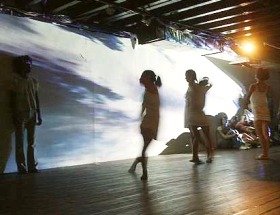
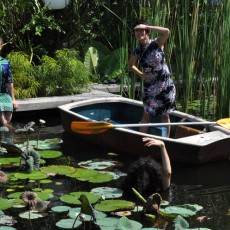
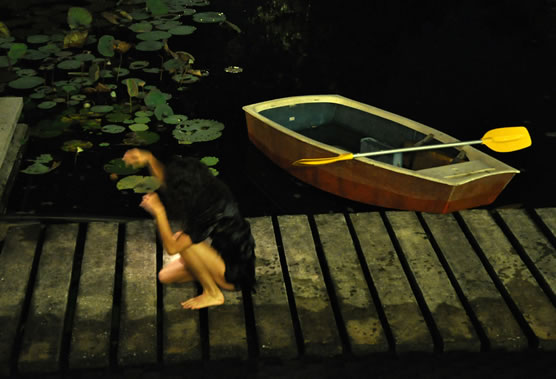
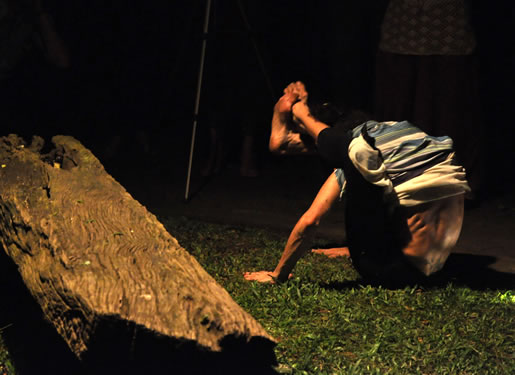
The performers used a number of different sites around the property, including the central space of the underground gallery, the reflective lotus pond, outdoor sculptures and herb garden. The performers invited the audience of 100-200 people to follow them from site to site, linking the vignettes with a narrative about Orpheus and searching for love.
The performance incorporated digital art, with a dance film taking a comic look at residencies at Rimbun Dahan, and an interactive soundscape in which selected audience members wearing headphones heard the accompanying music change as they moved around the space. The audience was also invited to participate in the work, manipulating the dancers, helping them with specific tasks, answering questions and holding flashlights.
FIND.MOVE.PLAY alternated impressionistic romantic moments – Joey Chua wearing a traditional Chinese cheongsam and singing a Chinese love song while paddling herself about among waterlilies, or Marie Chabert flinging herself about among towered sculptures of lit glass – with moments of slapstick comedy, as when Marie slapped Rhys Turner on the face in retaliation for his bad pickup lines, and moments of unforgettable eeriness, such as Csilla Nagy’s mysterious inhuman emergence from the darkened pool followed by her literally stalking a quivering audience member. The tone of the work transitioned easily, tracing the natural atmospheres of the various different performance sites.
In addition to being a fun, funny and thought-provoking work in its own right, FIND.MOVE.PLAY also functioned perfectly as a teaser for Dancing in Place, a weekend of site-specific contemporary dance performances that will take place at Rimbun Dahan during the final week of the Art for Nature exhibition. By using multiple venues in very different ways, the audience was able to appreciate the potential for site-specific work at Rimbun Dahan. For many members of the audience more used to visual art, it served as an accessible introduction to contemporary dance and audience participation.
This performance was supported by and National Arts Council (Singapore).


 Wong Yoke Hin Nicholas took up a one-month residency at Rimbun Dahan in August 2008. He read some of his poetry in an informal presentation in the Underground Gallery on 25 August 2008. During his residency, he worked on pieces about Malaysian flora and fauna, as part of his first poetry collection.