Resident Artist
Louise Saxton

Louise Saxton is a Melbourne-based artist who trained in painting and printmaking at RMIT and holds a Post-graduate Diploma with the Victorian College of the Arts and a Masters Degree in Fine Arts with the University of Ballarat.
Since 2000, Louise’s practice has centred on the reconstruction of detritus from the home. This has included the re-use of her own paintings, collections of everyday business envelopes and vintage wallpapers and discarded needlework.
In 2006 she was awarded a Sir Ian Potter Cultural Trust travel grant to undertake an artist residency at Rimbun Dahan in Malaysia. In 2008, her joint exhibition dot-net-dot-au (with Tim Craker) toured to Malaysia and Singapore, including works she had conceived and created at Rimbun Dahan.
Artists’ Statement from the Travelling Exhibition dot-net-dot-au
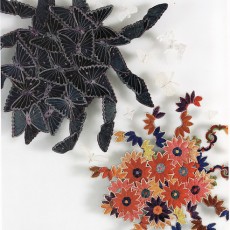
Based on a collection of small henna-hand stencils (mehndi) I found in KL in 2006, I made (the linen coloured) Hand-work first. I chose the hornbill as the negative motif inside the hand because, being a vulnerable species in Malaysia, I wanted to create a connecting point between Malaysia, my time at Rimbun Dahan (the image was found in a Malaysian Nature Society magazine on the property) and our two very different cultures. I liked it so much that I made the blue one, mirroring the hand and repeating the hornbill negative within it. The Home-Tree was made next (based on an Indian Tree of Life image that I’ve been carrying around with me for the past 15 years) and the koala was chosen as the negative motif. Being a vulnerable species here at home, the koala acts for me, as an Australian counterpart to the Malaysian hornbill. The koala also has a deep connection, within Australia, to the decorative home-based traditions of the past (“Australiana” doilies etc) and as a national icon.
The use of the negative motif inside the highly decorative outer motif becomes a metaphor of vulnerability and potential loss (of species and also traditions) which is common to both our cultures. So, the choices I’ve made here are about my trying to find connecting points between my brief encounters with South East Asia and my ongoing life in Australia.
The majority of motifs I am choosing for dot-net-dot-au were “collected” in Asia and the majority of actual embroidered materials were collected here in Australia. These, largely Western motifs (dotted throughout with Asian inspired imagery) could be seen to represent colonisation, but hopefully, they can also create another link between cultures – that of the home and the garden.
In-filled with hundreds of, individually extracted, embroidered motifs, the Hand-work pieces create, because the palms are opened outwards, a gesture of welcome and offering (which links them to the original henna (mehndi) hands used for Indian weddings and other celebrations). In both Hand-works and Home-Tree there is also a sense of protection, by holding the vulnerable, absent image within their palm or branches. There is perhaps also, the possibility of loss and at the same time, the potential for ‘salvage’.
The other image I have chosen to work with is the Buddha head, also brought home with me from Malaysia as a simple pencil line-drawing. Traced from a book I found in my guest room at Rimbun Dahan, the original sculpture housed in the Rijksmuseum in Amsterdam, is a 7th Century Cambodian Buddha. Imitations of these ancient sculptures are found here in Australia, one being spotted recently sitting outside my local garden shop. The image represents my own fascination with the incredible beauty of Eastern arts traditions, but also the difficult arena of the displacement of traditions, of Colonisation and the plundering of other cultures. At the same time, there seems to exist in the image, an enduring sense of quiet, humility and peace, which allows the image to somehow transcend its appropriation – or does it? The Buddha’s cast-down eyes, in my re-appropriation, are made of pearl-drop lace, a feather and a blue flower. His ear and cheek are embellished with tiny blue birds and a miniature Chinese fishing boat, a delicate butterfly caresses his neck and in his hair knots, (made from over 100 circular crochet and embroidered motifs) ‘nest’ two running-stitched swallows. These embellishments on an image once cast in bronze, and now drawn by me in delicate reclaimed lace, could point to the Buddhist idea of transience? However, it also makes me feel uncomfortable – is it still a “stolen” image? This also causes me to wonder, about the nature of travel, of my residency and my return to Malaysia and Singapore to exhibit this year – while we try to grasp something of the wisdom and experience of other traditions, can we ever really hold on to it, or make it our own?
Louise Saxton
March 2008
Helen Bodycomb

Helen Bodycomb of Castlemaine, Australia, had a residency at Rimbun Dahan in 2006. She returned to Malaysia in 2009 with three other mosaic artists to work on the collaborative artwork ‘The Shyness of Trees’ at Hotel Penaga.
Bio
Helen Bodycomb moved to the Castlemaine area in late 2007 from Melbourne, where she had lived on and off for almost 30 years. Born in Adelaide and raised as a young child in Elizabeth (SA), she went to Uni High and later – to art school – in Melbourne. She completed a BA in Fine Art (majoring in Painting) at Victoria College, Prahran and then a Post-Graduate Diploma at Monash Uni. See http://www.helenbodycomb.com/
Suzanne Ingleton
Suzanne Ingleton has been at the forefront of political cabaret and stand-up comedy since the mid-seventies, touring widely in Australia and overseas, writing and producing for television and community arts projects. During this residency Ingleton completed a play dealing with the Malayan Emergency of the fifties, Flower of Malaya, and visited local communities in Kelantan to undertake field study and research into shamanism and performance which will feed into her book Being There in Spirit.
Jayne Fenton Keane
In 2005, Australian poet Jayne Fenton-Keane spent an Asialink residency in India, Singapore, and at Rimbun Dahan in Malaysia.
Jayne Fenton-Keane is a poet, new media artist and composer who takes poetry to different spaces with her poetry-sound fusions, installations and performances. The author of three poetry books, Torn, Ophelia’s Codpiece and The Transparent Lung, Keane is an award winner in several genres, is completing a doctorate on embodiment and spatial poetics, and the founding Director of National Poetry Week. During her residency Keane explored pilgrimage as a creative method for inviting new knowledge into her writing. Activities included a residency at Rimbun Dahan in Malaysia, a residency at the Singapore Poetry Festival and appearances with the CGH Earth Chain in India.
Nadiah Bamadhaj
Nadiah Bamadhaj was in residence at Rimbun Dahan in 2005 alongside her spouse Arie Dyanto. A number of Nadiah’s works are in the Permanent Collection at Rimbun Dahan. Angela Hijjas also opened the exhibition of her work, ‘1965 Rebuilding its Monuments’, at Galeri Petronas in 2001.
Bio
Nadiah Bamadhaj (b. 1968, Petaling Jaya, Malaysia) was initially trained as a sculptor at the University of Canterbury in New Zealand but now produces drawings, sculptures, installations and digital images. She has worked in nongovernmental organizations, lectured in art, and has written on both Malaysia and Indonesia. In 2000, she began her fulltime art-practice and was awarded the Nippon Foundation’s Asian Public Intellectual Fellowship in 2002, electing to spend her fellowship period in Yogyakarta, Indonesia, where she currently lives with her husband and son. Her artwork continues to focus on the social intricacies of Yogyakarta’s society, using myth, architecture, and dwelling to articulate her observations.
Exhibition opening remarks by Angela Hijjas
1965: Rebuilding its Monuments
An Installation of Drawings by Nadiah Bamadhaj
I am honoured to be invited to open this outstanding exhibition in Galeri Petronas. I have been intrigued by watching Nadiah weave paper into maps and sculpt forms out of plaster of Paris, but I did not have a clear understanding of the cohesion of the exhibition until I saw the final display of the scale and content of her intentions.
The title Nadiah chose, 1965 Rebuilding its Monuments, unites all the disparate elements into a cohesive creation. I suspect that all of us have a fragmented understanding, at best, of the events in 1965, but this exhibition brings them all together. The exhibition highlights the separate events of the overthrow of Sukarno by Suharto, the subsequent slaughter of suspected Communists in Java and Bali, the split between Malaysia and Singapore, and the foreign construct of the domino theory that overshadowed the entire region. The year 1965 represented a major turning point in the history and culture of this region, and Nadiah’s exhibition forces us to realise not only that no event occurs in isolation, but also that a new marker or monument of 1965 is required.
I would like to note some of my impressions from viewing the exhibition.
The first segment represents the arsenal of Communism in Indonesia, and the wave of revolution and violence from Jakarta which topples the original monument to independence from colonisation. The catastrophe of crisis is brilliantly illustrated by the torn hole of society’s woven fabric, frayed and broken around a black abyss, and the sheer size of the archipelago as it stretches beyond the horizons, with only violence for a compass.
The next segment commemorates the subsequent bloodletting. Half a million people were slaughtered by militant Muslims in the backlash against Communism, while the Indonesian military stood by. In Nadiah’s work, the sparseness of the remaining landscape is haunted by the lack of figures, even the tomb stones are massed together in an unfamiliar and unacceptable way. A single monolithic stone is felled in grief, while Arabic numerals spiral out of control.
The quieter worlds of Malaysia and Singapore were not immune to the upheavals of that year. The declared objectives of ‘peace, tolerance and stability’ were undermined by communal insecurities. In the next sector of the exhibition we see the postcolonial network coming apart in our own country, as Singapore was forced out to find its own way. The emergence of the so-called Malay Ultras effectively destroyed the marriage, and we see the procession of the hantaran (gifts in a traditional Malay wedding) tumble into the crevasse.
The final sector of the exhibition looks at how the rest of the world perceived the region at this time, a perception dominated by the so-called domino theory. Escalating tensions in the region between Communism and the American Way were an unspoken omnipresence in Southeast Asia. Now it is apparent that many events at the time were engineered by the centres of the Cold War. In Nadiah’s work, the tiny local protagonists are surrounded by the interests of these larger powers, disguised in the traditional regalia of the shadow play. The larger powers, like the shadow puppeteers, were supposedly magnanimous, but ignored the needs of Southeast Asia for the sake of their own agendas.
The exhibition comes full circle, returning to the arsenal of Communism and the violence between Right and Left, the recent horrors, and the reactions of neighbouring countries and the international community. After several revolutions of the exhibition, one has an impression of the drama and complexity of those times and of how each event fuelled and influenced the others. Traditional history tends to itemize events on a time scale and from a single point of view, but experiencing the power of these individual events and realizing how they influence each other is the great message of this exhibition.
There is also another imperative in this show: the need to commemorate by reinventing our monuments.
After the First World War between 1914 and 18, monuments sprang up all over England propounding ‘For God, King and Country’, glorifying the dead while while never questioning the responsibility of the existing power structure. But the process of modernization unleashed by the war left people feeling betrayed by the same God, King and Country. The tone of later monuments changed to ‘Never Again’ and ‘Lest We Forget’, which provide none of the comfort of glorious death but reassert the absolute imperative to remember.
The monument to the Vietnam War in the United States is a memorial that was very long in coming. It commemorates a lost war with a discredited cause. It honours individual soldiers who gave their lives, but it still only tells one side of the story. One day I hope there will be a parallel monument to the other sides. Any monument, like the Vietnam War Memorial, reminds us of the imperfections of history and the necessity for constant revision. Periodically we need to recast our monuments in a manner that relates to the changes we have experienced since, because any monument to a major event also marks the beginning of a new era that was built on the past.
Often damage is caused not just by the commemorated events, but by the monuments that remain to perpetuate the old myths. There is no predominantly right way to remember and memories do change over time. Rather than accepting the platitudes of existing monuments and the history books, this exhibition marks a new interpretation of an important period in the history of Southeast Asia, calling us to build again on our new understanding.
Quite apart from the cultural importance of Nadiah’s exhibition, the work is remarkable in Malaysia because it deals not only with visual impact, but with underlying ideas. Betrayed by history as written in books, Nadiah communicates her strong intellectual ideas in a different medium. Not only has she accomplished the presentation of ideas as an art form, but she has built a new monument to remembrance, cast in the idiom of our own time but in memory of all that has gone before.
Angela Hijjas
12 April, 2001
Arahmaiani


Arahmaiani’s exhibition, entitled Lecture on Painting, Part I, accompanied by photographs by Bernice Chauly, will be on display at Vallentine Willie Fine art from 24 August 2005 to Saturday 10 September 2005.
The artist will give a talk on her work on Saturday, 3rd SEPTEMBER, 2005, at 3.30 pm. Tea will be served.
Vallentin Willie Fine Art,
1st Floor, 17 Jalan Telawi 3
Bangsar Baru
59100 Kuala Lumpur
Malaysia
Tel: 60 3- 2284 2348
Fax: 60 3- 2282 5190
rachel@artsasia.com.my
www.artsasia.com.my
Southeast Asian Paintings & Works of Art
Gallery & resource room opening hours Monday – Friday: 12 noon – 6pm. Closed on Sundays and public holidays.
About the artist:
Coming soon to VWFA is one of Indonesia’s most outstanding contemporary artists, Arahmaiani (b. Bandung, W.Java, 1961). Working mainly in performance and installation art since the early 80s, Arahmaiani has gained an international reputation for her often provocative work. Her Indonesian
roots, Western art training and humanist concerns has bought Arahmaiani to numerous exhibitions and performances, ranging from those held directly in streets protests in Indonesia, contemporary art museums in Asia, Europe and America, and notably to events as such as the pretigious 50th Venice
Biennale 2003 and the “Breaking Words” Performance Art Expo in Nagano, Japan (2004). More recently, Arahmaini has been working on art and social projects in Kuala Lumpur and Germany.
For her first solo exhibition in Malaysia, Arahmaiani will use this private gallery as a platform to question the mechanisms and politics that govern the making and selling of art. As the artist aptly puts it “I am not against the market, but I hate market fundamentalism, exploitation, monopoly – market terrorism!” To express this delicate negotiation between her needs and personal journeys as an artist with the pressures of mass consumerism, the artist will present a series of painted diptychs and also give a performance. “I want to turn the medium of painting into performance. I want to transform the individual ‘product’ of painting for the commercial art world into a complex question of authorship and its marketability”. Photographs by Bernice Chauly of Arahmaiani’s performance ‘body/text’ will also be on view.
More information on Arahmaiani please visit, http://universes-in-universe.org/eng/islamic_world/articles/2003/arahmaiani.
Yau Bee Ling


Yau Bee Ling was one of the Malaysian artists of the year-long Malaysia-Australia Visual Arts Residency in 2005.
Above: From The Gardener Series – exhibited at the 2005 Art for Nature exhibition in Rimbun Dahan.
Bio
Yau Bee Ling was born in 1972, Port Klang. She graduated from Malaysian Institute of Art (1992-1995) with award of full scholarship in fine art course (painting). Since then, she has been actively practising and exhibiting in Kuala Lumpur since she graduated in 1995. She was selected by the National Art Gallery to represent Malaysia at the 9th Asian Art Biennal in Dhaka, Bangladesh in 1999. In 2000, she was selected by the renowned regional curator T.K. Sabapathy to exhibit at Singapore Sculpture Square. In 2002, her paintings were chosen to exhibit at the 2nd Fukuoka Triennale, Fukuoka Asian Art Museum and her paintings were collected as part of the Fukuoka Museum permanent collection. In 2004, her paintings traveled to Hokkaido Museum of Contemporary Art as part of “Soul of Asia: Fukuoka Asian Art Museum Collection”. In 2005, she was awarded as Rimbun Dahan, Malaysian – Australian Artist-in-Residence programme which was generously supported by Hijjas Kasturi Association/ Rimbun Dahan, Kuala Lumpur.
Exhibition Catalogue Essay
by Sharon Chin
If there is one thing that characterizes moving out of a home and into a new one, it is the humble cardboard box. More than being a container for objects, they also hold memories, histories and hopes for the future. Looking at Bee Ling’s previous works that paint the idiosyncrasies of home life in all its ritual complexity, and now at the new series created during the year-long Rimbun Dahan residency, I am reminded strongly of unpacking a cardboard box in a new house – the jumble of the past colliding with a heady anticipation of new independence.
Rimbun Dahan has been a transition of sorts for Bee Ling. Together with her husband and fellow artist, she has moved out of the old family home into new territories and new roles. What sort of home has Rimbun Dahan provided for the artist? It was always to be a temporary abode, but dwelling somewhere for any amount of time means that habits are developed, certain rituals invented, and time and care is devoted to one’s surroundings. This is the nature of inhabitation. No place is ever neutral, nor stays unchanged if you place someone in it.
Hence we are presented with paintings that act like windows looking in and out. In the foreground, views are framed – here by a stripe of color, there by the cheerful edge of a floor rug. We look in upon traces of life lived at Rimbun Dahan. In Celebration, for example, a multitude of empty glasses tells us light-heartedly of the consumption and chatter that accompany a heightened social occasion. Windows in the background leading to the world outside reinforce the in-between nature of these works, reminding us (and the artist) that all this must sit in context of a wider societal picture.
A period of transition is also one of negotiation. For Bee Ling, there are many roles to play as artist, wife, woman, daughter and now, daughter-in-law. In between must lie the personal search for individuality. As such, in the paintings, tables become platforms for a parliament of objects. It is not so much what is depicted, as the way they are grouped. They crowd each other, jostling for space and prominence, much as one must feel torn between fulfilling the many expectations of society, family and the self. There are quieter dialogues though, such as in Make-up set on Pink Table and Typewriter on Pink Table. These reveal a calmness that exists within the intimate private space of a person.
We could see the home as a container for all aspects of our lives – basically everything we put into a cardboard box upon moving out, as well as our very bodies. There are many symbolic containers in Bee Ling’s works, taking the form of baskets, which sit large upon the aforementioned tables. The objects that fill these containers are less defined, blurring into each other in a riot of color that threatens to overspill the confines of the basket, onto pristine table-tops and into the surrounding environment. These seem to speak of emotions and the sheer energy of living, the fruits of which are naturally a vibrant and at times chaotic harvest.
Here we see the artist pushing the potential of her medium, reveling in paint’s materiality to convey thought and feeling. In Working Hard in the Kitchen, for example, a basket is filled with a jumble of groceries. The brushstrokes overlap each other on a surface that is built and rebuilt again. These painterly gestures are almost self-contradictory – having started by making meaning, the artist proceeds to efface that meaning with other layers. This is reflective of a self-identity that is mutable and in constant change. After all, as any cook will tell you, in the kitchen one must be organizer, toiler, purchaser, and provider!
Moving out also means moving on. It takes courage to do so, to recognize the need for personal privacy, freedom and individuality. These are as important as the familial ties that bond people together. As much as we move into a new place, we carry with us that which has made us what we are. Yet if we hold on too firmly to the past, we can stifle the opportunity for growth. I see these new paintings as a transition between moving out and moving in, a record of the first brave steps into a world and a home of one’s own making.
Sharon Chin is an artist and writer. She majored in sculpture at Victorian College of the Arts in Melbourne, Australia and has been living and working in Kuala Lumpur for the past year.
My garden does not exist in reality but evolved as a mental picture of those who inhabit it; a garden that oscillates between dream and reality. It changes from a site for self-discovery to a place for cultivating personal vision.The Gardener Series – exhibited at the 2005 Art for Nature exhibition.
Tony Twigg

Australian sculptor Tony Twigg was the Australian resident artist of the year-long Malaysia-Australia Visual Arts Residency in 2005.
Bio
Tony Twigg has produced over 40 solo exhibitions of wall-based objects and installations in Australia, Malaysia, The Philippines, Singapore and the U.S.A., and has been included in group exhibitions across Asia and Europe. He received his Master of visual Arts from the City Art Institute Sydney in 1985. He lives and works in Sydney, Australia and Manila, Philippines.
Tony’s numerous exhibitions have been presented in a variety of disciplines including, performance, film/video, installation, painting and sculpture, as well as curatorial practice. He is represented in private collections and public collections in Australia, Singapore, Malaysia and the Philippines including: the National Gallery of Australia, the Queensland Art Gallery, the Art Gallery of New South Wales, the Ateneo Art Gallery Manila and the BenCab Museum, in the Philippines.
Tony Twigg in conversation with Gina Fairley. Rimbun Dahan December 2005
How did your journey to Rimbun Dahan, from Manila to Ho Chi Minh, up the Mekong to Phnom Penh and Angkor Wat, colour your arrival in Malaysia?
I arrived in Kuala Lumpur with certain expectations of an Asian experience built around the places I’ve gravitated to over the past decade. These are places where people quickly adapt ‘things’ – found objects – into life’s necessities, objects I see as ‘accidental art’. There’s an intuitive creativity in their making which speaks to me passionately of the human spirit. K.L. is a first world city, complete with all the accoutrements of now, where the prerequisites of “life-style” decide how things look rather than human need. Somehow, the first marks I made were ruled lines and then a lot of time was spent looking for a mark that comes from here, that is Malaysia, not just K.L.
Where did you find that Malaysian mark?
Here, along Jalan Kuang, at a demolition site, in discarded fish boxes beside a pasaraya and as crazy looking bottles of Chinese liquor from Kuang. It turned out that the Malaysian mark, for me, was the fish box. I started working with the ‘physical’ line of the object rather than its inspiration. The major impact was the surface. I found the subtle and random shifts in colour and texture of the timber aesthetically moving, so I began using thinner and thinner paint until I had the courage to use none. For me these fish boxes engaged the spirit of the original maker. There are two hands at work in my pictures.
Clearly you have a passion for the found object, but this feeling of a dialogue with the ‘original maker’ is a new development.
It occurred to me while making the works called 30 Fish Boxes. My proposition was simple: join three fish boxes together vertically to make a construction. As I worked the possibilities multiplied and I felt like I was jamming with the guy who made the boxes. The piece MT Madras was an amazing find and the most extreme relationship with the original ‘maker’. I found it in Brickfields during Deepavali and photographed it. The crate collapsed neatly enough to make it back to the studio. Not only did it not need paint, it didn’t need any carpentry either. My role as artist was limited to identifying the object, and conservator. This piece is the end point in the show and it has necessitated relinquishing certain controls over my surfaces and the arrangement of my constructions. Slowly, I’ve become aware of how subversively an object can be spirited. Accidental art has a great deal of beauty that I try to emulate by considering the making process rather than considering what beauty ‘looks’ like. The result is a set of elementary forms that have a certain universal understanding common to places like Chau Doc, Pasir Mas or Manila – the bird cages of Kelantan are a good example of this – but put them in cities like Sydney or K.L., they become exotic.
A dialogue with space is a constant in your work: architectural space, conceptual space, personal space, cultural space – it’s not static. Do you perceive an ‘Asian’ space?
I find the sensation of space physically exciting. I’ve come to realise that the way we perceive space governs our proximity to the objects we encounter. You and I might see U-shaped canyons walking through the city, but a town planner or crane driver would probably see it differently. In that sense, the way we perceive space becomes the operating system of our aesthetic. The idea of stacking space, and how that establishes illusionistic depth without referencing perspective, I think, is essentially ‘Asian’. Seeing Gao Xingjian’s recent show at Singapore Art Museum underlines this and it was also the big discovery for Ian Fairweather, an English artist who worked through Asia in the ‘30s on his way to becoming Australia’s pre-eminent Abstract Expressionist.
Do you consciously push the parameters of space outside the edges of the work to engage the gallery wall?
Yes, it is absolutely vital. It is not a question of an object surrounded by space, it’s a composition of positive and negative space. So, like a doughnut, the defining feature of the work could be an empty space. As a result my works are often multi-panelled because there are moments when the negative space is stronger than the positive space and consequently the work splits in two or perhaps fails to join. In this kind of work there are no right or wrong decisions, and the final relationship of the parts can change as they adapt to the constraints of a location or reflect the taste of a new owner. However, the drawing of the work – its lines, its spaces and its surfaces – remain unchallenged.
About the Work
Thompson Birdwing Butterfly (above), exhibited at the 2005 Art for Nature exhibition.
Shortly after arriving in Kuala Lumpur, I found a very appealing broken wooden box in Chinatown. Back in the studio, I put it together as an ordinary looking thing that I then tried to liven up with yellow paint. A month or two later, I was on a demolition site and found two pieces of circular something in wood. Back in the studio it was a match for my yellow construction. Once it was together I started wondering if a butterfly might be a solution to the picture, inspired by the Art of Nature show. Bee Ling came to my studio and said that I had a word on my box, and it was butterfly. Next Angela was looking at this piece and said, “Look, a yellow and black butterfly,” just like my work, outside the studio, in the garden. It is Troides aeacus Thompsonii, a male Thompson Birdwing.
Victoria Cattoni


Victoria Cattoni spent an Asialink residency at Rimbun Dahan in 2005. She is a visual artist working in the mediums of video, installation and multimedia. Cattoni’s practice during the residency focused on dress and its cultural interpretations. The first half of the residency took place at Rimbun Dahan and culminated in the presentation of a collaborative video work TREE, at Art for Nature 2005.
TREE is a montage of image, sound, text and performance structured around a simple question: ‘if you were a tree, what kind would you be?’ The video acts as an imaginative trigger, inviting the viewer to identify with a tree that becomes a metaphor for human existence, an embodiment of ourselves in relation to others.
During this time her work was also screened at the not that balai festival and she presented a public lecture at Galeri Petronas. In the second half of her residency Cattoni completed works for a growing list of exhibition commitments in Malaysia and Indonesia. Since completing the residency Cattoni has participated in the Bali Biennale 2005 with a digital media work titled White Onion:Bali Bride and exhibited new work entitled Kedai Kebaya.