Choy Chun Wei

Malaysian Resident Artist 2005

Choy Chun Wei is enjoying his time playing the “collector” and the “engineer” in Rimbun Dahan. Look around and you will find his workspace populated by jars and tubes of paint in different degrees of exhaustion, while piles of unidentifiable junk and a plethora of paraphernalia lay scattered across the floor. When I visited his studio recently, he tells me “I still return to the city to collect all this junk”. The process of collecting and constructing, or building, forms the root of Chun Wei’s artistic approach. Whether in the form of photographs, paint, ink, or other found materials, the potential in each of the artist’s materials will be stretched out, deconstructed, reconstructed and layered to present unique views of life within an urbanscape. Those familiar with Chun Wei’s body of work will recall his early photo-collage series such as Citadel and Link House from 2001. They were the result of a morning ritual whereby the artist would walk with his camera to work, photographing random exteriors of homes in Bandar Utama to relieve the monotony of this routine. The collection of photographs captured from these walks later grew into a series of musings about home within our fragmented urban environment seen through the eye of an outsider.

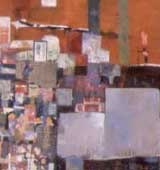
In his latest series, Construction Site, paint and found materials have replaced photographs to become the building blocks in the artist’s work. He tells me that every single paint mark and object is treated as an individual units, “like Lego blocks”, built layer upon layer, one over the other. Each work begins with the overlaying of paint onto the surface ground in broad sweeps. “I rarely know what is going to happen during the early stages so I just let it happen.” Once these initial sweeps have been established, ‘units’ of paint and materials are incorporated into and over the initial foundation through the use of a diverse range of tools – hands included – as well as other media to create a spectrum of marks and textures. It is clear, through this new body of work, that the artist has discovered a more instinctive and energetic process in creating image and texture; there is an obvious sense of play, as well as a newfound confidence in distilling the images to near abstraction.

The urban landscape and mapping continue to figure prominently in Chun Wei’s work. The ritual of returning to the city to collect the artist’s ‘junk’ bears poetic resonance in the artist’s dedication to his subject matter. While his mapping process may have begun within the immediate confines of Bandar Utama, his concerns have since extended into farther reaches, taking on a wider worldview beyond geography and tangible matter. Perhaps this development has been prompted by changes in the artist’s personal life. Marriage and moving out to a new home has shifted his outlook on life; he is no longer the wandering outsider looking in, but rather someone who has found hearth and home.

Construction Site begins with The Construction of Metaphysical Site I. While the spatial arrangement in this painting may appear conventional to the eye, it is nonetheless striking in its composition and form. It recalls the imaginary maps many of us would have drawn during childhood. Colours and simple geometric shapes are employed to demarcate different territories and densities while incidental marks may imply roads, railway tracks or borders. The Construction of Metaphysical Site II suggests a fantastical yet apocalyptic cityscape alluding to Italo Calvino’s Invisible Cities. Vertical forms, or monoliths, grow from opposite directions; they weave in and out of the dramatic foliage, moving towards each other, drawing closer to convergence.

Subsequent works such as The Changing Mindscape, Intimate Dwelling Site and Configuration l, demonstrate to the viewers that the spatial configuration in each painting has grown progressively tighter and denser through the course of development. The drama and density of this series culminates in the epic Big Dwelling Site. Impressive and intense, the painting’s expanse and tight overlapping layers of paint and found materials overwhelm the senses. The eye picks out the random details and unexpected textures as it roves through this dense forest of marks and colours; you will find bits of corrugated board here, unidentifiable slices of plastic and dried materials there, a shaved off bar code somewhere above. The painting possesses a cubistic resonance as the artist breaks up the picture plane to create multiple perspectives. They also remind us of Mondrian’s earlier paintings where grid and lines form the artist’s primary motives. Spaces move in and out, shifting from two-dimensional to three-dimensional planes, taking our eye on a manic ride through tightly wound nooks and crannies, before launching into exhausting claustrophobic areas that slowly ease off towards the edges.

Configuration lll (Breathing Space), one of the later pieces, sees the artist side-stepping his usual media employed in this series. It is perhaps the most carefree piece in this body of work, and as the title suggests, this painting provides a beguiling reprieve from the intense concentration of heavy impasto marks and texture. Here, the brush takes over from the palette knife to create a delicate yet intricate web of lines. They float evocatively in space, layered in muted neutral shades, amidst collaged drawings of furniture culled from the pages of an IKEA catalogue. The minimal treatment draws attention to the construction of the image, allowing the visual narrative and emotional content to exude its understated charm.

Adeline Ooi
December 2005, KL

Garden Objects

This is part of a series exhibited in Art for Nature 2005 that delves into the formation of mental maps to explore human dwellings within the landscape. The garden is a place for tactile and sensory engagement, where one may expand sensibility within space. Click on the thumbnails above to view larger images.

Biodata

Choy Chun Wei (b. 1973) is a graduate and full scholarship holder from the faculty of Graphic Design at Central Saint Martins College of Art and Design, majoring in Illustration. He has been actively painting and exhibiting in a number of exhibitions in Kuala Lumpur and won an Honourable Mention at the Philip Morris Malaysia/ASEAN Art Awards in 2003. In 2004, Chun Wei received the Juror’s Choice Award (2D) at the Malaysian Young Contemporaries Exhibition organized by National Art Gallery. He became the artist-in-residence at Rimbun Dahan Artist in Residence Programme in 2005.

See more of Chun Wei’s work on his blog website http://cwconstructionsite.blogspot.com/

Saiful Razman

Saiful Razman

Saiful Razman was the Malaysian artist of the year-long Malaysia-Australia Visual Arts Residency in 2004-05.

Bio

Saiful Razman (b.1980, Malaysia) graduated from UiTM with a bachelor degree in Fine Art in 2003. He has exhibited widely in Malaysia, Lebanon, Australia and Singapore. In 2003, he was awarded both the Honourable Mention at the Philip Morris Malaysia-Asean Arts Awards and the Incentive Award at the Open Show, Galeri Shah Alam.

Malcolm Utley

Malcolm Utley
'Kuala Lumpur Journey with Rain', 2004, 120 x 120 cm, oil on sealed board.
‘Kuala Lumpur Journey with Rain’, 2004, 120 x 120 cm, oil on sealed board.

Malcolm Utley, from Bellawongarah, New South Wales, Australia, was the Australian artist of the year-long Malaysia-Australia Visual Arts Residency in 2004.

Malcolm Utley has a varied art practice encompassing architecture, film, installations, painting and sculpture. He graduated with 1st Class Honours in Architecture from the University of Sydney in 1990 and was awarded the Elizabeth Munro Prize for Design and the Ruskin Rowe Prize for History. In 1993 he studied film at FAMU, the national film school in Prague, Czech Republic. From 1998 he studied painting in the 3-year course at the Charlie Sheard Painting School in Sydney.

In 2002, Utley traveled to Paris, France to work as assistant to the Australian painter Tim Maguire. Upon returning to Australia, he enjoyed a brief contract as a visiting artist teaching sculpture at four Aboriginal community schools in the central lands of South Australia, before taking up his residency at Rimbun Dahan.


Sally Heinrich

In 2004, Australian illustrator Sally Heinrich spent an Asialink residency at Rimbun Dahan.

Sally Heinrich has worked as a freelance illustrator for twenty years. As well as writing and illustrating children’s books, her clients have included ad agencies, design studios and government departments. During her residency at Rimbun Dahan, Malaysia, and during side trips to Singapore, Heinrich produced an impressive volume of work, including the completion of the final draft of a YA novel Hungry Ghosts. She also collected much valuable reference material which will aid in polishing the illustrations for another forthcoming book The Most Beautiful Lantern.

She also made the work Princess Wonky in the Painted Castle, an illustration of the Rumah Uda Manap at Rimbun Dahan where Sally lived with her family, their adopted cat Wonky, and other birds and animals. The work currently hands in the Rumah Uda Manap.

Sally’s residency at Rimbun Dahan was also supported by Arts SA and the Australian High Commission, Kuala Lumpur.

Visit the artist’s website: www.sallyheinrich.com

Troy Ruffels

Troy Ruffels

D

Troy Ruffels was the Australian resident artist of the year-long Malaysia-Australia Visual Arts Residency at Rimbun Dahan in 2003.

Biography

Troy Ruffels was born in Devonport, Tasmania in 1972. Upon completion of the 12 month Rimbun Dahan Art’s Residency in Malaysia he will return to Tasmania where he works and resides – overlooking the Forth Valley and farmlands of the Tasmania’s North West Coastline. Ruffels graduated from the Tasmanian School of Art @ Hobart, University of Tasmania (UTAS) with a Bachelor of Fine Art in 1994, where he was also awarded the degree BFA (1st Class Honours) in 1996. He obtained a Postgraduate Diploma ( with Distinction) from the Glasgow School of Art, 2001, and was in 2002 admitted to the degree Doctor of Philosophy ( Fine Art), University of Tasmania.

Ruffels’ work has been featured in numerous Australian and international curated exhibitions, with work exhibited in New York, London, Madrid, Barcelona, Alicante, Lisbon, Lubjjana, the Canary islands, Glasgow, Berlin, Sydney, Melbourne, Canberra, Brisbane, Perth and Hobart. His work is held in numerous collections including the Tasmanian Museum and Art Gallery, The Devonport Regional Gallery, and Artbank.


Exhibition Catalogue Essay

Filtered Sky

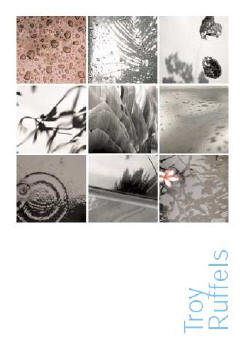
Rimbun Dahan exhibition catalogue cover.

I have a memory of Troy Ruffels as the only outdoor coffee drinker in the hair-raising cold of a Tasmanian winter morning.  I would pass him most days on my way to university. All other patrons were on the inside of the cafe window, protected behind a curtain of condensed air, their heads in newspapers.  But the folded arms and casual sitting style of the outdoor patron belied the chill as Ruffels embraced the opportunity to observe and respond to the outdoor world, ‘gathering and collecting small details of the passing environment.’ [1]

This memory is five years old, and comes to me in irony as I consider the work that has evolved during 12 months in tropical Malaysia. In the heat saturated studio at Rimbun Dahan, Ruffels continues to be fuelled by the natural elements that exist in the urban environment.  The images conceived there reveal that the artist’s interest in an emotional sense of place travels with him, and is not limited to, nor lost without, his home in Tasmania. Alert to the smells, sounds and sights intrinsic to the places he visits, the artist is a filter for these experiences and memories to distil, and ultimately take root in paintings and photographs.

The works in Sampled Reality simultaneously ground and throw the viewer. They form a push me – pull me map from diaristic imagery that has been snatched by the artist from its otherwise temporary moment of beauty and being. We are grounded in the panoramic and all encompassing scale of the works, and settled by the poignant aesthetic of each reflection. Ruffels’ work draws you in, offering a journey through the artist’s experience of the world around him.

Rain. Trees. Clouds. These soft aspects of nature settle almost too comfortably in the seemingly impenetrable surfaces of new cars, puddles, glass, and hard, wet ground.  Reflections in such urbane, ever-present fabrics are not something we usually register consciously.  We look at the object itself, rather than the image nesting within it. Reflections do not break surfaces like scratches, dents, ripples and graffiti. Instead, they briefly accommodate the shape of the object and are almost camouflaged to eyes unaccustomed to looking beyond the expected. Ruffels has trained himself to see, snaring these apparitions as they pass across the object’s skin, and revealing the world’s infinite network of reflected, subterranean passages.

The viewer experiences subtle confusion in the artist’s use of reflection, for we normally register reflection through the live, mirrored image of ourselves or our immediate environment. The artist has further evaded other mirrored references by ensuring no part of himself is captured in the photograph.  Trees, sky and stone are gently altered by the blurred movement, muted colour, shifting focus, and colliding imagery characteristic of these urban reflections. These subtle transformations trigger a sense of unease as one recognises that the painted or photographed image is not taken directly from its subject.  Ruffels crops the imagery so that the edge of the reflective surface is gone. The image is floating.  ‘Sky, tree and stone hang suspended’ as the frameless, softly mirrored world turns the tactile world on its head. [2]

In Malaysia, after years of working with photo media, Ruffels has again taken up painting.  He writes that putting paint on canvas allows for ‘prolonged sensorial engagement’ with the subject, sensing that real value of the work is in the ‘process of engagement with the world, and the processes through which [the subject] is interpreted, and brought to life in the studio’. [3]The moving brush across canvas is not unlike the reflection moving across its surface, however the brush passes back and forwards, often repeatedly over the one area, as the image materialises. As each work-in-progress develops as an archive of the reflection, the painter exists in a world divined by instinct, a ‘continuous cycle of experience, response, and expression.’ [4]

It is hard to fight romantic writing when considering Ruffels’ imagery. Descriptions of the work are easily loaded with words like ‘poignant, whimsical, ephemeral, ethereal’. This is because the work is all of these things.  Ruffels makes no bones about the fact that his art is rooted in poetry and imagination, emotions, memories and histories.  Each piece is a layering process of experiences and responses to the natural environment.  The artist ‘takes’ natural forms to construct the images, and creates only beautiful works that trigger the human desire to experience something breathtaking.  In doing so, Ruffels drives the viewer into a flip-book of emotional responses, inciting us to reflect upon the extraordinary possibilities of the world sub-surface.

Ruffels has always responded directly to his immediate environment.  In Tasmania, photographic works about reflections were printed in steel grey, cold blue, and later, a metallic pink.  The rain, in its refected form, felt as if it would sting one’s skin, the waves were blackly Antarctic, and the path of the birds was ominous, as if a southern storm was brewing. Five years later, he wrote to me from Malaysia:

I have continued to work with reflections of nature in the environment.  It is a meaningful motif, which I embrace. It signifies the possibility that another world exists other than the one we are able to subject to rational analysis.  It gives rise to the possibility that there are other pathways we may travel in life – another level of appreciation, of understanding, of communicating with the world we inhabit – other than the one that is sold to us as being real … and subsequently finite. [5]

In the uncanny beauty that emanates from the images reflecting from duco or murky pools of water, there is a moment where one is uprooted by a feeling of wonder in the world, an awe-inspiring second of realising how small we really are, a flash where one is lifted through the clouds, or dipped beneath the molten surface of the water.  The gentle manipulation of natural elements, captured reflections, the transformation of passé surfaces, and the devout attention paid to an urbane instant catch the viewer in a sensory eclipse. Brief moments of recognition are surpassed by super-real interpretations of the physicalworld. These sensations linger as the viewer moves from the work, only to come across fragments of Ruffels’ imagery all around, and ordinary experiences intensify as reality is sampled by both artist and the viewer.


Jane Stewart, 2004
Director, Devonport Regional Gallery, Tasmania


[1] RUFFELS, Troy, Artist Notes to the Author, December 2003

[2] RUFFELS, Troy, as above

[3] RUFFELS, as above

[4] RUFFELS, as above

[5] RUFFELS, as above


Above: Troy and Anne Morrison standing in the underground gallery at Rimbun Dahan.


Jasmine Kok

Jasmine Kok
Jasmine in her studio at Rimbun Dahan.

Immersed in the richness and complexity of nature at Rimbun Dahan, Jasmine was searching for a dialectic experience with the plants and objects around her.  Obsessed with the regular pattern of the lines and textures on plants, different sizes of leaves were collected as models and cast with plaster of Paris.  Slabs of soft clay were pressed against the plaster moulds to question the ephemeral nature of the objects and things around us, and render the impermanent permanent.

‘Ceramic by its nature cannot escape medium-hood’. For an artist like Jasmine ‘working in a medium so identified with craft-based procedures, her clay sculpture is immediately subject to sustained discussion on its material language’, challenging the perception of the custody of material use and the art forms in contemporary art practice today in Malaysia.

Installation, as the British writer Michael Archer described it, is ‘a kind of art making which rejects concentration on one object in favor of a consideration of the relationships between a number of elements or of the interaction between things and their contexts’.  In Jasmine’s case, her works were a suggestion of scene and environment, which derived from her memories as well as from reality.  The imprinted clay leaves were glazed with color and scattered on fabric, referring to the changing seasons.  For instance, the imprinted lotus leaves of various sizes mimic the green summer water pond.  All these pieces of work bring the connection of the scene from outside to inside, from exterior to interior.  The relationship of human to nature was revealed through Jasmine’s intellectual interest, her participating in nature and sharing that experience with others.

Stone carving, like clay forming, is a slow and time consuming process.  The physicality of force and the gradual changes of surface and shape were important to Jasmine and can be seen in her stone sculptures.  Inspired by the curved and pointed elegance of the Jade Vine flower, Jasmine used marble to reinterpret her chosen subject through the physical process of carving.  The smoothness and reflective nature of the marble was tarnished, the solid surface was opened and revealed by force.  The original shape of the Jade Vine was copied, altered and magnified.  The meaning of the work lies not in the work itself but in our attitude towards the art work.

Jasmine Kok’s work ‘does not reproduce what we see, it makes us see’.  Her intention is not simply about recording the natural world but in transforming an object, a space and environment into something profound and intellectual.  The work offers a fresh vision to her and to the viewer.  The perceptual knowledge about the place around her, about things and objects she encounters and feels, are shown through her sculpture and installation works in a stage of ‘metaphysics concerned with the nature of existence’.

During her studies in London, Jasmine participated in an organization called ‘Art Express’, where she  taught wood and stone carving within the community for several years.  She was also involved in art therapy projects with problem children and the homeless, and the feedback was positive.  She had some special experiences working with other artists from different countries while in London, and shared different culture experiences when working in the quarries and sculpture parks.

In the past, Jasmine Kok’s sculpture was primarily figurative, but since her residency in Rimbun Dahan, her art practice has embarked on a whole new journey by exploring nature and different materials.  The artist in residence programme allowed her to explore new perceptions within her art, while assisting her to develop and understand the arts of her homeland.

Biography

Jasmine Kok Lee Fong

Date of birth: 28th October 1970

Nationality: Malaysian

Address: C109, Kampung Kundang, 48020 Rawang, Selangor, Malaysia.

Telephone:  0060-3-60341398 / 013- 639 9831

Email: rollingjas@hotmail.com

Education

1993: Diploma in Fine Art (Painting), Kuala Lumpur College of Art (KLCA).

1995 – 1996: Second year BA in Fine Art, University of Wolverhampton.

1996 – 1998: Diploma in Fine Art Sculpture, City and Guilds London Art School.

1998 – 1999: Stone Carving Course, City and Guilds London Art School.

1999 – 2002: MA in Fine Art, City and Guilds London Art School.

Solo Exhibition

August 2002 : Pain and Injury, Broken Spine Series, Life performance at Kennington Sovi Art Centre, London.

Mixed Exhibition

October 1984: The Second Asean Exhibition of Children’s Art at Malaysian National Art Gallery.

April 1993: Life Drawing & Oil Painting Exhibition at KLCA.

May 1993: “Earth Day” Performance Art at Central Market, Kuala Lumpur.

July 1993: Fine Art (Painting) Diploma Exhibition at KLCA.

May 1996: Sculpture Exhibition at Victoria Street Art Gallery, Wolverhampton.

May 1997: Sculpture Exhibition at Lumsden Art Gallery, Scotland.

June 1998: Find Art (Sculpture) Diploma Exhibition at City & Guilds London Art School.

September 2000: Fine Art (Sculpture) Exhibition (First Year MA) at City & Guilds London Art School.

September 2002: Fine Art (Sculpture) Exhibition (MA) at City & Guilds London Art School.

February 2004: Artist Residency Exhibition at Rimbun Dahan, Malaysia.

Awards

1984: The Second Asean Exhibition of Children’s Art, Manila, Philippines.

2003-2004: Resident Artist, Rimbun Dahan, Malaysia.

Anne Morrison

Anne Morrison
Anne standing in the underground gallery at Rimbun Dahan, surrounded by her work.

Rimbun Dahan Exhibition Catalogue Essay

HAVEN

Anne Morrison beckons you to hover over crevices, lie beneath canopies, bury beneath undergrowth. Slip behind membranes. Peel back foliage. Slide against cell walls.

The painted environments in Haven are both macro and microscopic, bodily and earthly, scientific and sensory. The artist asks that you peer deeper into the shadowy spaces that haunt the leaves, spores, and parasites inhabiting the canvas. The surface of each work is similar to a forest floor, where decaying leaves, peat, feathers, skeletons, and twigs collide so that elements of each are only partially exposed. It is this fragmented imagery that reflects her unique approach to representing the land: ‘the layering experiences of place, relating to memories and to the movement through the landscape.’1

During the 12 months at Rimbun Dahan, Morrison has dug into and reinterpreted the organic fabric making up the vast garden that surrounds the studio. At the beginning of the residency, Malaysia’s tropical forms were unknown, and responses were acute and overwhelming. But time has allowed the artist to study the foreign land through its flora, her perceptions and understanding building with accelerating intensity. She has been able to track the seasonal transformation of the plants so that smells and textures have become vividly and evocatively familiar. The initial razor-sharp responses to the strangeness of a new environment have matured into a complex series of observations that compound with each painting, nourishing and anchoring both the artist and her work in this place.

Morrison’s practice is a continuous process of inspecting and translating the interface of tree, plant and grass forms. Cataloguing the extraordinary colour, texture, and shape of tropical growth, she is a world away from the Tasmanian seeds and grasses that triggered the preceding body of work. These were fine, weightless structures, ‘simple forms, light and ephemeral, carrying a multitude of possibilities upon a breath of air… seeds flying, dancing in the wind, settling, perhaps seeding.’2 In contrast, the moisture-congested air in Malaysia leans on equivalent biology, preventing flight and suppressing movement.

In Haven, colours are saturated, almost garish: turquoise, orange, yellow and white, unlike the muted reds, blues and greys intrinsic to Tasmania. Tropical patterns are webbed, not podded. Forms are plastic, as if slackened by the heat, not taut like those plucked from a colder climate. Paint is thinner and more viscous. Imagery is created through spilling, dripping and pouring paint on canvas, and at other times by employing methodical, repetitive brush marks. The artist’s visual language is constructed from these diverse methods of paint application, and from the ever-changing forms that surround her. Within this painted lexicon, evolving and existing dialects are employed to reflect both newly-discovered and reinterpreted forms.

Morrison’s more recent investigation of plants and landscape stems directly from an earlier emphasis on the body. During the 1990s, she fused imagery related to medical scans, diagrams, and x-rays, with maps of the land. These works were also about the unfamiliar, but probed the darker regions of the human body rather than the surface patterns of plants. They referred to the vulnerability of the body, and our inability to understand the path of foreign bodies and invasive cells. Red, pink, orange, and white paint was spilled onto the canvas, staining and penetrating its surface rather than resting with the modulated control of brush strokes. Veins, sinew, plasma, and cells were manipulated to create trails that alluded to mapping and the exploration of the unknown. Gradually, these paintings have lead to the artist’s subtle inversion of imagery: from inner body shapes that are suggestive of land, to land forms that allude to body. Though perspectives shift from looking in, to looking out, each work continues to be a highly personal landscape capturing the osmotic relationship between body and land.

Weave, Scatter, Envelop, Lattice, Storm. These are titles of earlier paintings that evoke strong imagery as words alone. They encourage bodily engagement with the work: pulling, hugging, whispering. Like these previous works, the images in Haven call the viewer towards Morrison’s unfolding interpretations of dense tropical landscape. Plants resemble the hairs, bones, veins of the body, and the heated colours mimic the effect of humidity. ‘The air is palpable … moisture is thick … beads of sweat gather on the skin … one is continuously aware of one’s body….’3 As a personal catalogue of responses to a foreign environment, each work is familiar yet strange. Lines are both sharp and blurred. Foreground and background are combined. Fleeting forms are nearly recognisable, but impossible to pinpoint. We are netted in pattern and movement, grasping and sliding, aware only of our emotions and response to the landscape before us. A haven.

Jane Stewart 2004.
Director, Devonport Regional Art Gallery, Tasmania.


1 MORRISON, Anne, Notes to the author, December 2003.

2 MORRISON, Anne, as above.

3 MORRISON, Anne, as above.

From 'Hybrid series'1. Hive 2. Pod 3. Spore 4. Scale Size: 71.5 x 71.5cm (each work) Medium: oil on canvas.
From ‘Hybrid series’1. Hive 2. Pod 3. Spore 4. Scale Size: 71.5 x 71.5cm (each work) Medium: oil on canvas.

Biography

Born Glasgow, Scotland in 1966.

Morrison graduated with a Bachelor of Fine Arts Degree with Honours at Glasgow School of Art in 1988 before relocating to London to undertake a Master of Fine Arts at The Royal College of Art, graduating in 1990. In 1995 she was awarded a Commonwealth Scholarship to undertake research in Australia and in 1999 she was among the first to successfully complete a practice-based Doctorate in Fine Art at The University of Tasmania.

Morrison has had 11 solo exhibitions in the UK and Australia since 1989. Recent exhibitions include Cluster at Despard Gallery Hobart Tasmania and Body and Land at Devonport Regional Art Gallery Tasmania 2003, Weave of Nature at Essoign Club Melbourne 2002, The Sentient Body at Plimsoll Gallery Hobart 1999 and Intermediate Groundat The Bond Store, Tasmanian Museum and Art Gallery Hobart 1997.

Curated group exhibitions in 2003 include Love letter to China: Drawings by 35 Australian Artists at Ivan Doherty Gallery Sydney (Touring China 2004), Painting Tasmanian Landscape at Plimsoll Gallery Hobart, Future Perfect at Bett Gallery Hobart. Synergy at (Artist/Scientist collaboration), CSIRO Hobart and My Father is the Wise Man of the Village at Fruitmarket Gallery Edinburgh, Scotland 2002, Zero Horizon at CAST Gallery, Hobart 1999.

Arts awards and arts residencies include The Fusion Arts Commission Edinburgh, 2001, The Scottish Arts Council Small Assistance Award 1999, The Scottish Arts Councils One Year Australian Arts Residency 1994-95, The Ensign Prize, Painting, Royal College of Art, London 1990, The British Institution Fund (1st prize Painting), Royal Academy, London and The John Minton Travel Award RCA 1989, The Elizabeth Greenshields Award, Canada and The Jock Macfie Award, Glasgow School of Art, 1988.

Work in art collections include The Derwent Art Collection, Tasmania, The Scottish Arts Council, The Royal College of Art London, The University of Tasmania, Ensign Trust London, Devonport Regional Art Gallery, Aberdeen Hospital and Northfield Academy, Aberdeen, Scotland and Hijjas Kasturi Associates/ Rimbun Dahan, Kuala Lumpur.

Morrison is a Permanent Australian Resident who works and resides in Forth, Tasmania.

For full Curriculum Vitae contact Anne Morrison, anniemorrison@hotmail.com

Anne Morrison is represented in Tasmania by Despard Gallery, Hobart
www.despard-gallery.com.au

Wong Perng Fey

Wong Perng Fey

PerngFey2

Malaysian painter Wong Perng Fey was one of the Malaysian artists of the year-long Malaysia-Australia Visual Arts Residency at Rimbun Dahan in 2002.

Bio

Born in Kuala Lumpur in 1974, Wong Perng Fey is an artist who has built his reputation as an experimental and versatile painter since his graduation from the Malaysian Institute of Art under the school’s scholarship in 1998. His works are in many prominent public collections such as the National Visual Arts Gallery, Kuala Lumpur, Bank Negara Malaysia Museum Art Gallery, Kuala Lumpur and Galeri Petronas, Kuala Lumpur. He lives and works in Beijing.

Exhibition Opening Speech

by Angela Hijjas

Solo Exhibition
2 – 19 October 2002
Valentine Willie Fine Art, Bangsar, Kuala Lumpur

Thank you all for coming this evening to see these new landscapes by Wong Perng Fey.

I would like to thank Beverly and Valentine Willie Fine Art not just for inviting me to open this show today but for having being such strong supporters of our artists’ residency programme. This gallery has suggested to us a stream of fine young artists to support, one of whom is Perng Fey, and it has provided Hijjas and I with our greatest pleasure in seeing their works develop up to this exciting exhibition stage.

Like most of us, I am neither art critic nor scholar, but I come to the new work of any artist with formed ideas about what the world is like, and inevitable expectations about how it might be portrayed. I also have a particular affinity with landscape as it illustrates to me the way we relate to the environment around us, but as in most areas where we have a little knowledge and think we know what is going on, in fact we may not.

Perng Fey’s depiction of landscapes definitely overturns any preconceived ideas of what we are likely to see. These are not pretty kampongs or rivers winding through romantic hills and forests: these landscapes portray what happens to nature and land when they are modified by man. Landscapes are not static, they change, which in itself confronts our expectations of variations caused by mere weather and light. Today, unfortunately, landscapes have been destroyed and desecrated, but it is something we rarely confront, not wanting to question the very real benefits that development has brought us.

Landscapes have shaped every culture, including Malaysia’s for generations, and yet we ignore their plight in our flurry of progress. At the same time, many of us are influenced by the cultural values of more temperate climates where open spaces are commended as ‘vistas’ and exotic gardens are the epitome of beauty. We occupy this place, but we do not know it as well as we should.

From my personal perspective Perng Fey is painting the landscapes that people would rather ignore: the ravaged and the marginal. These are the landscapes that are the closest to us but are the most neglected. Perng Fey’s are the landscapes from our peripheral vision that we really do not recognize as our own, but which are in fact our prevailing visual experience.

Despite this dark side of the work, his skills of composition and handling of his medium seduce one into looking and seeing beauty, but they are simultaneously disturbing.

PerngFey1Another area of Perng Fey’s interest lies in the remains of settlements, most of them tacked together as temporary shelters that have served out their usefulness and have since been abandoned. Like his landscapes, they are devoid of people, as if he is charting our passage across the land, tracing the trail of our transience. They are however, quite beautiful, forcing us to review something that has always been seen as a blight on the
landscape, once again transforming our usual perspective.

These paintings bring the conflicts of occupying a place to the surface: they are compelling canvases portraying something that I did not initially recognise for what they are, they are puzzling and yet beautiful, and I can assure you that a longer acquaintance with these works will not disappoint.

I have been watching Perng Fey’s works develop over the last 9 months and am intrigued by these landscapes that he is understandably reluctant to verbalise. At first viewing each piece seems simple enough, but as the series has developed so has his subject. Just the other day, we were discussing how, by seeing all his work hung together like this, we can experience the development of his ideas as body of work. Even those of us who are fortunate enough to acquire one of them might want to return to this brief opportunity to see the whole collection, because it works so well as a changing viewpoint of landscape and our human habitation.

I congratulate Perng Fey for this remarkable show, and thank you all for coming this evening. Enjoy the exhibition.

Jean Weiner

Jean Weiner

Visual artist Jean Weiner was the Australian resident artist in the year-long Malaysia-Australia Visual Arts Residency at Rimbun Dahan in 2002.

The scientist does not study nature because it is useful. He studies it because he delights in it, and he delights in it because it is beautiful.
Jules-Henri Poincaré

Jean_at_work

Jean Weiner’s bold, organic, painted surfaces play on the ambiguity between abstraction and realism, and between art and science. The works are abstract, yet are also re-presentations of physical reality. They are a fusion of art and entomology: an in-depth look at colours and patterns of butterflies, moths and beetles, enlarged so that they impact upon the senses.

The artist’s aim is to encourage the audience to become aware of their physical, intuitive and emotional responses to colour and pattern. To encourage this embodied meditation between a composition and its audience, the artist employs a wet-on-wet technique of blending oil colours through the use of a variety of fine brushes in order to produce his signature-style blurred borders and smooth finishes. This technique arrests focused vision, invoking a momentary feeling of chaos, but ultimately invites a new sense of ‘alive calm’.

Jean Weiner is particularly versed in his subject, bringing together in an interdisciplinary approach: a Master of Art in painting; a Bachelor of Arts in philosophy, for which he received first class honours; and his work as the honorary curator of foreign lepidoptera (butterflies) at the Australian Museum. Like the new theories in science and philosophy, the artist’s practice demonstrates the interconnectedness of both natural and cultural life. His works especially resonate with Chaos Theory’s ‘Butterfly Effect’. This environmental notion of the beating of an insect’s wing in one hemisphere having, through a web of events, possible catastrophic outcomes in another, becomes in the artist’s work a statement of hope, a way of exploring new ways of being. Just as the natural world is interrelated, so are cultures: as an Australian of Czech and French origin who has lived and practised in Sydney, Asia and Europe and exhibited internationally, he lives and celebrates this (bio)diversity.

Ultimately, Jean’s art is about wonder; it reminds us that the world, even in its smallest detail, is extraordinary.

Jean’s work has received growing recognition and acclaim through university conferences, judged and curated exhibitions, government and philanthropic grants, artist residencies and public collections. His paintings have been exhibited in museums and galleries in Sydney, Los Angeles, New York, Aix-en-Provence, Paris and Kuala Lumpur. Recently he was selected by the National Art Gallery of Malaysia to participate in the Alami II Science/ Art conference at Mt. Kinabalu as part of UNESCO’s international year of the mountain. The artist’s upcoming exhibition will show the work – based specifically on Malaysian butterfly, moth and beetle species – that he has produced during his year-long artist residency at Rimbun Dahan.

Paint not the thing, but the effect it produces…
Mallarmé

Ahmad Shukri Mohamed

Ahmad Shukri Mohamed
Work by Ahmad Shukri at the Singapore Contemporary Arts Fair, 2002.

Ahmad Shukri’s work for the Rimbun Dahan residency is as profuse and multi-layered as a tropical garden. The artist will exhibit paintings, installations and a large drawing on canvas, all in his highly decorative and richly referential style.

Shukri_eggsOut of the explosion of work in his studio he identifies four major series. Two installations of ‘incubators’, structures filled with hundreds of white and black plaster eggs, draw on the yin-yang concept to suggest the inevitably heterogeneous nature of the world. As Shukri puts it, within a hundred white eggs there will be a black egg, and vice versa.

The ‘people’s forum’ (sidang rakyat) installation consists of multiple pairs of boxing gloves cast in plaster and set atop a low table covered in a patchwork of textiles. For Shukri, the boxing gloves represent the sparring of politicians, while the textiles are the backdrop of unresolved and perhaps unresolvable situations against which their competitions take place.

A series of diskettes embedded in perspex sheets and overlaid with resin and silk-screen printing point to the irresistible spread of technology, which he sees as again neither wholly good nor bad but always composite. In the voyager series of paintings nature and culture morph into each other: the blades of a ceiling fan echo the petals of a flower and a chicken appears both as a living animal and as a child’s plastic toy. Whereas the installations illustrate socio-political conditions as Shukri sees them, he describes the paintings—featuring paper boats and planes, dragonflies, butterflies, cartoon characters, scrawled scraps of text—as diaries, eclectic personal records of memory and experience.

Many of the motifs—the eggs, the chickens, the fabrics representative of Malaysia’s main ethnic groups, the diskettes—are familiar from Shukri’s previous work, but for the artist the significance of these images is inexhaustible and ever elusive. A thread running through Shukri’s work in this exhibition is precisely this multivalent eloquence of objects: a loosely sketched rabbit in one painting alludes to the rabbit-breeding business started by a friend of the artist, whereas the origami rabbit appearing in the same work is suggestive of Japan’s influence on Malaysia.

An interest in texture and textiles and the play of surfaces also underlies Shukri’s work. His canvases are layered with squares of fabric or cut-out numbers, reflecting, he says, the multi-layered nature of the world. Several of the paintings feature scraps of fabric machine-embroidered with bands of thread in subtle gradations of colour. The use of techniques such as these, from outside the strictly traditional artist’s repertoire, as well as the incorporation of images of found objects like coconut husks and flowers, spring from Shukri’s belief that art is embedded in everyday life. The everyday world revealed in Shukri’s work is one of vibrant, chaotic and constantly changing multiplicity.