Anne Morrison

Anne Morrison
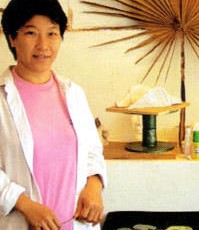
Anne standing in the underground gallery at Rimbun Dahan, surrounded by her work.

Rimbun Dahan Exhibition Catalogue Essay

HAVEN

Anne Morrison beckons you to hover over crevices, lie beneath canopies, bury beneath undergrowth. Slip behind membranes. Peel back foliage. Slide against cell walls.

The painted environments in Haven are both macro and microscopic, bodily and earthly, scientific and sensory. The artist asks that you peer deeper into the shadowy spaces that haunt the leaves, spores, and parasites inhabiting the canvas. The surface of each work is similar to a forest floor, where decaying leaves, peat, feathers, skeletons, and twigs collide so that elements of each are only partially exposed. It is this fragmented imagery that reflects her unique approach to representing the land: ‘the layering experiences of place, relating to memories and to the movement through the landscape.’1

During the 12 months at Rimbun Dahan, Morrison has dug into and reinterpreted the organic fabric making up the vast garden that surrounds the studio. At the beginning of the residency, Malaysia’s tropical forms were unknown, and responses were acute and overwhelming. But time has allowed the artist to study the foreign land through its flora, her perceptions and understanding building with accelerating intensity. She has been able to track the seasonal transformation of the plants so that smells and textures have become vividly and evocatively familiar. The initial razor-sharp responses to the strangeness of a new environment have matured into a complex series of observations that compound with each painting, nourishing and anchoring both the artist and her work in this place.

Morrison’s practice is a continuous process of inspecting and translating the interface of tree, plant and grass forms. Cataloguing the extraordinary colour, texture, and shape of tropical growth, she is a world away from the Tasmanian seeds and grasses that triggered the preceding body of work. These were fine, weightless structures, ‘simple forms, light and ephemeral, carrying a multitude of possibilities upon a breath of air… seeds flying, dancing in the wind, settling, perhaps seeding.’2 In contrast, the moisture-congested air in Malaysia leans on equivalent biology, preventing flight and suppressing movement.

In Haven, colours are saturated, almost garish: turquoise, orange, yellow and white, unlike the muted reds, blues and greys intrinsic to Tasmania. Tropical patterns are webbed, not podded. Forms are plastic, as if slackened by the heat, not taut like those plucked from a colder climate. Paint is thinner and more viscous. Imagery is created through spilling, dripping and pouring paint on canvas, and at other times by employing methodical, repetitive brush marks. The artist’s visual language is constructed from these diverse methods of paint application, and from the ever-changing forms that surround her. Within this painted lexicon, evolving and existing dialects are employed to reflect both newly-discovered and reinterpreted forms.

Morrison’s more recent investigation of plants and landscape stems directly from an earlier emphasis on the body. During the 1990s, she fused imagery related to medical scans, diagrams, and x-rays, with maps of the land. These works were also about the unfamiliar, but probed the darker regions of the human body rather than the surface patterns of plants. They referred to the vulnerability of the body, and our inability to understand the path of foreign bodies and invasive cells. Red, pink, orange, and white paint was spilled onto the canvas, staining and penetrating its surface rather than resting with the modulated control of brush strokes. Veins, sinew, plasma, and cells were manipulated to create trails that alluded to mapping and the exploration of the unknown. Gradually, these paintings have lead to the artist’s subtle inversion of imagery: from inner body shapes that are suggestive of land, to land forms that allude to body. Though perspectives shift from looking in, to looking out, each work continues to be a highly personal landscape capturing the osmotic relationship between body and land.

Weave, Scatter, Envelop, Lattice, Storm. These are titles of earlier paintings that evoke strong imagery as words alone. They encourage bodily engagement with the work: pulling, hugging, whispering. Like these previous works, the images in Haven call the viewer towards Morrison’s unfolding interpretations of dense tropical landscape. Plants resemble the hairs, bones, veins of the body, and the heated colours mimic the effect of humidity. ‘The air is palpable … moisture is thick … beads of sweat gather on the skin … one is continuously aware of one’s body….’3 As a personal catalogue of responses to a foreign environment, each work is familiar yet strange. Lines are both sharp and blurred. Foreground and background are combined. Fleeting forms are nearly recognisable, but impossible to pinpoint. We are netted in pattern and movement, grasping and sliding, aware only of our emotions and response to the landscape before us. A haven.

Jane Stewart 2004.
Director, Devonport Regional Art Gallery, Tasmania.


1 MORRISON, Anne, Notes to the author, December 2003.

2 MORRISON, Anne, as above.

3 MORRISON, Anne, as above.

From 'Hybrid series'1. Hive 2. Pod 3. Spore 4. Scale Size: 71.5 x 71.5cm (each work) Medium: oil on canvas.
From ‘Hybrid series’1. Hive 2. Pod 3. Spore 4. Scale Size: 71.5 x 71.5cm (each work) Medium: oil on canvas.

Biography

Born Glasgow, Scotland in 1966.

Morrison graduated with a Bachelor of Fine Arts Degree with Honours at Glasgow School of Art in 1988 before relocating to London to undertake a Master of Fine Arts at The Royal College of Art, graduating in 1990. In 1995 she was awarded a Commonwealth Scholarship to undertake research in Australia and in 1999 she was among the first to successfully complete a practice-based Doctorate in Fine Art at The University of Tasmania.

Morrison has had 11 solo exhibitions in the UK and Australia since 1989. Recent exhibitions include Cluster at Despard Gallery Hobart Tasmania and Body and Land at Devonport Regional Art Gallery Tasmania 2003, Weave of Nature at Essoign Club Melbourne 2002, The Sentient Body at Plimsoll Gallery Hobart 1999 and Intermediate Groundat The Bond Store, Tasmanian Museum and Art Gallery Hobart 1997.

Curated group exhibitions in 2003 include Love letter to China: Drawings by 35 Australian Artists at Ivan Doherty Gallery Sydney (Touring China 2004), Painting Tasmanian Landscape at Plimsoll Gallery Hobart, Future Perfect at Bett Gallery Hobart. Synergy at (Artist/Scientist collaboration), CSIRO Hobart and My Father is the Wise Man of the Village at Fruitmarket Gallery Edinburgh, Scotland 2002, Zero Horizon at CAST Gallery, Hobart 1999.

Arts awards and arts residencies include The Fusion Arts Commission Edinburgh, 2001, The Scottish Arts Council Small Assistance Award 1999, The Scottish Arts Councils One Year Australian Arts Residency 1994-95, The Ensign Prize, Painting, Royal College of Art, London 1990, The British Institution Fund (1st prize Painting), Royal Academy, London and The John Minton Travel Award RCA 1989, The Elizabeth Greenshields Award, Canada and The Jock Macfie Award, Glasgow School of Art, 1988.

Work in art collections include The Derwent Art Collection, Tasmania, The Scottish Arts Council, The Royal College of Art London, The University of Tasmania, Ensign Trust London, Devonport Regional Art Gallery, Aberdeen Hospital and Northfield Academy, Aberdeen, Scotland and Hijjas Kasturi Associates/ Rimbun Dahan, Kuala Lumpur.

Morrison is a Permanent Australian Resident who works and resides in Forth, Tasmania.

For full Curriculum Vitae contact Anne Morrison, anniemorrison@hotmail.com

Anne Morrison is represented in Tasmania by Despard Gallery, Hobart
www.despard-gallery.com.au

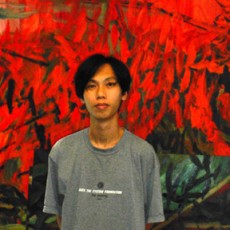
Wong Perng Fey

Wong Perng Fey

PerngFey2

Malaysian painter Wong Perng Fey was one of the Malaysian artists of the year-long Malaysia-Australia Visual Arts Residency at Rimbun Dahan in 2002.

Bio

Born in Kuala Lumpur in 1974, Wong Perng Fey is an artist who has built his reputation as an experimental and versatile painter since his graduation from the Malaysian Institute of Art under the school’s scholarship in 1998. His works are in many prominent public collections such as the National Visual Arts Gallery, Kuala Lumpur, Bank Negara Malaysia Museum Art Gallery, Kuala Lumpur and Galeri Petronas, Kuala Lumpur. He lives and works in Beijing.

Exhibition Opening Speech

by Angela Hijjas

Solo Exhibition
2 – 19 October 2002
Valentine Willie Fine Art, Bangsar, Kuala Lumpur

Thank you all for coming this evening to see these new landscapes by Wong Perng Fey.

I would like to thank Beverly and Valentine Willie Fine Art not just for inviting me to open this show today but for having being such strong supporters of our artists’ residency programme. This gallery has suggested to us a stream of fine young artists to support, one of whom is Perng Fey, and it has provided Hijjas and I with our greatest pleasure in seeing their works develop up to this exciting exhibition stage.

Like most of us, I am neither art critic nor scholar, but I come to the new work of any artist with formed ideas about what the world is like, and inevitable expectations about how it might be portrayed. I also have a particular affinity with landscape as it illustrates to me the way we relate to the environment around us, but as in most areas where we have a little knowledge and think we know what is going on, in fact we may not.

Perng Fey’s depiction of landscapes definitely overturns any preconceived ideas of what we are likely to see. These are not pretty kampongs or rivers winding through romantic hills and forests: these landscapes portray what happens to nature and land when they are modified by man. Landscapes are not static, they change, which in itself confronts our expectations of variations caused by mere weather and light. Today, unfortunately, landscapes have been destroyed and desecrated, but it is something we rarely confront, not wanting to question the very real benefits that development has brought us.

Landscapes have shaped every culture, including Malaysia’s for generations, and yet we ignore their plight in our flurry of progress. At the same time, many of us are influenced by the cultural values of more temperate climates where open spaces are commended as ‘vistas’ and exotic gardens are the epitome of beauty. We occupy this place, but we do not know it as well as we should.

From my personal perspective Perng Fey is painting the landscapes that people would rather ignore: the ravaged and the marginal. These are the landscapes that are the closest to us but are the most neglected. Perng Fey’s are the landscapes from our peripheral vision that we really do not recognize as our own, but which are in fact our prevailing visual experience.

Despite this dark side of the work, his skills of composition and handling of his medium seduce one into looking and seeing beauty, but they are simultaneously disturbing.

PerngFey1Another area of Perng Fey’s interest lies in the remains of settlements, most of them tacked together as temporary shelters that have served out their usefulness and have since been abandoned. Like his landscapes, they are devoid of people, as if he is charting our passage across the land, tracing the trail of our transience. They are however, quite beautiful, forcing us to review something that has always been seen as a blight on the
landscape, once again transforming our usual perspective.

These paintings bring the conflicts of occupying a place to the surface: they are compelling canvases portraying something that I did not initially recognise for what they are, they are puzzling and yet beautiful, and I can assure you that a longer acquaintance with these works will not disappoint.

I have been watching Perng Fey’s works develop over the last 9 months and am intrigued by these landscapes that he is understandably reluctant to verbalise. At first viewing each piece seems simple enough, but as the series has developed so has his subject. Just the other day, we were discussing how, by seeing all his work hung together like this, we can experience the development of his ideas as body of work. Even those of us who are fortunate enough to acquire one of them might want to return to this brief opportunity to see the whole collection, because it works so well as a changing viewpoint of landscape and our human habitation.

I congratulate Perng Fey for this remarkable show, and thank you all for coming this evening. Enjoy the exhibition.

Jean Weiner

Jean Weiner

Visual artist Jean Weiner was the Australian resident artist in the year-long Malaysia-Australia Visual Arts Residency at Rimbun Dahan in 2002.

The scientist does not study nature because it is useful. He studies it because he delights in it, and he delights in it because it is beautiful.
Jules-Henri Poincaré

Jean_at_work

Jean Weiner’s bold, organic, painted surfaces play on the ambiguity between abstraction and realism, and between art and science. The works are abstract, yet are also re-presentations of physical reality. They are a fusion of art and entomology: an in-depth look at colours and patterns of butterflies, moths and beetles, enlarged so that they impact upon the senses.

The artist’s aim is to encourage the audience to become aware of their physical, intuitive and emotional responses to colour and pattern. To encourage this embodied meditation between a composition and its audience, the artist employs a wet-on-wet technique of blending oil colours through the use of a variety of fine brushes in order to produce his signature-style blurred borders and smooth finishes. This technique arrests focused vision, invoking a momentary feeling of chaos, but ultimately invites a new sense of ‘alive calm’.

Jean Weiner is particularly versed in his subject, bringing together in an interdisciplinary approach: a Master of Art in painting; a Bachelor of Arts in philosophy, for which he received first class honours; and his work as the honorary curator of foreign lepidoptera (butterflies) at the Australian Museum. Like the new theories in science and philosophy, the artist’s practice demonstrates the interconnectedness of both natural and cultural life. His works especially resonate with Chaos Theory’s ‘Butterfly Effect’. This environmental notion of the beating of an insect’s wing in one hemisphere having, through a web of events, possible catastrophic outcomes in another, becomes in the artist’s work a statement of hope, a way of exploring new ways of being. Just as the natural world is interrelated, so are cultures: as an Australian of Czech and French origin who has lived and practised in Sydney, Asia and Europe and exhibited internationally, he lives and celebrates this (bio)diversity.

Ultimately, Jean’s art is about wonder; it reminds us that the world, even in its smallest detail, is extraordinary.

Jean’s work has received growing recognition and acclaim through university conferences, judged and curated exhibitions, government and philanthropic grants, artist residencies and public collections. His paintings have been exhibited in museums and galleries in Sydney, Los Angeles, New York, Aix-en-Provence, Paris and Kuala Lumpur. Recently he was selected by the National Art Gallery of Malaysia to participate in the Alami II Science/ Art conference at Mt. Kinabalu as part of UNESCO’s international year of the mountain. The artist’s upcoming exhibition will show the work – based specifically on Malaysian butterfly, moth and beetle species – that he has produced during his year-long artist residency at Rimbun Dahan.

Paint not the thing, but the effect it produces…
Mallarmé

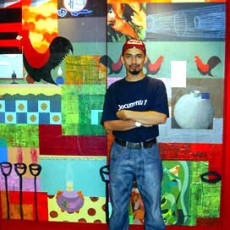
Ahmad Shukri Mohamed

Ahmad Shukri Mohamed
Work by Ahmad Shukri at the Singapore Contemporary Arts Fair, 2002.

Ahmad Shukri’s work for the Rimbun Dahan residency is as profuse and multi-layered as a tropical garden. The artist will exhibit paintings, installations and a large drawing on canvas, all in his highly decorative and richly referential style.

Shukri_eggsOut of the explosion of work in his studio he identifies four major series. Two installations of ‘incubators’, structures filled with hundreds of white and black plaster eggs, draw on the yin-yang concept to suggest the inevitably heterogeneous nature of the world. As Shukri puts it, within a hundred white eggs there will be a black egg, and vice versa.

The ‘people’s forum’ (sidang rakyat) installation consists of multiple pairs of boxing gloves cast in plaster and set atop a low table covered in a patchwork of textiles. For Shukri, the boxing gloves represent the sparring of politicians, while the textiles are the backdrop of unresolved and perhaps unresolvable situations against which their competitions take place.

A series of diskettes embedded in perspex sheets and overlaid with resin and silk-screen printing point to the irresistible spread of technology, which he sees as again neither wholly good nor bad but always composite. In the voyager series of paintings nature and culture morph into each other: the blades of a ceiling fan echo the petals of a flower and a chicken appears both as a living animal and as a child’s plastic toy. Whereas the installations illustrate socio-political conditions as Shukri sees them, he describes the paintings—featuring paper boats and planes, dragonflies, butterflies, cartoon characters, scrawled scraps of text—as diaries, eclectic personal records of memory and experience.

Many of the motifs—the eggs, the chickens, the fabrics representative of Malaysia’s main ethnic groups, the diskettes—are familiar from Shukri’s previous work, but for the artist the significance of these images is inexhaustible and ever elusive. A thread running through Shukri’s work in this exhibition is precisely this multivalent eloquence of objects: a loosely sketched rabbit in one painting alludes to the rabbit-breeding business started by a friend of the artist, whereas the origami rabbit appearing in the same work is suggestive of Japan’s influence on Malaysia.

An interest in texture and textiles and the play of surfaces also underlies Shukri’s work. His canvases are layered with squares of fabric or cut-out numbers, reflecting, he says, the multi-layered nature of the world. Several of the paintings feature scraps of fabric machine-embroidered with bands of thread in subtle gradations of colour. The use of techniques such as these, from outside the strictly traditional artist’s repertoire, as well as the incorporation of images of found objects like coconut husks and flowers, spring from Shukri’s belief that art is embedded in everyday life. The everyday world revealed in Shukri’s work is one of vibrant, chaotic and constantly changing multiplicity.


Lau Siew Mei

Lau Siew Mei migrated from Singapore to Australia in 1994. She undertook an Asialink residency at Rimbun Dahan in 2001. Her first novel Playing Madame Mao was published in 2000 after the manuscript was shortlisted in the inaugural Queensland Premiers Literary Awards for the Best Emerging Queensland Author. Her short stories have been broadcast on the BBC World Service and published in literary journals in Australia, USA, Canada and the UK. During her residency in Malaysia, she researched Peranakan culture for her new novel. She also appeared at the Singapore Writers Festival, and gave a reading at Badan Warisan.

Margot Wiburd

Margot Wiburd

Margot was the Australian artist of the year-long Malaysia-Australia Visual Arts Residency in 2001.

Biography

Margot_bowls
Breathing Space, 250cm x 99.5cm, pastel on paper, 2002.

Australian artist Margot Wiburd began her creative career as an advertising copywriter, followed by work as a producer’s assistant with ABC Television in Melbourne. After extensive language studies in Germany and Spain she returned to advertising for five years, working with Saatchi & Saatchi Compton in Madrid.

After a nine year absence, Margot returned to Australia to study art, graduating from RMIT with a Bachelor of Fine Art in 1989. Since graduation, steady development in painting has been complemented by a stimulating ten years assisting feature film director, Paul Cox, in a variety of roles, including a writing collaboration. During this period Margot was awarded a short tuition scholarship at the Academy of Realist Art in Seattle and was accepted into the Ecole Albert de Fois in France to study classical oil painting techniques for six months and a further three months the following year. A masterclass in portraiture followed with Jacob Collins in New York.

In 1998 a residency at the Banff Centre for the Arts in Canada resulted in her first solo exhibition. Later that year, at the conclusion of work on a major feature film in Hawaii, Margot lived for a month in a beach shack on the outskirts of the remote settlement of Kalaupapa (a former leper colony) on the island of Molokai. The isolation, tranquility and overwhelming spirituality of her surrounds resulted in the first of her multi-panelled works combining figurative and abstract elements to create the mood of a particular place and time.

Several group shows and a further solo exhibition in Melbourne reveal a consolidation of the main features of her work: an exploration of space, calm and simplicity.

During her residency at Rimbun Dahan, Margot worked both in pastel on paper and oil on canvas, inspired by the abundance of natural resources at her disposal at Rimbun Dahan, by her travels within Malaysia, by the jade bracelets she so admires, and from still life. She considers the Rimbun Dahan residency to be one of the finest opportunities available world wide through which an artist can focus, take risks, grow and give themselves heart and soul to their work in an atmosphere of complete support and kindness, with the added interest of immersion into a challenging new culture.

Works by Margot Wiburd hanging in the Underground Gallery at Rimbun Dahan.

‘Breathing Space’

The Japanese aesthetic of wabi-sabi suggests that greatness exists in the inconspicuous, the minor, the hidden and the ephemeral. Pared down to the essentials, the beauty of things modest and humble can gain strength through understatement, creating a reverberation on a sensory level. Kandinsky spoke of the choice of that object corresponding to a vibration in the human soul. “As every word spoken rouses an inner vibration, so like-wise does every object represented.”

The French poet, Francois Ponge, writes: “A shell is a small thing, but I can exaggerate its size by putting it back where I found it on an expanse of sand. What I’ll do is to take a fistful of sand and observe the little that’s left in my hand after almost all of it has run through the interstices between my fingers; I’ll observe a few grains, then each grain, and not one of these grains will still seem a small thing; soon the form of the shell, this oyster shell or this razor clam, will impress me as an enormous monument, colossal and yet exquisite. Mysterious.”

I have attempted through my drawings and paintings to capture that intangible sense of something greater than ourselves that one can find in nature or in a carefully crafted object. I hope to engage the viewer’s intuitive love of beauty, letting his or her mind wander into the painted image, soak up the quiet space, go inward and beyond.

In Australia I draw sustenance from the ocean’s infinite horizon. When you sit by the sea, the clarity and expansiveness of the image can trigger haunting memories, dreams, emotions.

Here in Malaysia, as the lush surrounds of Rimbun Dahan’s fertile garden jostled for attention, my work became preoccupied with isolating elements from their prolific, competitive environment, separating them from the mass of sensory input, giving them space to breathe and convey a sense of their uniqueness. In a quest for peace, beauty and space, I found myself continually eliminating elements, reducing the images to a state of unencumbered simplicity.

Abdul Multhalib Musa

Abdul Multhalib Musa

'Sixty Turns', by Abdul Multhalib Musa, commissioned by Rimbun Dahan for Angela Hijjas' 60th birthday, and now part of the permanent collection.

‘Sixty Turns’, by Abdul Multhalib Musa, commissioned by Rimbun Dahan for Angela Hijjas’ 60th birthday, and now part of the permanent collection.

Artist’s Statement for Rimbun Dahan Exhibition

INTRODUCTION It is my intention to highlight in my work some of the issues related to

affecting everything that we perceive as tangible and implied, in an attempt to establish a complex relationship between art and architecture. When considering my work, it is necessary to be aware that current thinking suggests that each domain may be addressed in isolation from one another, and that academically there are perceptible similarities and differences between art and architecture. However, for me any distinctions are becoming more difficult to distinguish from what was preconceived. It is at this initially conceptual level that an intangible idea (re)shuffles between what can be classified as art and what architecture, and thus is materialized into the final body of work.

CONCEPTION Most of my work is derived from a sort of spontaneous, nonlinear, seemingly non-sequential contemplation between what could be and what exists, what is meant to be experienced and what is actually felt. It is from our surrounding natural and built environment, and consequently the interactions or lack of them, that we acquire knowledge and inform our thinking, and it is from others that we learn about the self and how to nurture any talent that God has given us. At this stage, I have come to perceive the self as a composite that is often contradictory and internally incomplete. Perhaps this is one way to relate to my work, in a sense that it is conceptualized and manifested in fragments and aggregates to reveal a certain personal characteristic that challenges the reader to engage with the work at various levels of interpretation.

CONFLICT It has been a struggle for me to envisage a three-dimensional non-planar composition such as a non-Euclidean design for a sculpture, which is represented on the two-dimensional plane in terms of plans, sections, and elevations. Even more difficult perhaps, is the need to acquire a sort of paradigm shift from thinking in terms of large-scale projects such as buildings, to a more subtle language that is better suited for a sculptural undertaking, much smaller in scale by comparison. Hence, the problem with physical models is that you can only do so many and while computer-aided designs are better for the diversified repetitive tasks, the form is only virtual and lacks the inherent property of the finished material to create a spatial-temporal relationship between the viewer and the work. These concerns have been an ongoing personal conflict and the result, whether successful or not, is apparent in the work. My undergraduate studies in architecture have undoubtedly molded a certain way of thinking in conceptualizing the physical body of the work.

PROCESS As a result of this particular way of thinking, the process of realizing an idea can be scrutinized as rather architectural in its approach, yet does not have the constraint architects normally face. It is said that one way of differentiating art and architecture is their different responses to objective requirements. Hence, if art is seen as speculative thinking, then what I am doing must be art by default since everything I do is conjectural and self-directed – though I am not implying that architecture is already art, or vice-versa. Consequently, I do not design the final works themselves, but am more oriented towards conceiving the possible relationship between solids and voids, which is more analogous to the notion of suggestive space. I prefer to consider this process as parallel to generating a conceptual system in order for the tectonic idea to be realized. This would result in the actual fabrication
being more feasible and practical in a sense that wastage of material is minimized and ease of fabrication is achieved, while still maintaining the desired result that was originally conceived.

DO-UNDO-REDO All of the possible generative sources are given adequate consideration during inception and this develops into a wide spectrum of architectural and artistic interpretation. Although difficult to describe, the work often begins from this infinite and productive intuition which is challenged and tested both physically and mentally. It then matures from the intangible realm of thought, propelled by its own internal energy, in an effort to consciously make something out of nothing. This is an iterative methodology of working and reworking an idea at various stages of the design development, and perhaps a feasible justification on the continuity of form that is apparent from one work to another. In a way, the coherence is a result of the consistent use of this repetitive method, which evidently is carried throughout the physical aspect of the work itself.

TECTONIC The works themselves are certainly ‘end products’ in their own respect. Basically, the final built objects are finite, well-defined, and are more or less free from the imperfections of the production process. Nevertheless, I still consider the works to be incomplete, schematic, trapped in the midst of their production, with potential to be further developed. Seen from this perspective, the work is left as if merely to engage other students and professionals within the field of art and architecture. However, as built and finished works they also have the opportunity to engage the public for whom they were meant and any subsequent unanticipated public. Therefore, the work is indeed offered with the intention of being read while addressing the reader with a multitude of interpretations, and to personally sustain the intellectual animation of the design process.

Multhalib_

Biography

1976  Born in Pulau Pinang.

As a child, I was interested in drawing and won several competitions in Malaysia and overseas. The most recent and important being the Malaysian nominee and Asian finalist for the prestigious Oita Asian Sculpture Exhibition and Open Competition at the Fumio Asakura Memorial Park in Oita, Japan to be held in June 2002.

After secondary school, my interests broadened to theoretical thinking, science and engineering.  I studied architecture at the University of Adelaide, Australia and obtained a Bachelor Degree in Design Studies in 1996. I later obtained the Bachelor of Architecture with Honours at UiTM. I always longed to do fine arts while studying architecture and fortuitously an opportunity arose. I applied for the 2001 Rimbun Dahan Residency Program organized by Angela and Hijjas Kasturi at their residence at Kuang and was accepted as the Malaysian resident artist.

The year-long residency has revived my interest in fine arts and again in architecture, with a more serious conviction and undertaking. In my work, I attempt to highlight some of the issues related to space and temporality, the integration of technology and inspiration, truth and delusion, affecting everything that we perceive as tangible and implied, in an attempt to establish a complex relationship between art and architecture.

Background
Education
 1999-2000  Bachelor of Architecture (Hons.), MARA University of Technology, Shah Alam, Selangor, Malaysia
 1996-1998  Bachelor Degree in Design Studies, University of Adelaide, Adelaide, South Australia, Australia
 Selected Group Exhibitions and Awards:
 2001  Artist in Residence Rimbun Dahan, MalaysiaMalaysian Nominee and Finalist ‘6th Oita Asian Sculpture Exhibition’ Open Competition, Fumio Asakura Memorial Park, Japan

‘Open Show’ National Art Gallery, Kuala Lumpur

‘Rimba Ilmu Nature Art Week’ University of Malaya, Kuala Lumpur

‘Manusia’ NN Gallery, Kuala Lumpur

 1999  ‘Creative Craft Design’ Mid Point Shopping Centre, Kuala Lumpur’Tasik Kenyir’ Pengkalan Gawi Tourist Information Centre, Tasik Kenyir, Terengganu

Special Mention Prize ‘World-Wide Millennium’ Painting Competition, Winsor & Newton with Nanyang Art Supplies Sdn. Bhd., Kuala Lumpur

 1994  ‘Malaysian Wildlife’ Plaza Bukit Bintang, Kuala Lumpur; Consolation Prize
 1993  ‘Old Kuala Lumpur’ Plaza Putra, Kuala Lumpur; Consolation Prize’Watercolour Competition & Exhibition’ Creative Art Centre, The National Art Gallery, Kuala Lumpur; Second Prize
 1991  ‘One World – No War’ City Hall, Kuala Lumpur; Consolation Prize’National Fire Prevention Week’ Galeri Shah Alam, Selangor; First Prize
 1990  ‘National Children’s Day Festival’Institut Bahasa, Kuala Lumpur1999 ‘Creative Craft Design’ Competition & Exhibition

gunnery_residency

Former Resident Artist Wins Gunnery Residency

Above: Abdul Multhalib Musa has been awarded a 3 month residency at the Gunnery Studios in Sydney from June to August, 2004, sponsored by the Australian High Commmission in Kuala Lumpur. Here Talib receives the award from H.E. Mr. James Wise, the Australian High Commissioner to Malaysia, at the Australian High Commmission on Friday 23rd April. The announcement of the award coincided with the posters from the urbanart2003 project being placed in the lobby of the High Commission for exhibition. All five artists on display have been resident at Rimbun Dahan: Chong Siew Ying, Noor Mahnun Mohamed, Wong Perng Fey, Ahmad Shukri Mohamed and Abdul Multhalib Musa. The website for this Melbourne Tram Shelter exhibition is www.vicnet.net.au/~urbanart/

Christine Gillespie

Christine Gillespie

Christine Gillespie was a Melbourne-based writer who has published short fiction in Australia, India and Paris. She won a number of competitions and awards and her first play, White Stars, was commissioned by Playbox Theatre, Melbourne and performed in 2000. During her Asialink residency in 2000, Gillespie spent nearly nine months at Rimbun Dahan as well as undertaking a research trip to India. In Malaysia, Gillespie gave talks, readings and workshops at various universities and the Australian High Commission and networked extensively with Malaysian and Indian writers and artists. She completed the first draft of her novel, Ornamental Bodies, based on the story of Muddupalani, an Indian dancer and courtesan.

Christine died in 2012, following a long illness.

Noor Mahnun Mohamed

Noor Mahnun Mohamed

Noor Mahnun Mohamed (Anum) was the Malaysian artist of the year-long Malaysia-Australia Visual Arts Residency in 2000. The works from her exhibition were presented in the Underground Gallery at Rimbun Dahan from 16 February to 14 March 2001.

Anum was also the Visual Arts Residency Manager at Rimbun Dahan for several years, and curated the annual fundraising Art for Nature exhibition.

Conversation with the artist

Laura Fan talks to Noor Mahnum Mohamed about the body of work produced during her residency at Rimbun Dahan. This is an excerpt of their conversation.

How has your time in Rimbun Dahan influenced your work?

Being at Rimbun Dahan settled me down and got me back on the track of working as a painter again. I returned from Germany to Malaysia at the end of 1997 and stayed in Kelantan for a year to be with my family. There I had a studio but I did not produce any significant work – only one small oil portrait of my dad’s goat. In my second year I moved to Kuala Lumpur, bunked in at a friend’s apartment, didn’t have a studio and didn’t paint much that year either. By the time I moved to Rimbun Dahan for the residency program, I was eager to work again, to smell oil and turpentine.

Rimbun Dahan provides me with just the right environment and facilities. Here I find myself getting back into my usual work habits. I feel at home here and I’m at peace which is necessary for me to paint, be productive, and develop my ideas.

These paintings are a continuation of what I have done before. For example the Karaoke singers are figures in a room, isolated and dominant, in a composition using flat perspective. On the other hand, being in a tropical climate there is much more human activity happening outdoors, in the open. And being at Rimbun Dahan I am surrounded by nature so I become interested in going ‘back to nature’ and landscapes, such as the painting of a lady looking out the window. Nature or landscape is reflected in the window pane. She wants to be in the landscape, but not yet. The painting is self referential because that is how I feel.

In what other ways has that outdoor shift influenced your work?

At the moment, the landscape appears only as a detail or as a background to a painting (for example the lady by the window), or the three faces. I put each face in a different location, one in a room, one outside by the pool and one underneath the trees in the orchard. I am still getting to know the landscape in itself: the horizon, the sky and the ‘geological drama’ of the ground. At the moment I feel it is much more comfortable to look at a landscape through a frame, a window view.

But if you look at it through the window you’re always looking at a framed view and not the entire scene. Isn’t that limiting?

I am interested in window views because frames have a relationship to the framed structure of a painting. The window is like a viewfinder where I can analyze a scene. It’s a controlled image with different qualities of light and colour depending on which time of the day I look at it, from the glaring to the sublime. And I sometimes find so much visual sensation that I have to close the folding doors of my apartment or studio.

This aspect of control is very interesting, especially in relation to your figurative paintings. Looking at your preliminary sketches, I can see that your initial figures re much more emotive, but in the final work the emotion disappears and the figures are very controlled – event though sometimes there’s a sense that the emotion still exists under the visible surface. Your work creates a relationship between coldness and emotion.

The figures in my work are in their own world and they do not need to communicate with the audience. The emotional distance creates a space between the painted figures and the viewer; it is deliberate, so the emotion is a tension beneath the surface. I prefer these undercurrents rather than a direct emotional confrontation.

To create this distance I manipulate shapes and colours. Using flat perspective as a structure in my composition, the choice of colours applied becomes important to convey the pictorial space. A wall can look as it if has no depth or is very solid depending on my intention as I use layers of colours to get to the right hue.

Why is it so important for you to create distance?

Because I find buffer zones necessary.

Is there a relationship between your desire to create distance and your interest in still life paintings?

When I do figures, they tend to be narrative. With figurative themes, I will be distracted by other concerns such as the expression of the figure in relation to the whole colour compostiion. Still life is much more neutral as a subject, it can tell a story, but while painting a still life, my main concern is the painting process and how painterly I want the work to be. In my still life, I just focus on how it is presented through colour, texture, shadow, luminosity, shape and brushstroke.

For me painting is about exploring things. It is like being a traveler, where covering distance is more important than the destination. I feel like a traveler all the time.

Gary Proctor

Gary Proctor

Gary Proctor was the Australian artist in residence in the year-long Malaysia-Australia Visual Arts Residency in 2000. In addition to his own arts practice, during his residency he started a project with members of the Orang Asli community of Kampong Peta, Endau, Johor, making slumped glass art works. The project was similar to previous projects he had been involved with, with Australian Aboriginal communities in Warburton, Western Australia.
gary

Towards an Art of Habitation

notes for Gary Proctor’s exhibition catalog, by John von Sturmer

This is sincere art. There are multiple impulses. Some of it may be closer to art brut than first meets the eye. The orderliness may be deceptive; the high design value may value design less than first appears. There is an edginess, maybe a prevarication, which is disconcerting.
If an idea works in art it’s not because of the worthiness or the strength of the idea but because of how it is worked. This is not just about how it is rendered or translated into art. Instead, it is how it works within the activity of art-producing, how it twists, deforms, regulates, directs, translates, frees, re-works the very intentionality and capacity of the artist. Unless it has the capacity to make and to unmake the artist it’s a waste of time. For ‘idea’ to become ‘truth’ it has to be taken into the very body of the artist, and there exposed ruthlessly to what we might call the ‘real’, the whole weight of the artist’s biography as lived and, more than that, to the very possibility of the artist as a living being. Unless the artist can engage with the idea, unless the artist can approach the idea through that thing they inhabit, their body, the idea is unworkable and useless. This is not to say that the useful idea must be easily approached or even that the art work should exhaust its potential. We must allow that the gap between the idea and truth may be rather large, and full of shadows and ‘unknowing’. The artist ‘revels’ – a form of play. It may be hard and it moves us rapidly beyond any conscious pursuit, whether this be of pleasure, pain, release, calm, revelation, an active ‘dumbing down’. Such things may be brought to bear – indeed, it is hard to avoid them. I shall call them orientations; but any claim that they can be willed to constancy must be greeted with extreme dubiousness.

* * *

To work in a new context, surrounded by different stimuli, smells, tastes, sounds, colours, textures, manners, attitudes, different ideas of all kinds, is to enter a whole language of otherness. Mr Proctor is, of course, not new to the new. His experiments are broad and wide-reaching, both within art practice itself, moving with confidence from medium to medium (in this he is happy to have a high aptitude for things technical and practical), and within the politics of art practice.

Lest the phrase ‘politics of art practice’ offend, let us substitute what hopefully is more accurate: namely, a conscious reflexion on the contexts and conditions and purposes of art practice. This almost obsessive interest has, within my certain knowledge, involved this artist in working with street artists in Sydney and with the Ngaanhatharra people of the Western Desert, as well as maintaining a formal exhibition path. In all situations, let me suggest, issues of personal and group identity have been involved; also, the transfer of designs developed in accordance with the dictates and possibilities of one medium to other media. This has not been about forging new identities so much as widening the capacity of this or that image-producer to engage with new materialities of expression. Let me venture to suggest that it is in this ‘shifting’ or ‘displacement’ that the image-producer has the opportunity to become an artist for the first time. In pursuing these goals Mr Proctor has deliberately eschewed the commercial – a strategic decision which raises serious questions about the capacity of any individual regardless of ethnicity or point of origin to maintain identity (already a difficult notion) in the face of the insistent urgings of the cash nexus and the process of commodification.

I do not wish to judge on these matters. It is important only to indicate certain tendencies – tendencies which, while they may appear conservative, have nonetheless led, in the case of this artist, to radical innovations sustained by intense commitment and drive. I refer notably to the creation of an enormous ‘archive’ of Western Desert paintings, designs, objects, stories, oral accounts, social record, photographs of the Ngaanhatharra Aboriginal people – selected components of which have been made available at public exhibition in many parts of Australia, as well as overseas.

One might expect that such activities might leave a large, even a transparent trace in his own work. Outside the production of glass pieces, this appears by and large not to be the case. Certainly at first glance. Moreover, it is easily argued that glass was always one of his interests. At a deeper level, there is no conspicuous impact of Ngaanhatharra visual or representational traditions; nor is there any apparent reliance on Ngaanhatharra narrative devices. Yet the Ngaanhatharra influence may be there, not so much in the elements of his work, but increasingly insinuating itself as a working method. Mr Proctor has told me as much and willingly acknowledges the ‘message of trust’ – the necessity to trust the self – imparted to him by the late Mr Holland, an artist of rare talent and worldly insight. I may also be remiss in ignoring the impact of rock painting – and the way they disburse disparate elements over large surfaces.

I make these remarks only to get at the ‘truth of the work’. What they suggest is that this artist has a rather watertight set of concerns which have maintained a high biographical constancy. The same may hold true to what he might consider a proper context or politics of art production. In other words, the twin tendencies to experiment with new media and to engage with new and rather large projects are keyed to rather fixed concerns. Watertight does not mean static – for it is clear that there is an unfolding. And while the overt content may appear to be about protest, let me suggest that a more productive reading might be to consider the notion of living spaces. I would like to suggest that there is a profoundly architectural impulse to his work. The body – his body – is never far away. This involves more than furthering the range of expressive possibility; there is a desire for completion if not closure. The idea has to be made concrete; he surfs ideas not quite sure what shore he might land on or what dangers lie in his path. The ‘letting go’ involved, the sense of abandonment, always involves, however distantly, a notion of home. This is more than mere habitus.

Art glass panels designed by Orang Asli in collaboration with Gary Proctor

* * *

Somewhere between the pathology and earnestness of ‘the great public issues’ and the quiet interstices of ‘the inner life’, there is a third space, more humdrum, so ‘usual’ its value is apt to be totally discounted: the everyday. It is here that ordinary people seem most intent on sustaining themselves. It demands no grand vision, it pleads no special causes – but satisfies itself with the steady accumulation and sifting and retaining and disposal of the elements of life as they arise. It operates close to the ground; it does not pride itself on its utility yet it is ‘useful’ precisely because it is there.

The problem lies in how to give the ordinary value – or perhaps more accurately, how to participate in it, as an artist, without distorting its value. This is a tricky business. Any inflation of the lifeworld immediately makes it uninhabitable. Conversely, any retreat from the lifeworld surely treats it as already uninhabitable. Put simply, the task is to keep the habitable habitable.

We might think that the habitable should be able to look after itself but it doesn’t. Unless it can be made constant with our ordinary concerns it is gone – in all likelihood forever. It is the most endangered of all endangered species. To survive it requires careful attention: almost a tending. For it is never just there; it isn’t a constant in itself but subject to the most subtle modulations as well as the most devastating happenings. The habitable is constant in its need for constant adjustment.

* * *

How do we inhabit these times – or are they merely to occupy us? Are we all just engines running together, pretending to the illusion that we are all radios intended for tuning to the same frequency band? Is speed to substitute for our inability to inhabit memories, or is it the agent of loss? Does the rain soothe our naked skin or should we protect our full body suits as a matter of routine self-protection? What, are we to be locked within an Eternal Doomsday (what I call ‘the economy of remedy’) or shall we trust to the progress of ‘Progress’? To occupy the bland, repetitive, sterile spaces we have created for ourselves will we need somehow to develop the ‘art of self-ignition’ – endlessly pushing ourselves to responsiveness as if, somehow, we were little ‘generators of meaning’? Is meaning just to be another word for shock?

These images come from the artist. In the same spirit I would like to conclude with a passage in his words which links the elements of play, discipline, technique, a coming-into-knowing through activity:

I have canoes for the sea. Away from the ocean I work to maintain body strength for the return. I can roll upside down and watch things underwater, and then roll back up with a flick of the paddle. In a Malaysian swimming pool I practiced my rolls for a year, all a matter of knowing what a paddle is doing. I can do five different rolls …

I like this notion of differentiation through practice, a practicing which engenders its own carefully calibrated experience, a working at being at home that can be anywhere. I had thought of habitation as rooms – rooms to be designed, used, filled with familiar things. But activities, too, can be habitations.

Remembering, too, that not all of us yearn for the sea.

John von Sturmer
Sydney
10 January 2000


Art glass panels designed by Orang Asli in collaboration with Gary Proctor.