Mutalib Mann

Mutalib Mann

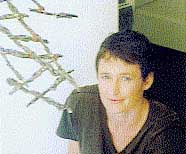
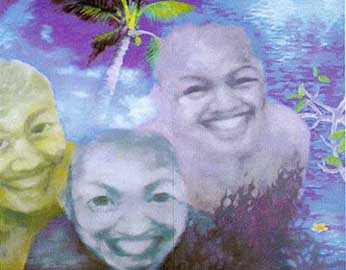
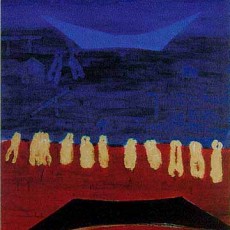
mutalibMutalib Mann was the Malaysian resident artist of the Malaysia-Australia Visual Arts Residency at Rimbun Dahan in 1998. The exhibition of his works took place in the Underground Gallery at Rimbun Dahan from 28 August to 27 September 1998.

Mutalib Mann is an artist based in London, born in Alor Setar, Malaysia. He was trained at The MARA University of Technology, Kuala Lumpur, Malaysia and The London College of Printing in Graphic Design.

Mathew Calvert

Mathew Calvert

Glass_shards1

mattTasmanian sculptor Mathew Calvert was an Asialink resident artist at Rimbun Dahan in 1998.

Curriculum Vitae

Born Smithton Tasmania, 1969

Exhibition

1997      Poets and Painters, Dick Betts Gallery, Hobart

1996   Survivability, Hobart GPO

Pulp, Burnie, Regional Art Gallery

1995   Bubble Rap, M&B Motors, New Cross, London

1994   Selected Works from the 1993 Anne & Gordon Samstag International Visual Arts Scholarships, Adelaide

1993      Group 16 Exhibition, Long Gallery, Hobart

1991      National Student Exhibition, Exhibition Building, Melbourne

1990      Insitu Fine Arts Gallery, University of Tasmania

Residencies

1998      Asialink Rimbun Dahan Malaysia

1994      McCulloch Studio, Cite International des Arts, Paris

Commmissions

1997      Art for Public Buildings Scheme, TAFE Training Facility Prince of Wales Bay, Hobart

1991      Installation for Fletcher Construction at the ANZ Centre, Hobart

Scholarships and Awards

1992      Samstag International Visual Arts Scholarship

Dean’s Role of Honour, University of Tasmania

Education

1995      MA Goldsmith’s College, University of London

1993      Graduated with Honours (First Class)

1994      1992   Bachelor of Fine Arts, Tasmanian School of Art, University of Tasmania

matt1

Notes on the Asialink Rimbun Dahan Residency Exhibition

by Adam Aitken

Kuang Malaysia
28th August to 27 September 1998

In the six months Tasmanian sculptor Mathew Calvert has resided at Rimbun Dahan, his glass monoliths have attracted the attention of his fellow artists and visitor alike.  Within the Balinese Hindu-inspired water temple surroundings of Rimbun Dahan’s guest-house studio, these pieces are quasi-architectural forms which reflect the on-going modernist desire for pure clean forms, that comment upon eclectic post-modernity and the trace of Asian ideals inherent in their setting.

Each sculpture is composed of up to a thousand pieces of broken plate glass formerly used as building material which Calvert salvaged from a nearby kampung dump (below).  These pieces tell the story of their own salvation from the melancholy fate of rejected industrial materials.  Each piece extends our perceptions of how these materials can be used and viewed, as objects with intelligence and meanings they would not have enjoyed had they fulfilled their original utilitarian purpose as glass for high rise.

matt4

Each piece attests to the artist’s ritual of collection, cleaning and sorting the colour and thickness of each single shard before its actual placement. Such a process requires the will to discipline the chaos of the dump, to arrest the process of decay, to rescue perfectly usable material from industry’s unthinking wastage. Each piece yearns to be something spiritually complete, an ideal which an industrialising landscape struggles to realise.

From the detritus of a boom gone bust Calvert has transformed the ugliness of broken 10 millimetre plate glass into things conventionally beautiful on the outside, but haunting and threatening inside, a solid oblong and two “sarcophagi’.  Each piece seems to mourn at the unmarked grave of an industrial disaster.  Over the largest piece hangs a billboard sized back lit photograph of a landmark familiar to the KL commuter, a large abandoned skeleton of what could have been just another condominium.  Its bare stairwells and lack of cladding reveal the emptiness of real-estate denuded of its “face”, its loss of status as well as the evidence of KL’s suddenly arrested modernisation.  Through its empty floors one can view bare laterite hills and the transient outlands of the shabby city fringe.  The building has colonised what was once a useful, perhaps picturesque space with its own semi-rural complexities of people, space, work and environment.

matt2This juxtaposition of image and glass pike is a reflexive gesture and a reanalysis of the urban environment, as well as a poignant commentary on the history of all overreaching development.  A wan fluorescence lights this edifice t0 failed vision, each piece emanating the same milky-white pallor of transience, decay, vacancy.  Twentieth century modernity seemed to promise a simple mode of being, but is this  an empty promise after all, a conceptual dead end?

The material to a certain extent has dictated Calvert’s choice of form, and every shard has been placed carefully to achieve a layer-cake of fractured light and resonance.  Through judicious placement of each shard, Calvert has captured both the beauty and the ugliness of glass, which lies in its unpredictable nature:  two perfectly flat surfaces, but the edge can be either ruler-straight, or jagged and chaotic depending how the sheet breaks.

Like Petronas Towers, the viewer is astonished at the weighty impact of something so abstract, single minded, and virtually colourless.  But Calvert’s pieces are ironic commentaries on ideals of giantism, purity and perfection.  Like the generic office tower of curtain glass the surfaces of these sculptures shine with autonomy, and a power expressed through total dominance of medium.

matt5Most of the shards have had minimal but intensive handling, with no intentional breakage.  The edges of each fragment are aligned in perpendiculars, each a brick in the wall that might go on forever if the artist had given full rein to his obsession.  In “Recovery” (right), the viewer, from a confident position of privilege, seems to be walking around disciplined walls of glass, only to find this complacency shaken on looking down into a menacing shark’s mouth of broken edges.

Glass is fragile yet potentially dangerous to the flesh.  Each piece says, “come and view me, but keep your distance!”

The paradox of glass is the fact that it is both solid and transparent, and each piece exploits this double identity.  There are no false bottoms or hollow spaces in “Platform” yet the sarcophagus hints at containing the organic trace of life (below).  But what life?  Does the oblong bury a living thin, an essence of life?  Like Narcissus, we gaze from Rimbun Dahan’s soft watery surrounding, we run aground o the force of these surfaces.  The viewer apprehends the work as a sublime force, both beautiful and terrifying; it promises everlasting life for itself, more permanent and immutable than us.  It refers to a technological future which is frightening, because the abandoned building signifies the incompletion of human creativity and our loss over control.  The abandoned structure will never know the warmth and familiarity of human activity, and is haunted by the disquietude of ghosts.

matt3Ross Wolfe, director of the Samstag Program wrote of Calvert’s early work as being in the nature of “a barricade which assaults and offends the aesthetic, rendering itself unapproachable through gross physical attributes alone.  It’s spirit is open.  As art, it is naked and vulnerable” (Samstag catalogue 1994). In this installation Calvert has disciplined his earlier sense of violence and grossness.  Perhaps these pieces carry a new subliminal message:  that meaning lies beyond cliches of economic rationalism.  It’s wastefulness, is revealed, when the “used” must pay as much as the user in terms of lost space, lost greenery and blotted out horizons.  One question Calvert’s work asks is whether the broken and rejected junk of a throw-away culture can be redeemed.  Calvert’s pieces make us look at the piece itself, and contemplate the labour that makes it a thing in itself with its own aesthetic value, but they also express the human yearning for permanence.  It is also art that risk ugliness and generates a slight feeling of repulsion and alienation one much feel when confronted by effective political art.  These sculptures, born of the scrap heap, are perhaps windows, or more mysteriously looking-glasses for those who can read their destiny, but all they reveal is the law of their own grim presence, one a lot less illusory and therefore more strikingly truthful than the vision of “development” has every quite promised.


Adam Aitken has published two books of poetry, he is associate editor of “HEAT”, the Australian literary journal and was the Asialink Writer in Residency at Rimbun Dahan during Matt Calvert’s residency.

This is an Asialink project assisted by the Commonwealth Government through the Australia council, its funding and advisory body;  Arts Tasmania and the Australian High Commission, Kuala Lumpur.

Stephen Turpie

Stephen Turpie

steveStephen Turpie was the Australian artist of the year-long Malaysia-Australia Visual Arts Residency at Rimbun Dahan in 1998.

Stephen’s is currently a lecturer of painting and drawing at LaTrobe University, Bendigo, and his qualifications include DipArt (Painting-VCA), GradDipFine Art (VCA), MVA (RMIT). Stephen has a range of interests that include sculpture, installations and time-based work along with his continuing practice as a painter. His research involves major phenomenological questions about the self, visual analogy and the engineered world, expressed in a metaphorical and sybolic format. Stephen Turpie has undertaken numerous other residencies, including at Green Street Studios , New York (1986) and Padiès Château , Lempaut, France (2008).

Catalogue Essay

In these new works, Stephen Turpie explores the evasive qualities of appearances; the ambiguity of things which have not come into sharp focus, but are demanding of our attention and ‘as through a glass darkly’ we try to make sense. Fusing imagery from biology, construction and abstract thought (mathematics, physics and philosophy) he traverses the natural and cultural worlds. This symbolic play in the metaphorical landscape resonates with an emotional intensity gained only from personal and ontological inquiry.

Turpie’s visual themes are influence by a diverse array of artists and works: from Joseph Beuys’ conceptual investigations into the fundamental principles of energy and the effects of both natural forces and of art, to Jean Miro’s symbolic innovations and Ken Whisson’s abstract treatment of the landscape.

The formal concerns of past works in painting, as well as sculpture and performance, recur again in this new series. His painted forms display the solidity and presence of three dimensional objects which are poised in ambiguous landscapes and receding intimate spaces. These arrangements are reminiscent of Turpie’s sculptural works of over a decade and a half ago in which clusters of discarded objects were delicately balanced in small museum boxes. These curious objects were the decaying leftovers of another time whose concealed histories conferred a certain dignity to their presence, the significance of which remained quietly elusive.

Stephen Turpie’s work contemplates ancient modes of thought alongside modern and contemporary ideas which reflect something of the all-at-once attempts to render life and appearances in theoretical guises. The use of the landscape genre is a significant choice for this subject as the natural cycles and biological processes have been commonly employed as metaphors for psychological and social phenomena in both ancient and contemporary descriptions. Turpie’s images are carefully constructed between the borders of figuration and abstraction, as such, his ‘figures’ are neither fixed in meaning nor anchored in the landscapes over which they hover.

Turpie’s choce and use of symbols reflect the flavour of Pre-

Socratic and Platonic modes of analogical thought. The invisible correspondences by which “all things pass through all things”; the similarity in dissimilars, were uncovered by the principle of analogy, for example, almonds are good for the eyes, walnuts for the brain, the seven planets with the sun and the moon relect the nine portals of the body (macrocosm=microscosm). The ephemeral nature of these protean transformations was underpinned by the notions of singularity and duality, sameness and difference, harmony and strife.

Throughout these works, T-junctions, chromosomes, blue intruding figures, houses and wedges group together in pairs, clusters or alone, their identity of difference forming the basis of their relation. For example, the house stands in relation to the cultural landscape as the chromosome to the internal microcosm of the body, as the defining points of civilization and humanity. These symbols display simultaneous features of singularity, self-same duality and multiplicity, yet, their identities are never simple: a T-junction can be a signature (of the artist perhaps), a letter referring to the building blocks of language and representation, it could be a telephone pole signifying energy and communication grids imposed on a barren landscape, or perhaps it represents the junction of various levels of existence, the organic and inorganic, or the biological and social. Two T’s join together to form a gateway, a bridge or a simplified dog. The chromosomes sometimes curiously look like two copulating figures, in other places like a solitary floating character. Electric blue figures invade the picture plane resembling cells in mitosis, ovum or phallus, or perhaps neurological cross sections indicating either the dualistic tension of creativity, the genesis of life, of the beginnings of intelligence and complexity.

Turpie’s imagery concurs with Richard Long’s description of his work as “a balance between patterns of nature and the formation of human abstract ideas”. Lattices, webs and branching structures are observed throughout the natural world from biology to chemistry and the mathematical descriptions of contemporary physics. The ambiguity of the brain/cell division when juxtaposed with such structures also brings into question the relationship between the structure of the world and the structure of our perceptions. The extent to which these patterns of order are inherent in the world or are imposed on sensations by the brain remains in question. In natural and human sciences as well as in art, the dividing lines between invention and discovery are hazy. For over a century, these issues have been hotly debated through the perennial questions of evolution theories and their explanatory metaphors.

Turpie’s depiction of the wedge/arrow, indicates the dark underbelly of evolution theories (competition and biological arms races) as well as the teleological notions (arrow of the Great Chain of Being) which Darwin’s wedge had overturned. The patchwork effect of some of the larger works reflect the newer modes of describing evolutionary change (and perhaps the creative process of the artist) as ‘biffrucation, tinkering and bricolage’. In biological terms, these notions emphasise the historical contingency and the exquisite imperfections of the actual structures which developed by chance from the myriad possible alternatives which had insufficient opportunity to develop. It also provides an apt metaphor for the artist and his work. According to evolutionary biologist, Francois Jacob:

“…often without knowing what he is going to produce, he (the tinkerer) uses what ever he finds around him, old cardboards, pieces of strings, fragments of wood or metal, to make some kind of workable object. As pointed out by Claude Levi-Strauss, none of the materials at the tinkerer’s disposal has a precise and definite function. Each can be used in different ways. What the tinkerer ultimately produces is often related to no special project. It merely results from a series of contingent events from the opportunities he has to enrich his stock with leftovers.”

The historical result of this process of tinkering is not a seamlessly engineered creation, but as Jacob proposes,

“a patchwork of odd sets pieced together when and where opportunity arose. For the opportunism of natural selection is not simply a matter of indifference to the structure and operations of its products. It reflects the very nature of historical processes, full of contingency.”

Turpie is both a tinkerer of symbols and a bricoleur of ideas. His fascination with the processes of nature, thought and art are both hidden and revealed in the verdant ‘openness’ of his paintings which allows us to explore the question of how ideas and experience are ordered in our attempts to apprehend the world. To the Appolonian urge for clarity and definition, Turpie’s fuzzy chromosomes reply,

“Do not befriend an elephant keeper,
if you have no room to entertain an elephant”.

Rumi.

Catalogue by Elizabeth Thomas

Jan Owen

Jan Owen

janJan Owen, Resident Poet at Rimbun Dahan in 1997, is a South Australian who now lives in the country outside Adelaide. Since 1985 she has worked as a writer, a creative writing teacher and an editor. She has published four previous books of poetry, including Boy with a Telescope, Fingerprints on Light and Blackberry Season, and her prizes include the Anne Elder and Mary Gilmore Awards for her first book, and the Gwen Harwood Poetry Prize in 2000.


In 2002, Jan Owen launched her collection of poetry Timedancing at the South Australia Writer’s Centre in Adelaide. Tom Shapcott, Chair in Creative Writing at the University of Adelaide, who launched the ceremony, called it “a luminous book.”

'Air and Edge,' Jan's poem dedicated to Hijjas Kasturi's architecture.
‘Air and Edge,’ Jan’s poem dedicated to Hijjas Kasturi’s architecture.

Timedancing contains poems inspired by Jan’s residency at Rimbun Dahan, as well as by her travels to Thailand, Italy and Spain, and is marked by her eye for sensuous detail and by her appreciation for the value and beauty of everyday objects.

To buy a copy of Timedancing, contact Five Islands Press, PO Box U34, Wollongong University, 2500 Australia.
Fax (612) 4272 7392.
Email: kpretty@uow.edu.au

Previous versions of some of the poems in Timedancing appeared in Illuminated Leaves, an online exhibition of poetry and art at Rimbundahan.org, also featuring the works of Margot Wiburd and Noël Norcross.

The cover illustration for Timedancing is a detail of a watercolour by Thornton Walker, Resident Artist at Rimbun Dahan in 1997.

Anne Neil

Anne Neil is a Perth based artist who works in the fields of sculpture, design and public art. Together with her partner Steve Tepper, Neil travelled to Malaysia to undertake a residency based at Rimbun Dahan in 1997. During this time Neil produced several series of ephemeral works that she exhibited there and as a collaborative team, Neil and Tepper made significant contacts with Malaysian architects resulting in a commission to produce lights and signage for a new golf course and residential development. In 1999 Neil participated in the critically acclaimed exhibition and residency project, Sekali Lagi: Australian artists revisit Malaysia, with seven other past residents.

Thornton Walker

Thornton Walker

Australian painter Thornton Walker was the Australian artist of the year-long Malaysia-Australia Visual Arts Residency at Rimbun Dahan in 1996, and undertook a one-month residency in Hotel Penaga in 2012.

Bio

thorntonThornton Walker was born in Auckland, New Zealand in 1953, and emigrated to Australia, settling in Melbourne in 1965.  He graduated with a Diploma of Art (Printmaking) from the Prahan College of Advanced Education in 1976, and began a Post Graduate Diploma (Printmaking) at the Victorian College of the Arts, Melbourne in 1977. He later deferred these studies to travel and work in Europe and the United States.

The artist’s first solo exhibition was held in Melbourne in 1980. Walker’s work is represented in collections throughout Australia including the National Gallery of Australia, Art Gallery of New South Wales, Art Gallery of Western Australia, QUT Art Museum, Brisbane, Artbank, University of New South Wales, Philip Morris Arts Grant Collection: Parliament House, Canberra, Macquarie Bank, and AXA Australia.

Exhibition Catalogue Essay

A traveller in the landscapes of our world and the landscapes of his mind, Thornton Walker evokes in his works both the presence of the environment in which they were created and the inner contemplation of their creator.

In subject, Walker’s works include three established genres of traditional art – the landscape, the portrait and the still life. Yet he blurs the distinction between these genres, and creates works which embody all three of these forms while embracing abstraction and the serendipity of chance.

Overlaying or, perhaps, underpinning Walker’s choices for the content of his work, is his own personal interest in philosophy and the spiritual, and with Eastern/Asian philosophy in particular. One particular Buddhist text has long been of importance in his considerations of the great questions of human existence: “What is the enduring body of reality?” It is a question that perhaps best conveys the concerns that Walker addresses in his work and, by implication, in his life, and it is a question to which I will return.

The work which Walker had created during his residency at Rimbun Dahan follows naturally from his accumulated body of previous work. His depiction of the orchard outside his Rimbun Dahan studio and various studies of fruits and ceramic bowls reflect his continuing use of the external world as a means of considering, even meditating on, the internal world of the mind.

For many years, Walker has depicted a simple Chinese bowl, whether alone or with one or two others, as the sole physical object set in an abstract and seemingly random background whose presence is, nevertheless, just as concrete as the delicately painted but solid bowl. Examples of this aspect of Walker’s work can be seen in “Two Chinese Bowls (Tea Ceremony l)” 1997 and “Two Chinese Bowls (Tea Ceremony ll)” 1997. These are paintings that were made using wood found in the Rimbun Dahan grounds. The ‘background’ of each painting happens to be naturally occurring marks and stains on the wood arising from its previous use in some form of construction. However, the works’ appearance is not unlike paintings which Walker has previously created on canvas, where the space surrounding the bowls has been built up with layers, drips and washes of paint and, sometimes, fragments of handwritten text.

In both paintings, the bowls are distinct and unique individuals, their substance confirmed by the shadows which they cast on their uncertain surroundings. However, they have a presence beyond that of mere inanimate objects. They are metaphors for order, creation and life, surrounded by the apparent chaos of vast forces we cannot measure and do not fully understand.

In the suite of watercolours, Walker once again focuses on ceramic bowls, some plain and unadorned, others with decorative patterns or embellishments. Sometimes they are alone, at other times in pairs or in groups or hovering over a paler reflection or ghostly image of themselves. These bowls, which themselves take on a life, are often seen together with fruit in or around them. Guavas, limes, papaya and cempedak provide forms through which Walker can apply, with such delicacy, his fluid washes of colour onto a paper that is stained and splattered, like some parchment that has been recovered from a flood.

These images of bowls and fruit acquire their own personalities, engage in dialogue, remain silent, occupying space in a minimalist landscape of washes which run and drip. Once again these objects are lit by an unseen source of light and although their shadows confirm their existence, they seem removed from space and time and become, for us, almost devotional objects upon which we may meditate.

A group of somewhat dark and brooding landscapes, based on the view of the orchard outside his Rimbun Dahan studio, provides an insight into another aspect of Walker’s oeuvre. These images are essentially tonal, capturing both shadow and light, and transforming the simple, close view of tree trunks and branches into a mysterious place where the footfall of people is anticipated but not witnessed.

'Two Malaccan bowls', watercolour, 1997, 76 x 56 cm.
‘Two Malaccan bowls’, watercolour, 1997, 76 x 56 cm.

In some of the watercolours appear fragments of text, sometimes Chinese, sometimes European, adding another dimension to an already multi-layered image. The graphic linear quality of the Chinese characters which appear to have been stamped on (but which are in fact rendered painstakingly by hand) give the work a sense of documentation, something vaguely official. In two works in particular, small red freshly rendered lychees maintain their distance from the well-ordered text, text that may describe or perhaps proscribe them.

And there, in the overlapping washes of “Two Malaccan Bowls” 1997, we can make out the words “the enduring body of reality”. For Walker, it comes down to this: What are we? What is real? What is unreal? What is permanent? What is transient? What is the mind? What is the body? Walker’s works address these questions with a quiet persistence and we have the privilege of experiencing, with him, this quest for the essential nature of the universe.

Guy Abrahams
August 1997
Director, Christine Abrahams Gallery


Artist Statement for Hotel Penaga Residency

I wanted to be completely open to new influences and subject matter during my time at Penaga as the artist in residence; to absorb the rich culture in Penang and respond to it as best I could, in the studio.

After exploring the town for a week, what stayed with me were the old faded photographs of faces I saw on temple and clan house walls. They resonated for me as a window into the past, a nostalgic glimpse of a rich culture.

I decided to do my best to recreate this feeling in paint. I took snap-shots of these photographs, often out of focus and partly obscured with reflections on their glass frames, and then set about interpreting them in watercolor, ink, acrylic and oil paint.

Renee Kraal

Renee Kraal

reneeRenee Kraal was the Malaysian artist of the year-long Malaysia-Australia Visual Arts Residency at Rimbun Dahan in 1996.

She studied at the St Martin’s School of Art in London, as well as studying pottery at Stanhope Institude and Campden Arts Centre. Her work includes drawing, painting and batik, and has been exhibited in Germany and Australia as well as in Malaysia. In 2005, she was featured as one of three women artists in an exhibition at NN Gallery in Kuala Lumpur.

Maps of Transitions 

notes on Renee Kraal’s exhibition at Rimbun Dahan.

Appearance and disappearance.  Form and de-form.  Structure and ‘dis-structure’.  Sight and insight.  The paintings of Renee Kraal seem to inhabit these realms of tensions.  The realm between Being and Nothingness.  Meanings obtain only in the dialectical relationships between states of consciousness.  An art that thrives on the awareness of the necessity of forms while simultaneously intent on the possibilities of formlessness.  Conscious formlessness and formless consciousness.

This mode of artistic creation, of course, has always been important in modernist painting traditions, given the preoccupation with intuition, the subconscious, the spiritual, dreams and what not, of early European modernists, and also in the covert ‘action’ and ‘freedom’ of American Abstract Expressionists.  In Symbolism, Expressionism, Surrealism. or even Impressionism with its interest in the effects of transitory light on the perception of forms, at various times either extreme dominates artistic production, giving free rein either to conscious disorder or unconscious order.  At other times, ambivalence takes over, or as could be appreciated in Kraal’s works, a sense of emergence and submergence of both seems to rule the life in flux of the subject matter.

It would not do, however, to identify her works with just one of the modernist labels, because interestingly, the works are at once symbolic, expressionistic, surrealistic, and impressionistic, and more.  The works do not convey the artist’s message as much as the ‘message’ conveys the artist.  It is not difficult to imagine that the artist is quite essentially immersed in the works, journeying freely within the terrains of the subconscious.  The paintings then become intriguing maps of these journeys, topographies of Freudian signs and Jungian de-signs.

Whatever title is affixed to a painting, whether it be Joy, Energy, Vibrations, Mental/Emotional Physical Bodies, Levitation,Mask, Nature or even Secret Music of Plants, they are all Primal Screams of sorts.  The forms and colours do not merely describe the essential external world, but express profoundly an inner pathos alluding to an aesthetic of pathology that is neither pathetic nor pathological.  On the contrary, the allusion reminds us of the inscrutable aspects of human life and the universe.  When Kraal says that ‘it’s troublesome to be human’, it is not just a whimsical platitude.  From looking at her works it is the ever-shifting boundaries between visible reality and invisible sensibility, the fluid tension of, and in life, to which she refers.

Kraal’s maps of transitions aptly appropriate the Greenbergian modernist idiom with a twist.  The flatness that predominates Greenberg’s theory of modernist painting while offering aesthetic meaning to Kraal’s work does not overpower the artist’s insights about life.  Kraal is not limited by total subservience to formalistic concerns as is demanded from the Greenbergian reduction of painting to painting.  She does not shy away from revealing allusions to pictorial recession.  Nor does she intentionally restrict her painterly explorations to considerations of properties of painting as art, as propounded by Greenberg. In fact, just as they inhabit the realms of tension and transition, Kraal’s paintings derive from and defy the Greenbergian canon.  They operate as painting as art, and as windows to the outer and inner worlds.  The medium does not just define her paintings as art, it is also the vehicle in her journeys to somewhere and nowhere, between the conscious and the unconscious.

quantumIn the context of Malaysian art, Kraal’s paintings show affinity with many Malaysian artists, in as much as many Malaysian artists’ mode of creation exhibit a tendency to explore the aesthetic possibilities of the indefiniteness of forms and contents.  Sometimes the pictorial context is reminiscent of unlocatable landscapes, as in Latiff Mohidin’s Pago-Pago paintings or Syed Ahmad Jamals’ Gunung Ledang.  Kraal’s enigmatic figures and forms are often depicted against and within a landscape context, projecting the inner psychological and spiritual worlds into the more physical outer world, or vice versa, a mode of artistic expression also seen in the abstract or abstracted landscapes populated by barely perceptible bare torsos painted by Yeoh Jin Leng, Joseph Tan and Ibrahim Hussein.  But more clearly, Kraal’s painting show closer affinity with the worlds of Ali Mabuha and the much younger Anna Chin, especially in the projection of psychological states into the physical landscapes. Perhaps because of this, the artists’ worlds cannot just be described as inaccessible by their being highly personal or that the artists are not concerned about the external and the real social world.  Perhaps, our appreciation of this kind of work would be all the more meaningful if we regard the indeterminable landscapes as metaphors of commentary about society and the environment.  With the works of Kraal, our contextual appreciation of them in this regard could take an existential view point. The individual could be seen as having to exist and struggle within the dialectical relationship between personal hopes and environmental determination.  He or she has to realise the reality of this existence that does not always offer a clear demarcation between concrete graspable reality and the no less concrete but ephemeral unconscious.  Kraal’s works map out this realm of transition.  In this she shows quite an exceptional level of artistic sincerity and conviction.  Surely in these times of unbridled commodification of artistic productions, such a quality ranks high as a criterion for critical regard.

Zainal Abidin Ahmad Shariff
Lecturer in Art History and Criticism
Pusat Seni Universiti Sains Malaysia

Enid Ratnam Keese

Enid Ratnam Keese
'Quantum Leap,' 150 x 100cm, oil on canvas, 1995
‘Quantum Leap,’ 150 x 100cm, oil on canvas, 1995

‘Out of the nine month midnight’

‘There is but one truly serious philosophical problem, and that is suicide. Judging whether life is or is not worth living amounts to answering the fundamental question of philosophy’
Albert Camus

‘old Death
Shall dream he has slain me, and I’ll creep behind him,
Thrust off the bloody tyrant from his throne
and beat him into dust, or I will burst
Damnation’s iron egg, my tomb, and come
half damned, ere they make lightening of my soul,
And creep into thy carcase as thou sleepest
Between two crimson fevers, I’ll dethrone
the empty skeleton, and be thy death’.
Thomas Beddoes


Enid Ratnam Keese is well known in Australia for her printmaking and her drawing. Her prints in particular are greatly admired and figure in our public museum collections. In the light of these new paintings it is worth considering this background. Printmaking has long been a neglected practice in international contemporary art. But it is often precisely in those areas of apparent neglect, removed from the fashion of the moment, that a great deal of the more interesting thought takes place.

In this exhibition of paintings, constructed in three sections: Connections, Requiem and Out of the nine month midnight ( a line from Walt Whitman), Enid has brought a great deal of the sequential and fragmented nature of the imagery of her printmaking to bear on the subject matter of the paintings. The process of layering images in sequence and allowing for their ambiguous juxtapositions to act on the viewer independently of the general narrative text of the image is much more common in adventurous print works than in painting. In this way Enid has brought a fresh approach to the construction of these images that belie the conservative choice of painting as their media. She has also deployed her images so as to reference numerous icons from the history of western painting: the Birth of Venus, the fish and the cross are part of Western Christian repertoire. Even the manner of isolating the garment of the Kebaya recalls modernist iconography, in the bathrobes of Kim Dine for example.

However these images escape easy associations, for as a Malaysian woman resident in Australia she represents the most interesting contemporary visual phenomena of cross cultural pluralism exemplified by the Asia Pacific Triennial, whose second incarnation will take place in Brisbane later this year. In these paintings she speaks of the difficulties of acceptance in your culture of origin and of the displacement of your culture of acceptance. She is placed in a zone of production where her work could be perceived to be not really Malaysian and not really Australian.

This state of hybridity is characteristic of art itself today, in which significant work arises within the region of this collision of cultures. Previously Enid dealt with these issues through an analysis of the way we gained our perceptions of the Gulf War through the images of satellite television. Her fascination with periods of the human horrors of war are intriguing and ever prescient. At the end of the century art is witness to the excesses of our deterioration as a species. Perhaps it is only in this kind of cross cultural art practice that we see the possibilities for hope and even survival.

Enid’s work has always dealt with signs of the body, particularly the female body. In these paintings she uses the distortion of the body to symbolise the status of sensation within. For her in these paintings the body is absent, but present through its exoskeletal sign of the traditional Malaysian women’s costume of the kebaya. The distortion is both representative of the subjugation of the gendered body from without (the impositions of society on women) and indicative of the distortions of the sensations and aspirations of the person as individuated subject. The body here disappears in this space, crushed as it is between the emotive aspirations of placement from within and the socially driven control imposed from without.

In these paintings the shredded form of the traditional dress wavering under the tension of the space becomes a powerful and resonant image at odds with its historical context. The Kebaya is here depicted as a sinuous set of veins pulsing and contorting both the presence and absence of the human figure. This presence, defined by the metonomic use of the kebaya as icon of traditional culture acts as guardian against reductive gestural expressionism. It has been observed that metonomy, unlike metaphor, is based on a sequential link between the object and its replacement, ‘the record of a move or displacement from cause to effect, container to contained, thing seen to where it was seen, goal to auxiliary tool’. In these paintings metonomy takes the form of the absent or repressed images of memory and displacement.

In the large triptych paintings of the series titled “Out of the nine month midnight”, the nine months represent on the one hand the duration of Enid’s residency and the gestation time for both the paintings exhibited here, and on the other the period of solitude experienced by every human child. One triptych titled “Lament for a Solo Performer” has the image of a rock precariously suspended above an egg held outwards by its nurturing hand/cradle. This image recalls Samuel Beckett’s description of life as being the “womb suspended above the tomb”. In this large and impressive painting the landscape is at once solid in its colour and turbulent like a lake of molten rock in which faces loom up from beneath the surface only to disappear like images in the memory. Seated to the left of the painting clutching a hand full of flowers is a figure cut by a mouth that literally slashes the distorted face leaving in its wake a razor like trace.

The ambiguous images that surface from this at times almost violent brushwork evoke a melancholic search for the lost, the loss of identity and of definition of one’s ability to write oneself into culture. Through metonomy Enid forces the viewer back to a re-reading of these sign as though for the first time. The desolate disillusion of the space between is the metier of these paintings. They speak to that hallucination of the will of the other. We want to imagine that we can summon the object of our desire at will, but desires are never determined, they are received.

Donald Fitzpatrick
1995-96 Visiting Scholar in Fine Arts
Queensland College of Art
Griffith University

enid2

Zheng Yuande

Zheng Yuande
'Private rites' oil on canvas, 1994, 92 x 92 cm
‘Private rites’
oil on canvas, 1994, 92 x 92 cm

Painter Zheng Yuande was the first Malaysian artist of the year-long Malaysia-Australia Visual Arts Residency at Rimbun Dahan, in 1994.

Bio

yuandeYuande is a distinguished artist who has had a notable career since the 1980s. He is perhaps most known to collectors for his Chinese Opera series of paintings from the 1980s and 1990s. In the years since then, Yuande has ventured to concentrate more on 3D molded metal art works, which are unique in their focus on the fluidity and movement of the human body, rather than concentrating on static beauty and aesthetics.

Exhibition Catalogue Essay

by Chu Li

The Echo of Light and Shadow

The echo between light and shadow is not an unfamiliar language in art.  Through the years, Zheng Yuande has developed this language in his paintings and sculpture by manipulating inter-personal space, feeling, mood and the body language of his subjects.  His topic remains the same: the backstage drama of the Chinese opera, the rarely seen moments of tension and release of the actors and actresses backstage, though Yuande is no longer interested in capturing the ‘real face’ of the Chinese opera.

More than ten years ago, he was painting the shifting faces of this unique art form.  His passion for the opera has taken him through three artistic phases.  He started by capturing the sound , the colours of the stage and the story line, the stylized masks and make-up, the symbolic gestures.  This phase did not last long, and he moved o to paint the hidden colours in the life of the performers backstage.  The third stage is a deeper study of is subject matter in attempting to express on canvas the silent thought so the actors just before or after a performance.  ‘He Who Was the Hero Just Now!’ won for the artist the National Art Gallery’s Young Contemporary award in 1985.

In 1994, Yuande was awarded a Petronas Art Salon Young Contemporaries Prize for his painting, but Yuande knows that an artist does not paint merely for awards as the involvement in his art is total.  In the early days, he was more concerned with the psychology behind the movement of every character by understanding subtle hints of colour and plays of light and he has now moved onto more subtle challenges in his art evolution.

The language of Silence is the language of Light and Shadow.  Every artist knows that Light, the giver of presence, casts a shadow belonging to Light, and in between this Light and Shadow is the realm of Silence: in the heart of Silence is the Echo.  This is the art of Yuande in his current Chines opera series.  One cannot help feeling that the young artist is using the opera more and more as a metaphor, for he is no longer interested in painting the real facial expressions, emotions or psychology of movement; these languages have given way to the language of Echoes between Light and Shadow.

Echoes mirror their resonates loudly in Silence.  Yuande’s is a spatial language of inter-relationships between forms. and he uses it to convey his feelings, building up dark sombre tones of shade, concealing markings between layers of shade and maneuvering light within the space of shadows.

His opera figures have taken on a universal quality of old world romanticism, its mystique rested in a more mature and challenging manner.  The mastery of his medium, oil on canvas, is more complete and he cites as inspiration Rembrandt and Turner with Pre-Raphaelite colours, but he has also returned to draw upon the dynamics and ideas of Chinese calligraphy to build his paintings.

In sculpture as in painting, Yuande’s approach is minimalist in essence and calligraphic in style.  His challenge in this current series of works is to express in minimal strokes the vastness and fullness of space, rich layers of feeling and the intense resonance of echoes between Light and Shadow, paring back unnecessary strokes and colous by going back to the basics of solid and void instead of colour and tone.

His intention is to wield understatement and restraint, drawing the viewer closer to his works, so that they may discover themselves within them.  He is more aware now of forging a closer bond with his audience by withdrawing his dominance as artist, and allowing his work to declare its own presence.

Powerful silence, whose echoes speak of tone, colour, nuance and innuendo, is sure to score an impact in art as it does in life.  For the artist, this language is a challenging search for basic breathing and release, and to hold the mirror of art to the echo of Light and Shadow.  Zhang Yuande’s journal of Chinese opera is this Echo.


Chu Li is a Malaysian writer and photographer.

John Foubister

John Foubister

Australian visual artist John Foubister was Rimbun Dahan’s first Australian artist-in-residence in 1994. From September to November 2011 he undertook a three-month residency along with his artist partner Melanie Fulton at Hotel Penaga in Georgetown, Penang.

Bio

johnJohn Foubister studied a BA in Visual Arts at the South Australian School of Art from 1980-1983. From 1984-1995 he maintained a consistent art practice alongside paid employment. During these years John held five solo exhibitions, and participated in twelve group shows in Adelaide, and one at the National Gallery, Canberra. He was a founding member of three artist run studio spaces in Adelaide. In the years 2005 to 2011 John participated in group exhibitions in South Australia, Kuala Lumpur and Singapore. In 1994 he was recipient of the Rimbun Dahan Residency which provided studio space for one year in Malaysia, with an exhibition at the Australian High Commission in Kuala Lumpur on completion.

From 1992 until 2007 John worked as a recreation provider for people with disabilities. His joint roles included Coordinator and Arts Worker in Art Programs for people with disabilities. John project managed six major disability arts exhibitions in South Australia.

John produces medium to large scale oil paintings which reflect his interest in environment, philosophy and the role of the imagination in creating realities. Most recently his work has been concerned with the relationship between humanity and the natural world.

John has work in the National Gallery, Canberra, and private collections in Australia, Malaysia, New Zealand, England and the USA. In 2011 the Adelaide City Council Public Art Program featured a selection of John’s paintings, reformatted into large light boxes and positioned externally in the CBD area.


THE BIG VIEW FROM THE ROOM

Catalogue notes to John’s December 1994 exhibition at Rimbun Dahan by Julian Bowron, Director, Contemporary Art Centre of South Australia.

‘If infinity can be grasped and manipulated using rational thought, does this open the way to an understanding of the ultimate explanation of things without the need for mysticism?  No, it doesn’t.’[1]

The ineffable, the intensely personal and the perverseness of things are the subject matter of John Foubister’s paintings. While this is by no means new territory, the pervasive inclination to rationality, expertise, and the systematic will to a taxonomy of the metaphysical. along with the material which pertains in the current era, makes it a hard road. Much contemporary art practice prospects rich veins of current theoretical discourse and mines them with alacrity and diligence. Particular attention is paid to ensuring that the appropriate commentators are on hand to endorse the process.  Consequently, artists’ and writers’ endeavours are contained within the current orthodoxy.  The bigger picture is less frequently attempted.

Foubister’s interest in quantum physics reflects the ‘preoccupations’ driving his work ‘the big view from the room’.[2]  The artist’s recurrent visual language also grapples with the dilemma of reconciling personal and wider relevance.  At first an exhibition of his work can appear disparate, disconcertingly so, but this has to do with an unwillingness to adopt the convenient package of a suite of work systematically or didactically promoting a neat set of ideas, or forming a too-tidy aesthetic hanging.  In his determination, this strategy of discomfort, Foubister aligns with much current installation practice in insisting that the viewers begin to look beyond ‘familiar’ vocabularies and bring to the work readings of their own informed by various permutations of private, collective and cultural experience.

Adelaide poet and writer Ken Bolton has referred to Foubister’s work as ‘paintings for people who are no longer enchanted with painting’[3].  Greenberg’s dogma continues to haunt painting, obstructing its ready acceptance as a site of intellectual engagement, despite an irrefutable catalogue of intelligent contemporary work.  The primary obstacle is however not the monolith of modernist notions but the obsessive drive to exorcise the modernist ghost which too often results in a denial of the continuity or histories of practice.    Contemporary conceptual practices and the theoretical concerns which commonly inform them are consequently presented as having somehow spontaneously arrived fully formed and unencumbered by a history of ideas.  Painting site most uncomfortably with this persistent if untenable position because its formalist concerns especially, persistently evidence a long history.  The cult of the curator/specialist has been particularly unhelpful in this respect, focusing opportunistically as it does on the apparently new in order to promote the discovery of ‘innovation’.  Edward Said has encapsulated this pervasive dilemma particularly well.

‘Specialization means losing sight of the raw effort of constructing either art or knowledge;  as a result you cannot view knowledge and art as choices and decisions, commitments and alignments, but only in terms of impersonal theories or methodologies.’[4]

In these new works, enhanced by a year’s consolidated work away from familiar spheres, a definite narrative emerges from familiar imagery and concerns.  A vivid internal world apears in haunting primordial pictures dominated by dark seas and dense jungles overlaid and intertwined with labial whirlpools and sucking vortexes of swirling paint.  Alternatively grids of flatter colour are a field or a blind for an amorphous figure and the letters ‘I f if?’  Or perhaps “JF” the artists self mocking  grandiose signature.  Certainly Foubister teases the seriousness of  the gaze and disarmingly parodies his own self-consciousness.  Often floating in the foreground of the picture plane is a grinning smiley face, the artist returning the viewers’ gaze with a wry and at times slightly frightened assurance.

Foubister knows what can be done with paint, knows well the seductive and lyrical qualities which can so effectively promote sensuality and aesthetic bravado.  Critically he knows also how to withhold the medium from the surface and manipulate by means of latency,, banality and deliberate unpaintedness.  It is by these means, as well as his deliberate jerky narrative, that he invokes a journey which is strange and at times uneasily familiar.  Wider concerns such as the way in which individual subjective reality is ‘constructed through the processing of sensory stimuli’[5] consideration of the infinite which ‘can be contemplated and symbolised but not known’[6] are intermingle with the obsessively personal, the palpably erotic and a sense of absurdity and pervading doubt.

These are not the ubiquitous media or technologically generated images though which many painters have sought to transcend the ‘inescapably precious materials of painting’[7].  These are overtly painted and drawn images consisting of particular and downright expressive marks and technique.  They draw upon Hodgkin, Guston, McCahon and Magritte at least.  Painting unrepentant:  this work demonstrates a thriving practice.

In the work of Australian contemporary visual arts a sustained commitment to making work and maintaining articulate ideas is too often rewarded by a highly marginal existence.  In a recent conversation with an Adelaide artist I found myself all but asserting that this endemic situation somehow works to maintain the urgency and edge necessary for a vital visual culture and was rightly taken to task.  The equation of poverty of means with creative energy as co-dependent factors in sustaining ideas is a sentimental and insidious notion.  Opportunities for artists to concentrate on their work relatively free from financial pressures are all too few.  Foubister’s generous residency in Malaysia has been one such opportunity and is reward for great persistence and determination against the odds.

[1]Davies, Paul.  The Mind of God  London, Penguin 1992

[2] Foubister, John,  letter to the author 14 November 1994

[3] Bolton, Ken.  John Foubister-the resent work: some notes towards a reading of his work  Broadsheet Vol        23 No 1 Autumn 1994   p. 25

[4] Said, Edward.  Representations of the Intellectual: the 1993 Reith LecturesLondon Vintage 1994 P. 57

[5] Foubister, John letter to the author 14 November 1994

[6] ibid

[7] Bowron, Julian. Mark Wingrave, Crossing (exhibition catalogue) Adelaide The Contemporary Art Centre of South Australia June 1994