Le Hoang Bich Phuong (b. 1984) is a visual artist based in Ho Chi Minh City, Vietnam. Her art is an outlet for expression and a means to deliver her concerns regarding sexuality and eccentricity. Recently, Phuong’s focus has shifted more toward nature, time, space and social awareness in her country, Vietnam.
Even though Vietnamese culture doesn’t emphasize on individuality, I often wonder about the state of individuality in the other countries. My works are usually a blend of imagery of human sexual organs twisted into seemingly familiar distortions and contrast elements that do not seem to belong together. For me, these unlikely combinations often create the perfect piece. I have been using Vietnamese traditional silk paintings as my primary medium, but I always experiment with new mediums as it could be the new language in my art. I enjoy reflecting my thoughts on contemporary issues through art, using traditional medium and materials as a way to challenge to the dogmas of society.
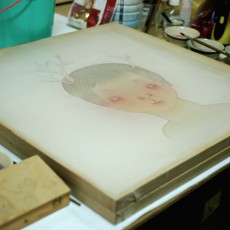
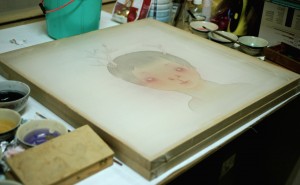
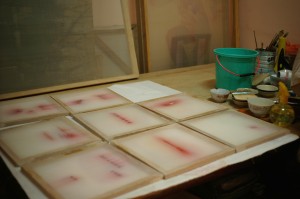
To view more of Phuong’s work, visit her website. You can also view the process of making one of her works (pictures below), here on YouTube.
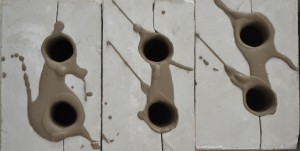
Paeonia Dream (2013) by Le Hoang Bich Phuong
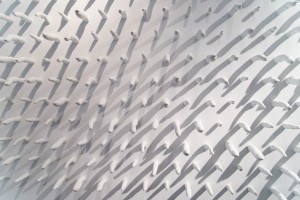
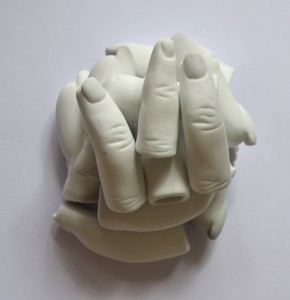
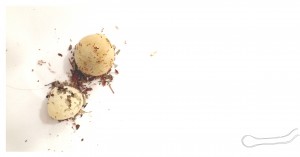
The Milky Way (White, Black, Gold, 2015) by Le Hoang Bich Phuong
Irwan Sofwan is a poet and writer from Indonesia. His biography is written below in his mother tongue with a rough translation appended after:
Irwan lahir dan tinggal di Serang, Banten – Indonesia. Karya-karyanya terdapat dalam beberapa buku antologi puisi bersama, di antaranya: Dari Batas Waktu ke Perjalanan Kamar sampai Kabar dari Langit (2006), Candu Rindu (2009), Akulah Musi (2011), Narasi Tembuni (2012) dan juga di beberapa media massa.
Sehari-hari ia bekerja sebagai guru Bahasa dan Sastera Indonesia di SMP PGRI 2 Kota Serang dan aktif berkegiatan di Kubah Budaya (Komunitas untuk Perubahan Budaya) – sebuah komunitas sastera dan budaya yang didirikannya bersama Wan Anwar (alm) dan beberapa kawan satu angkatan. Ia kemudian dipercaya menjabat sebagai ketua Kubah Budaya dari tahun 2006 ke 2009. Bergelut dan berdiskusi bersama komunitas membuatnya lebih mencintai dunia sastera dan semakin terjerumus ke dalam belantara puisi. Puisi seolah menjadi magnet yang menarik keinginannya untuk selalu menulis dan berkarya, meski ia juga sesekali menulis esei dan beberapa artikel yang berkaitan dengan sastera dan dunia pendidikan.
Baginya, menulis puisi adalah mencatat kehidupan. Mengekalkan sekaligus menyatukan pengetahuan, pengalaman batin dan pikiran untuk kemudian dilepaskan mengarungi lautan kehidupan itu sendiri. Dalam lawatannya ke Rimbun Dahan sebagai artist resident, ia berharap dan akan berusaha untuk menemukan pengetahuan dan pengalaman-pengalaman itu – yang seutuhnya baru – untuk diolah kembali menjadi karya-karya yang memiliki corak berbeda dengan karya-karya yang ia tulis sebelumnya.
Sekarang, Irwan sedang menyiapkan puisi-puisinya untuk diterbitkan dalam sebuah buku yang akan menjadi buku kumpulan puisi pertamanya. Menjadi penyair dan guru adalah hal yang tidak pernah ia cita-citakan semenjak kecil, namun ia bersyukur dapat menjalaninya sekarang ini. Ia pun percaya dengan apa yang dituliskan Herwan FR (penyair, guru dan sahabat) dalam sebuah ulasan untuknya, “Penyair yang baik adalah penyair yang santun. Penyair yang santun adalah penyair yang rendah hati. Penyair yang santun dan rendah hati, berkemungkinan besar termasuk penyair yang beriman dan beraamal sholeh, sehingga terhindar dari azab Tuhan, karena penyair, menurut tuhan, adalah orang yang suka mengembara ke lembah-lembah khayalan. Maka sebagai penyair dan guru adalah sebuah kenikmatan yang harus disyukuri, sebagaimana seorang penyair dan sekaligus kyai.”
—
Irwan was born and lives in Serang, Baten in Indonesia. His works have appeared in a few poetry anthologies, such as Dari Batas Waktu ke Perjalanan Kamar sampai Kabar dari Langit (2006), Candu Rindu (2009), Akulah Musi (2011), Narasi Tembuni (2012) and have also appeared in other mass media.
His day job is as a teacher of Indonesian language and literature SMP PGRI 2 Kota Serang, and he is also active in Kubah Budaya (Community to Change Culture) – a cultural and literary community founded by himself, colleague and friend Wan Anwar, and a few other peers. Irwan was entrusted with the heading Kubah Budaya from 2006 to 2009. Engaging and conversing with the community increased and deepened his love for literature and involvement with poetry. Poetry to him became like a magnet for his deep interest in writing every day; he has also written a few essays about the world of literature and education.
To him, writing poetry is to record life, a way to preserve as well as unite knowledge, experience, and thought to then be released into the flow and waves of each person’s life. During his residency at Rimbun Dahan, he hopes to discover new knowledge and experiences to be formed into works that contain different patterns to works he has written before.
Currently, Irwan is working on writing poems for his first poetry collection. Being a teacher and a poet was something he never even dreamed of, but he is grateful now for the opportunity to be both. He believes in what Herman FR (poet, teacher, and friend) once wrote, “A good poet is a poet that is a mannered poet. A mannered poet is a humble poet. A mannered and humble poet has a high likelihood of becoming a poet of deep belief and piety, escaping the punishments of God – because poets, according to God, are those who like to explore the wilderness of fantasy and the imagination. Therefore to be both a poet and a teacher is a pleasure to be appreciated.”
Doni Maulistya (b. 1987 in Yogyakarta, Indonesia) is an artist with an educational background in photography. He studied documentary photography through workshops such as Angkor Photography Workshop in Siem Reap, Cambodia (2009) and Foundry Photo Workshop in Istanbul, Turkey (2010). He’s also made works using installation and film.
As I live my life as an artist, I started to question my position in a society that is continuously in a dynamic negotiation between ‘the old’ and ‘the new’. I see the negotiation as an identity formation process that will always happen in human history. Thus, in making artworks, I am always interested in exploring the themes of history, tradition, and other dialectic dimensions that happens within society, an intermingling of culture.
Through my artistic research, I realize that no one medium should be considered a sole artistic language that can convey messages. Therefore, I expand my exploration on photography as well as on other media beyond photography.
Within the past four years, my artistic exploration has mostly been of the elements of performing and motion. My interests in that exploration started when I worked on performing art projects with Papermoon Puppet Theatre and Migrating Troop Theatre. Those events have enriched my experience to develop my body of work. One of the biggest challenges I have gone through is how to make objects that can cover all the different elements in performing art, such as movement, sound, interactivity, storytelling, etc. Afterwards, I decided to explore kinetic, video, sound, installation, and any other medium that I can learn about and apply to my artistic works. Besides learning the intermingled elements of any medium I use, I also always aim to learn how to discuss the local aspects in global context.
During the residency at Rimbun Dahan I hope to work on developing my current project called Still Praying. This project is about exploring the ‘Believing Practice’ that happens in contemporary society. But still, I always keep a vacant room on every project to allow new ideas to further develop.
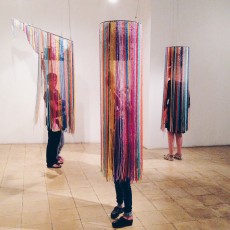
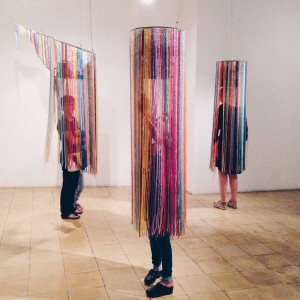
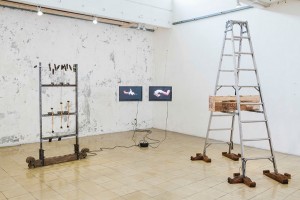
A Moment After Birth (2015); Installation, object, and sound
To find out more about Doni and his work, you can find him on Instagram, Facebook, Issuu, Youtube, or check out his website. He will be in residency in Rimbun Dahan until the end of July 2016.
Thynn Lei Nwe (b. 1991) is an artist based in Yangon, Myanmar. She studied for a Diploma in Fine Arts specialized in Painting at the Lasalle College of the Arts, Singapore from 2012 to 2014. She usually works with different mediums including oil paintings and ceramics. Her recent works deal with the concept of creating an environment that do not exist in real life and existing in a part of her own imaginary world.
Artist Statement
I have been asked over and over why I paint hybrids. And to every questioner, I asked, “Have you ever gotten tired of looking at the same person in the mirror every morning? Or have you felt tired when you see other people too?” Because this has happened to me a lot for years and my recent series shows the progression of this feeling, and it’s a part of the solution for myself.
I started from pretending the people, family, friends, neighbours and those random strangers I pass by on the street are ‘hybrids’ in the way I want to see them. I use painting as a medium to create an imaginary world where the people I know, including me, change every day, may be a plant today and a bird the next day. My imaginary people make me want to deal with ‘real’ people again. And it’s fun to see new people living around me every day. For me at the moment, nothing is more joyful than to create something that will never exist in the real life and to live among them.
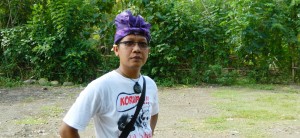
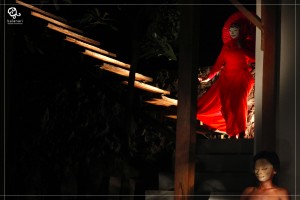
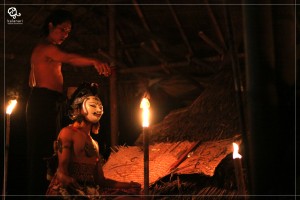
Ibed Surgana Yuga was born in a traditional Balinese farming family, 14 August 1983. He has been living in Yogyakarta, Java since 2003 to complete his theatre direction study in the Theatre Department of the Indonesia Arts Institute of Yogyakarta.
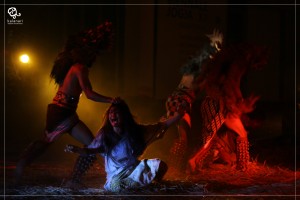
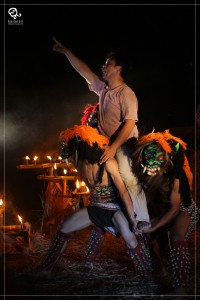
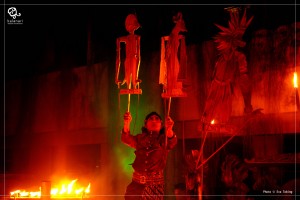
In 2012, Ibed initiated the Kalanari Theatre Movement, an institution which conducts cultural movements through theatre works. The objective of Kalanari is to reaffirm the bond between performance and society, and to inspire people to develop their cultures. In Kalanari, Ibed has framed his works through the concept of engaging intimately with space with ‘space’ understood both in a broader social and cultural context and more narrowly as the physical (natural and architectural) space of performance. His theatre works are site-specific so as to give highest value to improvisation.
He’s applied this concept by working with groups such as villagers, labourers, traditional art communities, domestic workers, interdisciplinary artists, etc. Ibed has worked in and around Indonesia, in historical, natural and architectural sites. He has also worked internationally, in Japan, Singapore and Ireland. He’s given meaning to his works as not just a collaborative artistic work, but a cultural dialogue. According to Ibed, theatre is neither for the creation of only performances or artistic works; it has a noble vision and mission to develop society’s cultures by emphasizing values of humanity.
During his short residency at Rimbun Dahan, Ibed wants to create a theatrical work based on ideas of engaging intimately with the natural, architectural and textual (story, history, myth, etc.) aspect of the site. He aims to choose a site in Rimbun Dahan by digging into the many textual aspects of the site, which will then be interpreted to create a site specific performance which is blended with his cultural background. He hopes to collaborate in this endeavour with local artists in any disciplines.
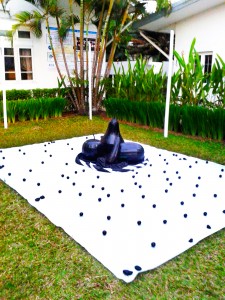
Pitchaya Ngamcharoen is Thai artist based in Chiang Mai and Bangkok. As an animal spirit, Pitchaya has always been drawn to her own species — non-human. Her artistic process usually involves animals and human participants to create a form of transparent overlap which is then transformed into an art event or object. The outcomes are often shown in interactive installation, sculpture and online sites.
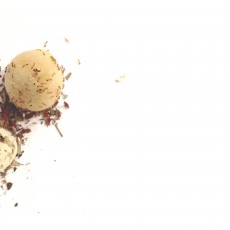
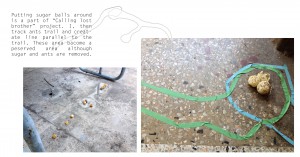
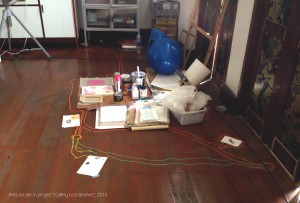
Her last experimental project, “Calling Lost Brothers”, is a project which aims to visualize an animal as an unnoticed and unperceived territory. Conversations between the artist and other species are easily made when we share one thing in common — energy resources.
Pitchaya is interested in the overlapping layers of human living space and that of animals. In the city, a small amount of people realize or care about animate creatures living underneath or above us unless they bother them. In this project, sugar is used to track ants which live in the same building with the artist. The ants’ trails are marked and preserved. The audience is presented with a map showing these ants’ trails and invited to explore the building through the ants’ eyes.
Pitchaya will be in residency at Rimbun Dahan for the months of April and May 2016.
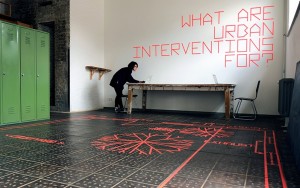
Goh Sze Ying (b. 1983) is a visual designer and researcher based in Kuala Lumpur. In the past decade, she has had many disparate roles in the areas of art, design, and urbanism. Her work is predominantly concerned with the relationship between design and politics in urban public space.
Between 2011 and 2014, Sze led an initiative advocating participatory urbanism called #BetterCities. While at #BetterCities, she developed various programmes – from public talks, private-public partnerships, workshops, research projects and urban interventions – framed around how art, design, and architecture can introduce tactics and situations capable of transforming the city into a playground of collective or individual actions. Some of these projects had been exhibited in Rio de Janeiro, Berlin, Kuala Lumpur, and George Town. More recently, she completed her MA in urban sociology in London and a research residency at Zentrum für Kunst und Urbanistik (ZK/U) in Berlin. Since then, she is more focussed on research-based projects.
Presently, she is researching and developing an exhibition that will be staged in 2017 as part of a curatorial development programme under the aegis of Japan Foundation Asia Centre. Her exhibition proposal foregrounds the Southeast Asian haze crisis as a framework of inquiry to tease out socio-economic, geo-political, environmental, and technological narratives and issues in Malaysia and the region.
Her residency at Rimbun Dahan is intended to explore and develop a curatorial approach to look at exhibitions as archives and exhibition-making as a research methodology.
Ineza Roussille is an independent documentary filmmaker from Malaysia. She’s produced videos for local NGOs on various social issues. These include videos for Yayasan Chow Kit on street children, for the Joint Action Group for Gender Equality (JAG), a coalition of local feminist civil society organisations, on the importance of women’s participation in the elections (Undi Anda, Suara Anda), a series for PT Foundation on People Living with HIV (PLHIV), and for UNICEF on children’s rights in Malaysia. Currently Ineza is working on an ongoing campaign called I Am You: Be A Trans Ally, which aims to raise awareness on the issues of the Transgender community in Malaysia, and complement the efforts regarding the recent judicial challenge against laws that infringed on the rights of the Trans* community.
Other than her documentary work, she has also worked on several creative side projects, including a short film entitled Blackbird, and a mockumentary on lesbians in KL entitled, Angmo & Amoi. Angmo & Amoi has been screened at various queer film festivals including in Manila, Philippines, Jakarta, Indonesia, and Austin, Texas in the USA. She recently won first prize for the PLHIV series at the Red Ribbon Short Film competition, organized by the Malaysian AIDS Council.
She’ll be in residency at Rimbun Dahan for January 2016 to work on a memoir project to explore the story of her father’s life, which may be turned into a graphic novel further down the line.
“As fulfilling as my journey into video activism has been, I feel like I need to step away from the camera and focus more on my writing. My father passed away in March this year, and while clearing out his apartment, I realized I was surrounded by his life story. From the primary school report cards that he kept, to the disgustingly smoke stained walls of his apartment, the visuals in that space painted a picture of him I knew so well, and yet did not understand at all. I realized I needed to write his story, from the perspective of the only person who had the experience of being his child. In writing his story, I hope to allow myself the space to personally grieve his loss, and at the same time produce a story that would make him proud.”
Chan Aye (b. 1954) is a sculptor, installation artist, painter, and writer from Myanmar. He was self taught before going on to study traditional Myanmar painting between 1986 and 1989. He has developed a unique pictorial language that is inventive and at the same time inherits the iconography of Myanmar cave painting and mural paintings, as found in the temples at Bagan, Sitkaing, and Po Win Taung in North Myanmar, as well as his studied interest in Western art, which the artist has studied in magazine and book reproductions through the years. His art is rooted in physicalizing the various states of life’s existence and spirituality, and engages with the dualities of material and immaterial forms: color, time, and the dimensions of human emotions, of anger, love, hate, and greed, with diverse materials such as paint, wood, marble, glass, sandstone, and paper from Myanmar Shan State, silk, motor equipment, lighting, bronze, and steel. Searching for new ways to merge traditions with the contemporary condition, he continues to create art through periods of political turmoil and change, and in the aftermath of the devastating Cyclone Nargis in 2008. Chan Aye has exhibited in Singapore, Germany, Finland, France, Hong Kong, India, Thailand, China, New York, and London.
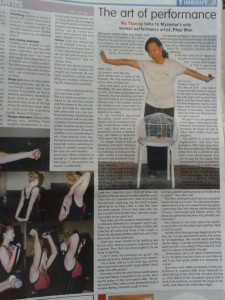
Phyu Mon (b. 1960), writer, photographer, performance artist, and painter, grew up in an environment distinguished by strong tradition and rich culture. Since her teens she has written poetry, short stories and also painted. Now, her recent work is writing articles about art in Myanmar Magazine and Journal, as well as other international publications. Her work expanded beyond writing when she was introduced to video and film production through a program at the University of Finland, and also when she accepted a Diploma of Photography from Myanmar Photography Association. She is one of the very few women artists in Myanmar who currently works with digital photography and visual art. She is also the first female performance artist in Myanmar and has participated in several local and international exhibitions and festivals. She currently runs the Blue Wind Art project in Myanmar.
In her art, she presents the contentment and peace even of a hard life, the need for progress but at the same time the need to care for the environment. She is at present witnessing the cultural changes taking place in the urban areas through globalisation but she feels confident that the rural people, the true representatives of Myanmar, will not be overly swayed by western culture. Having struggled to break out of a restrictive and traditionalistic society, she knows how strong the culture’s values are. Her hope, presumed in her art, is that the best of these values will be kept intact for the sake of future generations. Phyu Mon has exhibited her works in Japan, Thailand, Hong Kong, Malaysia, Cambodia, Singapore, Korea, Denmark, Spain, UK, France and the US.
Chan Aye and Phyu Mon will be undergoing a two month residency at Rimbun Dahan. For more information on their work, visit Chan Aye’s website, and Blue Wind Art’s website.
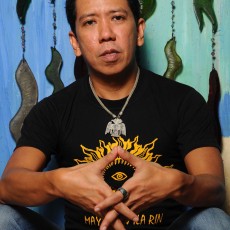
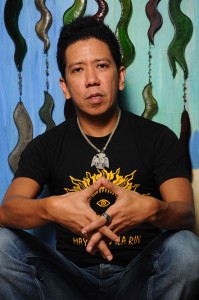
Kanakan Balintagos (meaning ‘hunter of truth’), formerly known as Auraeus Solito, is an internationally acclaimed and award-winning Palawán-Filipino filmmaker and playwright. He comes from a lineage of Shaman-Kings from the Palawán tribe of South Palawan. He grew up in the city of Manila and after graduating from the Philippine Science High school studied Theatre at the University of the Philippines, where he received a degree in Theater Arts. One of the leading independent filmmakers in the Philippines, he was recently chosen in Take 100, The Future of Film which presents an emerging generation of the most talented filmmakers around the world. This book, published by Phaidon Press, New York, is a survey featuring 100 exceptional emerging film directors from around the world who have been selected by 10 internationally prominent film festival directors.
His first feature film Ang Pagdadalaga ni Maximo Oliveros (The Blossoming of Maximo Oliveros) won 15 international awards including 3 awards at the Berlinale (The Teddy award, International Jury Prize at the Kinderfest and Special Mention from the Children’s Jury of the Kinderfest). It is also the first Philippine film nominated for Best Foreign film at the Independents’ Spirit Awards in the US and has been shown in more than 50 film festivals around the world.
Tuli (Circumcision), his second feature film won Best Picture and Best Director at the Digital Competition at the 2005 CineManila Film Festival; won the NETPAC Jury Prize at the Berlinale, International Forum for New Cinema and the Best International feature Film at Outfest in Los Angeles. Solito is the first Filipino to make it to the premiere independent film festival in the world, the Sundance Film Festival in Park City, Utah, USA, two years in a row (with The Blossoming of Maximo Oliveros and Tuli). His films have been screened in major festivals around the world including Berlin, Sundance, Montreal, Pusan, Toronto and Rotterdam.
Solito completed a screenplay development program at the Binger Film Lab in Amsterdam.
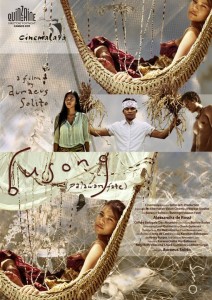
His film Busong (Palawan Fate) was selected at the prestigious Cannes Directors’ Fortnight in 2011, and it was awarded Best Director, Best Sound Design, and Best Original Music Score at Cinemalaya 2011. His film Busong was also shown at the 2012 National Geographic All Roads Film Festival in Washington, D.C.,where it was awarded Grand Prize, the Merata Mita “Best of Stories” Award.
In 2013 he adopted his tribal-spirit name Kanakan Balintagos after his uncle, who is a shaman in Palawan, dreamt about him. He said in an interview, “In his dream, he saw me in the middle of a sandbar holding a camera that turned into a blowgun. I became a kanakan … a hunter. Suddenly, great waves appeared from both sides of the sandbar, but I remained unharmed, untouched.”
In 2014 his film Esprit de Corps, based on the play he wrote when he was seventeen, won three awards at the Cinema One Originals Film Festival, including Best Director.
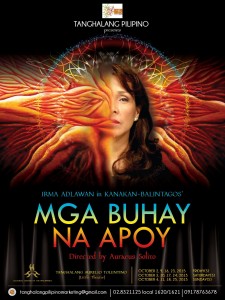
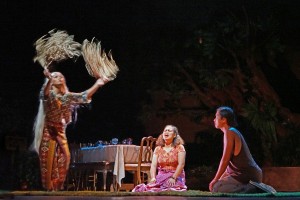
In 2015 he was awarded 1st Prize in the prestigious Palanca Awards, Filipino Division, Dulang Ganap Ang Haba (Full Length Play in Filipino), for his literary work “Mga Buhay na Apoy” and in 2016 won the Gawad Buhay ( Philippines’ Stage Awards) for Best Original Script for the same play.
For more information on Kanakan and his work, visit his website.