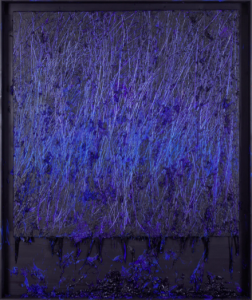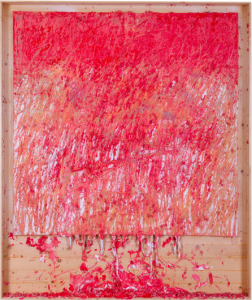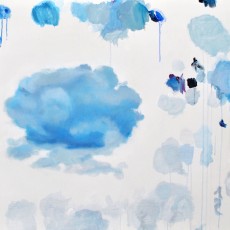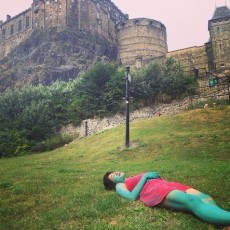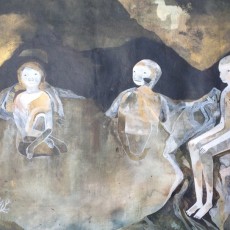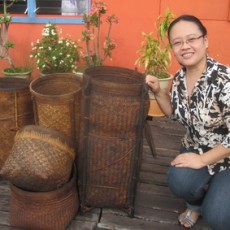
Yeoh Choo Kuan (b. 1988, Malaysia) is a young artist working in the veins of Abstract Expressionism though he installs narratives and hints of figuration to the formal language of his paintings. He graduated from Dasein Academy of Art, Kuala Lumpur with a Diploma in Fine Arts in 2010. Solo exhibitions include: 50/50, Taksu, Kuala Lumpur, Malaysia; and Private+ Sentiment, House of Matahati, Kuala Lumpur, Malaysia. Recent group exhibitions include: Configuration, G13 Gallery, Kuala Lumpur, Malaysia; Connection, Orange Gallery, Philippines; and No+ Random+ Nonsense, Boston Gallery, Bacolod City, Philippines. He lives and works in Kuala Lumpur, Malaysia.
Yeoh Choo Kuan will be at Rimbun Dahan as a resident artist for the month of June 2015, via a collaboration with Richard Koh Fine Art.
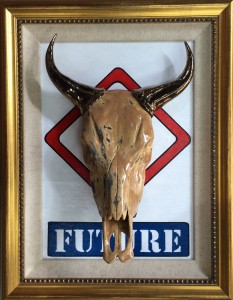
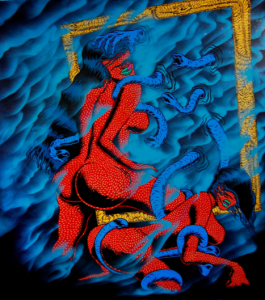
Don’t Let Me Be Misunderstood, 2015, Oil and lacquer on canvas with custom wooden frames, 160 x 134 cm
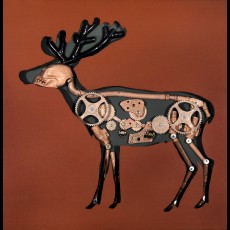
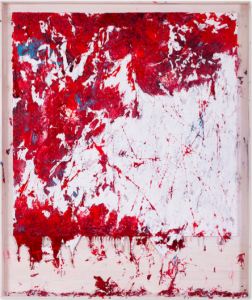
He Took off His Skin for Her, 2015, Oil and lacquer on canvas with custom wooden frames, 160 x 134 cm
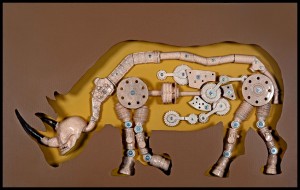
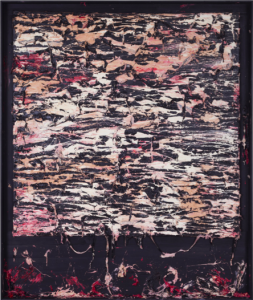
I’m Gonna Make Him an Offer He Can’t Refuse, 2015, Oil and lacquer on canvas with custom wooden frames, 160 x 134 cm
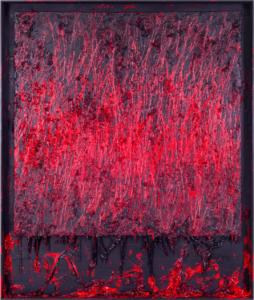
Remisniscences of a Deceased Me, 2015, Oil and lacquer on canvas with custom wooden frames, 160 x 134 cm
You May Live Through This Tragic Affair, 2015, Oil and lacquer on canvas with custom wooden frames, 160 x 134 cm
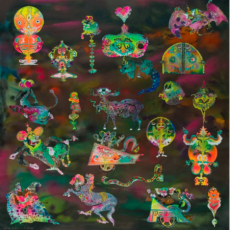
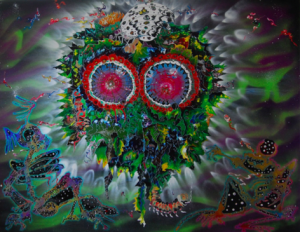
Hasanul Isyraf Idris (b. 1978, Malaysia) was trained at Mara University of Technology, UiTM, in Perak. He has received a number of awards, including the Young Contemporary Arts Award in 2007 at the National Visual Arts Gallery, Kuala Lumpur, the Incentive Award at the Open Show held at the Shah Alam Gallery and the Consolation Prize for the Young Talent Art Exhibition at the Penang Art Gallery. A highly elusive artist, Hasanul shuns attending openings and attempts to work anonymously in the art scene. He produces works in a variety of media, from paintings and meticulously crafted drawings to painted oven-baked clay sculptures. Mining inspiration from within, he articulates his personal struggles as an artist by personifying them as strange characters that inhabit his invented universes. Influenced by the graphics of underground comic books, 1960s science fiction, fast food, and street art and fashion, he juggles pop-culture references with a personal viewpoint. Recurring topics in his practice are the meaning of life and death, memories and fantasies and sin and reward.
Hasanul will be at Rimbun Dahan as a resident artist for the month of June 2015, via a collaboration with Richard Koh Fine Art.
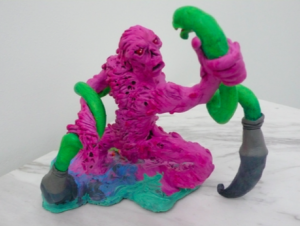
Flower Fairies of The Summer, 2012, Mixed media on paper, 122x158cm
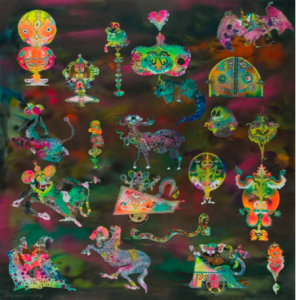
Luring Hue, 2011, Acrylic and aerosol paint on canvas, 213 x 195 cm
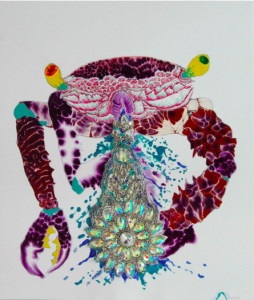
Parasin, 2014, Acrylic, enamel, rhinestones, semi-precious stones, glitter, pearls and PVA glue on paper, 152.4 x 152.4 cm
Working on his two pieces for the Bricolage exhibition (March 2015)
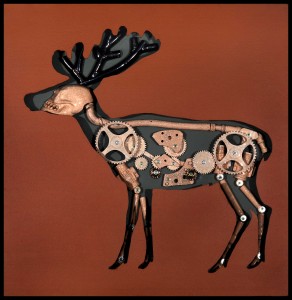
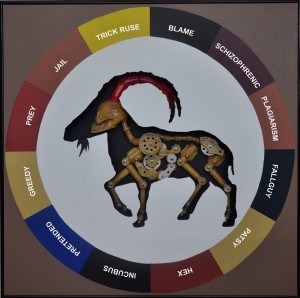
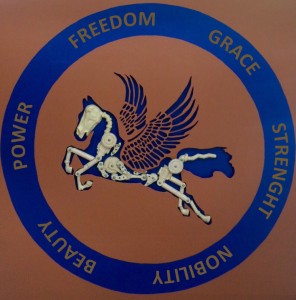
Tran Dan studied architecture in university, but his artistic career is built on self-taught painting and sculpture. His primal medium is lacquer, which is widely represented and used in Vietnamese traditional and modern arts. Tran is keen to further develop its form and use in art: lacquer with/as mix-material paintings/sculptures or (video) installations. He has made full use of Rimbun Dahan’s gardens and surroundings for materials to make into lacquers and paints. His collaborations with foreign cultural institutions in Vietnam, such as British Council, Embassy of Denmark, L’espace French Cultural Centre, and The Japan Foundation Center for Cultural Exchange have resulted in experimental videos and performances about human consciousness, dreams, Vietnamese culture, and food. Tran has also opened an independent art space in Hanoi where he organizes and directs programs for local and international artists. His recent lacquer paintings are inspired by the relationship between humans and animals, and by the power of humans and nature. Tran’s work explores the dreamlike rhythm of life, stories that are repeated every night; this also speaks to existentialism, a theme he consistently returns to.
Yuwatee Jehko (b. 1984) is a Thai painter and educator based in Chiang Mai, Thailand.
She derives inspiration from process, believing that the paint palette is an integral part of each painting, because without this tool and experimental space, the work would not exist. Yuwatee finds in the paint palette purity, a struggle between the colours, the residue, choices, mistakes, and ultimately, the journey of the resulting painting hidden in a blob of paint. Her works often depict every day objects, which she hopes will evoke memories, both good and bad, within the viewer and remind them both of who they are today and who they will be tomorrow.
Yuwatee studied at the College of Fine Arts in Bangkok before getting both her Bachelors and Masters of Fine Art in Chiang Mai University. During that time, she was a part of an artist apprentice-training programme at the Fabric Workshop and Museum in Philadelphia in 2011. Yuwatee has also taught basic drawing in multimedia technology and animation in Mae Fah Luang University in Chiang Mai.
In 2009, she mounted her first solo exhibit, “Mindscape” at Galerie N in Bangkok. Her most recent exhibit titled “Paints Palette” was held in 2014 at The Meeting Room Art Café in Chiang Mai.
Khairani Barokka (b. 1985) is a writer, poet, and interdisciplinary artist. She is also a practitioner of think/do advocacy in the arts, particularly on the ways in which new media can increase inclusion and access for and by disability cultures and feminisms (both of which she is happy to be a part of). Born in Jakarta, Okka works, teaches, and is published internationally, with art, literature, disability culture and transdisciplinary performances and workshops held across India, the US, Australia, Malaysia, the UK, Austria, Singapore, and her native Indonesia. She has a masters from NYU’s Tisch School of the Arts, as a Tisch Departmental Fellow, and among her awards and honors was Emerging Writers Festival’s (AUS) Inaugural International Writer-In-Residence for 2013. Okka is the writer, performer, and producer of a (hearing-impaired accessible) solo poetry/performance art show, “Eve and Mary Are Having Coffee”, which premiered at Edinburgh Festival Fringe 2014.
Okka is delighted to be part of the Rimbun Dahan community for 6 months, where she is working on writing projects as well as using text in mixed media works.
Malaysian artist and astrologer Melissa Lin was in residence at Rimbun Dahan in 2014, where her work ventured into new degrees of scale.
Bio
Melissa Lin is an artist and astrologer who loves how both disciplines deepen, teach about and reveal the mystery and richness of life and living. Art for her is a process of becoming and of encouraging the intrepid traveler on the way to wholeness and experience, not only for the individual self, but also for the health of the community and collective. Art can be the voice that returns us to our best selves and to the world.
Artist’s Statement
The gift of time and of spaciousness by the Rimbun Dahan residency has opened up new possibilities of exploration for my drawing and painting practice.
The process of exploration for me has been one of allowing and observing visual narratives, characters, expressive impulses that want to emerge from a sea of stories of the world, drawn from experience, the psyche, history, culture, magic, myth and wisdom.
This organic emergence to me is a way to return to feeling, sensing, drawing out pleasure from slowness, from savouring, and creates wholeness while living in a world where it is easy to lose and to drown oneself too much information and stimuli that leads to being dislocated from the self.
My drawings and paintings also reflect my interest in natural yet otherworldly environments that are like an interface or in between dimension where the personal internal world and the external world, the realm of imagination and of reality can come together and are a meditation on my physical travels, as well as traveling through ones own internal landscape and life.
Anniketyni Madian is a Sarawakian artist who is currently creating a stir in the local art scene with her sculptural works. Fresh, energetic and visually arresting, her current works are an embodiment of her love for her native culture. Deriving her inspiration from the exotic Pua Kumbu textiles, her works are given a personal, contemporary touch which makes every sculpture a unique piece. She translates her works from two-dimensional drawing of Pua Kumbu patterns to a painstaking three dimensional sculptures , creating an interesting perspective and depth to her works. One cannot fail to notice the intricacies of her complex work where each slice of wood is minutely detailed and perfectly aligned in order create a smooth, seamless flow.
Having progressively paved her way in a scene which is largely dominated by male artists, Anniketyni’s sculptural journey is currently ongoing at Rimbun Dahan. Come interact and watch the artist delve into the intricacies of her complex work that narrates the beauty of her heritage in her very own language. The open studio residency will take place on 6 September 2014 and is open to public from all walks of life.
Carlo “Caloy” Gernale (b. 1979) is a Filipino visual artist based in Southern Tagalog, Philippines. As a contemporary social-realist artist, he attempts to articulate not only his personal views, but more importantly, the collective stand and the national democratic aspiration of the marginalized.
As an artist, Gernale is driven by the past and present events that mould Philippine history; he also has a penchant for indigenous and contemporary myths, fables, and banter, and tries to incorporate them into his works of art. Guided by his socio-political leaning, he attempts to come up with a cohesive body of works that are visually and semiotically potent.
Gernale studied Bachelor of Fine Arts in Philippine Women’s University. In 2006, he mounted his first solo exhibit “Ispup.” His most recent exhibit titled “Allegories and Allergies” was held in May 2013 at West Gallery, Philippines.
Le Thua Tien has a diverse art practice that includes paintings, installation, experimentation with sculpture and community based art projects. The direction of Tien’s paintings changed from figurative to abstract when he arrived at the Rijks Academy in Amsterdam in 1995. Some of his most recent works are mixed media and lacquer and can be considered symbolic of his subjects. He is one of Vietnam’s few artists who address the American War in his works. His work also tends to be more conceptual than many other Vietnamese artists. His work has been displayed in the United States, Thailand, the Netherlands, France, Germany, Venezuela, Japan, and Australia. Le Thua Tien lectured at the Fine Arts University in Hue, Vietnam, from 1989 to 2008. He now lives and works in Hue.
About the Residency
The Haiku Path Project in Rimbun Dahan is a sculpture / installation project. It contains a series of selected haiku poems, engraved onto granite slabs, arranged along the walking paths of Rimbun Dahan’s garden. The granite used in this project is recycled material. By laying it back to the ground; with time, the slabs will embed themselves into the forest.
Create a walking path through Rimbun Dahan’s compound, where visitors can approach the sculpture/poem works in different locations.
The first stage of the project, created in February 2013, features 5 haiku poems written by Matsuo Basho (1644-1694) [with English translation by R. H. Blyth] and two poems by Mike Ladd (b.1959), a former Rimbun Dahan artist in residence. Tien considers The Haiku Path Project an ongoing project and plans to add more poems to the compound.
Poem by Mike Ladd (1959- ). Material: Recycled granite slabs/ sandblasted engraved text (Al Himmah Global, Batu Caves, Selangor). Size: approximately 60 x 40 x 20 cm each; seven pieces.
Poem by Matsuo Basho (1644- 1694) . Material: Recycled granite slabs/ sandblasted engraved text (Al Himmah Global, Batu Caves, Selangor). Size: approximately 60 x 40 x 20 cm each; seven pieces.
The location of the first Basho haiku installation, along the driveway at Rimbun Dahan.
Le Thua Tien with Laila from the Al Himmah Global Batu Caves Engraving Process.
Le Thua Tien working with stickers to design the engravings
Haiku (Hi-koo) is a traditional Japanese verse form, notable for its compression and suggestiveness. In the three lines totalling seventeen syllables measuring 5-7-5, a great haiku presents, through imaginary drawn from intensely careful observation, a web of associated ideas (renso) requiring an active mind on the part of the listener. The form emerged during the 16th century and was developed by the poet Matsuo Basho (1644-1694) into the refined medium of Buddhist and Taoist symbolism.
Ashly Nandong is a thirty-year old artist from Kuching, Sarawak who joins us for three months as short-stay artist-in-residence at Rimbun Dahan.
Ahsly completed a Bachelor’s degree in Mechatronics and Robotics Engineering at Swinburne University, in Victoria, Australia in 2009, returning to Malaysia in early 2011. However, it was his informal art education and exposure to traditional dance and music during his formative adolescent years that marked him for quite a different life direction. Eventually, and inevitably it seemed, what placed him firmly on this different road was his continued active involvement in the performance and visual arts, while living in Melbourne. Having been taught the sapeh lute as a teenager under different gurus, the traditional Dayak dance of the Orang Ulu and Iban people, and now as painter, Ashly crosses from performance to visual arts and back with ease.
A strong sense of his Iban cultural heritage is what binds; one medium of expression inspires the other in a non-hierarchy. Traditional motifs and metaphors make for meaningful markers and anchor him along the way in his berjalai, an ancient Iban custom of roaming or journeying in search of greener pastures of knowledge and hopefully the ‘wisdom’ that comes from hands-on experience.
At Rimbun Dahan, Ashly is given a much-needed time for contemplation in an important part of his berjalai; an introspective time to connect with his creative aspirations in response to his current ‘spiritual’ situation. Ashly is presently working on a painting depicting the Tree of Life, a motif found in Iban symbolism and in religions, mythologies and philosophies throughout many different cultures, in varying permutations.
A unifying principle that unites all cultures and religions is something Ashly gravitates towards, being very keen to understand deeper the creative force that at core animates all living entities with spirit. The living tree, rooted in earth but with branches reaching upwards for the heavens is aptly symbolic of Ashly’s current station of berjalai at Rimbun Dahan, a place of lofty trees and sounds of ancient cicadas and birdsong.
Anima mundi, a work inspired by Rimbun Dahan, currently on display at MAP Publika, Solaris Dutamas.
Tree of Life.
Ashley in his studio at Rimbun Dahan with Tree of Life.